
NEW
Font size
 Worksheets
FDHRC PREP TEST 2
Total questions: 74
Worksheet time: 37mins
Ashley, 14 years old, has type 1 diabetes and is scheduled for the continuing care appointment after lunch. Why is it important for Ashley to be seen promptly?
To ensure she does not become drowsy after her meal
To reduce the risk of an emergency developing
To enable her to follow her strict meal regimen
To allow sufficient time to complete dental hygiene therapy
Mr. Ungle, 35 years old, presents for his continuing care appointment. The dental hygienist records generalized posterior periodontal probing depths of 5-6 mm. Mr. Ungle reports some sensitivity on the maxillary left quadrant. What radiographic views would be most appropriate to take to assess this area?
4 vertical bitewings
4 horizontal bitewings
2 vertical bitewings
2 horizontal bitewings
Ms. Cameron, 44 years old, is taking antidepressant medication and is experiencing mild xerostomia. What should the dental hygienist suggest to alleviate Ms. Cameron’s discomfort?
Increase the frequency of toothbrushing
Use an essential oil mouthrinse
Chew candies or breath mints
Use a saliva substitute
Which one of the following factors is the most reliable indicator that oral self care procedures are effective?
Reduction of dental biofilm
Change in tissue color
No signs of gingival inflammation
Absence of calculus
Wilhem, 17 years old, presents with localized inflammation, and exudates around a partially erupted tooth. He is also experiencing some pain that is radiating to his ear. These signs and symptoms indicate which one of the following conditions?
Frictional keratosis
Herpetic gingivostomatitis
Pericoronitis
Necrotizing gingivitis
Which step will facilitate sterilization in a pressurized steam sterilization unit?
Tightly fill the chamber tray with instrument packages to ensure heat conduction
Provide space between packaged instruments to ensure steam circulation
Pack the chamber tray with unwrapped instruments to maximize steam penetration
Ensure the chemical solution is at the appropriate level in the reservoir
Who would benefit most from shorter continuing care intervals?
A client who just completed a tobacco use cessation program
A client who is starting an at-home whitening program
A client with a history of periodontal disease
A client with no dental concerns
A dental hygienist takes a maxillary impression. In assessing the result, the dental hygienist notes good representation of the vestibule to the left of the central frenum, with a shallow imprint of the lip on the right side. What technique should be used to ensure a better impression?
Place the impression tray further back in the mouth
Insert the impression tray on the right side first
Fill the impression tray with more alginate
Seat the impression tray lifting both sides of the lip
Mr. Carlyle, 51 years old, presents with gingival recession of 2 mm on the facial surfaces of all molars and premolars. The exposed roots are hard and intact. Upon exploration, he jumps with pain at the majority of the sites. What should the dental hygienist include in Mr. Carlyle’s dental hygiene treatment plan?
Chlorhexidine mouthrinse
Fluoride varnish
Pit and fissure sealants
Topical anesthetic
Joey, 11 years old, needs local anesthesia for periodontal debridement in quadrant 3. The procedure will take approximately 30 minutes to complete once anesthetized. What anesthetic agent and injection(s) would be ideal for this situation?
Mepivacaine 3% and the inferior alveolar nerve block, the lingual and long buccal nerve injections
Lidocaine 2% and buccal infiltrations
Articaine 4% with epinephrine 1:200,000 and the inferior alveolar nerve block and long buccal nerve injections
Prilocaine 4% with epinephrine 1:200,000 and an incisive nerve block, long buccal, and lingual nerve injections
Don, an 18 year old athlete, has been taking penicillin for pericoronitis of tooth 38. He presents for repair of a clasp on an ill-fitting maxillary partial denture. Don reports a metallic taste and a burning sensation in the palatal area. The clinical assessment reveals a lesion under the partial denture. There is a white, curd-like material with underlying erythematous mucosa. What condition should the dental hygienist suspect?
Denture stomatitis
Erosive lichen planus
Necrotizing periodontitis
Pseudomembranous candidiasis
Ms. Katerinova, 32 years old, has recently received local anesthetic for periodontal debridement by the dental hygienist. She reports pain and some difficulty opening her mouth the day after treatment. What post care recommendations should the dental hygienist consider?
Heat therapy, warm saline mouth rinse, and analgesics
Cold therapy, antimicrobial mouth rinse and analgesics
Antibiotic treatment and warm saline mouth rinse
Analgesics and referral for physiotherapy
Kevin, 22 years old, arrives for his initial dental hygiene appointment. The dental hygienist notes that he has not seen a physician for the last 4 years. The client’s intraoral assessment reveals removable white plaques on the soft palate and reddish-purple lesions on the gingiva and the palate. What should the dental hygienist suspect?
Nicotine stomatitis
Oral cancer
HIV infection
Oral candidiasis
During periodontal debridement, the dental hygienist administered 2 cartridges of Xylocaine (Lidocaine 2%) with epinephrine 1:00,000 and an additional cartridge of articaine (Septanest SP 4%) with epinephrine 1:100,000. What information should be documented in the client’s chart?
3.6 mL of Lidocaine 2% with epinephrine 1:100,000 and 1.7 mL of Septanest SP 4% with epinephrine 1:100,000
36 mg of Lidocaine 2% with epinephrine 1:100,000 and 17 mg of Septanest SP 4% with epinephrine 1:100,000
144 mg of Lidocaine 2% with epinephrine 1:100,000 and 72 mg of Septanest SP 4% with epinephrine 1:100,000
72 mL of Lidocaine 2% with epinephrine 1:100,000 and 34 mL Septanest SP 4% with epinephrine 1:100,000
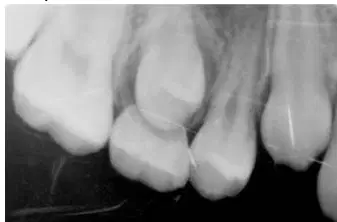
In reviewing the following radiograph, how should the area surrounding the crown of tooth 15 be interpreted?
Pericoronitis
Primordial cyst
Eruption follicle
Supernumerary tooth
A client regularly uses beclomethasone dipropionate (Beclovent) to treat asthma. What is a possible oral manifestation caused by this type of medication?
A soft creamy white lesion that when removed leaves a red and raw surface
A painful, white, ulcerative lesion that leave a permanent scar
A painful, white, necrotizing lesion with an inflammatory halo
A white, keratinized, bilateral asymptomatic lesion
A 78 year old client has recently developed osteoarthritis. Her intraoral assessment reveals moderate interproximal dental biofilm with open gingival embrasures. What oral self care recommendations should the dental hygienist provide to address this issue?
Bush using the Fones technique
Floss using the C shape method
Clean with an interdental brush
Use floss with a holder
Katia, 17 years old, presents for her continuing care with profound mental disability. During the appointment, the dental hygienist notes that she has several traumatized areas on her lips and tongue. Which one of the following strategies would be the most appropriate in this situation?
Suggest behavior modification to reduce lip biting
Recommend a nightguard
Apply a topical antiseptic agent to the traumatized areas
Consult with a client's caregiver to determine the cause of her injuries
A severely disabled 6 year old Sara presents for her continuing care appointment. Her mother informs the dental hygienist that she is usually uncooperative and resists sitting in her wheelchair during daily oral care. Which one of the following recommendations should the dental hygienist make concerning the provision of Sara’s oral self care at home?
Place the child in a supine position
Lay the child on the bed placing her head in her mother’s lap
Maintain the child in an upright position
Use a tilt board in the child’s wheelchair
Tristian, 14 years old, refuses to have professional topical fluoride treatment after the dental hygienist explained the benefits of fluoride. What action by Tristian would indicate that he understands the benefits of fluoride?
Paraphrases the information provided
Repeats the information verbatim
Listens with eye contact
Defers the decision to his parents
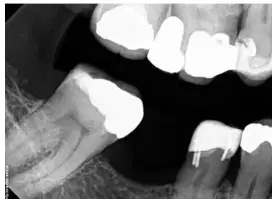
Which tooth is missing from the following radiograph?
Tooth 35
Tooth 36
Tooth 45
Tooth 46
The client asks the dental hygienist how often the masks are changed. How should the dental hygienist respond?
Once in the morning
Between clients, or if the mask becomes wet
Once every 2 hours
If the mask becomes blood splattered
Robert, 13 years old, reports sensitivity to pressure on tooth 37. He had sealants placed on all molars 1 week ago. What should the dental hygienist do to determine the source of the discomfort?
Take a PA radiograph of tooth 37
Adjust the dental sealants in quadrant 3
Check the occlusion with articulating paper
Conduct a pulp vitality test
Gary, 14 years old, presents for his dental hygiene appointment. It has been 19 months since he was last treated. His mother states that he has never had any decay even though he does not like to brush his teeth. What type of radiographs would be indicated?
Panoramic film only
Posterior bitewings only
Posterior PA films
Two occlusal films
Which one of the following oral microorganisms may overgrow with the use of broad-spectrum antibiotics?
Porphyromonas gingivalis
Streptococcus mutans
Actinomyces viscous
Candida albicans
Lila, 16 years old, presents for her continuing care appointment. During the intraoral assessment, the dental hygienist notes redness, welling, and suppuration around a recent tongue piercing. What action should the dental hygienist take?
Ask Lila to remove the tongue jewelry and proceed with treatment
Inform Lila of the findings and refer her to a physician
Irrigate the area with a saline solution
Teach Lila how to brush her tongue properly
The periodontal assessment of Mr. Stevens, 30 years, includes a dental biofilm score of 60%, a BOP score of 30% and generalized clinical attachment loss of 3 mm with no gingival recession. The radiographs indicate generalized horizontal bone loss that account for a % of bone loss/ age of 0.20. What is Mr. Steven’s periodontal classification?
Generalized periodontitis Stage I, Grade B
Generalized periodontitis Stage III, grade B
Generalized dental biofilm-induced gingivitis on an intact periodontium
Generalized periodontitis Stage II, Grade A
Which one of the following conditions is associated with the normal aging process?
Root caries
Smaller pulp chamber
Xerostomia
Gingival recession
When placing pit and fissure sealants, which one of the following procedures produces microscopic porosities?
Etching
Chemical cure
Sclerosing
Gingival recession
Mrs. Ridley, 81 years old, is now living with her daughter's family. When she presents for her 9 month continuing care appointment, she appears withdrawn and anxious even though she has been a long standing client in the practice. During the intraoral assessment, the dental hygienist notes poor oral hygiene, a fractured upper denture, and bruising of the edentulous ridge. What should the dental hygienist suspect?
Iron deficiency
Dementia
Self neglect
Elder abuse
Mr. Applebaum, 29 years old, presents for his annual continuing care appointment. He reports extreme sensitivity to cold in the mandibular right quadrant. Intraoral findings reveal localized gingival recession of 4 mm on teeth 43 and 44. What should the dental hygienist recommend for Mr. Applebaum?
Acidulated phosphate fluoride
Fluoride varnish
Composite restorations
Gingival graft
Which one of the following design features provides the best tactile sensitivity in a hand instrument?
Long functional shank
Serrated handle texture
Paired working ends
Hollow handle
Mrs. Weinberg, 78 years old, indicates a concern about small ulcers at the corners of her mouth that do not heal. What vitamin or mineral deficiency may cause this type of lesion?
Riboflavin
Vitamin K
Zinc
Calcium
Which one of the following statements about the clinical significance of calculus is true?
The surface texture of subgingival calculus causes gingivitis
Lactobacillus microorganisms are essential for the formation of calculus
The correlation between dental biofilm and gingivitis is much stronger than the correlation between calculus and gingivitis
When calculus becomes embedded in the connective tissue it results in an inflammatory response
Mrs. Savage, 73 years old, presents for her 6 month continuing care appointment. She presents with generalized Stage II Grade B, generalized gingival recession of 2 mm on the facial surfaces of sextant 5 and porcelain crowns on teeth 13 to 23. The dental hygienist notices the presence of carious lesions on the roots of the maxillary premolars. What fluoride agent should the dental hygienist select for Mrs. Savage?
Acidulated phosphate fluoride gel
Sodium monofluorophosphate dentifrice
Stannous fluoride solution
Sodium fluoride varnish
Amy, 7 years old, presents for her continuing care appointment. The fist permanent morals are fully erupted. The enamel is partially to completely missing throughout, with yellowish-brown intrinsic staining. Amy most likely has which one of the following conditions?
Systemic hypoplasia
Dental fluorosis
Amelogenesis imperfecta
Erythroblastosis fetalis
Shamir, 17 years old, has uncontrolled type 1 diabetes and is at increased risk for dental caries. What is the best explanation for this increased risk?
A wide fluctuation in blood glucose levels
A high carbohydrate diet to control hypoglycemia
A reduction in phagocytic activity due to hyperglycemia
A reduction in salivary flow due to fluid loss
A community dental hygienist has provided oral health education in a local high school for 6 months. The primary objective of the program was to improve the level for dental health knowledge in the student population. What outcome measure would be best suited to determine if the interventions were successful?
Assess the oral hygiene status of participating students
Administer a post-test survey to the students
Gather information about program attendance
Follow up with the students’ parents regarding home practices
Which condition always appears in the mouth as a band of white keratotic tissue along the buccal mucosa, parallel to the occlusal plane?
Frictional keratosis
Lichen planus
Leukoplakia
Linea alba
What feature is characterized by white, raised, soft, yellow papules located bilaterally on the buccal mucosa?
Fordyce’s granules
Koplik’s spots
Lichen planus
Linea alba
Mr. Roznowski, 33 years old, has multiple sclerosis and is unhappy with his loss of autonomy. How should the dental hygienist proceed?
Assist only with his dental hygiene needs
Contact a social worker on Mr. Roznowski’s behalf
Provide information regarding resource agencies
Consult with Mr. Roznowski’s mother
Residents of a facility for older adults identify a need for more preventive oral care services. The dental hygienist confirms this need. During the program planning stage, which one of the following issues should the dental hygienist address?
Resources required for implementation
Calibration of examiners for needs assessment
Type of dental indices to use
Satisfaction with oral care services
The dental hygienist administers local anesthetic for periodontal debridement in sextant 1. The needle tip is inserted and advanced to the correct depth and location. Which one of the follow stops must be performed to ensure proper aspiration?
Slowly withdraw the needle tip while aspirating
Slowly advantage the needle tip which aspirating
Aspirate twice without moving the needle tip during aspiration
Aspirate twice, rotating the bevel after the first aspiration
Patricia, 17 years old, expresses concern about her “bad breath”. Her toothbrushing and flossing techniques are adequate. What should the dental hygienist recommend?
Tongue cleaning
Referral to a dietician
Mouthrinse recommendation
Salivary assessment
A dental hygienist is asked to assess safety and emergency preparedness in the practice environment. What must be readily accessible?
A medical stretcher
A portable source of oxygen
A copy of the Compendium of Pharmaceuticals and Specialties (CPS)
A clearly posted route to the nearest hospital
A client has been diagnosed with generalized Stage I periodontitis. What radiographic finding should the dental hygienist expect to observe?
Fuzziness in the interdental crest region
Radiolucency in the interradicular area
Presence of a vertical bone defect
Widening periodontal ligament space at the apex
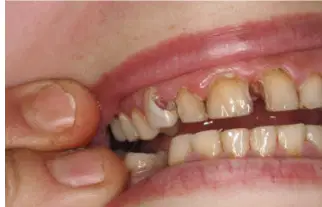
According to G.V. Black classification, what type of lesion is present on tooth 13?
Class I lesion
Class II lesion
Class V lesion
Class III lesion
The dental hygienist will be using air polishing to remove stains from the client’s teeth. Which one of the following statements correctly describes the technique?
Position the nozzle tip near the cervical third of the tooth
Direct the powder spray at the gingival margin
Direct the powder spray on the tooth for 4-5 continuous seconds
Position the nozzle tip 3-5 mm from the tooth
Todd, 18 years old, presents to his continuing care appointment with fractures of the lingual surfaces of teeth 41 and 31. What most likely caused these fractures?
A parafunctional habit
Bulimia nervosa
A tongue barbell
Pencil chewing
Mrs. Peters, 67 years old, has a recent history of leukemia. She is scheduled for a continuing care appointment. The dental hygienist updates her health history. She confirms that she is presently in remission. Which one of the following actions should the dental hygienist take next?
Document the changes in the client’s health history and initiate dental hygiene therapy
Consult with the client’s physician regarding her hematologic status prior to dental hygiene therapy
Confer with the dentist and send the client for a hematologic evaluation prior to dental hygiene therapy
Confirm with the client that prophylactic antibiotics have been taken and initiate dental hygiene therapy
A dental hygienist is motivated to ensure continuing competence. Which one of the following strategies would best serve this purpose?
Consulting with colleagues frequently
Presenting a professional manner with clients
Reviewing dental hygiene journals regularly
Participating in health promotion activities
A client’s diet is contributing to her increased incidence of dental caries. What represents the greatest dental caries risk for this client?
Triglycerides
Disaccharides
Cellulose
Xylitol
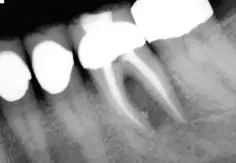
Based on the following radiograph, what is the best interpretation of the radiopacity on the apical third of the mesial root of tooth 36?
Radiographic artifact
Enamel pearl
Residual gutta percha
Retrograde restoration
What clinical finding indicates the periodontal inflammation?
Radiographic crestal bone loss
Periodontal probing depths
Clinical attachment loss
Bleeding on probing
Mr. Barrett, 49 years old, arrives late for his periodontal debridement appointment as he is “very busy at work”. His health history indicates he is still smoking 25 cigarettes per day and he continues to take his antihypertensive medication. His breathing appears labored. What should the dental hygienist do initially?
Accommodate Mr. Barrett’s time constraints and shorten the appointment
Consult Mr. Barrett’s physician about the medication
Obtain Mr. Barrett’s pulse, respiration, and blood pressure readings
Schedule another appointment when Mr. Barrett is feeling better
Leonary, 8 years old, attends his continuing care appointment. His mother reports that the swelling of his upper lip and the loss of tooth 21 was due to a bicycle injury. During the course of the appointment, the dental hygienist observes that Leonard has multiple circular cruising on both arms and back of his neck. What should the dental hygienist do next?
Document the findings and see if Leonard appeals with similar lesions at the next appointment
Arrange to speak with Leonard’s school principal to discuss the concerns
Speak to the dentist to determine office protocols for this situation
Document the findings and file a report with the local child protection agency
What oral self care strategy should be recommended in the recovery phase of oral candidiasis?
Rinse with warm salt water
Avoid the use of sodium lauryl sulfate
Replace the currently used toothbrush
Rinse with chlorhexidine
A panoramic radiograph taken on David, 14 years old, reveals teeth 14 and 24 are morphologically complete but unerupted. What is the most probable cause?
Congenitally missing teeth
Retained first primary molars
Impacted canines
Normal eruption
What specific oral side effect is associated with most calcium channel blockers and most anticonvulsants?
Xerostomia
Gingival atrophy
Tissue sloughing
Gingival overgrowth
Under what condition is a topical fluoride application most beneficial?
When its applied as an aqueous solution
When application follows fit and fissure sealant application
When it is applied to demineralized dental enamel
When application follows restorative procedures
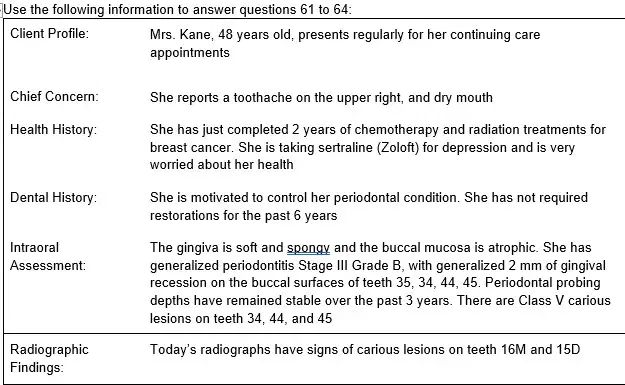
What conclusion can be drawn based on a comparison of the previous treatment record with the current assessment findings for Mrs. Kane?
Mrs. Kane was caries-free, but now requires restorative work
Periodontal tissues are inflamed and aggressive periodontal therapy is required
Large doses of radiation were recently received, so radiographs should be limited
Mrs. Kane’s depression is responsible for the changes in her oral health
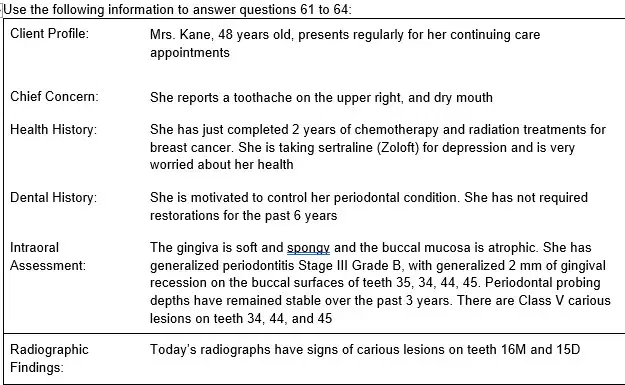
Mrs. Kane appears anxious and begins to move around in the dental chair during periodontal debridement. How should the dental hygienist proceed?
Administer a local anesthetic to decrease discomfort
Apply a desensitizing agent for immediate pain control
Place the client in a supine position and allow her to relax
Position the client in a semi-supine position and talk with her
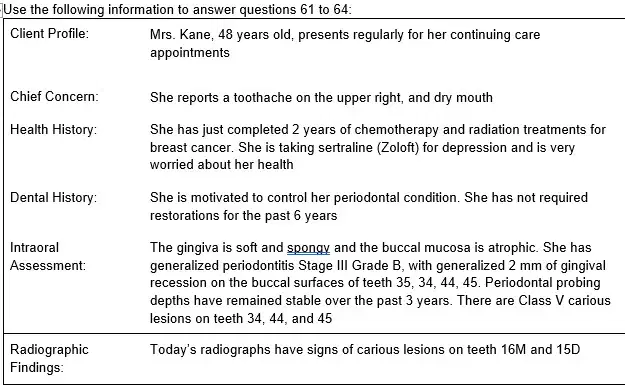
When developing the dental hygiene care plan, Mrs. Kane emphasized that she often feels nauseous and has an irregular work schedule. How should the dental hygienist proceed?
Plan for a series of short appointments
Recommend alternate oral self care regimens
Discuss what works well for her
Schedule long appointments with frequent breaks
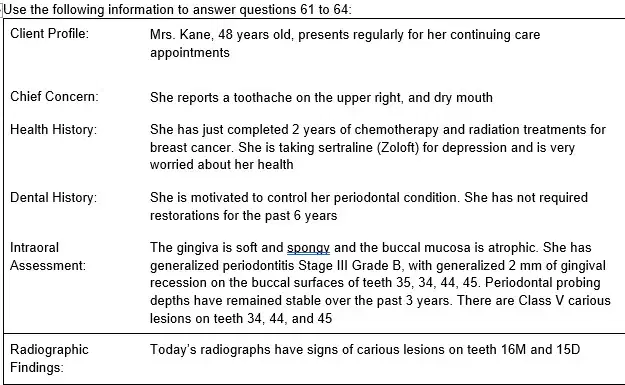
Which one of the following topics is most important for the dental hygienist to discuss with Mrs. Kane?
The use of antidepressants can contribute to xerostomia
Dental biofilm-induced tissue edema requires home antimicrobial mouthrinses
The relationship between diet and dental caries
Composite and amalgam restorative options
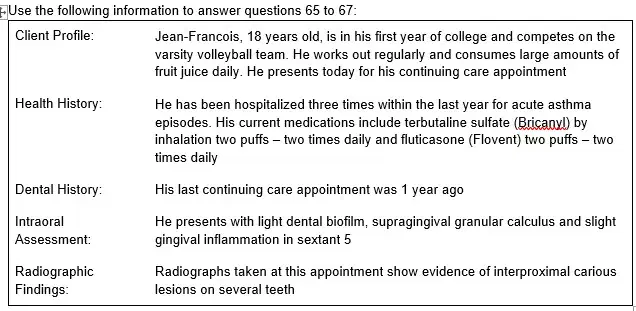
Prior to commencing dental hygiene care, what should the dental hygienist ask Jean-Francois?
If he ever had an allergic reaction to a local anesthetic
What factors tend to trigger his asthma attacks
How long was he hospitalized for the asthma attacks
What he had to eat and drink prior to his appointment today
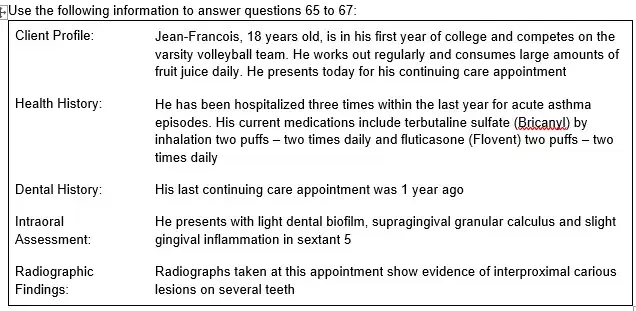
Why should Jean-Francois rinse his mouth with water after using his medication?
It will limit the development of black-line stain
Terbutaline sulfate (Bricanyl) may increase saliva viscosity
Residual inhalant may cause enamel erosion
Fluticasone (Flovent) may result in oral candidiasis
To help reduce Jean-Francois’ susceptibility to dental caries, what should the dental hygienist recommend?
Use of a daily fluoride mouthwash
Brush using a powered rotary toothbrush
Use of a daily antibacterial mouthrinse
Increase the frequency of his continuing care appointments
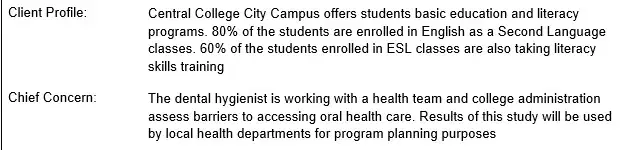
The information gathered from the student population includes written transcripts of their feelings and beliefs about oral health care. How should this information be analyzed?
Mean, median, and mode
T-test analysis
Statistical significance
Developing common themes
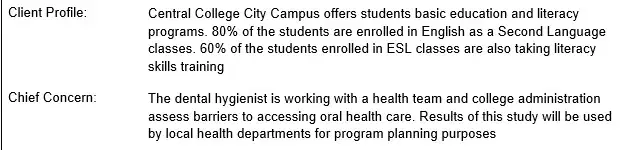
Once the health team has developed an initial plan for the study, how should this initial plan be communicated to ensure the success of the project?
Send copies of the plan to the student council
Hold a meeting for interested people to discuss it
Develop a newsletter for distribution
Speak to the president of the college
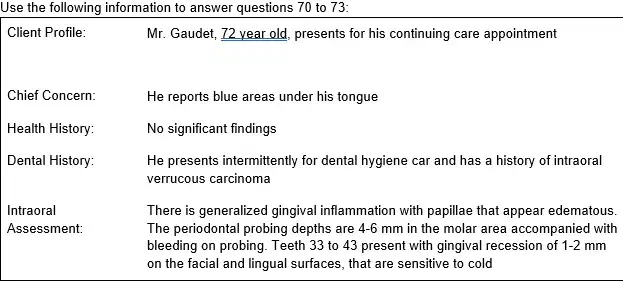
During the review of the health history, Mr. Gaudet reports that he has been seeing a herbologist because of his history of cancer. What is the most effective strategy for the dental hygienist to obtain further information on herbal remedies?
Refer to a reference text
Ask the client questions
Contact the dental hygiene association
Consult with colleagues
How should the dental hygienist address M. Gaudet’s chief concern?
Assure him that the condition is normal
Send a cytologic smear to the lab for analysis
Refer him to an oncologist for further assessment
Prepare an in-office brush biopsy
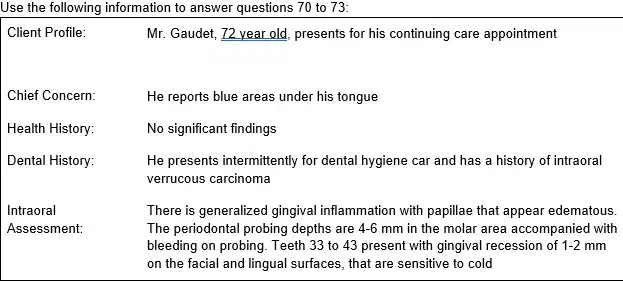
Which one of the following topics is most appropriate to include in Mr. Gaudet’s education?
Using sunscreen
Wearing a wide brimmed hat
Eating antioxidants
Conducting oral self exams
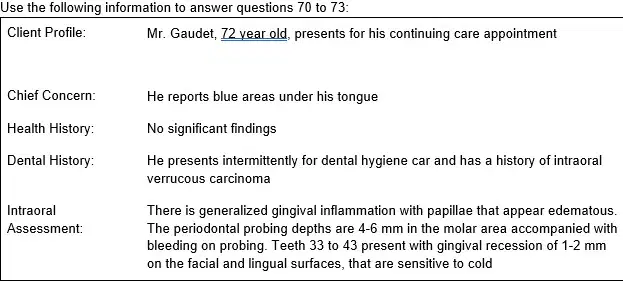
Which one of the following interventions would be most effective to alleviate the pain experienced by Mr. Gaudet in the areas of the gingival recession?
Using a desensitizing dentifrice
Rinsing twice daily with chlorhexidine
Scheduling shorter continuing care intervals
Changing to a soft-bristled toothbrush
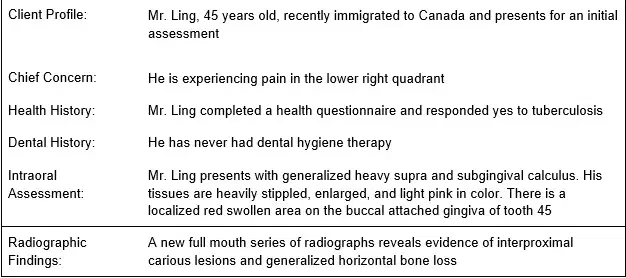
Which one of the following lesions is the most likely to present on the buccal attached gingiva of tooth 45?
Periodontal abscess
Radicular cyst
Periapical abscess
Ameloblastoma

