
Font size
 Worksheets
Science 8
Total questions: 116
Worksheet time: 58mins
What does the word ‘diet’ mean?
an insect repellent
trying to loose mass
what you eat
a type of nutrient
Which nutrient is tested for using iodine solution?
sugar
fat
protein
starch
fibre
In which sentence is the word ‘diet’ used in a scientific way.
Jack does not want to eat a diet.
No answer text provided.
Julie has a lot of starch in her diet.
Miriam decided to go on a diet and lose some weight.
A nutrient found in many foods is:
carbon dioxide.
potato
energy
carbohydrate.
Water is important for your body because:
it can dissolve substances.
it is a source of energy
it can be a solid, a liquid or a gas.
it is a source of fibre.
Our bodies need food as a fuel for:
nutrition
respiration
excretion
combustion
Good sources of protein are:
meat, fish and nuts.
meat, fish and nuts.
pasta, potatoes and rice.
fruit juices.
Proteins are mainly used in the body for:
energy
growth and repair.
digestion
strong bones.
Which of these people will need to eat food containing the most energy in a day?
a 3-year-old child
an 85-year-old woman
a 35-year-old man who works outside cutting down trees
a 25-year-old woman who works in an office using a word processor
Test for the presence of starch with dilute iodine solution gives which of the following colour:
blue-black
blue-violet
blue-orange
blue-green
You have a balanced diet when:
the mass of all the food you eat in a day adds up to 100 kg.
the mass of all the food you eat one day is equal to the mass you eat the next day.
you eat foods containing the right amounts of all the different nutrients.
you only eat fish.
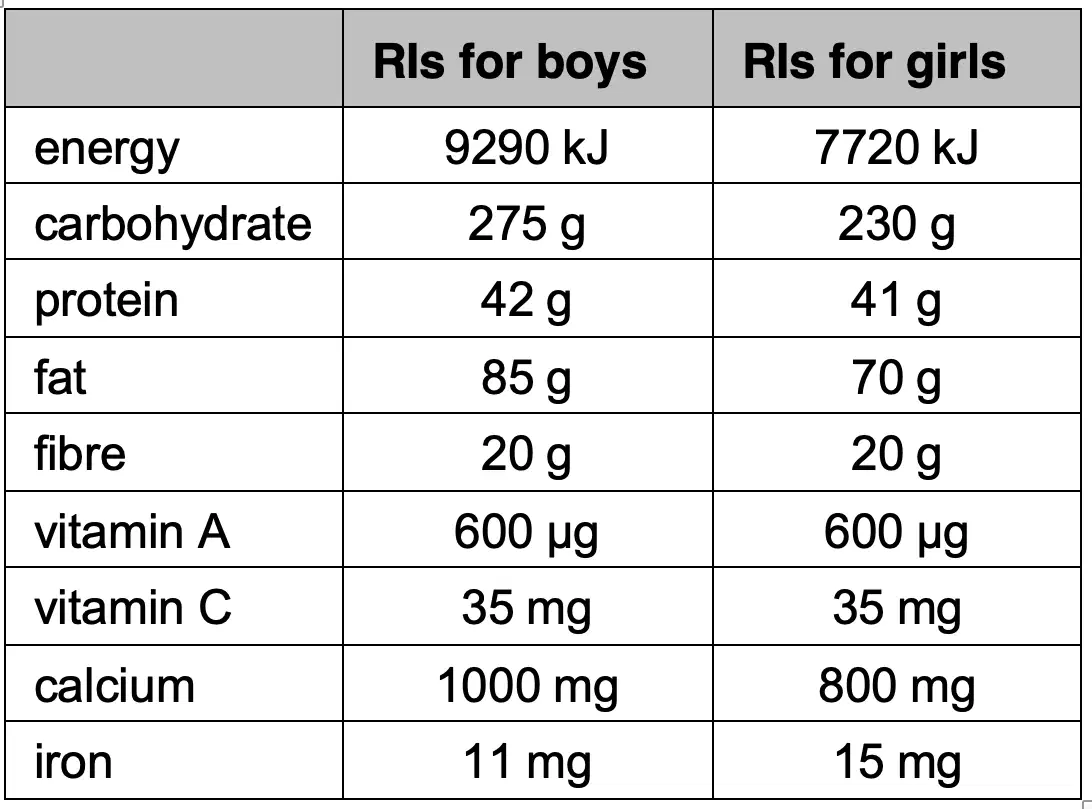
The table shows Reference Intakes for
11 year olds.
Which nutrient do girls need more of than boys?
vitamin C
energy
iron
carbohydrate
Which of these problems cannot be caused by eating too much sugar?
malnutrition
obesity
tooth decay
starvation
A disease that causes weak bones that do not form properly is:
rickets.
scurvy
arthritis
measles
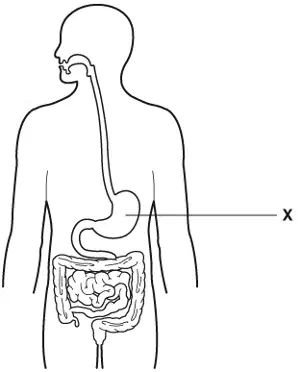
Which organ is labelled X in the drawing?
small intestine
liver
stomach
mouth
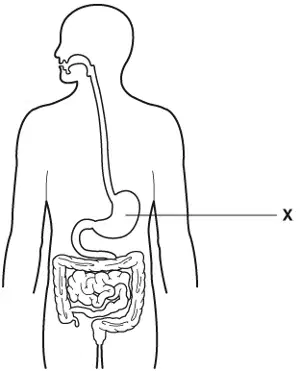
In the diagram in question 1, what does the organ labelled X do?
It mixes up food with acid and breaks down proteins.
It adds vitamins to the food.
It takes the water out of the food.
It stores waste food until it can be got rid of.
In digestion:
soluble food substances are made into insoluble ones so that they can be taken in by the small intestine.
insoluble food substances are broken up into soluble ones so that they can be taken in by the small intestine.
soluble food substances are made into insoluble ones so that they can be stored inside the body until needed.
insoluble food substances are broken up into soluble ones so that they can form waste.
The main chemical substances used to digest foods are:
vitamins
bacteria
digestifs
enzymes
Starch is broken down into smaller molecules called:
salts
sugars.
proteins
amino acids.
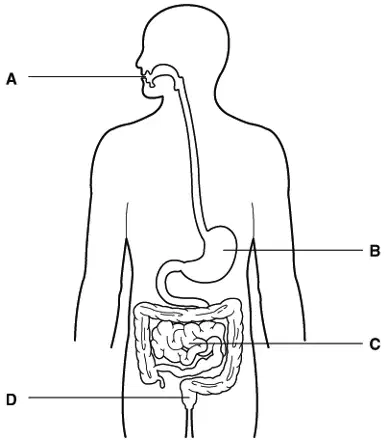
Which label shows the place where digested food passes into the blood?
A
B
C
D
Digested food mainly passes into the blood by the process of:
diffusion
diffraction
digestion
dilution
The process in question 3 is speeded up because the part of the body where it occurs:
has a much higher temperature than the rest of the body.
has a very large surface area.
contains blood.
contains faeces.
In which kingdom do all the organisms have many cells and their cells have no cell walls?
plant kingdom
animal kingdom
fungus kingdom
Characteristics of conifers include having:
needle-shaped leaves.
flowers
flat leaves.
a lack of xylem tissue.
Primula vulgaris is the scientific name for wild primroses. What genus do wild primroses belong to?
plants
Primula vulgaris
vulgaris
Primula
We should preserve biodiversity:
to stop it going off.
so that it is easier to tell organisms apart.
to stop organisms producing hybrids.
because many organisms may be useful to us.
Asexual reproduction needs:
sperm cells and egg cells.
two parents.
only one parent.
no parents.
Strawberry plants can reproduce using:
runners.
sprinters.
joggers.
walkers
Which of these is an example of inherited variation in plants?
having a disease
flower colour
being used as a vegetable
being eaten by slugs
In fertilisation:
a fertilised egg cell grows into an embryo.
a male and a female gamete fuse.
male gametes are produced.
a plants grows in some animal droppings.
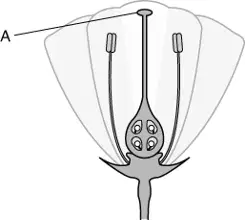
On the diagram, the part labelled A is the:
stigma.
style
ovary
anther
In a flower, the anther:
receives pollen grains.
makes pollen grains.
makes nectar.
contains the egg cells.
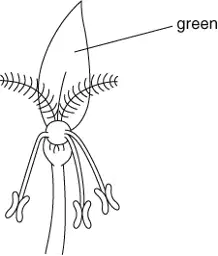
The flower in this drawing is pollinated by:
an insect.
the wind.
an insect or the wind.
bacteria
If self-pollination occurs:
the offspring will not have variety.
offspring can never be produced.
a plant will die.
the bees will die.
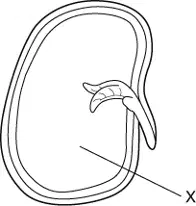
What part of the seed is labelled X?
food store
embryo
seed coat
zygote
The seeds inside an apple are dispersed by:
the wind.
insects.
animals that eat them.
being carried on the fur of animals.

In the diagram, the part labelled Y is:
a food store.
a nectary.
an egg cell.
a pollen tube.
Why is seed dispersal important?
so that plants can reproduce asexually
so that plants can reproduce sexually
so that offspring do not compete with their parents
so that animals have something to eat
Which of these resources is always needed for germination?
water
light
carbon dioxide
nitrogen
During germination, some of the food store in the seed is turned into glucose for:
photosynthesis.
respiration
competition
dispersal
The raw materials for photosynthesis are:
water and oxygen.
oxygen and glucose.
carbon dioxide and water.
glucose and water.
Bees and apple trees are interdependent because:
bees and apple trees both make things that humans like to eat.
bees feed on apples.
bees and apple trees are the same species.
they both make use of the other.
What is released during respiration?
energy
food
air
glucose
Respiration is aerobic if it requires:
oxygen.
carbon dioxide.
lungs.
energy.
Which of these is a correct word equation for respiration?
glucose + oxygen → carbon dioxide + water
carbon + dioxygen → glucose + oxygen
glucose → energy
oxygen + carbon → carbon dioxide
The main difference between combustion and aerobic respiration is that:
combustion is much faster.
only combustion releases energy by heating.
only respiration produces carbon dioxide.
only respiration produces water.
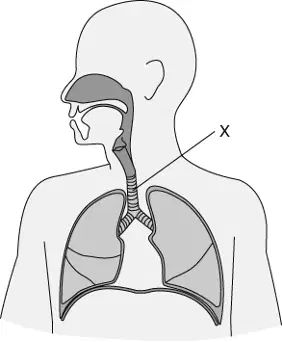
On the diagram, the part labelled with the letter X is the:
trachea.
blood vessel.
oesophagus.
bronchus
During gas exchange in the lungs, there is an overall diffusion of:
carbon dioxide into the lung and oxygen into the blood.
oxygen into the lung and carbon dioxide into the blood.
oxygen and carbon dioxide into the blood.
oxygen and carbon dioxide into the lung.
During inhalation, rib and diaphragm muscles:
contract to reduce the pressure inside the lungs.
contract to increase the pressure inside the lungs.
relax to reduce the pressure inside the lungs.
relax to increase the pressure inside the lungs.
Dust is prevented from getting into the lungs by a layer of mucus, which is swept away by:
cilia.
alveoli
filaments.
flagella
Heart disease is caused by:
blood vessels leading to the heart muscle becoming blocked.
the heart growing too big.
eating too much, which causes the stomach to push up on the heart.
being allergic to a certain substance in food.
A poisonous substance in cigarette smoke stops red blood cells carrying oxygen. This substance is called:
carbon monoxide.
tar.
nicotine.
water vapour.
How is carbon dioxide transported around the body?
dissolved in the plasma
carried on white blood cells
carried on red blood cells
as a gas
During strenuous exercise:
the pulse rate increases so that oxygen can get to cells faster for respiration.
the pulse rate decreases to stop so much carbon dioxide getting to cells.
the pulse rate increases so that carbon dioxide can get to cells for respiration.
the pulse rate decreases so less carbon dioxide can get into the blood from respiring cells.
Aerobic respiration in plants:
is the same as in animals.
does not occur (plants use photosynthesis).
does not use glucose.
does not use oxygen.
When carbon dioxide is added to limewater:
the limewater turns from clear to cloudy.
the limewater turns from cloudy to clear.
the limewater turns green.
nothing happens.
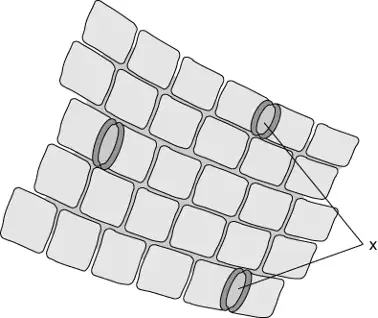
The drawing shows the underside of a leaf. What are the parts labelled X called?
stomata
guard vessels
alveoli
cilia
Which organ do fish use for gas exchange?
gills
lungs
skin
mouth
Which substance does anaerobic respiration in humans produce?
lactic acid
water
carbon dioxide
carbon monoxide
Anaerobic respiration can occur in a cell if there is a lack of:
oxygen
water
glucose.
nitrogen
For each molecule of glucose, how much energy does anaerobic respiration release compared with aerobic respiration?
less energy.
no energy.
more energy.
the same amount of energy.
One cause of excess post-exercise oxygen consumption is:
replacing stores of oxygen in the body.
being thirsty.
aching muscles.
an increased rate of anaerobic respiration after exercise.
Two kingdoms that contain many unicellular microorganisms are:
viruses and bacteria.
animals and plants.
yeast and fungi.
prokaryotes and protoctists.
One feature of all prokaryotes is that they:
have chloroplasts.
do not have nuclei.
do not respire.
do not have cytoplasm.
Virus particles contain:
a strand of genes and a protein coat.
a strand of proteins and a gene coat.
a strand of fats and a gene coat.
a strand of proteins and a fat coat.
Multicellular organisms need transport systems to carry materials to their cells because:
diffusion is not fast enough to do this.
diffraction is not fast enough to do this.
dissolving is not fast enough to do this.
dispersion is not fast enough to do this.
Which of these is a food often made using yeast?
chips
cheese
bread
yoghurt
Which of these shows the correct word equation for anaerobic respiration in yeast?
oxygen + glucose → carbon dioxide + water
carbon dioxide + water → oxygen + glucose
glucose → carbon dioxide + etha
glucose + carbon dioxide → oxygen + water
Yeast reproduce by:
binary fission
binary fusion
fermentation
budding
The graph shows the growth of a population of yeast.
the yeast cells can only grow to a certain size.
the food for the yeast has started to run out.
it has got dark and there is not enough light for the yeast to grow.
the carbon dioxide for the yeast has started to run out.
Three resources needed by all bacteria for growth are:
warmth, food and moisture.
light, carbon dioxide and glucose.
oxygen, nitrogen and mould.
darkness, moisture and nitrogen.
A product of fermentation of milk by bacteria is:
ethanol.
oxygen.
glucose.
lactic acid.
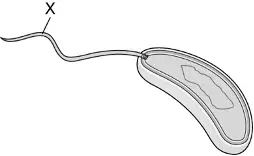
The drawing shows a bacterium.
tail
chromosome
cilium
flagellum
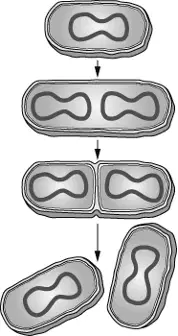
What process is shown in the diagram?
globulisation
globalisation
binary fission
glandibular separatisation
Three resources needed by algae are:
carbon dioxide, darkness, food.
water, warmth, light.
nitrogen, salt, water.
oxygen, glucose, darkness.
In total, the organisms that contain the most energy in a food web are the:
producers.
secondary consumers.
primary consumers.
top predators.
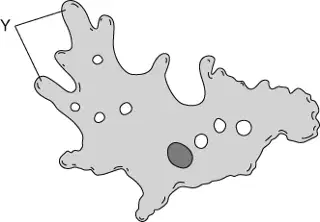
The drawing shows an Amoeba.
photosynthesis
moving
controlling the cell
storage
Why is light important for photosynthesis?
It transfers energy from the Sun.
It lets the organisms see.
It warms up the ground.
It contains chlorophyll.
A decomposer is:
an organism that spends a lot of its time asleep.
an organism that is used to remove poisons from contaminated soils.
an organism that breaks down dead organisms and animal wastes.
an organism that has ten legs.
Examples of organic compounds include:
sodium chloride, magnesium oxide and ammonium nitrate.
fish, meat and eggs.
water, oxygen and carbon dioxide.
glucose, proteins and fats.
Combustion of hydrogen produces:
carbon hydride
hydrocarbon
carbon
water
Carbon dioxide can be detected using:
a glowing splint
pure water
orangewater
limewater
When hydrated copper sulfate is heated, the gas produced is called:
the water of crystallisation
oxygen
carbon dioxide
hydrogen
methane + oxygen -> ...
carbon dioxide + water
hydrogen + oxygen
carbon dioxide + hydrogen
carbon + water
During a chemical reaction, reactants form products. Compare the mass of reactants with the mass of products formed.
The mass of reactants is greater than the mass of products
The mass of products is greater than the mass of reactants.
The mass of products is the same as the mass of reactants.
The change in mass depends on what the reactants and products are.
Oxidation is always:
a reaction in which a substance combines with oxygen.
a reaction in which a substance burns in oxygen.
a reaction in which a substance burns in air.
an explosive reaction.
When zinc burns in oxygen it forms:
water.
zinc hydroxide.
zinc carbonate
zinc oxide.
When 4.8 g of magnesium reacts with 3.2 g of oxygen, how much magnesium oxide is formed?
1.6 g
4.9 g
7.0 g
8.0 g
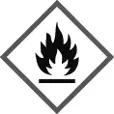
What does this hazard symbol warn of?
The substance is explosive.
The substance burns easily.
The substance supplies oxygen to fires.
The substance puts out fires.
The three sides of a fire triangle are:
fire, water, heat.
heat, water, fuel.
heat, oxygen, fuel.
fire, oxygen, fuel.
What happens in an exothermic reaction?
Energy is released that increases the temperature of the surroundings.
Energy is taken in from the surroundings, reducing the temperature.
The reacting substances always explode.
You need to heat a substance or substances to get a reaction to occur.
The best way to put out a small electrical fire is:
spray it with water to cool it down.
cover with a wet cloth to exclude air and cool it down.
cover with a wet cloth to exclude air and cool it down.
spray with a powder extinguisher to exclude air.
Name two pollutants that may be formed when fossil fuels are burnt in a vehicle engine.
carbon dioxide and sulfur
sulfur dioxide and water
nitrogen oxides and sulfur
nitrogen oxides and sulfur dioxide
How do sulfur dioxide and nitrogen oxides help cause acid rain?
These acidic gases dissolve in water droplets in clouds.
These alkaline gases react with water droplets in clouds.
They make rain happen more easily.
The gases react together forming sulfonitroxidic acid in clouds.
Why are carbon monoxide and soot particles found in the exhaust gases of vehicles?
These substances are in the fuel used in the vehicle.
The fuel reacts completely with oxygen in the air.
The fuel does not react fully with oxygen in the air.
These substances are formed from impurities in the fuel.
How does a catalytic converter help to reduce pollution from burning fossil fuels?
It filters out soot particles from the gases formed.
It changes pollutant gases into less harmful gases.
It absorbs sulfur dioxide so that it isn’t released into the air.
It reacts with the pollutants to form a solid, which has to be scraped out of the converter at regular intervals.
What does global warming mean?
The warming effect of the Sun on the Earth.
The natural warming effect caused by greenhouse gases in the atmosphere.
The additional warming effect caused by increasing amounts of carbon dioxide in the air.
The way the climate is changing as a result of more carbon dioxide in the air.
Which of these factors caused the Earth’s surface temperature to vary thousands of years ago?
release of carbon dioxide by burning fossil fuels
variation in the energy emitted by the Sun
variation in the number of vehicles on Earth
variation in ice ages
Which description explains how carbon dioxide helps to cause the greenhouse effect?
It blocks energy from the Sun from reaching the Earth’s surface.
It absorbs energy emitted from the Earth’s surface and re-emits it out into space.
It absorbs energy emitted from the Earth’s surface so that it doesn’t get any warmer.
It absorbs energy emitted from the Earth’s surface and re-emits it back to the surface.
Which of these methods would not help to reduce the amount of carbon dioxide released each year?
Changing from fossil fuel power stations to nuclear power stations.
Fitting catalytic converters to all vehicles.
Setting government targets for carbon dioxide production and fines for industries that exceed their target.
Travelling by bus or train rather than by car.
When magnesium ribbon reacts with steam a solid called magnesium oxide and hydrogen gas are formed. In this reaction, which element has the lowest boiling point?
hydrogen
water
magnesium
magnesium oxide
The correct symbol for carbon is:
C
Ca
Cal
N
According to Dalton’s theory, elements:
are always solids.
contain only one kind of atom.
can be split up into simpler substances.
contain at least two different kinds of atom.
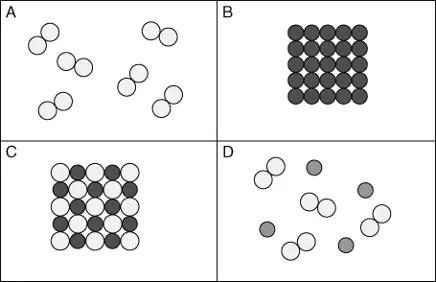
Which of these diagrams shows the particles in a compound?
A
B
C
D
The main difference between a chemical change and a physical change is that in a chemical change you always get:
a change of state.
heat given out.
a change in colour.
a new substance being formed.
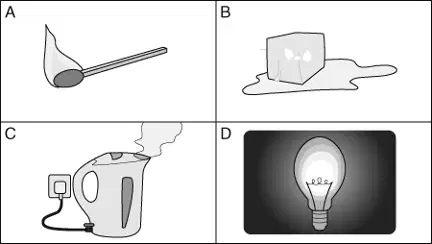
Which of the following is a chemical change?
A
B
C
D
Which of the following always happens during a chemical reaction?
Compounds react and split up into free atoms.
Elements join together to make new elements.
Atoms are broken down into smaller particles.
The atoms in the reactants are rearranged to make the products.
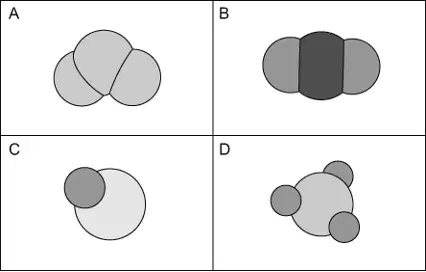
Which of the following could have the formula XY2?
A
B
C
D
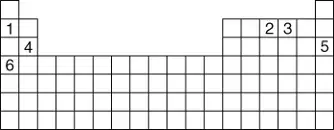
Which two elements in the periodic table below would have the most similar chemical properties?
1 & 4
2 & 3
1 & 6
5 & 6
Which element is very unreactive?
helium
lithium
hydrogen
fluorine
Which of the following describes a group 1 element?
a very reactive metal
a very unreactive metal
a very reactive non-metal
a very unreactive non-metal
The elements are arranged in the periodic table in order of increasing:
density.
melting point.
reactivity.
atomic number.
The melting point of a substance is:
higher than its boiling point.
lower than its freezing point.
higher than its freezing point.
the same temperature as its freezing point.
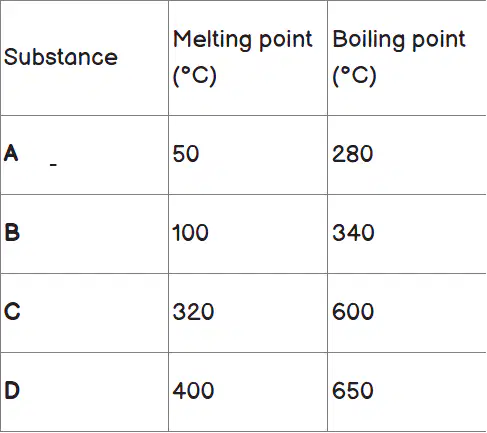
Which of the following substances will be a liquid at 350 °C?
A
B
C
D
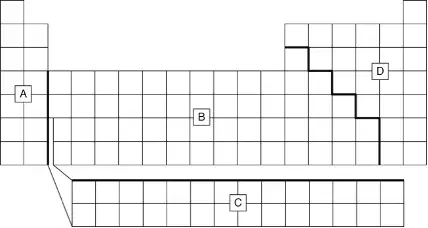
Where are most non-metals found in the periodic table?
A
B
C
D
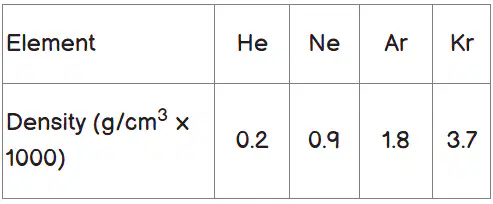
Some information about group 0 elements is given below.
The density of group 0 elements:
does not change down the group.
increases down the group.
decreases down the group.
shows no pattern within the group.

