
 Worksheets
Chem - Modified Collins/Carreiro
Total questions: 24
Worksheet time: 54mins
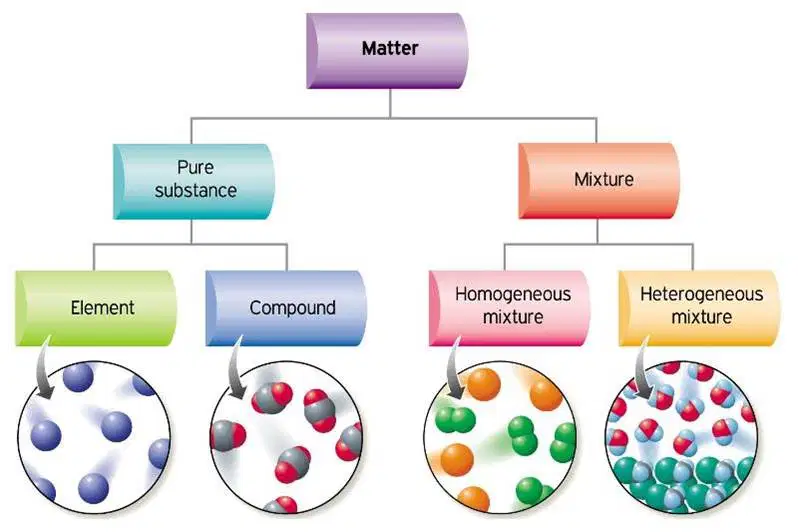
Salt (NaCl) is a(n):
Element
Compound
Homogeneous Mixture
Sand and water is a(n):
Compound
Homogeneous Mixture
Heterogeneous Mixture
Salt and water is a(n):
Compound
Homogeneous Mixture
Heterogeneous Mixture
Neon (Ne) is a(n):
Element
Compound
Homogeneous Mixture
The only type of matter where there is a clear and visible separation of the parts is:
Compound
Homogeneous Mixture
Heterogeneous Mixture
Density is described as:
The ratio between the mass and volume of a substance
Anything that has mass and volume
The space that matter takes up
Mass is described as:
The amount of matter in a sample
The space that matter takes up
Anything that has mass and volume
Matter is described as:
The amount of matter in a sample
The space that matter takes up
Anything that has mass and volume
Volume is described as:
The amount of matter in a sample
The space that matter takes up
Anything that has mass and volume
A chemical change could have all the following characteristics EXCEPT:
Same materials, different form
Explosions could happen
New materials forming
Which one of the following is a chemical change?
Boiling
Dissolving
Rusting
What kind of property is volume?
Chemical property
Extensive physical property
Intensive physical property
What kind of property is flammability?
Chemical property
Extensive physical property
Intensive physical property
What kind of property is conductivity?
Chemical property
Extensive physical property
Intensive physical property
Gold is metallic, with a yellow colour when in a mass, but when finely divided it may be black, ruby, or purple. It is the most malleable and ductile metal; 1 ounce (28g) of gold can be beaten out of 300 square feet. It is a soft metal and is usually alloyed to give it more strength. It is a good conductor of heat and electricity and is unaffected by air and most reagents. Gold is usually alloyed in jewelry to give it more strength, and the term "carat" describes the amount of gold present (24 carats is pure gold). It is estimated that all the gold in the world so far refined could be placed in a single cube 60 ft. on a side.
Gold is a well-known conductor of heat is:
Physical
Chemical
Not listed in the passage
Gold will react with the halogens is:
Physical
Chemical
Not listed in the passage
Gold does not react with air:
Physical
Chemical
Not listed in the passage
If you had to separate a mixture of different dyes, what technique would you use?
Filtration
Chromatography
Crystallization
If you had to separate a mixture of salt and sand, what technique would you use?
Filtration
Chromatography
Crystallization
If you had to separate a mixture of sand and water, what technique would you use?
Filtration
Chromatography
Crystallization
The only diagram above which represents a mixture is the:
Top picture
Bottom left picture
Bottom middle picture
Change #1 is:
Chemical
Physical
Impossible
Change #2 is:
Chemical
Physical
Impossible
Change #3 is:
Chemical
Physical
Impossible
The change from A to B is called:
Boiling
Condensing
melting
The change from A to C is called:
Melting
Condensing
Boiling
The change from B to C is called:
Boiling
Condensing
Melting
The change from B to A is called:
Melting
Subliming
Freezing
The change from C to A is called:
Melting
Subliming
Freezing
If you place an object with a density of 0.50 g/ml in a sample of water (D = 1.00 g/ml), what will happen?
It will be suspended.
It will sink.
It will float.
Determine the density of gasoline (red line) by finding the slope of its trendline: The density of gasoline is:
1.00 g/ml
2.00 g/ml
0.70 g/ml
Object E will:
Be suspended.
Sink.
Float.
Object G will:
Be suspended.
Sink.
Float.
mass = density × volume
Determine the mass in grams of an object if it has a density of 5.65 g/ml and a volume of 3.2 ml.
0.566 g
1.64 g/ml
18.08 g
density = mass ÷ volume
What is the density of an object with a mass of 45 grams and a volume of 15 ml?
3.0 g/ml
0.333 g/ml
675 g/ml
volume = mass ÷ density
What is the volume of an object with a mass of 12 grams and a density of 3 g/ml?
4 ml
36 ml
0.67 ml
The following statements are accurate about the particle diagram below EXCEPT:
The models shown represent the plum pudding model of the atom (top) and the nuclear model of the atom (lower). The model changed with Rutherford's gold foil experiment in which he discovered the:
Electron
Proton
Nucleus
The diagram below represents the reaction of calcium with a solution of zinc carbonate to make zinc and a solution of calcium carbonate. How many grams of zinc will form?
408 grams
128 grams
104 grams
According to the included table, which substance is a better conductor of heat? Liquid water is the least conductive of all of these materials.
Copper
Basalt
Granite
Determine the amount of energy needed to increase the temperature of 50.0 g of granite from 10 degrees Celsius to 25 degrees Celsius. The c for granite is 0.79 J/gC.
Use the equation: E = m x c x change in temperature.
3138 J
395 J
592.5 J
If 25,000 J of energy are given to a sample of water which increases 50. degrees. What is the mass of the water? The c for water is 4.184 J/gC.
119.5 g
29.6 g
200.1 g0.00836 g
What is the specific heat (c) of a substance with a mass of 750 grams if 13,500 J of energy raises the temperature by 45 degrees?
2.50 J/gC
67 J/gC
0.400 J/gC
Particle kinetic energy depends mainly on temperature (higher temperature → higher average kinetic energy).
In which substance do the particles contain more kinetic energy?
Solid ice at 0℃.
Water vapor at 112℃.
Liquid water at 15℃.
Use the Fahrenheit to Celsius formula:
Paper catches fire at about 451 ℉. What is the temperature in Celsius?
233℃
908℃
506℃
The amount of energy to raise the temperature of one gram of a substance by one degree Celsius is:
Kinetic energy
Boiling point
Specific heat
The transfer of energy is called:
Heat
Kinetic energy
Boiling point
Energy of motion is called:
Heat
Kinetic energy
Boiling point
Use this cooling curve to answer the following questions:
Segment AB represents:
cooling a gas
condensing
cooling a liquid
Segment BC represents:
cooling a gas
condensing
cooling a liquid
Segment CD represents:
cooling a gas
condensing
cooling a liquid
Segment DE represents:
cooling a liquid
freezing
cooling a solid
Segment EF represents:
cooling a liquid
freezing
cooling a solid
Use the notation below to answer the following questions:
The mass number is:
59
28
+2
The number of electrons is:
E = (P - Charge)
59
26
+2
The charge is:
59
28
+2
The number of protons is:
59
28
+2
Neutrons=Mass number−Atomic number
The number of neutrons is:
+2
26
31
The number of particles in the nucleus is:
T* he number of particles in the nucleus is the sum of protons + neutrons.
59
28
+2

