
 Worksheets
Ch.5 Tissue Quiz
Total questions: 135
Worksheet time: 1hrs 13mins
Which statement best defines why cells are considered the functional units of life?
They exist in large numbers within organisms
They perform essential processes sustaining organisms
They house all vital organelles for metabolism
They form tissues by simply adhering together
Approximate how many cells make up the human body.
Ten to twenty million cells
One to two quadrillion cells
Fifty to one hundred trillion cells
Five to ten billion cells
Choose the principle that links anatomy and physiology.
Varied structure determines corresponding function
Function persists despite structural differences
Structure varies yet function remains identical
Function dictates structure in organ systems
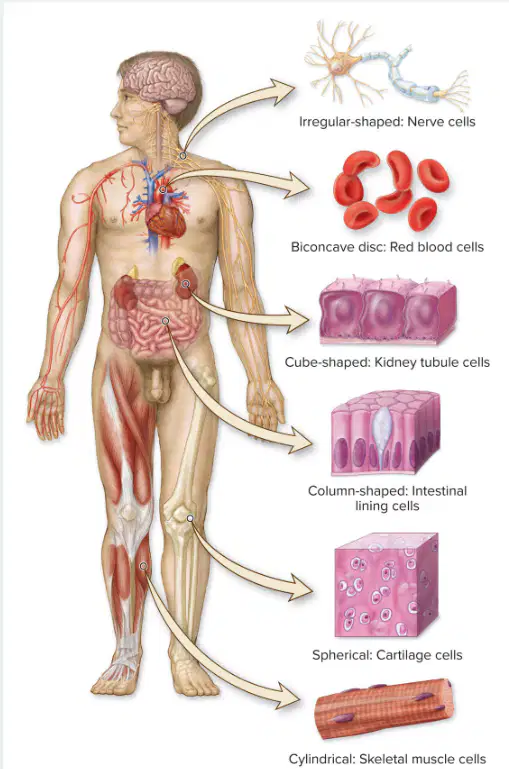
Identify the cell shape most suited for lining and absorption in the intestine, based on the diagram.
Cylindrical skeletal muscle cells
Irregular nerve cell bodies
Spherical cartilage cells
Column-shaped epithelial cells
Which part of a generalized cell acts as a selective barrier separating internal contents from the environment?
Cytoplasm and cytosol
Plasma membrane bilayer
Golgi and endoplasmic reticulum
Nucleus with nuclear envelope
What role does the nucleus primarily serve in a eukaryotic cell?
Energy production via mitochondria
Control center housing genetic material
Protein modification and trafficking
Structural support through cytoskeleton
Where do most cellular activities occur within a generalized cell?
Inside lysosomes and peroxisomes
Across the plasma membrane exterior
Inside the nucleus and nucleolus
Within cytoplasm inside the membrane
Which component correctly pairs with its key content: deoxyribonucleic acid (DNA)?
Plasma membrane contains DNA
Nucleus contains DNA
Golgi apparatus encodes DNA
Cytoplasm stores most DNA
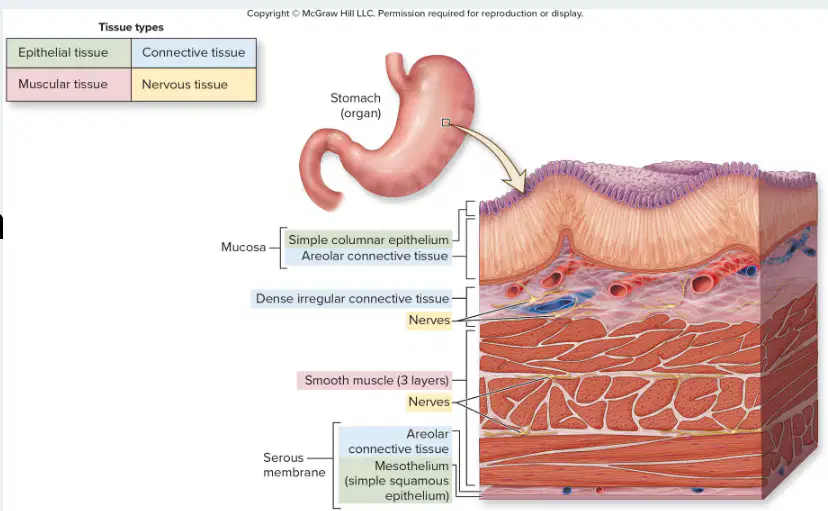
Which statement best defines a tissue in the human body as depicted in the diagram showing stomach wall layers?
A single cell specialized for electrical signaling
A fluid mixture of proteins circulating in blood
An organ formed by multiple distinct organ systems
A group of similar cells performing shared functions
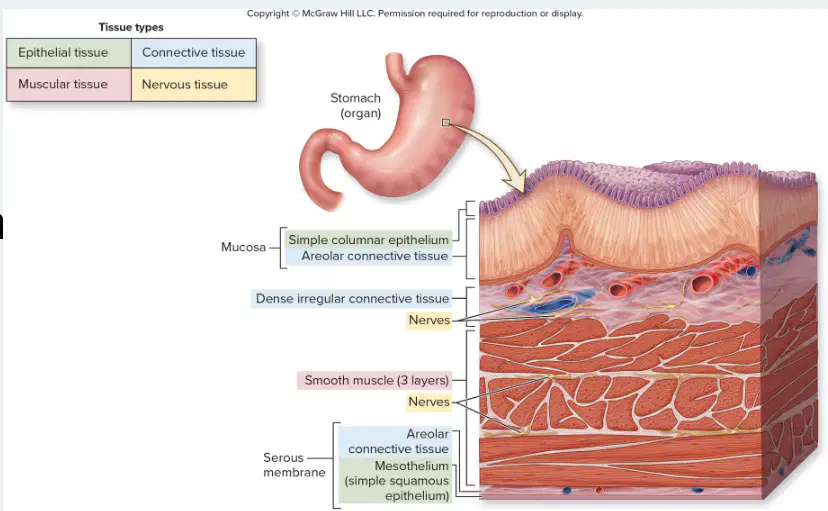
In the labeled stomach wall diagram, which layer represents epithelial tissue?
Nerves embedded within connective tissue
Smooth muscle composed of three layers
Dense irregular connective tissue beneath mucosa
Simple columnar epithelium lining the mucosa
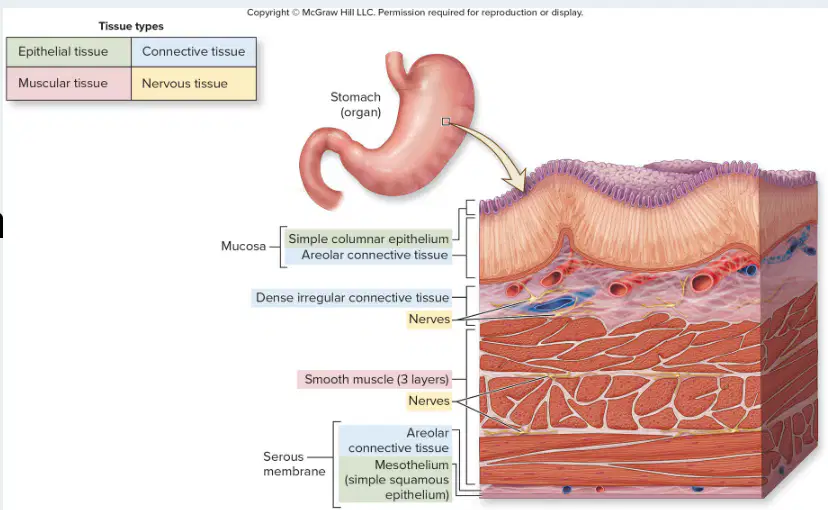
Select the primary function most associated with connective tissue in the depicted wall organization.
Initiation and propagation of action potentials
Secretion forming a protective luminal barrier
Rapid contraction generating mechanical force
Support and structural integration of other tissues
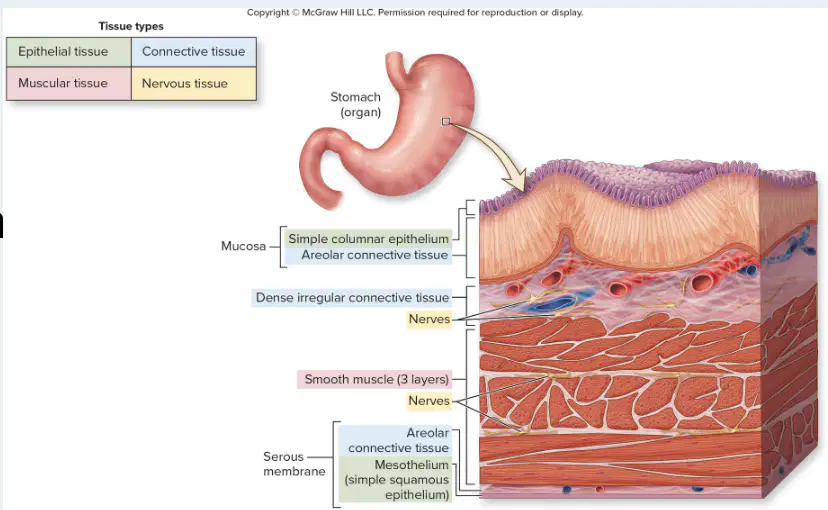
The diagram identifies nerves within the stomach wall. Which tissue type do nerves primarily belong to?
Epithelial tissue specialized for secretion
Connective tissue specialized for support
Nervous tissue specialized for signaling
Muscle tissue specialized for contraction
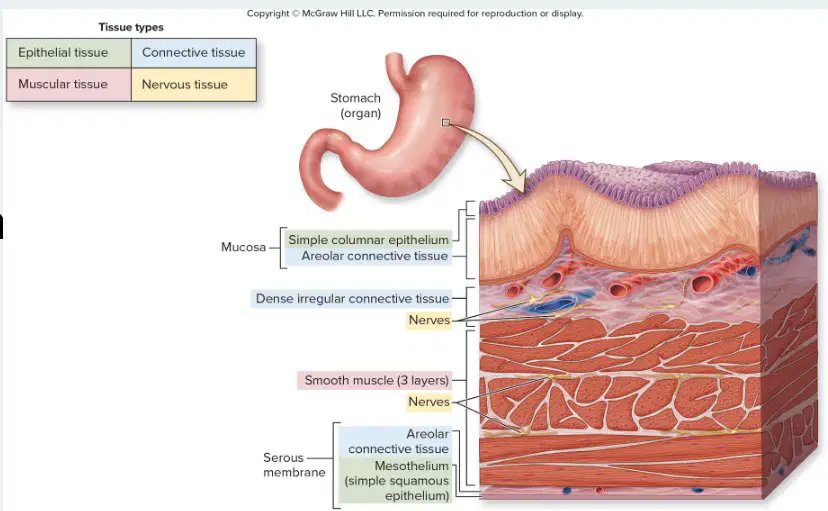
Reasoning with the organization shown, which sequence correctly orders the major tissue types from lumen outward in the mucosa of the stomach wall?
Epithelium → connective tissue → muscle → serous membrane
Muscle → epithelium → connective tissue → serous membrane
Connective tissue → muscle → epithelium → serous membrane
Epithelium → muscle → connective tissue → serous membrane
Which feature best defines epithelial tissue at a cellular level?
Cells widely separated by abundant matrix
Cells loosely arranged with many fibers
Cells closely packed with minimal matrix
Cells embedded in fluid-filled lacunae
What does it mean that epithelial tissue is avascular?
It cannot regenerate after injury
It lacks nerve endings entirely
It has no direct blood supply
It stores blood within its matrix
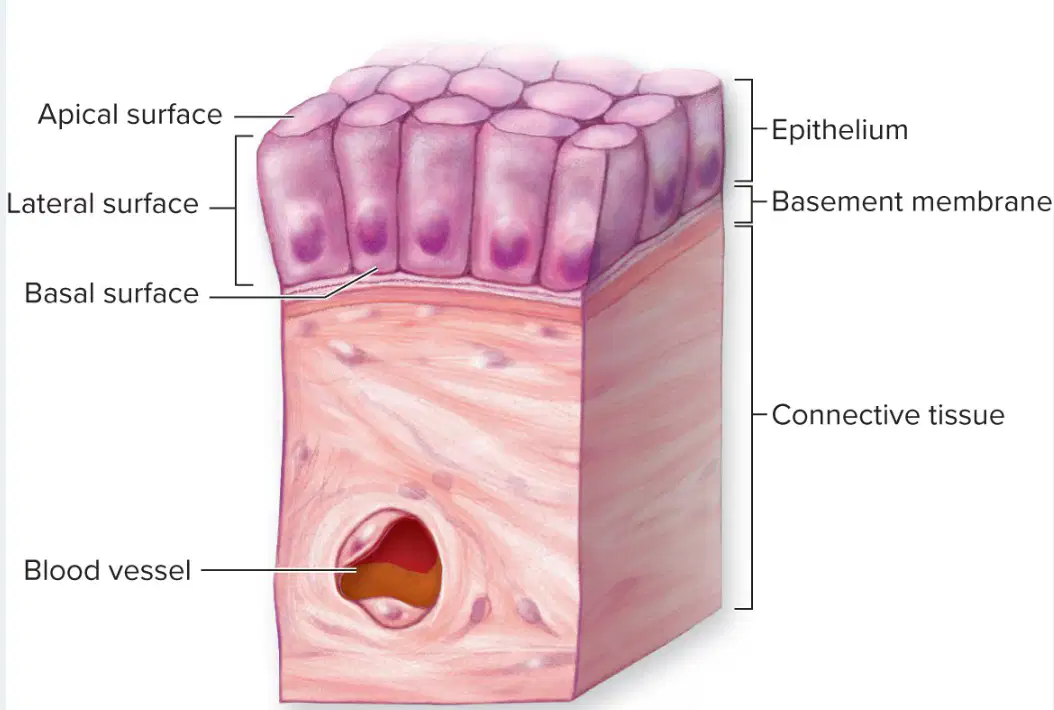
Identify the surface of epithelial cells that faces the body exterior or lumen.
Basal surface facing basement membrane
Apical surface facing free space
Lateral surface contacting neighbors
Deep surface facing connective tissue
Which statement correctly describes the basement membrane?
A vascular layer within epithelium
A protein-rich anchor for basal surface
A loose connective tissue layer
A fluid barrier inside blood vessels
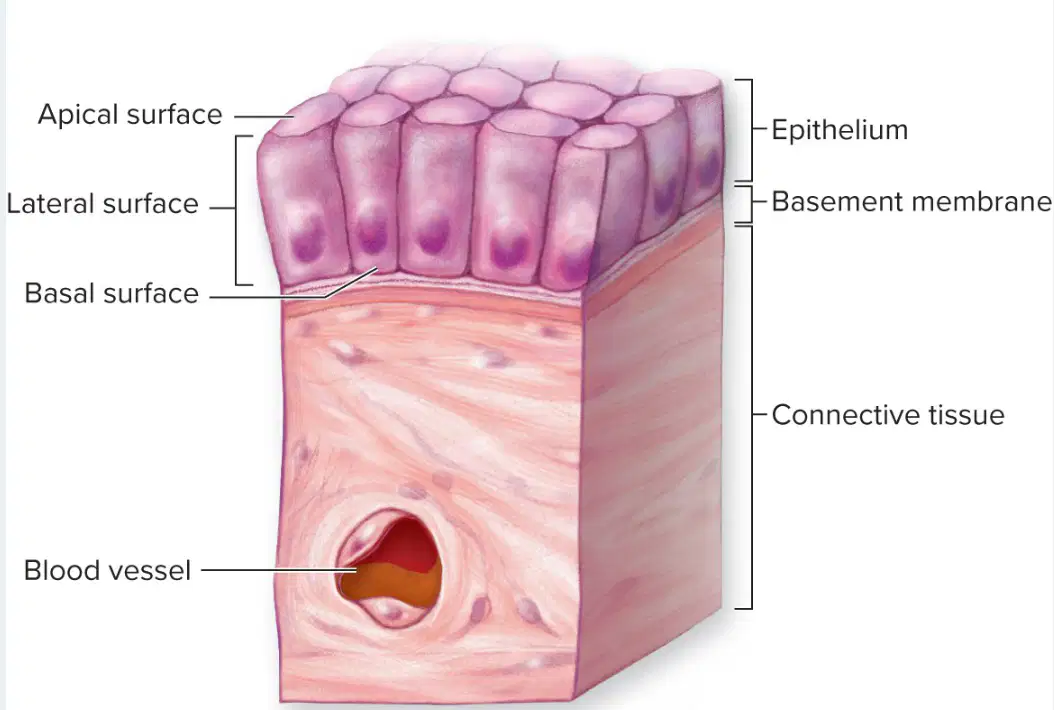
Epithelial sheets typically have which arrangement of surfaces?
Only lateral surfaces with junctions
Multiple basal surfaces facing lumen
One free apical and one basal anchored
Two free surfaces without anchoring
Which function exemplifies epithelial selective permeability?
Storing ions within cytoplasmic granules
Permitting water while blocking pathogens
Blocking gases and allowing proteins
Allowing all solutes to diffuse freely
Which protective role is characteristic of epithelium?
Protection from dehydration and abrasion
Protection by forming muscle fibers
Protection by producing red blood cells
Protection by mineralizing collagen
A gland primarily composed of epithelial cells is performing which function?
Secretion of products like enzymes
Generation of contractile force
Formation of bone tissue matrix
Conduction of electrical impulses
Why can epithelial tissues regenerate efficiently when well nourished?
They avoid mitosis to reduce damage
They are mostly acellular and inert
They receive oxygen directly from vessels
They have abundant stem cells at basal layers
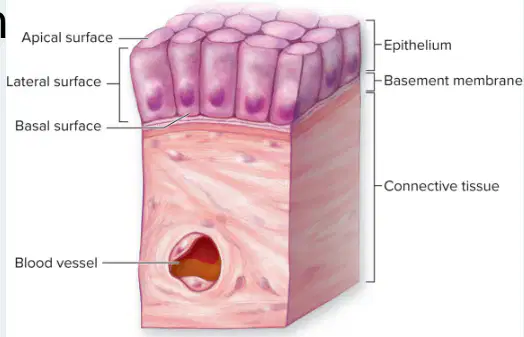
In the diagram, which layer lies immediately beneath the epithelium and contains blood vessels?
Basement membrane with capillary beds
Apical surface containing hemoglobin
Connective tissue supporting vasculature
Lateral surface forming vessel walls

Which criterion classifies epithelium as simple rather than stratified?
Presence of alternating thick layers
Presence of one continuous layer
Presence of folded multilayered sheets
Presence of multiple scattered layers

Which epithelial shape is best described as flattened like fish scales at the free surface?
Squamous shape cells
Columnar shape cells
Transitional shape cells
Cuboidal shape cells
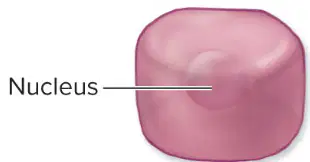
Cells that are about as tall as they are wide correspond to which epithelial type?
Pseudostratified shape
Squamous cell shape
Columnar cell shape
Cuboidal cell shape

Which surface of an epithelial sheet faces the lumen or external environment?
Lateral surface region
Apical surface region
Basal surface region
Basement membrane region
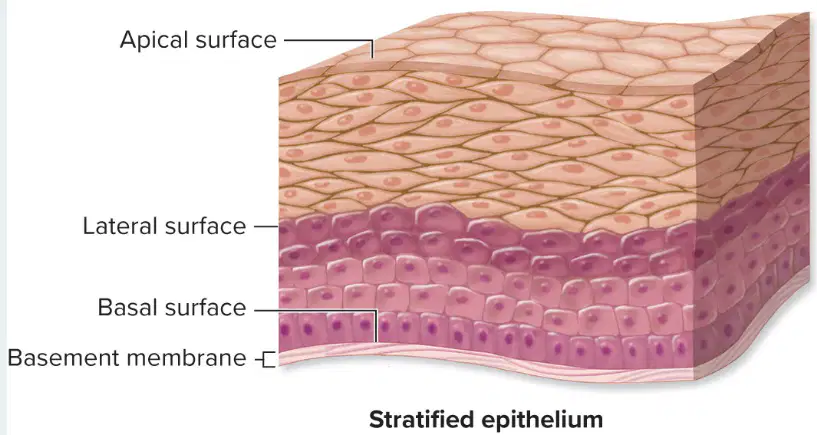
Which statement correctly distinguishes stratified epithelium?
Single layer only throughout
Cells anchored without basement membrane
Cells taller than they are wide
More than one stacked layer

Which epithelial type is most suited for rapid diffusion across thin barriers, such as in alveolar walls?
Transitional epithelium
Simple squamous epithelium
Keratinized stratified squamous
Simple columnar epithelium

In the small intestine, microvilli and goblet cells are typical of which epithelial type?
Stratified squamous epithelium
Simple columnar epithelium
Simple cuboidal epithelium
Pseudostratified ciliated epithelium

Which epithelium lines kidney tubules and specializes in absorption and secretion of filtrate?
Transitional epithelium
Keratinized stratified squamous
Simple columnar epithelium
Simple cuboidal epithelium

Which epithelial type protects most of the upper respiratory tract by moving mucus with cilia?
Pseudostratified ciliated columnar
Transitional epithelium
Simple squamous epithelium
Keratinized stratified squamous

Which stratified epithelial type forms the epidermis and resists abrasion with a tough surface?
Nonkeratinized stratified squamous
Simple squamous epithelium
Keratinized stratified squamous
Stratified cuboidal epithelium

Which epithelial type lines the urinary bladder and can distend to accommodate volume changes?
Transitional epithelium
Pseudostratified ciliated epithelium
Simple cuboidal epithelium
Nonkeratinized stratified squamous
Which pair correctly matches cell shape with typical function emphasis seen in epithelia?
Squamous—diffusion; Columnar—absorption and secretion
Squamous—secretion; Columnar—gas exchange
Columnar—urine storage; Cuboidal—keratin production
Cuboidal—abrasion resistance; Squamous—mucus propulsion
Which epithelium best permits rapid diffusion across its surface?
Stratified squamous epithelium
Simple columnar epithelium
Simple cuboidal epithelium
Simple squamous epithelium
A single layer of cells that are as tall as they are wide typically lines which structure?
Kidney tubules
Air sacs of lungs
Small intestine
Tracheal mucosa
Which description correctly characterizes pseudostratified columnar epithelium?
Two or more layers with cuboidal surface cells
Single layer ideal for absorptive functions
Multiple layers with dead superficial cells
Appears multilayered but all cells touch basement
Where is simple columnar epithelium most suited for absorption and secretion?
Urinary bladder
Sweat gland ducts
Alveolar walls
Small intestine
Keratinized stratified squamous epithelium is most likely found where?
Salivary gland ducts
Trachea lining
Skin epidermis
Oral cavity
Which statement differentiates keratinized from nonkeratinized stratified squamous epithelium?
Keratinized has dead superficial layers
Nonkeratinized has columnar surface cells
Nonkeratinized has cilia on apical cells
Keratinized has all cells alive and moist
Which stratified epithelial type has columnar surface cells and commonly occurs in salivary glands?
Stratified columnar epithelium
Pseudostratified columnar epithelium
Stratified cuboidal epithelium
Transitional epithelium
Transitional epithelium is specialized to accommodate which functional demand?
Variable stretching in urinary bladder
Rapid gas diffusion in alveoli
Mucus clearance in trachea
Enzyme-mediated absorption in intestine
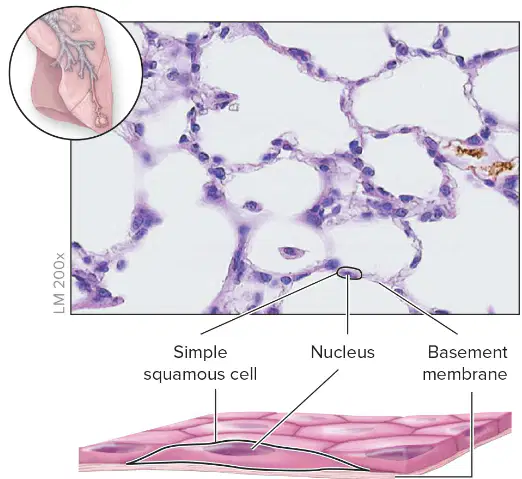
Which feature best distinguishes simple squamous epithelium in the alveoli micrograph?
Cube-shaped cells with central nuclei
Multiple layers with keratinized surface
Tall cells with apical cilia
Single flat cells with thin cytoplasm
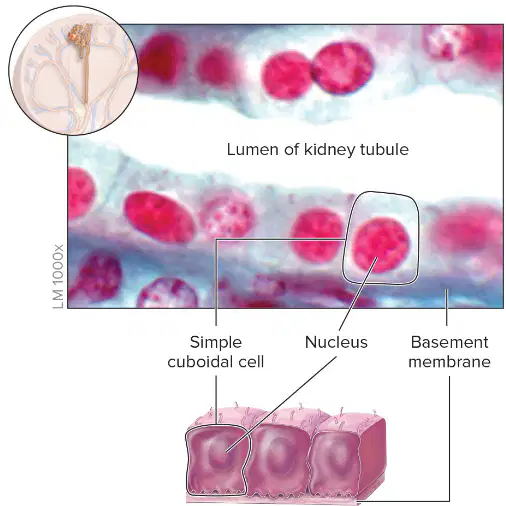
In the kidney tubule image, the lining epithelium is primarily responsible for which function?
Absorption and secretion in tubules
Propulsion of mucus by cilia
Rapid diffusion across air sacs
Protection from surface abrasion
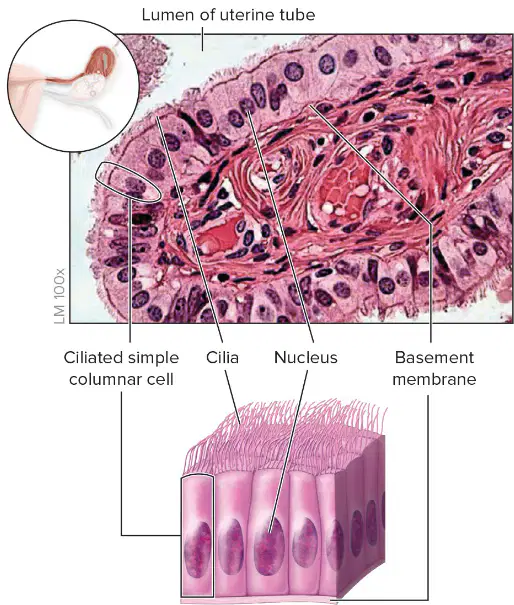
Which location matches ciliated simple columnar epithelium shown in the uterine tube micrograph?
Esophagus and oral cavity lining
Kidney glomerular capsules
Epidermis of skin exclusively
Uterine tubes and larger bronchioles
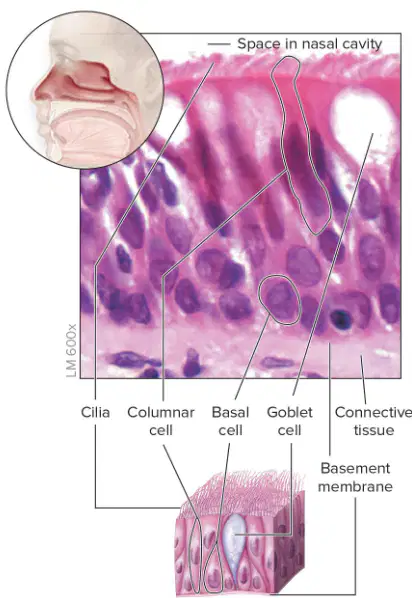
What cell type secretes mucin in the pseudostratified ciliated columnar epithelium of the nasal cavity?
Keratinized superficial cells
Basal cells at the basement
Goblet cells within the epithelium
Squamous cells of the surface
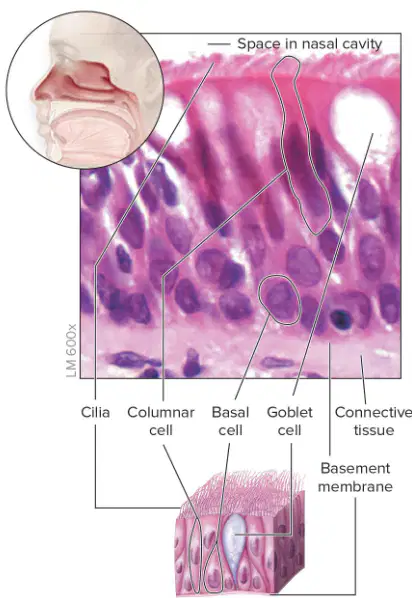
Which structural characteristic identifies pseudostratified ciliated columnar epithelium?
Multiple layers of dead keratinized cells
All cells reach basement membrane
Cube-shaped cells equal height and width
Flat single layer lining serous membranes
Which statement correctly contrasts simple cuboidal and simple squamous epithelia in the provided images?
Cuboidal cells are as tall as wide; squamous are thin
Cuboidal cells form epidermis; squamous lines trachea
Squamous cells have cilia; cuboidal cells are keratinized
Squamous cells have central spherical nuclei; cuboidal lack nuclei
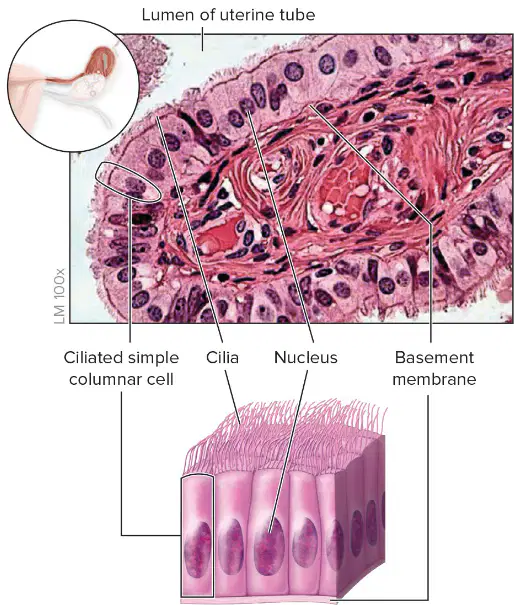
In ciliated simple columnar epithelium of the uterine tube, what is the role of cilia?
Form tight junctions to prevent leak
Move oocyte along apical surface
Store glycogen for energy
Secrete keratin to waterproof
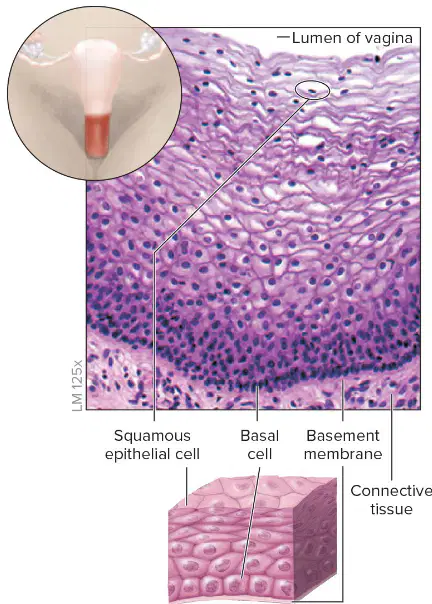
Which epithelial type provides abrasion resistance without keratin and lines the vagina?
Nonkeratinized stratified squamous epithelium
Keratinized stratified squamous epithelium
Pseudostratified ciliated columnar epithelium
Simple cuboidal epithelium
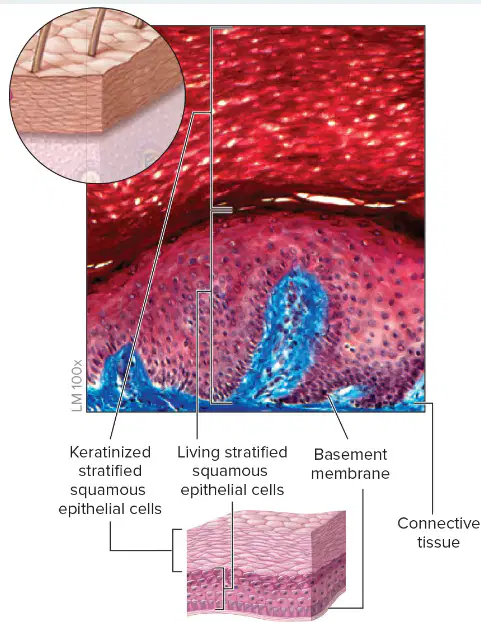
Which feature differentiates epidermis from oral cavity lining in the images?
Abundant goblet cells and cilia
Single layer of flat squamous cells
Cube-shaped cells forming ducts
Presence of dead keratinized superficial cells
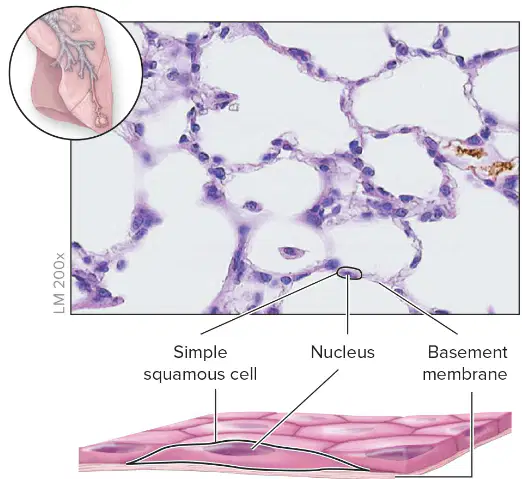
Which epithelial subtype is optimized for rapid diffusion and filtration across thin barriers?
Pseudostratified ciliated columnar
Ciliated simple columnar
Keratinized stratified squamous
Simple squamous epithelium
During bladder distension, which epithelial characteristic allows expansion without damage?
Simple columnar epithelium with cilia
Simple squamous epithelium rigid
Transitional epithelium with domed superficial cells
Keratinized stratified epithelium thin
Which component lies directly beneath epithelial cells and is labeled in multiple images?
Adventitia anchoring organs
Basement membrane supporting epithelium
Stratum corneum storing keratin
Smooth muscle controlling airflow
Which combination defines the extracellular matrix in connective tissue?
Protein fibers plus ground substance
Cells plus blood vessels
Collagen plus mesenchyme origin
Elastic fibers plus resident cells
Which protein fiber primarily provides tensile strength to connective tissues?
Myosin filaments
Collagen fibers
Elastic fibers
Reticular fibers
What is the embryonic origin common to all connective tissues?
Mesenchyme
Ectoderm
Endoderm
Yolk sac
Which set lists the shared components of connective tissues?
Axons, dendrites, synapses
Keratin, desmosomes, stratification
Cells, basement membrane, lumen
Cells, protein fibers, ground substance
Which description best matches loose connective tissue?
More fibers, less ground substance
Solid matrix with osteons
Fewer fibers, more ground substance
Semisolid matrix with chondrocytes
Which category is part of connective tissue proper?
Dense regular connective tissue
Hyaline cartilage
Compact bone
Blood plasma
Which tissue is classified as supporting connective tissue with a solid matrix?
Bone
Areolar
Elastic dense
Reticular
Which option correctly pairs fiber type with a typical function?
Keratin fibers form basement membranes
Elastic fibers enable stretch and recoil
Collagen fibers support electrical signaling
Reticular fibers drive muscle contraction
Which trio belongs to the loose connective tissue subtypes?
Areolar, adipose, reticular
Regular, irregular, elastic
Compact, spongy, lamellar
Hyaline, elastic, fibrocartilage
Which statement best distinguishes dense from loose connective tissue?
Dense contains a semisolid matrix with lacunae
Dense has more fibers and less ground substance
Dense develops exclusively from ectoderm
Dense has fewer fibers and more ground substance

Which tissue type is classified as connective tissue proper and functions to bind structures together?
Blood plasma formed elements
Compact bone osteon lamellae
Dense regular connective tissue bundles
Hyaline cartilage matrix zones
Which feature best distinguishes loose connective tissue from dense connective tissue?
Circulating cells in liquid matrix
Mineralized matrix with osteocytes
More chondrocytes in lacunae
Fewer fibers, more ground substance
Areolar connective tissue is most accurately described as:
Parallel collagen for high tension
Energy storage with triglycerides
Packing material widely distributed
Semisolid cartilage with flexibility

Adipose tissue primarily serves which function?
Framework for soft body tissues
Transport of gases and wastes
Energy storage and insulation
Shock absorption in joints
Reticular connective tissue is typically found forming stroma in which locations?
Dermis and joint capsules
Spleen, liver, kidney organs
Tendons and ligaments
Aortic elastic walls
Dense regular connective tissue is best characterized by:
Parallel collagen bundles resisting tension
Random meshwork resisting distortion
Chondrocytes within lacunae clusters
Mineralized concentric lamellae rings

Dense irregular connective tissue is commonly located in which region?
Within blood vessels lumen
Dermis of the skin layers
External ear elastic cartilage
Bone marrow trabeculae spaces
Elastic connective tissue allows stretching and recoil. Where is it prominently found?
Costal cartilage near ribs
Intervertebral disc fibrocartilage
Compact bone diaphysis cortex
Walls of large arteries like aorta

Which cartilage type provides support with more flexibility than bone and is found in costal cartilages?
Elastic cartilage in ear
Fibrocartilage in discs
Hyaline cartilage in rib cartilage
Spongy bone in epiphyses

Fibrocartilage is specialized to withstand compression and often acts as a shock absorber. Where is it commonly located?
External ear pinna structures
Intervertebral discs between vertebrae
Articular cartilage of long bones
Costal cartilages of ribs area

Elastic cartilage maintains shape while permitting extensive flexibility. Which location matches this function?
Epiphyseal plate in bone
External ear structures pinna
Menisci of the knee joint
Tracheal rings of hyaline

Compact bone is organized into osteons primarily providing:
Transport of nutrients and wastes
Semisolid support with chondrocytes
Strong structural support and protection
Energy storage and thermal insulation

Compared to compact bone, spongy bone is characterized by:
Flexible semisolid matrix zones
Trabeculae network with marrow spaces
Parallel bundles of collagen fibers
Liquid matrix of plasma proteins

Blood, a fluid connective tissue, primarily functions to:
Form supportive organ stroma
Store calcium and phosphorus
Bind muscles to bones firmly
Transport nutrients, gases, and wastes
Connective tissue proper, supporting connective tissue, and fluid connective tissue share a common embryonic origin. What is it?
Ectoderm neural crest lineage
Mesenchyme embryonic connective tissue
Endoderm gut tube epithelium
Myotome somite muscle cells
Which cartilage type provides strong but flexible support and forms costal cartilages between ribs and sternum?
Fibrocartilage in intervertebral discs
Compact cartilage in osteons
Hyaline cartilage at costal cartilages
Elastic cartilage forming ear pinna
Which feature best distinguishes elastic cartilage from the other cartilage types?
Flexible tissue returning to original shape
Highly mineralized extracellular matrix
Greatest resistance to compression
Forms articular surfaces of long bones
Fibrocartilage is characterized by which combination of properties?
Durable, resists compression, least flexible
Highly elastic, easily deformed, very flexible
Weak support, high vascularity, rapid turnover
Soft matrix, abundant adipocytes, energy storage
Mature bone cells housed within lacunae are called what?
Chondroblasts within perichondrium
Osteoclasts at Howship lacunae
Fibroblasts in dense regular
Osteocytes residing in lacunae
Which statement correctly contrasts bone with cartilage?
Both have equal rigidity and identical flexibility
Bone is more solid, offers greater support, less flexible
Cartilage contains calcium salts while bone does not
Bone is less solid, offers weaker support, more flexible
Which pairing correctly matches bone component with category?
Glycoproteins as mineral components
Collagen fibers as inorganic components
Water as primary mineral component
Calcium salts as inorganic components
Which description accurately differentiates compact and spongy bone?
Compact bone has cylindrical osteons; spongy bone is latticework
Compact bone is latticework; spongy bone forms cylindrical osteons
Compact bone is only in epiphyses; spongy bone only in shafts
Both consist mainly of elastic cartilage structures
Which statement about blood as a connective tissue is accurate?
Cells are in plasma; fibers appear during clotting
Cells are in lacunae; fibers constantly visible
Matrix is solid; inorganic salts dominate
Primary role is shock absorption in joints
Which muscle tissue is primarily responsible for voluntary movement of body parts?
Smooth muscle tissue
Cardiac muscle tissue
Visceral muscle tissue
Skeletal muscle tissue
Which feature distinguishes cardiac muscle cells from skeletal muscle cells?
Presence of intercalated discs
Multiple peripheral nuclei
Absence of striations
Long cylindrical fibers
Which muscle tissue is found only in the heart and pumps blood through vessels?
Cardiac muscle tissue
Visceral muscle tissue
Skeletal muscle tissue
Smooth muscle tissue
Which statement correctly compares voluntary and involuntary control in muscle tissues?
Smooth muscle operates under voluntary control
Cardiac muscle contracts under conscious control
Skeletal muscle is typically under voluntary control
Skeletal muscle acts involuntarily during reflexes
Which structural characteristic is typical of skeletal muscle fibers?
Lack of visible striations
Long cylindrical multinucleated fibers
Single central nucleus
Short branching cells
Which component facilitates rapid synchronized contraction in cardiac muscle?
Myofibril bundles
Peripheral nuclei
Intercalated discs
Endomysium sheaths
Which muscle tissue commonly propels materials through the digestive and urinary tracts?
Cardiac muscle tissue
Skeletal muscle tissue
Smooth muscle tissue
Striated muscle tissue
Which term describes the striped appearance seen in skeletal and cardiac muscle?
Fascicles
Striations
Sarcomeres
Intercalations
Which statement best identifies a key difference between neurons and glial cells?
Neurons provide structural support only
Glial cells generate electrical impulses
Neurons transmit signals via axons and dendrites
Glial cells form muscle fibers
A muscle cell with one nucleus, short branching shape, and striations is most likely which type?
Smooth muscle cell
Skeletal muscle fiber
Myofibroblast cell
Cardiac muscle cell
Which cellular extension carries signals away from the neuron’s cell body?
Dendrite
Axon
Cilium
Microvillus
Which property describes muscle tissue being able to respond to stimuli?
Elasticity
Irritability
Conductivity
Plasticity
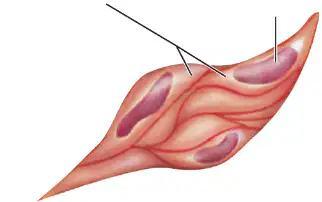
Which feature best distinguishes smooth muscle cells from skeletal muscle cells?
Single centrally located nucleus
Striated cylindrical fibers
Branched fibers with intercalated discs
Multiple peripheral nuclei per cell
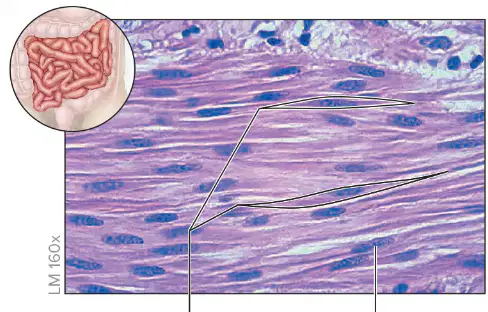
Where is smooth muscle most commonly located?
Attached to bones via tendons
Walls of hollow organs
Alveoli of the lungs
Dermis of the skin
Which statement about smooth muscle control is accurate?
Voluntary via somatic motor neurons
Involuntary regulated by autonomic input
Voluntary using motor end plates
Involuntary but always rhythmic

Which cellular structure receives incoming signals in a neuron?
Node of Ranvier
Dendrite
Axon terminal
Axon hillock
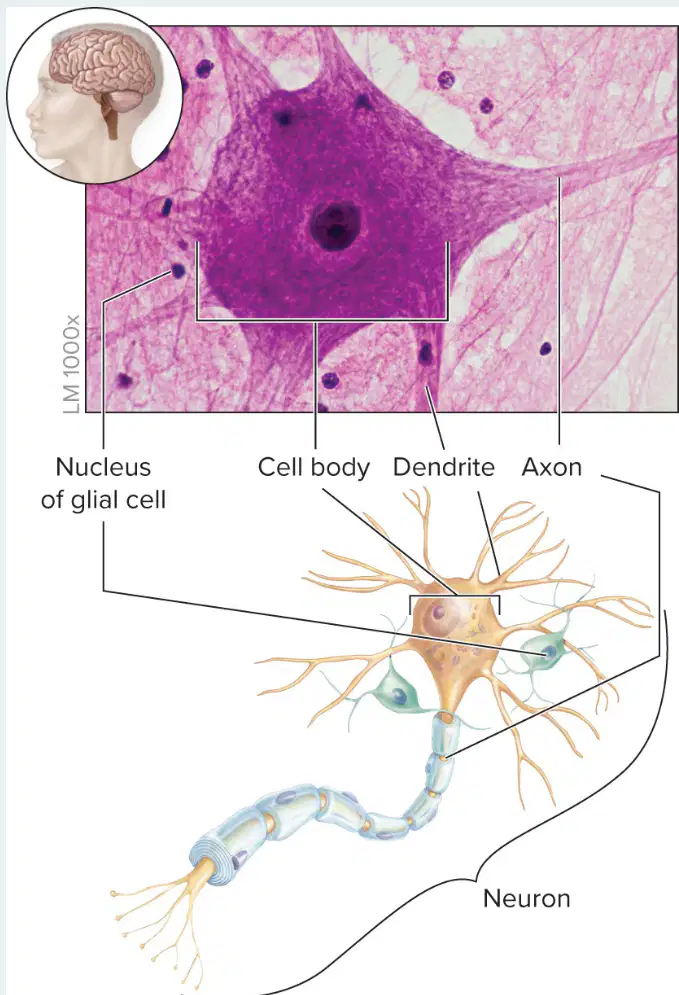
Glial cells primarily function to:
Generate action potentials
Form contractile myofilaments
Provide protection and nourishment
Store calcium for contraction
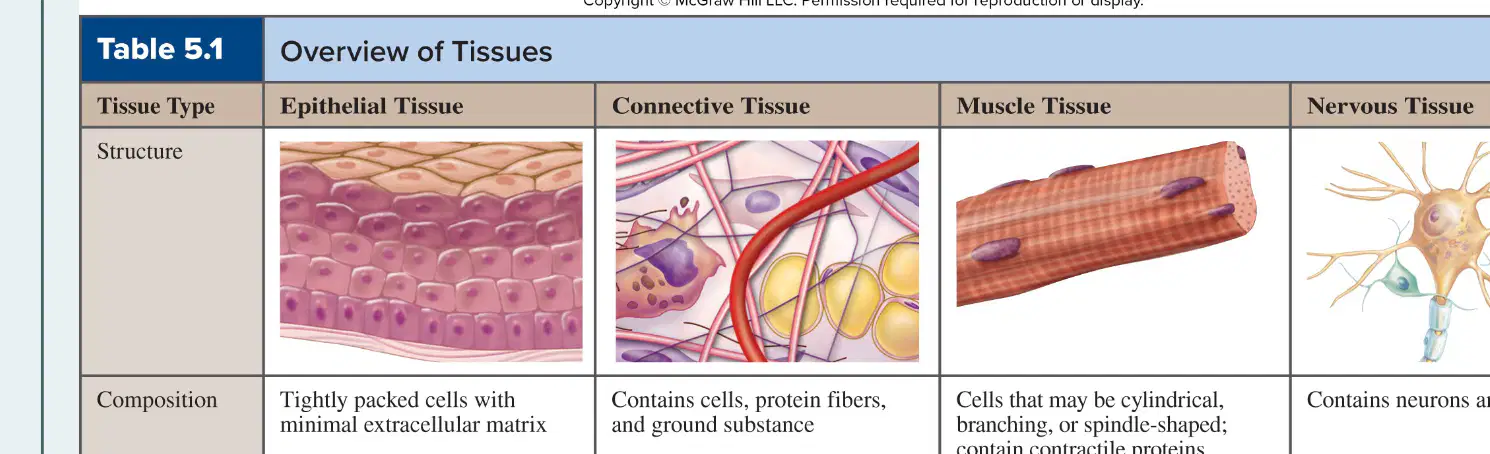
Which tissue type is characterized by tightly packed cells with minimal extracellular matrix?
Nervous tissue
Epithelial tissue
Connective tissue
Muscle tissue
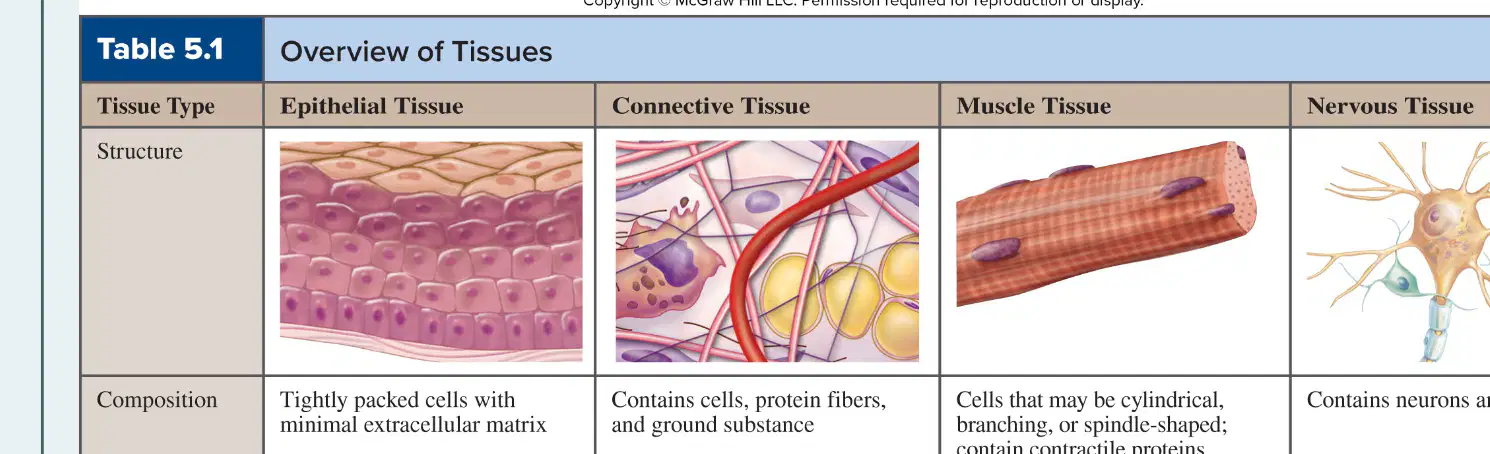
Which pairing of tissue and primary function is correct?
Muscle tissue—binds and supports organs
Epithelial tissue—stores triglycerides
Connective tissue—propels materials through organs
Nervous tissue—relays electrical signals

Which connective tissue component is part of its composition?
Keratinized stratified cells
Neurons and dendritic spines
Protein fibers and ground substance
Myofilaments forming striations
Which epithelial subtype is correctly classified as simple epithelium?
Transitional epithelium
Stratified cuboidal epithelium
Pseudostratified columnar epithelium
Stratified squamous epithelium
Which muscle tissue subtype is responsible for moving blood through the cardiovascular system?
Reticular muscle
Skeletal muscle
Cardiac muscle
Smooth muscle

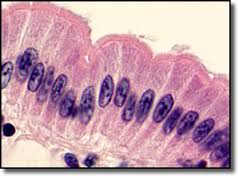

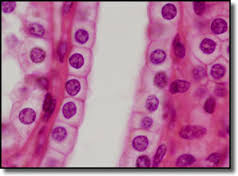

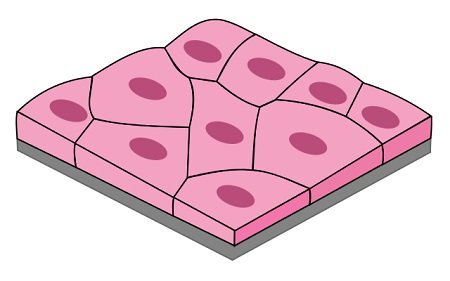
Name the type of epithelium
simple cuboidal
simple squamous
simple columnar
stratified squamous


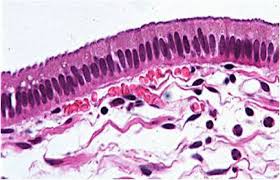
Name the type of epithelium
simple squamous
stratified squamous
simple cuboidal
simple columnar


simple columnar
simple cuboidal
simple squamous
stratified cuboidal

pseudostratified columnar
stratified columnar
simple columnar
basic columnar

simple cuboidal
simple columnar
stratified squamous
stratified columnar


Identify the image:
Columnar
Cuboidal
Squamous

Identify the image:
Columnar
Squamous
Cuboidal


Identify the image:
Cuboidal
Columnar
Squamous


