
 Worksheets
Page 1
Total questions: 122
Worksheet time: 1hrs 1mins
Which option best explains why the Northern Hemisphere experiences summer when Earth is tilted toward the Sun?
Equal sunlight and equal daylight everywhere
Sun gets closer and emits stronger solar flares
Less direct sunlight and shorter daylight hours
More direct sunlight and longer daylight hours

Look at the four moon images. Which phase shows the Moon more than half lit but not full?
Waxing gibbous
First quarter
Waning crescent
New moon
Which diagram feature correctly shows Earth’s revolution around the Sun?
An elliptical path completing one orbit yearly
A circular path completing one orbit weekly
A spiral path completing one orbit monthly
A straight path completing one orbit daily
What is Earth’s axis tilt relative to its orbit, causing seasons?
About five degrees
About ninety degrees
About forty-five degrees
About twenty-three and a half degrees
Which statement about the Moon’s phases is accurate?
Phases are caused by Earth’s shadow blocking the Moon
Phases are caused by sunlight reflecting off different portions
Phases occur because the Moon changes color each week
Phases happen when clouds cover parts of the Moon
If Earth is positioned so the Northern Hemisphere leans away from the Sun, which season occurs there?
Winter
Summer
Spring
Autumn
Which pair correctly matches the celestial body to the motion shown?
Earth—rotates around Moon daily
Earth—revolves around Sun yearly
Moon—revolves around Sun yearly
Sun—revolves around Earth monthly
In the diagram with Sun, Moon, and Earth, which alignment could lead to a full moon?
Moon beside Earth at a right angle
Sun—Moon—Earth in a straight line
Sun—Earth—Moon in a straight line
Sun diagonally positioned off the orbital plane
What evidence from the diagrams supports that seasons are not caused by distance from the Sun?
Sun’s brightness changing weekly shown
Earth’s tilt and consistent orbit shown
Large changes in Earth–Sun distance shown
Earth’s axis flipping directions shown
A student says the Moon makes its own light. What do the diagrams suggest is the correct explanation?
Moon reflects sunlight toward Earth
Moon glows from internal heat
Moon’s light comes from volcanic fires
Moon’s light is electricity stored inside
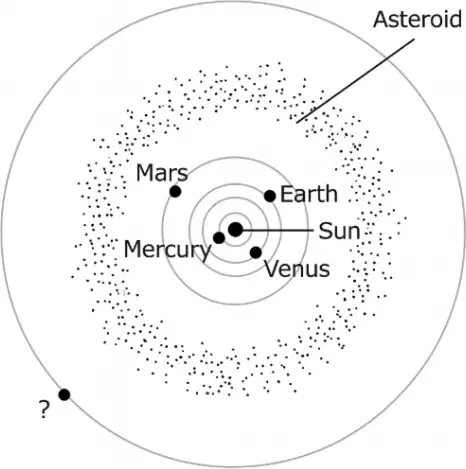
Look at the diagram of the solar system with the labeled asteroid belt between Mars and the first outer planet. Which outer planet is closest to this asteroid belt?
Neptune
Saturn
Uranus
Jupiter
Asteroids are described as large bodies of rock that are too small to be planets. Which statement best matches this description?
Asteroids are icy balls that form comets
Asteroids are rocky objects smaller than planets
Asteroids are clouds of gas forming stars
Asteroids are moons orbiting inner planets
In the diagram, the asteroid belt is located beyond Mars. Which inner planet is farthest from the asteroid belt?
Mercury
Venus
Earth
Mars
A student wants to add labels to the diagram. Where should the label ‘Sun’ be placed?
Between Earth and Mars orbits
On the outermost circle of the diagram
At the center of the planetary orbits
Just outside the asteroid belt
Which list correctly orders the first four inner planets from the Sun outward as shown in the diagram?
Earth, Mercury, Venus, Mars
Mercury, Venus, Earth, Mars
Venus, Mercury, Earth, Mars
Mercury, Earth, Venus, Mars
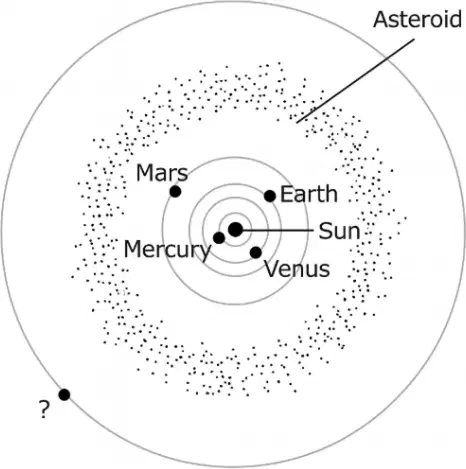
The diagram places the asteroid belt between Mars and the first outer planet. Which is the first outer planet in our solar system?
Neptune
Saturn
Jupiter
Uranus
A student draws a model showing the movements of Earth, the moon, and the sun. Which movement happens once each year?
The moon orbits Earth
The sun orbits Earth
Earth rotates on its axis
Earth revolves around the sun
Which movement of the moon best explains why we see different phases each month?
Orbit of the moon around the sun
Rotation of the sun around the moon
Revolution of Earth around the moon
Orbit of the moon around Earth
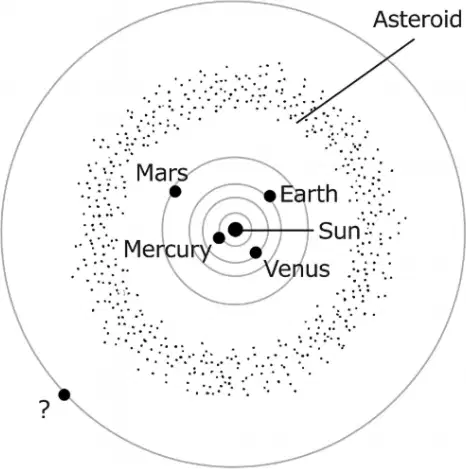
If the asteroid belt were moved closer to the Sun, which inner planet would be at greater risk of collisions with asteroids?
Earth
Mars
Venus
Mercury
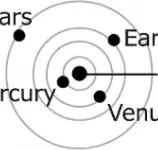
In the diagram, the planets move in paths around the Sun. What is the name for these paths?
Rings
Belts
Orbits
Axes
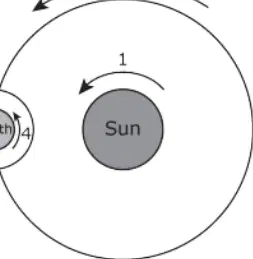
Which arrow shows the movement that causes day and night on Earth?
Arrow 4, because it shows the rotation of Earth
Arrow 3, because it shows the orbit of the moon around Earth
Arrow 2, because it shows the orbit of Earth around the sun
Arrow 1, because it shows the rotation of the sun
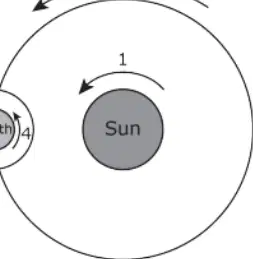
What motion of Earth creates a 24-hour cycle of day and night?
Earth’s revolution around the sun
Earth’s rotation on its axis
Moon’s revolution around Earth
Sun’s rotation around the galaxy
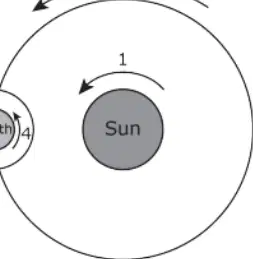
Which movement is responsible for changing seasons over a year?
Moon’s revolution around Earth
Sun’s rotation on its axis
Earth’s revolution around the sun
Earth’s rotation on its axis
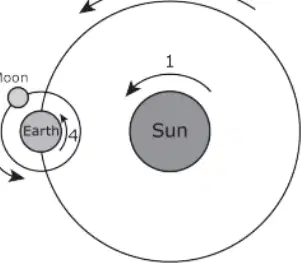
The moon’s phases are best explained by which motion?
Moon’s rotation on its axis
Moon’s revolution around Earth
Earth’s revolution around the sun
Earth’s rotation causing shadows
If Earth stopped rotating but kept orbiting the sun, what would most likely happen to day and night?
Nights would last only a few minutes
Days would become shorter everywhere
One side would face day, the other night
Day and night would stay the same
At noon, where is the sun generally located in the sky for most places?
Directly below the horizon
Low in the western sky
High near the middle sky
Low in the eastern sky
A student draws her house with the sun shown low in the west at 9:00 a.m. Which best evaluates this diagram?
Correct, the sun is high near noon
Incorrect, morning sun is low in the east
Correct, the morning sun is low in the west
Incorrect, the sun is below the horizon
Which diagram does not correctly represent the sun’s location at the time shown?
Sun high east at midnight
Sun high south at noon
Sun low east at sunrise
Sun low west at sunset
If it is sunset at your house, where should the sun appear in a correct diagram?
Directly north of the house
Low in the western sky
High overhead in the sky
Low in the eastern sky
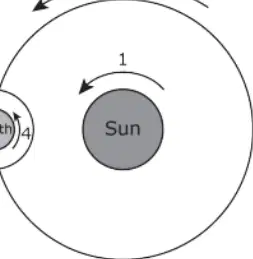
Why does the sun appear to move across the sky during the day?
Earth rotates once every day
The sun orbits Earth each day
The moon pushes the sun across
Clouds carry sunlight across
At 8:45 A.M., where is the Sun in the sky relative to a house, and which way will the house’s shadow point?
Sun overhead, shadow points north
Sun in east, shadow points west
Sun overhead, shadow points south
Sun in west, shadow points east
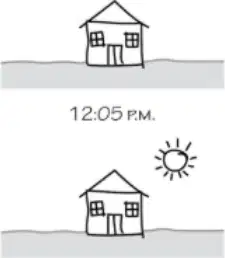
At 12:05 P.M., the Sun is near the highest point. What happens to the length of a tree’s shadow at noon on a summer day?
Shadow disappears completely
Shadow becomes longest
Shadow becomes shortest
Shadow stays medium length
Which direction does a shadow point when the light source is to the east of an object?
Shadow points south
Shadow points east
Shadow points west
Shadow points north
At 7:00 P.M., the Sun is shown near the western horizon. Which statement best describes the shadow of the house then?
Very long, pointing west
Medium length, pointing east
Very short, pointing west
Very long, pointing east
A diagram labels West on the left and East on the right. If the Sun icon is on the right of the house at 10:15 A.M., which way does the shadow point?
Toward the left side
Toward the right side
Straight down under house
Straight up from roof
Which time is most likely to have the shortest shadow for the house during a sunny day?
12:05 P.M.
7:00 P.M.
8:45 A.M.
10:15 A.M.
Why do shadows change length throughout the day?
Wind speed changes
Earth’s shape changes
Clouds move away
Sun’s angle changes

A student sees a tree’s shadow pointing west at noon in summer. Which conclusion fits the diagram’s labels of West and East?
Sun is slightly east of the tree
Sun is slightly west of the tree
Sun is directly below the tree
Sun is north of the tree
Compare morning and evening shadows. Which statement is most accurate for a clear day?
Both are long but point opposite ways
Morning long, evening short
Morning short, evening long
Both are short and point same way
If the Sun rises in the east and sets in the west, how do shadow directions change from morning to evening?
Shadows point north all day, then south
Morning shadows point east, evening shadows point west
Morning shadows point west, evening shadows point east
Shadows point south all day, then north
The sun rises at 7:00 A.M. On a clear day at 10:00 A.M., where is the sun in the sky relative to east and west?
Low in the western sky
High in the eastern sky
Directly above the tree
Low in the southern sky
At 10:00 A.M., the tree’s shadow points mostly toward which direction?
Toward the south
Toward the west
Toward the north
Toward the east
How does the length of a tree’s shadow at 10:00 A.M. compare to noon on the same day?
Longer at 10:00 A.M.
Shorter at 10:00 A.M.
Exactly the same
No predictable change
Which factor mainly causes a tree’s shadow to change direction during the day?
Growth of the tree
Movement of clouds
Wind pushing branches
Rotation of Earth
If the sun is drawn in the eastern sky, which shadow direction best matches a morning time?
No shadow visible
Shadow stretching westward
Shadow straight down
Shadow stretching eastward
Between sunrise and noon, how does the sun’s position change?
Drops lower in east
Stays fixed in east
Moves west to east
Moves east to west
A student thinks the shadow points toward the sun. What correction should you give?
Shadows form toward light
Shadows form away from light
Shadows form randomly
Shadows form under objects
At 7:00 A.M., the tree’s shadow is long. What best explains why?
Sun low above horizon
Sun blocked by clouds
Sun directly overhead
Sun setting in west
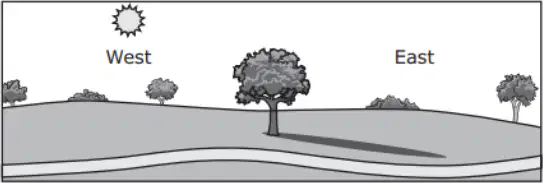
Which diagram best shows the shadow at 10:00 A.M. if the sun is on the east side?
Shadow pointing westward
Shadow pointing eastward
No shadow present
Shadow pointing northward
By late afternoon, where will the sun appear and how will the shadow change?
Sun in west, shadow east
Sun overhead, no shadow
Sun in west, shadow west
Sun in east, shadow west
Which TWO planets are closer to the Sun than Earth? Select all that apply.
Jupiter and Venus
Mercury and Mars
Mars and Jupiter
Mercury and Venus
Which statement BEST explains why the planets you selected in Part A are closer to the Sun than Earth?
They take longer to orbit the Sun than Earth does.
They have orbits that lie between the Sun and Earth's orbit.
They receive less sunlight than Earth because they are smaller.
They orbit the Sun more quickly because they are farther away.
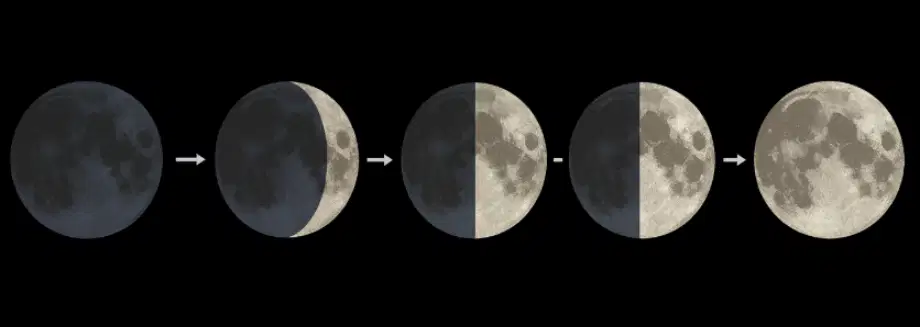
Which statement shows the correct sequence of Moon phases as the Moon changes from a New Moon to a Full Moon?
New Moon → First Quarter → Waning Gibbous → Full Moon
Full Moon → Waning Gibbous → Third Quarter → Waning Crescent
New Moon → Waxing Crescent → First Quarter → Waxing Gibbous → Full Moon
New Moon → Waning Crescent → Full Moon
Which term describes when the lit part of the Moon is increasing each night?
Eclipse phase
Quarter phase
Waning phase
Waxing phase
After the First Quarter, which phase comes next as the Moon approaches a Full Moon?
New Moon
Waxing Gibbous
Waning Crescent
Third Quarter

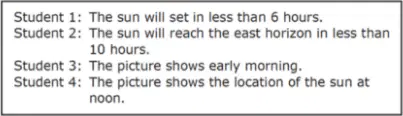
A picture shows the Sun high in the western sky above a house, with west labeled on the left and east on the right. Which student explanation is most reasonable?
The picture shows the location of the sun at noon
The sun will set in less than 6 hours
The sun will reach the east horizon in less than 10 hours
The picture shows early morning
Why does the Moon appear to change shape over about a month?
Clouds block sunlight from the Moon
Earth’s distance to the Moon changes daily
The Moon’s rotation slows and speeds up
Different amounts of its lit side face Earth
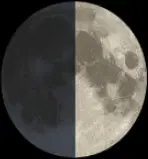
Which phase shows exactly half of the Moon’s lit side visible from Earth?
New Moon
First Quarter
Waxing Gibbous
Waning Crescent
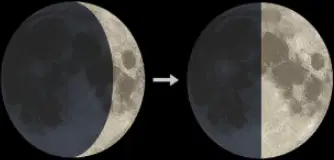
If tonight is a Waxing Crescent, which phase is most likely about one week later?
Third Quarter
Full Moon
First Quarter
Waning Gibbous
A student says the Moon goes from Full Moon directly to New Moon the next night. What is the best response?
Incorrect, it wanes through gibbous and quarters
Correct, the Moon completes phases in two days
Correct, the Moon switches phases overnight
Incorrect, it waxes through crescent first
Which direction does the Sun appear to move across the sky during the day?
West to east
East to west
North to south
South to north
In the diagram, the Sun is drawn near the western side of the sky. What time of day is most likely shown?
Morning after sunrise
Midday around noon
Late afternoon before sunset
Midnight after dusk
Which of the students gave a correct explanation about shadows changing during the day?
Student 1 only
Students 2 and 4 only
Student 2 only
Students 1 and 3 only
At noon, our shadows are usually what length?
long
short
bright
dim
At 5pm, our shadows are usually what length?
long
short
dim
bright
Which word does not belong when describing shadows at noon or at 5pm?
short
long
gas giant
dim
Why are shadows shortest at noon?
The Sun is high overhead
The Sun sets in the west
The Moon blocks sunlight
Clouds make light brighter
Which statement best explains why shadows get longer by late afternoon?
The Earth stops rotating then
Light travels slower at 5pm
The Sun is lower in the sky
The Sun is hotter at 5pm
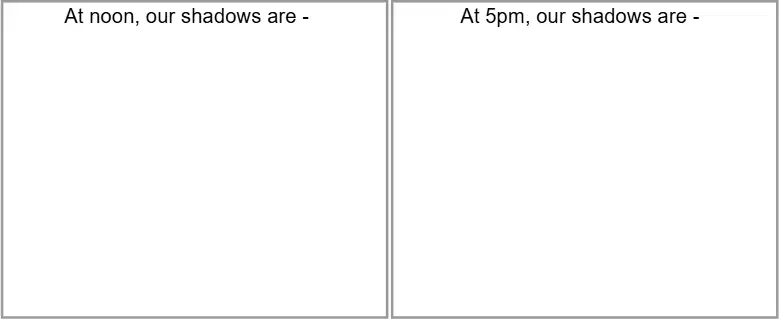
Choose the correct pair to complete the chart: At noon — ____; At 5pm — ____.
dim; bright
long; short
bright; dim
short; long
Which term describes how shadows can appear in brightness?
bright
gas giant
continent
orbit
If your shadow at noon looks long, what is the most likely reason?
You are facing the wrong direction
The Sun is not directly overhead
Light stops reaching the ground
The Earth moves away from the Sun
During which part of the day would you expect the longest playground shadows?
Midnight
Mid-morning
Around noon
Late afternoon
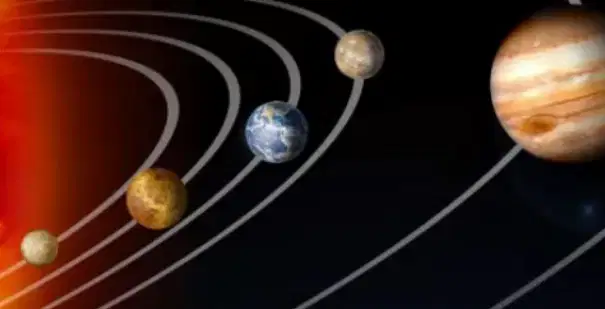
Identify which inner planet is located right before the asteroid belt. Select the correct planet.
Mercury
Venus
Earth
Mars
Which statement best explains why the sun appears to move across the sky during the day?
The Earth is closest to the sun in winter
The Earth is tilted at 23.5 degrees
The Earth is revolving around the sun
The Earth is rotating on its axis
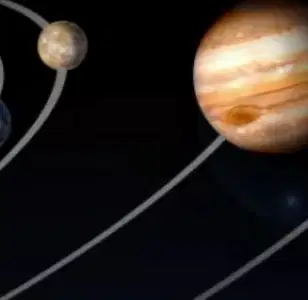
Which planet is the largest in our solar system and is shown with prominent bands?
Mars
Jupiter
Venus
Earth
Which planet is shown farthest from the sun in the image on the right side?
Uranus
Saturn
Neptune
Jupiter
What force keeps planets in their orbits around the sun?
Electricity
Magnetism
Friction
Gravity
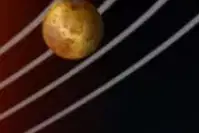
Which inner planet is known for having thick clouds and a very hot surface?
Earth
Mars
Venus
Mercury
Why does Earth have different seasons throughout the year?
Its distance from the sun changes a lot
Its axis is tilted while it revolves
Clouds block sunlight in winter
It rotates faster in the summer
Which motion of Earth causes day and night?
Revolution around the sun
Rotation on its axis
Orbit shifting outward
Precession of its axis
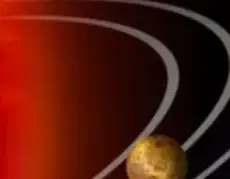
Which planet is closest to the sun and has the shortest year?
Mars
Earth
Venus
Mercury
A student claims the sun moves around Earth each day. Which explanation corrects this claim?
Clouds make the sun change position
The moon pulls the sun across the sky
Earth spins, making the sun seem to move
The sun circles Earth due to gravity
Students make a solar system model on the playground. The school building represents the sun. They label round objects for each planet. Which planet should they place at the greatest distance from the school building?
Neptune
Saturn
Jupiter
Mercury
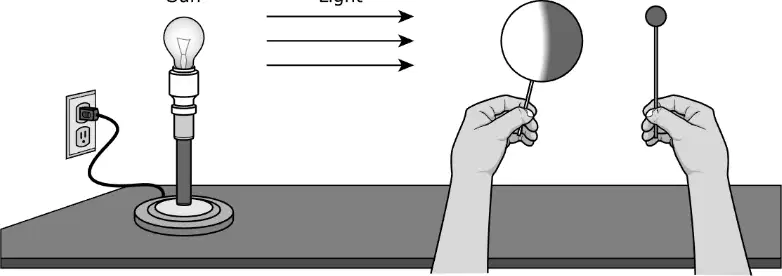
A student builds a model with a lamp as the sun, a ball as Earth, and a smaller ball as the moon. Which action best demonstrates one complete day-night cycle on Earth?
Spin Earth one full turn on its axis
Spin the lamp around in a circle once
Move the moon around Earth once
Move Earth around the lamp once
Which planet listed is closest to the sun and has the shortest orbit time?
Saturn
Jupiter
Mercury
Neptune
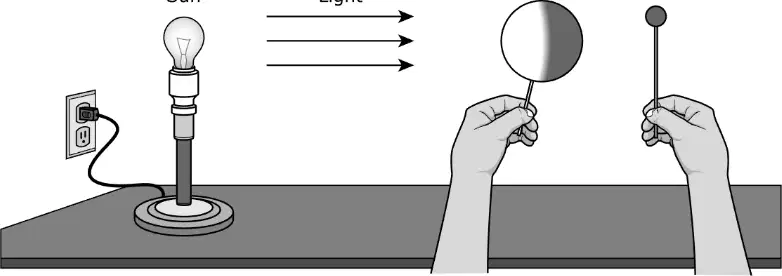
In the classroom model, what provides light to represent the sun’s energy reaching Earth?
An electric lamp
A water spray
A magnet coil
A handheld fan
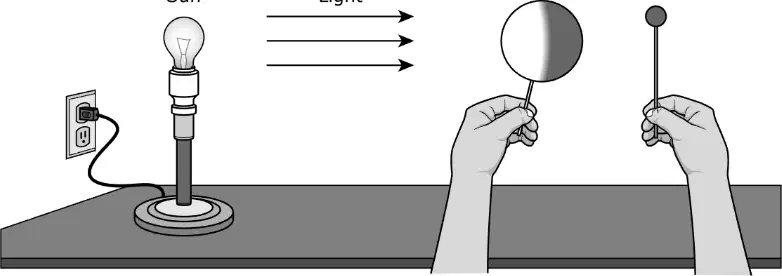
To show seasons with the same model, which movement should be demonstrated?
Moon rotating on its axis
Sun revolving around Earth
Earth rotating on its axis
Earth revolving around the sun
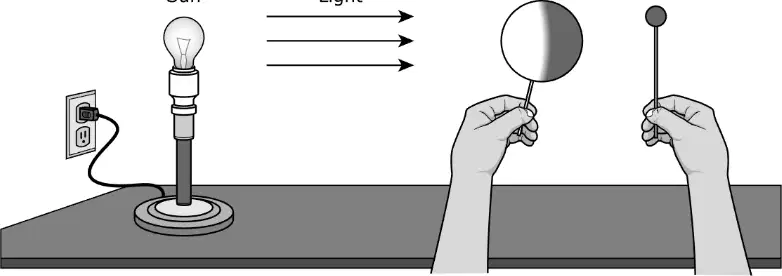
Which option correctly matches the object to its role in the model?
Lamp represents the moon
Large ball represents the sun
Lamp represents the sun
Small ball represents Earth
If the student spins Earth twice as fast as normal, what part of the cycle changes first?
Phases of the moon
Length of a day
Length of a year
Distance to the sun
Which planet from the choices is a gas giant located beyond the asteroid belt?
Neptune
Earth
Jupiter
Mercury
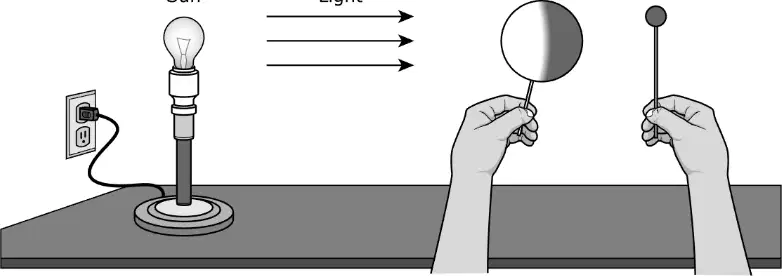
In the model, arrows pointing from the lamp to Earth show what physical effect?
Light traveling
Sound waves
Gravitational pull
Magnetic force
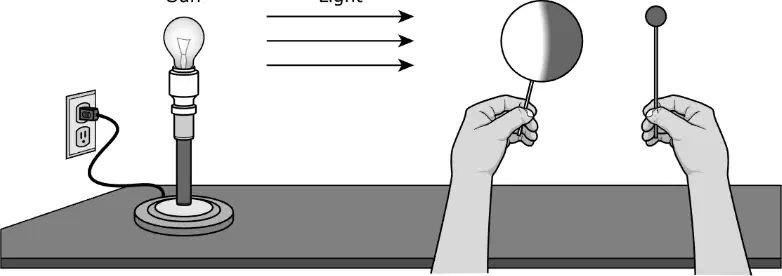
To correctly demonstrate lunar phases, what motion should be added to the model?
Earth orbiting the moon
Moon orbiting Earth
Sun spinning quickly
Earth tilting more
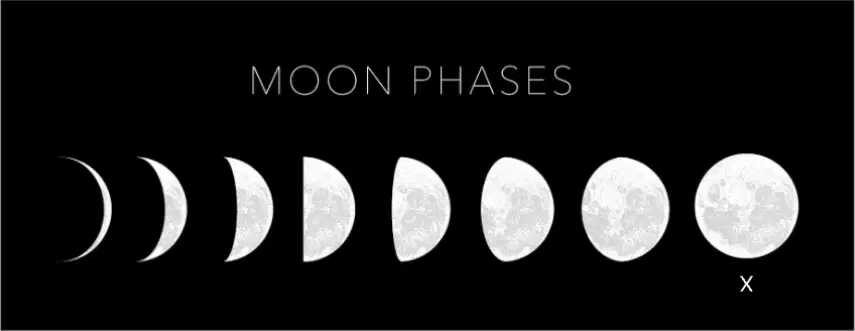
Look at the moon phase sequence where X marks the last shown phase. Which phase happens immediately after X in the monthly cycle?
Waning crescent with a thin left sliver
New moon when the Moon appears dark
Last quarter with half lit on the left
Waning gibbous phase continues shrinking
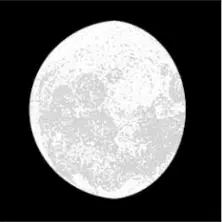
Which statement best describes a full moon?
Moon is fully lit facing Earth
Moon is half lit on the right side
Moon is mostly dark with thin light
Moon is quarter lit at the top edge
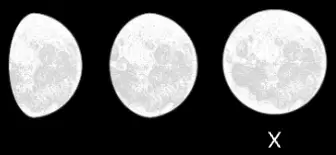
In the sequence shown, which phase directly precedes the full moon?
Waxing crescent with thin right sliver
First quarter with exactly half lit
Waxing gibbous with more than half lit
Waning gibbous with more than half lit
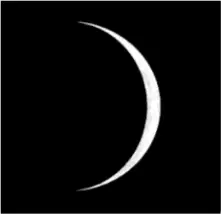
Which option shows a waxing crescent?
Nearly full with small dark edge
Thin bright curve on the left
Thin bright curve on the right
Half circle lit on the left
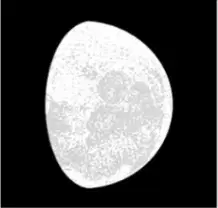
If the Moon is at first quarter, what is the next phase in the sequence?
Waxing gibbous with larger bright area
Last quarter with left half lit
New moon with no visible light
Waning crescent with thin left light
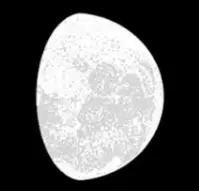
Which phase has more than half but not fully lit and is increasing in light?
Last quarter with left half lit
Waxing crescent with minimal light
Waning gibbous with shrinking light
Waxing gibbous with expanding light
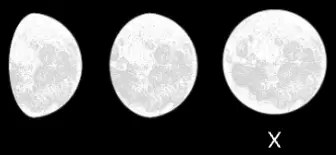
A student claims the Moon becomes a waning crescent right after the full moon. What is the correct next phase?
Waning gibbous with decreasing light
Waxing crescent with growing light
First quarter with right half lit
New moon with no visible light

Which choice best matches the option labeled A in the images?
First quarter with right half lit
Last quarter with left half lit
Waxing gibbous with right side lit
Waning gibbous with left side lit
Why does the Moon appear to change shape in the sky over a month?
Different amounts of sunlight reflect
The Moon changes physical size
Clouds cover parts of the Moon
The Earth blocks the Sun daily
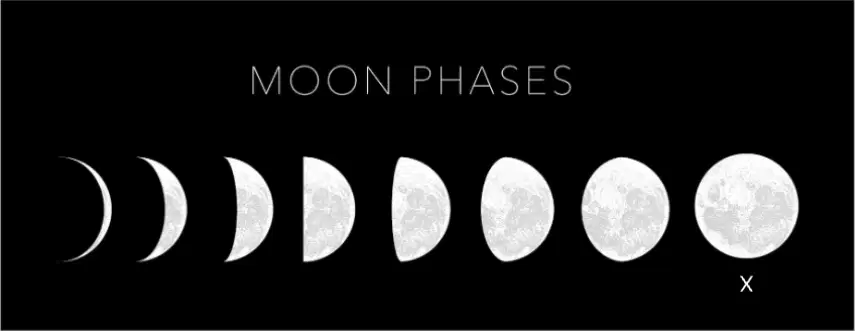
Which sequence shows increasing illumination correctly?
First quarter → waning gibbous → full
New → waxing crescent → first quarter
Full → last quarter → waning crescent
Waning crescent → new → waning gibbous
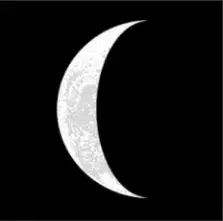
Look at the crescent Moon shown. Which phase comes directly after a waxing crescent in the usual cycle?
New Moon phase
Full Moon phase
First quarter Moon
Third quarter Moon
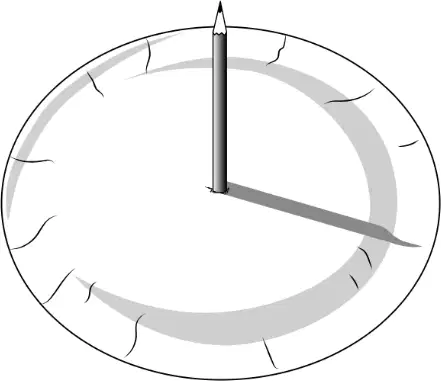
The picture shows a sundial at 3:30 p.m. The shadow points toward letter X. Where in the sky is the Sun relative to the dial?
Near the letter Z
Near the letter X
Near the letter Y
Near the letter W
On a sundial, what causes the shadow to move around the dial during the day?
Earth’s rotation on its axis
Sun moving around Earth
Earth’s revolution around Sun
Moon’s orbit around Earth
At noon, where would the sundial’s shadow most likely point if the dial is correctly set in the Northern Hemisphere?
Toward letter W
Toward letter X
Toward letter Z
Toward letter Y
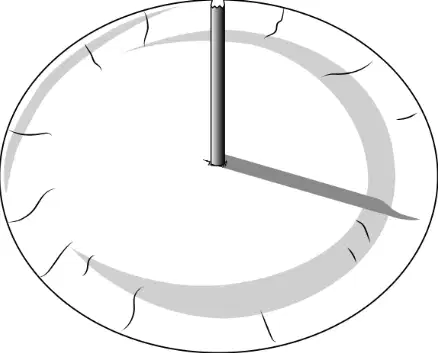
If the shadow points between X and Y, what time is most likely being shown?
Around 9:00 a.m.
Around 12:00 noon
Around 3:30 p.m.
Around 7:00 p.m.
Which part of the sundial makes the shadow?
The lettered markers
The numbered rim
The central gnomon
The outer casing
Why can’t a sundial tell time at night?
Shadows only form in winter
Moon blocks the Sun entirely
No sunlight to cast shadows
Earth stops rotating at night
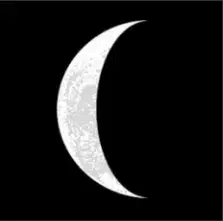
The crescent in the image is bright on the right side. What does this suggest about the phase?
Third quarter phase
First quarter phase
Waning crescent phase
Waxing crescent phase
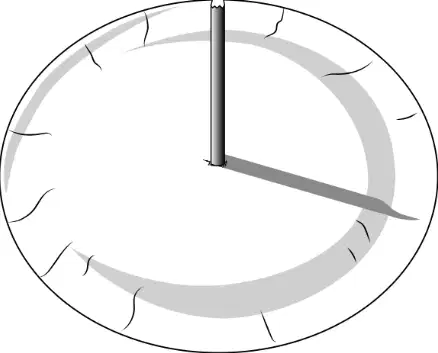
If the sundial shows a shadow pointing slightly past X toward Y, which clock time is closest?
3:30 p.m.
11:00 a.m.
2:00 p.m.
5:00 p.m.
A class wants to compare sundial time with clock time. What should they do to collect reliable evidence?
Move the dial each reading
Record both times every hour
Check once at lunchtime only
Use the sundial on a cloudy day
Why does the Moon look different on different nights?
It glows brighter after full moons
It changes shape during each orbit
It moves behind clouds every night
It rotates and reflects varying sunlight
What motion causes the Moon’s phases to appear from Earth?
The Moon’s rotation on its axis
The Moon’s orbit around Earth
Earth’s orbit around the Sun
Earth’s tilt changing seasons
Which statement best explains why sometimes we see the whole Moon?
The Sun lights the far side fully
The near side is fully sunlit
Earth blocks no sunlight then
The Moon is closest to Earth
On some nights, only part of the Moon is visible. What causes this?
Clouds cover the Moon’s surface
Only part of the near side is lit
The Sun turns off its brightness
The Moon loses its light energy
Why can the Moon sometimes appear not visible at all?
It stops orbiting temporarily
Its sunlit side faces away
It melts during hot days
It hides behind Earth’s clouds
Which phase occurs when the Moon’s near side is entirely lit?
First quarter Moon
Waning crescent
New Moon phase
Full Moon phase
Which phase happens when the Moon’s near side is entirely dark?
Full Moon phase
New Moon phase
First quarter Moon
Waxing gibbous Moon
How long does it roughly take the Moon to go through all its phases once?
About one week total
About twenty-nine days
About sixty full days
About two weeks total
If you observed a waxing crescent Moon this week, which phase is most likely next?
New Moon phase
Full Moon phase
First quarter phase
Waning crescent phase
A friend says the Moon changes phases because clouds cover parts of it. Which response uses evidence?
Clouds move faster than phases
Phases occur only in winter
Phases match its orbit pattern
The Moon makes its own light

