
 Worksheets
Midterm
Total questions: 85
Worksheet time: 1hrs 15mins
Which best describes a scientific law?
It explains why a phenomenon occurs
It explains how a phenomenon occurs
Which of these is a controlled variable in an experiment testing the effect of sunlight on plant growth?
Number of hours of sunlight
Amount of water given to each plant
Plant height
Type of sunlight
There are hundreds of kinds of macromolecules that make up living things.
True
False
Which property of water describes water molecules sticking to other water molecules?
cohesion
adhesion
polarity
specific heat capacity
Which macromolecule most directly helps transport food and water in and out of the cell?
Proteins
Lipids
Carbohydrates
Nucleic Acids
0 on the pH scale represents
a strong acid
a strong base
water (neutral)
weak base
When a molecule is polar, the charges are found
unevenly distributed
evenly distributed
not at all
randomly
Carbohydrates are also known as
sugars
saccharides
carbs
all of the above
In a solution, what is the term for the substance that is dissolved?
Solvent
Solute
Mixture
Compound
Which one is an ion?
C
H20
H+
BeCr
What type of bond is this?
C-C
Covalent
Ionic
Hydrogen
Double
What type of bond links water molecules together and is found between the nitrogenous bases in DNA?
Covalent
Ionic
Hydrogen
Triple
Which property of water is being described here. The oxygen atom 'hogs' the electrons making it have a slight negative charge. The hydrogens have a slight positive charge.
High Specific Heat
Cohesion
Adhesion
Polar
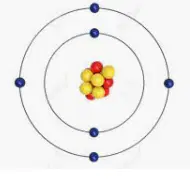
How many bonds will a C atom form?
1
2
3
4
What type of compounds have at least 1C atom bonded to at least 1H atom?
inorganic
organic
ionic
inionic
Which process creates polymers?
Dehydration Synthesis
Hydrolysis
Which process breaks down polymers?
Dehydration Synthesis
Hydrolysis
Lipids are made of...
CHO
CHON
CHONP
CHONPS
Proteins are made of...
CHO
CHON
CHONP
CHONPS
A student claims that sugar molecules can be converted directly to proteins by the cell since proteins contain the same elements as sugar. Which statement best evaluates this claim?
The claim is incorrect because proteins contain nitrogen. Cells can use the elements in sugar but will need to combine them with other elements to form proteins.
The claim is incorrect because all proteins are enzymes, which are used to make sugar molecules.
The claim is correct because proteins help form DNA, and DNA synthesis uses energy from sugar molecules.
The claim is correct because proteins are made from only carbon, hydrogen, and oxygen, which are all parts of a sugar molecule.
Which sequence represents the process by which snake venoms are most likely formed?
Protein molecules from prey are broken down and used to form sugars. Sugars form amino acids in the venom.
Sugar molecules from prey are broken down and used to form proteins. Proteins form amino acids in the venom.
Sugar molecules from prey are broken down and used to form amino acids. Amino acids form proteins in the venom.
Protein molecules from prey are broken down and used to form amino acids. Amino acids form sugars in the venom.
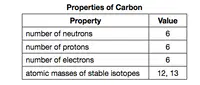
The chart shows some properties of the element carbon . Which property is most responsible for carbon’s ability to form complex biological macromolecules?
The number of protons in carbon.
The atomic mass of carbon isotopes.
The number of electrons in carbon.
The number of neutrons in carbon
A teacher demonstrated protein formation to a science class . The model shows three steps the teacher used in the demonstration . How can the steps in the model best be described?
In Step 1, amino acid monomers are present . In Step 2, the monomers are attached together to form a protein polymer . In Step 3, more amino acid monomers are added to the chain, making a larger protein
In Step 1, nucleotide monomers are present . In Step 2, the monomers are attached together to form a protein polymer . In Step 3, more nucleotide monomers are added to the chain, making a larger protein
In Step 1, amino acid polymers are present . In Step 2, the polymers are attached together to form a protein monomer . In Step 3, more amino acid polymers are added to the chain, making a larger protein
In Step 1, nucleotide polymers are present . In Step 2, the polymers are attached together to form a protein monomer . In Step 3, more nucleotide polymers are added to the chain, making a larger protein
Squirrels can be observed eating and hoarding nuts in the fall.
Use your understanding of macromolecules to explain why they are doing this.
Using the concept of macromolecules, explain how all living organisms (from bacteria to trees to humans) are similar.
Which statement best describes how enzymes affect activation energy?
Enzymes increase activation energy
Enzymes decrease activation energy
Enzymes do not affect activation energy
Enzymes eliminate activation energy
Which of the following is most likely to increase the rate of an enzyme-catalyzed reaction up to a certain point?
Increasing substrate concentration
Decreasing enzyme concentration
Lowering the temperature below optimal
Adding a noncompetitive inhibitor
A student adds more substrate to a solution with a fixed amount of enzyme. What will happen to the reaction rate?
It will decrease steadily
It will increase and then level off
It will remain constant
It will stop immediately
A student is investigating the effect of enzyme concentration on reaction rate. She doubles the enzyme concentration while keeping all other factors constant. What is the most likely outcome?
The reaction rate will decrease
The reaction rate will increase
The reaction rate will remain the same
The enzyme will denature
A researcher wants to speed up a reaction that is catalyzed by an enzyme. Which strategy would be most effective if the substrate concentration is already very high?
Add more enzyme
Add more substrate
Lower the temperature
Add a competitive inhibitor
The role of DNA polymerase is to:
Add complementary nucleotides
Unwind the DNA
Join Okazaki fragments
Make RNA primers
The process of copying DNA code onto mRNA.
Replication
Translation
Transcription
Transformation
Which type of RNA carries the genetic code from DNA out of the nucleus and to the ribosome?
rRNA
tRNA
mRNA
siRNA
Where does transcription occur in a eukaryotic cell?
Ribosome
Cytoplasm
Nucleus
Golgi body
Translation takes place in the
Nucleus
Cytoplasm at the ribosome
Mitochondria
Rough ER only
Which of the following best explains why transcription must occur before translation?
Ribosomes cannot read DNA directly
tRNA cannot function without mRNA
Amino acids must be copied first
Proteins must be broken down
During translation, the anticodon is found on:
mRNA
tRNA
rRNA
DNA
Which statement is true about the genetic code?
All living things have their code stored with the same 4 bases.
Living things use different types of bases for their codes.
It changes with every generation
It is only found in eukaryotes
Which type of mutation is most likely to have no effect on the protein?
Frameshift mutation
Silent mutation
Nonsense mutation
Missense mutation
Which of the following is an example of a mutagen?
Water
UV radiation
Oxygen
ATP
Replicate A T G C C A T G A
Transcribe T A C G G T A C T

Translate AUG GCU UAC GGA UGA
Compare the effects of denaturing DNA polymerase and denaturing RNA polymerase.
A scientist was studying a long protein in a cell. The amino acid leucine (Leu) was observed in the middle of the protein. Further testing revealed that the codon UUA codes for the leucine.
Part A: Provide an example of a mutation to the leucine codon in the cell that would NOT result in a physical change to the cell or trait.
A scientist was studying a long protein in a cell. The amino acid leucine (Leu) was observed in the middle of the protein. Further testing revealed that the codon UUA codes for the leucine.
Part B: Provide an example of a mutation to a single nucleotide of the leucine codon in the cell that would cause a stop codon to be inserted into the middle of the protein.
A scientist was studying a long protein in a cell. The amino acid leucine (Leu) was observed in the middle of the protein. Further testing revealed that the codon UUA codes for the leucine.
Part C: Explain what effect deleting a single base from the gene that codes for the protein would likely have on the function of the protein.
Given that monosaccharides can link to form long, compact polysaccharide chains which require less space than the equivalent amount of monosaccharides, which option best explains why forming polysaccharides is beneficial to organisms?
Polysaccharide formation allows organisms to store energy more efficiently
Polysaccharide formation allows organisms to store more energy per carbohydrate bond
Polysaccharide formation limits the number of carbohydrate bonds that can be formed
Polysaccharide formation limits the amount of energy an organism can store
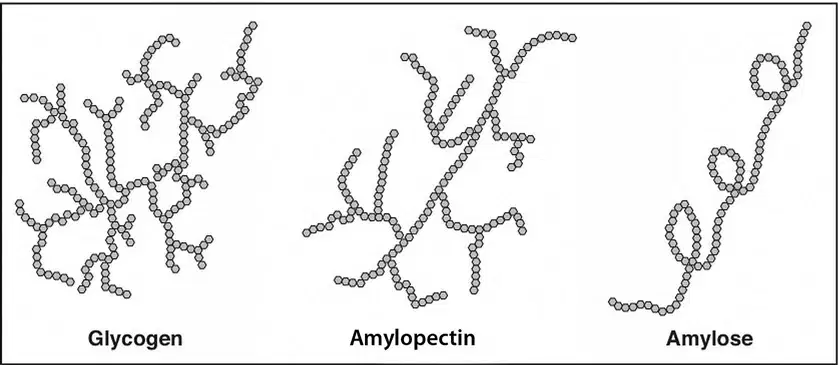
Amylose and glycogen are both polysaccharides used for energy storage. Based on their structures shown, how do they compare?
They contain different monomer subunits and are arranged differently
They contain the same monomer subunits and are arranged in the same pattern
They contain the same monomer subunits but they are arranged differently
They contain different monomer subunits but they are arranged in the same pattern
Sugars such as glucose, fructose, and ribose are examples of _______.
lipids
nucleic acids
proteins
carbohydrates
The characteristics of organisms and viruses are determined by the instructions carried in _______.
DNA is a double-stranded nucleic acid formed by millions of linked nucleotides that each contain the sugar deoxyribose, a phosphate group, and one of four nitrogenous bases. How does the structure of DNA allow it to store hereditary information?
Each strand of DNA codes for one specific trait in an organism.
The sugar deoxyribose codes for all of the specific traits of an organism.
Each nucleotide in a strand of DNA codes for one specific trait in an organism.
The unique order of the nitrogenous bases codes for specific traits in an organism.
Which can you increase if you wanted to increase the rate of an enzyme catalyzed reaction?
Amount of substrate
Amount of enzyme
Both
Neither would work
Which subatomic particle is responsible for bonding?
Proton
Neutron
Electron
Photon
Dr. Stevens is examining the DNA sequences of a group of mice. He notices that in one of the mice, one nucleotide has been substituted with another in the part of the DNA sequence that codes for fur color. However, despite the substitution, the mouse still has the same fur color as the other mice that have the typical DNA sequence.
What best explains why the nucleotide substitution in the mouse does not change its phenotype?
Substitutions in the nucleotides in the DNA of the mouse can affect its genotype but rarely affect its phenotype.
DNA sequences do not determine the color of a mouse's fur.
The mouse has a completely different DNA sequence than the other mice.
The substituted nucleotide produces codons that correspond to the same amino acid that is found in the other mice.
Proteins play a vital role in all cells. In fact, cells need thousands of proteins in order to function properly. What primarily directs the synthesis of proteins?
the genetic information stored in DNA
the cytoplasm found throughout a cell
the folding patterns of strands of RNA
the energy that is stored in mitochondria
Serum albumin is a type of protein that regulates the exchange of fluids between blood vessels and body tissues. The image below shows the structure of this protein.In a particular animal, this protein is deformed and does not function properly. As a result, too much fluid is forced into the animal's tissues. What most likely caused the problem involving the serum albumin protein?
The high fluid pressure folded the serum albumin into an unusual shape.
A mutation in the animal's DNA caused the serum albumin to be produced incorrectly.
Another protein interacted with the serum albumin to produce a hybrid protein.
The animal did not eat a sufficient amount of the serum albumin protein.
As an embryo develops, identical cells give rise to specialized cells that perform different functions. What statement best describes the role of RNA in the differentiation of a specialized cell?
RNA synthesizes new genes, and then it transcribes and translates these new genes into proteins specific to the cell.
Certain genes in the cell are transcribed into RNA molecules, which are then translated into proteins specific to the cell.
All genes in the cell are transcribed into RNA molecules, but only some of these molecules are translated into proteins.
RNA deletes regions of the DNA that are unnecessary to the cell, and then it uses the remaining DNA to make proteins.
Cardiac muscle cells are called myocytes. Myocytes are composed of smaller units called myofibrils. Each myofibril is made up of two types of filaments, one made of actin proteins and one made of myosin proteins. The protein troponin I, which is encoded by the TNNI3 gene, affiliates with the actin filament.
When muscles are relaxed, troponin I attaches to the myosin binding site on the actin filament. This attachment blocks myosin from binding to actin. In response to chemical signals, troponin I changes its position and allows myosin to bind. When myosin attaches to actin, the myocyte contracts.
In people with a heart condition called restrictive cardiomyopathy, troponin I has a reduced ability to attach to the myosin binding site. Which of the following is likely to be observed in the TNNI3 gene, troponin I proteins, and myocytes in individuals with restrictive cardiomyopathy?
Normal nucleotide sequence--> Altered structure and function of protein-->reduced ability to relax
Normal nucleotide sequence--> Altered structure and function of protein-->reduced ability to contract
Abnormal nucleotide sequence--> incorrect amino acid sequence-->reduced ability to contract
Abnormal nucleotide sequence--> incorrect amino acid sequence-->reduced ability to relax
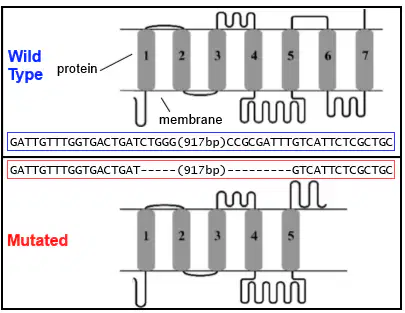
The silkworm, Bombyx mori, normally only feeds on mulberry leaves. This feeding preference is thought to be controlled by gustatory receptors (GRs), proteins embedded in the membranes of specialized cells called gustatory receptor neurons. These neurons are located in the mouthparts of insects. When gustatory receptors bind to specific chemicals, a response is initiated in the neuron.
Scientists hypothesized that the specific silkworm feeding preference is determined by a single gustatory receptor protein called GR66. To investigate this hypothesis, the scientists identified a strain of B. mori with an abnormal GR66 protein structure. The image shows the normal, called the wild type (WT), DNA sequence of a section of the GR66 gene and the structure of the wild type GR66 protein. As shown in the image, the wild type GR66 protein consists of seven large protein regions that span the cell membrane and are connected through smaller protein chains. This image also shows the abnormal GR66 protein and the same section of DNA sequence in the mutated GR66 gene. In the gene sequences, 917 bp refers to a section of 917 base pairs that did not differ between the strains. The results showed that wild type only ate mulberry leaves. The mutated type ate a wide variety of food sources. Which of the following statements best explains these findings?
The change in the size of the GR66 protein leads to a loss of nucleotides from the GR66 gene, and this change improves the sensitivity of gustatory receptor neurons to specific chemicals.
The addition of nucleotides to the GR66 gene increases the size of the GR66 protein, and this change expands the taste preferences of B. mori.
The decrease in the size of the GR66 protein leads to an increase in the number of nucleotides in the DNA, and this change further restricts the taste preference of B. mori.
The removal of nucleotides from the GR66 gene decreases the size of the GR66 protein, and this change alters the ability of gustatory receptor neurons to sense and respond to chemicals.
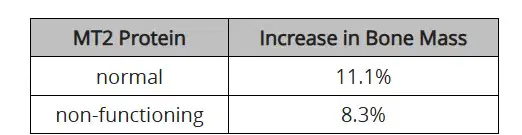
The hormone melatonin regulates many physiological processes in vertebrates. Melatonin is synthesized by a gland in the brain, and it is carried by the bloodstream to different cells throughout the body. The effects of melatonin depend on the type of cell it is received by.
Melatonin affects the process of bone remodeling, which renews the adult skeleton. This process is partly regulated by the actions of a type of bone cell called osteoblasts. The melatonin receptor, MT2, is a membrane protein found in cells such as osteoblasts. When the MT2 receptor is bound by melatonin, it directs a change in the activity of osteoblasts. A comparison of bone mass over six weeks in mice with functioning and non-functioning versions of the MT2 receptor revealed the following. Which of the following best explains the results?
Osteoblasts that have abnormalities in the structure of the MT2 protein were more effective in synthesizing the melatonin needed to make new bone.
A mutation in the gene encoding MT2 disrupted the ability of some cells to respond to melatonin, but these changes did not affect the function of osteoblasts.
Osteoblasts that have abnormalities in the structure of the MT2 protein did not respond to melatonin, and this impacted the function of the cell but did not have an effect on the organism.
A mutation in the gene encoding MT2 produced a non-functioning protein, which altered the function of a specialized cell and decreased the ability of the mice to produce new bone.
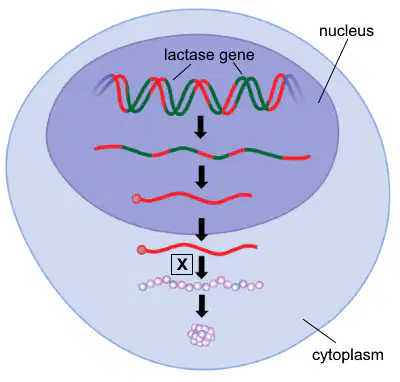
Lactase is an enzyme produced by cells in the small intestine. Lactase helps break down lactose, a sugar in milk.
In humans, lactase is encoded by a single gene. Transcription of this gene produces a primary transcript. The primary transcript is processed and then exported out of the nucleus. In the cytoplasm, the transcript is translated to synthesize lactase. This process is summarized in the diagram below.
What are the roles of RNA molecules during the step labeled with an X in the diagram?
mRNA-produces amino
acids to make
lactase-->rRNA-makes up the
ribosome, which
synthesizes lactase-->tRNA carries nucleotides
to the mRNA copy
of the lactase gene
mRNA-forms peptide bonds
between amino acids-->rRNA produces amino
acids from an
RNA template--> tRNA contains instructions
to synthesize lactase
mRNA-carries instructions
to build lactase--> rRNA makes up part of
the ribosome, which
decodes mRNA--> tRNA-carries amino
acids to the growing
lactase molecule
Insulin is a protein hormone produced by the pancreas in humans that regulates the metabolism of food. In 1978, scientists successfully spliced the human gene for insulin into the bacterium E. coli. This enabled insulin to be produced by the bacteria. This insulin could then be extracted and used as a medication to treat people with diabetes. Since then, the gene for insulin has also been spliced into yeast cells and plant cells for the same purpose.
Which explains why different species are able to produce insulin?
All living organisms have genes that are made up of the same components.
The gene for insulin originated in bacteria and was passed on to other species over time.
Insulin is a protein that all species produce in order to regulate metabolism.
All species contain DNA, which naturally rearranges itself into any gene.
The information in DNA is coded in its sequence. Which of the following correctly describes the relationship between a change in the sequence of a cell's DNA, the proteins produced by that cell, and the function of the body tissue that the cell is part of?
A change in the sequence of a cell's DNA does not change the structure or function of proteins, but will cause the body tissue to stop functioning.
A change in the sequence of a cell's DNA can alter the structure and function of proteins, but does not have an effect on the function of the body tissue.
A change in the sequence of a cell's DNA will always change the structure and function of the proteins produced, and will cause the function of the body tissue to improve.
A change in the sequence of a cell's DNA can change the structure and function of the proteins produced, which can affect the proper functioning of the body tissue.
Chromosomes contain genes, and genes determine an organism's characteristics. Sometimes mutations occur in which the sequence of nucleotides within a gene becomes altered. Which of the following describes how a gene mutation would most likely affect an organism?
It would cause the sugar-phosphate backbone of all of the organism's DNA to be modified.
It would cause different proteins to be produced during translation.
It would cause the wrong type of nucleic acid to be incorporated into the organism's genes.
It would cause the codons produced to be more or less than 3 nucletoides in length.
The final shape of a protein is determined by the sequence of its amino acid residues. What determines this amino acid sequence?
the sequence of nucleotides in the DNA template
the number of nucleotides in the polypeptide
the sequence of nucleotides in the polypeptide
the number of nucleotides in the DNA template
After protein translation is complete, the newly-formed polypeptide...
moves to the mitochondrion, where it is broken down to form ATP.
embeds itself on the surface of a ribosome, which carries it back to the nucleus for alterations.
breaks down the RNA molecules that helped form the polypeptide.
folds into a three-dimensional structure due to the interaction of neighboring amino acids in sequence.
The shape of a protein is determined by...
the sequence of amino acids that compose the polypeptide.
the lipid concentration in the immediate environment.
the type of cell in which the protein was synthesized.
all of these
DNA contains all the information a cell needs in order to make certain proteins. Where are the protein-synthesizing instructions stored on a DNA molecule?
Certain sequences of nucleotides code for the production of specific proteins.
Every gene on certain chromosomes codes for the production of different kinds of uracil, which then promotes protein synthesis.
The phosphate group in a strand of DNA codes for the production of amino acids.
The deoxyribose portion of certain genes codes for the production of certain proteins.
How many somatic cells does human have?
37 trillion
46
23
1 million
What are sections of code that express traits? They are found on chromosomes.
genes
nucleotides
traits
Alleles
Which is a version of a gene?
allele
genotype
chromosome
phenotype
Which of the following combinations of alleles represents the same phenotype but different genotypes?
Aa and AA
Aa and aa
AA and aa
Aa and Aa
A heterozygous parent and a homozygous dominant parent have offspring. What is the probability that any one offspring will be homozygous?
25%
50%
75%
100%
Which statement summarizes the law of independent assortment?
A parent can pass on only one allele of each gene to any one offspring.
A recessive trait will only be expressed if two alleles are present.
The chance of inheriting an allele is not effected by any other allele.
The probability of offspring inheriting either allele from a parent is 50%
Two parents with genotypes Aa and aa have an offspring. What is the probability that the offspring will express the dominant allele?
25%
50%
75%
100%
In fruit flies, the allele for normal wings(T) is dominant to the allele for small, vestigial(nonfunctioning) wings(t). A fruit fly with a normal wings is crossed with a fruit fly with vestigial wings. What are the possible phenotypic ratios in the offspring?
4 normal: 0 vestigial or 2 normal: 2 vestigial
4 normal:0 vestigial or 3 normal:1 vestigial
3 normal: 1 vestigial or 1 normal:3 vestigial
3 normall:1 vestigial or 2 normal:2 vestigial
The colors of human hair and eyes are controlled by two or more genes. Which term describes this type of inheritance?
codominance
multiple alleles
polygenic traits
incomplete dominance
Which of the following describes incomplete dominance?
The traits of both parents are expressed
More than one trait is affected by a single gene
The offspring has a different trait from either parent.
In a species of lizard, the trait for tail length shows a dominant allele of long tail and a recessive allele of short tail. Also in this species, the trait of having stripes is dominant and no stripes is recessive. A parent that is homozygous recessive for tail length and heterozygous for stripes breeds with a parent that is heterozygous for tail length and homozygous dominant for stripes. What are the probabilities for all phenotypes? Use any letters in your Punnett square.
Long tail ,stripes=100%
Long tail, stripes- 25%
Long tail, no stripes-25%
Short tail, stripes- 25%
Short tail, no stripes-25%
Long tail, stripes- 50%
Short tail, stripes- 50%
Short tail, stripes-100%
Amylase is a protein that is an enzyme that breaks down carbohydrates. Which organelle is responsible for the synthesis of proteins that will be exported from the cell?
Lysosome
Ribosomes
Golgi apparatus
Smooth endoplasmic reticulum
Prokaryotic cells are generally much smaller than eukaryotic cells.
Identify a structural difference between prokaryotic cells and eukaryotic cells that is directly related to their difference in size.
Prokaryotes are much smaller than eukaryotes.
Explain why prokaryotic cells can be much smaller than eukaryotic cells.
Describe one similarity between prokaryotic cells and eukaryotic cells that is independent of size.
Explain how the presence of membrane-bound organelles increases the efficiency of cellular processes in eukaryotic cells compared to prokaryotic cells.

