
Font size
 Worksheets
SCIENCE REVIEWER
Total questions: 149
Worksheet time: 1hrs 15mins
In a solution the substance that does the dissolving is called _____.
soluble
the solute
the solvent
an ion
Water is a good solvent because _____.
Water is a good solvent because it is a negatively charged ion.
Water is such a good solvent because it repels most molecules.
Water is such a good solvent because it is such a small molecule
Water is a good solvent due to its polarity and small molecular size
A solution that cannot hold any more solute at room temperature would be _____.
a dilute solution
a concentrated solution
a saturated solution
a supersaturated solution
Ethanol dissolved in water would be an example of _____.
a solution between two miscible liquids
a solution between a solid and liquid
a suspension between two liquids
ethanol and water do not form a solution
To form a supersaturated solution requires _____.
reducing the amount of solute
reducing the amount of solute
reducing the amount of solute
none of the above
Which one of the following is an example of a physical change?
iron rusting
a steak cooking
sugar dissolving in water
a candle burning
Which one of the following is not a physical change?
clothes drying in the dryer
making a cup of coffee
chopping wood
boiling an egg
The chemicals after a chemical change _____.
have properties identical to the chemicals before the change.
have properties different to the chemicals before the change.
both A and B
none of the above
Heptane is always composed of 84% carbon and 16% hydrogen by mass. What law does this observation illustrate?
The Law of Multiple Proportions
The Law of Definite Proportions.
The Law of Conservation of Mass
The Law of Conservation of Energy
Give the mass number for an atom that has 10 protons, 10 electrons, and 11 neutrons.
31
20
10
21
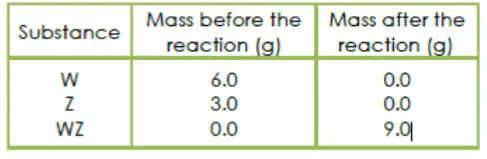
How much of substance W will react with 9.0 g of substance Z? Use the reaction data table: Substance W, mass before the reaction 6.0 g and mass after the reaction 0.0 g; Substance Z, mass before the reaction 3.0 g and mass after the reaction 0.0 g; Substance WZ, mass before the reaction 0.0 g and mass after the reaction 9.0 g.
9.0 g
12.0 g
15.0 g
18.0 g
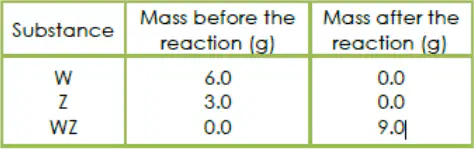
The amount of substance WZ that will be produced from 12.0 g of substance Z assuming that substance W is in excess is _____. Use the reaction data table: Substance W, mass before the reaction 6.0 g and mass after the reaction 0.0 g; Substance Z, mass before the reaction 3.0 g and mass after the reaction 0.0 g; Substance WZ, mass before the reaction 0.0 g and mass after the reaction 9.0 g.
22.5 g
27.0 g
31.5 g
36.0 g
Which conditions will increase the rate of chemical reaction?
decreased temperature and decreased concentration of reactants
decreased temperature and increased concentration of reactants
increased temperature and decreased concentration of reactants?
increased temperature and increased concentration of reactants?
When a lit match is touched to the wick of a candle, the candle begins to burn. When the match is removed, the candle continues to burn. In this reaction, the match _____.
behaves as a catalyst.
supplies activation energy.
is part of the rate determining step.
lowers the activation energy barrier.
Compared to a glass of ice water with ice in it, a glass of plain ice-cold water without ice on a warm day will warm up _____.
faster
slower
in the same amount of time
none of the above
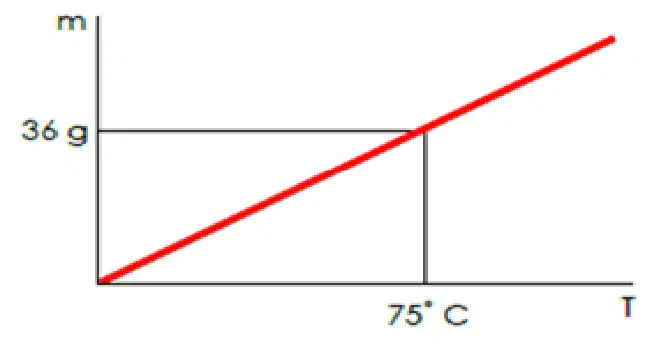
In 150 cm3 water, how much of the substance will dissolve at 75° C? The solubility of a substance was determined in 300 cm3 water at different temperatures and a graph was obtained, showing 36 g soluble at 75° C.
18 g
20 g
36 g
40 g
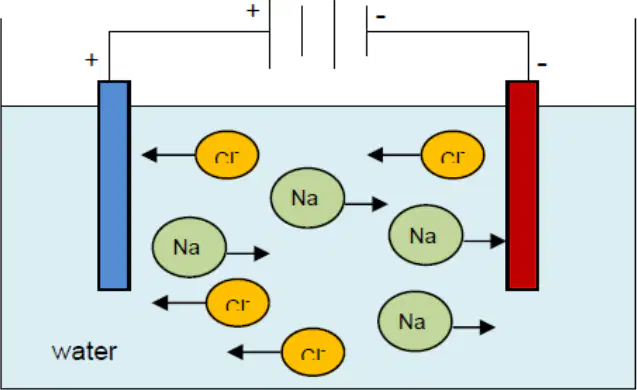
Questions 17 and 18 refer to the diagram that follows. After studying the illustration above, one may conclude that _____.
water molecules are attracted by the electrodes
sodium chloride dissociates when placed in water
chlorine ions are attracted to the negative electrode
current flow cause an increase in water temperature
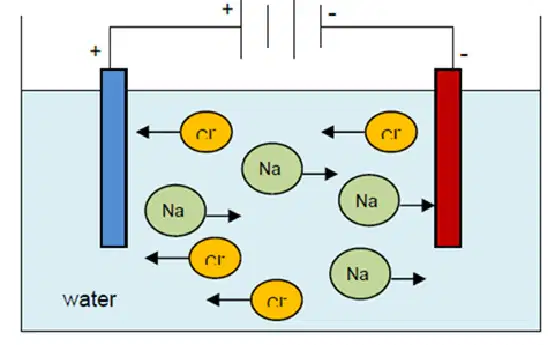
Questions 17 and 18 refer to the diagram that follows. One may also conclude that _____.
only chlorine ions conduct current
the solution will not conduct current
the closed circuit illustrated results in neutrality
when ions are present they are attracted to electrodes having opposite electrical charges
For questions 19 and 20: Jacques Charles was a French hot air balloonist and scientist. He discovered Charles' law by studying the relationship between the volume and temperature of a gas at a constant atmospheric pressure. As the temperature of the gas in a balloon increased, its volume also increased. In equation form, for the case of a constant pressure: V/T=constant . If the volume of a gas at a certain pressure is halved, _____.
its temperature is halved
its temperature is doubled
its temperature remains constant
its temperature increases according to a geometric progression
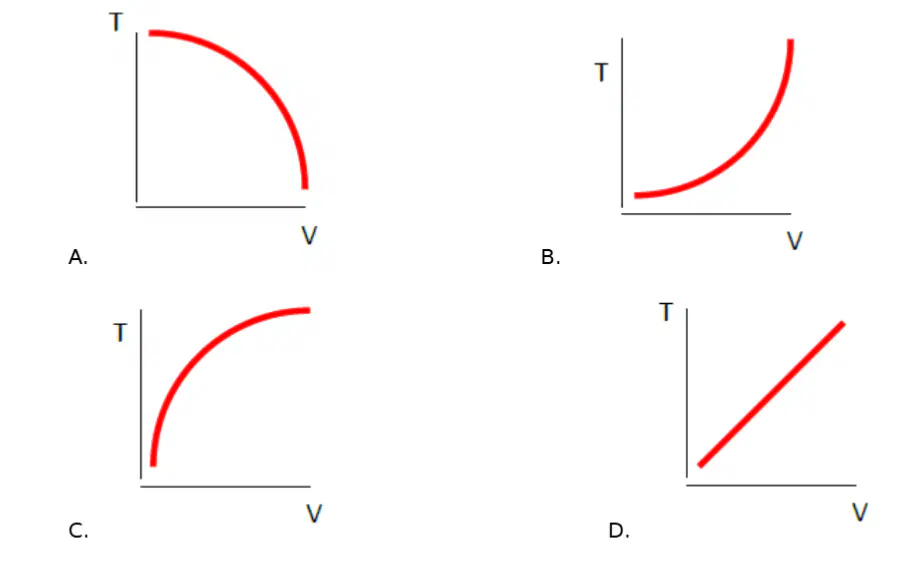
For questions 19 and 20: Jacques Charles was a French hot air balloonist and scientist. He discovered Charles' law by studying the relationship between the volume and temperature of a gas at a constant atmospheric pressure. As the temperature of the gas in a balloon increased, its volume also increased. In equation form, for the case of a constant pressure: V/T=constant . Which of the following graphs shows the temperature–volume relationship for a gas? (T = temperature and V = volume)
Graph A
Graph B
Graph C
Graph D
Unless an object at rest is acted upon by a force, it stays at rest due to its _____
matter
inertia
friction
gravity
Maron rode on his bike from 9:00 am to 10:30 am. If he drove at an average speed of 15 kph, what was the total distance he covered?
17.5 km
22.5 km
27.5 km
32.5 km
A woman exerts a constant horizontal force on a large box. As a result, the box moves across a horizontal floor at a constant velocity. The constant force by the woman _____
has the same magnitude as the weight of the box
is greater than the weight of the box
has the same magnitude as the total force which resists the motion of the box
is greater than the total force which resists the motion of the box
If the woman in the previous question suddenly stops applying a horizontal force to the box, then the box will _____
immediately come to a stop
continue moving at a constant speed for a while and then slow to a stop
immediately start slowing to a stop
continue at a constant speed
The 0.20 kg block is attached to a spring which has a spring constant of 20 N/m. The block is initially stretched 0.10 meters and released at time t = 0 seconds. Complete the following statement: In order to increase the frequency of the motion, one would have to _____
reduce the spring constant
decrease the mass of the block on the end of the spring
increase the length of the spring
reduce the distance that the spring is initially stretched
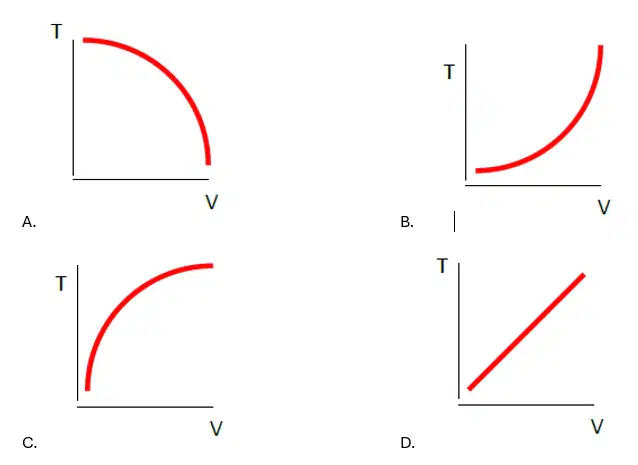
For the velocity-time graphs shown, which graph indicates a body moving at constant speed?
Graph A
Graph B
Graph C
Graph D
Which of the velocity-time graphs shows a body moving at high acceleration at the beginning then starts to lose acceleration towards the end?
Graph A
Graph B
Graph C
Graph D
The acceleration in a body is due to
balanced force
unbalanced force
mass
electrostatic force
Two students are posed to dive off equal height diving towers to a swimming pool below. Student B is twice as massive as student A. Which of the following is true?
Student B will reach the water sooner than student A
Both students have the same gravitational potential energy
Both students will have the same kinetic energy just before hitting the water
Student B did twice as much work climbing the tower
Which of the following cases is/are NOT a uniformly accelerated motion? (1) A feather falls from a certain height inside a vacuum tube. (2) A ball rolls along a frictionless plane at uniform speed. (3) A coin falls from a certain height in air but air resistance is negligible.
(1) only
(2) only
(1) and (2) only
(2) and (3) only
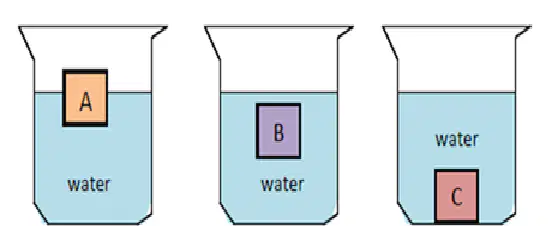
From the illustration with three cubes labeled A, B, and C in water, one can conclude that _____
cube A has the least weight
cube C has the highest density
cube A has the highest density than cube A
water has greater buoyant force than cube A
Cube C sinks because _____
it weighs much
it displaces much water
its weight is less than the weight of the water it has displaced
its weight is greater than the weight of the water it has displaced
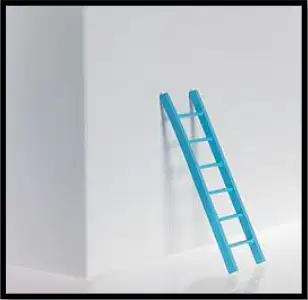
In the figure that follows, what is the direction of the force exerted by the ladder?
downward and toward the wall
downward and away from the wall
upward and toward the wall
upward and away from the wall
A 200 N box is pushed up an incline that is 5.00 m long and rises 1.00 m. If the incline is frictionless, then the work done by the pushing force is _____
336 J
305 J
275 J
200 J
A 2000 kg car accelerates from rest to a velocity of 20 m/s in 10 seconds. The power of the engine during this acceleration is _____
200 kW
20,000 kW
4000 W
40 kW
A gem or mineral that is red absorbs _____
red light
mostly red light
most wavelength of the visible spectrum except red
more of the visible spectrum than a gem or mineral that is violet
When viewed straight down (90° to the surface), an incident light ray moving from the water to air is refracted _____.
away from the normal
toward the normal
not at all
about 49°
Someone is wearing perfume on their wrist. Why can people near them smell it?
the particles of perfume spread from an area of higher concentration, their wrist, to areas of lower concentration, the air
people can smell the concentrated perfume on the wrist, but it doesn't travel through the air
some of the perfume leaves the wrist, mixing with air particles
both A and B
both A and C
Your flashlight has three identical 1.5 volt batteries in it, arranged in a chain to give a total of 4.5 volts. Current passes first through battery (a), then through battery (b), then through battery (c), on its way to the bulb. When you operate the flashlight, the batteries provide power to the current and they gradually use up their chemical potential energy. Which battery will run out of chemical potential energy first?
All three will run out at the same time.
Battery (a) will run out first.
Battery (b) will run out first.
Battery (c) will run out first.
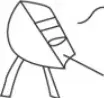
The figure shows a radiation heater. What heat transfer processes are involved at positions E and F?
E is radiation and F is conduction.
E is conduction and F is convection.
E is convection and F is conduction.
E is radiation and F is convection.
An astronaut picks up a stone on the moon and finds its mass to be 2 kg. If the mass of the earth is 6 times more than the mass of the moon, what will the mass and the weight of the stone be on the earth?
2 kg 12 N
2 kg 20 N
12 kg 120 N
20 kg 200 N
Water is boiled in a flask with a balloon over the top. As the water heats, the balloon expands. What has happened to the weight of this flask and balloon in this experiment?
It has increased as the balloon expands.
It has decreased as the water boiled away.
It has stayed the same.
It is unpredictable because the balloon is flexible.
A student wishes to find the density of an irregular piece of rock. How will she find volume?
length × width × height
place it on a triple beam balance
put it in a beaker
use water displacement
A barge filled with scrap iron is in a canal lock. If the barge were to sink what would happen to the water level?
It would fall.
It would remain unchanged.
It would rise.
It would depend on its mass.
Suppose you have a pendulum clock which keeps correct time on Earth (acceleration due to gravity = 9.8 m/s2). Without changing the clock, you take it to the Moon (acceleration due to gravity = 1.6 m/s2). For every hour interval (on Earth) the Moon clock will record _____.
9.8/1.6 h
1 h
9.8/1.6 h
1.6/9.8 h
1.6/9.8 h
As a star exhausts hydrogen in its core, it _____.
becomes hotter and more luminous
becomes cooler and more luminous
becomes hotter and less luminous
becomes cooler and less luminous
An upright stick that is allowed to cast a shadow in sunlight is called _____.
Almagest
Primum mobile
Equinox
gnomon
A solar or lunar eclipse will occur _____.
when the sun is near the line of nodes of the moon and the moon is new or full
any time the moon is new or full
when the sun is near the solstice and the moon is new or full
half way through an eclipse year
when the sun is near the equinox and the moon is new or full
How much time should it take for a traveling bullet to hit the ground compared to a bullet dropped from rest? Assume the ground remains flat for the entire distance the bullet may travel.
The traveling bullet will take longer to hit the ground than the bullet dropped from rest.
The traveling bullet will hit the ground at the same time as the bullet dropped from rest.
The traveling bullet will hit the ground before the bullet dropped from rest.
The traveling bullet moves so fast that it will never hit the ground.
Bart placed four identical candles on a table and lit them. He covered the first candle with a big jar, the second with a medium-sized jar, and the third with a small jar. He left the last candle uncovered. Which candle probably took the longest time to burn?
the lit candle left uncovered
the lit candle covered with the biggest jar
the lit candle covered with the smallest jar
the lit candle covered with the medium-sized jar
Which of the following is not considered a simple machine?
wedge
pulley
lever
wheelbarrow
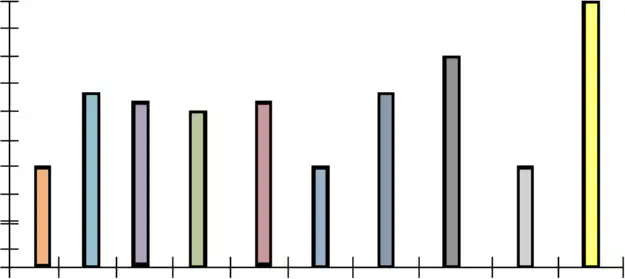
For questions 52–53. Number of OFW’s in four countries: A table lists the number of OFW’s (x1000) in Hongkong, Kuwait, Italy, and USA for each year from 1995 to 2004. Which country shows the greatest rate of increase over the years?
Hongkong
Kuwait
Italy
USA
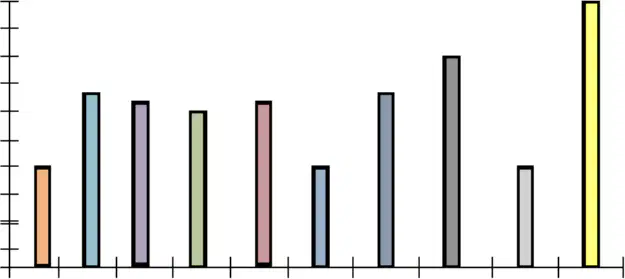
For questions 52–53. Number of OFW’s in four countries: Refer to the bar graph of the Number of OFW’s for the years 1995 to 2004. The graph below shows the number of OFW’s in which country?
Hongkong
Kuwait
Italy
USA
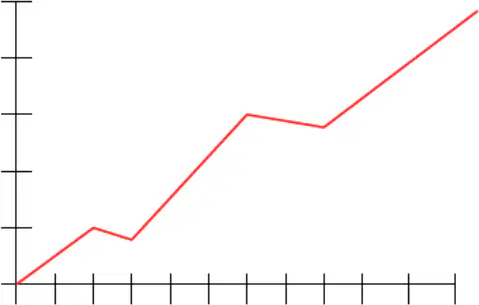
For questions 54–60, refer to the following graph. A substance is heated by a source supplying 1000 calories per minute. The freezing point of this substance is _____.
0°C
10°C
20°C
30°C
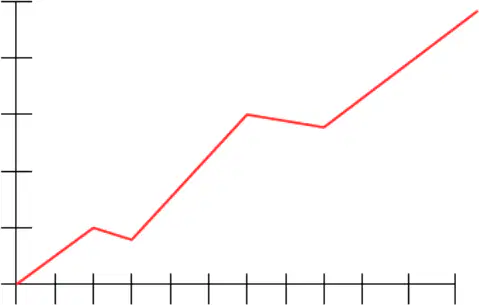
For questions 54–60, refer to the following graph. A substance is heated by a source supplying 1000 calories per minute. The boiling point of the substance is _____.
10°C
20°C
30°C
40°C
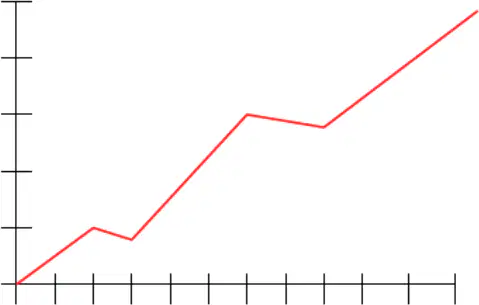
For questions 54–60, refer to the following graph. A substance is heated by a source supplying 1000 calories per minute. The substance undergoes a phase change between the _____.
4th and 6th minutes
6th and 14th minutes
14th and 18th minutes
16th and 22nd minutes
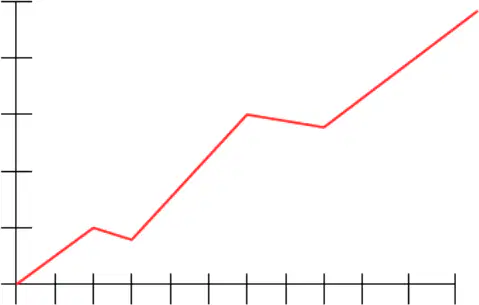
For questions 54–60, refer to the following graph. A substance is heated by a source supplying 1000 calories per minute. How many calories are needed to completely melt the sample at its melting point?
500
1000
2000
3000
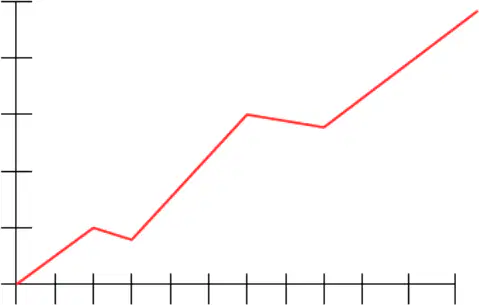
For questions 54–60, refer to the following graph. A substance is heated by a source supplying 1000 calories per minute. How long did it take for the substance to completely turn into gas?
4 min
6 min
10 min
16 min
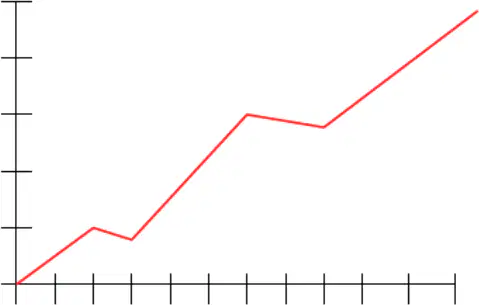
For questions 54–60, refer to the following graph. A substance is heated by a source supplying 1000 calories per minute. The substance is solid at _____.
2 min
5 min
10 min
18 min
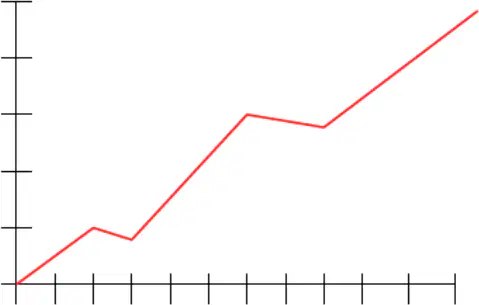
For questions 54–60, refer to the following graph. A substance is heated by a source supplying 1000 calories per minute. How many calories are needed to completely change the sample into a liquid?
4000
6000
14 000
16 000
What factor distinguishes a suspension from a colloid?
light reflects off the particles of a suspension
the particles of a suspension will sink out if left over time to rest
suspensions are clear
Lorna placed 1 kg of sandy soil and 1 kg clay soil into Pot A and Pot B respectively. She then poured equal volumes of water into each pot. After a day, it is expected that _____.
Pot A will weigh more than Pot B
Pot B will weigh more than Pot A
Pot A and Pot B will weigh the same
Pot A will be wet and Pot B will be dry
Hydrogen and oxygen molecules in a gas sample have the same temperature. This means the hydrogen molecules, on the average, have the same _____.
speed, but more kinetic energy
kinetic energy, but more speed
kinetic energy, but less speed
speed and the same kinetic energy
Acids are substances that _____.
form hydronium ions when dissolved in water
turn red litmus paper blue
make foods taste bitter
react with neutral liquids to form bases
Marinades for meat commonly include acids such as vinegar or wine, because the acids can _____.
toughen meat
tenderize meat
preserve meat
react with salt
The basic requirement for the separation of the components by _____ is that the composition of the vapor be different from the composition of the liquid at the boiling point of the liquid.
absorption
distillation
extraction
crystallization
Taken by itself, the fact that 8.0 g of oxygen and 1.0 g of hydrogen combine to give 9.0 g of water demonstrates what natural law?
Multiple Proportions
Periodicity
Conservation of Mass
The Atomic Theory
What are the coefficients that will balance the formula equation below? AlCl3 + NaOH → Al(OH)3 + NaCl
1, 3, 1, 3
3, 1, 3, 1
1, 1, 1, 3
1, 3, 3, 1
A hydrocarbon that contains one or more double bonds is classified as a(n) _____.
alkyne
alkene
ketone
alkane
When heat is absorbed by the system from the surroundings, the process is said to be _____, and the sign of process is _____.
exothermic, negative
endothermic, positive
exothermic, positive
endothermic, negative
Which of the following did not help Darwin formulate his theory of evolution?
fossil evidence that species had changed over time
closely related species on oceanic islands
belief that the earth was several thousand years old
evidence of artificial selection in domestic animals
Which of the following pairs are analogous structures?
the front leg of a horse and a human arm
the front leg of a frog and a bat wing
the wing of a bird and a bat wing
the front flipper of a porpoise and a human arm
Of the following biological levels of organization, which represents the smallest or lowest level?
organs
organisms
cells
tissues
Which of the following is not a property of life?
molding or adapting to one's environment
regulating materials that enter or leave the system
responding to stimuli
reproducing, passing hereditary material to the next generation
Five positions of a swinging pendulum are shown in the diagram. A and E are the highest positions attained by the pendulum; the lowest is C. The kinetic energy of the pendulum is highest at position(s) _____.
C
B and D
A and E
A, C and E
Five positions of a swinging pendulum are shown in the diagram. A and E are the highest positions attained by the pendulum; the lowest is C. Speed is minimum at position(s) _____.
C
B and D
A and E
A, C and E
The sexually-transmitted disease gonorrhea is becoming difficult to treat because the causative bacteria are evolving resistance to antibiotics. For example, in Hawaii between 1997 and 1999 resistance to fluoroquinolones increased from 1.4 percent to 9.5 percent. Scientists attribute this to natural selection. What does natural selection mean in this context?
The germs have learned to avoid that particular class of antibiotic.
The antibiotic has changed the genetic structure of the germs allowing them to become antibiotic-resistant.
The germs changed their genetic code in order to avoid problems with the antibiotic.
The antibiotic created an environment in which germs harboring antibiotic-resistant genes could flourish.
The mutation rate for antibiotic-resistance increased during the time period.
A slippery outer covering in some bacteria that protects them from phagocytosis by host cells is _____.
capsule
cell wall
flagellum
peptidoglycan
Differences between eukaryotic and prokaryotic cells include all of the following except _____.
eukaryotic cells have mitochondria
eukaryotic cells have cilia and flagella with complex structure
prokaryotic cells have more complex cell walls
prokaryotic cells have no genetic material
The optimum temperature for an organism is the one at which _____.
it grows with the shortest generation time
it has the longest time between cell divisions
it is near one extreme of its range of tolerated temperatures
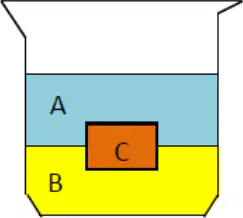
In the illustration below, A and B are liquids while C is a solid. Which of the following is true?
C is denser than both A and B.
C is less dense than B but denser than A.
C is less dense than A but denser than B.
C has just about the same density as both A and B.
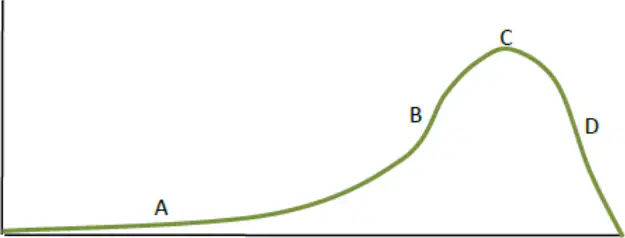
For the following graph of the movement of a car, at which point is the car decelerating?
A
B
C
D
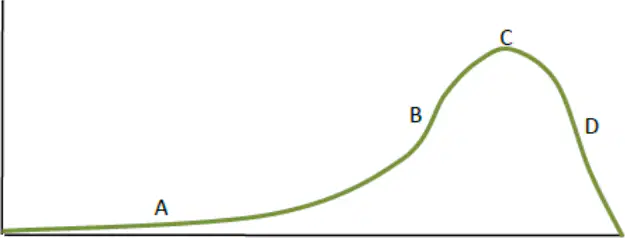
For the following graph of the movement of a car, at which point is the car accelerating rapidly?
A
B
C
D
In a plant, what part stores sugars as starch?
leaves
roots
seeds
all of the above
ADP energy is used for ______.
synthetic reactions
active transport
all energy-requiring processes in cells
none of the above
The cytoskeleton of the cell functions to ______.
give the cell shape
anchor organelles
allow organelles to move
all of the above
A red blood cell plasma membrane contains ______ different types of proteins.
over 10
over 20
over 40
over 50
During ______, the chromosomes attach to the spindle and align at the metaphase plate of the spindle.
prophase
prometaphase
metaphase
anaphase
In the diagram, assume that each container contain equal volumes of water. In what container is the pressure at the bottom greatest?
A
B
C
The pressure is the same in each container
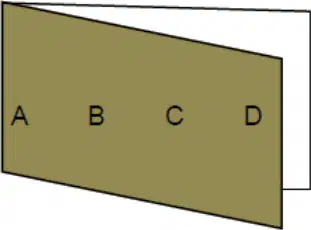
At which point on the door will you apply the greatest force to close it?
A
B
C
D
Graphs of distance (d) or velocity (v) of a body against time (t) are shown. Which one shows that a body is at rest?
Graph A
Graph B
Graph C
Graph D
Which of the velocity–time graphs in the figure represents an object falling freely in a vacuum? (v = velocity, t = time)
Graph A
Graph B
Graph C
Graph D
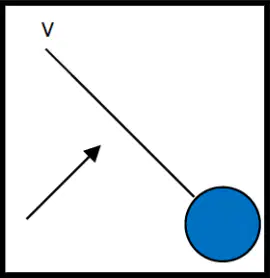
In the following illustration, if the pendulum was swinging in the direction indicated by the arrow when its string was suddenly cut, in what direction did the pendulum go?
upward-right diagonal arrow
downward-right diagonal arrow
downward arrow
rightward horizontal arrow
If two flies heterozygous for wing length and body color are crossed, which of the following are possible results?
chance of L, long wings = 3/4
chance of l, short wings = 1/2
chance of G, grey body = 1/4
all of the above are true
A cross in which true-breeding plants differ in two traits is known as a ______ cross.
test
dihybrid
multi trait
hybrid
Which is narrower?
fundamental niche of an organism
realized niche of an organism
habitat of an organism
all are the same
______ are protozoa with no means of locomotion.
Amoeboids
Ciliates
Zooflagellates
Sporozoa
The vertebrate skeleton ______.
is a living tissue which grows with the animal.
protects internal organs.
serves as a place of attachment for muscles.
all of the above
Protoplasts are cells without ______.
a nucleus.
a membrane.
a wall.
cytoplasm.
The relationship of give-and-take of living organism in the biosphere is a balance of nature called ______.
universal relationship
symbiotic relationship
spontaneous relationship
abiogenetic relationship
Process of removing excess odor in water.
sedimentation
distillation
chlorination
aeration
Which of the following statement is CORRECT?
As altitude increases, atmospheric pressures corresponding
Throughout the available space, gas tends to contract
Equal chances are always given to all in life
Shadow is formed when a colored object is projected against the wall
The earth rotates on its axis from west to east. This causes the sun to ______?
appear with a fiery orange color
cause the appearance of solar eclipse
rise from the east and sets in the west
emit solar radiation
One of these planets has the greatest gravitational pull. Which one is it?
Mars
Earth
Mercury
Jupiter
It is the law which explains why one can pull a piece without topping a glass in a quick motion.
energy in motion
gravity
law of inertia
force
Which of the following is NOT a source of energy?
water
nuclear
geothermal heat
inertia at rest
Which instrument will one use to convert mechanical energy to electrical energy?
rotor
generator
motor
circuit
Sun’s energy is generated by?
nuclear fission
sun enacting with gravity
nuclear fusion reaction
reaction with magnetic field
Application of energy is called ______?
work
inertia
kinetics
simulation
The falling of any form of water from the air to the earth’s surface.
Condensation
Precipitation
Water vapor
Rainwater
The part of the atmosphere that filters the ultraviolet rays of the sun.
stratosphere
Troposphere
Ozone layer
Ionosphere
The point in the earth’s orbit nearest to the sun.
Solstice
Eclipse
Aphelion
Perihelion
A property of minerals which gives off rays of light when exposed to ultraviolet light.
Luminescence
Phosphorescence
Radiation
Fluorescence
Which process involves chemical weathering?
Carbonation
Oxidation
Hydration
All of the above
How long does it take for the earth to complete one rotation?
365 days
30 days
24 hours
12 hours
What is the principal function of gravity in the universe?
Provision for energy
Keeps the stars and other heavenly bodies in orbit
Causes movement in space
Part of universal design
What does the word “monsoon” mean?
Moon will soon come
Rains
Seasons
Wet weather
Its’ discovery enable geologist to date rocks accurately.
layering
Evolutionary staging
Radioactivity
Carbon-dating
It occurs when the earth is between the sun and the moon, with the earth’s shadow cast over the moon.
Total eclipse
Lunar eclipse
Eclipse
Partial Eclipse
Male and female reproductive part of a flower.
Pollen grains and ovules
Stamen and pistil
Pollen grains and pistil
Stamen and ovules
In the human body, the cell that most nearly resembles a one-celled animals.
Red Blood cell
White Blood cell
Nerve cell
Antibodies
The main energy source of a plant-eating animals.
Glucose
Starch
Cellulose
Glycogen
These are cellular secretions which help regulate the breakdown and buildup of various substance in the body.
Enzymes
Amino Acids
Plasma
Hormones
It is the energy source of the cell which it uses for growing, reproducing and other activities.
Adenosine Triphosphate
Amino Acids
Chloroplast
Sunlight
It is a segment of DNA molecule which controls the appearance of a given trait.
Chromosomes
Genes
Gametes
Zygotes
Group of similar cells performing similar functions together.
Organs
System
Nucleus
Tissue
The diffusion of water through a semi permeable membrane.
osmosis
permeability
Transfusion
Capillary
It shows the complex food relationship of organism in a given area and the cyclic flow of food through organisms.
Food chain
Food web
Food pyramid
Biological cycle
Which of the following does NOT occur to both respiration and fermentation?
energy is released
sugar is broken down
carbon dioxide is produced
alcohol is formed
Energy removal is best illustrated in
boiling of liquid substances
changing water to ice
changing water to stem
none of the above
Refers to the maximum amount of solute expressed in grams that can be dissolved in 100 grams of water at a specific temperature.
Solubility
Stability
Molarity
Molality
Compounds with the same molecular formula but with different structural formulas.
Cellulose
Isomers
Polymers
Monomers
The most penetrating type of radiation given off by radioactive elements.
Alpha particle
Beta particle
Gamma particle
None of the above
The basic unit for expressing the masses o individual atoms.
Atomic number
Atomic mass unit
Nucleus
Atomic weight
A substance that speeds up a chemical reaction without itself undergoing a chemical change.
catalyst
Enhancer
Electrolytes
Ionizer
The temperature at which the vapor pressure of the liquid is equal to the pressure of the surroundings atmosphere.
Melting point
Critical point
Boiling Point
None of the above
The warming of the earth’s surface due to an increase in atmospheric carbon dioxide phenomena.
“Greenhouse effect”
Ozone
Atmospheric pressure
El Nino
Describe the force of gravity on an object.
mass
weight
capacity
pressure
When gaseous molecules are compressed, they tend to?
increase in volume
decrease in volume
repel each other
attract and liquefy
It is the union of two light nucleus to form a heavier nucleus, resulting in a mass defect and release of energy.
Radiation
Nuclear Fission
Nuclear Fusion
Radioactivity
Which of the following statements is a characteristic of an electronic spectrum?
They all travel at the same speed in fire space
The exhibit diffraction and interference phenomena
They follow the laws of refraction and reflection
All of the above
The term “RADAR” is derived from the phrase?
“Radiation Detection and Ranging”
“Radiation Diffusion and Ranging”
“Radio Diffraction and Resolution”
“Radiation Diffraction and Resolution”
A material whose ability to conduct electricity lies between those of conductors and insulators
Integrated Circuits
Silicon Chips
Semiconductors
Insulators
“LASER” is derived from the phrase?
Light Amplification by Stimulated Emission of Radiation
Light Application by Simulated Emission of Radiation
Light Amplification by Simulated Ejection of Radiation
None of the above
What is the color of a transparent substance?
The color of the light it absorbs
The color of light it reflects
The color of light it transmits
The color of light it refracts
What is a rotating electromagnetic called?
Motor
Rotor
Phasor
Sensor
What happens with the centripetal force when speed is doubled?
Remains the same
Force increases 4x
Triples
Force is doubled
What is an electrochemical cell in which the reacting materials can be renewed by the use of reverse current?
Storage cell
Primary cells
Fuel cell
Chemical cell
What will make an object move in a circular path?
Central force
Gravitational force
Frictional force
Electromagnetic force

