
Font size
 Worksheets
Exam Review Chapter 11 - unit 3 Cells
Total questions: 44
Worksheet time: 23mins
Which of the following limits cell size? Select 3 of the answers that apply.
efficiency of DNA replication and cell division
ratio of surface area to volume
rate of moving materials across the cell's membrane
efficiency of using the information in a cell's DNA
Why are cells generally so small? Select 3 of the answers that apply.
As they grow, their surface area increases faster than their volume.
Moving waste materials across their cell membranes is more efficient.
Moving nutrients across their cell membranes is more efficient.
As they grow, their volume increases faster than their surface area.
Which of these events happens immediately before cell division occurs?
The cell’s DNA is distributed evenly throughout the cell.
The cell’s volume decreases more than its surface area.
The cell’s surface-area-to-volume ratio increases.
The cell’s genetic material is copied.
Three spherical cells have radii of 1 cm, 2 cm, and 3 cm. Using the relationship between surface area and volume in spheres, which cell has the greatest surface‑area‑to‑volume ratio?
the cell with radius 1
the cell with radius 2
the cell with radius 3
All three cells have the same surface-area-to-volume ratio.
How does the size of a cell's surface area change compared to its volume when the cell grows?
The surface area increases at the same rate the volume does.
The surface area increases faster then the volume does.
The surface area does not increase as fast as the volume does.
The surface area remains constant as the volume changes.
Which describes sexual reproduction, and not asexual reproduction?
can occur very quickly, allowing a population to expand into new territory
produces offspring that are genetically identical with a single parent
ensures all members of a population have equal fitness in their environment
produces offspring that inherit half of their genetic information from each parent
Hydras may reproduce by budding. In this process, a small polyp forms on an adult hydra, and then it leaves to become a new organism. Which observation would support the conclusion that budding is an example of asexual reproduction?
Budding may occur in a hydra that has been completely isolated from others of its kind
Budding may occur in a hydra that has been raised with many others of its kind.
The polyp that buds off the hydra is significantly smaller than its parent.
The polyp that buds off the hydra has different DNA from the parent.
When conditions in the environment change, a lack of genetic diversity may be disadvantageous for organisms that reproduce ________.
Asexually.
Sexually.
Genetic diversity may be advantageous for organisms that reproduce __________ when conditions in an environment change.
Sexually
Asexually
The Paramecium uses __________ reproduction when it splits into two identical copies of itself.
Asexual
Sexual

Look at the diagram of the cell cycle. Which set of events occurs in the S phase?
cell growth and mitosis
mitosis and cytokinesis
DNA replication
cell growth
Cell division occurs in two stages, division of the nucleus is called ___________.
Mitosis
Cytokinesis
Cell division occurs in two stages, division of the cytoplasm is called ___________.
Cytokinesis
Mitosis
Genetic Information is bundled into packages of __________ known as chromosomes.
DNA
Centrioles
RNA
Chromosomes
In eukaryotic cells, DNA is packaged with proteins into structures called chromosomes. What advantage do chromosomes provide the cell?
They allow all genes to be expressed at the same time.
They eliminate the need for a nuclear membrane.
They ensure equal division of genetic material when a cell divides.
They allow random distribution of genetic material when a cell divides.
The drug colchicine stops or inhibits the formation of spindle fibers during mitosis. If you treat dividing plant cells with colchicine, what would you expect the result to be?
The chromosomes are separated during prophase. Each of the four daughter cells receives a haploid number of chromosomes.
The chromosomes do not pull apart during cell division. The result is a cell that has double the number of chromosomes than it would normally have.
The chromosomes do not pull apart in an orderly fashion during cell division. The result is two cells with unequal numbers of chromosomes.
The chromosomes are halved during cell division. The result is a cell that has half the number of chromosomes that it would normally have.
The centromeres of the duplicated chromosomes line up (meet) across the center of the cell during _______.
Telophase
Prophase
Interphase
Cytokinesis
Metaphase
The cytoplasm pinches in half during _______.
Cytokinesis
Prophase
Interphase
Metaphase
Telophase
The cell grows and replicates its DNA and centrioles during _______.
Prophase
Cytokinesis
Interphase
Metaphase
Telophase
The chromosomes, which were once distinct and condensed, begin to spread out into a tangle of chromatin during _______.
Interphase
Telophase
Prophase
Cytokinesis
By regulating the cell cycle, multicellular organisms gain which of these benefits? Select 2 correct answers.
preventing communication among cells
healing wounds effectively
eliminating unnecessary genes
replacing lost cells, such as shed skin cells
Why are cancer cells harmful? Choose three correct answers.
They prevent organs from functioning properly.
They stop cell growth and division.
They block nerve connections.
They absorb nutrients needed by other cells
Which of the following are functions of external regulators of the cell cycle? Select two answers.
regulate checkpoints
make sure chromosomes have replicated
speed up or slow down the cell cycle
stop the cell cycle
What is the relationship between mutation, the cell cycle, and cancer? Select 3 statements that apply.
Cancerous cells may form malignant tumors that invade and destroy surrounding healthy tissue.
Mutated, defective genes may cause cells to become unable to respond to signals that regulate the cell cycle.
As a result of unregulated cell cycles, cells may become cancerous, meaning that the cells grow and divide uncontrollably.
Mutated genes typically allow cells to respond to checkpoint proteins that halt the cell cycle, thus avoiding the formation of tumors.
Humans and other animals regulate cell growth and cell division. In humans, which of these types of cells generally do not divide after they have developed?
cells of the lining of the digestive tract
cells in the bone marrow that generate blood cells
skin cells
muscle cells and nerve cells
High-energy radiation is often used to treat cancer. Which statement BEST explains why this treatment is effective?
The radiation is especially damaging to cancer cells because of their genetic composition.
The radiation kills cancer cells and healthy cells equally, but is directed precisely at cancer cells.
The radiation kills cancer cells but leaves healthy cells intact.
The radiation is especially damaging to cancer cells because of their high rate of mitosis.
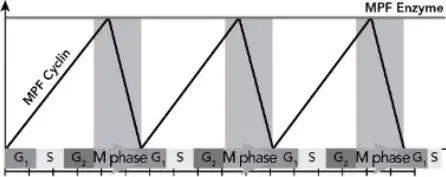
Which statement BEST describes the relationship between MPF and the cell cycle?
Cyclin binds with an enzyme to produce MPF Cyclin and as its concentration rises, it promotes mitosis.
The MPF Cyclin concentration increases and decreases in a cycle, but does not control the cell cycle.
Cyclin binds with a factor to produce MPF enzyme and as the enzyme's concentration decreases, it promotes mitosis.
The MPF Cyclin concentration remains constant, as the rise and fall of the MPF enzyme controls the cell cycle.
How does apoptosis relate to cancer cells?
In cancer cells, too much apoptosis occurs, resulting in malignant cells that will not undergo programmed cell death.
In cancer cells, apoptosis occurs only when cells grow without proper regulation.
In cancer cells, apoptosis occurs only when the cells receive the proper hormones.
In cancer cells, too little apoptosis occurs, resulting in malignant cells that will not undergo programmed cell death.
A physician takes a biopsy, or tissue sample, from a patient's skin. Which observation of the cells in the tissue would support the conclusion that the patient has skin cancer?
Some of the cells were dead when the biopsy was obtained..
A group of cells appears larger and rounder than surrounding cells.
All of the cells are packed closely together.
Many cells in the tissue sample appear identical to one another.
When does the mitosis-promoting factor (MPF) Cyclin concentration decline during a typical cell cycle in clam eggs?
when the cell nucleus divides.
when haploid gametes are produced
when DNA is synthesized
when the cells grow larger
The zygote is described as __________, because it is able to develop into any kind of cell in the body.
multipotent
omnipotent
totipotent
pluripotent
In the human body, stem cells in the bone marrow produce a variety of blood cells. What process produces these cells?
Undifferentiated cells divide to produce differentiated cells.
Specialized cells of one type divide to produce specialized cells of another type.
Differentiated cells divide to produce undifferentiated cells.
Specialized cells of one type are genetically transformed into specialized cells of another type.
Which is the most likely application of stem cell research?
a cure for genetic disorders, which are inherited from either or both parents
a treatment for macular degeneration, in which cells of the eye are damaged or killed
a cure for cancer, a disease in which cells divide rapidly and without proper control
a treatment for viral infections, in which viruses invade cells
Adult stem cells are referred to as ________ because they can differentiate usually only into the cells of the tissues where they are found.
omnipotent
totipotent
multipotent
pluripotent
Embryonic stem cells are ________, because they can develop into any of the body's cell types, although they cannot form the tissues surrounding the embryo.
omnipotent
totipotent
pluripotent
Multipotent
Stem cells are
never go through cell division
undifferentiated and can be any type of cell
only found in embryos
cells that grow uncontrollably
Stem cells can be obtained from
some adult tissues
umbilical cord blood
embryos
all of the above
What is the importance of apoptosis?
To produce two identical cells
To cause uncontrolled cell growth
To create specialized cells
To eliminate damaged or unnecessary cells
Stem cell research is controversial because it involves?
educational issues
economic issues
social issues
ethical issues
What is one goal of cellular differentiation/specialization?
Too many cells.
to make single-celled organisms
To create specialized cells to help organisms maintain homeostasis.
To make stem cells
In an investigation, plant cells are placed in water that has been tinted blue. The investigators observe the color of the cells changing to blue. What additional observation would be evidence that the cells maintain homeostasis in response to this change?
The central vacuole in the cells increases in size.
The cell membranes shrink away from the cell walls.
The cells burst apart.
The cells pump out water by endocytosis.
Which of the following activities occurs in both prokaryotic cells and eukaryotic cells?
Mitochondria provide energy for cell processes.
Chloroplasts capture and transform the energy of sunlight.
A large central vacuole stores DNA and RNA.
Proteins are assembled on ribosomes.
Marcus is developing a model to compare the cells of prokaryotes, such as bacteria, and the cells of multicellular eukaryotes, such as a plant or animal. He begins by drawing a model of a bacterial cell. Which strategy would be MOST USEFUL for modeling the cells of the multicellular eukaryote?
Draw many cells that are larger than the bacterial cell, of a variety of sizes and shapes, and in close contact with one another.
Draw many cells that are the same size and shape as the bacterial cell, and in close contact with one another.
Draw many cells that are larger than the bacterial cell, all the same size and shape, and in close contact with one another.
Draw many cells that are either larger or smaller than the bacterial cell, of a variety of sizes and shapes, and isolated from one another.
Nayla is planning an investigation into the role of osmosis in maintaining homeostasis. She plans to study red blood cells in a liquid suspension, similar to blood plasma. For Nayla to observe the greatest variety of osmotic activity in the red blood cells, she should test the effect of which of these independent variables?
the number of red blood cells per liter of the liquid suspension
the oxygen concentration of the red blood cells
the salt concentration of the liquid that surrounds the red blood cells
temperature of the liquid suspension

