

10th Grade Titration Quizzes
Test your Grade 10 titration knowledge with this comprehensive chemistry quiz designed to assess your understanding of acid-base reactions and quantitative analysis techniques. Practice essential titration problems with instant feedback to strengthen your analytical chemistry skills through self-paced assessment.

16 questions
Titration Calculations

Quiz
•
10th Grade
15 questions
Titration
Quiz
•
10th Grade

15 questions
Titration
Quiz
•
10th Grade

15 questions
Titration
Quiz
•
10th Grade

25 questions
Titration Calculations
Quiz
•
10th Grade

25 questions
Titration
Quiz
•
10th Grade
10 questions
Titrations
Quiz
•
10th Grade
15 questions
Titration Skills
Quiz
•
10th Grade
8 questions
Titration calculations
Quiz
•
10th Grade
15 questions
Titration Calculations
Quiz
•
10th Grade
15 questions
Titration Calculations
Quiz
•
10th Grade
15 questions
Titration Skills
Quiz
•
10th Grade
Browse by grade
Explore 10th Grade Titration Quizzes
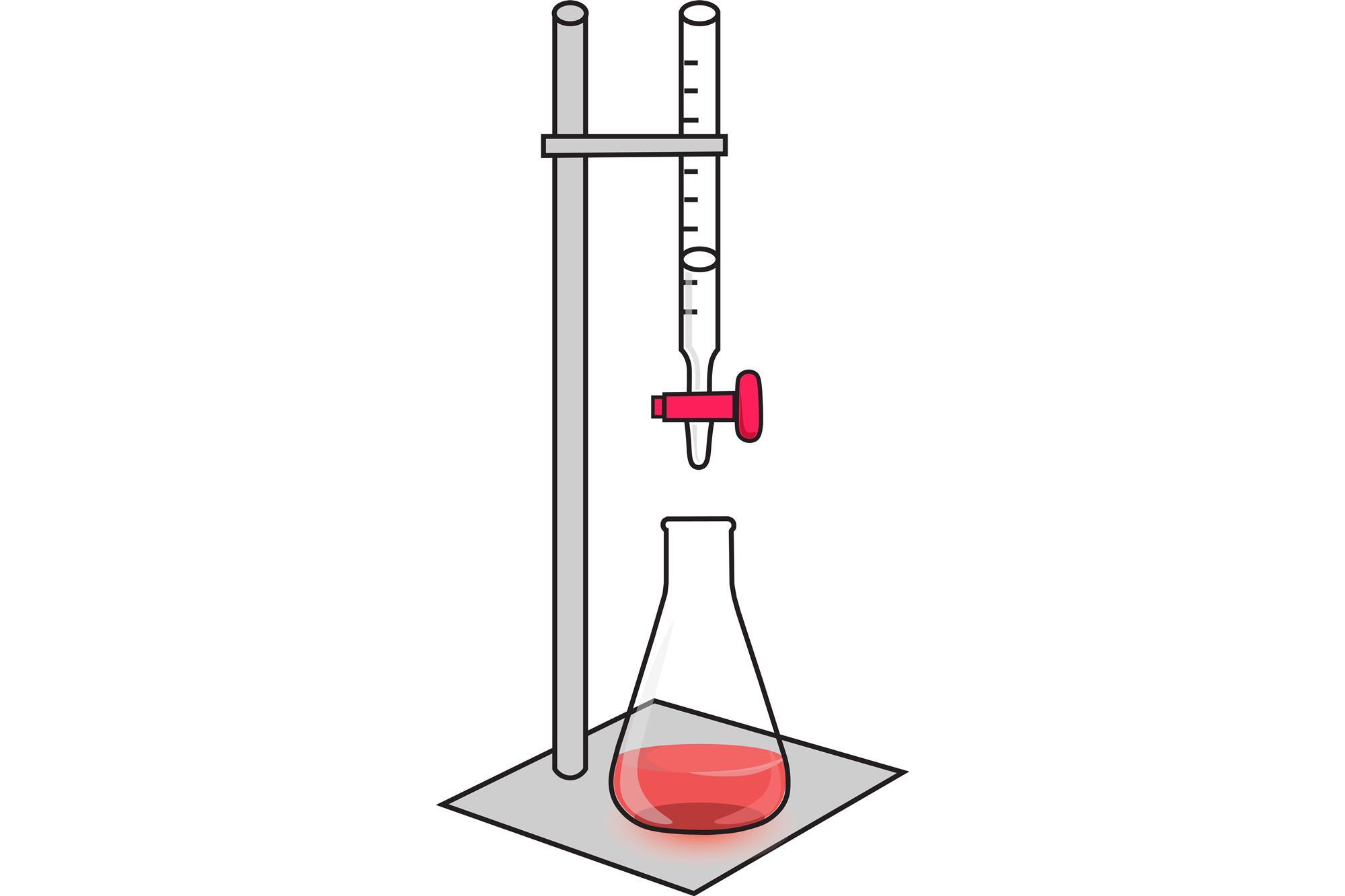
Titration assessment for Grade 10 students provides comprehensive practice questions that evaluate understanding of this fundamental analytical chemistry technique. These quizzes focus on the systematic process of determining unknown concentrations through controlled chemical reactions, testing students' grasp of concepts including molarity calculations, equivalence points, indicator selection, and proper laboratory procedures. The assessment materials reinforce critical problem-solving skills while providing immediate feedback on complex stoichiometric relationships and acid-base neutralization reactions that form the foundation of quantitative analysis in chemistry. Wayground's extensive collection draws from millions of teacher-created resources specifically designed for Grade 10 titration instruction, offering educators powerful search and filtering capabilities to locate materials aligned with their curriculum standards and learning objectives. The platform's customization tools enable teachers to differentiate assessment difficulty levels, modify question formats, and adapt content to meet diverse classroom needs through flexible digital delivery systems. These comprehensive quiz collections support instructional planning by providing targeted practice for skill reinforcement, systematic remediation for students struggling with concentration calculations, and enrichment opportunities for advanced learners ready to explore complex titration scenarios and real-world analytical applications.
FAQs
How do I teach titration to chemistry students?
Titration is best taught by first grounding students in stoichiometric ratios and molarity before introducing the lab procedure itself. Start with the conceptual relationship between moles of acid and base at the equivalence point, then layer in calculations for normality and pH curves. Using worked examples that progress from simple strong acid-strong base titrations to polyprotic acid systems helps students build confidence before tackling more complex scenarios. Pairing procedural instruction with structured practice problems reinforces both the calculation methods and the underlying analytical reasoning.
What exercises help students practice titration calculations?
Effective titration practice exercises include calculating unknown molar concentrations from given volume and molarity data, identifying equivalence points from titration curve graphs, and working through stoichiometric problems involving acid-base, redox, and complexometric reactions. Problems that require students to prepare standard solutions and apply dilution equations build foundational fluency, while multi-step problems involving buffer systems and polyprotic acids develop higher-order analytical skills. Sequencing problems from straightforward to complex ensures students develop procedural accuracy before applying concepts in unfamiliar contexts.
What mistakes do students commonly make when solving titration problems?
One of the most frequent errors is confusing molarity with normality, particularly in redox titrations where the equivalence factor changes depending on the number of electrons transferred. Students also commonly misidentify the equivalence point versus the endpoint, especially when reading titration curve graphs. A third persistent mistake is neglecting to account for stoichiometric ratios that are not 1:1, leading to incorrect mole calculations. Requiring students to explicitly write out the balanced equation and mole ratio before solving any calculation step can significantly reduce these errors.
How do I use titration quizzes effectively in the classroom?
Titration quizzes work best when introduced after students have had at least one hands-on or virtual lab experience, so the calculations connect to a concrete procedure they recognize. Use early problems as guided practice during class and later problems as independent assessment to measure individual mastery. Wayground's titration quizzes are available as printable PDFs for traditional classroom use and in digital formats for technology-integrated environments, and teachers can also host them as a quiz directly on Wayground to assign and track student performance.
How can I differentiate titration instruction for students at different skill levels?
For students who are struggling, focus initially on one-to-one stoichiometric ratios using strong acid-strong base problems before introducing redox or complexometric titrations. Advanced learners benefit from problems involving polyprotic acids, buffer calculations, and interpreting inflection points on titration curves. On Wayground, teachers can apply accommodations at the individual student level, including reduced answer choices to lower cognitive load for struggling students, extended time settings, and read aloud support for students with accessibility needs, without affecting the experience of the rest of the class.
What topics are typically covered in a titration unit in high school or college chemistry?
A standard titration unit covers acid-base titrations using strong and weak acid-base pairs, the preparation and use of standard solutions, calculating molarity and normality, identifying and calculating equivalence points, and interpreting titration curves including buffer regions and half-equivalence points. More advanced courses extend into redox titrations, complexometric titrations using EDTA, and polyprotic acid systems. Stoichiometric reasoning and dimensional analysis are applied throughout, making titration a high-leverage topic for reinforcing quantitative chemistry skills.

Accessibility
Features
Wayground Super
School & District
Wayground for Business
Create a quiz
Create a presentation
Wayground AI
Subjects
Mathematics
Social Studies
Science
Physics
Chemistry
Biology
About
Our Story
Wayground Blog
Media Kit
Careers
Support
F.A.Q.
Help & Support
Privacy Policy
Terms of Service
Teacher Resources
2026 Wayground


Get our app

