

10th Grade Orbital Diagrams Quizzes
Test your understanding of orbital diagrams with this comprehensive Grade 10 chemistry quiz featuring practice questions and instant feedback. Assess your knowledge of electron configuration, orbital filling rules, and diagram construction through self-paced assessment designed for chemistry students.

12 questions
Orbital Diagrams and Electron Configuration

Quiz
•
10th Grade

15 questions
Orbital Diagrams Rules and Principles
Quiz
•
10th Grade

25 questions
Orbital Diagrams and Electron Configurations
Quiz
•
10th Grade
20 questions
HW: 1.5 Wayground OLD
Quiz
•
10th Grade

10 questions
Electron Configuration and Orbital Diagrams Worksheet | Grade 10
Quiz
•
10th Grade

15 questions
Orbital Diagrams Rules and Principles
Quiz
•
10th Grade
19 questions
Electron Configuration
Quiz
•
10th Grade
20 questions
Orbits and eccentricity
Quiz
•
9th - 12th Grade
30 questions
Review: Orbital Motions and Moon
Quiz
•
9th Grade
Browse by grade
Explore 10th Grade Orbital Diagrams Quizzes
Orbital diagrams represent a fundamental concept in Grade 10 chemistry that students must master to understand electron configuration and atomic structure. These comprehensive quizzes available through Wayground provide targeted assessment opportunities for students learning to construct and interpret orbital diagrams, including the application of Hund's rule, the Pauli exclusion principle, and Aufbau principle. The practice questions systematically evaluate student understanding of electron placement in atomic orbitals, energy level arrangements, and the relationship between orbital diagrams and electron configuration notation. Through immediate feedback and varied question formats, students develop the analytical skills necessary to predict chemical bonding patterns and atomic behavior based on electron distribution. Wayground's extensive collection of teacher-created orbital diagram quizzes offers educators access to millions of resources specifically designed to support Grade 10 chemistry instruction. The platform's robust search and filtering capabilities enable teachers to locate assessments aligned with curriculum standards and learning objectives, while customization tools allow for differentiation based on individual student needs. These digital-first quizzes can be deployed flexibly for formative assessment, homework assignments, or review sessions, supporting both immediate intervention for struggling learners and enrichment opportunities for advanced students. Teachers utilize these resources for strategic lesson planning, identifying knowledge gaps through data analysis, and providing targeted remediation that reinforces orbital diagram concepts essential for success in advanced chemistry topics.
FAQs
How do I teach orbital diagrams to chemistry students?
Begin by grounding students in the three rules that govern electron placement: the aufbau principle (fill lowest energy orbitals first), Pauli exclusion principle (no two electrons share the same four quantum numbers), and Hund's rule (maximize unpaired electrons within a sublevel before pairing). Use visual diagrams with labeled boxes for each orbital and arrows to represent electron spin, so students can see the logic before they practice it independently. Transition from simple elements like hydrogen and helium to more complex cases like transition metals once students are confident with the foundational rules.
What exercises help students practice drawing orbital diagrams?
Effective practice starts with single-sublevel elements and progresses to multi-sublevel configurations, requiring students to draw box-and-arrow diagrams for each step. Exercises that ask students to identify errors in a pre-drawn orbital diagram are particularly useful because they reinforce rule application without simply repeating rote drawing. Connecting orbital diagrams to written electron configurations in the same exercise helps students see both representations as two ways of encoding the same information.
What mistakes do students commonly make when drawing orbital diagrams?
The most frequent error is violating Hund's rule by pairing electrons in the same orbital before filling all available orbitals in a sublevel. Students also commonly misorder sublevels, especially around the 3d and 4s crossover, leading to incorrect configurations for elements like chromium and copper. A third common mistake is drawing arrows without distinguishing spin direction, which obscures the Pauli exclusion principle and can lead to conceptually incorrect diagrams.
How do I use orbital diagram quizzes in my chemistry class?
Orbital diagram quizzes work well as guided practice after direct instruction, as homework reinforcement, or as a low-stakes formative check before a unit assessment. Wayground's orbital diagram quizzes are available as printable PDFs for traditional classroom use and in digital formats for technology-integrated environments, and can also be hosted as a quiz directly on Wayground. The included answer keys make them practical for self-paced work, peer review, or teacher-led correction sessions.
How do orbital diagrams relate to electron configuration notation?
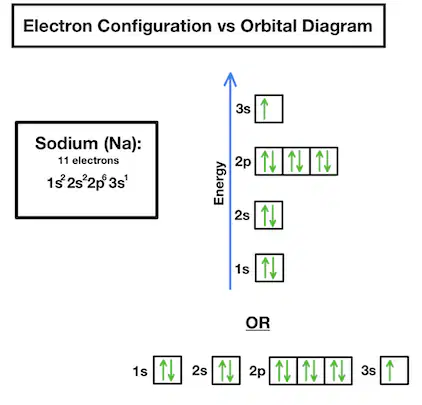
Orbital diagrams and electron configuration notation represent the same information in different forms: the diagram shows individual orbital boxes with spin-specific arrows, while configuration notation uses a condensed shorthand like 1s²2s²2p⁶. Orbital diagrams make Hund's rule and electron spin visible in a way that shorthand notation does not, which is why teachers typically introduce diagrams first to build conceptual understanding before moving to the abbreviated form. Students who understand orbital diagrams are better positioned to explain magnetic properties and exceptions to standard filling order.
How can I differentiate orbital diagram practice for students at different ability levels?
For students who are still developing foundational understanding, restrict practice to elements in the first two periods before introducing d-block elements. More advanced students can work through transition metal configurations, orbital hybridization, and exceptions like chromium and copper. On Wayground, teachers can apply individual accommodations such as reduced answer choices or read-aloud support to specific students, allowing the same quiz session to serve learners at different levels without disrupting the rest of the class.

Accessibility
Features
Wayground Super
School & District
Wayground for Business
Create a quiz
Create a presentation
Wayground AI
Subjects
Mathematics
Social Studies
Science
Physics
Chemistry
Biology
About
Our Story
Wayground Blog
Media Kit
Careers
Support
F.A.Q.
Help & Support
Privacy Policy
Terms of Service
Teacher Resources
2026 Wayground


Get our app

