Search Header Logo
SCIENCE YEAR 9 REVIEW PACKET

SCIENCE YEAR 9 REVIEW PACKET

Assessment

Presentation

Science

8th Grade

Practice Problem

Medium

NGSS
MS-LS4-4, MS-PS1-1, MS-PS3-4

+18

Standards-aligned

Created by

Gil legaspi

Used 2+ times

FREE Resource

101 Slides • 67 Questions

1

SCIENCE YEAR 9 REVIEW PACKET

HCIS

Slide image

2

Keys, Variations, Inheritance

UNIT 3

Slide image

3

Slide image

4

Slide image

5

Slide image

6

Slide image

7

Slide image

8

Slide image

9

Multiple Choice

Where do offspring get their genes?

1

Half from their mom, half from their dad

2

From their mom

3

From their dad

4

From their brains

10

Multiple Choice

Where are genes found?

1

In the mitochondria

2

In our bone marrow

3

Chromosomes, in the nucleus of a cell

4

In our brains

11

Multiple Choice

What is variation?

1

Racial diversity

2

The variation of females and males

3

Variation of personalities

4

The differences between the individuals in a species

12

Multiple Choice

What causes variation?

1

Your environment

2

Your genes and your environment

3

Your genes

4

Your names

13

Multiple Choice

What is a key (genetics)?

1

Something to open a lock

2

Something that tells us which object something is

3

A method of identifying a unknown organism

4

The key to life

14

Selective Breeding and Natural Selection

Slide image

15

Slide image

16

Slide image

17

Slide image

18

Slide image

19

Slide image

20

Multiple Choice

Question image

The long and sharp beak of a woodpecker is an example of

1

natural selection

2

selective breeding

21

Multiple Choice

Which organisms are most likely to survive?

1

The strongest

2

The best adapted

3

The fittest

4

The most athletic

22

Multiple Choice

Question image

Which is an example of selective breeding?

1

A giraffe's long neck.

2

Clipping a horse's tail so it's not too long.

3

Training a horse to run faster.

4

Cross breeding a labrador retriever with a poodle .

23

Multiple Choice

"Survival of the fittest" describes which theory

1

Natural selection

2

Selective breeding

24

Multiple Choice

Selective breeding

1

organisms better adapted to their environment tend to survive and produce more offspring

2

process used by humans to develop new organisms with desirable characteristics

25

Multiple Choice

Natural selection

1

organisms better adapted to their environment tend to survive and produce more offspring

2

process used by humans to develop new organisms with desirable characteristics

26

Multiple Choice

Question image

Change over time

1

Natural Selection

2

Evolution

3

Selective Breeding

4

Homeostasis

27

Material Properties

UNIT 4

Slide image

28

The Structure of Atoms


Slide image

29

Slide image

30

Slide image

31

Slide image

32

Slide image

33

Slide image

34

Multiple Choice

Question image
1
Protons
2
Neutrons
3
Electrons

35

Multiple Choice

Question image
1
Protons
2
Neutrons
3
Electrons

36

Multiple Choice

Question image
1
Protons and Neutrons
2
Protons and Electrons
3
Neutrons and Electrons
4
Neutrons and Valence Electrons

37

Multiple Choice

Question image
1
Number of protons
2
Number of neutrons
3
Number of electrons
4
Mass Number

38

Multiple Choice

Question image
1
Mass Number = Atomic Number + Neutrons
2
Mass Number = Atomic Number - Neutrons
3
Mass Number = Atomic Number + Electrons
4
Mass Number = Atomic Number - Electrons 

39

Multiple Choice

Question image
1
Neutrons = Mass Number + Atomic Number
2
Neutrons = Mass Number - Atomic Number
3
Neutrons = Atomic Number + Electrons
4
Neutrons = Atomic Number - Electrons

40

Periodic Table Trends

Slide image

41

Slide image

42

Slide image

43

Slide image

44

Slide image

45

Slide image

46

Slide image

47

Slide image

48

Multiple Choice

Vertical columns of elements (families) on the periodic table with similar  properties
1
groups
2
periods
3
quadrants
4
rows

49

Multiple Choice

The chart scientists use to organize and classify all the known elements
1
elements chart
2
the chart
3
Periodic Table of the Elements
4
Period table

50

Multiple Choice

A negatively charged subatomic particle that exists in various energy levels outside the nucleus of an atom
1
neutron
2
electron
3
proton
4
subatomic particle

51

Multiple Choice

Atomic radius generally increases as we move __________.  
1
down a group and from right to left across a period 
2
up a group and from left to right across a period 
3
down a group and from left to right across a period 
4
up a group and from right to left across a period 

52

Multiple Choice

Electronegativity __________ from left to right within a period and __________ from top to bottom within a group.
1
decreases, increases 
2
increases, increases
3
increases, decreases 
4
stays the same, increases

53

Multiple Choice

Which statement correctly and completely identifies a trend?
1
Atomic radius decreases across a period and increases down a group.
2
Electronegativity decreases across a period and decreases down a group.
3
Ionization energy increases across a period and increases down a group.
4
Ionic radius increases across a period and increases down a group.

54

Multiple Choice

Electronegativity is...
1
the ability of an atom to attract/ accept electrons
2
the ability of an atom to lose electrons
3
the energy required to remove an electron from a specific atom
4
how easy it is to make friends. 

55

Multiple Choice

As you move down the periodic table atoms get bigger.  This is because ____________.
1
The atoms have more mass.
2
The atoms have more protons.
3
The atoms have more energy levels
4
The atoms have more neutrons

56

Multiple Choice

As atoms of elements in group 16 are considered in order from top to bottom, the electronegativity of each successive element....
1
decreases
2
increases
3
remains the same
4
none of the above

57

Multiple Choice

Which of the following will have a larger radius than Zinc?
1
Gallium
2
Aluminum
3
Magnesium
4
Strontium

58

Energy Changes

UNIT 5

Slide image

59

Slide image

60

Slide image

61

Slide image

62

Slide image

63

Slide image

64

Slide image

65

Slide image

66

Multiple Choice

What type of chemical reaction absorbs energy and requires energy for the reaction to occur?

1

Endothermic

2

Exotermic

3

Exothermic

4

Endotermic

67

Multiple Select

Examples of endothermic reactions

1

Photosynthesis

2

Ice melting

3

Respiration

4

Sodium carbonate + ethanoic acid

5

Water + calcium oxide

68

Multiple Choice

if less heat energy is released in making bonds in the products than is taken in when breaking bonds in the reactants

1

Endothermic

2

Exotermic

3

Exothermic

4

Entrothermic

69

Multiple Choice

if more heat energy is released in making bonds in the products than is taken in when breaking bonds in the reactants

1

Exothermic

2

Endothermic

3

Exotermic

4

Endotermic

70

Multiple Choice

When calcium reacts with water, the temperature changes from 18°C to 39°C. Which statement is correct?

1

The solution at the end is acidic

2

The reaction is reversible

3

The reaction is exothermic

4

The reaction is endothermic

71

Multiple Choice

ΔH value in an endothermic reaction is a positive number.

1

True

2

False

72

Reactivity

UNIT 6

Slide image

73

Slide image

74

Slide image

75

Slide image

76

Slide image

77

Slide image

78

Slide image

79

Slide image

80

Multiple Choice

In nature, metals normally react with other compounds to form minerals. What is the metal that is found in the mineral Haematite?
1
Copper
2
Aluminium
3
Iron
4
Zinc

81

Multiple Choice

When a metal salt reacts with a more reactive salt, what sort of reaction occurs?
1
Displacement
2
Neutralisation
3
Combustion
4
No Reaction

82

Multiple Choice

Metals can also react with acids. This produces a gas. What is the name of this gas?
1
Hydrogen
2
Carbon Dioxide
3
Nitrogen
4
Oxygen

83

Multiple Choice

How can you tell that a metal is reacting with water?
1
Colour change
2
Bright light
3
Fizzing
4
It gets colder

84

Multiple Choice

The alkali metals are in group 1, on the far left of the periodic table. Which of these is NOT an alkali metal?
1
Lithium
2
Iron
3
Potassium
4
Francium

85

Multiple Choice

Question image
Which metal is more reactive than calcium?
1
magnesium
2
potassium
3
silver
4
aluminum

86

Multiple Choice

Which one of the following metals reacts most vigorously with cold water?
1
Sodium
2
Magnesium
3
Copper
4
Zinc

87

Multiple Choice

Which of the following the most reactive in dilute acid

1

magnesium

2

calcium

3

aluminum

4

zinc

88

Salts

Unit 7

Slide image

89

Slide image

90

Slide image

91

Slide image

92

Slide image

93

Slide image

94

Slide image

95

Slide image

96

Slide image

97

Slide image

98

Slide image

99

Slide image

100

Slide image

101

Slide image

102

Slide image

103

Slide image

104

Slide image

105

Slide image

106

Slide image

107

Slide image

108

Slide image

109

Slide image

110

Multiple Choice

Bryan wants to prepare potassium sulphate by reacting an acid with potassium hydroxide. Name the acid used in this experiment.

1

hydrochloric acid

2

nitric acid

3

sulphuric acid

111

Multiple Choice

Bryan wants to prepare silver chloride in the science laboratory. Which of the following reactants should he use?

1

silver + hydrochloric acid

2

silver hydroxide + hydrochloric acid

3

silver nitrate + potassium chloride

4

silver + chlorine gas

112

Multiple Choice

Precipitation involves mixing ___________ to form an insoluble solid that separates out from the reaction mixture.

1

acid and alkali

2

acid and metal

3

two acids

4

two solutions

113

Multiple Choice

What salt is produced if you react sodium hydroxide with hydrochloric acid?
1
sodium hydroxide
2
sodium sulfate
3
sodium nitrate
4
sodium chloride

114

Multiple Choice

Salts that are made with sulfuric acid are called ______________.
1
chlorides
2
sulfates
3
nitrates
4
carbonates

115

Multiple Choice

Salts that are made with hydrochloric acid are called ______________.
1
chlorides
2
sulfates
3
nitrates
4
carbonates

116

Multiple Choice

What type of reaction produced an insoluble salt?

1

Neutralisation reaction

2

Precipitation reaction

3

Titration reaction

4

Insoluble reaction

117

Multiple Choice

How do you remove the water to leave solid copper sulfate crystals?

1

Filter

2

Evaporate

3

Distill

118

Multiple Choice

Complete the following word equation:

Metal + Acid -->

1

Salt + water

2

Salt + hydrogen

3

Salt + Water + Carbon dioxide

119

Rates of Reaction

UNIT 8

Slide image

120

Slide image

121

Slide image

122

Slide image

123

Slide image

124

Slide image

125

Slide image

126

Slide image

127

Slide image

128

Slide image

129

Slide image

130

Slide image

131

Slide image

132

Slide image

133

Slide image

134

Slide image

135

Slide image

136

Slide image

137

Slide image

138

Slide image

139

Slide image

140

Slide image

141

Slide image

142

Slide image

143

Slide image

144

Slide image

145

Multiple Select

Which factors affect the rate of a reaction?

1

temperature

2

concentration

3

surface area

4

pressure

5

catalyst

146

Multiple Choice

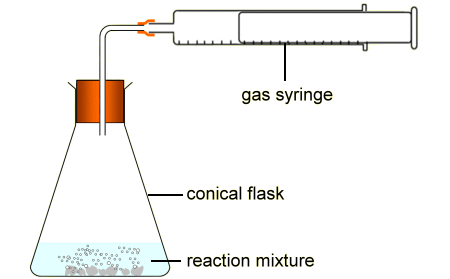
Question image

How is this equipment being used to measure the rate of reaction?

1

The gas syringe measures how much gas is produced in a certain time

2

The reaction mixture will increase in volume in a certain time

147

Multiple Choice

Question image

The amount of something; how many particles in a volume of a mixture

1

Rate

2

Collision

3

Catalyst

4

Concentration

148

Multiple Choice

The speed at which a chemical reaction occurs

1

Fast

2

Slow

3

Rate

4

Ratio

149

Multiple Choice

Why does breaking up a solid reactant increase the rate of reaction?
1
it creates more solid
2
it creates more energy
3
it increases the surface area
4
it increases the concentration

150

Multiple Choice

Question image

Icing sugar has a greater ______ _____ than a solid cube of

sugar.

1

Surface Area

2

Catalyst

3

Temperature

151

Multiple Choice

How can you increase the rate of a reaction?

1

Decrease the pressure

2

Decrease the concentration

3

Increase the concentration

152

Multiple Choice

What is the rate of reaction?

1

How fast a reaction is

2

How big a reaction is

3

How loud a reaction is

153

Multiple Choice

Which factors increase the rate of a reaction?

1

increasing temperature

2

increasing concentration

3

increasing surface area

4

all of these

154

Forces in Action

UNIT 9

Slide image

155

Slide image

156

Slide image

157

Slide image

158

Slide image

159

Slide image

160

Slide image

161

Slide image

162

Multiple Choice

Question image

#16 Show all your work on your answer document. m=D⋅V

1

0.625 g

2

1.6 g

3

10 g

4

7 g

163

Multiple Choice

Question image

#15 Show all your work on your answer document. m=D⋅V

1

0.25 g

2

3 g

3

4 g

4

5 g

164

Multiple Choice

If an object has a density of .6 g/mL and you put it into water, will it sink or float?  
1
sink
2
float

165

Multiple Choice

What two types of measurements make up DENSITY
1
Mass and Volume
2
Temperature and Mass
3
Grams and Centimeters
4
Volume and Weight

166

Multiple Choice

A block of aluminum occupies a volume of 15.0 mL and weighs 40.5 g. What is its density?
1
2.8g/mL
2
2.7g/mL
3
2.66.g/mL
4
2.5g/mL

167

Multiple Choice

Question image
How much water has been displaced in the image shown?
1
40 mL
2
65 mL
3
20 mL
4
25 mL

168

Multiple Choice

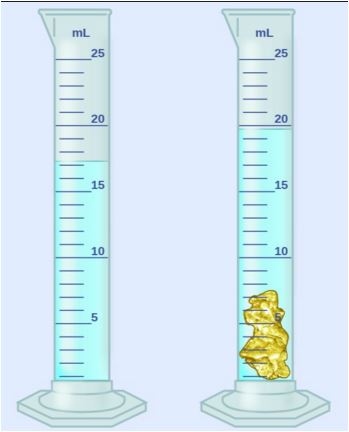
Question image

An irregularly shaped piece of gold was lowered into a graduated cylinder holding a volume of water equal to 17 ml. The height of the water rose to 20 ml. If the mass of the gold was 27 g, what was its density?

1

9 g/mL

2

10.5 g/mL

3

6.5 g/mL

4

8 g/mL

SCIENCE YEAR 9 REVIEW PACKET

HCIS

Slide image

Show answer

Auto Play

Slide 1 / 168

SLIDE