Science 8 Year End Review - Unit C
Presentation
•
Science
•
8th Grade
•
Practice Problem
•
Hard
Standards-aligned
Erin Hill
Used 35+ times
FREE Resource
18 Slides • 12 Questions
1
Science 8 Year End Review - Unit C
2
3
4
5
Multiple Choice
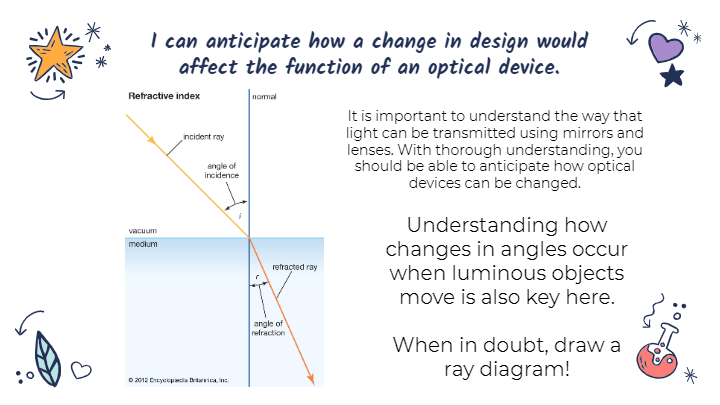
The original theory that indicated light traveled from our eyes to the objects we see was disproven because:
It disobeyed the law of reflection.
We were unable to see in the dark.
Light is split into various colours when put through a prism.
Ole Romer's experiment demonstrated it was false.
6
7
Multiple Choice
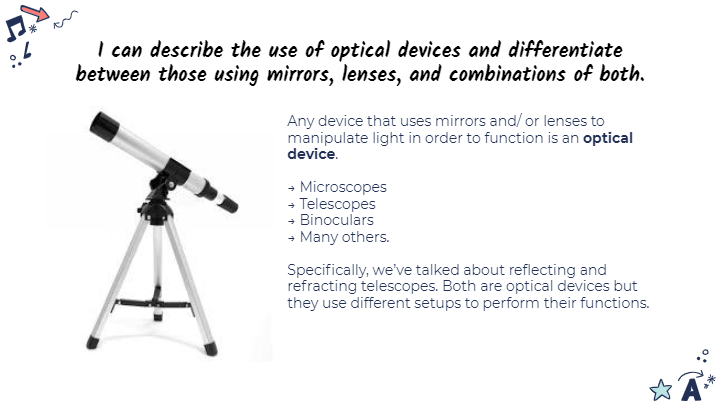
What optical device is being shown in the attached image?
A reflecting telescope which uses only mirrors.
A reflecting telescope which uses mirrors and lenses.
A refracting telescope which only uses lenses.
A refracting telescope which uses mirrors and lenses.
8
9
Multiple Choice
The property of light that allows it to be refracted is:
Light is a form of energy.
Light travels in straight lines.
Light can be reflected.
Light can bend.
10
11
12
Multiple Choice
A frosted light bulb could be described as both:
transparent and luminous
transparent and non-luminous
translucent and luminous
translucent and non-luminous
13
Multiple Choice
Which of the following statements is correct?
The moon is luminous.
opaque materials create umbras.
a penumbra is the darkest part of a shadow.
transparent materials diffuse light slightly as it passes through.
14
Multiple Choice
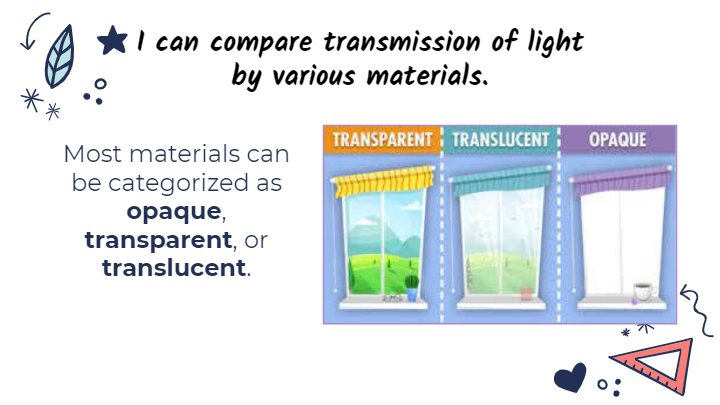
Which image represents a transluscent object?
None of these.
15
16
17
Multiple Choice
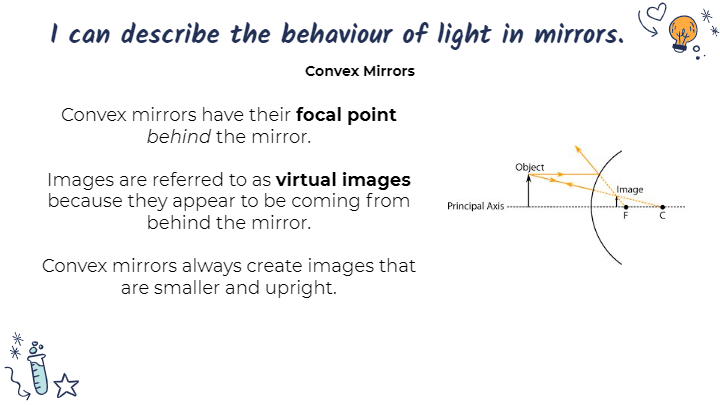
Given the attached image, which statement is correct regarding the reflected image?
This image will be upright and enlarged.
Moving the object towards the mirror will increase the size of the reflection.
The image will flip right side up once it passes the centre of curvature.
The focal point in the concave mirror is behind the mirror.
18
19
Multiple Choice
Which of the statements is true of convex mirrors?
They are not useful if you need an upright image.
At the point of curvature, the images they create will flip right side up.
They are great for use in makeup mirrors.
The virtual image will never be as large as the actual object.
20
21
22
Multiple Choice
Convex and concave lenses have different effects on light because:
The light is slightly reflected in a concave lens.
Differences in light wavelengths alter how it bends.
The thicker the glass, the more light will refract.
None of these.
23
24
Multiple Choice
In the case of telescopes, in order to see a larger area of space, a designer could:
Increase the size of the mirror in a reflecting telescope.
Increase the size of the lens in a reflecting telescope.
Decrease the size of the mirror in a refracting telescope.
Decrease the size of the lens in a refracting telescope.
25
26
27
Multiple Choice
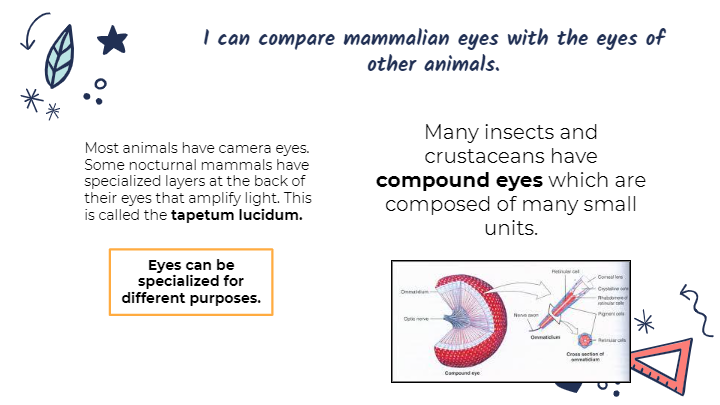
Paralysis in the nerves that control the movement of the iris would result in:
A reduction in the number of rods and cones in the retina.
Difficulty adjusting to varying levels of light.
Eventual damage to the cornea.
Issues relaying messages to the brain through the optic nerve.
28
29
Multiple Choice
When compared to a camera, which part of the eye is most similar to the aperture?
Iris
Retina
Pupil
Lens
30
Science 8 Year End Review - Unit C

Show answer
Auto Play
Slide 1 / 30
SLIDE

Similar Resources on Wayground
24 questions
Satellite Images and Topographic Maps Test Review LESSON
Presentation
•
8th Grade
21 questions
8.L.5 Review
Presentation
•
8th Grade
21 questions
8.8A Components of the Universe, H-R Diagram Review
Presentation
•
8th Grade
23 questions
Chapter 8, Lesson 2
Presentation
•
8th Grade
23 questions
Newton's 3 Laws of Motion
Presentation
•
8th Grade
24 questions
Review: Watersheds, Estuaries, and Dead Zones
Presentation
•
8th Grade
24 questions
10/17 - Weather Maps and Symbols
Presentation
•
8th Grade
22 questions
Earth/Space Review 4. Earth' Spheres & Earth's Layers
Presentation
•
8th Grade
Popular Resources on Wayground
19 questions
Naming Polygons
Quiz
•
3rd Grade
10 questions
Prime Factorization
Quiz
•
6th Grade
20 questions
Math Review
Quiz
•
3rd Grade
15 questions
Fast food
Quiz
•
7th Grade
20 questions
Main Idea and Details
Quiz
•
5th Grade
20 questions
Context Clues
Quiz
•
6th Grade
20 questions
Inferences
Quiz
•
4th Grade
19 questions
Classifying Quadrilaterals
Quiz
•
3rd Grade
Discover more resources for Science
16 questions
Interactions within Ecosystems
Presentation
•
6th - 8th Grade
12 questions
PS.8.1.2, PS.8.1.3, PS.8.1.5 Review
Quiz
•
8th Grade
20 questions
Moon Phases and Eclipses
Quiz
•
6th - 8th Grade
22 questions
6th & 8th Grade Science Material SOL Review
Quiz
•
6th - 8th Grade
49 questions
NC Released EOG 8 Science (2024)
Quiz
•
8th Grade
48 questions
8th Grade NC Science EOG Review 2
Quiz
•
8th Grade
19 questions
Renewable and Nonrenewable Resources (CK)
Quiz
•
8th Grade
20 questions
8th Grade Science STAAR Review
Quiz
•
8th Grade