Search Header Logo
  1. Resource Library
  2. Science
  3. Earth & Space Science
  4. Weather Fronts
  5. Weather Maps And Station Models
Weather Maps and Station Models

Weather Maps and Station Models

Assessment

Presentation

Science

8th - 10th Grade

Medium

NGSS
MS-ESS2-5, MS-ESS2-6

Standards-aligned

Created by

Michael Stange

Used 25+ times

FREE Resource

6 Slides • 22 Questions

1

​Weather Maps, Station Models, and Air Masses

media

2

Multiple Choice

Question image
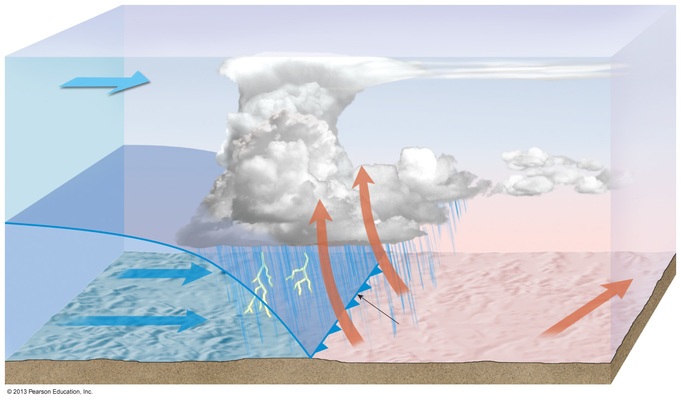
What type of storm front is this? 
1
warm front
2
cold front
3
stationary front
4
occluded front

3

Multiple Choice

When a warm air mass gently slides on top of a cold air mass, and you have drizzly rain and then warmer weather, what type of front is it?
1
warm front
2
cold front
3
occluded front
4
stationary front

4

Multiple Choice

rapidly moving cold air  mass runs into a warm air mass the cold air slides under the warm air. This is called a  .....
1
cold front
2
warm front
3
stationary front

5

Multiple Choice

Warm air is ______ dense than cool air. Warm air rises and cool air sinks.

1

less

2

more

6

Multiple Choice

Question image
This is the symbol for a... 
1
Stationary Front
2
Occluded Front
3
Cold Front
4
Warm Front 

7

Multiple Choice

Question image
This is the symbol for a... 
1
Cold Front
2
Warm Front
3
Stationary Front
4
Occluded Front 

8

Multiple Choice

Question image
This is the symbol for a... 
1
Stationary Front
2
Occluded Front
3
Cold Front
4
Warm Front

9

Multiple Choice

Question image
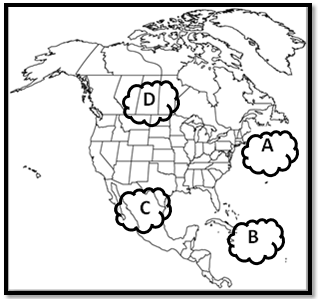
Which type of air would you find at air mass D?
1
cold, dry
2
warm, humid
3
warm, dry
4
cold, humid

10

Draw

Draw an arrow to identify the direction of the weather pattern approaching Virginia. Then indicate what type of weather is moving towards Virginia.

11

12

Draw

Answer the following: Identify which part tells you wind speed. What direction is the wind blowing? What is the current sky conditions? Is there precipitation and, if so, how much?

13

Multiple Choice

Question image

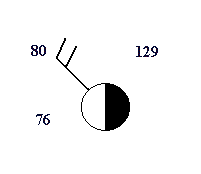
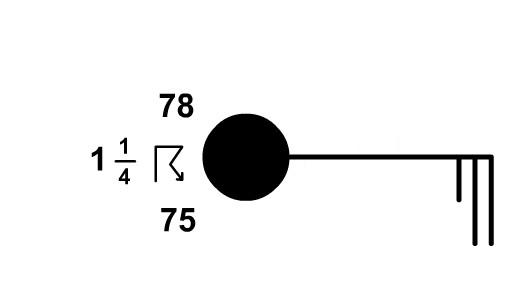
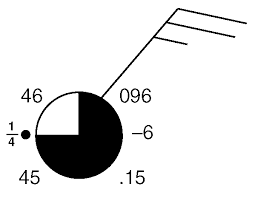
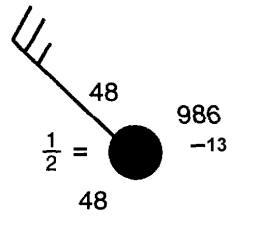
What is the temperature for the following station model?

1

4 ºF

2

76 ºF

3

80 ºF

4

129 ºF

14

Multiple Choice

Question image

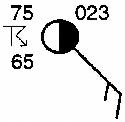
What is the dewpoint for the following station model?

1

10 ºF

2

23 ºF

3

65 ºF

4

75 ºF

15

Multiple Choice

Question image

What is the present weather for the following station model?

1

rain

2

thunderstorms

3

drizzle

4

fog

16

Multiple Choice

Question image

What is the amount of precipitation for the following station model?

1

.15 in

2

1/4 in

3

6 in

4

46 in

17

Multiple Choice

Question image

What is the wind direction for the following station model?

1

north

2

east

3

northwest

4

northeast

18

Multiple Choice

Question image

What is the wind speed at this location?

1

5 knots

2

10 knots

3

15 knots

4

20 knots

19

​What is an Air Mass?

​​An air mass is a large volume of air in the atmosphere that is mostly uniform in temperature and moisture. Air masses can extend thousands of kilometers across the surface of the Earth, and can reach from ground level to the stratosphere—16 kilometers (10 miles) into the atmosphere.

20

​Where do Air Masses Form?

Air masses form over large surfaces with uniform temperatures and humidity, called source regions. Low wind speeds let air remain stationary long enough to take on the features of the source region, such as heat or cold. When winds move air masses, they carry their weather conditions (heat or cold, dry or moist) from the source region to a new region. When the air mass reaches a new region, it might clash with another air mass that has a different temperature and humidity. This can create a severe storm.

21

​Types of Air Masses

Meteorologists identify air masses according to where they form over the Earth. There are two main categories for air masses: tropical and polar.

Polar air masses form in the arctic region and are very cold. Tropical air masses form in low-latitude areas and are moderately warm.

Air masses are also identified based on whether they form over land or over water. Maritime air masses form over water and are humid. Continental air masses form over land and are dry.

22

​Air Masses

Air masses are classified on weather maps using two or three letters.

  • A lowercase letter describes the amount of moisture in the air mass (m for maritime and c for continental).

  • ​An uppercase letter describes the heat of the air mass: T for tropical and P for polar.

  • ​There are 4 air mass abbreviations, which can be seen in the diagram to the right.

media

23

Multiple Choice

Describe an arctic air mass.
1
Dry
2
Wet
3
Cold
4
Warm

24

Multiple Choice

Describe a tropical air mass.
1
Dry
2
Wet
3
Cold
4
Warm

25

Multiple Choice

What types of air masses form over oceans?
1
Maritime
2
Continental
3
Polar
4
Tropical

26

Multiple Choice

What types of air masses form over land?
1
Maritime
2
Continental
3
Polar
4
Tropical

27

Multiple Choice

What types of air masses would be colder?
1
Maritime
2
Continental
3
Polar
4
Tropical

28

Multiple Choice

What types of air masses would be warmer?
1
Maritime
2
Continental
3
Polar
4
Tropical

​Weather Maps, Station Models, and Air Masses

media

Show answer

Auto Play

Slide 1 / 28

SLIDE