Search Header Logo
  1. Resource Library
  2. Science
  3. Earth & Space Science
  4. Galaxy Types
  5. Space Science Part 2: The Universe
Space Science Part 2: The Universe

Space Science Part 2: The Universe

Assessment

Presentation

Science

10th Grade

Practice Problem

Hard

NGSS
HS-ESS1-1, MS-ESS1-2, HS-ESS1-2

+1

Standards-aligned

Created by

Abby Fancsali

Used 13+ times

FREE Resource

18 Slides • 14 Questions

1

Space Science Part 2: Stars & Galaxies

2

​Lesson Objectives

  • Describe the relationship between star temperature and brightness

    • Interpret an H-R Diagram

  • Describe how a star changes over time

  • Distinguish between types of Galaxies

  • Describe the Events of the Big Bang

3

The Night Sky

  • Watching the stars was easier before modern cities

    • Lights and pollution make it hard to see​

  • Throughout History, people built structures to help follow the movement of the sun and the moon

    • Stonehenge in England

  • Every star generates its owns light which is reflected through the atmosphere

    • Stars seen outside of the atmosphere don't "twinkle" the way they do on Earth​

media

4

Measuring distance in space

  • Unit of astronomical distance is the light-year (ly)

    • The distance light travels in one year

    • 9.5 × 10¹² km​

media

5

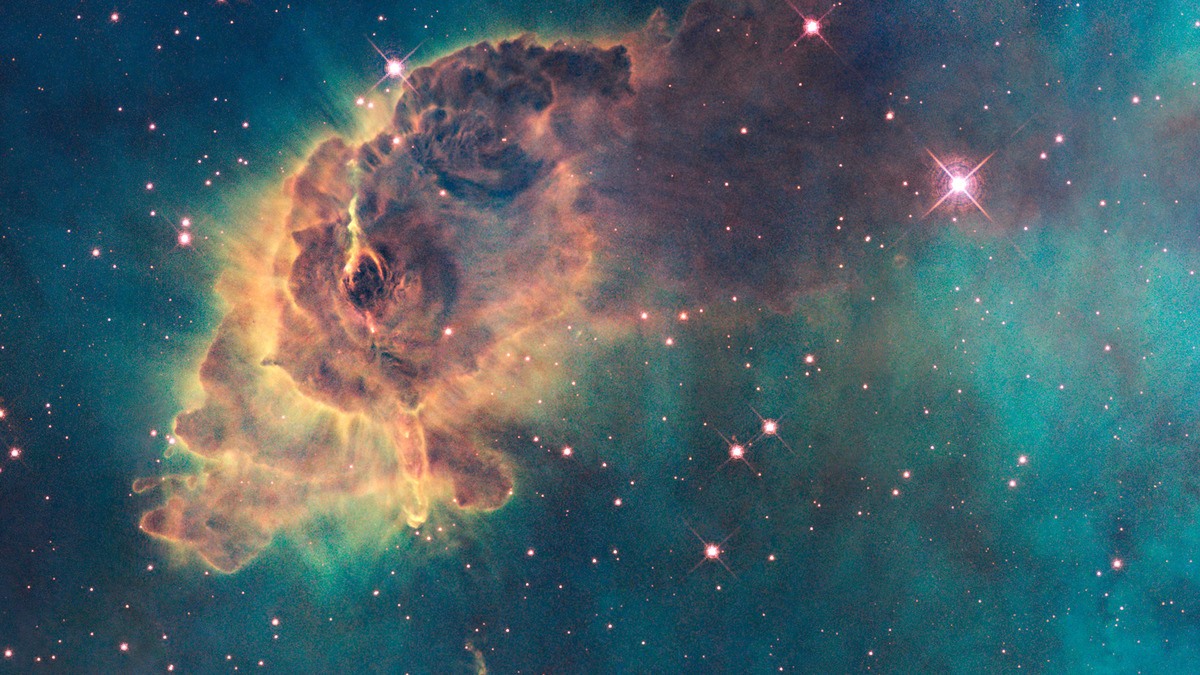
Origin of Stars

  • Stars come from nebulae, swirling clouds of hydrogen

    • Nebulae have very little mass and don't exert much gravity

  • As atoms in the nebula move, they are slowly brought closer and closer together and form a protostar

    • Still smaller than a star,

  • Protostars tend to shrink and pull matter closer together, raising the pressure and temperature to the point that eventually nuclear reactions take place, making it a full-grown star

    • Radiation forces cause the star to expand, and gravity causes the star to contract​

6

Hertzsprung-Russell Diagrams

  • There are patterns between the luminosity and temperature of stars

  • Two Astronomers, Ejnar Hertzsprung and Henry Noris Russel, mapped out this relationship in a chart called a Hertzsprung-Russell Diagram

    • Divides stars into distinct regions

    • Shows that the hotter stars are, the brighter they tend to burn

      • Blue stars burn hotter because they have more energy

media

7

Multiple Choice

Question image

In the H-R diagram, what happens as we move to the left?

1
Stars Get Larger
2
Stars get Colder
3
Stars get hotter

8

Multiple Choice

Question image
Use the Hertzsprung-Russell Diagram to answer the following question.  Betelgeuse is a _____
1
Hot and Bright Star
2
Cool and Bright Star
3
Hot and Dim Star
4
Cool and Dim Star

9

Multiple Choice

Question image

Analyze the HR Diagram. Which group of stars is considered to have lower than average luminosity as well as a higher than average temperature?

1
Giants
2
Main Sequence
3
White Dwarfs
4
Super Giants

10

Multiple Choice

Question image
On the H-R diagram, the Sun is a _____.
1
Main Sequence star
2
Red Giant
3
White Dwarf
4
Blue Giant

11

Evolution and Death of Stars

  • All Stars "burn" nuclear fuel

    • When that fire burns out, the star dies

  • Stars go through several stages before their death that depend on the mass of the star

12

Medium Sized Star Death

  • In Medium-sized stars, As helium contracts, the core heats up and expands to become a Red Giant

    • Our sun will do this in about 5 billion years

media

13

Smaller Sized Star Death

  • In Smaller-sized stars, the masses are not hot enough to fuse carbon, so they shrink

  • While shrinking, they lose particles and leave behind the core, which is called a White Dwarf

    • will eventually burn out and change into a stellar remnant and change colors from white to yellow to red to black

media

14

Binary Stars

  • Binary Stars: Some white dwarf stars "pair up" and exert a pull on each other

    • One star may pull hydrogen from the other and ignite fusion

      • Nova: the thermonuclear explosion of a star

media

15

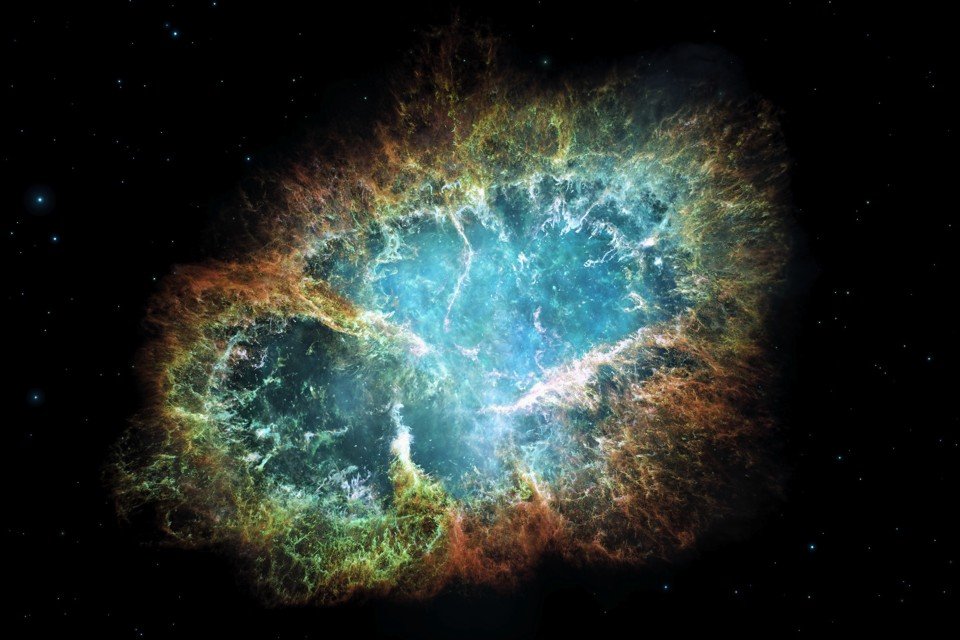
Supernovae

  • Larger stars don't go through the different dwarf stages

    • As larger stars contract, heat is generated, allowing carbon nuclei to fuse in the core and release heavier elements until iron is formed

      • Contraction pauses until all carbon is fused, then continues

  • Fusing elements beyond iron requires more energy than the star can release, causing the star to collapse into a Black hole

    • Gravity in a black hole is so strong that nothing can escape it

16

17

Multiple Choice

What determines if a star becomes a white dwarf, neutron star, or black whole?

1

Size

2

Shape

3

Types of Elements in the star

4

The age of the star

18

Multiple Choice

Gases in a nebula come together to form what?

1

red dwarfs

2

protostars

3

black holes

4

white dwarfs

19

Multiple Choice

Smaller stars turn in to these as they age

1

nova

2

supernova

3

black holes

4

white dwarfs

20

Galaxies

  • A Galaxy is a large group of stars, planetary nebulae, and interstellar gas/dust held together by gravity

    • We exist in the Milky Way Galaxy​

      • In good conditions, we can see the outline of the Milky Way with our eyes

  • Galaxies come in three main shapes

media

21

Elliptical Galaxies

  • The most Common type of galaxy in the universe

    • Sphere shaped, with most stars crowded towards the center​

    • Contain little gas or dust

    • Are see through, and usually yellow

      • primarily older stars

    • Smaller than other types of Galaxies

media

22

Spiral Galaxies

  • Have different arrangements of stars

    • Have some sort of hub with in them

    • Most have a black hole in the center​

media

23

Irregular Galaxies

  • Irregular Galaxies have no clear shape

  • As galaxies move in space, they may collide with each other and distort each other into unusual shapes

media

24

The Big Bang

  • Until the 1920's, scientists thought the Milky way the entire Universe

  • 1924: Edwin Hubble used a powerful telescope to see the Andromeda galaxy

  • 1931: Fr. Georges Lemaitre proposed the Big Bang theory

    • At one point, the universe exploded into being and began to grow, and it continues to do so

      • A cosmic egg

    • His idea was originally rejected as being too extreme, but was proven correct and accepted

media
media

25

Understanding The Big Bang

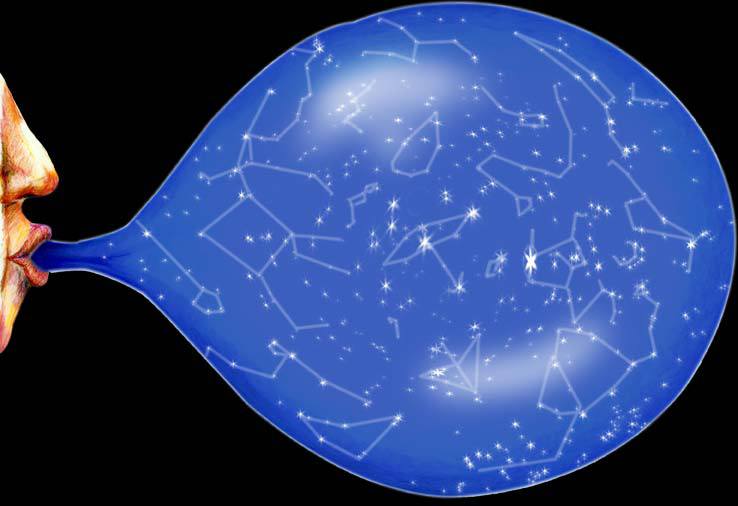
  • A major implication of the Big Bang is that the universe continues to expand

    • Space itself moves farther apart

      • Example: Think of a collection of ants on a balloon. As the balloon expands, the ants move farther apart, each compared to others

  • Hubble's Law: A relationship between the distance of galaxies and the speed they appear to move from Earth

    • The farther away a galaxy is, the faster it appears to move

media

26

Multiple Choice

Question image
What is the name of the gas/dust clouds where all stars form?
1
Nebulas
2
Protostars 
3
Supernova
4
Neutron Star

27

Multiple Choice

Question image
What type of galaxy is this?
1
Spiral
2
Elliptical
3
Irregular 
4
Irrational

28

Multiple Choice

The life cycles of stars are determined by their:
1
mass (size)
2
color
3
distance from Earth
4
luminosity

29

Multiple Choice

Question image
What type of galaxy is this?
1
Spiral
2
Elliptical
3
Irregular
4
Irrational

30

Multiple Choice

Question image
What is the name of the explosion at the death of a massive star?
1
Supergiant
2
Supernova
3
Black Hole
4
Nebula

31

Multiple Choice

Question image
What type of galaxy is this?
1
Spiral
2
Elliptical
3
Irregular
4
Irrational

32

Multiple Choice

Question image
What does the Big Bang theory suggest?
1

The universe is just there

2
The Milky Way is the only solar system
3
The universe is continually expanding
4
The universe is collapsing in toward a single point

Space Science Part 2: Stars & Galaxies

Show answer

Auto Play

Slide 1 / 32

SLIDE