Search Header Logo
  1. Resource Library
  2. Science
  3. Chemistry
  4. Heating Curve
  5. Heating Curve
Heating Curve

Heating Curve

Assessment

Presentation

Science

11th Grade

Easy

NGSS
MS-PS1-4, MS-ESS1-1, MS-PS3-4

+19

Standards-aligned

Created by

Jolene Kayser

Used 6+ times

FREE Resource

18 Slides • 43 Questions

1

media

Review and Heating Curves

Some text here about the topic of discussion.

2

First some review questions... Yes - this is a grade

Some text here about the topic of discussion

3

Multiple Choice

Question image

TRUE or FALSE: Liquids have a fixed volume but not a fixed shape.

1

TRUE

2

FALSE

4

Multiple Choice

Question image

Phase change from solid to gas is called:

1

Freezing

2

Condensation

3

Vaporization

4

Sublimation

5

Multiple Choice

Question image

Phase change from liquid to gas is called:

1

Freezing

2

Condensation

3

Vaporization

4

Sublimation

6

Multiple Choice

Question image

Phase change from liquid to solid is called:

1

Melting

2

Freezing

3

Deposition

4

Condensation

7

Multiple Choice

Question image

Look at the picture. Which state of matter is in beaker C?

1

Solid

2

Liquid

3

Gas

4

Blue thingys

8

Multiple Choice

Question image

What is sublimation? (Definition)

1

When liquid turns in solid.

2

When solid turns into gas.

3

When gas turns into solid.

4

When solid turns into liquid.

9

Multiple Choice

The unit for mass is...

1

Newton

2

grams

3

mililiters

4

centimeters

10

Multiple Choice

Question image

Measuring the volume of a block uses which equation

1

Length ×Width×HeightLength\ \times Width\times Height  

2

(radius)2×Length×π\left(radius\right)^2\times Length\times\pi  

11

Multiple Choice

What is the density of water?

1

34 g/mL

2

1 g/mL

3

29 g/mL

4

6 g/mL

12

Fill in the Blank

13

Fill in the Blank

14

Fill in the Blank

15

Multiple Choice

Question image

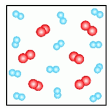
What is shown in the picture?

1

Element

2

Compound

3

Mixture

16

Multiple Choice

Question image

What is shown in the picture?

1

Element

2

Compound

3

Mixture

17

Multiple Choice

Question image
This diagram represents a _____.
1

pure substance that is a compound

2

mixture of elements

3

pure substance that is an element

4

mixture of compounds

18

Multiple Choice

Question image

What type of change is this?

1

Chemical

2

Melting

3

Evaporation

4

Condensation

5

Sublimation

19

Now get your packet out and open to pg. 11

Some text here about the topic of discussion

20

Use the following notes to complete page 13.

Make sure to label all the graphs and answer all the questions

21

media

22

media

23

media

24

media

25

media

26

media

27

media

28

media

​Here are some summary slides

You will need to know

  1. Where is a solid / liquid/ gas

  2. What is the melting, freezing and boiling point​

29

media

​Here are some summary slides

You will need to know

  1. Where is a solid / liquid/ gas

  2. What is the melting, freezing and boiling point​

This might be wise to draw (small) on your Periodic Table or Index Card​

30

Multiple Choice

Question image
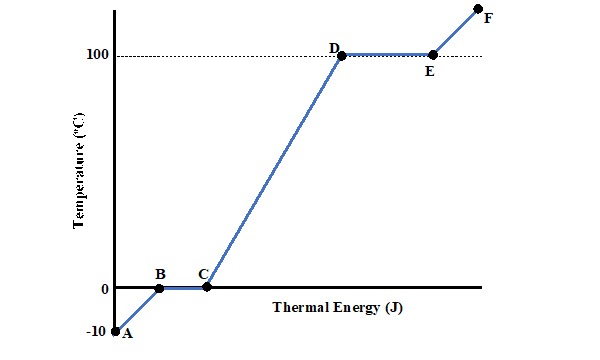
What line segment represents only the solid state?
1

A-B

2

B-C

3

C-D

4

D-E

31

Multiple Choice

Question image
In which segment is the kinetic energy remaining constant?
1

A-B

2

B-C

3

C-D

4

E-F

32

Multiple Select

Question image

Between which points is water changing states of matter?

1

A <----> B

2

B <----> C

3

C <----> D

4

D <----> E

5

E <----> F

33

Multiple Choice

Which of the following terms identifies the change from a liquid to gas?
1

Vaporization

2

Condensation

3

Deposition

4

Sublimation

34

media

35

media

36

Labelling

Use the following question to correct the answers in your packet.

Drag labels to their correct position on the image
Liquid
Solid
Freezing
Melting
Vaporization
Condensation
Gas

37

media

38

Hotspot


Which two spots represent an EXOTHERMIC physical change. Add the letters to your answer to your notes!

39

Hotspot


Which two spots represent an ENDOTHERMIC physical change. Add the letters to your answer to your notes!

40

Math Response


What is the temperature (in degrees Celsius) of the condensation point for NaCl? (Number only)

Make sure to add this to your notes

Type answer here
Deg°
Rad

41

Math Response


What is the temperature (in degrees Celsius) of the freezing point for NaCl? (Number only)

Make sure to add this to your notes

Type answer here
Deg°
Rad

42

media

​The following questions will help you check your answers for the right side of page 11.

You may complete that page before continuing or complete it as you go.

43

Multiple Choice

Question image

(1) In what part of the curve would substance X have definite shape and definite volume?

1

I

2

II

3

III

4

IV

5

V

44

Multiple Choice

Question image

(2) In what part of the curve would substance X have definite volume but no definite shape?

1

I

2

II

3

III

4

IV

5

V

45

Multiple Choice

Question image

(3) In what part of the curve would substance X have no definite shape or volume?

1

I

2

II

3

III

4

IV

5

V

46

Multiple Choice

Question image

(4) What part of the curve represent a mixed solid/liquid phase of substance X?

1

I

2

II

3

III

4

IV

5

V

47

Multiple Choice

Question image

(5) What part of the curve represent a mixed liquid/vapor phase of substance X?

1

I

2

II

3

III

4

IV

5

V

48

Multiple Choice

Question image

(6) What is the melting temperature of substance X?

1

-15

2

5

3

55

4

4

5

80

49

Multiple Choice

Question image

(7) What is the boiling temperature of substance X?

1

-15

2

5

3

55

4

18

5

80

50

Multiple Select

Question image

(8) In what part(s) of the curve would increasing kinetic energy be displayed? Select all that apply

1

I

2

II

3

III

4

IV

5

V

51

Multiple Select

Question image

(9) In what part(s) of the curve would increasing potential energy be displayed? Select all that apply

1

I

2

II

3

III

4

IV

5

V

52

Multiple Choice

Question image

(10) In what part of the curve would the molecules of substance X be farthest apart?

1

I

2

III

3

IV

4

V

5

II

53

Multiple Choice

Question image

(11) In what part of the curve would the molecules of substance X have the lowest kinetic energy?

1

I

2

III

3

IV

4

V

5

II

54

Multiple Choice

Question image

(12) In what part of the curve would the molecules of substance X have the greatest kinetic energy?

1

I

2

III

3

IV

4

V

5

II

55

​Other Review Questions...

56

Multiple Choice

Question image

The melting point of the sample is

1

-60 ºC

2

20 ºC

3

60 ºC

4

100 ºC

57

Multiple Choice

A measure of the average kinetic energy of the particles in an object is called

1

Heat

2

Temperature

3

Kinetic energy

4

Enthalpy

58

Multiple Choice

Question image

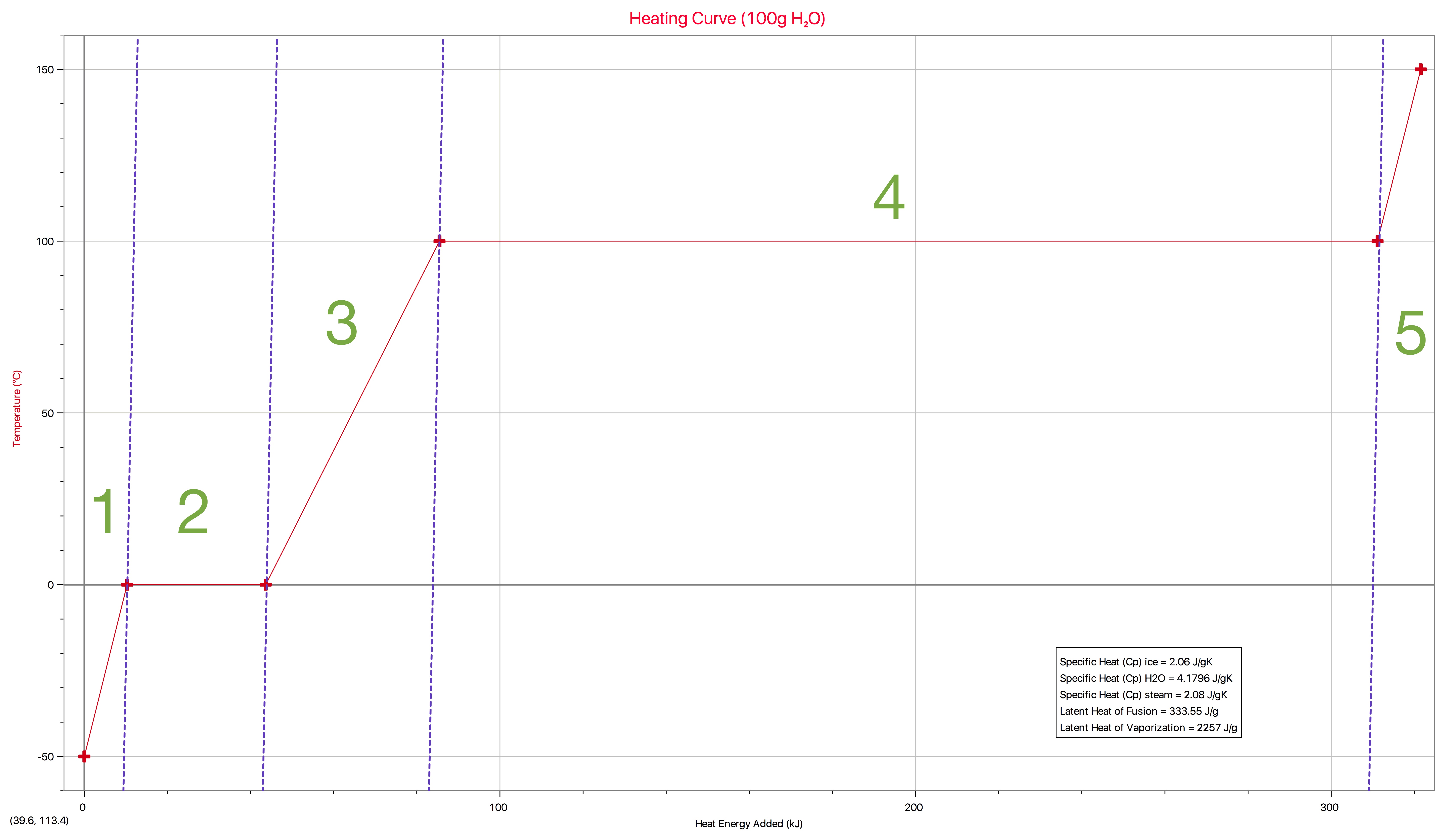
In which region(s) does temperature increase?

1

Region C only

2

Regions B and D

3

Regions A, C, and E

4

Regions A and B

59

Multiple Choice

Question image

Describe the substance at letter A.

1

Solid

2

Liquid

3

Melting

4

Evaporating

60

Multiple Choice

Question image
In which region(s) does temperature remain constant?
1
Region 1, 3, & 5
2
Region 2 & 4
3
Region 1 only
4
Region 1 & 2

61

Multiple Choice

Question image

Describe the substance at letter A.

1

Solid

2

Liquid

3

Melting

4

Evaporating

media

Review and Heating Curves

Some text here about the topic of discussion.

Show answer

Auto Play

Slide 1 / 61

SLIDE