Search Header Logo
AKS 9 Waves

AKS 9 Waves

Assessment

Presentation

Science

8th Grade

Medium

NGSS
MS-ESS1-1, MS-PS4-1, MS-ESS2-5

+17

Standards-aligned

Created by

Marissa Brown

Used 7+ times

FREE Resource

35 Slides • 53 Questions

1

Introduction to Wave pt 3: EM vs Mechanical Waves

2

Multiple Choice

Question image
1. What property of a wave is represented by letter A?
1

A. Wavelength

2

B. Amplitude

3

C. Speed

4

D. Frequency

3

Multiple Choice

Question image
2. What property of a wave is represented by letter B?
1

A. Wavelength

2

B. Amplitude

3

C. Speed

4

D. Frequency

4

Multiple Choice

Question image
3. What property of a wave is represented by letter C?
1

A. Wavelength

2

B. Amplitude

3

C. Speed

4

D. Frequency

5

Multiple Choice

Question image
4. What part of a wave is represented by letter D?
1

A. Crest

2

B. Compression

3

C. Rarefaction

4

D. Trough

6

Multiple Choice

7. Which of the following occurs as the frequency of a wave decreases?
1
A. The wavelength increases
2
B. The wavelength decreases
3
C. The wavelength increases and then decreases
4
D. The wavelength remains the same

7

Multiple Choice

16. The highest part of a transverse wave is known as a ____________________.
1
Crest
2
Trough
3
Compression
4
Rarefaction
5
Medium

8

Types of Waves

  • Waves may be categorized based on whether or not they need a medium.

  • There are two types of waves:

    • 1.) Mechanical waves: require a medium (matter) to travel.

      2.) Electromagnetic (EM) waves: do NOT require a medium to travel.

media

9

​Mechanical waves

  • ​These require a medium for the vibrations to travel and so cannot travel through space (vacuum)

  • ​May either move as transverse or longitudinal waves.

  • ​Ex. sound, water wave, slinky,

media

10

​​Mechanical waves

  • ​The speed at which they travel depends on either the type of wave or the medium they are in.

  • ​They travel fastest in more dense medium. Therefore, they move fastest in solids and slowest in gases.

  • ​Generally, these have longer wavelengths than electromagnetic waves.

media

11

media

12

​Electromagnetic Wave

  • A waves that does NOT require a medium (matter to travel), has an electric field component and a magnetic field component.

  • ​These two fields move perpendicular to the propagation of the wave and so they are all transverse waves

media

13

​Electromagnetic waves

  • All electromagnetic waves travels at the speed of light 3.0 x 10⁸ m/s in a VACUUM. However, they travels at different speeds when traveling through matter.

  • They travel fastest in less dense medium, so fastest in gases and slowest in solids.

  • Ex: Radio waves, Microwaves, Infrared, Visible Light, Ultraviolet, X-rays, and Gamma Ray.

media

14

​Electromagnetic Spectrum

  • ​Shows a visual display of various electromagnetic waves to compare their relative wavelengths and frequencies.

media

15

Multiple Choice

Which type of waves must have a medium in order to travel?

1

electromagnetic wave

2

mechanical wave

16

Multiple Choice

Mechanical waves usually travel fastest through:

1

solids

2

liquids

3

gases

17

Multiple Choice

Which type of waves must have a medium in order to travel?

1

electromagnetic wave

2

mechanical wave

18

Multiple Choice

Wave with the longest wavelength
1
microwave
2
radio
3
gamma
4
visible light

19

Multiple Choice

When the wavelength increases the frequency will

1

increase

2

decrease

3

remain same

4

none of these

20

Multiple Choice

EM waves  
1
Must travel through a vacuum
2
Can travel through a medium or a vacuum
3
Are the same type of wave as mechanical waves
4
Can only travel through a vacuum

21

Multiple Choice

All electromagnetic waves have the same...
1
frequency
2
speed
3
wavelength
4
energy

22

Multiple Choice

When a wave is travelling through matter, what happens to the matter?

1

The matter is pulled along behind the wave as that makes it a longitudinal wave.

2

The wave is making the matter move back and forth as that will make a transverse wave.

3

The wave is making the matter move up and down.

4

The matter is pulled along behind the wave as that makes it a compressional wave.

5

The matter does not move along with the wave.

23

Multiple Choice

It depends on the medium in which the wave is traveling. It varies in solids, liquids and gases.

1

Frequency

2

Wave speed

3

Amplitude

4

Wavelength

24

Multiple Choice

Question image

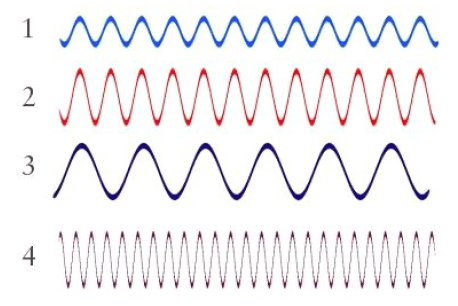
Which wave in the diagram has the greatest wavelength?

1

1

2

2

3

3

4

4

25

Wave Properties

media

26

Wave Interactions

Let's see what we know...

media

27

Parts of a Wave

Amplitude, Wavelength, Frequency, Wave Speed

All waves have these properties, regardless of their classification

28

Multiple Choice

Question image

What type of wave interaction is described by the bouncing back of a ray of light, sound, or heat when the ray hits a surface that it does not go through?

1

Reflection

2

Refraction

3

Diffraction

4

Interference

29

Amplitude

  • Amplitude is the maximum distance the particles vibrate from the rest position.

  • Rest position is the place where the particles of a medium stay when there is no disturbance. The taller the wave = larger amplitude

  • The taller the wave = larger amplitude

media

30

Multiple Choice

Question image

A water wave is an example of what type of wave?

1

electromagnetic wave

2

mechanical wave

31

media

32

Poll

If a wave has a small amplitude, do you think it has low energy or high energy?

Low energy

High Energy

33

Multiple Choice

The angle of incidence (incoming ray) will always equal the ray of reflection (outgoing ray).

1

True

2

False

34

Amplitude & Energy

  • Small amplitude = low energy

  • Large amplitude = high energy

media

35

Multiple Choice

What type of interaction is described a the bending of a wave as it passes at an angle from one medium to another?

1

Reflection

2

Refraction

3

Diffraction

4

Interference

36

Measuring Amplitude on a Transverse Wave

  • Measured from the rest position to the crest or trough of the wave

media

37

media

38

Measuring Amplitude on a Longitudinal Wave

  • It is difficult to show amplitude on this wave.

  • Amplitude of a longitudinal wave is related to how tightly packed the compressions are.

  • The tighter the packing = greater amplitude

39

media

40

Wavelength

  • Wavelength is the distance from any point on a wave to an identical point on the next wave

41

Multiple Select

What changes as a wave passes through a new medium?

1

Speed

2

Wavelength

3

Amplitude

4

Direction of the wave

42

Wavelength on Transverse Waves

  • The distance between two adjacent crests

  • OR the distance between two adjacent troughs

media

43

Multiple Choice

What wave interaction is described as the bending of a wave as it moves around an obstacle or passes through a narrow opening?

1

Reflection

2

Refraction

3

Diffraction

4

Rarefaction

44

Wavelength on Longitudinal Waves

  • The distance between two adjacent rarefactions

  • OR the distance between two adjacent compressions

media

45

media

46

Wavelength & Energy

  • The shorter the wavelength the greater the energy

  • OR the longer the wavelength the lower the energy

  • They are inversely proportional

  • The symbol for wavelength is the Greek letter lamda--> λ

47

media

48

Frequency

  • The number of vibrations (waves, cycles) that occur per second

  • Unit is Hertz (Hz)

  • 1 Hz = one wave per second

  • High frequency carry high energy

49

Multiple Choice

There is _______ relationship between the size of the opening a wave passes through and the amount of diffraction it experiences.

1

no apparent

2

a direct

3

an indirect

50

Frequency in Transvese Waves

  • Frequency is measured by the number of crests OR troughs that pass a certain point over a certain amount of time

media

51

Multiple Choice

What type of wave interaction is the interaction between waves that meet and overlap?

1

Reflection

2

Transmission

3

Transmutation

4

Interference

52

Frequency in Longitudinal Waves

  • To find the frequency, count the number of compressions or rarefactions.

media

53

media

54

Multiple Choice

Question image

Which wave carries more energy?

1

Wave A

2

Wave B

55

media

56

Wave Speed

  • Wave speed is the speed at which a wave travels

  • The speed depends on the medium in which the wave is traveling

  • Wave speed = wavelength x frequency

57

media

58

Multiple Choice

Question image

Which type of interference would result if waves A & B overlapped?

1

Constructive interference

2

Destructive interference

59

Multiple Choice

Question image

What type of interaction does this picture represent?

1

Reflection

2

Interference

3

Refraction

4

Diffraction

60

Multiple Choice

Question image

What type of interaction does this picture represent?

1

Reflection

2

Interference

3

Refraction

4

Diffraction

61

Multiple Choice

Question image

What type of interaction does this picture represent?

1

Reflection

2

Interference

3

Refraction

4

Diffraction

62

Multiple Choice

Question image

What type of interaction does this picture represent?

1

Reflection

2

Interference

3

Refraction

4

Diffraction

63

Multiple Choice

Question image

What type of interaction does this picture represent?

1

Reflection

2

Interference

3

Refraction

4

Diffraction

64

Multiple Choice

Question image

What type of interaction does this picture represent?

1

Reflection

2

Interference

3

Refraction

4

Diffraction

65

Multiple Choice

Question image

What type of interaction does this picture represent?

1

Reflection

2

Interference

3

Refraction

4

Diffraction

66

Doppler Effect

media

67

Learning Outcomes

  • State the Doppler Effect

  • Be able draw the Doppler effect

  • Give examples

  • Explain in terms of frequency

68

69

Multiple Choice

Question image
What can you tell about this object's motion?
1
Moving to the North (up).
2
Moving to the South (down). 
3
Moving to the West (left). 
4
Moving to the East (right). 

70

Multiple Choice

Question image
What can you tell about the motion of this object?
1
Moving left.
2
Moving right quickly.
3
Standing still. 
4
Moving up slowly. 

71

Multiple Choice

The vast majority of galaxies in our universe are moving away from us.  We know this because we observe __________ in the galaxies absorption spectra.
1
Redshift
2
Blueshift
3
Turbulance
4
Superposition

72

Multiple Choice

If a star is being observed from Earth and it's light has shifted towards the blue side of the electromagnetic spectrum it would be...
1
Moving towards the Earth
2
Moving away from the Earth
3
This is a trick question that cannot be answered
4
It isn't a star, it is a very large blueberry.

73

Multiple Choice

What best describes the doppler effect?
1
An apparent change in frequency of a wave due to the relative motion between a wave source and an observer
2
When sound changes pitch
3
When light changes color
4
An apparent change in the amplitude of a wave due to the relative motion between a wave source and an observer.

74

Multiple Choice

Question image
The Doppler effect is seen when a wave-making source moves toward an observer. 
1
True
2
False

75

Multiple Choice

Question image
When an ambulance move TOWARD you it sounds ________ pitched. 
1
high
2
low
3
medium

76

Multiple Choice

Question image
When the car moves AWAY from you, its horn seems...
1
Low pitched
2
High pitched
3
Normal

77

Multiple Choice

Question image
Short sound waves are...
1
high pitched
2
low pitched
3
medium pitched

78

Multiple Choice

Question image
Long sound waves are...
1
high pitched
2
low pitched
3
medium pitched

79

80

Multiple Choice

Sound does not travel in space because
1
Space is too far away.
2
There is no matter in space.
3
Space is the final frontier
4
Space has planets.

81

Multiple Choice

Question image

Roughly what is the speed of sound in water?

1

About 350 m/s

2

About 1 500 m/s

3

About 5000 m/s

4

About 1800 m/s

82

Multiple Choice

Roughly what is the speed of sound in air?

1

The speed of light.

2

About 10 m/s

3

About 340 m/s

4

About 1 500 m/s

83

Multiple Choice

Why does sound travel faster in solids than in liquids or gases.

1

They are harder.

2

The particles are closer together.

3

Solids have more energy.

4

Gases fill their container.

84

Multiple Choice

Which state of matter do sounds travel fastest in?

1

Solid

2

Liquid

3

Gas

4

Plasma

85

Multiple Choice

Which factor does not affect the speed of sound:
1
temperature
2
distance
3
density
4
elasticity

86

Poll

How are you at stating the Doppler Effect

Very confident

Okay

Not sure

Not a clue

87

Poll

How are you at giving examples of the Doppler effect?

Very confident

Okay

Not sure

Not a clue

88

Poll

How are you at explaining frequencies?

Very confident

Okay

Not sure

Not a clue

Introduction to Wave pt 3: EM vs Mechanical Waves

Show answer

Auto Play

Slide 1 / 88

SLIDE