Search Header Logo
8.11-The Sun and Other Stars

8.11-The Sun and Other Stars

Assessment

Presentation

•

Mathematics

•

9th Grade

•

Hard

Created by

Jessica Freeman

FREE Resource

56 Slides • 67 Questions

1

media

​NOTES PAGES HERE

2

Chapter 11
Stars & Galaxies
Lesson 8.11.2-The Sun & Other Stars


Mrs. Freeman's Classroom (Notes to Print)

3

media

​

​

4

media

​

​

5

media

Chapter 11-Stars & Galaxies
Lesson 8.11.1-The View from Earth

Let's take a look at the first question we will answer:

1. How do stars shine?

2. How are stars layered?

3. How does the sun change over short periods of life?

4. How do scientists classify stars?

6

media

Chapter 11-Stars & Galaxies
Lesson 8.11.1-The View from Earth

Let's take a look at the first question we will answer:

1. How do stars shine?

2.

3.

4.

​

7

Stars

media

8

Open Ended

In your own words, explain what a star is.

9

media

10

Open Ended

Question image

What is the star closest to us?

11

THE SUN!

*When did our sun form?

*What are the layers of the sun?

*What is the composition of the sun?

*What happens in the center of the sun?

What are sunspots?

*How will our sun end it's life?

*What would happen if there was no sun?


media

12

13

Multiple Choice

Question image

When did the sun form?

1

4.6 billion years ago

2

2.6 billion years ago

3

46 years ago

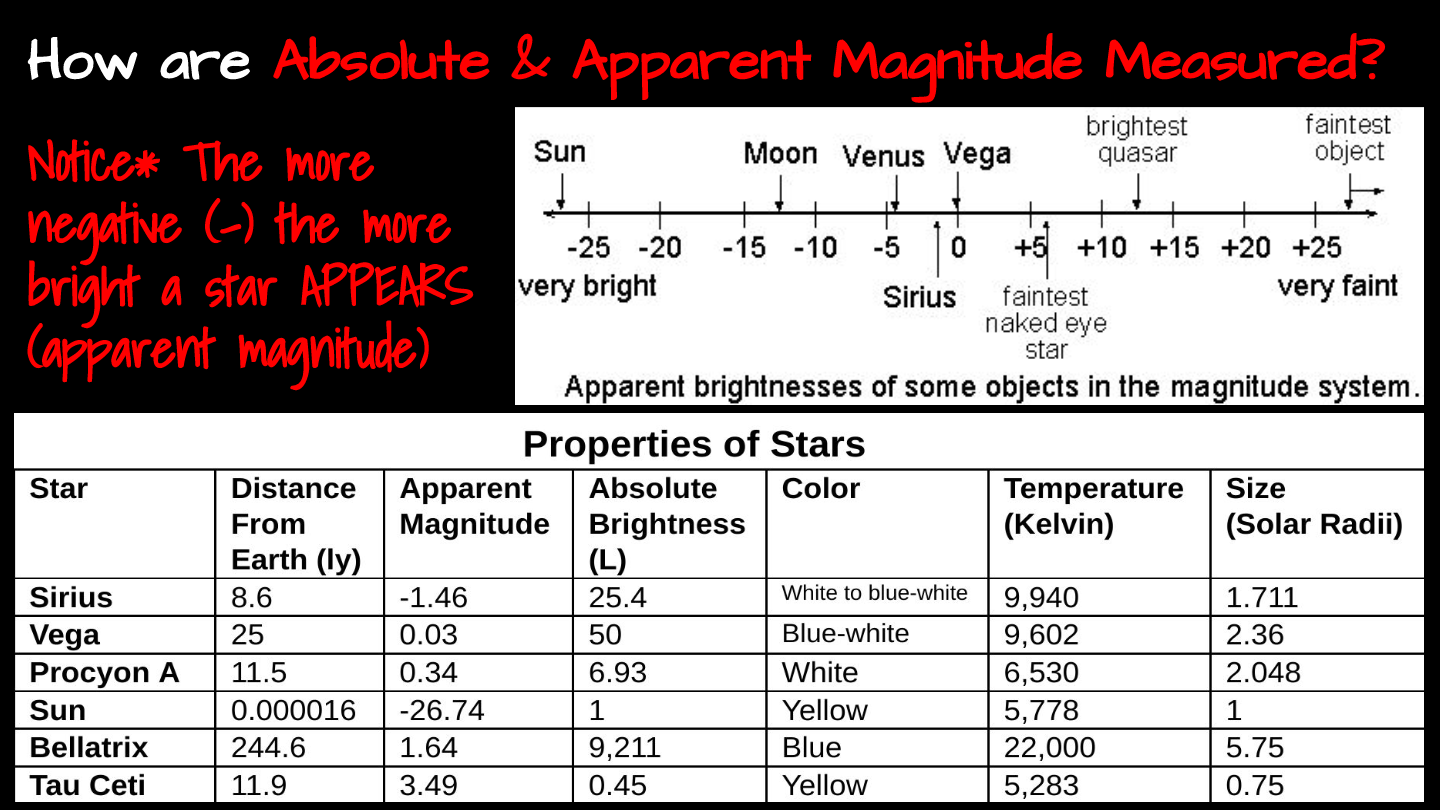
4

5 million years ago

14

Multiple Select

Question image

Which of the following are parts of the sun?

1

convective zone

2

corona

3

hydrosphere

4

biosphere

5

photosphere

15

Multiple Select

What are some of the elements found in the sun? (choose ALL correct answers)

1

carbon

2

hydrogen

3

oxygen

4

nitrogen

5

helium

16

Fill in the Blank

Question image

Hydrogen atoms fuse together to make helium in a process called ______ _____ which releases lots of energy/radiation, electricity, and solar wind.

17

Fill in the Blank

______ are dark spots on the surface of the sun, where there are strong pockets of magnetism.

18

Multiple Choice

How will our sun end its life?

1

explode

2

black dwarf

3

white dwarf

4

cosmic dust

19

Open Ended

What would happen if there was NO sun? Give 2 facts.

20

WOW!


So, if the sun stopped shinning, how long would it take for us to know?

media

21

media

22

Fill in the Blank

The Sun is a Yellow Dwarf ______.

23

Fill in the Blank

The sun core is primarily made of two gases that interact in nuclear fusion.

These gases are Hydrogen and ___________.

24

Fill in the Blank

Over____________Earths would fit inside the Sun.

25

media

26

Fill in the Blank

Heliocentric means _____ _________.

27

media

28

Fill in the Blank

Nuclear fusion of Helium and Hydrogen occurs in the ________.

29

media

30

media

Chapter 11-Stars & Galaxies
Lesson 8.11.1-The View from Earth

Let's take a look at the second question we will answer:

1.

2. How are stars layered?

3.

4.

​

31

media

32

media

33

media

34

media

35

media

36

media

37

media

38

media

39

media

40

Multiple Choice

Question image

Label part 1

1

#1 Core

2

#1 Radiation zone

3

#1 Convection zone

4

#1 Photosphere

41

Multiple Choice

Question image

Label part 6

1

#6 Prominences

2

#6 Corona

3

#6 Sunspots

4

#6 Photosphere

42

Multiple Choice

Question image

Label Part 3

1

#3 Chromosphere

2

#3 Radiation zone

3

#3 Convection zone

4

#3 Photosphere

43

media

Chapter 11-Stars & Galaxies
Lesson 8.11.1-The View from Earth

Let's take a look at the third question we will answer:

1.

2.

3. How does the sun change over short periods of life?

4.

​

44

media

45

media

46

media

47

media

48

media

49

Earth's energy budget allows us to track how much energy is coming in and going out. ​Incoming solar energy is either: Reflected or Radiated back to space, or Absorbed.  About 71% of the total incoming solar energy is absorbed by the Earth system.

media
media

​Where Does ALL the Sun's Energy Go?!

50

Multiple Choice

Question image

Earth's energy budget tracks how much energy flows in and out of Earth's climate.

1

True

2

False

51

Multiple Choice

Question image

Earth's energy budget tracks how much energy flows in and out of Earth's climate.

1

True

2

False

52

Multiple Choice

A giant eruption of plasma from the sun

1

Solar flares

2

Sunspots

3

Prominences

53

Multiple Choice

A huge loop of plasma that connects sunspots.

1

Solar flares

2

Sunspots

3

Prominences

54

Multiple Choice

Cooler areas of plasma on the surface of the sun.

1

Solar flares

2

Sunspots

3

Prominences

55

Multiple Choice

Large eruptions of heated gas from the Sun's surface are called

1

Prominences

2

Solar winds

3

Sunspots

4

Solar flares

56

Multiple Choice

The corona sends out a stream electrical particles called the

1

Solar flares

2

Solar winds

3

Sunspots

4

Prominences

57

Fill in the Blank

The Sun's layers, from innermost to outermost, are the core, the ___________, and the convection zone.

58

media

59

media

60

Fill in the Blank

The visible part of the sun is called the _________

61

Multiple Choice

What is the outermost layer if the sun's atmosphere? (Looks like a white halo)

1

Photosphere

2

Chromosphere

3

Corona

62

Multiple Choice

What layer of the sun's atmosphere gives off visible light?

1

Photosphere

2

Chromosphere

3

Corona

63

Multiple Choice

The layer that glows red. We can only see it during an eclipse.

1

Photosphere

2

Chromosphere

3

Corona

64

media

65

Sunspots

Sunspots are areas of plasma that are cooler than the plasma around them.

media

66

Solar Flares

When prominences connect, they produce a large amount of energy. When the energy become too much, it explodes. These eruptions are called solar flares.

media

67

media

68

Prominences

Huge loops of polarized plasma that connect sunspot regions

media

69

Multiple Choice

A giant eruption of plasma from the sun

1

Solar flares

2

Sunspots

3

Prominences

70

Multiple Choice

A huge loop of plasma that connects sunspots.

1

Solar flares

2

Sunspots

3

Prominences

71

Multiple Choice

Cooler areas of plasma on the surface of the sun.

1

Solar flares

2

Sunspots

3

Prominences

72

media

Chapter 11-Stars & Galaxies
Lesson 8.11.1-The View from Earth

Let's take a look at the last question we will answer:

1.

2.

3.

4. How do scientists classify stars?

​

73

media

74

Multiple Choice

Question image

Which image represents nuclear fusion?

1

A

2

B

75

media

76

Multiple Choice

Question image

Which is the hottest star?

1

Star A

2

Star B

77

Multiple Choice

Which one physical property that all stars have?

1

They are made of gases.

2

They shine very brightly

3

They have a triangular shape

4

They contain iron in their cores

78

Multiple Choice

Which characteristic is used to measure the amount of llight radiated by a star?

1

size

2

color

3

luminosity

4

temperature

79

Multiple Choice

Which color are the hottest stars?

1

blue

2

orange

3

red

4

yellow

80

Multiple Choice

True or False: The sun is much bigger than most of the stars in the sky.
1
True 
2
False

81

Multiple Choice

What is a large celestial body that is composed of gas and emits light?

1

Planet

2

Nebula

3

Moon

4

Star

82

Multiple Choice

A dark area of the photosphere that is cooler than the surrounding areas. Forms in areas of strong magnetic fields

1

Photosphere

2

Shade

3

Sunspot

4

Corona

83

Multiple Choice

________________ is the brightness of a star as seen from earth.

1

luminosity

2

apparent magnitude

3

absolute magnitude

4

star brightness

84

Multiple Choice

___________ is a measure of how bright a star would be if it were seen from a standard distance

1

luminosity

2

absolute magnitude

3

apparent magnitude

4

star brightness

85

Multiple Select

The closest star to earth is

1

Polaris

2

the North Star

3

the sun

4

Tatooine

86

Multiple Choice

A layer of charged gas that forms a stars outer atmosphere

1

Photosphere

2

Sun

3

Sunspot

4

Corona

87

Multiple Choice

The center of the star. Energy is produced here through nuclear fusion.

1

Middle

2

Core

3

Photosphere

4

Corona

88

media

89

8.8A Components of the Universe, H-R Diagram Review

media

90

Components of the Universe, H-R Diagrams

  • We will describe components of the universe, including stars, nebulae, and galaxies, and use models such as the Hertzsprung-Russell Diagram for classification by viewing the Quizizz slides.

  • I will describe components of the universe, including stars, nebulae, and galaxies, and use models such as the Hertzsprung-Russell Diagram for classification by answering questions with 100% accuracy.

media

91

media

92

Multiple Choice

Question image

Two stars are identified on the Hertzsprung-Russell diagram below.

Based on this diagram, how do the characteristics of Star 1 and Star 2 compare?

1

Star 1 is cooler and less bright than Star 2

2

Star 1 is hotter and brighter than Star 2

3

Star 1 is cooler and brighter than Star 2

4

Star 1 is hotter and less bright than Star 2

93

media

94

Multiple Choice

Question image

Star brightness is defined in terms of apparent magnitude. Apparent magnitude is how bright the star appears from Earth.

How does the brightness of white dwarfs compare to the brightness of the Sun?

1

The Sun is less bright than white dwarfs.

2

White dwarfs are less bright than the Sun

3

White dwarfs and the Sun have the same brightness

4

White dwarfs are not seen from Earth, therefore you can not compare the brightness.

95

Multiple Choice

Question image

The Hertzsprung-Russell Diagram is used to classify stars in terms of luminosity and temperature. Brighter stars are shown at the top of the diagram, while fainter stars are shown in the lower part of the diagram. Stars on the left side of the diagram are hotter than stars on the right side of the diagram.

Which of the following statements best describes the main sequence stars?

1

The main sequence stars are brighter than the White Dwarfs. The very hot, extremely small stars are located in group D.

2

The main sequence stars are located in group B. The main sequence stars are much brighter than the Giants located in group C.

3

The main sequence stars are located in group D. Main sequence stars trend from extremely bright stars in the lower right corner to cool, faint stars in the upper left corner of the diagram. The Sun is an example of a main sequence star.

4

The main sequence stars are located in group A. These stars trend from cool, faint stars in the lower right corner to hot, extremely bright stars in the upper left corner of the diagram. The Sun is an example of a main sequence star.

96

Multiple Choice

Our Sun is one of the many stars that has been classified as average. Its luminosity and its temperature place it in the middle of the ___ area of the H-R diagram.

1

Main Sequence

2

White Dwarf

3

Red Giant

4

Super giant

97

Multiple Choice

Question image

According to the diagram, which of these types of stars has the greatest luminosity?

1

Hot white dwarf

2

Hot main sequence star

3

Cool super giant

4

Cool giant

98

Multiple Choice

Question image

Most of the stars in the universe fit onto one of the four areas on this Hertzsprung-Russell diagram.

Which area of the diagram represents the Supergiants?

1

Area M

2

Area X

3

Area P

4

Area Z

99

Multiple Choice

Question image

The Hertzsprung-Russell diagram shows how the sun is classified among the stars.

A star that is several thousand times brighter than the sun with a temperature lower than 4,000 K would be classified as __________.

1

a main-sequenced star in spectral class B

2

a supergiant in spectral class K

3

a main-sequence star in spectral class K or M

4

a white dwarf in spectral class B

100

Multiple Choice

Question image

Stars are classified on the Hertzsprung-Russell diagram according to their absolute magnitude and their surface temperatures at a given time in a star’s life cycle. What classification would a star have if it was very hot and very bright?

1

Main Sequence

2

White Dwarf

3

Supergiant

4

Giant

101

media

102

media

103

media

104

media

105

Multiple Choice

Question image

Which Star is the HOTTEST?

1

Blue

2

Red

3

Orange

4

Yellow

106

Multiple Choice

Question image

Which Star is the COOLEST?

1

Blue

2

Red

3

Orange

4

Yellow

107

Multiple Choice

Question image

The Hertzsprung-Russell diagram shows how the sun is classified among the stars.

A star that is several thousand times brighter than the sun with a temperature lower than 4,000 K would be classified as __________.

1

a main-sequenced star in spectral class B

2

a supergiant in spectral class K

3

a main-sequence star in spectral class K or M

4

a white dwarf in spectral class B

108

Multiple Choice

Question image

Which star is the hottest?

1

Yellow Star

2

Red Star

3

Orange Star

4

Blue Star

109

Multiple Choice

Compared to the rest of the stars, our sun is considered...

1

red Extremely Large and Cold

2

white Small with a medium temperature

3

yellow Medium size with medium temperature

110

Multiple Choice

Which category is our Sun located in?
1
White Dwarfs
2
Supergiants
3
Main Sequence
4
Giants

111

Multiple Choice

Question image
Which spectral class does our star, the sun, belong to?
1
M
2
K
3
G
4
F

112

media

113

media

114

media

115

media

116

media

117

Multiple Choice

Question image
As a whole, Giants are considered hotter than White Dwarfs.
1
True
2
False

118

Multiple Choice

True or False: White dwarfs are warmer and dimmer than giants.

1

True

2

False

119

Multiple Choice

Question image

Which star is considered a supergiant?

1

Sirius B

2

Sun

3

Betelgeuse

4

Van Maanan's Star

120

Multiple Choice

Question image

Which star is considered a giant star?

1

Mira

2

Zeta Arindani

3

Barnard's Star

4

Betelgeuse

121

Multiple Choice

Question image

Which star is considered a main sequence star?

1

Vega

2

Betelgeuse

3

Pollux

4

Van Maanan's Star

122

Multiple Choice

Question image

Which star is hotter than Deneb

1

Procyon

2

Sun

3

Regel

4

Banard's Star

123

Multiple Choice

Question image
In the diagram given, what happens as we move to the left?
1
Stars Get Larger
2
Stars get Colder
3
Stars get hotter
media

​NOTES PAGES HERE

Show answer

Auto Play

Slide 1 / 123

SLIDE