Microscopes
Presentation
•
Biology
•
9th - 12th Grade
•
Easy
+1
Standards-aligned
Amy Kirkwood
Used 2+ times
FREE Resource
25 Slides • 102 Questions
1
Microscopes
2
3
4
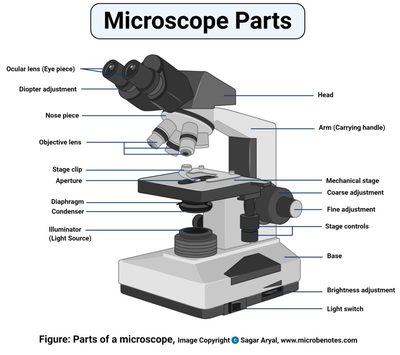
Parts of a Compound Light Microscope
Objective lenses: These lenses magnify the specimen.
Eyepiece: Also known as the ocular lens, it further magnifies the image.
Stage: The platform where the specimen is placed.
Condenser: Focuses light onto the specimen.
Light source: Provides illumination for the specimen.
Diaphragm: Controls the amount of light on the specimen.
5
Microscope Parts
Ocular Lens
Stage
Objective Lenses
Diaphragm
Coarse Adjustment Knob
Fine Adjustment Knob
Light
6
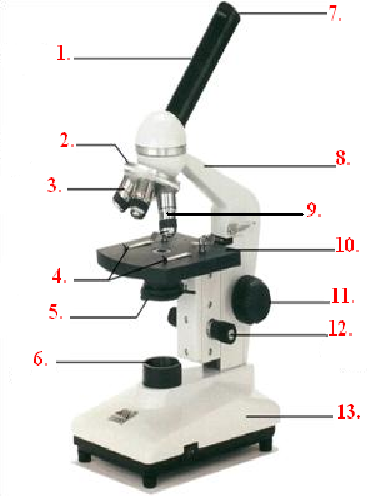
Parts of a Microscope
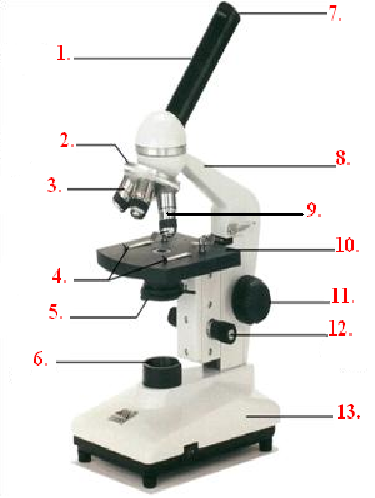
Objective Lens = Lens closest to the specimen; directs light to the ocular.
Ocular = Eyepiece; Lens in eye piece
Revolving Nosepiece = Holds the objective lenses; allows for adjustment of objective lenses to higher or lower magnification.
7
Parts of a Microscope
4. Stage = holds the specimen to be viewed
5. Stage Clips = keeps the microscope slide in place
6. Diaphragm = adjusts the amount of light that passes through the specimen
7. Light source = source of light on the microscope
8. Arm = holds the ocular and revolving nosepiece; carry using the arm
8
Parts of a Microscope
9. Coarse Adjustment knob = allows for focus of the specimen at low magnification; only use on low magnification
10. Fine adjustment knob = used to focus specimen at high magnification
11. Base = the bottom of the microscope; put one hand under the base to carry
9
Microscope Illumination
Did you know that the diaphragm is responsible for regulating the amount of illumination to the specimen in a microscope? The condenser focuses and directs light onto the specimen, enhancing visibility. The diaphragm then allows a portion of that light to pass through. Without the condenser and diaphragm working together, observing microscopic details would be challenging.
10
Controlling Light with Diaphragm
The diaphragm is a mechanism in microscopes that controls the amount of light passing through the specimen. By adjusting the diaphragm, you can increase or decrease the brightness of the image. Use the diaphragm to optimize the lighting conditions for better visibility and contrast.
Open the diaphragm for more light
Close the diaphragm for less light
11
In figure (a) the diaphragm is 100% open allowing the most light through.
100% Open
In figure (b) the diaphragm is 80% open creating a less bright image.
80% Open
40% Open
In figure (c) the diaphragm is 40% open. This image is quite dark.
12
Multiple Choice
What part of the microscope determines the amount of light on the specimen?
Objective lenses
Eyepiece
Diaphragm
Condenser
13
Dropdown
14
Objective Lenses
Objective lenses are used in microscopes to magnify the specimen.
They are available in different magnification powers, such as 4x, 10x, 40x and 100x.
Higher magnification lenses provide more detailed views of the specimen.
Objective lenses are typically color-coded for easy identification.
15
The paramecium in the 40x view are magnified by the low power lens (4x) and the eyepiece (10x). They appear 40 times bigger!
4 x 10= 40
40x
The paramecium in the 100x view are magnified by the medium power lens (10x) and the eyepiece (10x). They appear 100 times bigger!
10 x 10= 100
100x
The paramecium in the 400x view are magnified by the high power lens (40x) and the eyepiece (10x). They appear 400 times bigger!
40 x 10= 400
400x
16
Multiple Choice
What is the purpose of objective lenses in microscopes?
To magnify the specimen
To illuminate the specimen
To rotate the specimen
To clean the specimen
17
Match
Match the lens to its magnification power.
Low Power Lens
(Red)
Medium Power Lens (Yellow)
High Power Lens
(Blue)
Ocular Lens
Highest Power Lens (White)
10x
(Objective Lens)
20x
40x
10x
(Eyepiece)
100x
10x
(Objective Lens)
20x
40x
10x
(Eyepiece)
100x
18
Multiple Choice
What does the diaphragm control in microscopes?
Amount of light passing through the specimen
Magnification of the image
Color of the specimen
Size of the specimen
19
Use headphones if needed!
On the next slide you're going to watch a video about how to focus a microscope!
20
Our microscopes are slightly different but that is OK! Observe how the scientist knows she is in focus!
21
Coarse Adjustment
Coarse adjustment is used to roughly focus the microscope on the specimen.
It is done by moving the stage up and down using the coarse adjustment knob.
Be careful not to crash the objective lens into the slide as it may damage both.
22
Multiple Choice
What is coarse adjustment used for in a microscope?
To roughly focus the microscope on the specimen
To fine-tune the focus of the microscope
To adjust the lighting of the microscope
To clean the lenses of the microscope
23
Fine Adjustment
The fine adjustment knob is used to fine tune your image.
Typically, the fine adjustment knob will only be used in medium and high power magnification, as it moves the stage very slightly.
24
Multiple Choice
What is a fine adjustment knob used for in a microscope?
To roughly focus the microscope on the specimen
To fine-tune the focus of the microscope
To adjust the lighting of the microscope
To clean the lenses of the microscope
25
Steps for Focusing a Microscope
Step 1. Turn on your microscope and check that it is on the lowest power.
Step 2. Place the slide centered over the condenser on the stage, so that light shines through it and clip it in place.
Step 3. Slowly turn the coarse adjustment knob while looking through the eyepiece until your specimen comes into focus.
Step 4. Turn the fine adjustment knob and diaphragm to adjust the image.
26
Drag and Drop
Step 1.
Step 2.
Step 3.
Step 4.
Step 5.
27
Warning!!!
28
29
Carrying a Microscope
Hold the microscope by the arm and support it under the base
30
Multiple Choice
Which image shows the correct way to carry a microscope?
A
B
31
32
Multiple Choice
The first direction to move the stage using the coarse focus before putting the slide on the stage.
up
down
33
Multiple Choice
After putting the slide on the stage, when should coarse focus be used?
only in high power
only in low power
34
Multiple Choice
When should the fine focus be used?
Only after using coarse focus
on low power before using coarse focus
35
Multiple Choice
What objective lens should you start with?
low power
high power
36
37
Multiple Choice
What goes on top of the specimen (the thing you want to look at)?
the slide
the coverslip
38
39
Multiple Choice
Slides are glass, what do you do if they break?
pick up the pieces with your hands
it's glass, tell your teacher!
40
Multiple Choice
Coverslips are big and hard to lose.
true
false
41
Multiple Choice
When moving the stage, you have to be careful not to __________.
break the slide
move it to far down
break the lightbulb
42
Multiple Choice
When you clean the lens what should you use?
lens paper
tissues
43
Now it is time to practice your microscope knowledge!
Good Work!
44
Hotspot
Where are the objective lenses?
45
Hotspot
Where is the stage?
46
Hotspot
Where is the coarse adjustment knob?
47
Hotspot
Which part is used to focus the microscope on low power?
48
Hotspot
Which part is used to magnify and view the object?
49
Hotspot
Which part is used to focus for fine details?
50
Hotspot
Where is the specimen placed?
51
Multiple Choice
Which knob is used first to focus the specimen on low power?
fine adjustment knob
eyepiece
coarse adjustment knob
objective lens
52
Multiple Choice
Why is it important to carry the microscope with two hands?
so you will not drop it
so the microscope does not turn over
it is not important to carry it with two hands
53
Multiple Choice
If the eyepiece is magnified 10x and the objective lens is magnified 40x, what is the total magnification?
40x
50x
400x
10x
54
Reorder
Place the steps to focusing the microscope in the correct order from start to finish.
use the
coarse adjustment knob to focus on low
change the objective lens to medium power
use the fine adjustment knob to focus on medium
change the objective lens to high power
use the fine adjustment knob to focus on high power
55
Fill in the Blanks
56
Fill in the Blanks
57
Fill in the Blanks
58
Drag and Drop
59
Drag and Drop
60
Drag and Drop
61
Drag and Drop
62
Multiple Choice
How do you adjust the amount of light shining through your microscope?
Turn the coarse focus knob on the side of the microscope
Spin the eye piece around to a new position
Change the objective lenses to a different color
Turn the fine focus knob on the side of the microscope
Rotate the diaphragm, the large, black, flat dial built into the stage
63
Drag and Drop
64
Drag and Drop
You can hit the slide and
65
Match
If you put the graph paper on your microscope, and focused it on the low (red), medium (yellow), and high (blue) powers.
What would the graphing paper looked like under each power of the microscope?
Low Power
(Red)
High Power
(Blue)
Medium Power
(Yellow)
Low Power
(Red)
High Power
(Blue)
Medium Power
(Yellow)
66
Multiple Choice
What happened to your field of view as you moved from low to high power?
The view increased -
I could see more of the slide
The view decreased -
I could see less of the slide
The amount of slide I could see stayed the same
67
Multiple Choice
Set your microscope to the low power (red lens).
When you move the slide to the left, in what direction does the letter “e” appear to move?
Forwards
Backwards
To the Left
To the Right
68
Multiple Choice
Set your microscope to the low power (red lens).
How does the “e” move when you move the slide to the right?
Forwards
Backwards
To the Left
To the Right
69
Multiple Choice
Set your microscope to the low power (red lens).
How does the “e” move when you move the slide up?
Down
Up
To the right
To the left
70
Multiple Choice
Set your microscope to the low power (red lens).
How does the “e” move when you move the slide down?
Up
Down
To the right
To the left
71
Match
Set your microscope to the low power (red lens), then the medium (yellow) power, and finally the high (blue) power.
Show what the letter E looked like at different scales.
Medium Power
(yellow)
Just my eyes
Low Power
(red)
High Power
(blue)
Medium Power
(yellow)
Just my eyes
Low Power
(red)
High Power
(blue)
72
Multiple Select
Read the attached passage:
Why does a specimen placed under the microscope have to be thin?
Check all that apply.
So we are able to see clear details in the image
So that the light can shine through the object
There are no microscopes that can look at thick objects
Thick objects are too heavy to put under a microscope
73
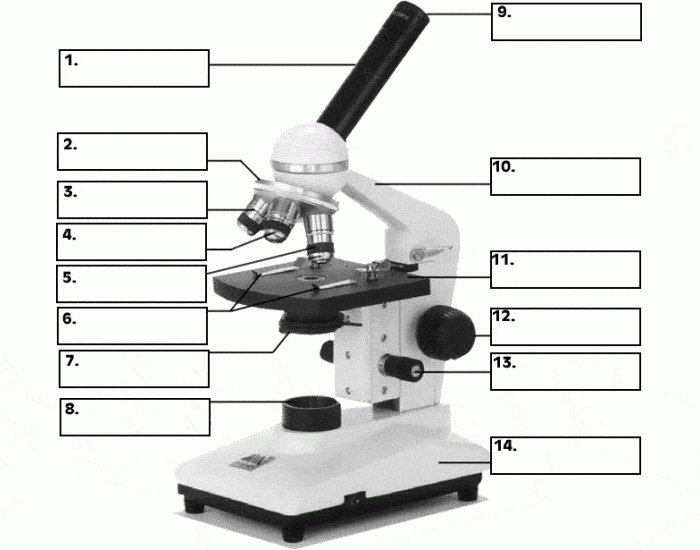
Labelling
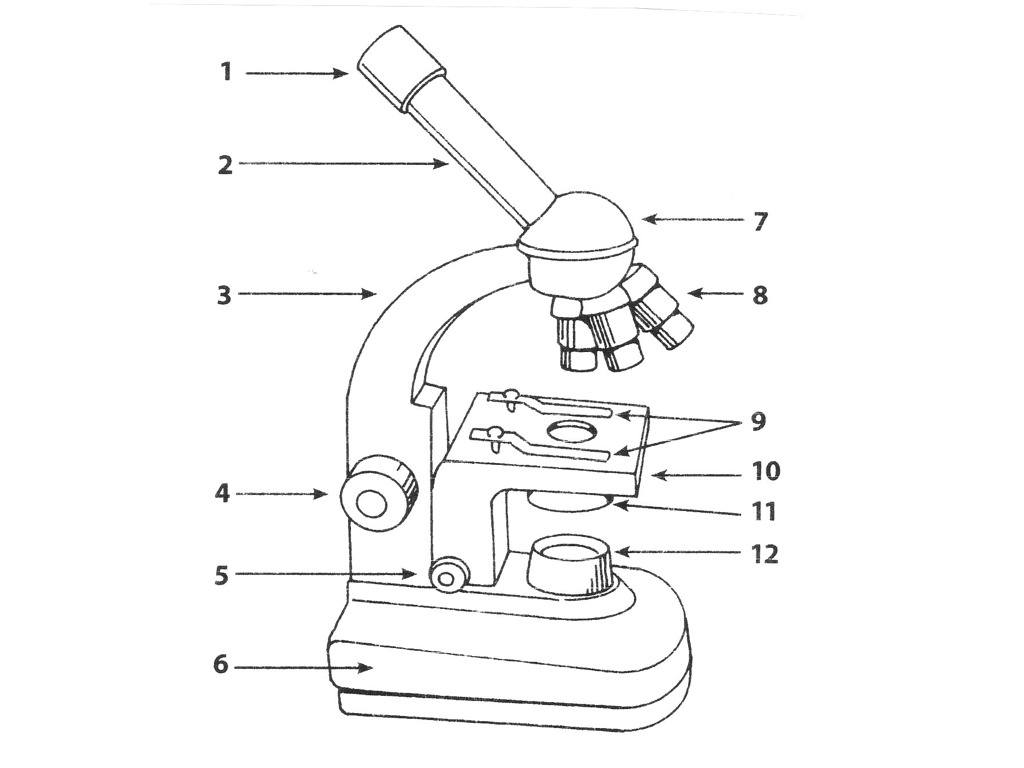
Label all the parts of the microscope
base
Light
Diaphragm
Objective Lens
Rotating Nosepiece
Eye Piece
Fine Focus Knob
Coarse Focus Knob
Stage
Arm
74
Labelling
Practice labeling the compound light microscope
Fine focus
Clip
Base
Light
Stage
Coarse focus
Tube
Eyepiece
Objective lens
Arm
75
Multiple Choice
Part B
Moves the stage very faster for general focus
Moves the stage slowly for a clear image
76
Multiple Choice
Part A
Moves the stage faster for general focus
Moves the stage slowly for clear image
77
Labelling
Orderly arrange how the compound light microscope can be used effectively in viewing a specimen on a slide.
Turn from 4X to 10X & 40X, and fine tune
Use fine focus for clear image
Use 4X objective first
Hold specimen on stage with clips
Use Coarse focus for general focus
78
Drag and Drop
79
Multiple Choice
Total Magnification is
Objective lens X Eyepiece lens
Eyepiece lens X Eyepiece lens
Eyepiece lens X Total Magnification.
80
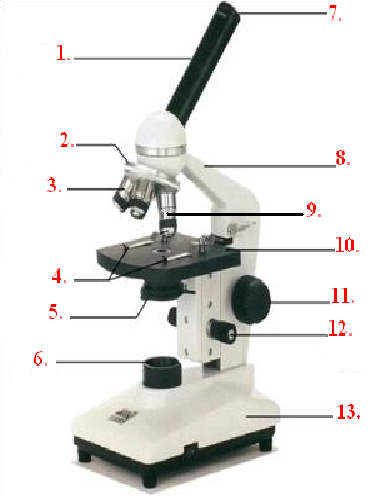
Multiple Choice
What is Part 12
Fine Adjustment Knob
Coarse Adjustment Knob
Diaphragm
Objective
81
Multiple Choice
What is Part 13
Fine Adjustment Knob
Course Adjustment Knob
Stage
Diaphragm
82
Multiple Choice
What is Part 7
Stage
Stage Clips
Light Source
Diaphragm
83
Multiple Choice
Diaphragm
Stage
Ocular Lens
Objective Lenses
84
Multiple Choice
The size of the specimen
The size of the slide
The area you can see under the microscope
The area from which your specimen came
85
Multiple Choice
As you move from low power to high power, the field of view becomes
Darker and larger
Darker and smaller
Brighter and larger
Brighter and small
86
Multiple Choice
The largest field of view shown is under the total magnification _____X.
40
100
400
87
Multiple Choice
If you wanted to center the image what direction would you move your slide in?
Down and left
Down and right
Up and left
Up and right
88
Multiple Choice
Which part of the microscope do you never use under high power?
Diaphragm
Coarse adjustment
Stage
Fine adjustment
89
Multiple Choice
Which part of the microscope should you use to focus the image?
Diaphragm
Coarse adjustment
Stage
Fine adjustment
90
Multiple Choice
40X
10X
100X
400X
91
Multiple Choice
90x
10x
110x
1000x
92
Multiple Choice
ocular PLUS objective
ocular TIMES objective
ocular MINUS objective
ocular DIVIDED BY objective
93
Multiple Choice
If you look at a letter such as "e" under the microscope, then how does it look when you are viewing the image?
upside down and backward
upside down and distorted
upside down and front view
94
Multiple Choice
When making a wet mount, place the coverslip at a 45-degree angle to reduce air bubbles.
True
False
95
Multiple Choice
This picture shows that the microscope:
only flips images upside down
only flips images over backwards
flips the image upside down and backwards
doesn't flip the image at all
96
Multiple Choice
The best way to avoid air bubbles when making a wet mount slide is to:
drop the cover slip on at an angle
drop the cover slip on flat
squeeze the slide and cover slip after it is on
tap on the cover slip once it is in place
97
Multiple Choice
1. Describe the purpose of staining cells before viewing them with a microscope
To clean them
So they absorb the liquid and grow
So the parts of the cells can be seen
So they shrink making them easier to look at
98
Multiple Choice
Which laboratory procedure is represented in the diagram below?
placing a coverslip over a specimen
removing a coverslip from a slide
adding stain to a slide without removing the coverslip
reducing the size of air bubbles under a cover- slip
99
Multiple Choice
Which laboratory technique is shown in the diagram?
testing a specimen for amino acids
determining the pH of a specimen
measuring the photosynthetic rate in a specimen
preparing a wet mount slide of a specimen
100
Multiple Choice
101
Multiple Choice
102
Multiple Choice
103
Multiple Choice
104
Multiple Choice
105
Multiple Choice
106
Multiple Choice
107
Multiple Choice
108
Multiple Choice
What does a microscope do?
Produces a magnified (bigger) image of something too small for the eye to see
Helps us look at stars
Produces a smaller image of something too big to see at once
Helps us look at our teeth
109
Multiple Choice
The greater the ___________________, the smaller the field you are actually viewing.
detail
objective
magnification
body
110
Multiple Choice
Which part is #8?
Revolving nosepiece
Objective lens
Stage clips
body tube
111
Multiple Choice
What part is # 9?
Body tube
base
arm
stage
112
Multiple Choice
What part is #1?
Base
Mirror
stage
stage clips
113
Multiple Choice
What part is AB?
Stage
Diaphragm
Light Source
base
114
Multiple Choice
What part is E?
Diaphragm
Eyepiece
base
Light source
115
Multiple Choice
Which part is D?
Body tube
fine adjustment knob
coarse adjustment knob
stage
116
Multiple Choice
Which part is C?
Stage
Fine Adjustment knob
Coarse Adjustment Knob
diaphragm
117
Multiple Choice
Which part is B?
body tube
eyepiece
objective lens
diaphragm
118
Multiple Choice
Which part is A?
body tube
eyepiece
objective lens
stage clip
119
Multiple Choice
120
Multiple Choice
121
Multiple Choice
122
Multiple Choice
123
Multiple Choice
124
Multiple Choice
125
Multiple Choice
To focus a specimen, it is best to start with which objective:
high power
low power
scanning
ocular
126
Multiple Choice
127
Multiple Choice
Microscopes
Show answer
Auto Play
Slide 1 / 127
SLIDE

Similar Resources on Wayground
116 questions
Race and Ethnicity
Presentation
•
KG - University
120 questions
Unit C: Moles & Stoichiometry
Presentation
•
11th Grade
119 questions
Milestone Writing Review
Presentation
•
11th Grade
123 questions
Imperialism
Presentation
•
9th - 12th Grade
120 questions
Unit 2 Chemistry Atomic Theory and Periodicity
Presentation
•
9th - 12th Grade
119 questions
Gerund and to-infinitive
Presentation
•
9th - 12th Grade
127 questions
Music Lab
Presentation
•
9th - 12th Grade
125 questions
F3 Family Ties L5
Presentation
•
9th - 10th Grade
Popular Resources on Wayground
20 questions
STAAR Review Quiz #3
Quiz
•
8th Grade
20 questions
Equivalent Fractions
Quiz
•
3rd Grade
6 questions
Marshmallow Farm Quiz
Quiz
•
2nd - 5th Grade
20 questions
Main Idea and Details
Quiz
•
5th Grade
20 questions
Context Clues
Quiz
•
6th Grade
20 questions
Inferences
Quiz
•
4th Grade
19 questions
Classifying Quadrilaterals
Quiz
•
3rd Grade
12 questions
What makes Nebraska's government unique?
Quiz
•
4th - 5th Grade
Discover more resources for Biology
14 questions
Ecological Succession: Primary and Secondary
Quiz
•
9th Grade
20 questions
Structure & DNA Replication Quiz
Quiz
•
9th Grade
50 questions
Biology EOC Review
Quiz
•
9th Grade
33 questions
Module C - Virus vs Cells, Biomolecules & Enzymes
Quiz
•
9th Grade
25 questions
photosynthesis and cellular respiration
Quiz
•
9th Grade
25 questions
STAAR Evolution Vocabulary
Quiz
•
9th Grade
20 questions
Food Chains and Food Webs
Quiz
•
7th - 12th Grade
20 questions
Genetics 2026
Quiz
•
10th Grade