
- Resource Library
- Science
- Chemistry
- Physical Properties
- Physical Science 2 2: Physical Properties Of Matter

Physical Science 2-2: Physical Properties of Matter

Presentation
•
Science
•
10th Grade
•
Easy
+8
Standards-aligned

Abby Fancsali
Used 8+ times
FREE Resource
26 Slides • 19 Questions
1

2
Multiple Choice
Benjamin is conducting an experiment to find out the amount of matter in different objects. What is he measuring ?
volume
inertia
mass
weight
3
Multiple Choice
Aiden is filling a balloon with air. What is he measuring as the balloon expands?
matter
mass
volume
element
4
Fill in the Blanks

Calculate the volume of this cube.
Type answer...
5
Describe what it means when a property is a physical property
Describe density
calculate the density of an object
use density to describe if an object will float or sink

6
What are the three states of Matter
All matter is made up of particles
Adding or subtracting energy can help move the particles into different rearrangements
State: The physical form of matter
The arrangement of these particles determines the state of matter
7
Solids and Their Properties
Solid: The State of Matter in which the volume and shape of a substance are fixed
Particles are held close together with little movement
Particles have very little energy

8
Liquids and Their Properties
Liquid: The State of Matter that has a definite volume but indefinite shape
Particles are close together, but can move and slide past each other, allowing them to change their shape to fit the container
Particles have more energy than a solid, but are still low-energy

9
Gases and Their Properties
Gas: A form of Matter that does not have a definite shape or volume
Particles have a high level of movement and can spread out or compact to fill an entire container
Particles have lots of energy that allows them to move far apart

10
Multiple Choice
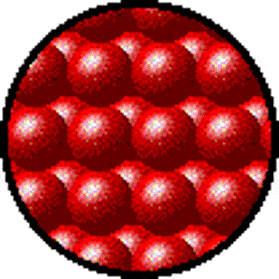
What state of matter does the picture represent?
solid
liquid
gas
11
Multiple Choice

What is a Solid?
Matter that has a fixed shape and size.
Matter that has no fixed shape or size
Matter that has a fixed size and no fixed shape
Matter that has no fixed shape and size
12
Multiple Choice
In which state of matter will there be the LARGEST space between molecules?
solid
liquid
gas
13
Multiple Choice
This state of matter has a constant volume, but fits the space of the container holding it.
Solid
Liquid
Gas
14
Physical Property: A characteristic of a substance that can be detected and measured without making a new substance.
does not involve a chemical change
Can be used to identify an object
There are many different physical properties that can be measured both with and without tools
Some Simple Physical Properties:
Color
Texture
Odor
15
Thermal Conductivity: How Heat moves through an object
Electrical Conductivity: How Electricity moves through an object
Metals tend to have both higher thermal and electrical conductivity due to how they are structured
16
17
Ductility: The ability of a substance to be pulled into a wire
Malleability: The ability of a substance to be rolled into a shape
Compressibility: The ability to be squeezed or pressed together


18
Solubility: The ability of a substance to dissolve
Some substances are easier to dissolve than others
Solubility is a physical change because it is possible to reverse the change and go back to the original state
Example: Dissolving salt in to water and then evaporating the water allows you to collect the salt
19
Magnetism: The ability of a substance to attract and repel other magnetic objects
It is based on the arrangement of electrons in an object
Objects can be made more or less magnetic through several different means, but still remain the same object

20
Multiple Choice
The rate at which a substance transfers heat is called....
Electrical conductivity
Thermal conductivity
Malleability
Boiling point
21
Multiple Choice
The ability of one substance to dissolve when put into another substance is called...
Magnetism
Compressibility
Solubility
Malleability
22
Multiple Choice
A characteristic of matter that can be observed and/or measured without changing the identity of the substance is a...
Physical Property
Chemical Property
23
Density: A physical property of matter that describes the amount of mass in a given volume
How much Matter exists in a given space
Density can be used to tell the difference between similar-looking objects
Example: A golf ball and a ping pong ball are the same size, but the ping pong ball has less mass
Density is a property that never changes, regardless of how much of an object you have

24
Density can be calculated using the base equation of mass divided by volume
If you are given any two variables in the density equation, you can solve for the third.
25
What is the density of mercury if 270 grams of mercury has a volume of 20 ml?
Step 1: Identify the information that you know
Mass= 270 grams
Volume= 20 ml
Step 2: Substitute your known information into the density equation and solve
26
Fill in the Blanks
What is the density of mercury if 270 grams of mercury has a volume of 20 ml?
27
What is the density of gold if 28 grams of gold has a volume of 1.45 cm3?
Step 1: Identify the information that you know
Mass= 28 grams
Volume= 1.45 cm3
Step 2: Substitute your known information into the density equation and solve
28
Fill in the Blanks
What is the density of gold if 28 grams of gold has a volume of 1.45 cm3? Round your Answer to two decimal places
29
Density is a ratio of both mass and volume, so objects with the same mass can have different densities
Example: 1 kg of lead is the same shape as a stick of butter, while 1 kg of feathers is the size of a pillow
If a solid object has a lower density than water, it will float on the water
Water has a density = 1.0
30
Different liquids have different densities.
When liquids of different densities are added to each other, they will arrange themselves into layers with the lowest density on the top and the highest density on the bottom

31
Multiple Choice
32
Multiple Choice
33
Reorder
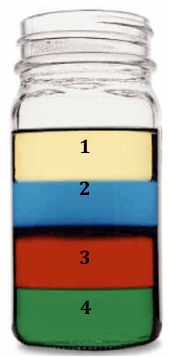
Put the liquids in order from least dense to most dense?
1
2
3
4
34
Fill in the Blanks
Frank has an eraser. It has a mass of 4g, and a volume of 2cm3. What is its density?
35
Physical Change: a change in matter from one form to another without a change in chemical properties
An object might change its state and appearance, but it is still the same substance
Physical changes can be undone/reversed
Examples
Cutting
Melting
Evaporating
Dissolving
36
Changes in state are related to the amount of energy an object has
Kinetic Energy=Temperature=heat
As an object absorbs heat, it gains energy, and particles move faster/farther apart
As an object releases heat, it loses energy, and particles move more slowly/closer together
The particles in the object may rearrange themselves, but do not break apart.

37
Melting: The change from solid to liquid caused by the addition of energy to a substance
Melting Point: The temperature at which a substance begins to melt

38
Freezing: The change from liquid to solid as a substance decreases the amount of energy
Freezing Point: The temperature at which a substance begins to freeze

39
Vaporization: The change from a liquid to a gas
Boiling point: The Temperature at which a liquid begins to boil and change from liquid to gas
Happens quickly
Vaporization Point: The temperature at which a liquid turns into a gas
Vaporization that occurs gradually over time without adding a significant amount of energy is called Evaporation

40
Condensation
Condensation: The process of a gas turning into a liquid
Cooling the temperature reduces the energy of particles, which allows particles to return to a liquid state
Condensation point: The temperature at which a gas becomes a liquid

41
Sublimation
Solids generally melt into a liquid at a gradual temperature change
In some cases, solids change to the vapor state without passing through the liquid phase
Sublimation: The change from a solid to a gas state

42
How are Changes of State & Temperature Related
Adding/removing energy to a substance does one of two things to the substance
It changes the temperature of the substance
It changes the state of the substance
These two things can not happen at the same time because energy is needed to separate the particles

43
Multiple Choice

The temperature at which a substance changes from a liquid to a solid is the
freezing point.
saturation point.
boiling point.
condensation point.
44
Multiple Choice

A substance changes from a liquid to a gas during evaporation because
energy is lost.
energy is released.
energy is created.
energy is absorbed.
45
Multiple Choice
Show answer
Auto Play
Slide 1 / 45
SLIDE
Similar Resources on Wayground

40 questions
Unit 7 Lesson
Presentation
•
10th Grade
40 questions
Work and Power
Presentation
•
KG
42 questions
All About Venn Diagrams
Presentation
•
10th Grade
39 questions
Precision, Accuracy, and Sig Figs
Presentation
•
9th Grade
42 questions
Origin of the Universe
Presentation
•
11th Grade
40 questions
Spectral Analysis
Presentation
•
10th Grade
40 questions
Chromatography Live
Presentation
•
10th Grade
38 questions
Structure and Properties of Matter
Presentation
•
9th Grade
Popular Resources on Wayground
10 questions
How much do you know about our Portrait of an Eagle?

Quiz
•
10th Grade
10 questions
Fast Food Slogans
Quiz
•
6th - 8th Grade
21 questions
Continents and Oceans
Quiz
•
6th Grade
20 questions
Parts of Speech
Quiz
•
5th Grade
16 questions
Subject & Predicate
Quiz
•
5th Grade
25 questions
Multiplication Facts
Quiz
•
5th Grade
12 questions
Map Skills
Quiz
•
3rd Grade
22 questions
Continents and Oceans
Quiz
•
5th Grade
Discover more resources for Science
10 questions
Exploring Chemical and Physical Changes

Interactive video
•
6th - 10th Grade
10 questions
Decoding the Periodic Table of Elements
Interactive video
•
6th - 10th Grade
10 questions
Exploring the Periodic Table
Interactive video
•
6th - 10th Grade
14 questions
Physical and Chemical Changes
Quiz
•
10th Grade
22 questions
Periodic Table Review
Quiz
•
9th - 12th Grade
10 questions
Exploring the States of Matter
Interactive video
•
6th - 10th Grade
10 questions
Exploring Physical and Chemical Changes
Interactive video
•
6th - 10th Grade
21 questions
Macromolecules and Enzymes Study Guide
Quiz
•
9th - 10th Grade