

*0 The Biology of Studying

Presentation
•
Biology
•
9th - 12th Grade
•
Practice Problem
•
Hard

James Franks
FREE Resource
68 Slides • 41 Questions
1
2

3

4

5

6

7
Multiple Choice
Which statement best explains how memory changes the brain?
Memories are stored in one special memory cell
Learning weakens connections between neurons
Repeated use strengthens connections between neurons
Memory is permanent once information is learned
8
Multiple Choice
A student studies vocabulary once and forgets it the next week.
Which conclusion best explains this outcome?
Memory does not work for vocabulary
The information was never stored
The memory was not strengthened through practice
Forgetting means learning never occurred
9
Multiple Choice
Which statement best supports the idea that how you study matters?
Memory improves naturally with age
Long study sessions guarantee learning
Effective strategies strengthen memory over time
Talent determines how well someone remembers
10
Multiple Choice
Which action best represents active learning based on the memory lesson?
Rereading notes silently
Copying information word for word
Thinking about meaning and making connections
Highlighting large sections of text
11
Multiple Choice
Which conclusion about memory is best supported by the lesson?
Memory is passive and automatic
Memory improves without effort
Memory requires attention and practice
Memory works the same for all students
12
Multiple Choice
Why is forgetting not always a sign of failure?
Forgetting means information was never taught
Forgetting shows the brain is full
Forgetting can occur when memory connections are weak
Forgetting improves intelligence
13

14
15
16

17

18
19
20

21
22

23
24
Multiple Choice
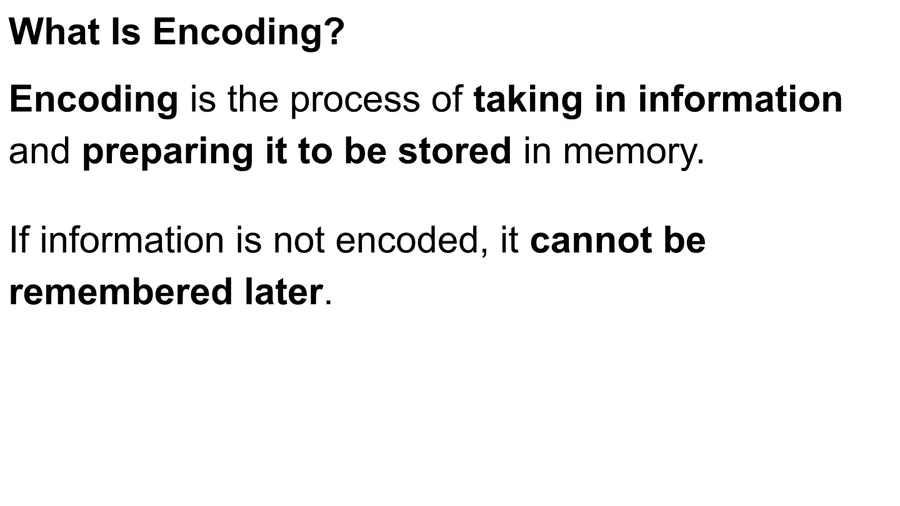
Which statement best describes encoding?
The long-term storage of information in the brain
The process of taking in information and preparing it for storage
The ability to recall information after studying
The automatic recording of everything you see or hear
25
Multiple Choice
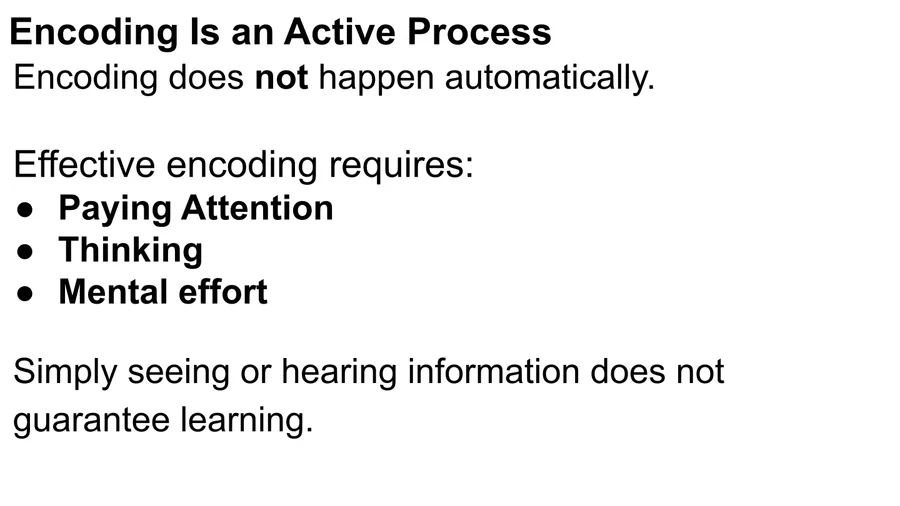
Why does encoding require active effort?
The brain stores information only during sleep
Information is remembered only if it is written down
Attention and thinking are needed to strengthen memory connections
Repetition alone guarantees learning
26
Multiple Choice
A student copies notes word-for-word from the board without thinking about their meaning.
Which type of encoding is most likely occurring?
Deep encoding
Semantic encoding
Shallow encoding
Elaborative encoding
27
Multiple Choice
Which study strategy would most likely result in deep encoding?
Highlighting a page multiple times
Rereading notes silently
Drawing a diagram of a cell from memory.
Copying definitions from a textbook
28
Multiple Choice
Why does deep encoding lead to stronger memory than shallow encoding?
It takes more time to complete
It involves memorizing more information
It focuses on meaning and connections
It prevents information from being forgotten
29
Multiple Choice
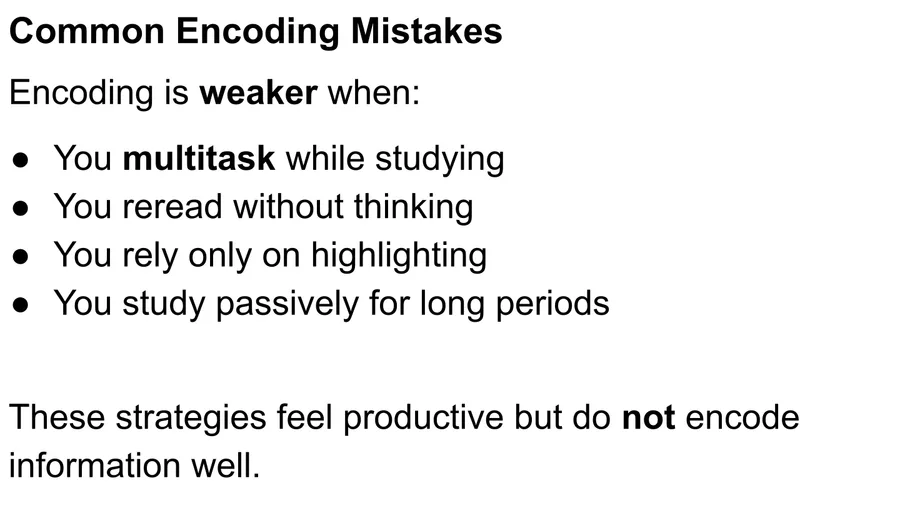
Which student behavior is most likely to weaken encoding?
Making connections to prior knowledge
Asking how a concept works
Studying while texting and watching videos
Organizing information into categories
30
Multiple Choice
A student says, “I read the notes three times, so I know it.”
Based on the lesson, why might this student still struggle on a test?
Reading does not involve vision
The student relied on passive strategies instead of deep encoding
Encoding only works for short-term memory
Studying multiple times causes confusion
31
Multiple Choice
Which conclusion is best supported by the lesson on encoding?
Time spent studying is more important than how you study
Encoding occurs automatically whenever information is presented
Meaningful thinking during study improves long-term memory
Multitasking improves attention during encoding
32
33
34

35
36
37

38
39
Multiple Choice
Why is long-term memory the main goal of learning?
It stores information only for tests
It has unlimited capacity
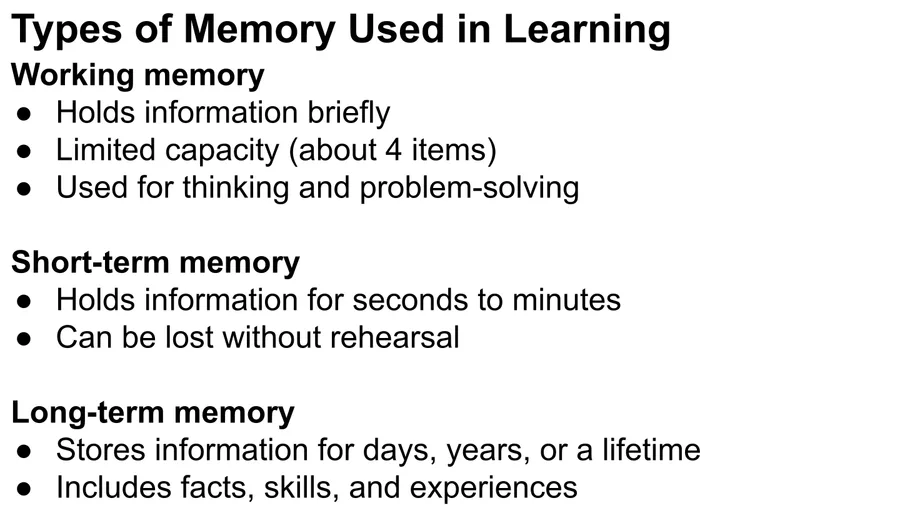
It allows information to be used over long periods of time
It prevents forgetting completely
40
Multiple Choice
Which strategy is most effective for strengthening storage?
Reading notes repeatedly in one night
Highlighting information without review
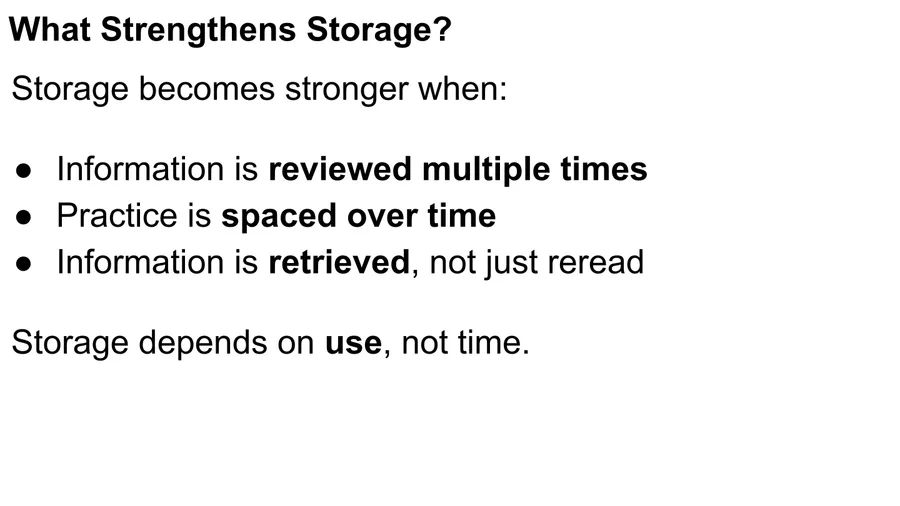
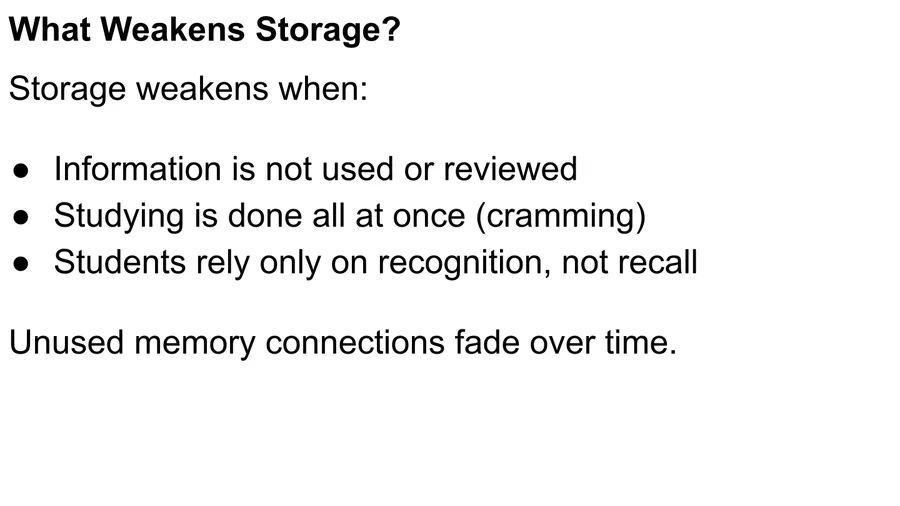
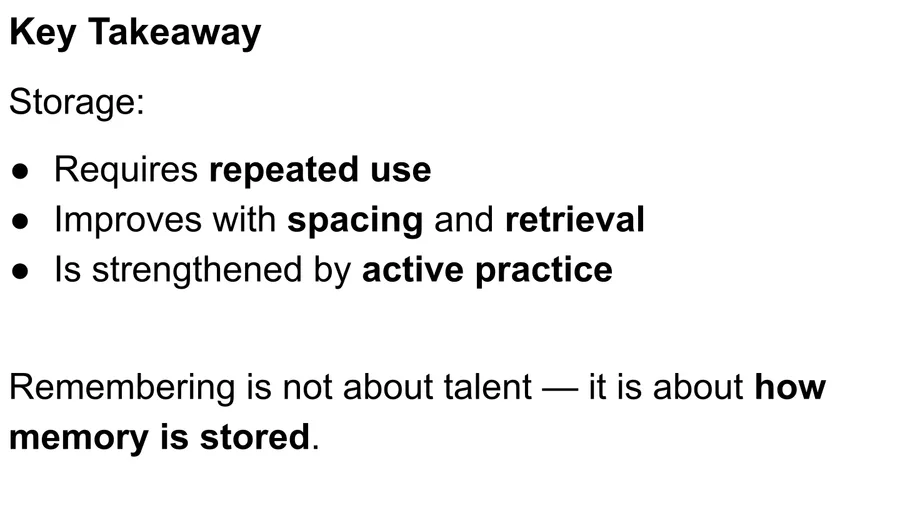
Spacing review and practicing retrieval over time
Memorizing information the morning of the test
41
Multiple Choice
What is most likely to happen to a memory that is not used or reviewed?
It becomes permanent
It strengthens over time
It weakens and becomes harder to retrieve
It transfers automatically to long-term memory
42
Multiple Choice
A student says, “I understood it when we learned it, but now I forgot it.”
Which explanation best fits the lesson on storage?
The student never encoded the information
The information was stored only in working memory
The memory was not reinforced through review and retrieval
Forgetting means learning never occurred
43
Multiple Choice
Which statement best explains the relationship between storage and forgetting?
Forgetting happens only when encoding fails
Stored memories disappear suddenly
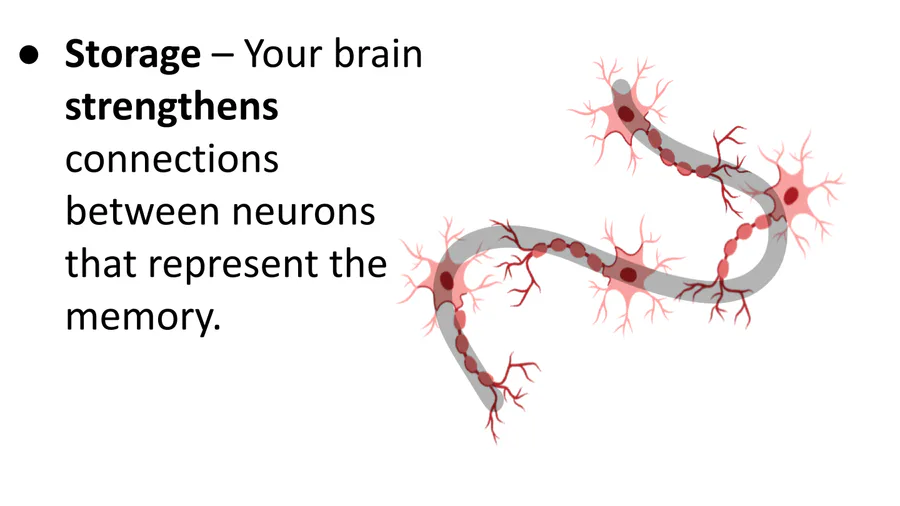
Forgetting often occurs when memory connections are weak or unused
Forgetting means the brain is full
44
Multiple Choice
Which conclusion is best supported by the storage lesson?
Storage depends more on time spent studying than study strategy
Memory storage improves through repeated use and retrieval
Long-term memory forms automatically after encoding
Working memory can store unlimited information
45

46

47
48

49

50

51
52

53
54
Multiple Choice
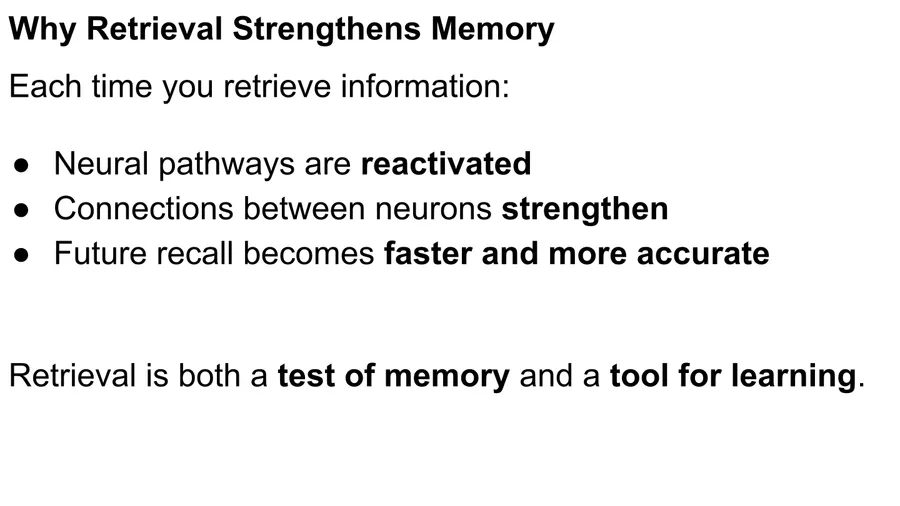
Which study behavior best demonstrates active retrieval?
Highlighting key terms
Rereading notes
Answering practice questions without notes
Copying definitions
55
Multiple Choice
Why does retrieval practice strengthen memory?
It increases the amount of information stored
It shortens the study time needed
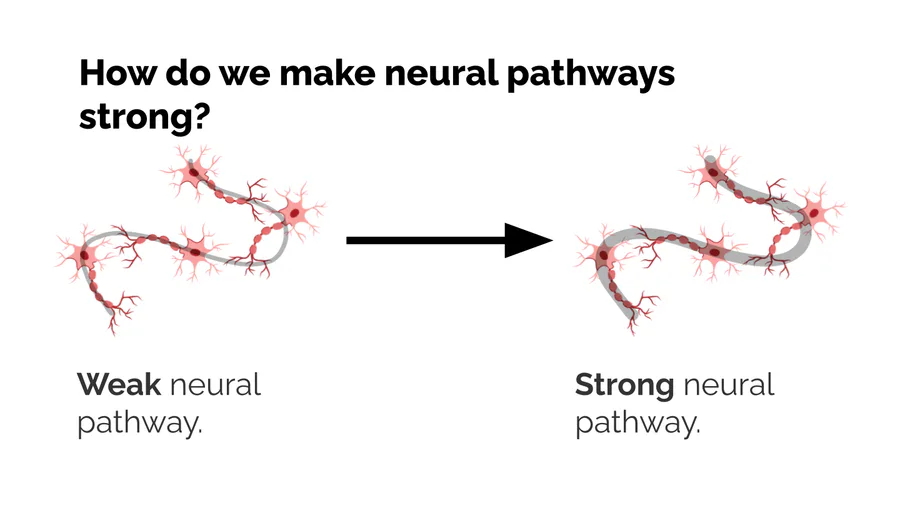
It reactivates and strengthens neural pathways
It prevents forgetting completely
56
Multiple Choice
A student says, “I knew it when I saw it on the review sheet, but I couldn’t answer it on the test.”
Which explanation best matches this situation?
The student encoded the information incorrectly
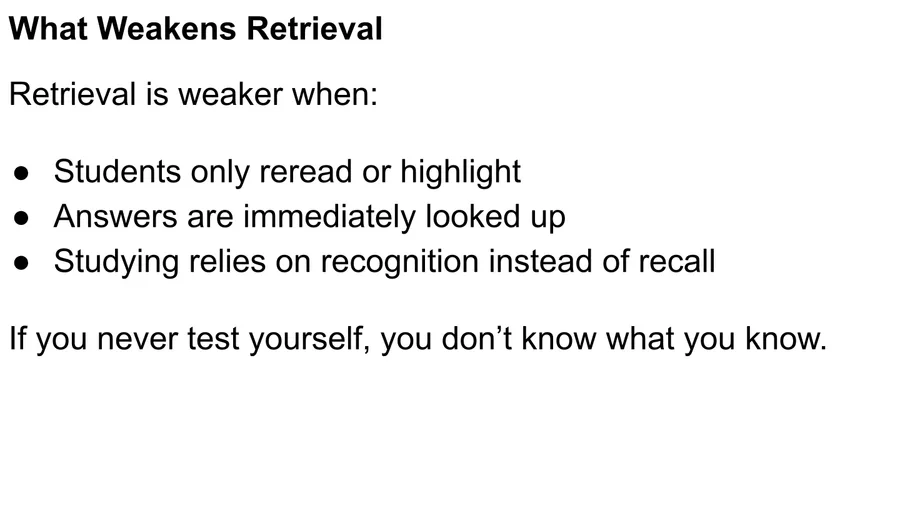
The student relied on recognition instead of retrieval
The student used working memory only
The student did not store the information
57
Multiple Choice
What does the lesson mean by effortful retrieval?
Retrieval that happens only after long study sessions
Retrieval that requires some struggle and thinking
Retrieval that feels easy and automatic
Retrieval that occurs only during exams
58
Multiple Choice
Which situation best illustrates the illusion of knowing?
A student explains a concept clearly from memory
A student recognizes terms but cannot explain them
A student uses flashcards to quiz themselves
A student practices retrieval over several days
59
Multiple Choice
Which strategy is most effective for improving retrieval?
Reading notes multiple times
Reviewing answers immediately
Practicing recall before checking notes
Studying only the night before a test
60
Multiple Choice
Which conclusion is best supported by the retrieval lesson?
Retrieval checks how much you know but does not improve learning
Retrieval should only be used after all studying is complete
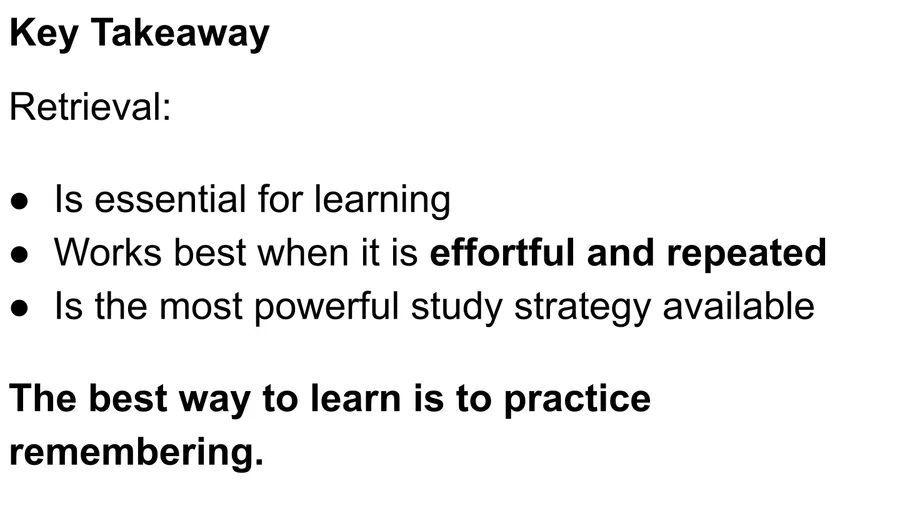
Retrieval strengthens both recall and storage over time
Retrieval is useful only for short-term memory
61

62
Multiple Choice
Which statement best describes the correct sequence of processes involved in learning?
Retrieval → Encoding → Storage
Encoding → Storage → Retrieval
Storage → Retrieval → Encoding
Encoding → Retrieval → Storage
63
Multiple Choice
A student listens to a lecture while texting friends and watching videos. Later, the student cannot remember the content.
Which process was most likely least effective?
Storage
Retrieval
Encoding
Recognition
64
Multiple Choice
Why does deep encoding result in better long-term learning than shallow encoding?
Deep encoding takes less time
Deep encoding focuses on repetition
Deep encoding emphasizes meaning and connections
Deep encoding occurs automatically
65
Multiple Choice
Which type of memory has the most limited capacity and is most affected during problem-solving?
Long-term memory
Semantic memory
Procedural memory
Working memory
66
Multiple Choice
A student remembers how to ride a bicycle years after learning.
Which type of memory is being used?
Semantic memory
Episodic memory
Procedural memory
Working memory
67
Multiple Choice
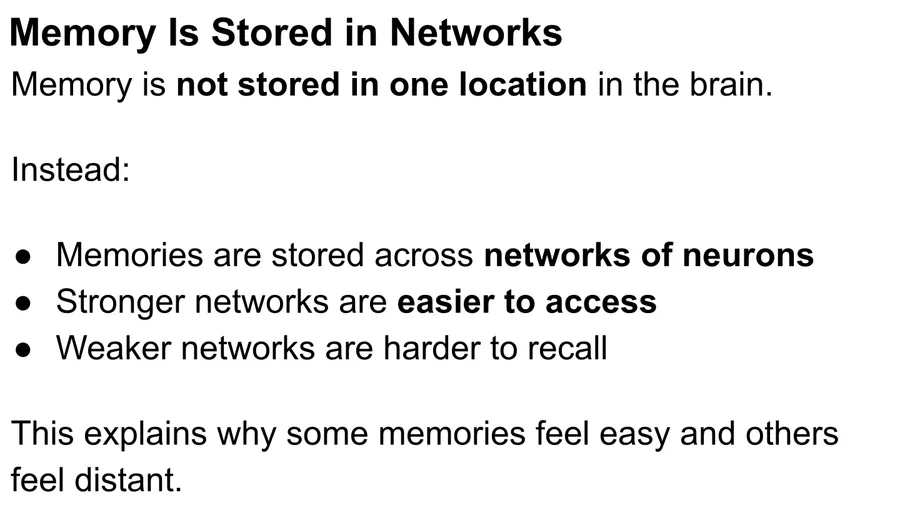
Why is memory not stored in a single location in the brain?
Why is memory not stored in a single location in the brain?
Memories are stored across networks of neurons
Each memory is stored in one specific neuron
Memory storage occurs only during sleep
68
Multiple Choice
A student recognizes vocabulary words during review but cannot explain them on a test.
Which explanation best fits this situation?
The student failed to store the information
The student relied on recognition instead of retrieval
The student never encoded the information
The student used procedural memory incorrectly
69
Multiple Choice
Why does retrieval practice improve long-term learning?
It increases study time
It prevents forgetting completely
It strengthens neural pathways each time information is recalled
It replaces the need for encoding
70
Multiple Choice
Which situation best represents effortful retrieval?
Reading highlighted notes
Copying answers from a review sheet
Writing everything remembered before checking notes
Watching a teacher explain the material again
71
Multiple Choice
A student says, “I understood it in class, but I forgot it later.”
Which conclusion best explains this outcome?
Storage was strengthened through retrieval
Encoding occurred, but storage was not reinforced
Retrieval occurred before encoding
The information was stored permanently
72
Multiple Choice
Which process is directly strengthened every time information is successfully recalled?
Encoding only
Storage only
Retrieval only
Storage and retrieval
73
Multiple Choice
Which statement best explains the illusion of knowing?
Forgetting information after studying
Believing information is learned because it feels familiar
Struggling to recall information during practice
Strengthening memory through retrieval
74
Multiple Choice
Why is retrieval considered both a learning tool and an assessment tool?
It saves time during studying
It replaces the need for review
It strengthens memory while revealing understanding gaps
It works only for short-term memory
75
Multiple Choice
Which conclusion is best supported by the lesson on memory?
Learning depends mostly on natural ability
Time spent studying matters more than strategy
Effective learning requires encoding, storage, and retrieval
Memory works best when studying feels easy
76
77

78
79
80
81

82
83

84

85

86
87
88

89
90

91

92
93

94
95
96

97

98

99
100
101
102

103
104

105

106

107
108
109
Show answer
Auto Play
Slide 1 / 109
SLIDE
Similar Resources on Wayground

101 questions
Holt Ch 8 PPT
Presentation
•
9th - 12th Grade
97 questions
Photosynthesis and Cellular Respiration Lesson
Presentation
•
9th - 12th Grade
99 questions
GOALS World History I Lesson 5
Presentation
•
9th - 12th Grade
101 questions
CRM 1.2 Text 1 Master Lesson
Presentation
•
10th Grade
105 questions
AP Bio Lesson Topic 2.1-2.2 Cell Size and Types
Presentation
•
9th - 12th Grade
99 questions
Continuity and Unity of Life
Presentation
•
10th - 12th Grade
106 questions
Punnett Square and Blood Types
Presentation
•
9th - 12th Grade
106 questions
Blood Type Genetic Problems Lessons and Quizzes
Presentation
•
9th - 12th Grade
Popular Resources on Wayground
10 questions
Safety Day 2026 – Student Review

Quiz
•
9th Grade
21 questions
Continents and Oceans
Quiz
•
6th Grade
20 questions
Parts of Speech
Quiz
•
5th Grade
16 questions
Subject & Predicate
Quiz
•
5th Grade
25 questions
Multiplication Facts
Quiz
•
5th Grade
12 questions
Map Skills
Quiz
•
3rd Grade
22 questions
Continents and Oceans
Quiz
•
5th Grade
15 questions
Rounding Decimals
Quiz
•
5th Grade
Discover more resources for Biology
20 questions
Cell organelles and functions
Quiz
•
10th Grade
20 questions
Cell Transport
Quiz
•
9th - 12th Grade
25 questions
photosynthesis and cellular respiration
Quiz
•
9th Grade
20 questions
Cell Cycle
Quiz
•
9th Grade
8 questions
DNA vs. RNA
Presentation
•
9th - 12th Grade
14 questions
Ecological Succession: Primary and Secondary
Quiz
•
9th Grade
20 questions
Macromolecules
Quiz
•
10th Grade
20 questions
Characteristics of Life
Quiz
•
9th - 10th Grade