Search Header Logo
8.ESS2.2-Inside Earth: Messages from Seismic Waves-slides/notes

8.ESS2.2-Inside Earth: Messages from Seismic Waves-slides/notes

Assessment

Presentation

Science

8th Grade

Hard

NGSS
MS-PS4-2, MS-PS4-1, MS-ESS2-1

+10

Standards-aligned

Created by

Jessica Freeman

FREE Resource

50 Slides • 94 Questions

2

media

3

media

4

media

5

media
media
media

6

Multiple Select

Select all that are true about P-waves

1

P stands for primary

2

They are slower than S waves

3

They travel as longitudinal waves

4

They cannot travel through liquids

7

Multiple Choice

Question image

Look at the image.

Which statement can be concluded based upon the information in the seismogram?

1

S waves travel faster than P waves

2

P waves travel faster than S waves

3

P waves initially travel faster, but S waves accelerate and overtake the P waves, so they reach the surface first

4

P waves and S waves travel at the same speed, but P waves arrive at the surface first because the earthquake releases them earlier

8

Multiple Choice

Question image

Look at the chart and read the scenario above the chart.

Which wave corresponds to a primary wave?

1

W

2

X

3

Y

4

Z

9

Multiple Choice

Which type of wave arrives first during an earthquake?
1

Primary (p-wave) waves

2

Secondary (s-wave) waves

3

Surface Waves

10

Multiple Choice

Question image

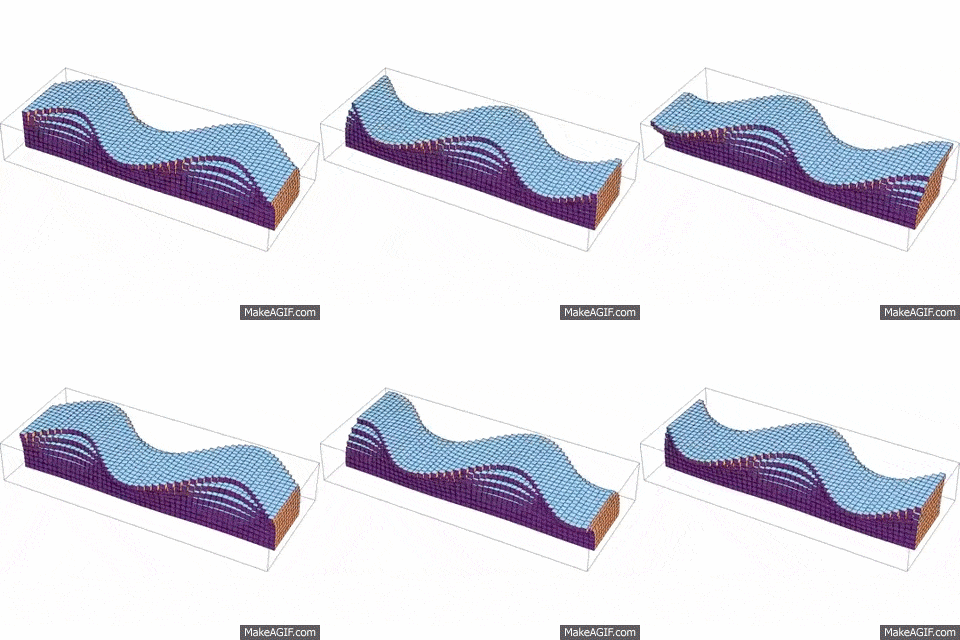
Which type of Seismic Wave is pictured?

1

P-Wave

2

S-Wave

3

Surface Wave

11

Multiple Choice

How are the two types of waves different from each other?

1

Within the earth, P waves can travel through solids and liquids, whereas S waves can only travel through solids.

2

Within the earth, S waves can travel through solids and liquids, whereas P waves can only travel through solids.

12

Multiple Choice

Question image
Which letter represents the movement created by the P Wave?  
1
A
2
B
3
C

13

Multiple Choice

Which of the following seismic waves can travel through gases, liquids, and solids?

1

P-wave

2

S-wave

3

both

4

none

14

media
media
media

15

media
media

16

media

17

Multiple Choice

Question image

Look at the chart and analyze what it is showing you.

The scientists conclude that the outer core is liquid and the inner core is solid. What evidence did the scientists use to draw their conclusion?

1

The outer core is thicker than the inner core

2

The S wave did not pass through the outer core

3

The inner core is the innermost layer of Earth

4

The velocity of the P wave is greater in the inner core than in the mantle

18

Multiple Choice

Question image

Which Seismic Wave is pictured?

1

P-Wave

2

S-Wave

3

Surface Wave

19

Multiple Choice

Main type of seismic waves that can only travel through the surface of the Earth.

1

seismic waves

2

surface waves

3

secondary waves

4

primary waves

20

Multiple Choice

True or False: Scientists have been able to make observations beneath Earth's crust.

1

TRUE:

Those observations come from seismic waves

2

TRUE:

Those observations come from rock samples of the asthenosphere

3

FALSE:

Scientists have not been able to take samples beneath Earth's crust

4

FALSE:

Scientists can only make guesses about Earth's interior

21

Multiple Select

Select all that are true about s-waves

1

They are slower than P waves

2

S stands for stationary

3

They travel as transverse waves

4

They cannot travel through liquids

22

Multiple Choice

Scientists know that Earth's outer core is liquid because....

1

P-waves can't travel through it

2

S-waves can't travel through it

3

They are just guessing

4

They've taken direct samples

23

Multiple Choice

What kind of waves are seismic waves?

1

Kinetic

2

Mechanical

3

Electromagnetic

4

Elastic

24

Multiple Choice

What would happen if an s-wave were to pass from a solid to a liquid?

1

It would slow down because the molecules are spaced further apart.

2

It would speed up because it has more room to move between molecules.

3

It would stop because s-waves can't pass through liquids.

4

It would maintain a constant speed.

25

Multiple Choice

How are scientist able to estimate the thickness of each layer of the Earth?By studying __________
1
 radio waves
2
sonar waves
3
laser waves
4
seismic waves

26

media

27

media

28

media

29

Multiple Choice

4) Which layer is the thin outer layer of the Earth?

1

Crust

2

Mantle

3

Outer Core

4

Inner Core

5

Tectonic plates

30

Multiple Choice

) Which of the following best describes the Earth's crust?

1

The area of the Earth that is sometimes called the lithosphere

2

The thinnest layer of the four layers that make up the composition of the Earth

3

It consists of liquid iron and nickel

4

It resides between the crust and the outer core

5

It is under such immense pressure that, even though it is very hot, it is still a solid

31

Multiple Choice

Scientists determine what Earth’s interior looks like by using:
1
Volcanoes
2
Seismic Waves
3
Continental Drift
4
Convection Currents

32

media

33

media

34

Multiple Choice

This layer of Earth is the thickest part
1
crust
2
outer core
3
mantle
4
inner core

35

Multiple Choice

Question image
What layer is located at #2
1
Crust
2
Mantle
3
Outer Core
4
Inner Core

36

Multiple Choice

This layer is solid to semi-solid and is slowly circulating because of convection

1

Mantle

2

Crust

3

Inner core

4

Outer core

37

Multiple Choice

5. Which layer is the thickest?
1
Core
2
Crust
3
Mantle

38

Multiple Choice

Question image
Identify the letter in the diagram.  Identify letter A
1
Lithosphere
2
Asthenosphere
3
Mantle
4
Outer Core

39

Multiple Choice

Which layer contains convection currents?

1

outer core

2

inner core

3

mantle

4

lithosphere

40

Multiple Choice

Question image
Layer 3 is the Earth's ______ core.
1
Core
2
Lithosphere
3
Mantle
4
Asthenosphere

41

Multiple Choice

The layer of the Earth where convection currents occur is called the

1

Mantle

2

Lithosphere

3

Upper core

4

Inner core

42

media

43

media

44

media

45

Hotspot

Which point is the crust?

46

Match

Question image

Match the following to the correct letter

The thinnest layer

The layer responsible for generating the magnetic field

The layer that is composed of magma

The hottest layer

1

3

2

4

47

Labelling

Identify the layers of the Earth shown in the diagram.
Drag labels to their correct position on the image

Crust

Mantle

Outer Core

Inner Core

48

Hotspot

Which point is the Outer Core?

49

Hotspot

Which point is the Inner Core?

50

Hotspot

Which point is the mantle?

51

Hotspot

Which point to the layer made of hot rock called magma?

52

Match

Question image

Name the layer of Earth that each letter represents.

A

B

C

D

crust

mantle

outer core

inner core

53

media

54

media

55

media

Earthquake

hot

seismic

heat

56

media

57

media

58

Multiple Choice

Mason, Kai, and Ethan were studying about earthquakes in their geography class. They learned that energy from earthquakes is carried by waves. Is this statement true?

1

True

2

False

59

Multiple Choice

David, Avery, and Jackson were discussing natural disasters. David made a statement, 'Whenever there is an earthquake, you will always find a volcano nearby.'

1

True

2

False

60

Multiple Choice

Anika, Aiden, and Olivia were discussing natural disasters in their geography class. Aiden stated that earthquakes happen every day. Is Aiden's statement true?

1

True

2

False

61

Multiple Select

Question image

Which of the following are types of seismic waves? Choose 3.

1

primary wave

2

secondary wave

3

tertiary wave

4

surface waves

5

outer waves

62

Multiple Choice

An earthquakes energy is strongest near the _____ .

1

center

2

edge

63

Multiple Choice

A scientist who studies earthquakes is called a _____ ?

1

paleontologist

2

seismologist

3

chemist

4

biologist

64

Multiple Choice

Question image

What is the machine called that is used to measure earthquakes?

1

seismogram

2

microscope

3

telescope

65

Multiple Choice

Question image

Vibrations caused when stress makes rocks pass their elastic limit.

1

epicenter

2

Earthquake

3

strike-slip

4

surface wave

66

Multiple Choice

Type of wave that causes particles in rocks to move back and forth in the same direction as the wave

1

love

2

secondary

3

surface

4

primary

67

Multiple Choice

Question image

The type of waves that make particles move at right angles to the direction of the wave

1

secondary

2

love

3

primary

4

surface

68

Multiple Choice

The name of all the waves caused by earthquake energy

1

primary waves

2

surface waves

3

secondary waves

4

seismic waves

69

Multiple Choice

Seismic waves that cause the most destruction

1

tsunami

2

secondary waves

3

surface waves

4

Primary waves

70

Multiple Choice

What does the rubbing and grinding of Earth's crust build-up? Ch. 10

1

Energy

2

Dirt

3

Magma

4

Fractures

71

Multiple Choice

What doesn't help scientists when recording and mapping earthquakes? Ch. 10

1

Map the boundaries

2

Predict where

it might happen

3

How to build the homes in the area.

4

When it will happen.

72

Multiple Choice

What seismic wave will travel through rock and magma? Ch. 11

1

P Waves

2

S Waves

3

Surface Waves

4

Love Wave

73

Multiple Choice

What seismic wave shows up on a seismometer last? Ch. 11

1

P Waves

2

S Waves

3

Surface Waves

4

Tidal Wave

74

Multiple Choice

What seismic wave shows up on a seismometer first? Ch. 11

1

P Waves

2

S Waves

3

Surface Waves

4

Tidal Wave

75

Multiple Choice

What seismic wave causes the most damage? Ch. 11

1

P Waves

2

S Waves

3

Surface Waves

76

Multiple Choice

What seismic waves can only travel through rock? Ch. 11

1

P Waves

2

S Waves

3

Pressure Wave

77

Multiple Choice

3. Which of these best describes why land moves on Earth’s surface?
1
Magic!
2
Tiny earthquakes we can’t feel.
3
Forces from Earth's interior.
4
Surface winds blowing dirt around.

78

Multiple Choice

4. What keeps a solid stable when forces are acting on it?
1
Balanced forces
2
A solid’s weight
3
Only vertical forces
4
Rapid rotation of Earth

79

Multiple Choice

5. If an object is stable, what can you say about the net force acting on it?
1
The net force is greater than zero.
2
The net force is zero.
3
The object must be moving.
4
Gravity stops affecting it.

80

Multiple Choice

7. When do solids deform or break under stress?
1
When forces are balanced.
2
When forces are unbalanced.
3
When forces are removed.
4
When gravity is zero.

81

Multiple Choice

8. What happens when you remove forces causing elastic deformation?
1
Solids explode.
2
Solids stay deformed forever.
3
Solids snap back to their original shape.
4
Nothing happens—it stays the same.

82

Multiple Choice

9. Why do unbalanced forces deep inside Earth cause surface changes?
1
They create windstorms.
2
They build up energy that leads to cracks and deformation.
3
They make rocks grow larger.
4
They make the crust softer.

83

media

84

media

85

media

seismograph

seismogram

interior

timing

strength

86

media

87

Scientists observe how wave energy travels along Earth's surface. 

During an earthquake, energy is released into the Earth as seismic waves.

media

88

Seismographs

media

89

Fill in the Blank

A seismograph is an instrument that _____ and records earthquake events.

90

Match

Match the following

Seismographs can tell how far away the ____ is.

Need __ seismographs to determine exact location.

Seismographs are also used to determine the ____ of the quake.

epicenter

3

strength

91

media

Locating Earthquake Distance

92

Multiple Choice

Seismographs measure the _______and length of earthquakes.  

1

time

2

distance

3

location

4

magnitude

93

Multiple Select

A modern seismograph can help scientists detect earthquakes and measure several aspects of the event (more than 1 is correct):

1

Time

2

Location

3

Depth

4

Energy

94

Multiple Choice

____ is an instrument that records seismic waves from earthquakes

1

meteorology

2

levee

3

seismograph

4

dam

95

media

a) How does stress act upon a rock?

Stress is a force acting upon and deforming rock

b) What is elastic deformation?

Changes to rocks based on their original form

c) Define:

Fault—fracture in Earth’s crust where slippage or ruptures

occur

Focus--origin of earthquake below the surface; the

shallower the focus = more destructive

Epicenter--point directly above focus

96

media

97

media

98

media

99

media

​speeds

bend

slow

different

100

media

101

Multiple Choice

Question image

Look at the image.

Which statement can be concluded based upon the information in the seismogram?

1

S waves travel faster than P waves

2

P waves travel faster than S waves

3

P waves initially travel faster, but S waves accelerate and overtake the P waves, so they reach the surface first

4

P waves and S waves travel at the same speed, but P waves arrive at the surface first because the earthquake releases them earlier

102

Multiple Choice

Question image

Look at the chart and read the scenario above the chart.

Which wave corresponds to a primary wave?

1

W

2

X

3

Y

4

Z

103

Multiple Choice

Question image

Read and analyze the chart.

Based on the table, which statement correctly describes the characteristics of Earth's layers?

1

The layers of the core are the most dense

2

The layers of the mantle are the least dense

3

The crust is more dense than the layers of the mantle

4

The density of the layers of the mantle decreases as depth increases

104

Multiple Choice

Question image

Look at the chart and analyze what it is showing you.

The scientists conclude that the outer core is liquid and the inner core is solid. What evidence did the scientists use to draw their conclusion?

1

The outer core is thicker than the inner core

2

The S wave did not pass through the outer core

3

The inner core is the innermost layer of Earth

4

The velocity of the P wave is greater in the inner core than in the mantle

105

Multiple Choice

How are P and S waves categorized?

1

Both P and S waves are longitudinal waves

2

Both P and S waves are transverse waves

3

P waves are longitudinal waves and S waves are transverse waves

4

P waves are transverse waves and S waves are longitudinal waves

106

Multiple Choice

Which type of wave arrives first during an earthquake?
1

Primary (p-wave) waves

2

Secondary (s-wave) waves

3

Surface Waves

107

Multiple Choice

Question image

Which Seismic Wave is pictured?

1

P-Wave

2

S-Wave

3

Surface Wave

108

Multiple Choice

Which is the strength of an earthquake?

1

Plate boundaries

2

Magnitude

3

Fault

4

Seismic

109

Multiple Choice

Main type of seismic waves that can only travel through the surface of the Earth.

1

seismic waves

2

surface waves

3

secondary waves

4

primary waves

110

Multiple Choice

Question image

Which type of Seismic Wave is pictured?

1

P-Wave

2

S-Wave

3

Surface Wave

111

Multiple Choice

What is a seismograph?

1

A record of the Earth's temperature

2

A recording of earthquakes waves

3

A log of the times and locations of Earthquakes

4

A list of the different states of matter found in the Earth

112

Multiple Choice

How are the two types of waves different from each other?

1

Within the earth, P waves can travel through solids and liquids, whereas S waves can only travel through solids.

2

Within the earth, S waves can travel through solids and liquids, whereas P waves can only travel through solids.

113

Multiple Choice

Which of the following seismic waves can travel through gases, liquids, and solids?

1

P-wave

2

S-wave

3

both

4

none

114

Multiple Choice

True or False: Scientists have been able to make observations beneath Earth's crust.

1

TRUE:

Those observations come from seismic waves

2

TRUE:

Those observations come from rock samples of the asthenosphere

3

FALSE:

Scientists have not been able to take samples beneath Earth's crust

4

FALSE:

Scientists can only make guesses about Earth's interior

115

Multiple Choice

Scientists know that Earth's outer core is liquid because....

1

P-waves can't travel through it

2

S-waves can't travel through it

3

They are just guessing

4

They've taken direct samples

116

Multiple Choice

What is the most common element in earth's inner and outer core?

1

iron

2

hydrogen

3

potassium

4

gold

117

Multiple Choice

This layer is solid to semi-solid and is slowly circulating because of convection

1

Mantle

2

Crust

3

Inner core

4

Outer core

118

Multiple Choice

What would happen if a p-wave were to pass from a solid to a liquid?

1

It would slow down because the molecules are spaced further apart.

2

It would speed up because it has more room to move between molecules.

3

It would stop because p-waves can't pass through liquids.

4

It would maintain a constant speed.

119

Multiple Choice

What would happen if an s-wave were to pass from a solid to a liquid?

1

It would slow down because the molecules are spaced further apart.

2

It would speed up because it has more room to move between molecules.

3

It would stop because s-waves can't pass through liquids.

4

It would maintain a constant speed.

120

Multiple Choice

How are scientist able to estimate the thickness of each layer of the Earth?By studying __________
1
 radio waves
2
sonar waves
3
laser waves
4
seismic waves

121

media

122

media

123

media

124

media

data

crust

mantle

core

composition

density

interior

125

media

126

media

127

media

128

media

129

media

hot

convection

earthquakes

volcanoes

130

Multiple Choice

An earthquake occurs when forces and stress along a fault build up, causing the rock to break at a weak point along the fault and release energy. How does this energy move through the Earth?

1

as seismic waves

2

as sound vibrations

3

as heat waves

4

as light radiation

131

media

132

Multiple Choice

Which property was first used to identify Earth's layers?

1

temperature

2

composition

3

thickness

4

density

133

media

134

media

135

media

136

media

Data

create

revise

evidence

137

media

138

media

139

Multiple Choice

Which evidence supports the inference that the outer core is liquid?


1

analysis of seismic wave data

2

analysis of bedrock core samples

3

analysis of Earth's rotational speed

4

analysis of earthquake activity

140

Multiple Choice

Question image

Which seismograph station was closest to the epicenter of the earthquake?


1

Station 1

2

Station 2

3

Station 3

4

Station 4

141

Multiple Choice

Question image

Which city received the most damage from the earthquake?

1

Biloxi

2

Natchez

3

Starkville

4

Yazoo City

142

Multiple Choice

Question image

Which city is closest to the source of the seismic wave?

1

Gulfport

2

Memphis

3

Meridian

4

Vicksburg

143

Multiple Choice

Question image

The outlines of the continents seem to correspond in shape where indicated by the arrows. Which is the best inference that can be made from this?

1

The continents have similar geography and climate.

2

The continents have similar weather patterns.

3

The continents were once joined together in a large land mass.

4

Africa contains more fossils than South America.

144

Multiple Choice

Seismic waves generated by earthquakes travel faster through the mantle than the crust. What information does that provide scientists?

1

The mantle is less dense than the crust.

2

The mantle is more dense than the crust.

3

The mantle is thinner than the crust.

4

The mantle is thicker than the crust.

Show answer

Auto Play

Slide 1 / 144

SLIDE