
Rock Correlation & Index Fossils
Authored by Danielle Foraker
Science
9th - 12th Grade
NGSS covered
Used 4+ times


AI Actions
Add similar questions
Adjust reading levels
Convert to real-world scenario
Translate activity
More...
Content View
Student View
15 questions
Show all answers
1.
MULTIPLE CHOICE QUESTION
1 min • 1 pt
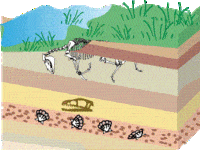
According to the Law of Superposition, the oldest fossils are found
at the top of the rock layers
in the bottom rock layers
in the middle of the rock layers
somewhat near the surface
Answer explanation
According to the Law of Superposition, in undisturbed rock layers, the oldest fossils are found in the bottom rock layers, while younger fossils are located above them. Therefore, the correct answer is 'in the bottom rock layers'.
Tags
NGSS.MS-ESS1-4
NGSS.MS-LS4-1
2.
MULTIPLE CHOICE QUESTION
30 sec • 1 pt

Which rock layer contains the youngest fossils?
F
E
B
C
Answer explanation
Layer F contains the youngest fossils because, in geological terms, the youngest layers are typically found at the top of the sequence. Therefore, F is the correct choice for the layer with the youngest fossils.
Tags
NGSS.MS-ESS1-4
NGSS.MS-LS4-1
3.
MULTIPLE CHOICE QUESTION
30 sec • 1 pt

Which fossil is the oldest?
Trilobite
Ammonite
Crinoid
Gastropod
Answer explanation
The trilobite is the oldest of the listed fossils, dating back to the Cambrian period, around 521 million years ago. In contrast, ammonites, crinoids, and gastropods appeared later in the geological timeline.
Tags
NGSS.MS-ESS1-4
NGSS.MS-LS4-1
4.
MULTIPLE CHOICE QUESTION
30 sec • 1 pt
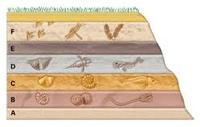
Which rock layer in the diagram seems to be the oldest?
F
E
B
A
Answer explanation
Layer A is the oldest because, in geological formations, the principle of superposition states that lower layers are older than those above them. Therefore, since A is at the bottom, it is the oldest rock layer.
Tags
NGSS.MS-ESS1-4
5.
MULTIPLE CHOICE QUESTION
30 sec • 1 pt

To be considered an index fossil, it must have lived for a relatively short period of time.
True
False
Answer explanation
True. An index fossil must have existed for a relatively short time span, allowing it to be used for dating and correlating the age of rock layers.
Tags
NGSS.MS-ESS1-4
NGSS.MS-LS4-1
6.
MULTIPLE CHOICE QUESTION
30 sec • 1 pt
To be considered an index fossil, it must have been abundant (commonly found).
True
False
Answer explanation
True. An index fossil must be abundant and commonly found in various geological formations, which helps in dating and correlating the age of rock layers.
Tags
NGSS.MS-ESS1-4
NGSS.MS-LS4-1
7.
MULTIPLE CHOICE QUESTION
30 sec • 1 pt
To be considered an index fossil, it must have a wide geographic distribution (found in many locations around the world).
True
False
Answer explanation
True. An index fossil must have a wide geographic distribution, meaning it is found in many locations around the world, which helps in correlating the age of rock layers.
Tags
NGSS.MS-ESS1-4
NGSS.MS-ESS2-3


Access all questions and much more by creating a free account
Create resources
Host any resource
Get auto-graded reports

Continue with Google

Continue with Email

Continue with Microsoft
or continue with

%20(1).png)
Apple

Others
By signing up, you agree to our Terms of Service & Privacy Policy
Already have an account?


