
- Resource Library
- Science
- Chemistry
- Activation Energy
- Constructing An Argument Using Collision Theory And Transition State Theory To Explain Activation Energy In Chemical Rea
Constructing an Argument Using Collision Theory and Transition State Theory to Explain Activation Energy in Chemical Rea
Authored by Kartik Garg
Science
9th - 12th Grade
NGSS covered


AI Actions
Add similar questions
Adjust reading levels
Convert to real-world scenario
Translate activity
More...
Content View
Student View
15 questions
Show all answers
1.
MULTIPLE CHOICE QUESTION
1 min • 1 pt

Looking at the graph, how would you know which reaction took place with the help of an enzyme?
The peak for the activation energy is lower.
The peak for the activation energy is higher.
There is less energy in the products than the reactants.
There is no way to really tell which line on the graph shows a reaction that takes place with a reaction.
2.
MULTIPLE CHOICE QUESTION
1 min • 1 pt
Enzymes ___________________ activation energy to speed up chemical reactions.
increase
decrease
3.
MULTIPLE CHOICE QUESTION
1 min • 3 pts
The activation energy needed for a chemical reaction is decreased by a
catalyst
reactant
product
substrate
4.
MULTIPLE CHOICE QUESTION
1 min • 1 pt
What is the relationship between enzymes and activation energy?
When an enzyme catalyzes a reaction, it increases the activation energy of the reaction
When an enzyme catalyzes a reaction, it increases the activation energy of the product.
When an enzyme catalyzes a reaction, it decreases the activation energy of the reaction.
When an enzyme catalyzes a reaction, it does not affect the activation energy of the
reaction
5.
MULTIPLE CHOICE QUESTION
1 min • 1 pt
Many of the proteins in the human body are enzymes that catalyze chemical reactions. What is the relationship between enzymes and activation energy?
When an enzyme catalyzes a reaction, it increases the activation energy of the reaction
When an enzyme catalyzes a reaction, it increases the activation energy of the product.
When an enzyme catalyzes a reaction, it decreases the activation energy of the reaction.
When an enzyme catalyzes a reaction, it does not affect the activation energy of the
reaction
6.
MULTIPLE CHOICE QUESTION
1 min • 1 pt

The catalyzed reaction has how many intermediates?
0
1
2
3
7.
MULTIPLE CHOICE QUESTION
1 min • 1 pt
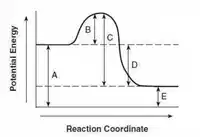
Using the diagram, which letter should be labeled Activation Energy
A
B
C
D
Tags
NGSS.HS-PS1-4


Access all questions and much more by creating a free account
Create resources
Host any resource
Get auto-graded reports

Continue with Google

Continue with Email

Continue with Microsoft
or continue with

%20(1).png)
Apple

Others
By signing up, you agree to our Terms of Service & Privacy Policy
Already have an account?


