Master circuit calculations with Wayground's comprehensive collection of free physics worksheets, featuring printable PDFs with practice problems and answer keys to help students understand electrical circuits, current, voltage, and resistance relationships.
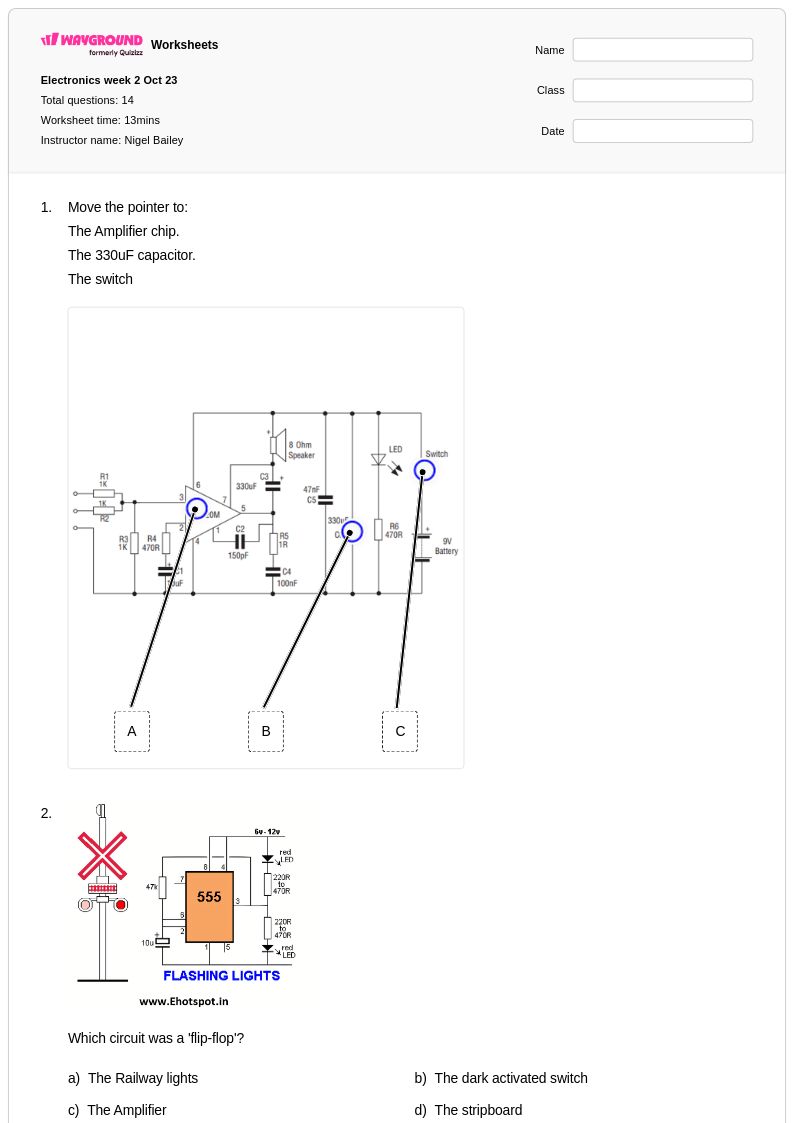
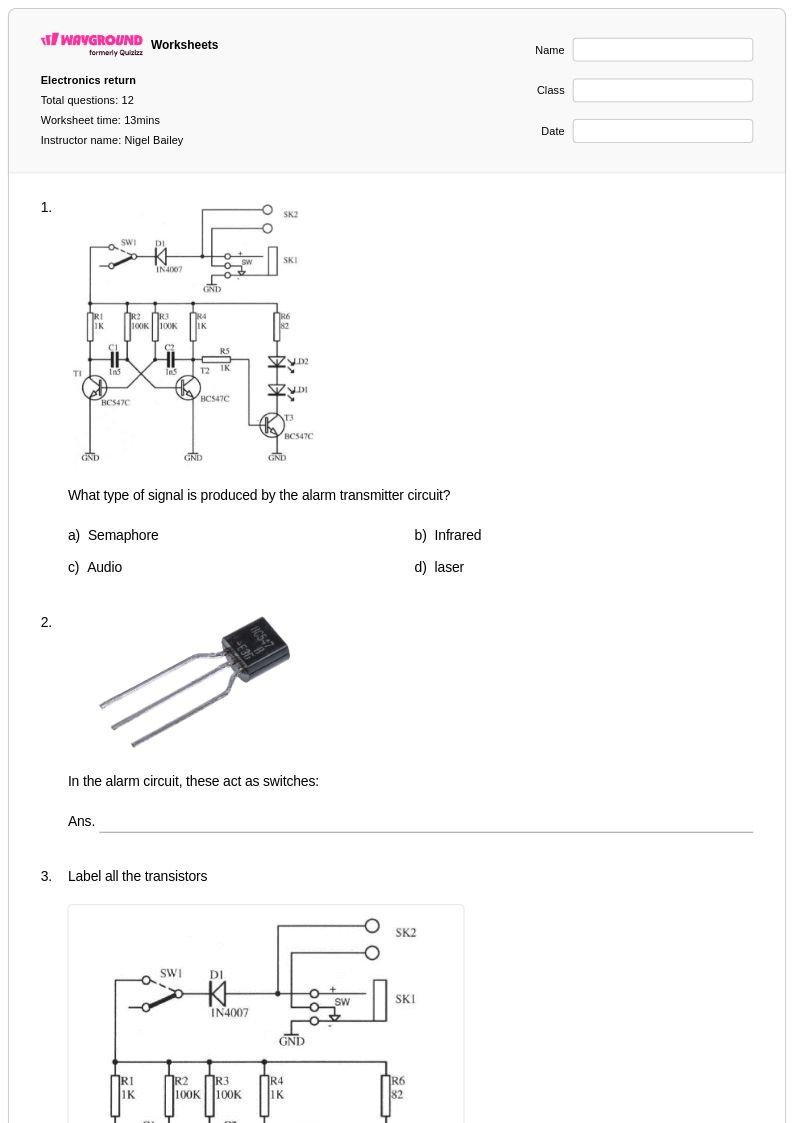
Circuit calculations worksheets available through Wayground (formerly Quizizz) provide comprehensive practice opportunities for students to master the fundamental mathematical principles governing electrical circuits. These expertly designed resources focus on essential skills including applying Ohm's Law, calculating voltage drops across resistors, determining current flow in series and parallel circuits, and analyzing power consumption in complex electrical networks. Students work through systematic practice problems that build proficiency in using circuit formulas, interpreting schematic diagrams, and solving multi-step calculations involving resistance, current, and voltage relationships. Each worksheet comes with a detailed answer key to support independent learning and self-assessment, and the free printable pdf format ensures easy classroom distribution and homework assignments.
Wayground (formerly Quizizz) empowers educators with an extensive collection of millions of teacher-created circuit calculation resources that streamline lesson planning and enhance student learning outcomes. The platform's robust search and filtering capabilities allow teachers to quickly locate worksheets aligned with specific physics standards and differentiate instruction based on individual student needs. Teachers can customize existing materials or create original circuit calculation practice sets, then distribute them in both printable pdf format for traditional classroom use and digital format for interactive learning experiences. These versatile tools support targeted remediation for students struggling with electrical concepts, provide enrichment opportunities for advanced learners ready to tackle complex circuit analysis, and offer consistent skill practice that reinforces mathematical problem-solving techniques essential for physics mastery.
FAQs
How do I teach circuit calculations to physics students?
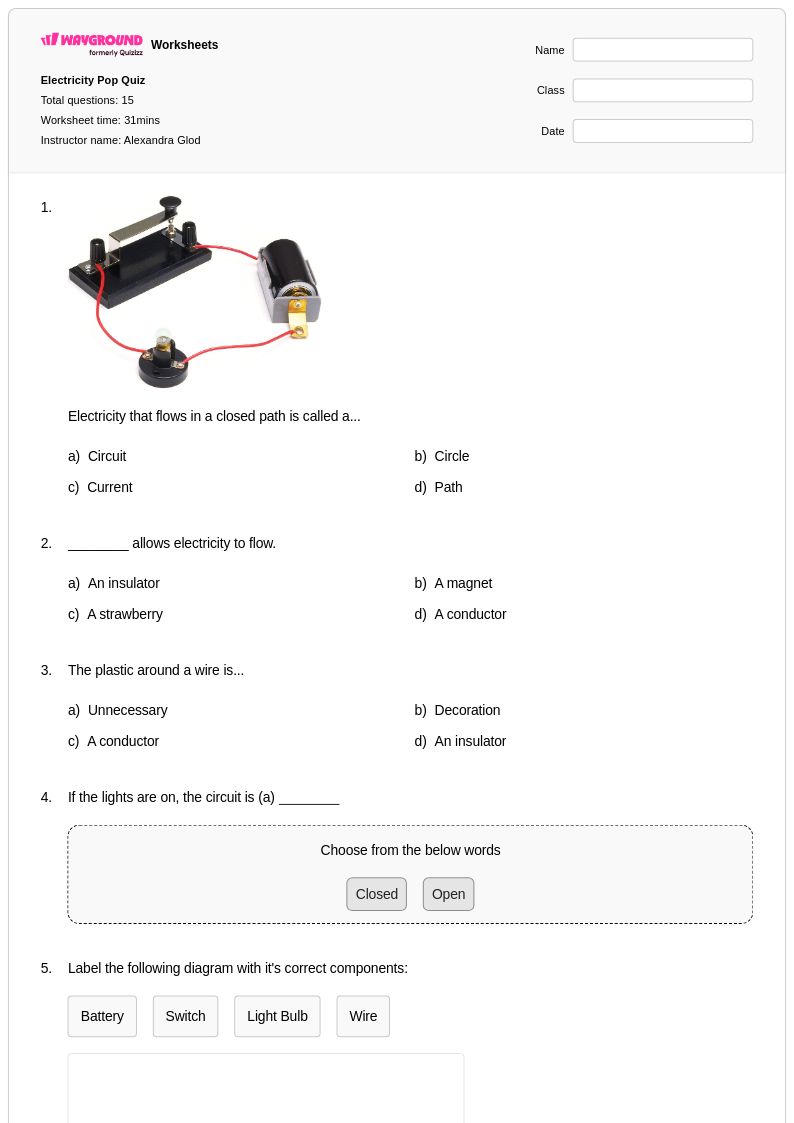
Start by grounding students in Ohm's Law (V = IR) before introducing series and parallel circuit configurations separately. Use schematic diagrams alongside numerical problems so students connect visual representations to mathematical relationships. Once students are comfortable with single-loop circuits, introduce multi-step problems involving voltage drops, current distribution, and power consumption. Building complexity gradually prevents the cognitive overload that often derails students when resistance networks become more involved.
What exercises help students practice circuit calculations?
Effective practice for circuit calculations includes applying Ohm's Law to find unknown variables, calculating voltage drops across individual resistors in a series circuit, and determining equivalent resistance in parallel networks. Multi-step problems that require students to first simplify a circuit before solving for current or power are especially valuable because they mirror the reasoning demanded on assessments. Systematic worksheet practice that progresses from single-resistor problems to complex networks builds the mathematical fluency students need for physics success.
What mistakes do students commonly make when solving circuit calculation problems?
The most frequent error is applying series circuit rules to parallel circuits and vice versa, particularly when calculating equivalent resistance. Students often forget that current remains constant throughout a series circuit while voltage divides, and that voltage remains constant across branches in a parallel circuit while current divides. A second common mistake is unit inconsistency, such as mixing milliamps with amps mid-calculation. Requiring students to label every known and unknown variable before solving can significantly reduce these errors.
How do I use Wayground's circuit calculations worksheets in my classroom?
Wayground's circuit calculations worksheets are available as printable PDFs for traditional classroom distribution and as digital formats for technology-integrated environments, giving teachers flexibility for in-class work, homework, or lab follow-up activities. Teachers can also host worksheets as a quiz directly on Wayground, enabling interactive digital delivery with built-in student response tracking. Each worksheet includes a detailed answer key, supporting both teacher-led review and independent student self-assessment. Wayground also allows teachers to customize existing materials or create original practice sets aligned to specific physics standards.
How can I differentiate circuit calculation instruction for students at different skill levels?
For students struggling with electrical concepts, begin with single-variable Ohm's Law problems and provide labeled schematic diagrams before moving to unlabeled ones. Advanced learners can be challenged with complex circuit analysis involving multiple resistor networks and power calculations across non-trivial configurations. On Wayground, teachers can apply individual accommodations such as reduced answer choices to lower cognitive load for students who need it, or enable Read Aloud for students with reading barriers, without affecting the experience of the rest of the class.
How do I help students understand the difference between series and parallel circuits in calculations?
Teach series and parallel circuits as distinct problem-solving frameworks rather than variations of the same process. In series circuits, students must understand that total resistance is the sum of all resistors and that current is identical at every point. In parallel circuits, the reciprocal formula for equivalent resistance and the fact that each branch carries the same voltage are the key anchors. Side-by-side comparison problems, where students solve the same circuit reconfigured as both series and parallel, are particularly effective for solidifying these distinctions.