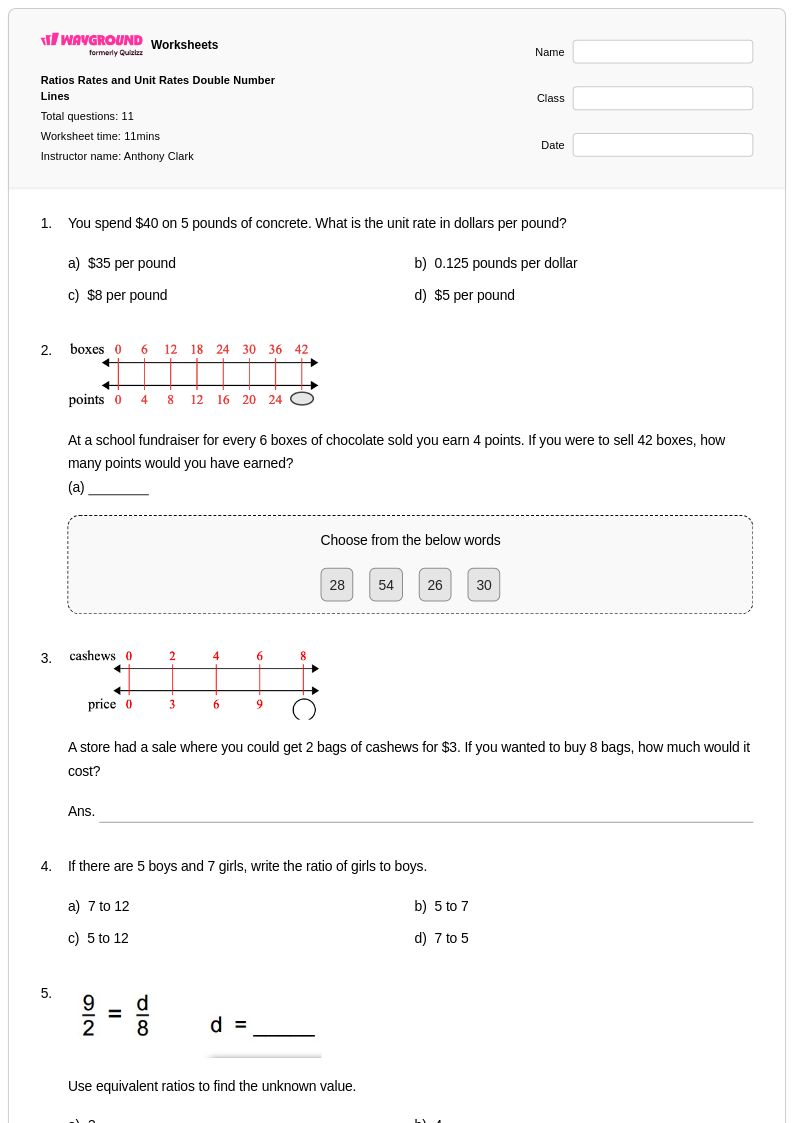
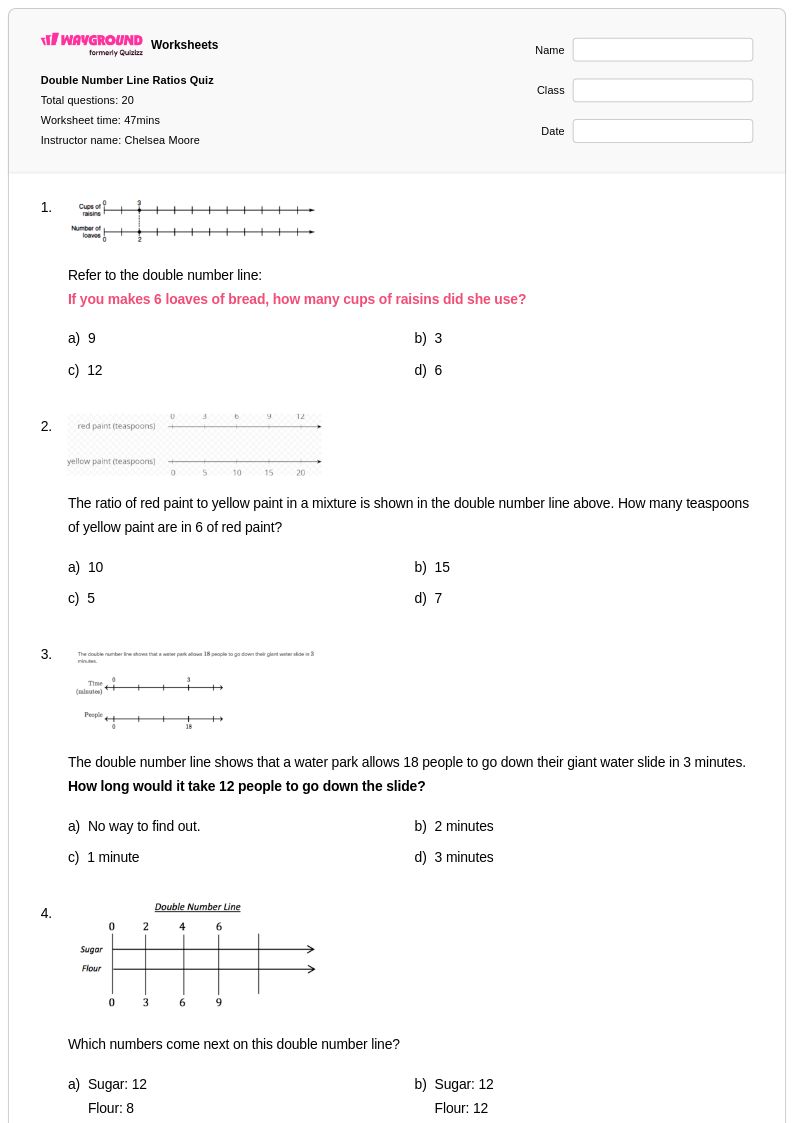
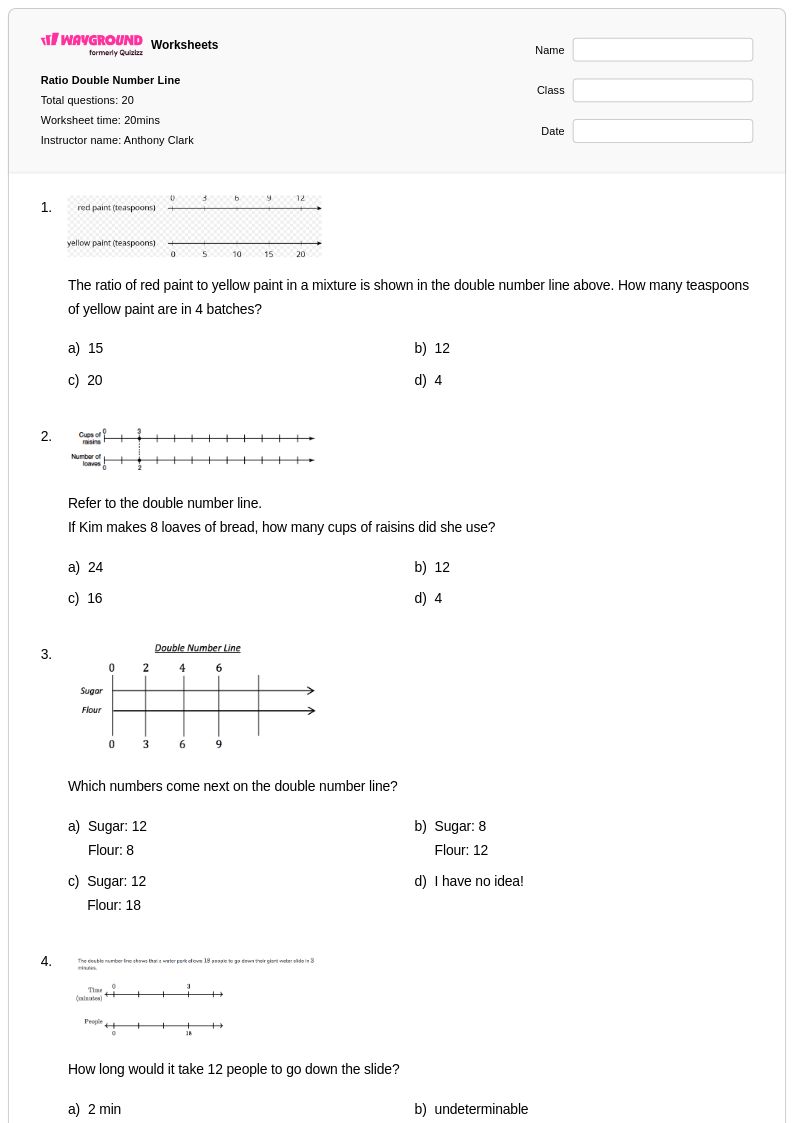
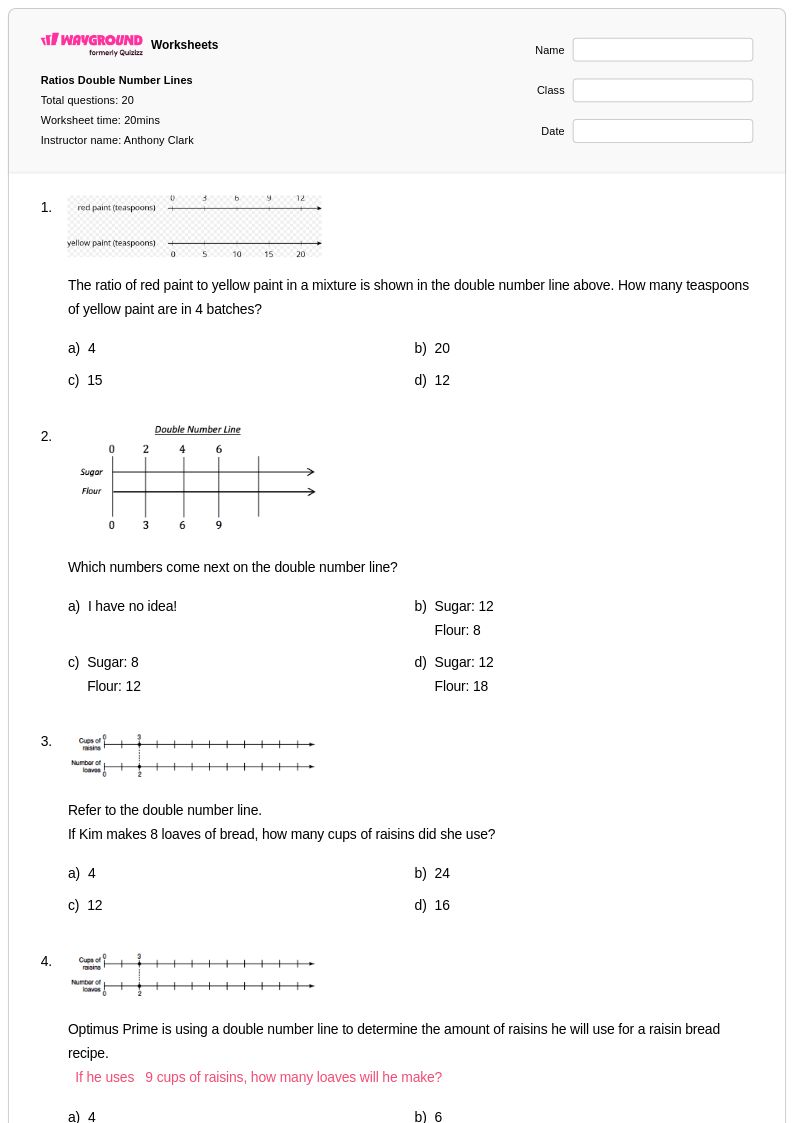
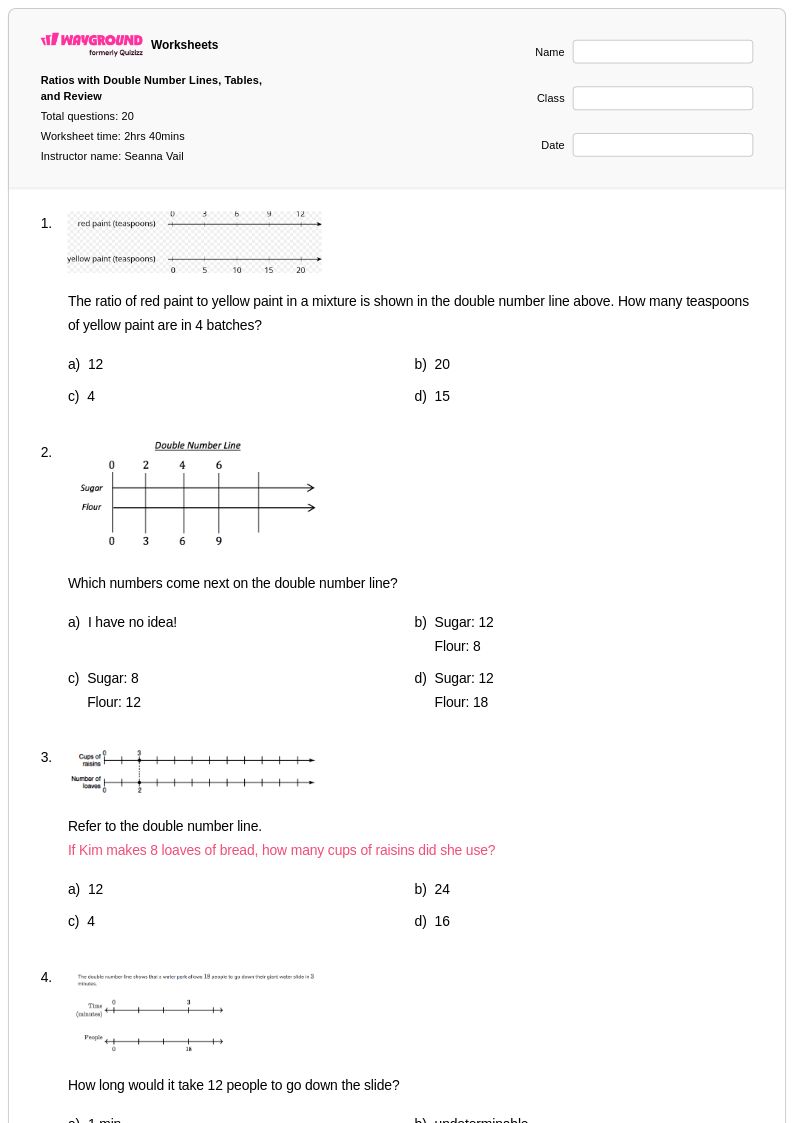
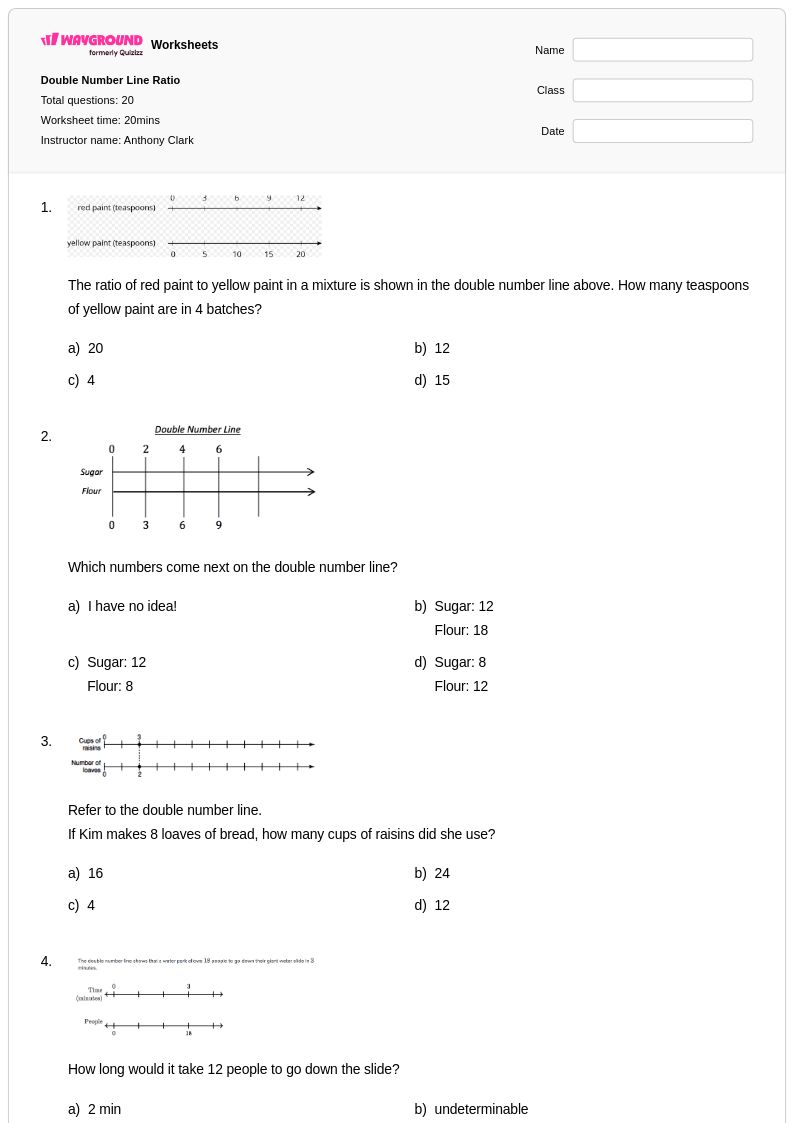
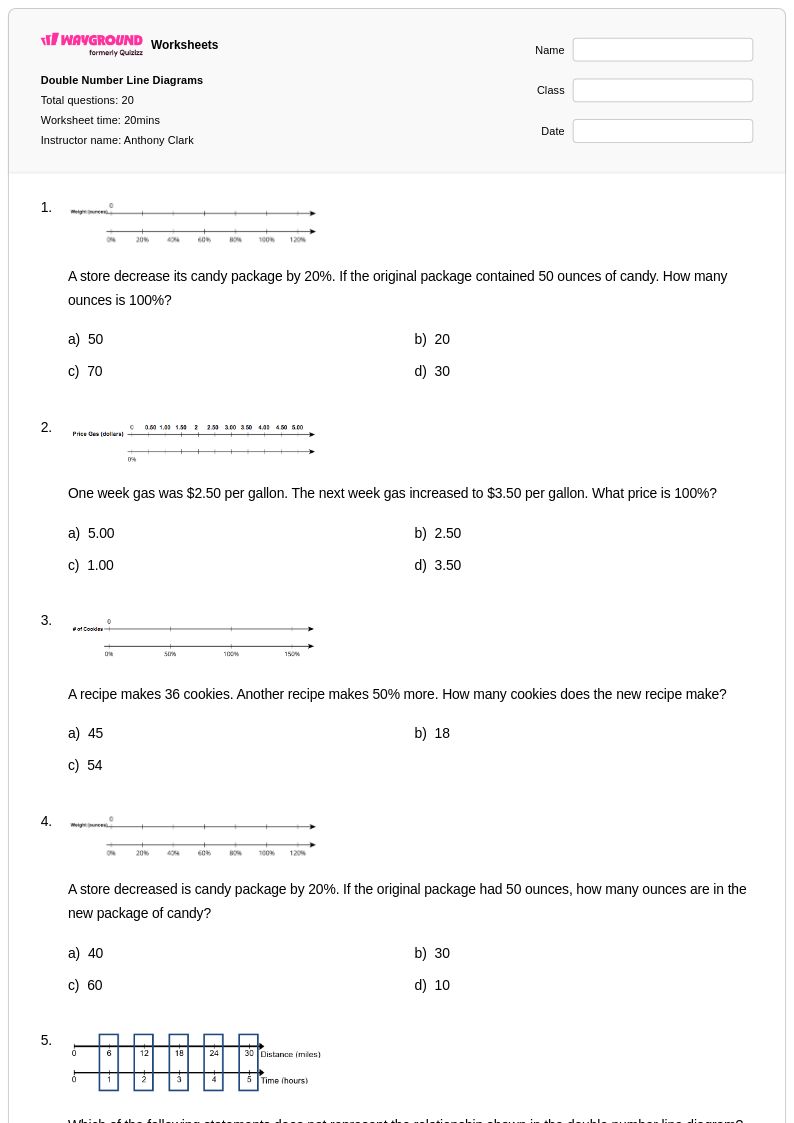
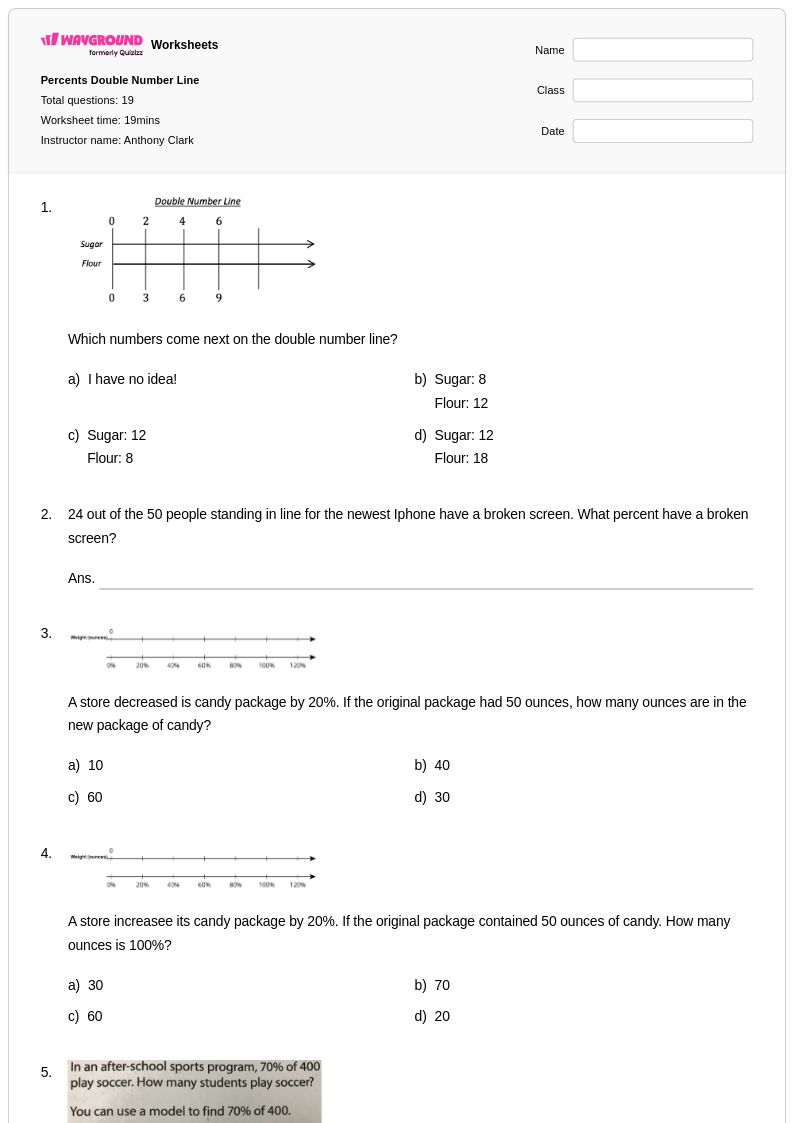
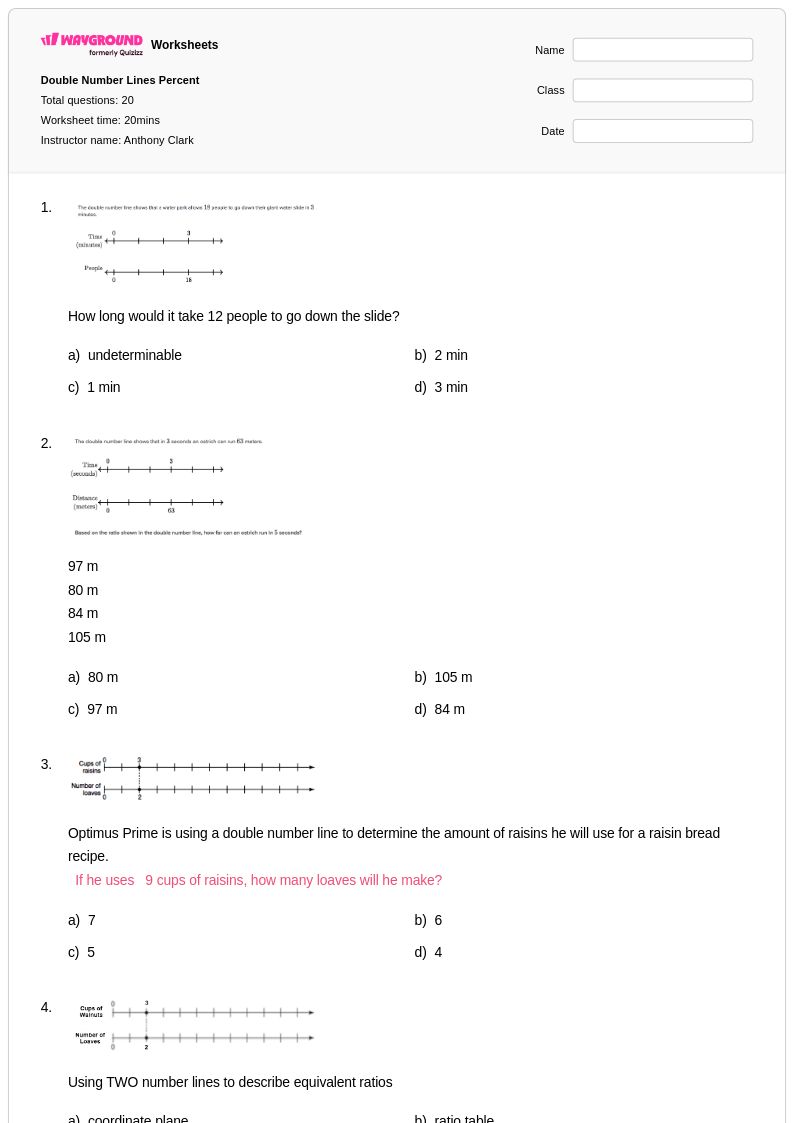
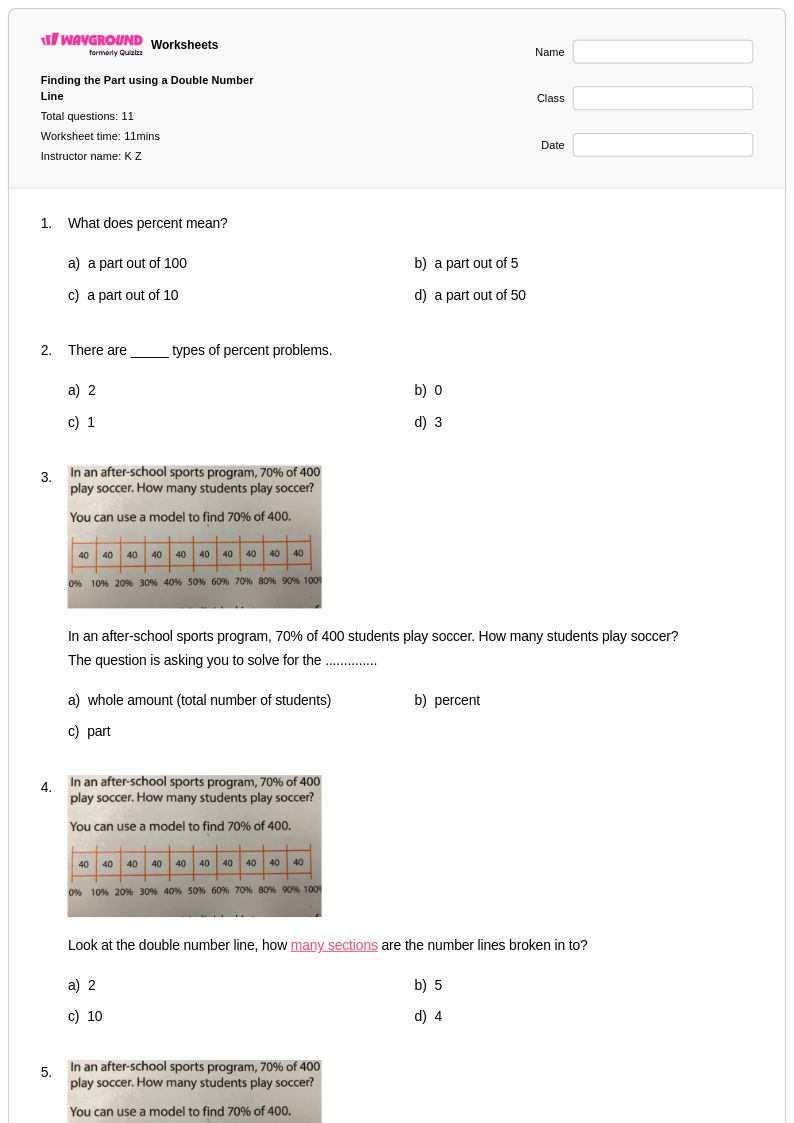
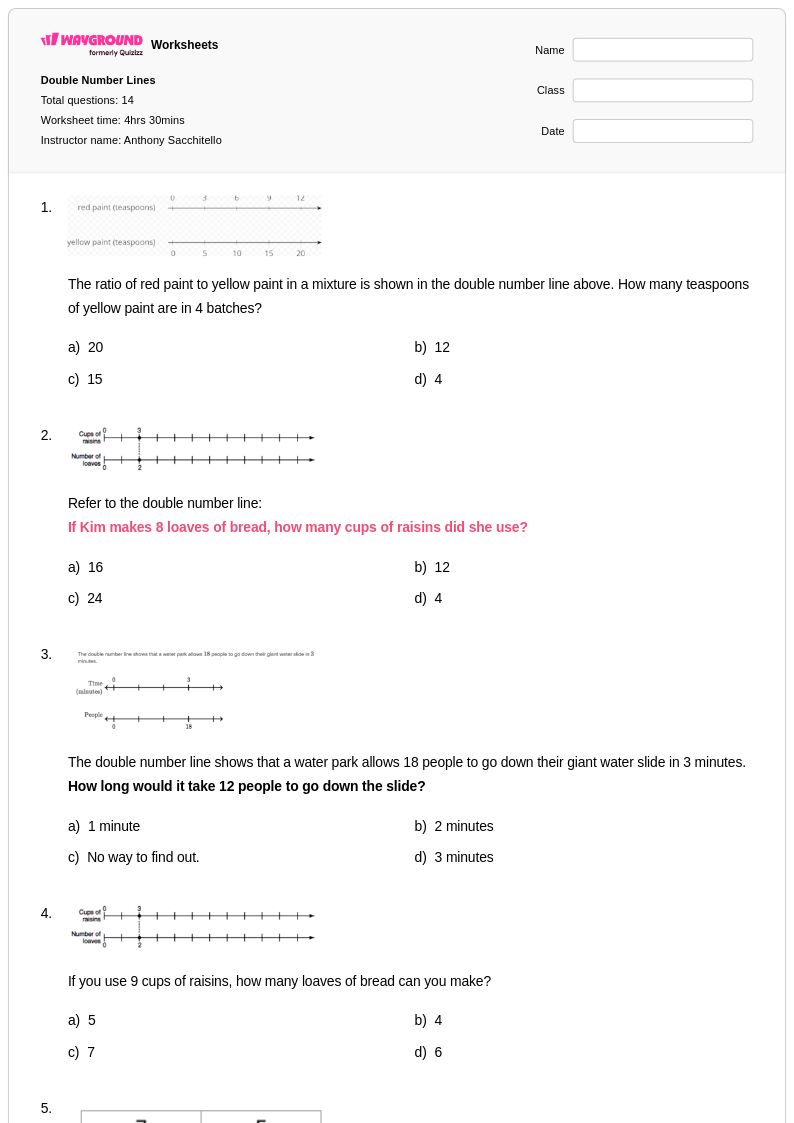
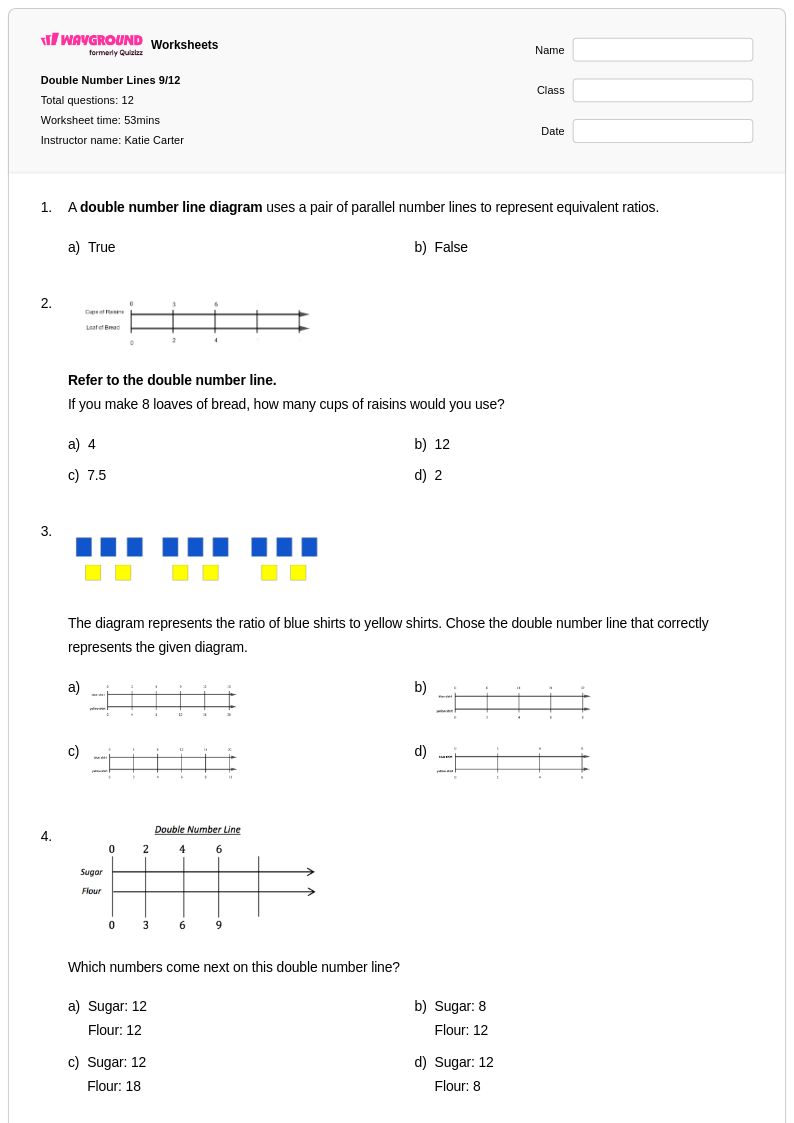
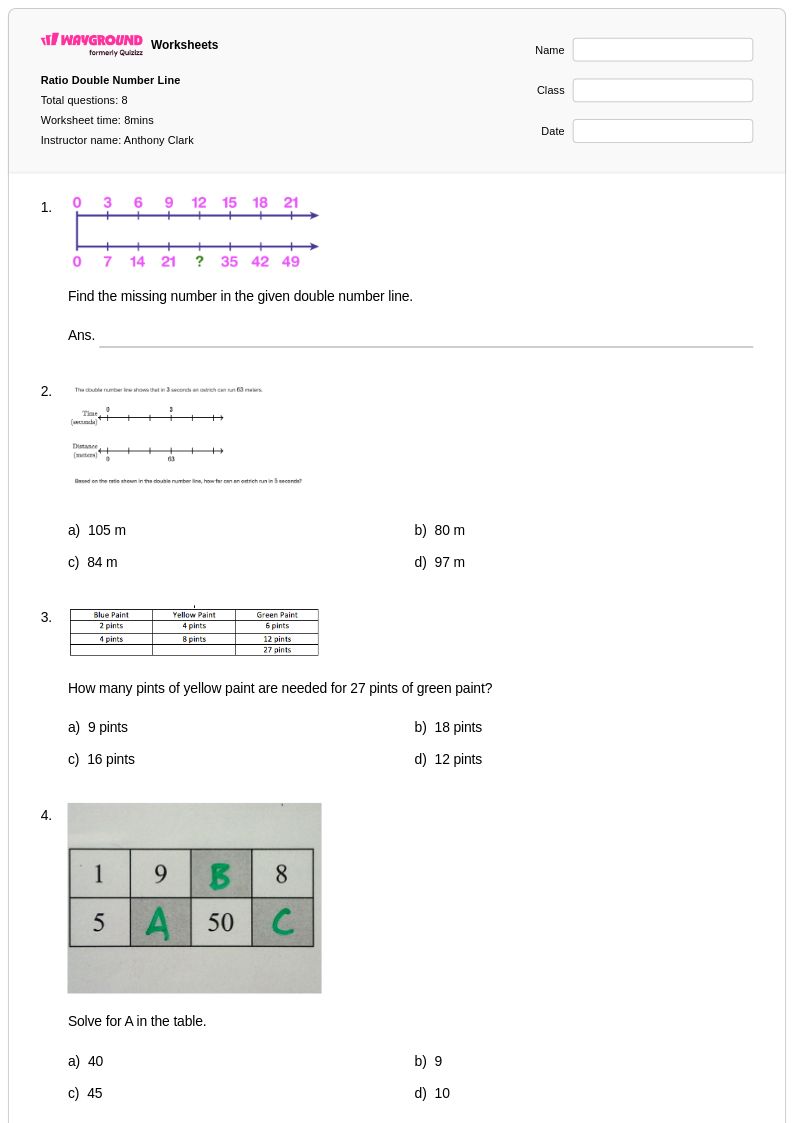
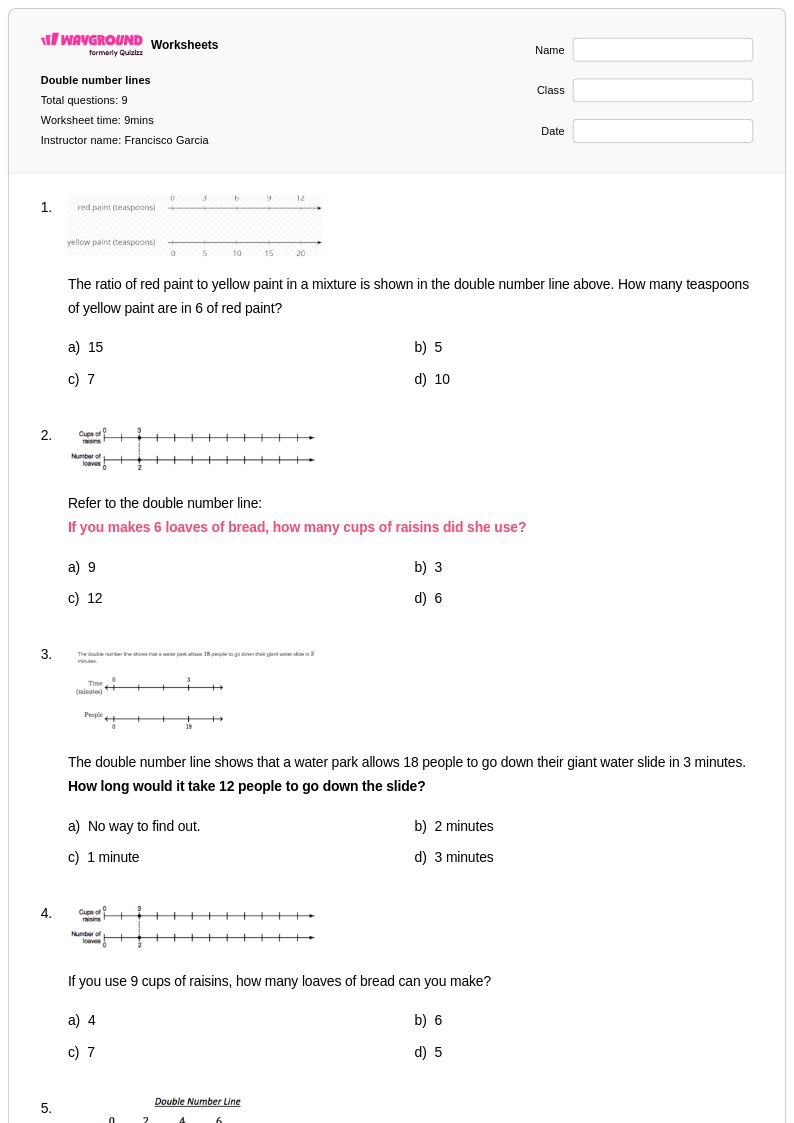
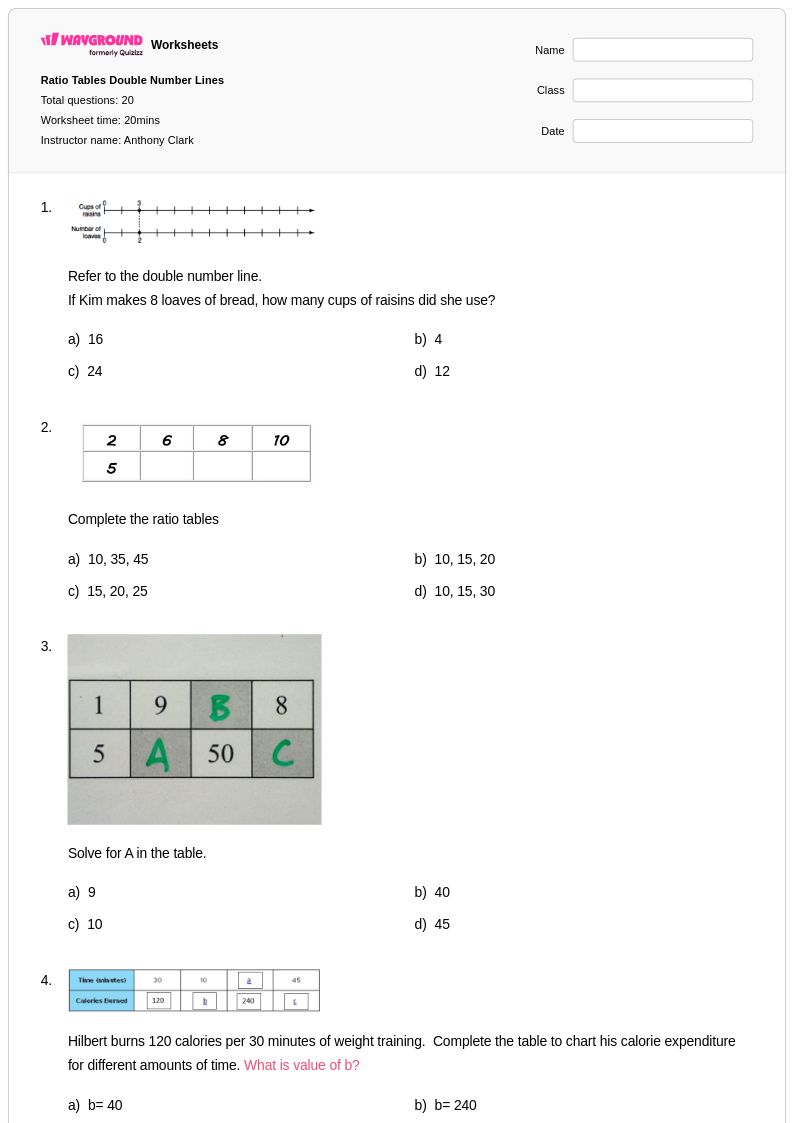
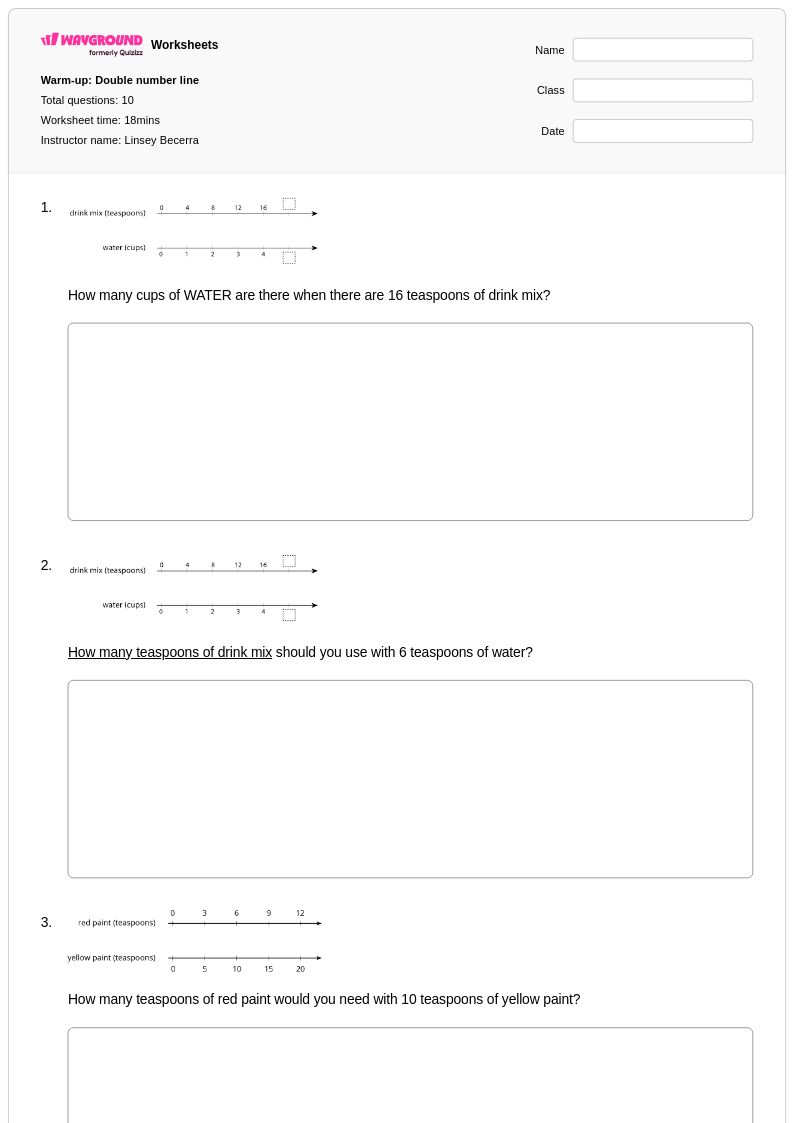
Explore Wayground's free double number line worksheets and printables that help students master visual representation of ratios, rates, and proportional relationships through engaging practice problems with comprehensive answer keys.
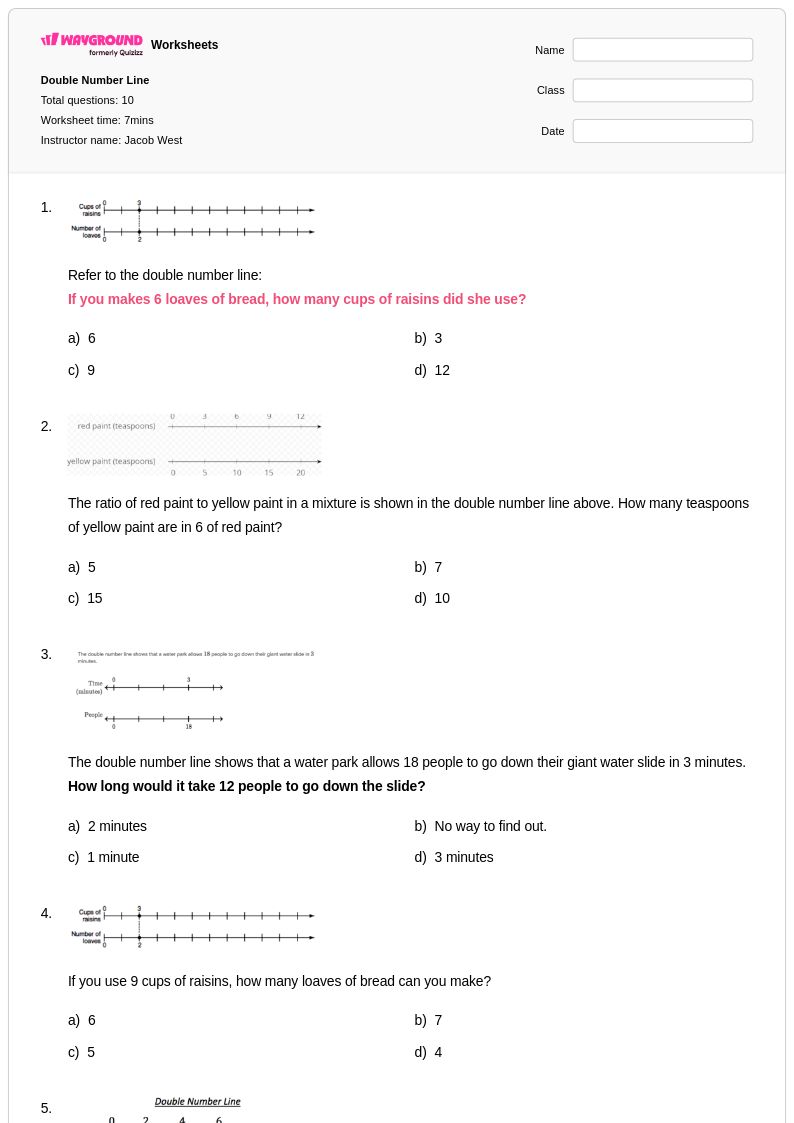
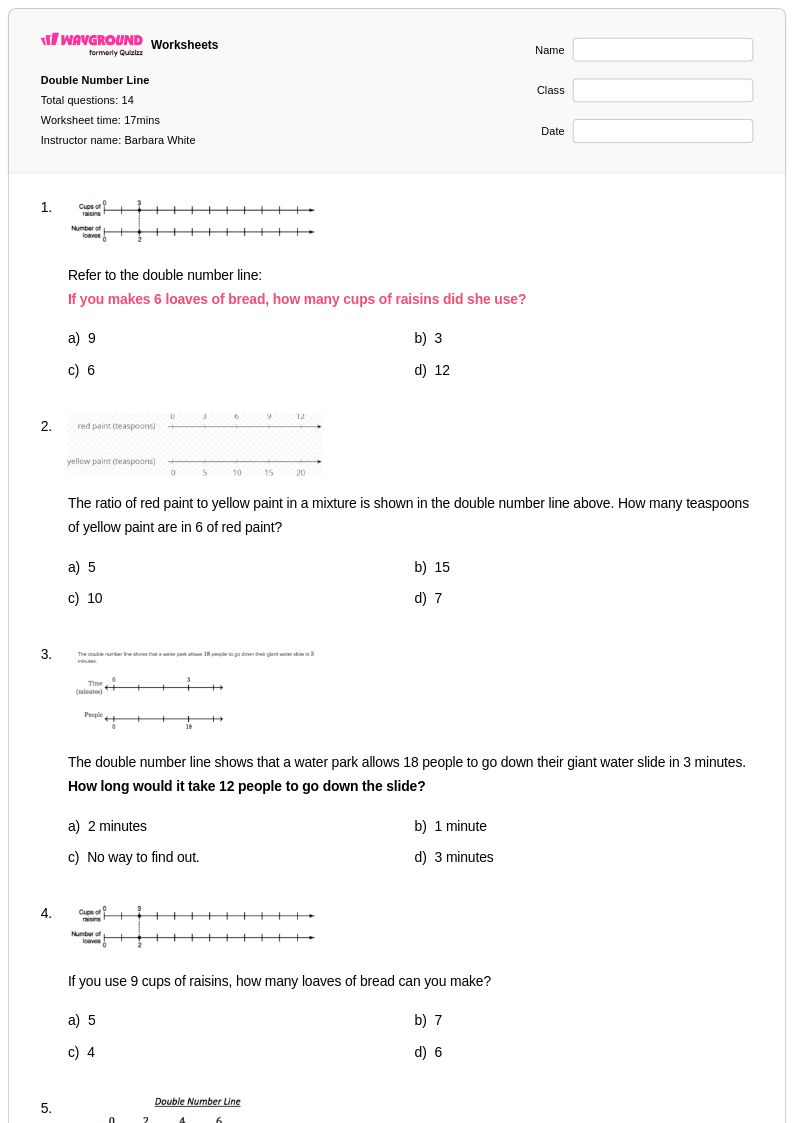
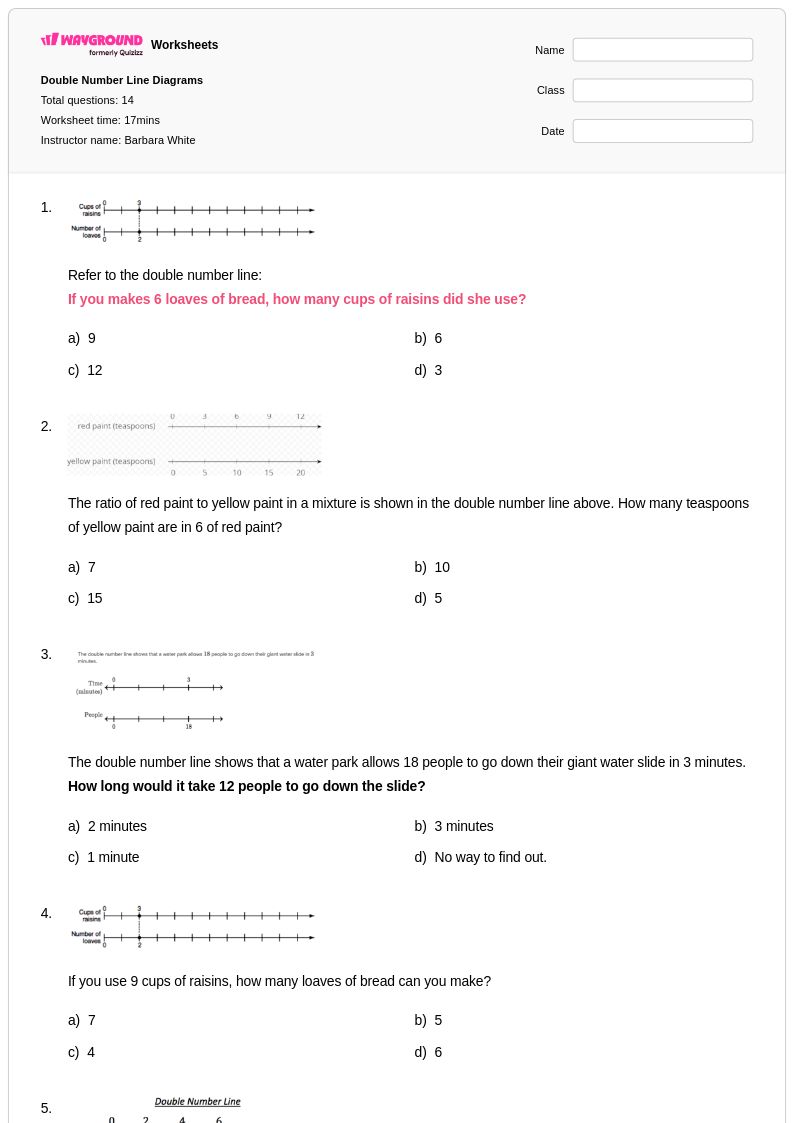
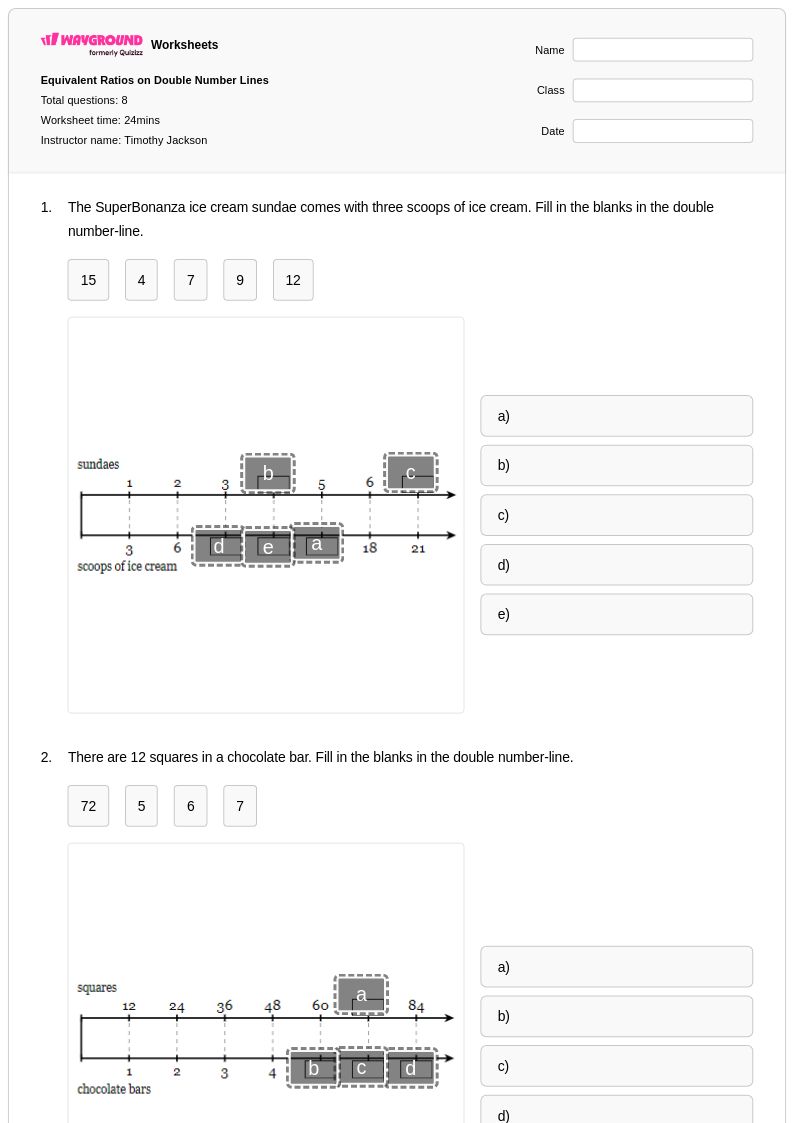
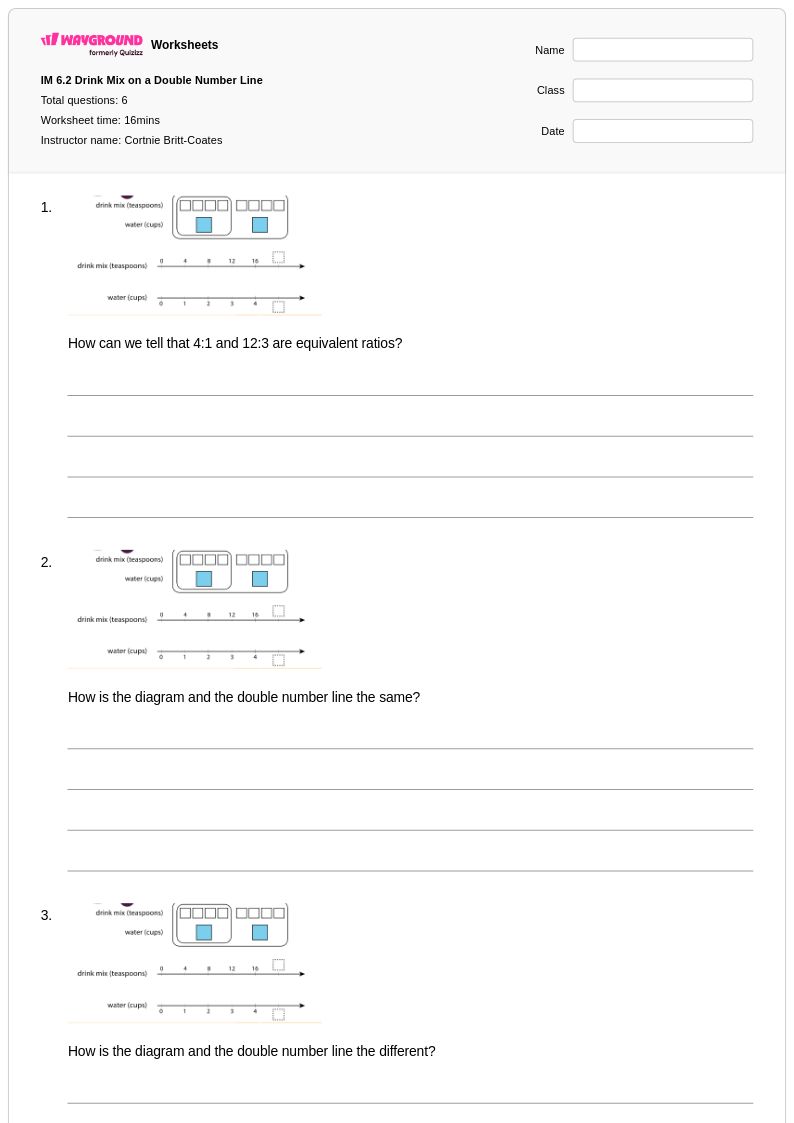
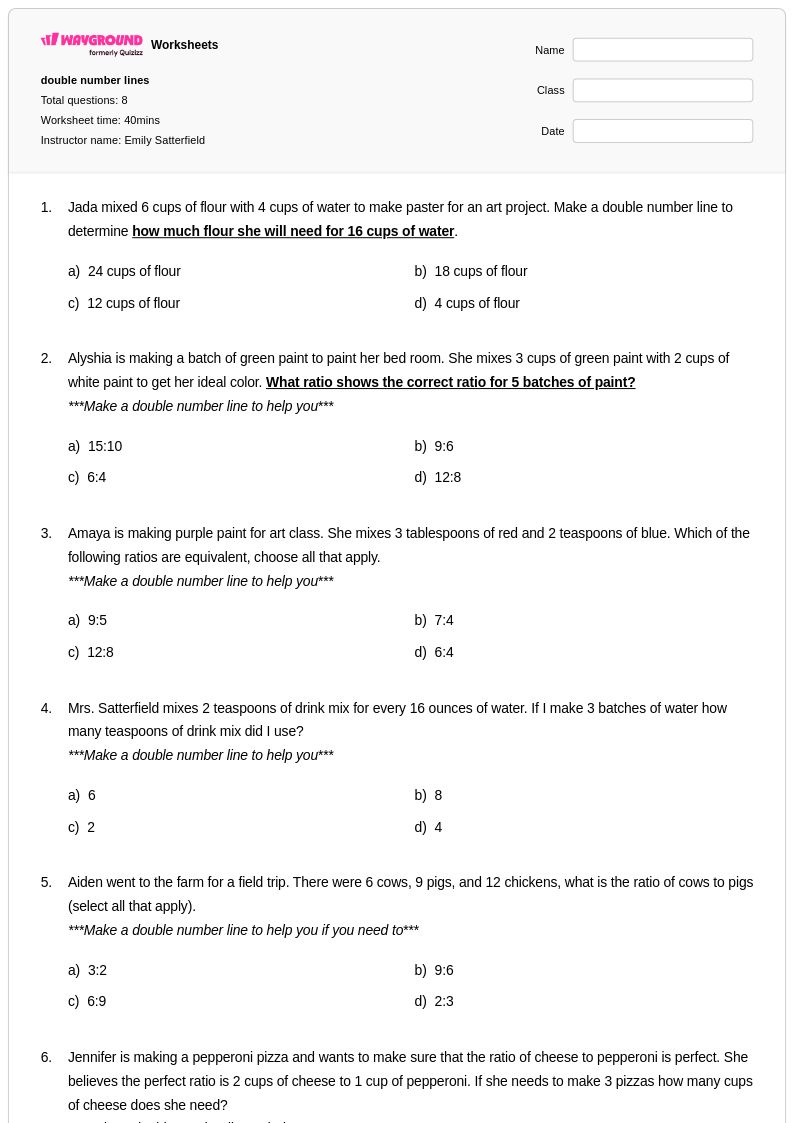
Double number line worksheets available through Wayground (formerly Quizizz) provide students with a powerful visual tool for understanding proportional relationships within percents, ratios, and rates. These carefully designed practice problems help students develop critical mathematical reasoning skills by using parallel number lines to represent equivalent ratios and solve complex proportion problems. Students work through systematic exercises that strengthen their ability to identify corresponding values, scale relationships up and down, and make connections between abstract mathematical concepts and real-world applications. Each worksheet includes a comprehensive answer key and is available as a free printable pdf, allowing educators to seamlessly integrate these resources into their mathematics curriculum while providing students with immediate feedback on their problem-solving strategies.
Wayground (formerly Quizizz) empowers educators with access to millions of teacher-created double number line worksheets that support diverse learning needs and instructional goals. The platform's robust search and filtering capabilities enable teachers to quickly locate resources that align with specific mathematics standards and learning objectives, while built-in differentiation tools allow for customization based on individual student readiness levels. These flexible worksheet collections are available in both printable and digital formats, including downloadable pdf versions, making them ideal for classroom instruction, homework assignments, remediation sessions, and enrichment activities. Teachers can efficiently plan targeted skill practice sessions, assess student understanding of proportional reasoning, and provide additional support for learners who need extra practice with visual representation strategies in mathematics.
FAQs
How do I teach double number lines?
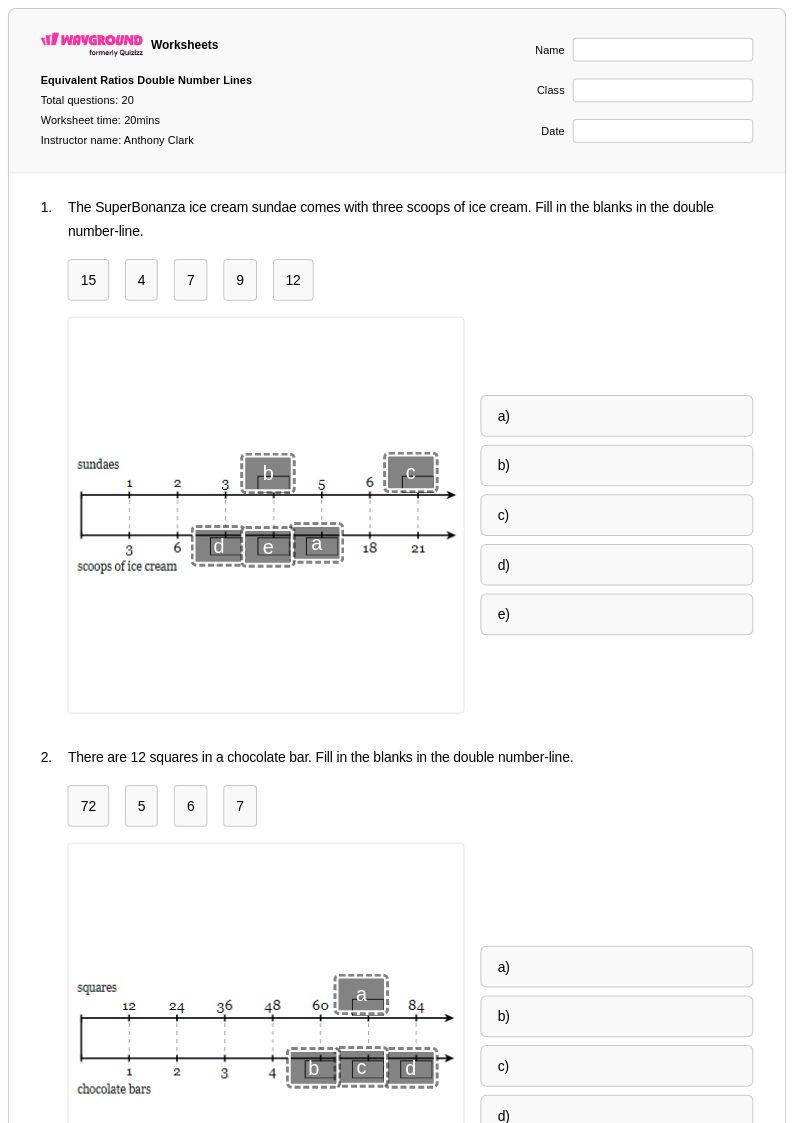
Start with a concrete context students already understand — like a recipe that doubles or triples — and draw both number lines together, labeling one for the ingredient and one for the servings. Once students see that both lines scale proportionally, move to ratios and rates. The key instructional move is making the scaling action explicit: ask students to identify what operation connects any two corresponding values, not just read off the answer.
What kinds of problems are double number line worksheets good for practicing?
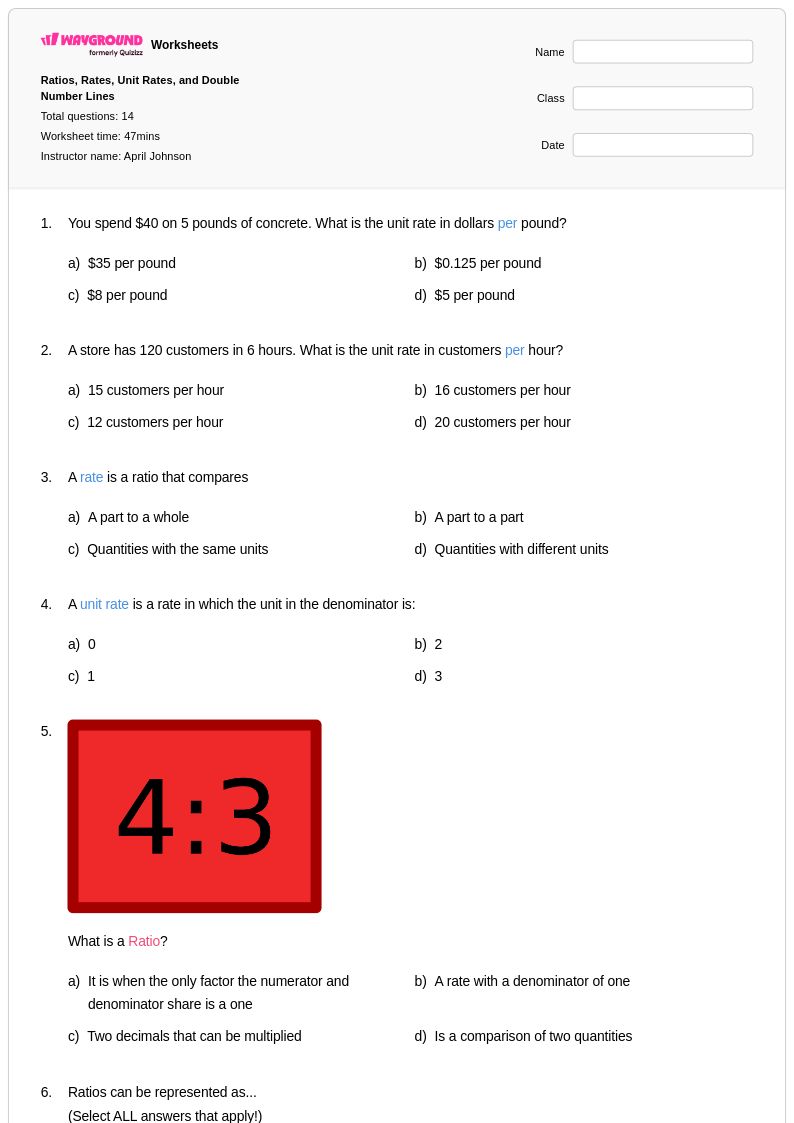
Double number line worksheets are most useful for three problem types: finding equivalent ratios, solving percent problems (e.g., what is 30% of 80?), and working with unit rates. The visual format forces students to think about proportional structure rather than just cross-multiplying, which builds genuine understanding of why the answer works.
What mistakes do students commonly make with double number lines?
The most common error is treating the two number lines as independent rather than proportionally linked — students place values at equal intervals on each line without checking that the ratio between corresponding values stays constant. A second frequent mistake is anchoring only at 0 and the given value, then guessing at intermediate points rather than scaling systematically. Asking students to verify one intermediate value before completing the rest of the line catches both errors early.
How do I use Wayground's double number line worksheets in my class?
You can run these as a digital quiz hosted on Wayground — students submit answers online and you get instant results — or download the PDF and hand it out on paper, which works well for classes reducing screen time. Either way, every worksheet includes a complete answer key. If you go the print route, the Wayground for Teachers app lets you scan or photograph student work to grade it without re-entering everything by hand.
How do double number lines fit into the Common Core progression for ratios and proportional reasoning?
Common Core introduces ratios and proportional relationships in Grade 6, and double number lines are one of the recommended visual models for that work. Students use them to reason about equivalent ratios and unit rates before they formalize proportional equations in Grade 7. By Grade 8, the same proportional thinking underpins linear relationships and slope — so fluency with double number lines in the middle grades directly supports that transition.
How can I differentiate double number line practice for mixed-ability classes?
For students who struggle with the visual layout, Wayground's worksheet-level tools let you increase font size or apply wider spacing so the number lines are easier to read and annotate. For students who need read-aloud support, the platform's Read Aloud accommodation reads problem text aloud during digital sessions. On the other end, the same worksheet set includes problems that scale up to multi-step percent and rate applications, so advanced students aren't waiting for the class to catch up.