Free Printable Earth History Worksheets for Year 7
Explore Year 7 Earth History worksheets and printables that help students master geological timelines, fossil evidence, and rock formations through engaging practice problems with complete answer keys available as free PDF downloads.
Explore printable Earth History worksheets for Year 7
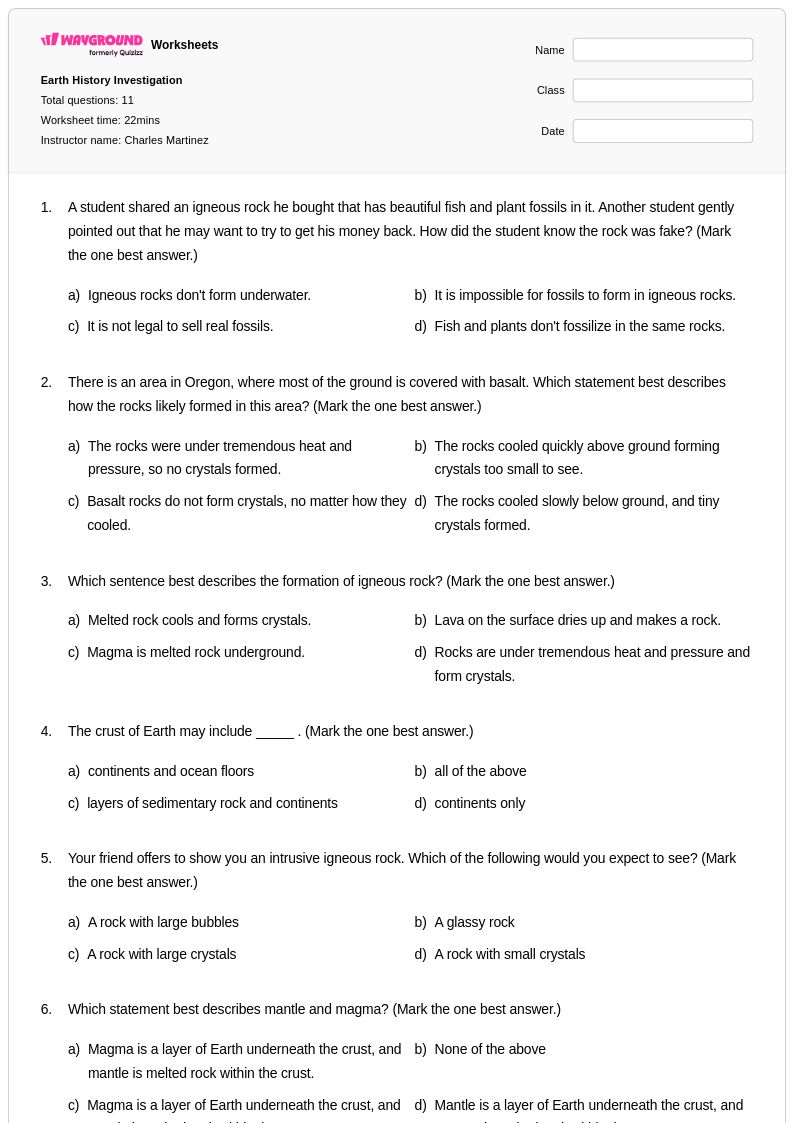
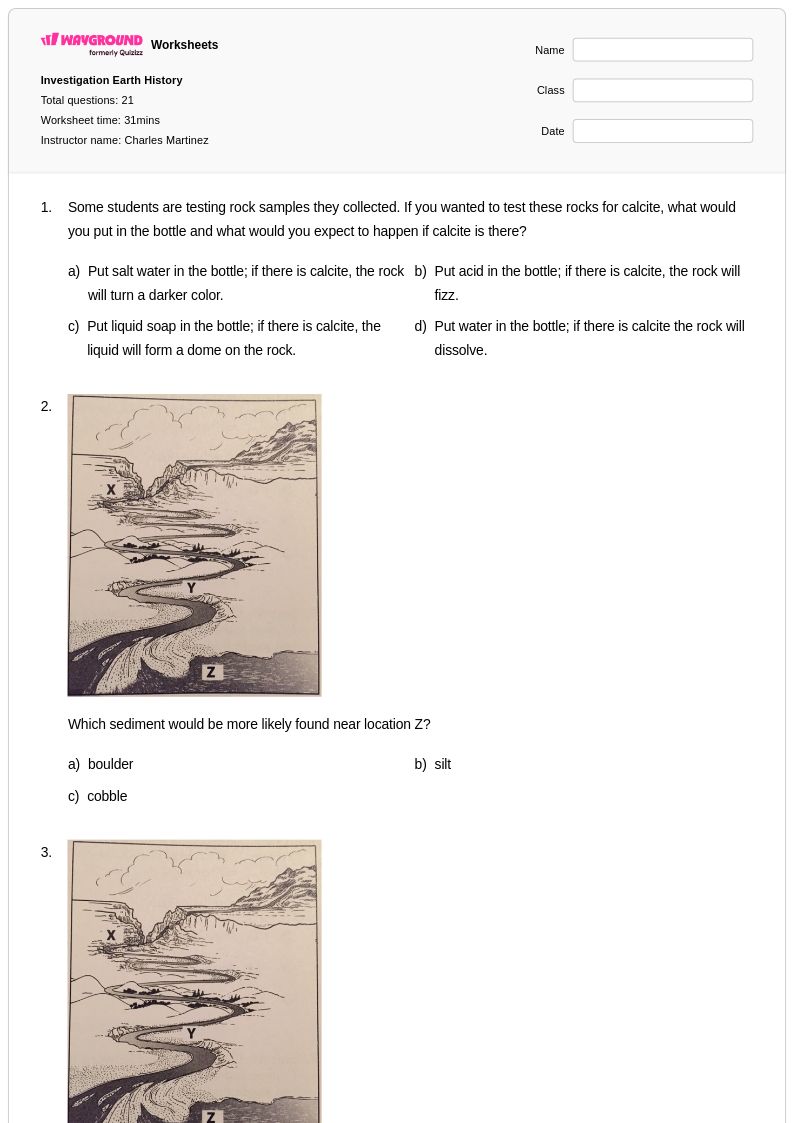
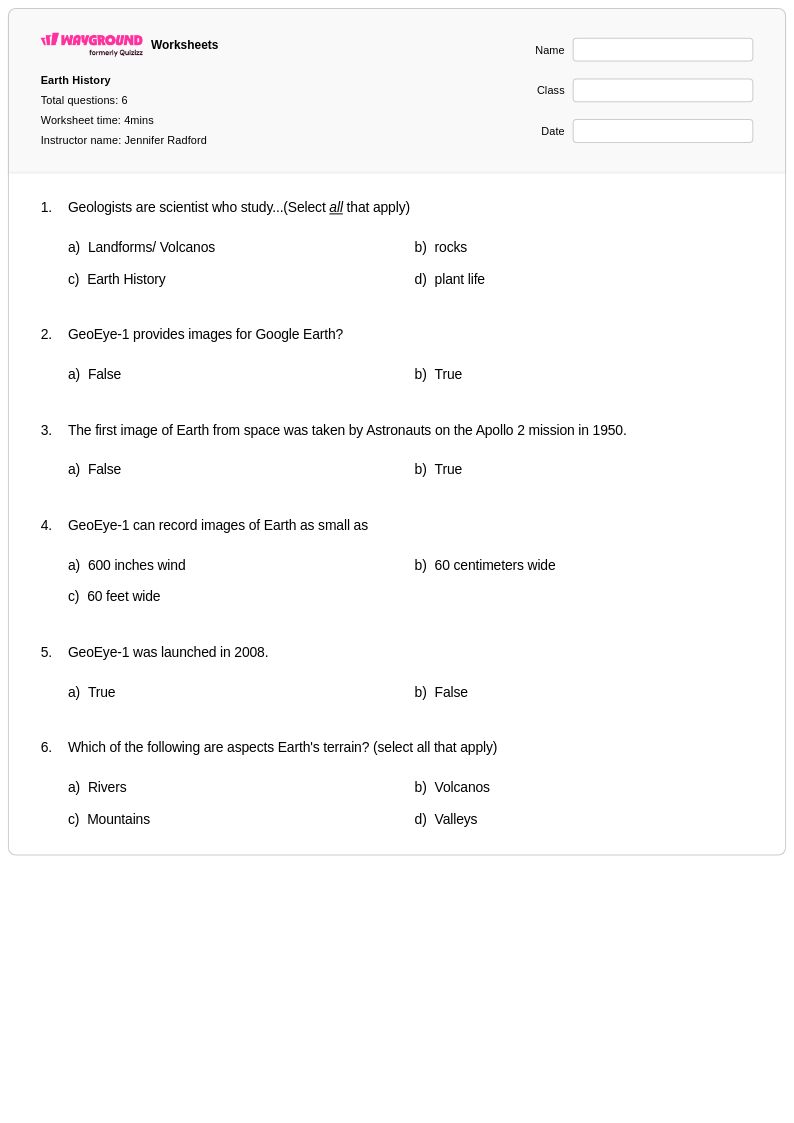
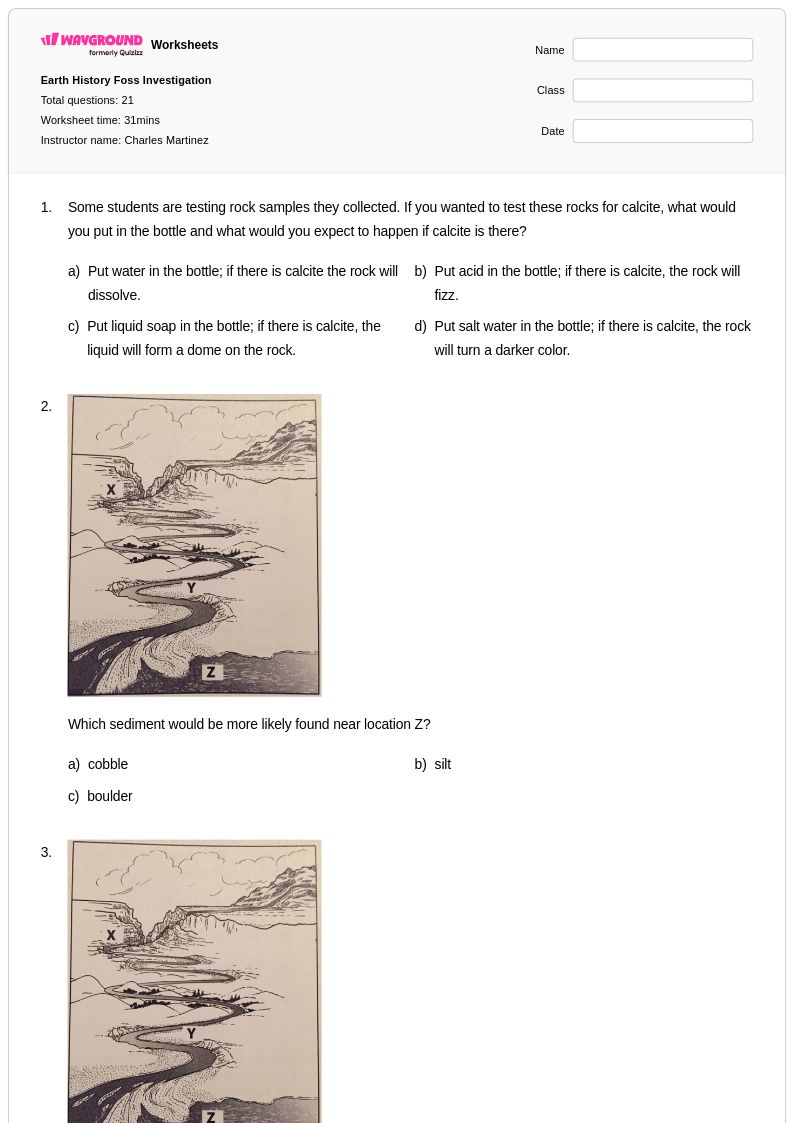
Earth History worksheets for Year 7 students available through Wayground (formerly Quizizz) provide comprehensive exploration of our planet's geological timeline and evolutionary development. These expertly designed educational resources strengthen students' understanding of fundamental concepts including fossil formation and interpretation, geological time scales, rock layer analysis, and the evidence for continental drift and plate tectonics. The worksheets incorporate practice problems that challenge seventh graders to analyze stratigraphic sequences, interpret fossil records to understand past environments, and connect geological processes to the formation of Earth's major features. Each printable resource includes detailed answer keys that support independent learning and self-assessment, while the free pdf format ensures easy classroom distribution and home study access.
Wayground (formerly Quizizz) empowers educators with an extensive collection of millions of teacher-created Earth History resources specifically aligned with Year 7 science standards and curriculum requirements. The platform's robust search and filtering capabilities allow teachers to quickly locate worksheets targeting specific geological concepts, time periods, or skill levels, while built-in differentiation tools enable seamless customization for diverse learning needs. Available in both printable and digital formats including downloadable pdfs, these resources support flexible lesson planning whether for whole-class instruction, small group activities, or individual remediation and enrichment. Teachers can efficiently modify existing worksheets or combine multiple resources to create comprehensive practice sets that address varying student abilities, making it simple to provide targeted skill practice in fossil analysis, geological dating methods, and understanding Earth's dynamic history.
FAQs
How do I teach geological time scales to middle or high school students?
Teaching geological time scales effectively requires helping students grasp the sheer magnitude of deep time, which is notoriously difficult to visualize. A common approach is to have students create a scaled timeline using a long strip of paper or a hallway, mapping eons, eras, and periods proportionally. Pairing this activity with fossil evidence and rock layer analysis helps students connect abstract time divisions to concrete physical records. Anchoring lessons around major events like the Cambrian explosion or mass extinction events gives students memorable reference points across the timeline.
What exercises help students practice reading and interpreting rock layers?
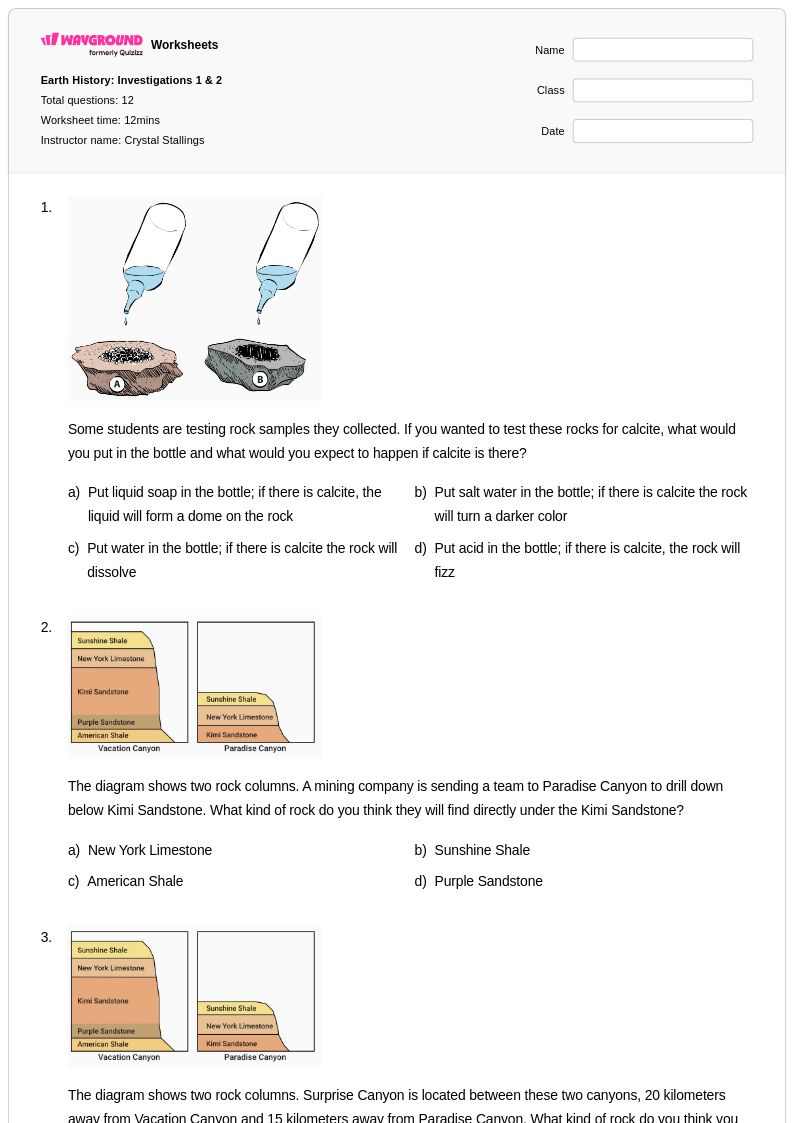
Students build rock layer interpretation skills through stratigraphic sequencing exercises, where they arrange or label rock strata from oldest to youngest using the principle of superposition. Practice problems that ask students to identify index fossils within layers and correlate them to specific geological periods are especially effective. Worksheets that combine cross-section diagrams with questions about unconformities, intrusions, and fault lines extend practice beyond simple ordering and develop more analytical thinking. Regular exposure to these diagram-based problems strengthens the skills geologists use to reconstruct Earth's history from physical evidence.
What mistakes do students commonly make when learning about Earth's history and geological time?
One of the most common misconceptions is that geological time periods are roughly equal in length, when in fact they vary dramatically and are defined by biological and geological events rather than uniform intervals. Students also frequently confuse relative dating with absolute dating, not recognizing that relative dating establishes sequence while radiometric dating assigns numerical ages. Another persistent error is assuming that evolution proceeds in a straight, linear progression rather than as a branching, non-directional process visible in the fossil record. Targeted practice with timelines and fossil interpretation exercises helps correct these patterns before they solidify.
How does fossil evidence connect to the broader story of life on Earth?
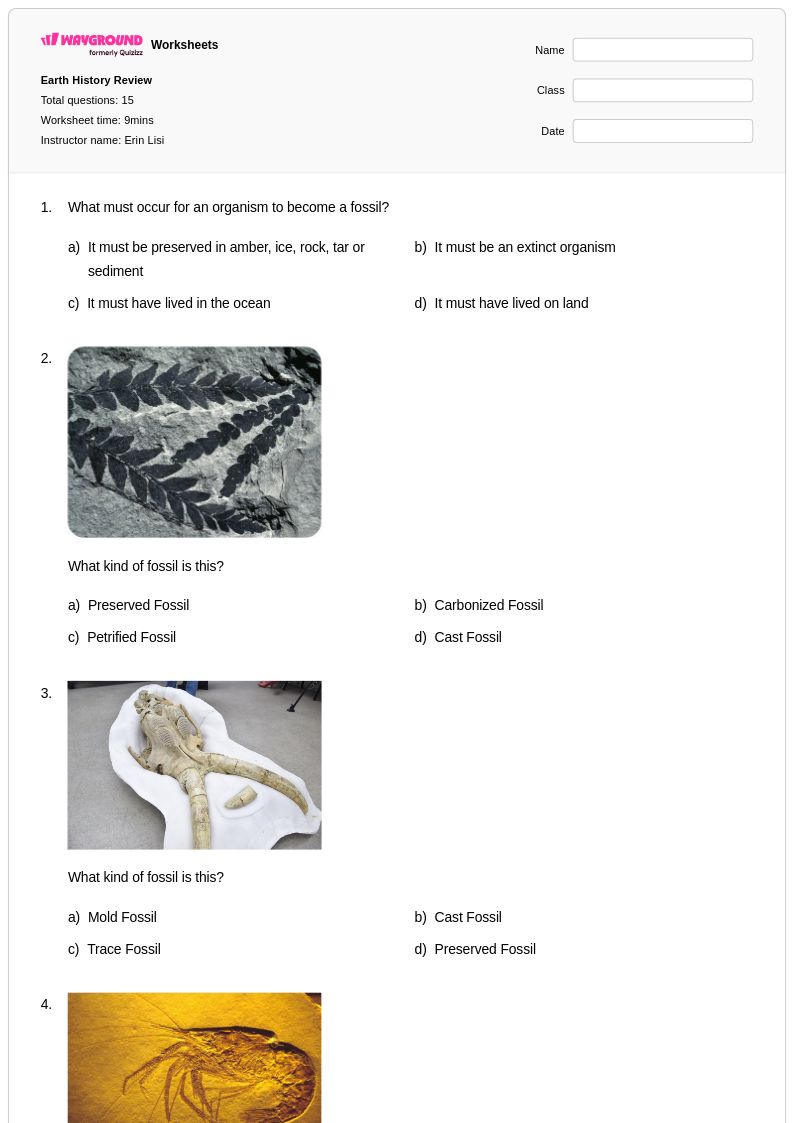
Fossil evidence provides the primary physical record of how life forms have changed across geological time, making it central to any Earth history curriculum. Students should understand that fossils document not just individual organisms but transitions between major groups, extinction events, and the appearance of new body plans. Analyzing fossil assemblages from different rock layers allows students to correlate biological evolution with geological events such as climate shifts, mass extinctions, and continental drift. This multi-line-of-evidence approach mirrors how scientists actually reconstruct Earth's biological history.
How can I use Earth History worksheets in both print and digital classroom settings?
Earth History worksheets on Wayground are available as printable PDFs for traditional classroom use and in digital formats for technology-integrated learning environments, giving teachers flexibility regardless of their setup. In a print-based classroom, they work well as guided notes, homework, or assessment tools alongside textbook units on geological time or plate tectonics. In digital environments, teachers can host them as interactive quizzes directly on Wayground, enabling instant feedback and progress tracking. Wayground also supports student-level accommodations such as read aloud, extended time, and reduced answer choices, which can be configured individually so that all learners can access the same Earth history content at an appropriate level.
How do plate tectonics connect to Earth history lessons?
Plate tectonics is a unifying concept in Earth history because it explains the movement of continents, the formation of mountain ranges, volcanic activity, and even patterns in the fossil record across different landmasses. Students studying Earth history should understand how the breakup of Pangaea and earlier supercontinents influenced climate, sea levels, and the distribution of species over geological time. Connecting plate motion to specific eras, such as the Mesozoic breakup of Pangaea, gives students a mechanism for understanding why fossil evidence on separated continents can still match. Worksheets that ask students to correlate tectonic events with biological and geological records reinforce this systems-level thinking.