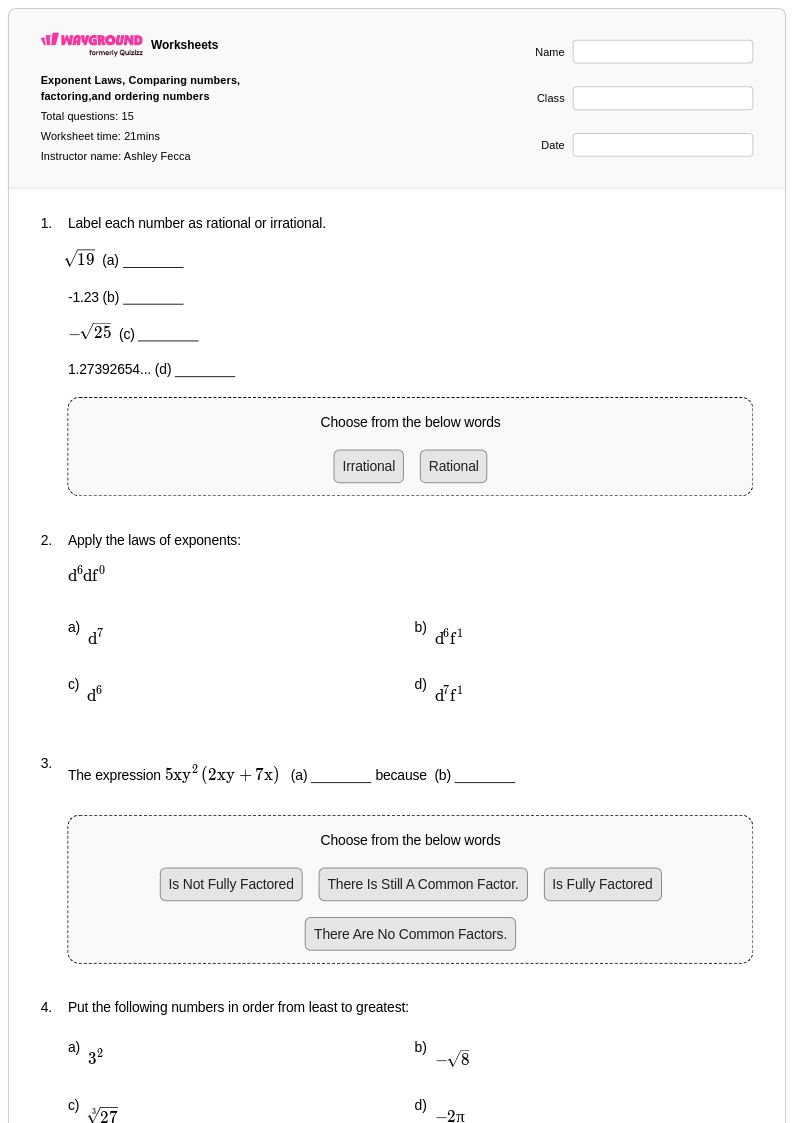
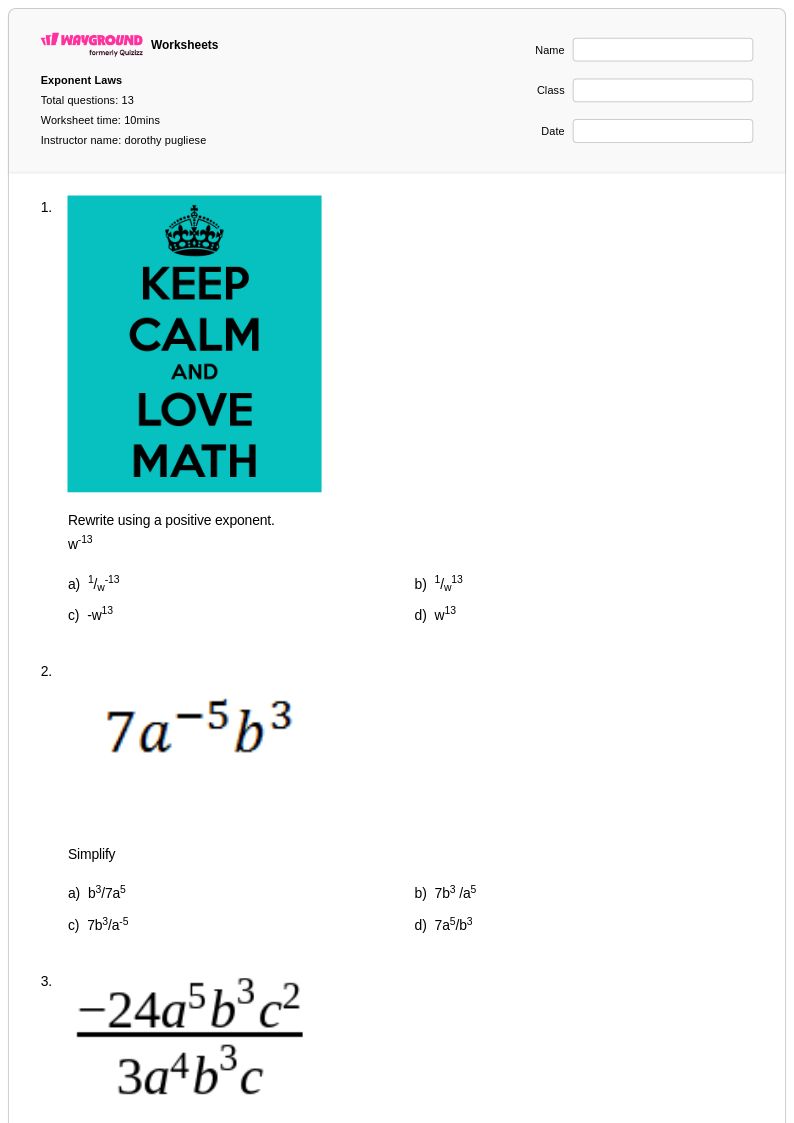
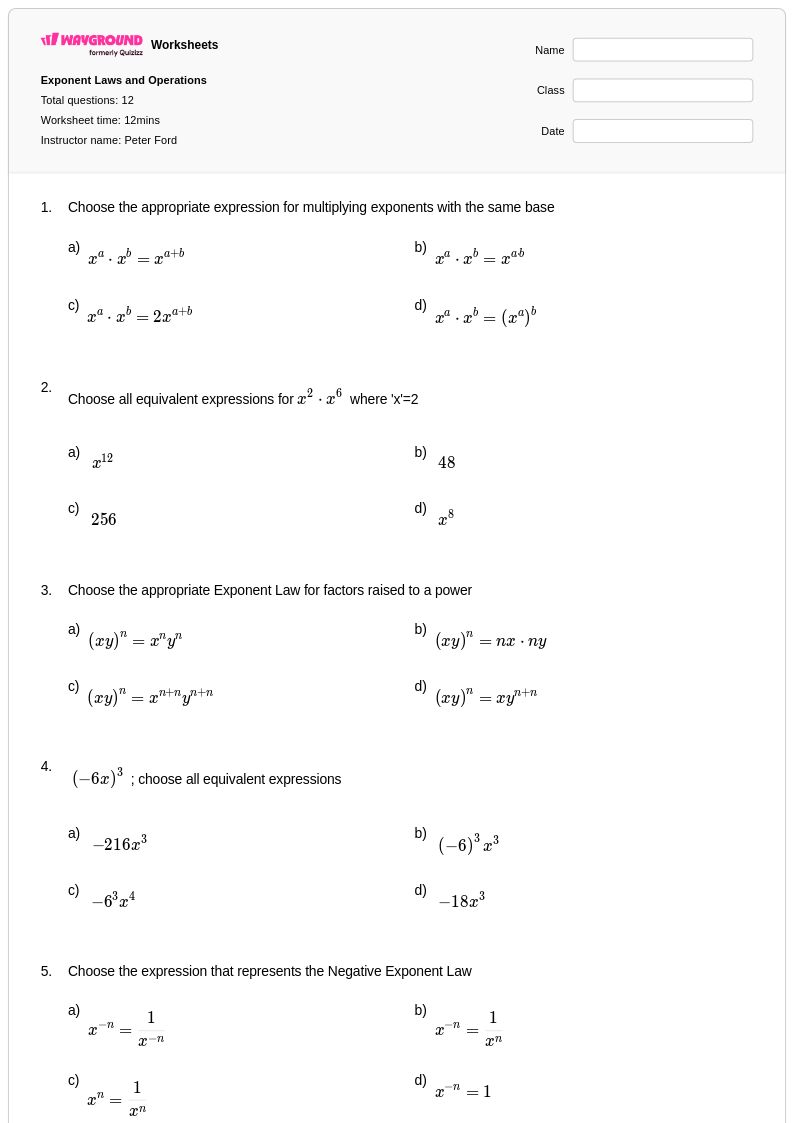
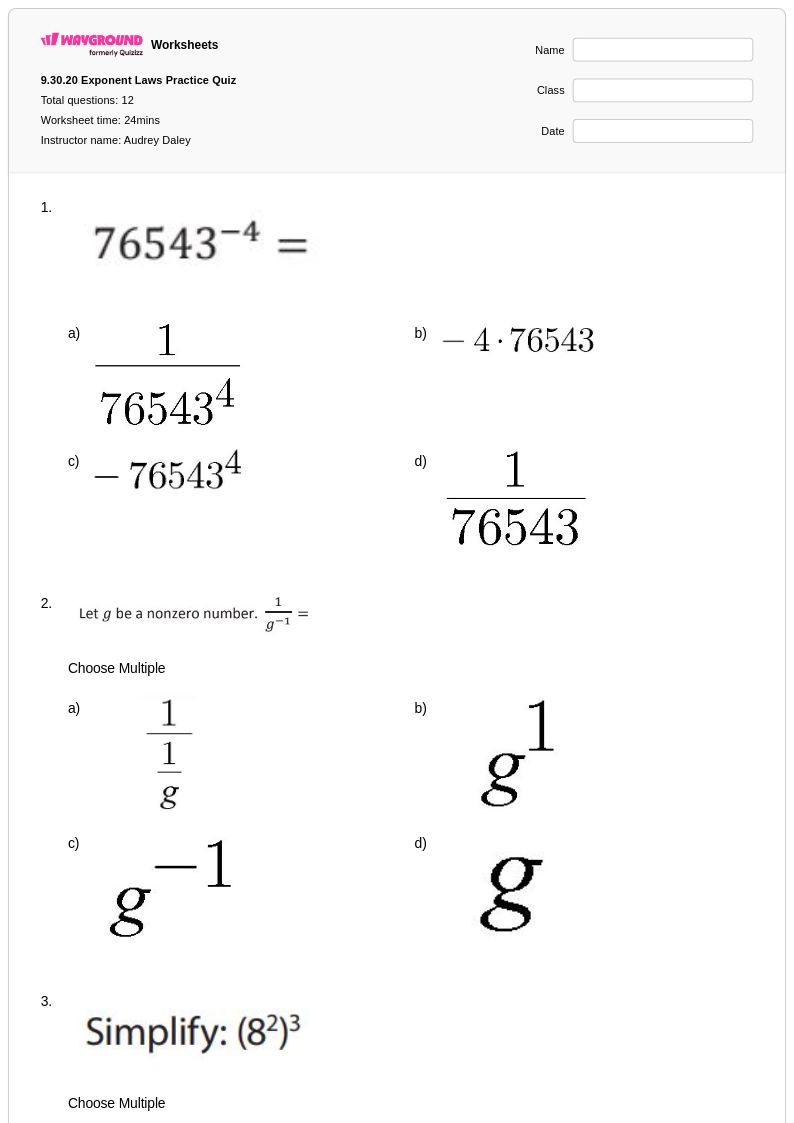
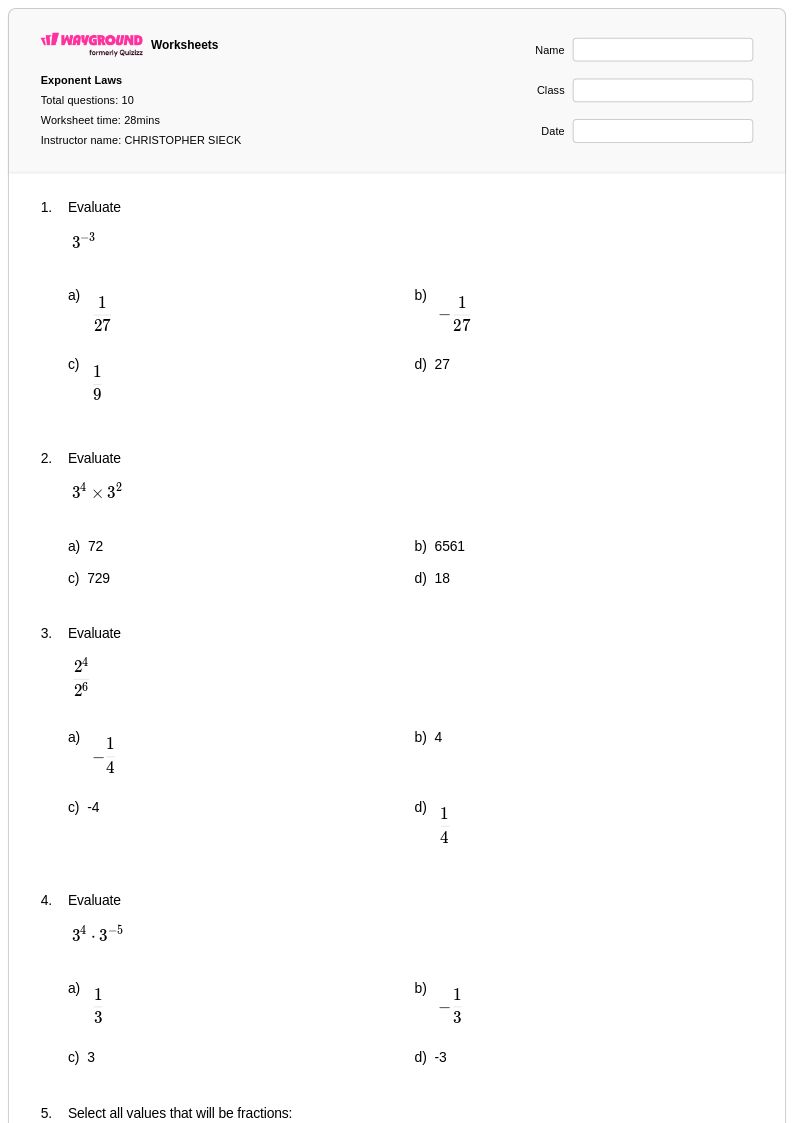
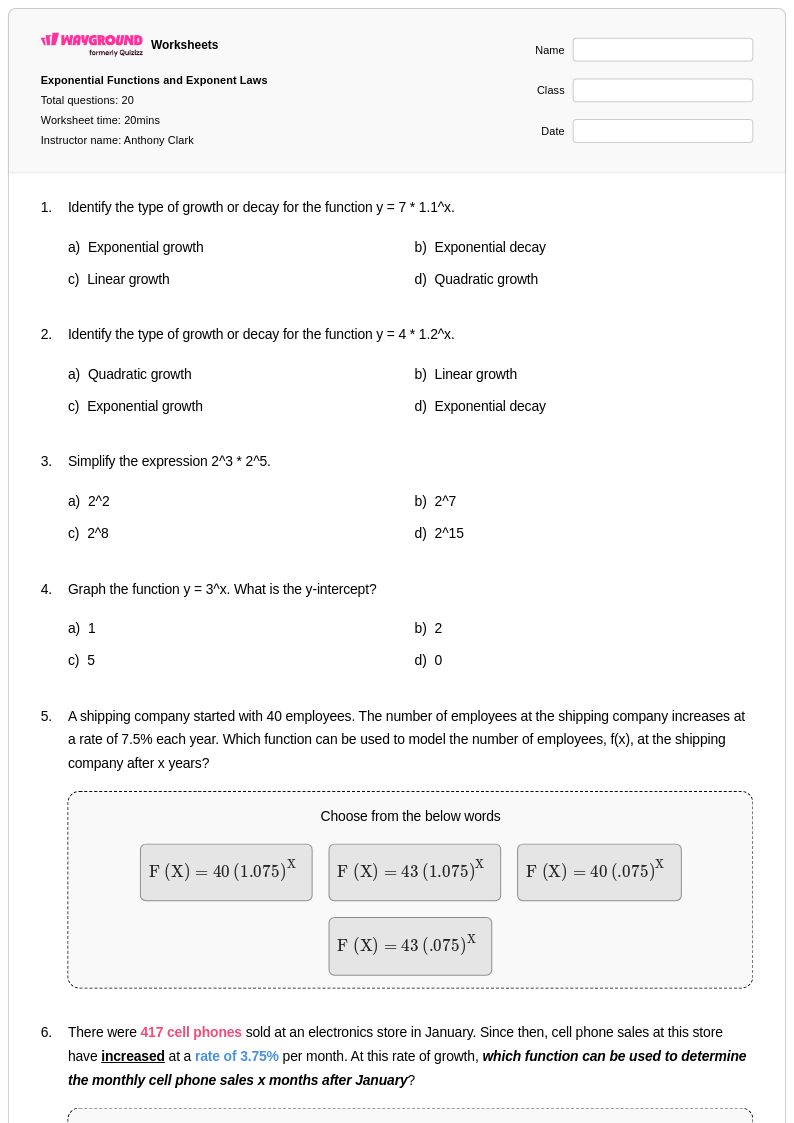
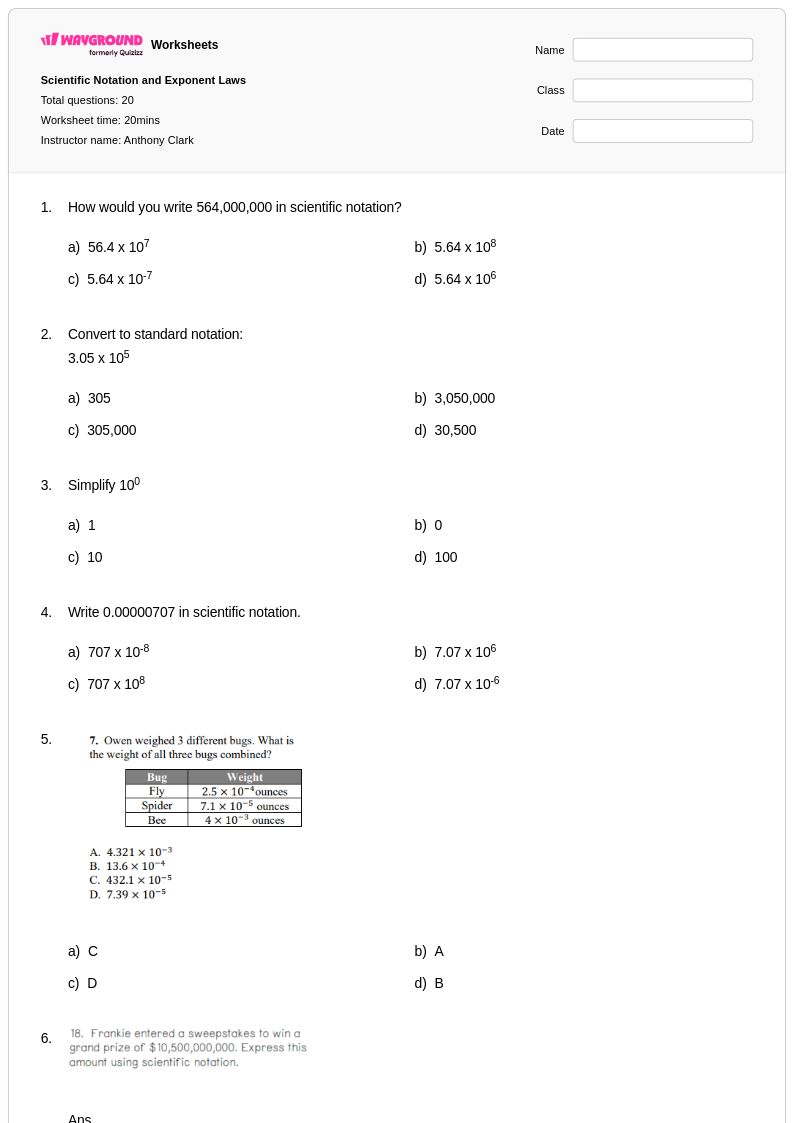
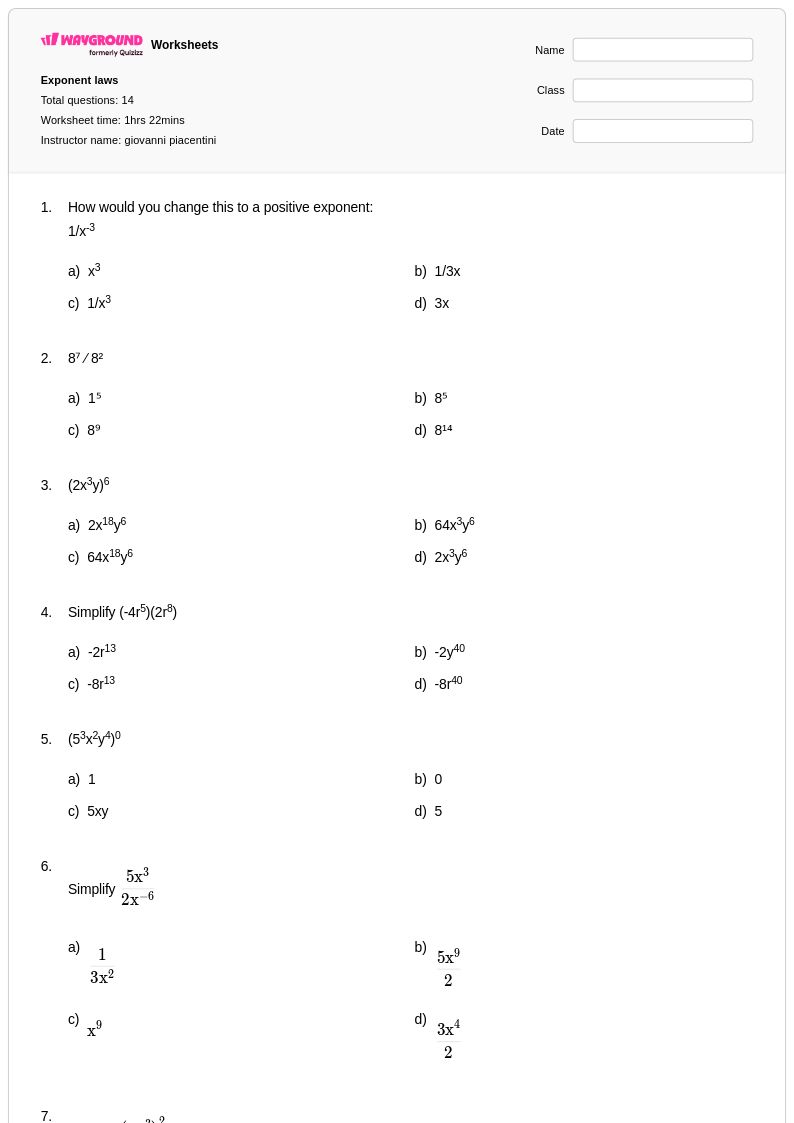
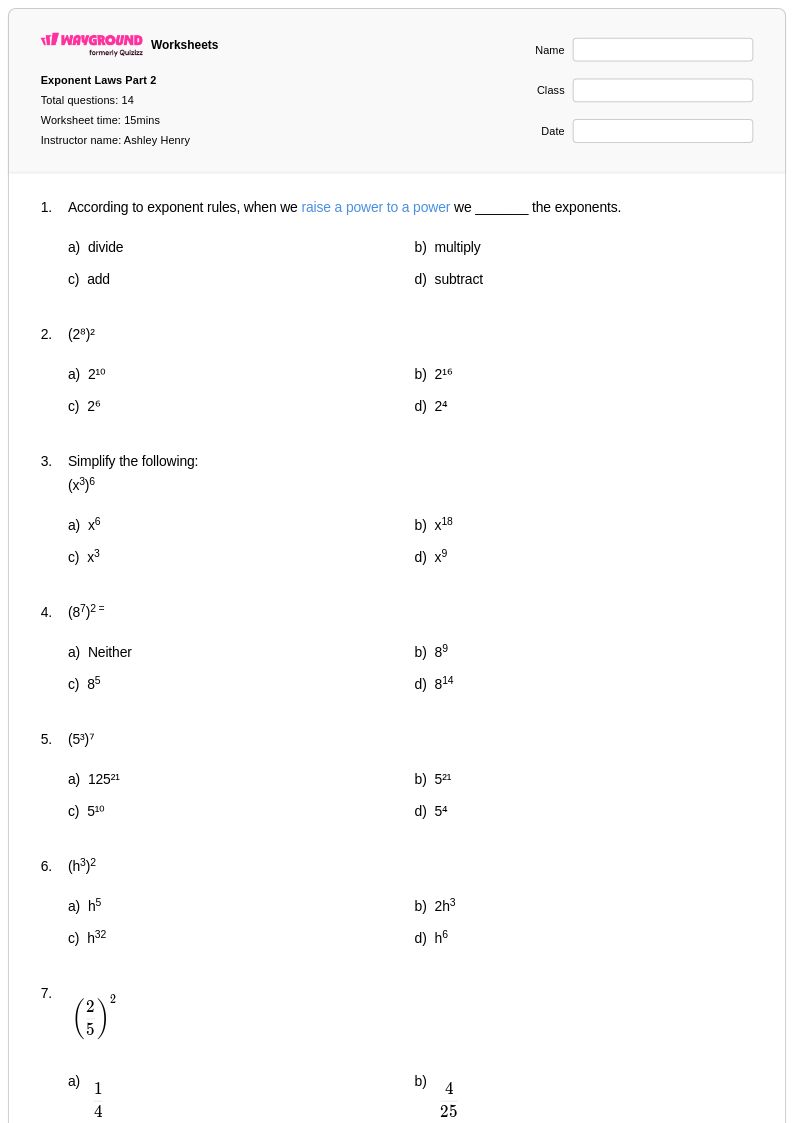
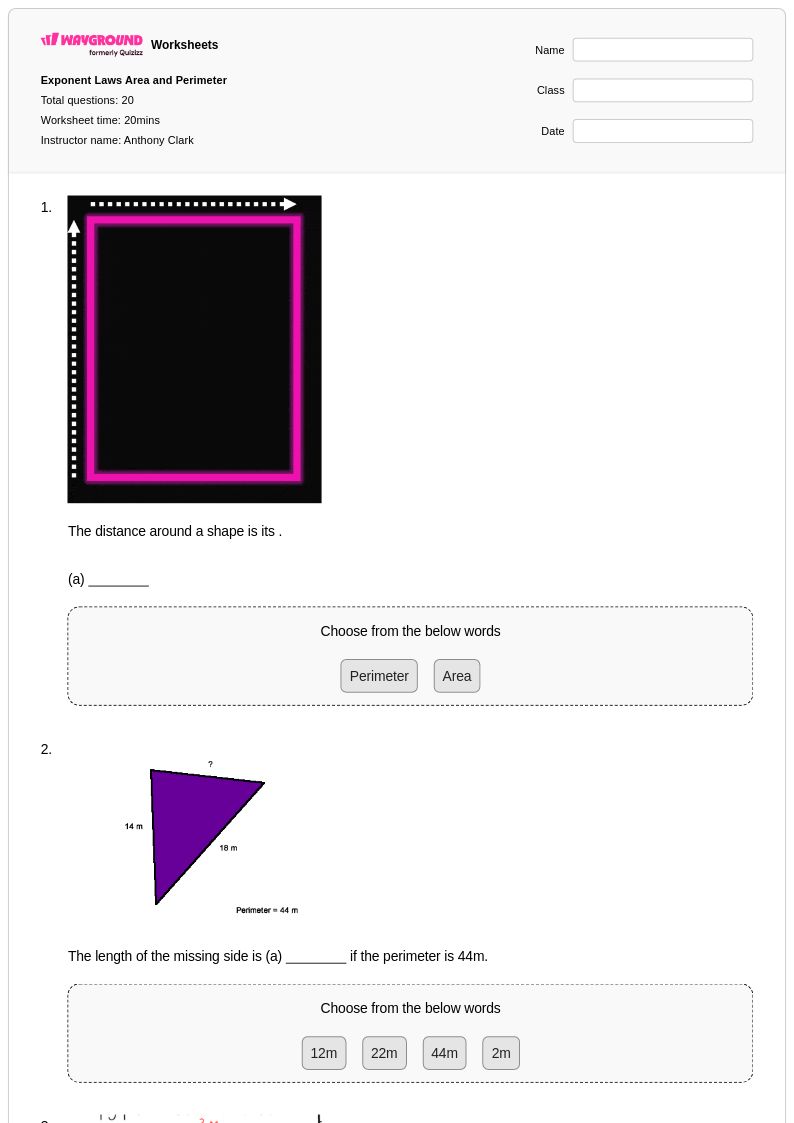
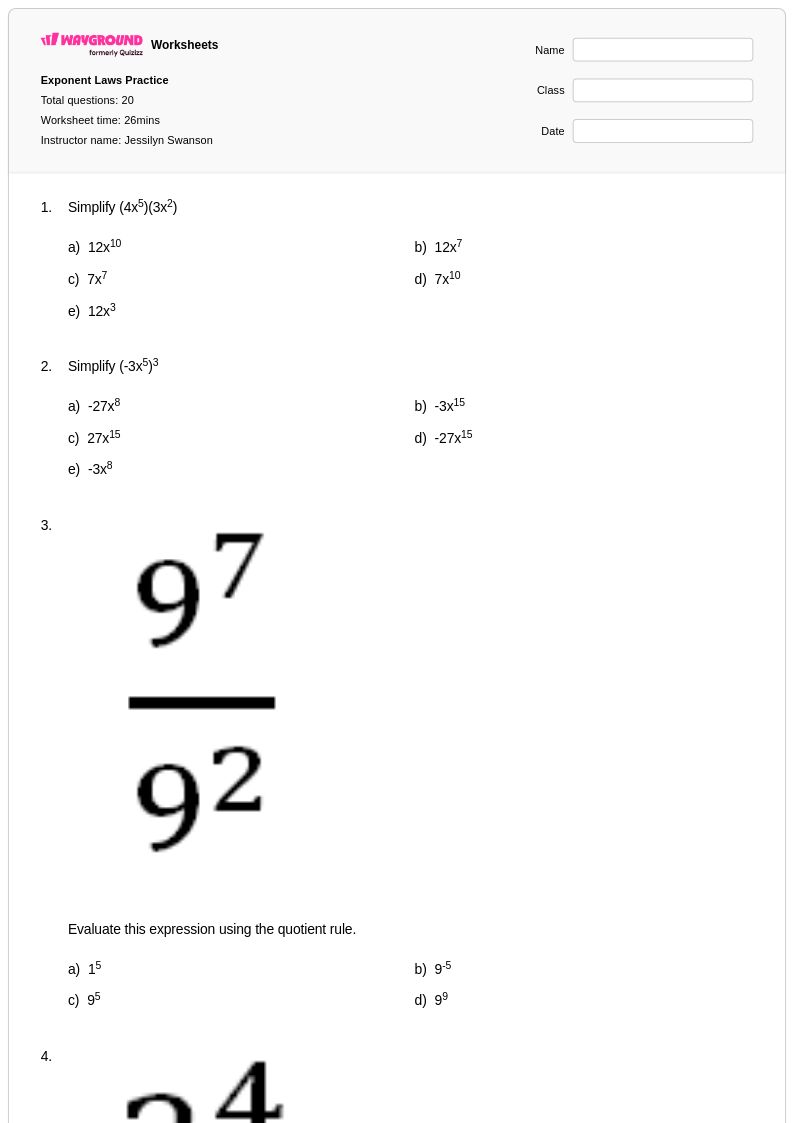
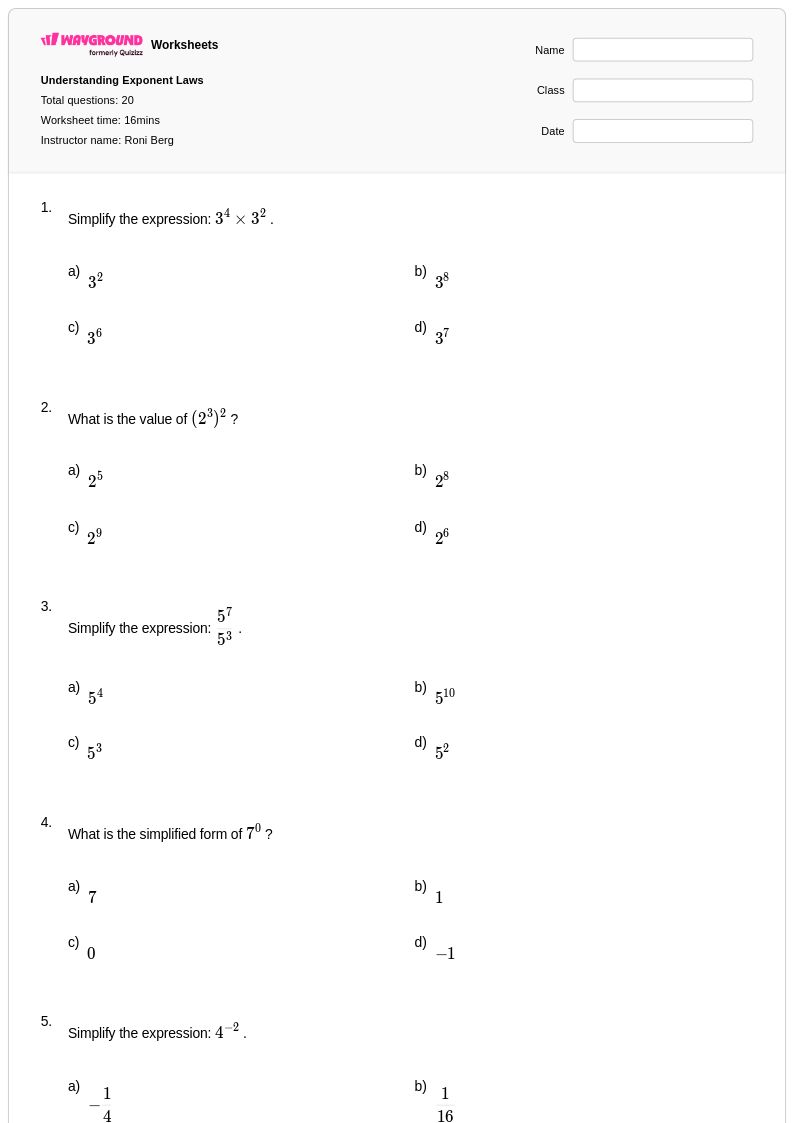
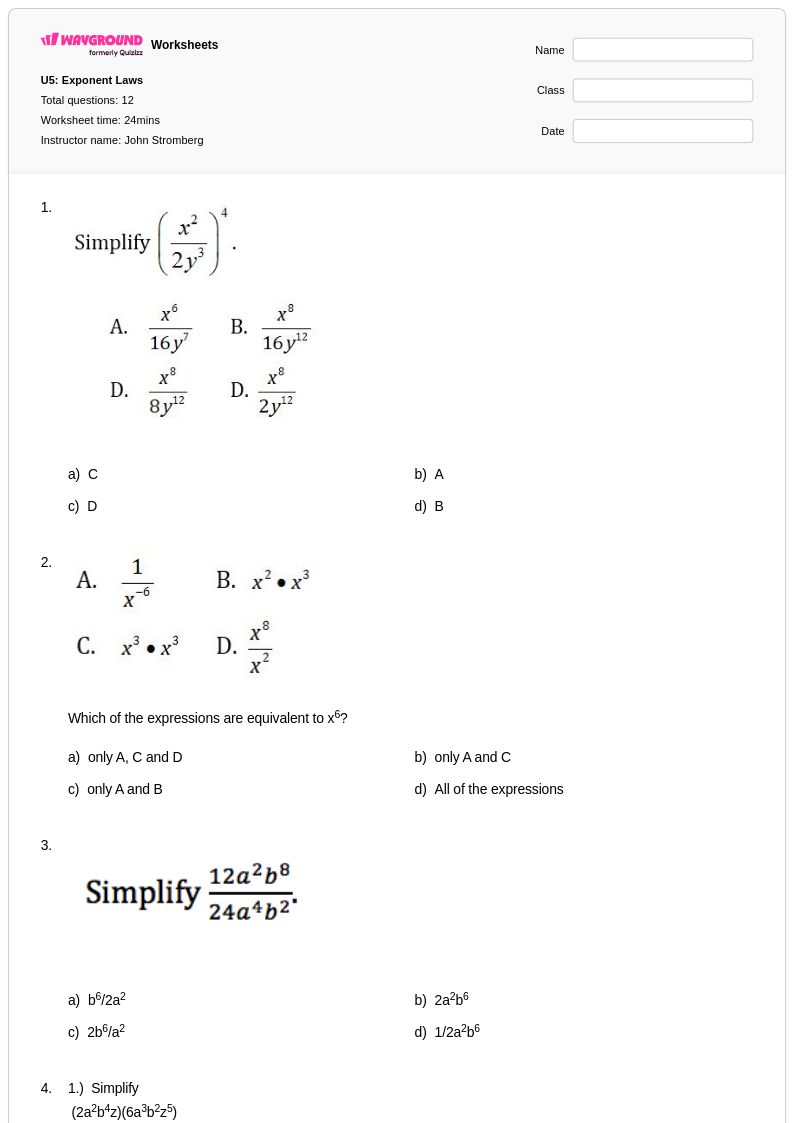
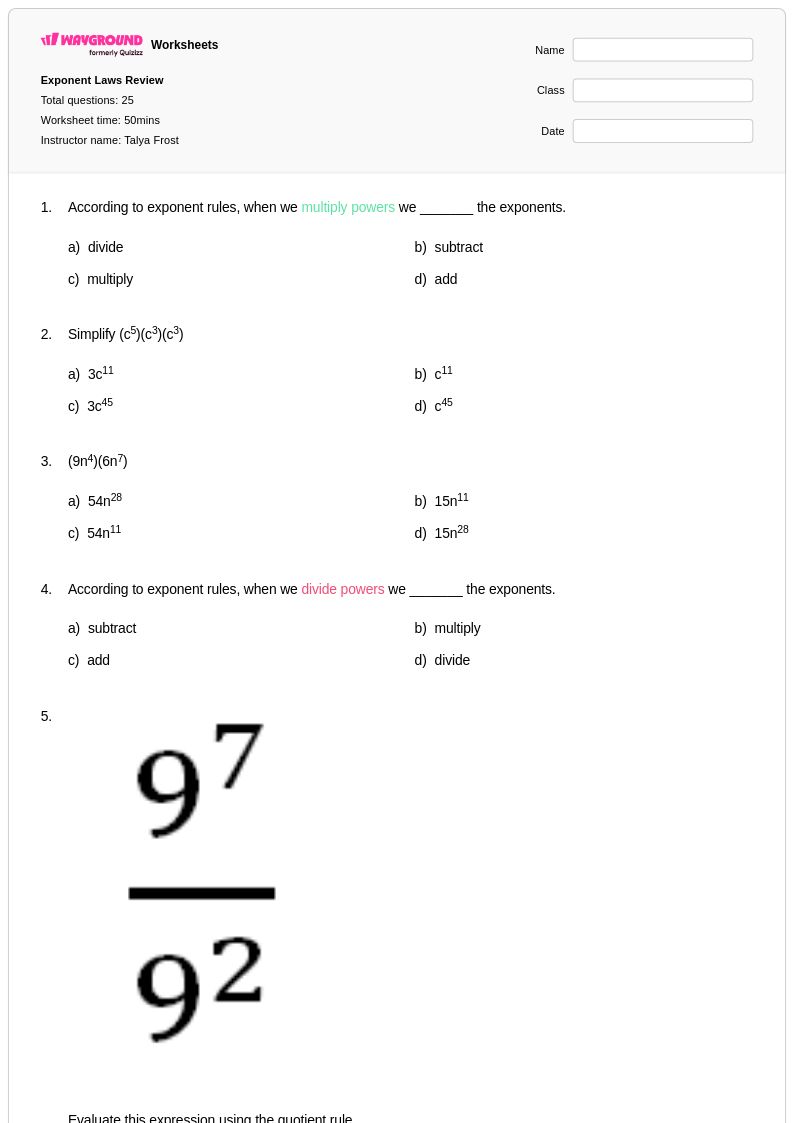
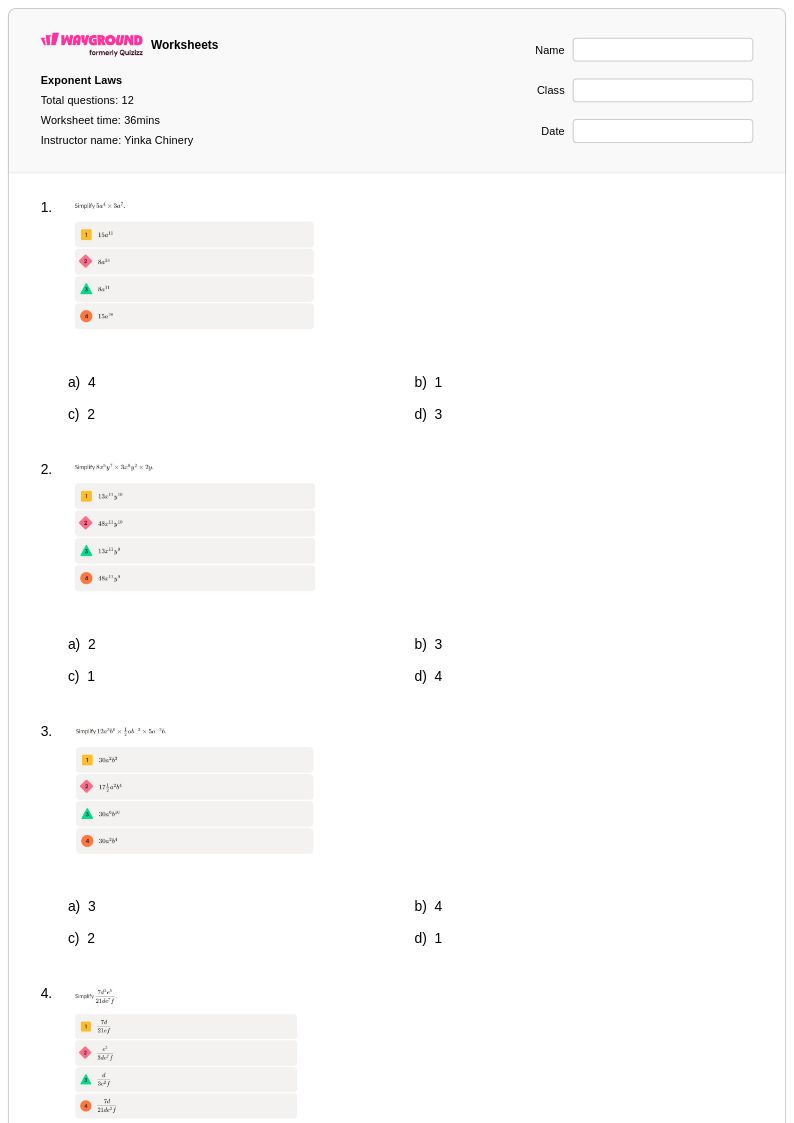
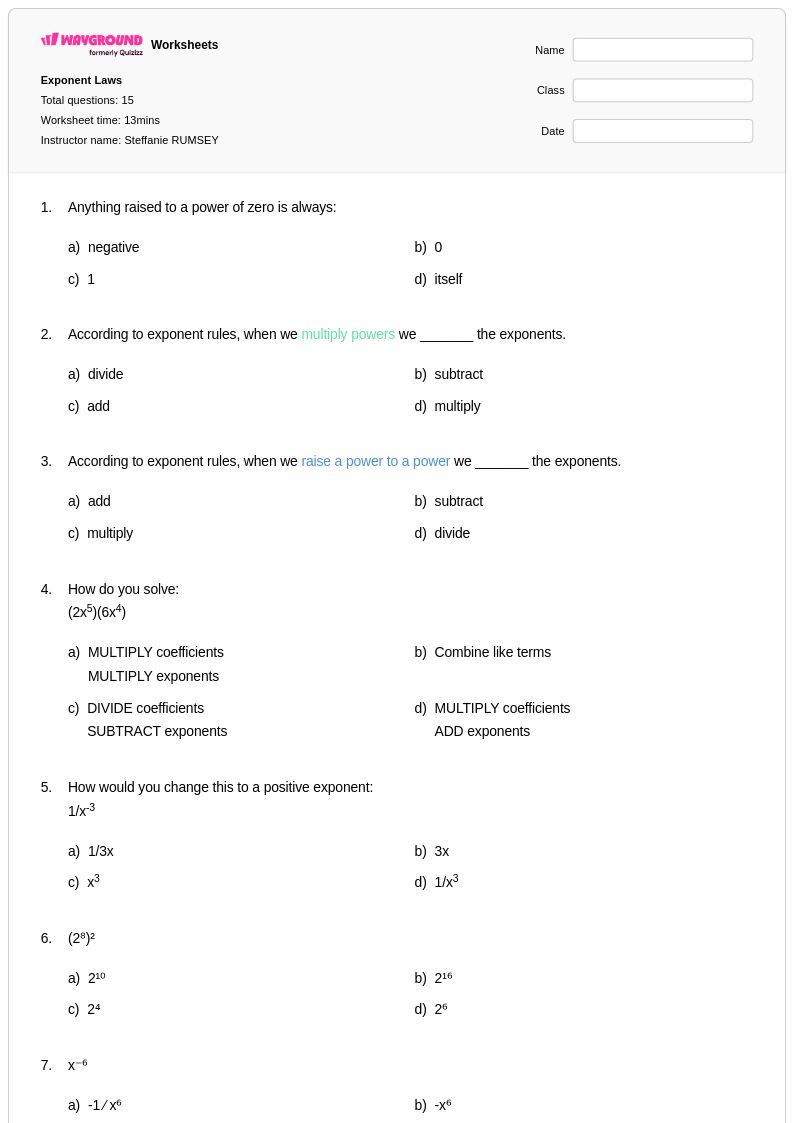
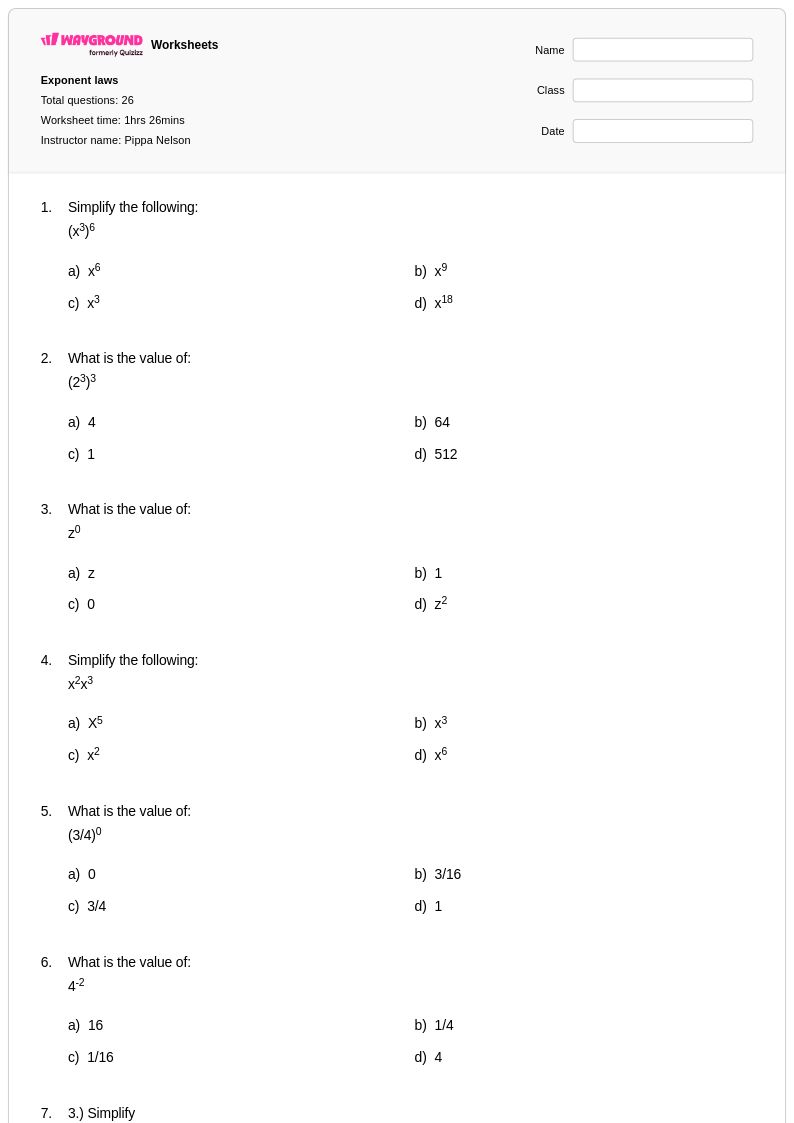
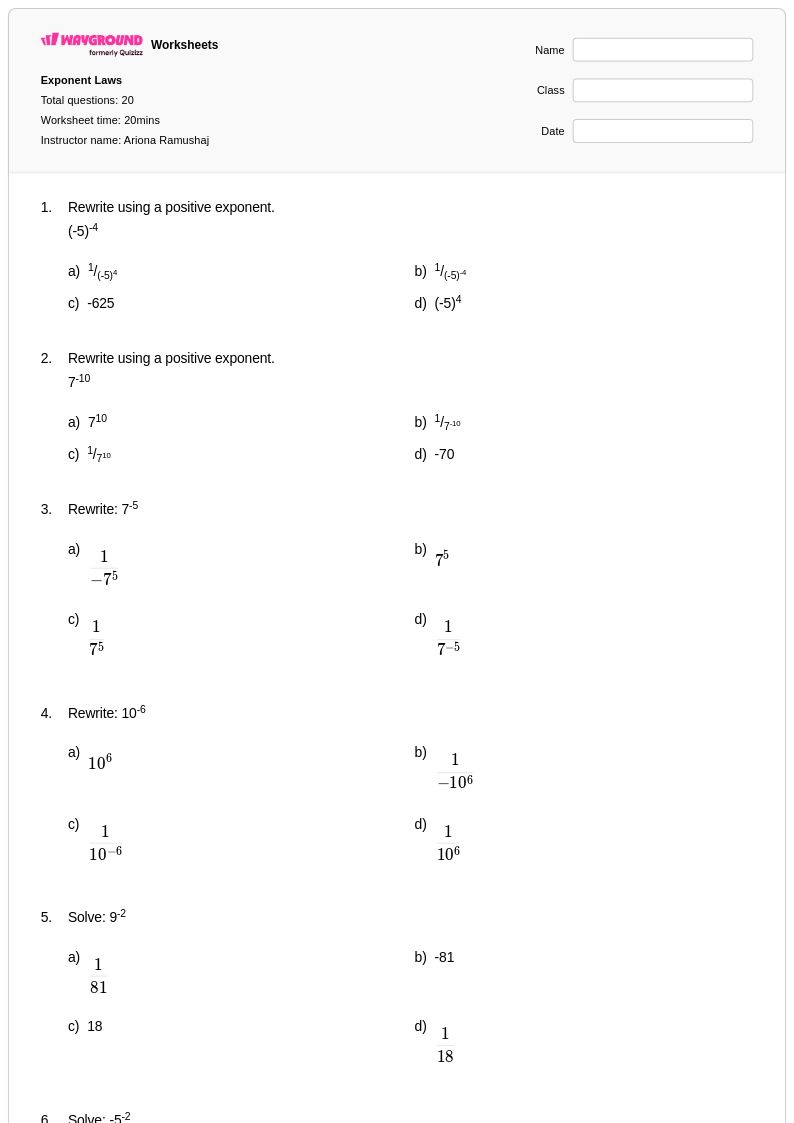
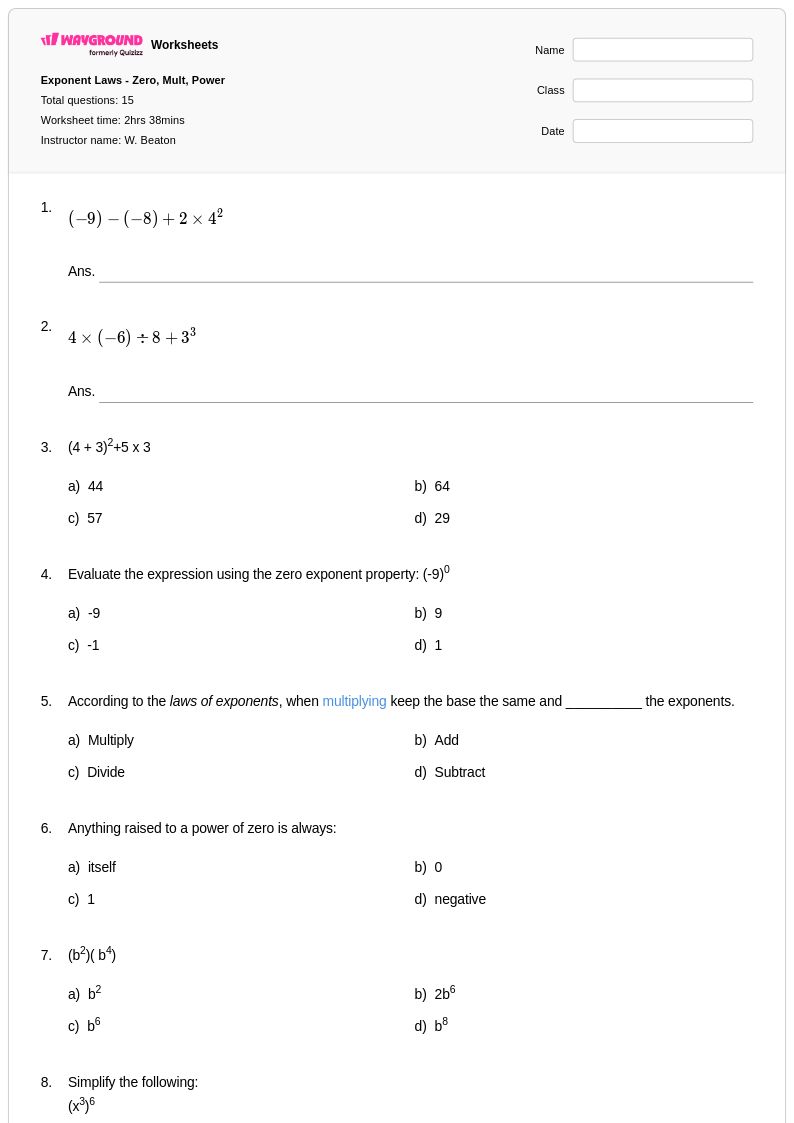
Master exponent laws with Wayground's comprehensive collection of free worksheets and printables, featuring practice problems and answer keys to help students understand mathematical rules governing powers and bases.
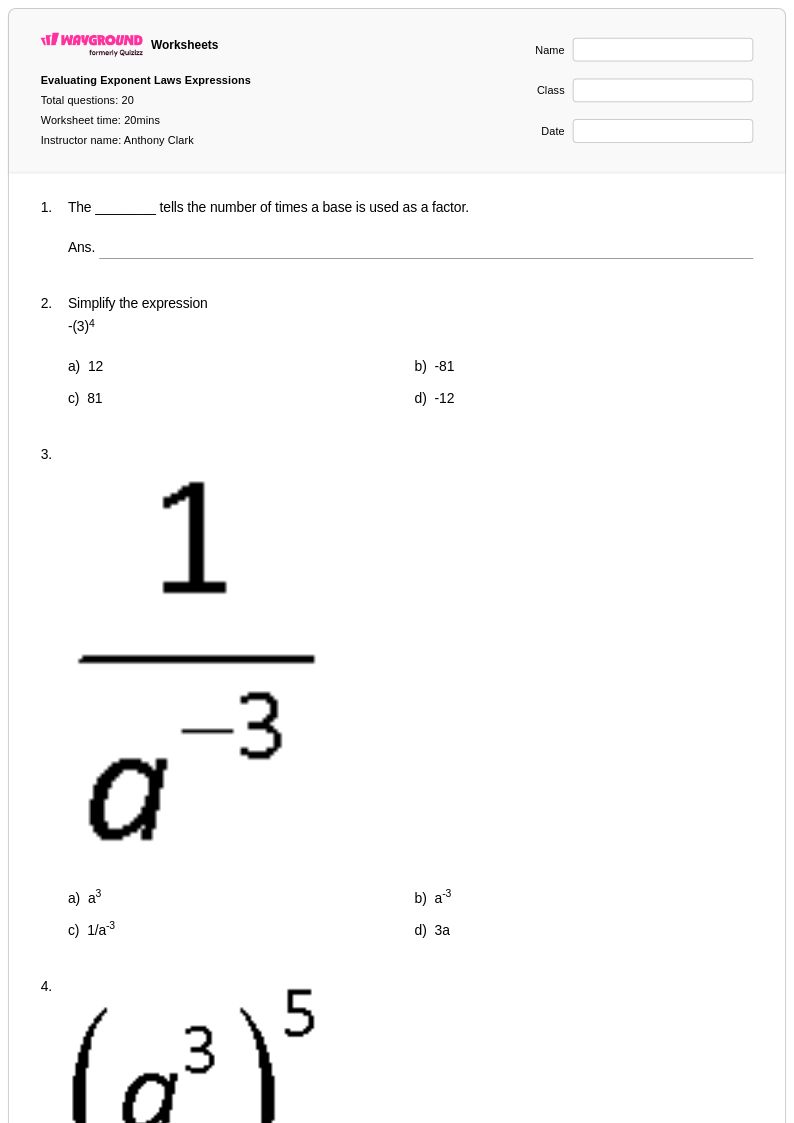
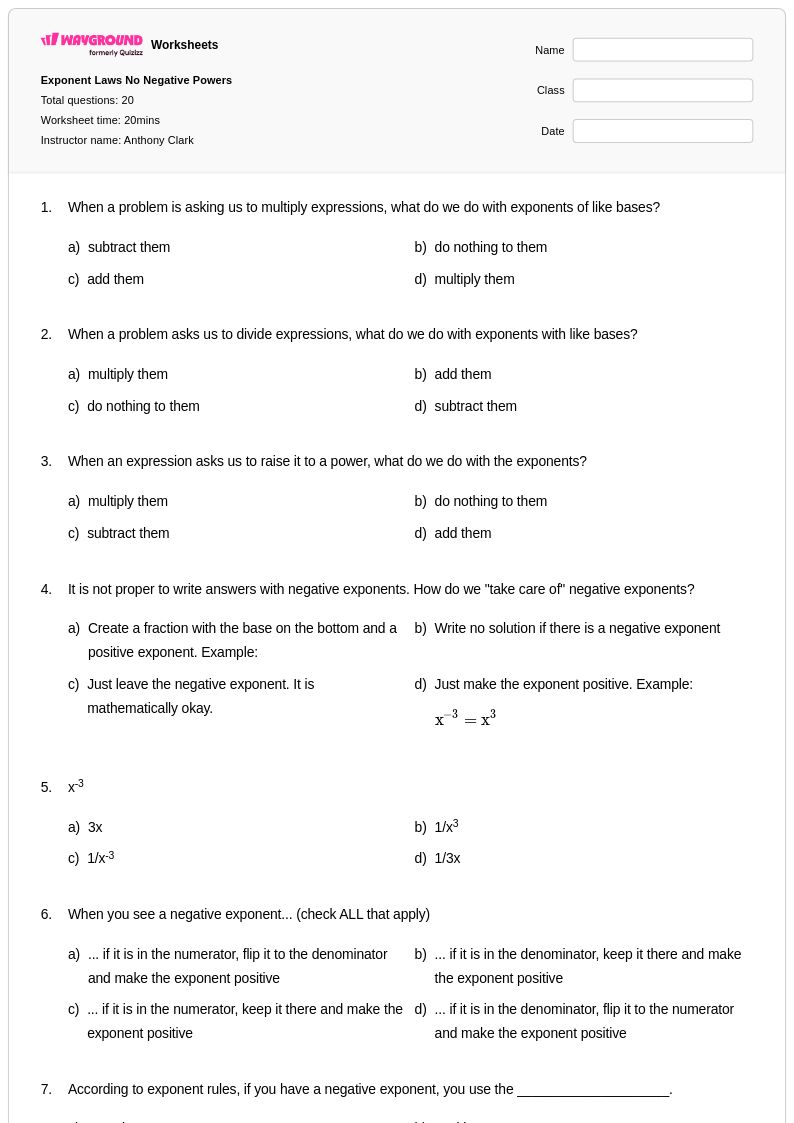
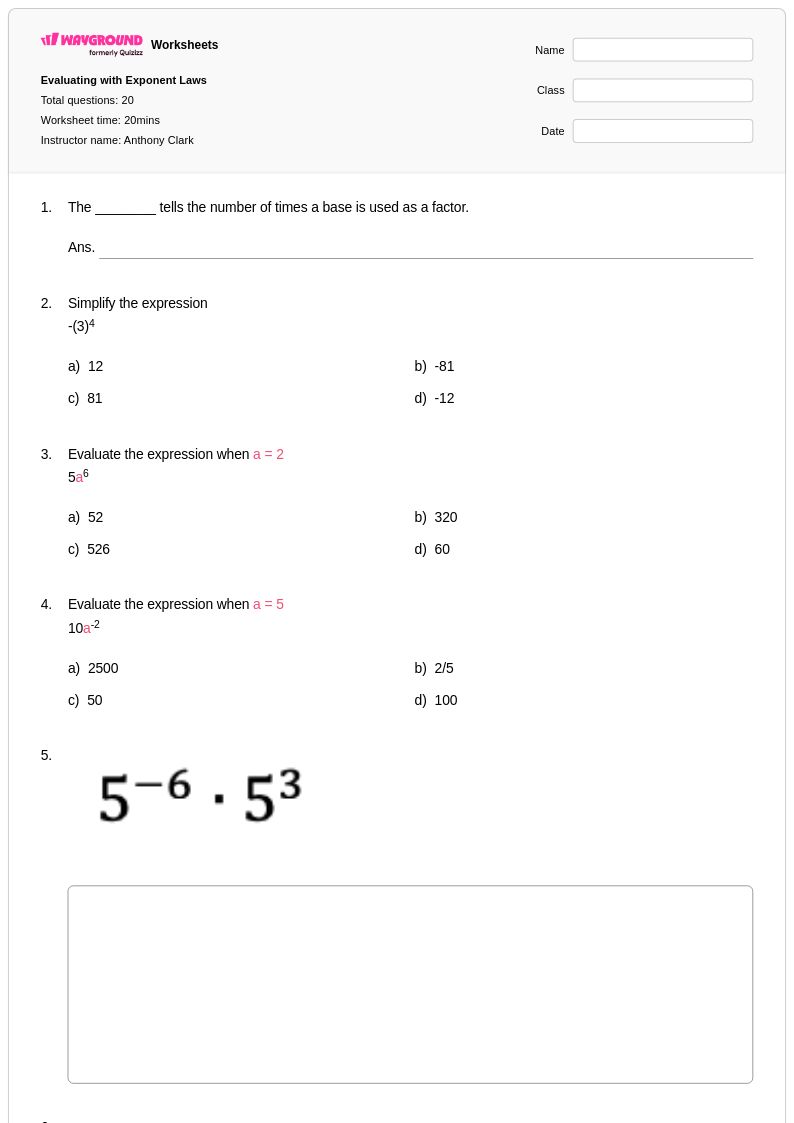
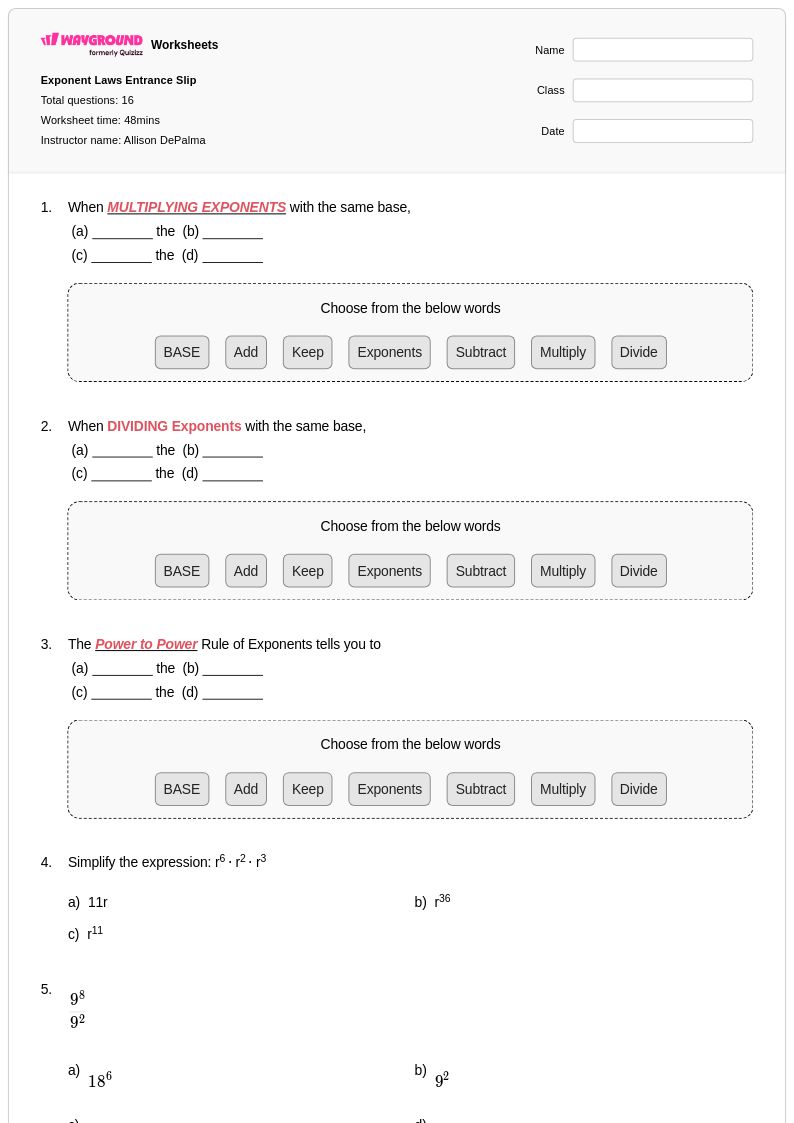
Exponent laws worksheets available through Wayground (formerly Quizizz) provide comprehensive practice opportunities for students to master the fundamental rules governing exponential expressions. These carefully designed resources strengthen critical mathematical skills including the product rule, quotient rule, power rule, zero exponent rule, and negative exponent rule through systematic practice problems that build conceptual understanding and procedural fluency. Each worksheet collection includes detailed answer keys and step-by-step solutions, making them invaluable for independent study and homework assignments. Teachers can access these free printables in convenient pdf format, ensuring easy distribution and consistent formatting across classroom and home learning environments.
Wayground's extensive mathematics resource library supports educators with millions of teacher-created exponent laws worksheets that can be easily located through robust search and filtering capabilities. The platform's comprehensive collection aligns with mathematical standards and provides differentiation tools that allow teachers to customize content difficulty and complexity to match individual student needs. These versatile resources are available in both printable and digital formats, including downloadable pdfs, giving instructors the flexibility to seamlessly integrate exponent practice into lesson planning, targeted remediation sessions, and enrichment activities. The platform's organizational features streamline the process of selecting appropriate skill practice materials, enabling teachers to efficiently address diverse learning objectives while ensuring students develop mastery of essential exponential concepts and computational techniques.
FAQs
How do I teach exponent laws effectively?
Start with the product and quotient rules before introducing the power rule — students need to see exponents as repeated multiplication before they can reason about raising a power to a power. Anchor each rule to a numerical example first (e.g., 2³ × 2² = 2⁵), then move to variables. The zero and negative exponent rules trip students up most, so treat them as their own mini-lessons rather than footnotes at the end of a unit.
What exercises help students practice exponent laws?
The most effective practice mixes rule-isolation problems with mixed-rule problems. Start with single-rule simplification (product rule only, quotient rule only), then introduce problems that require students to identify which rule applies before solving. Multi-step expressions with combined rules — like simplifying (x³y²)⁴ / x⁵ — are where real fluency develops. Wayground's exponent laws worksheets follow this progression, moving from basic simplification to multi-step algebraic expressions.
What mistakes do students commonly make with exponent laws?
Three errors come up constantly: multiplying exponents when they should add them (confusing the product rule with the power rule), treating a zero exponent as making the whole expression zero rather than equal to 1, and misapplying negative exponents by negating the base instead of taking the reciprocal. Watch for students writing x⁻² = −x² — that one is almost universal.
How do I use these exponent laws worksheets in my class?
Every worksheet includes a complete answer key, so they work well for independent practice, homework, or self-paced review. You can assign them as a digital quiz hosted on Wayground, or print the PDF and hand them out — useful for classes where you want students off screens. If you go the print route, the Wayground for Teachers app lets you scan or capture student work for grading without re-entering everything manually.
Are exponent laws aligned to Common Core standards?
Yes. Common Core introduces integer exponents in Grade 8, where students learn to apply the product, quotient, and power rules to numerical expressions. By high school, the expectation expands to rational exponents and rewriting expressions like x^(1/2) as √x. Exponent laws worksheets at the introductory level build the Grade 8 foundation; more advanced versions bridge into the high school algebra and functions standards where exponential and radical expressions converge.
How can I differentiate exponent laws practice for mixed-ability classes?
For students who struggle with the abstract notation, Wayground's worksheet-level tools let you increase font size or apply a dyslexia-friendly font to reduce visual noise. For students who need processing support during a digital quiz, the Read Aloud accommodation reads questions aloud and reduced answer choices can lower cognitive load on multi-step problems. Students who are ready for more challenge can move directly to combined-rule and multi-variable problems without waiting for the rest of the class.