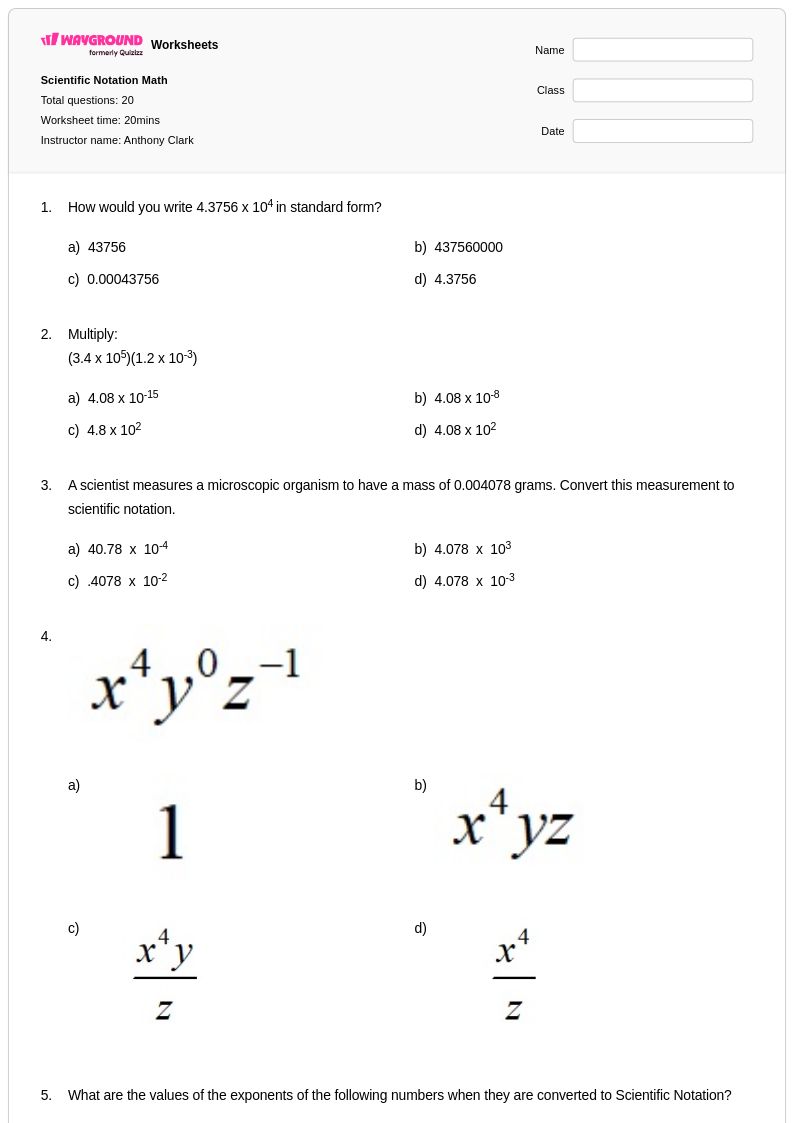
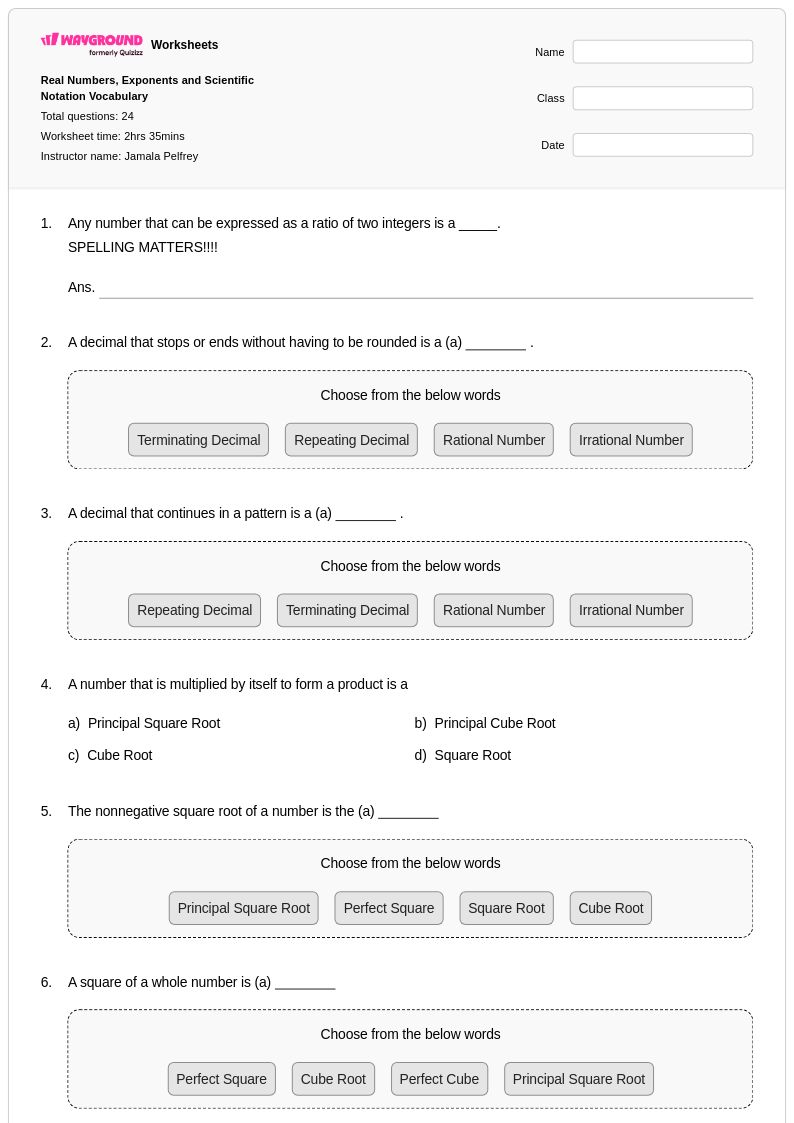
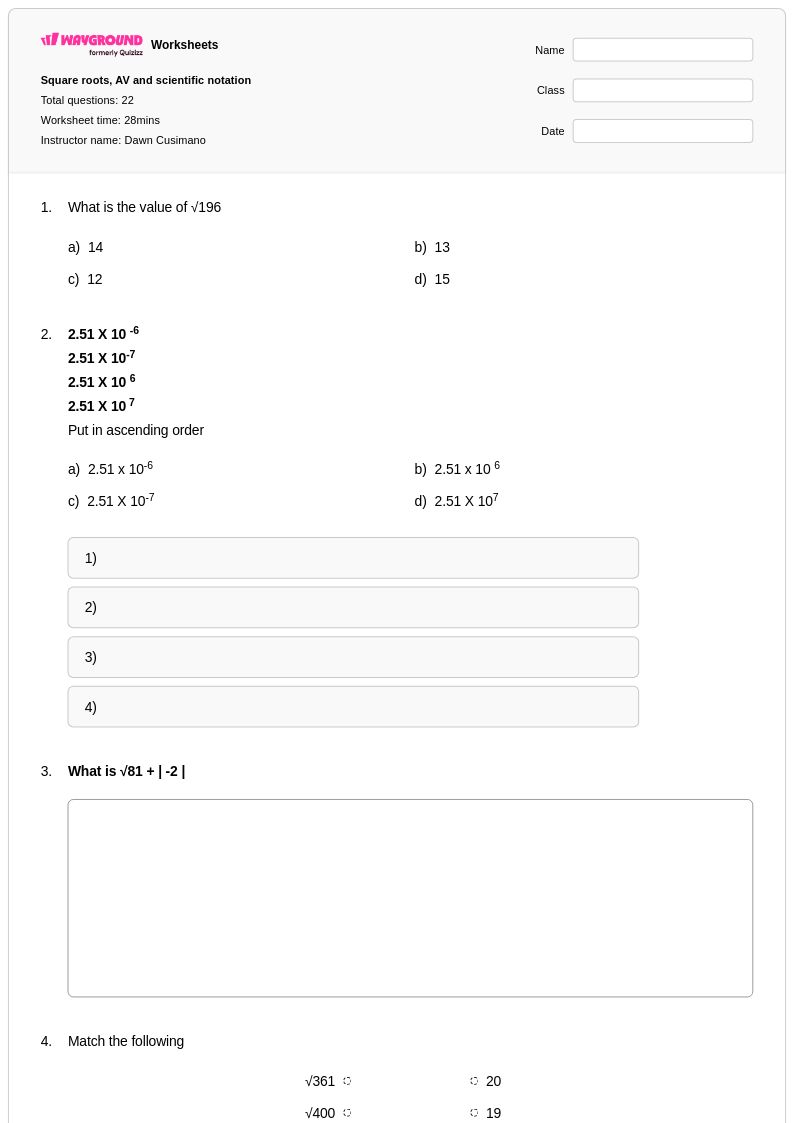
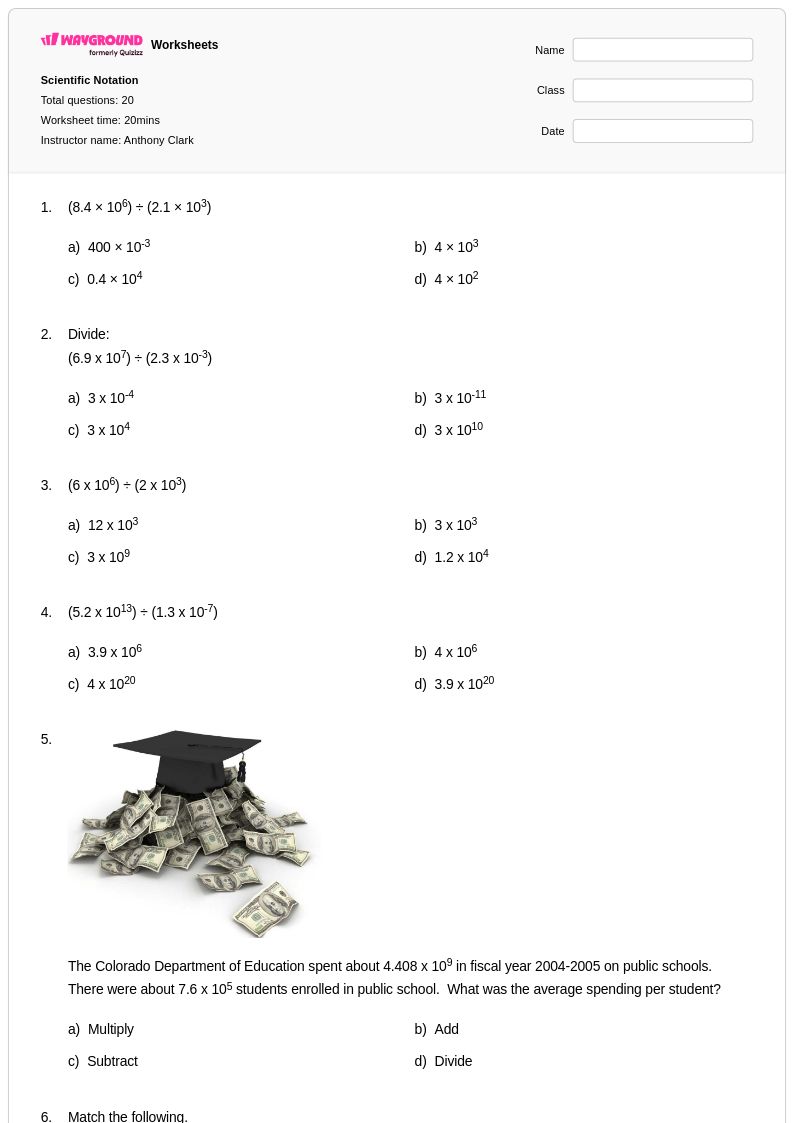
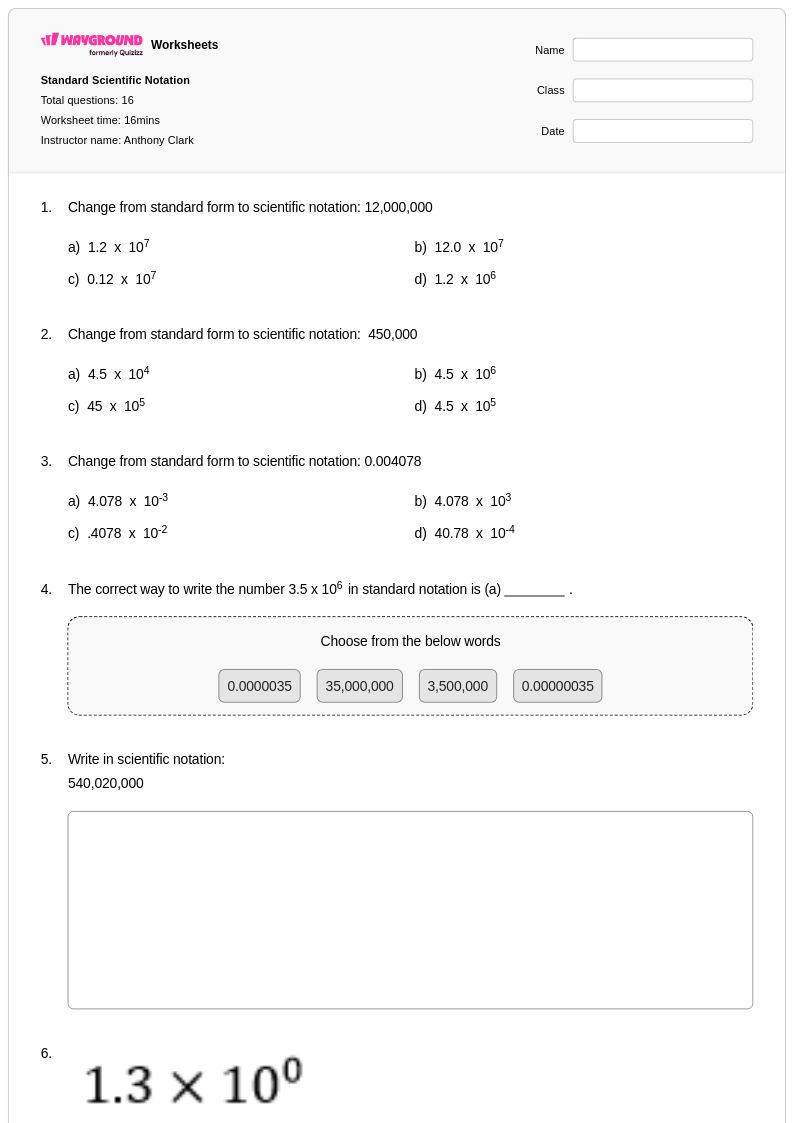
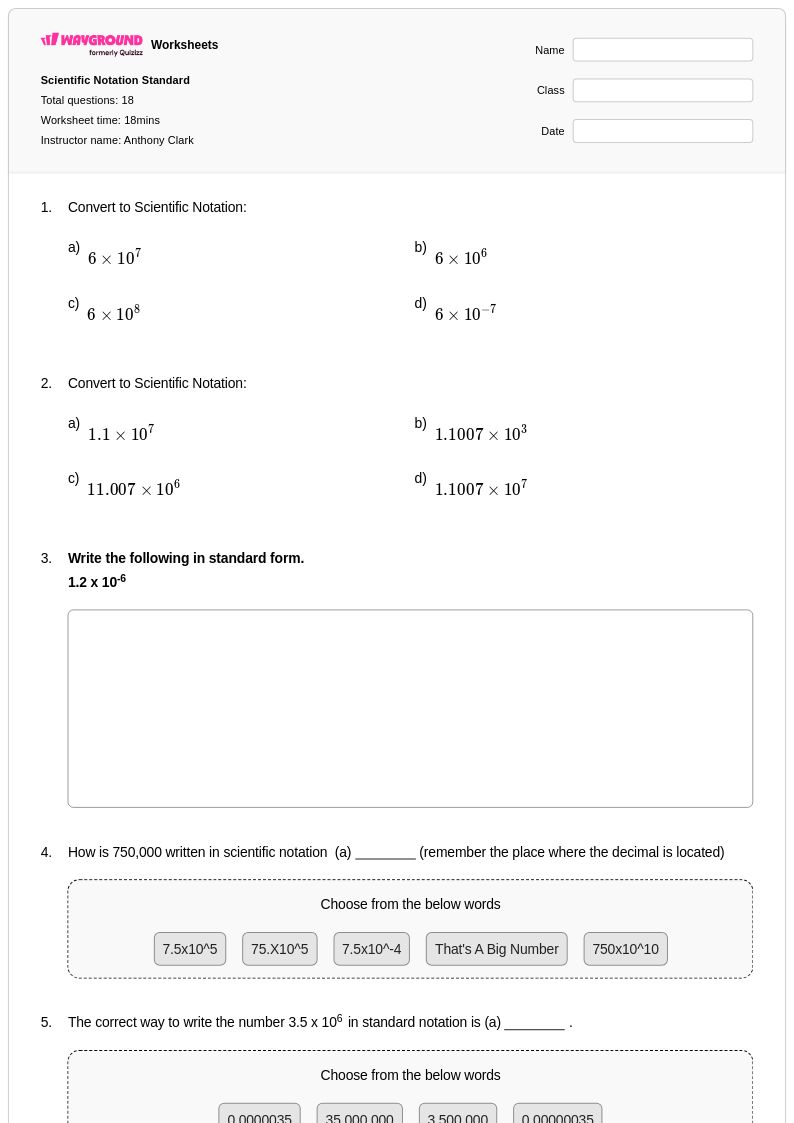
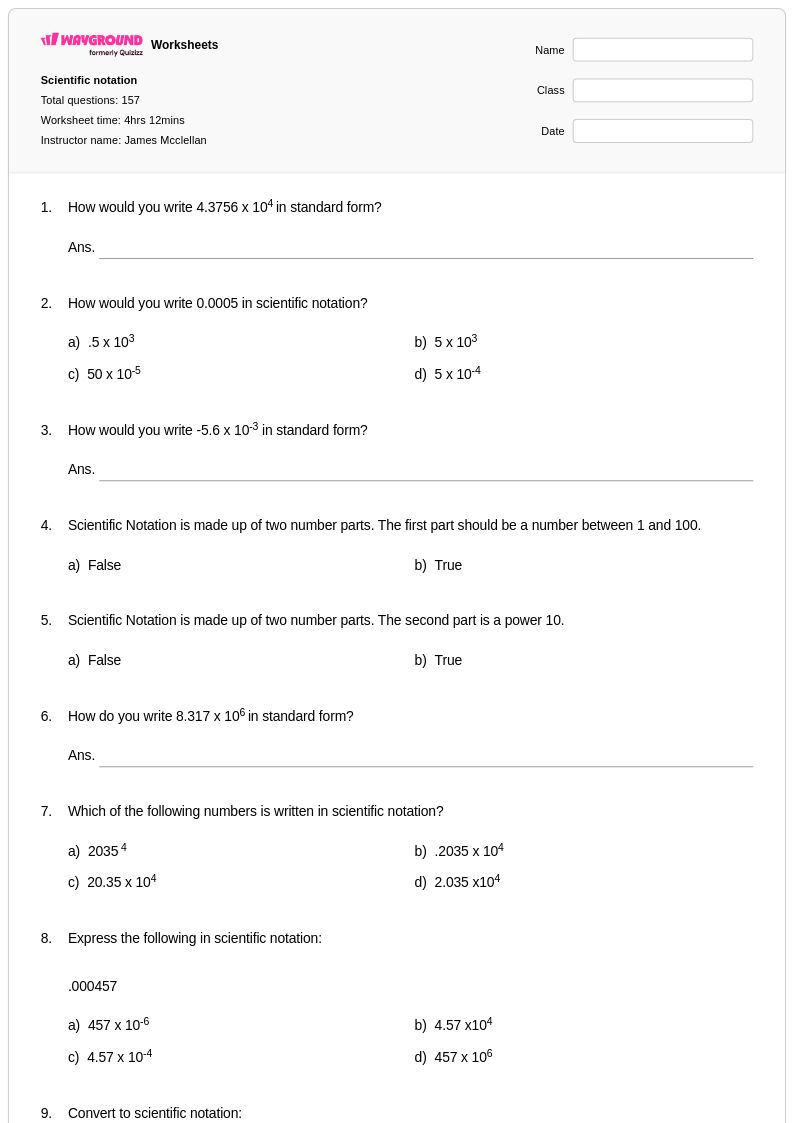
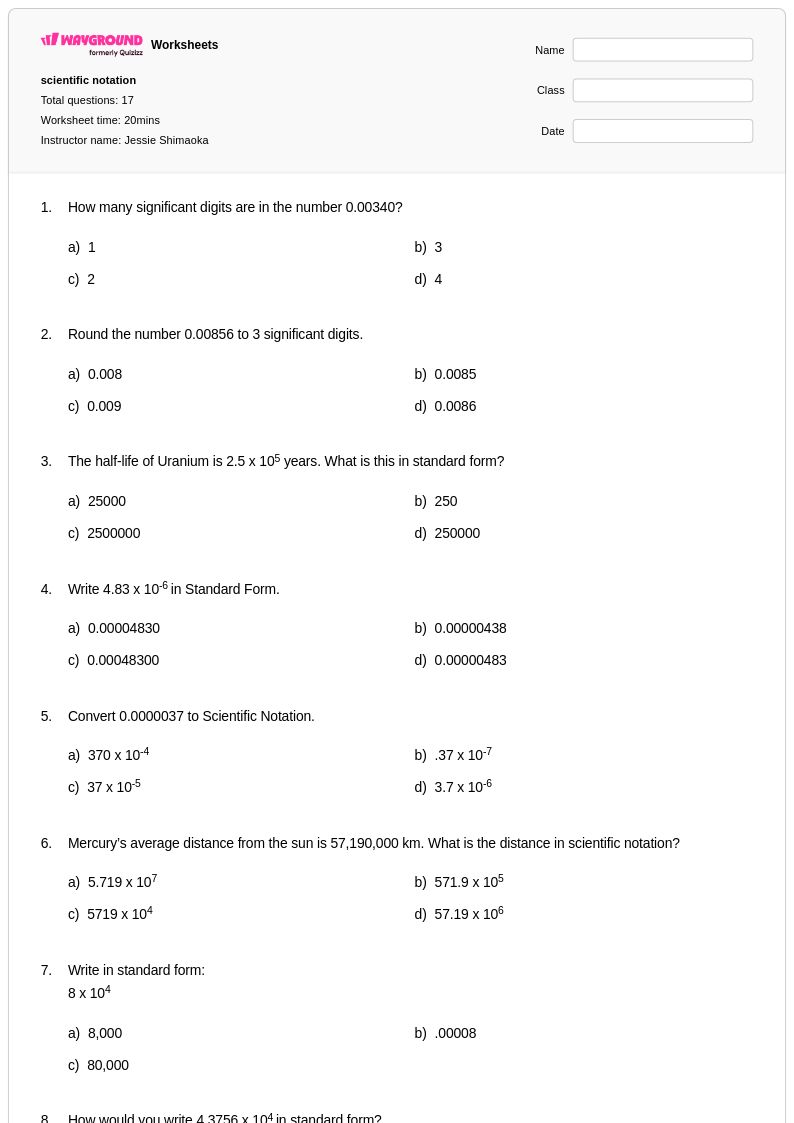
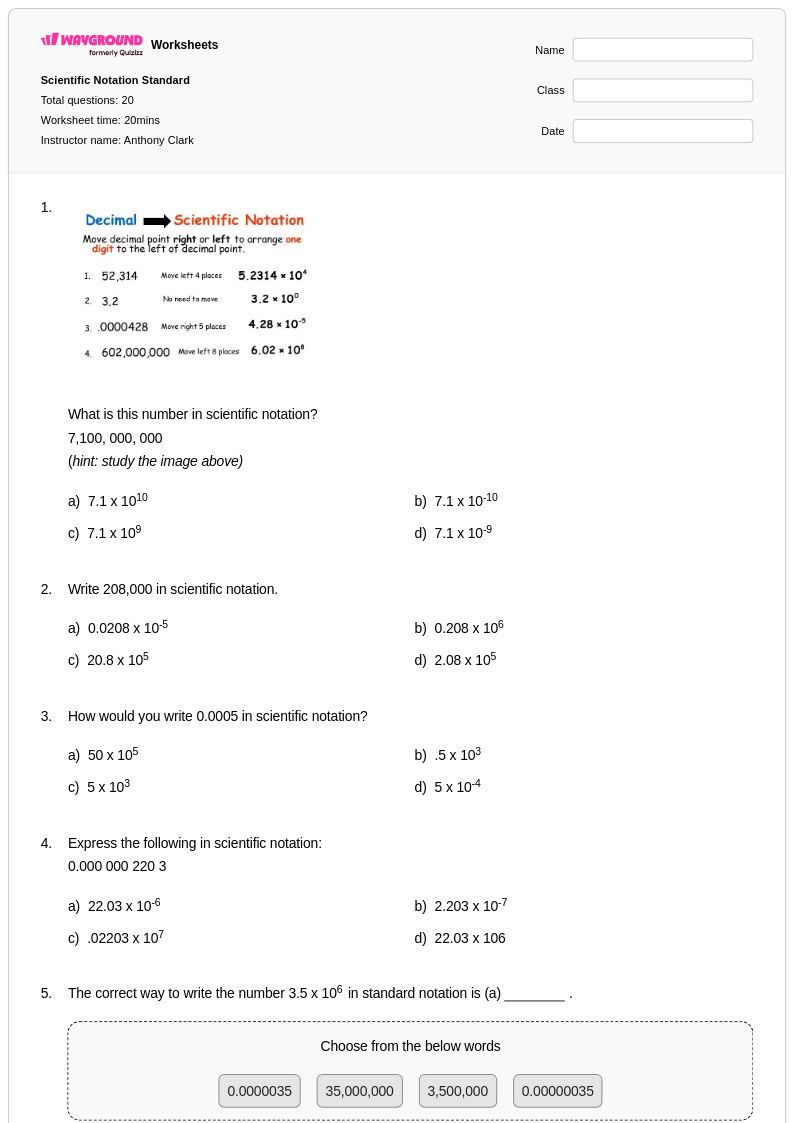
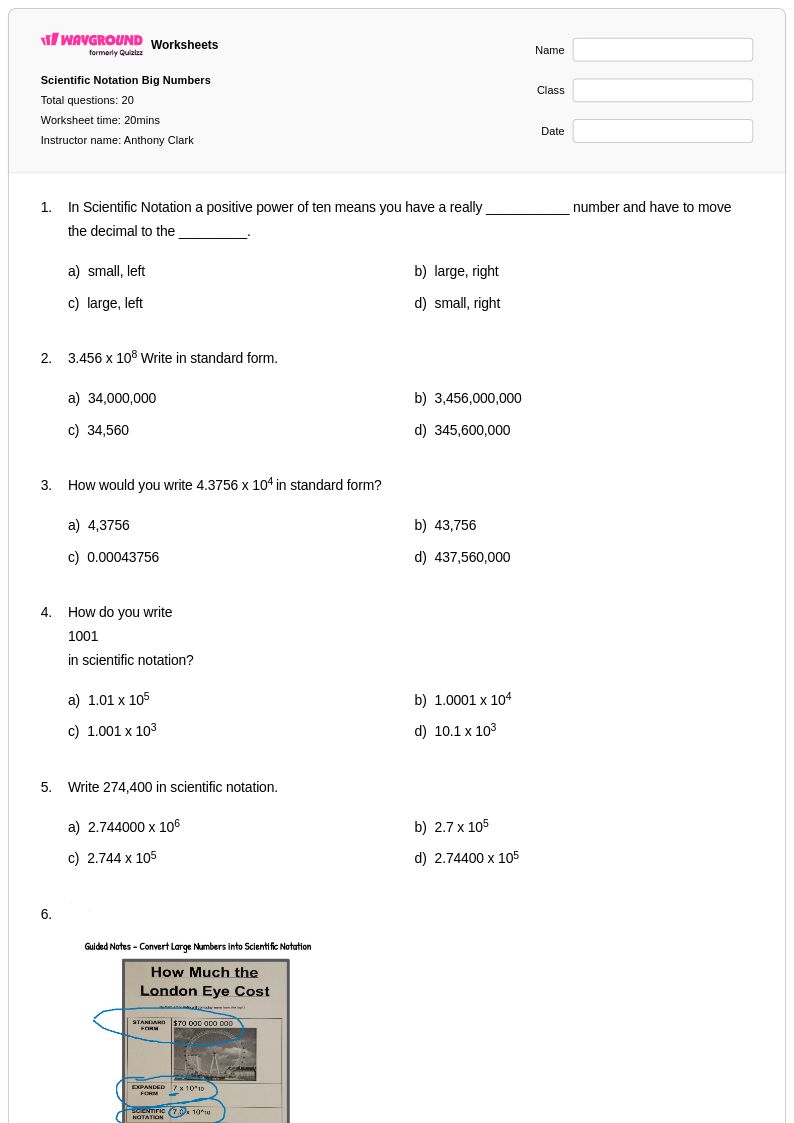
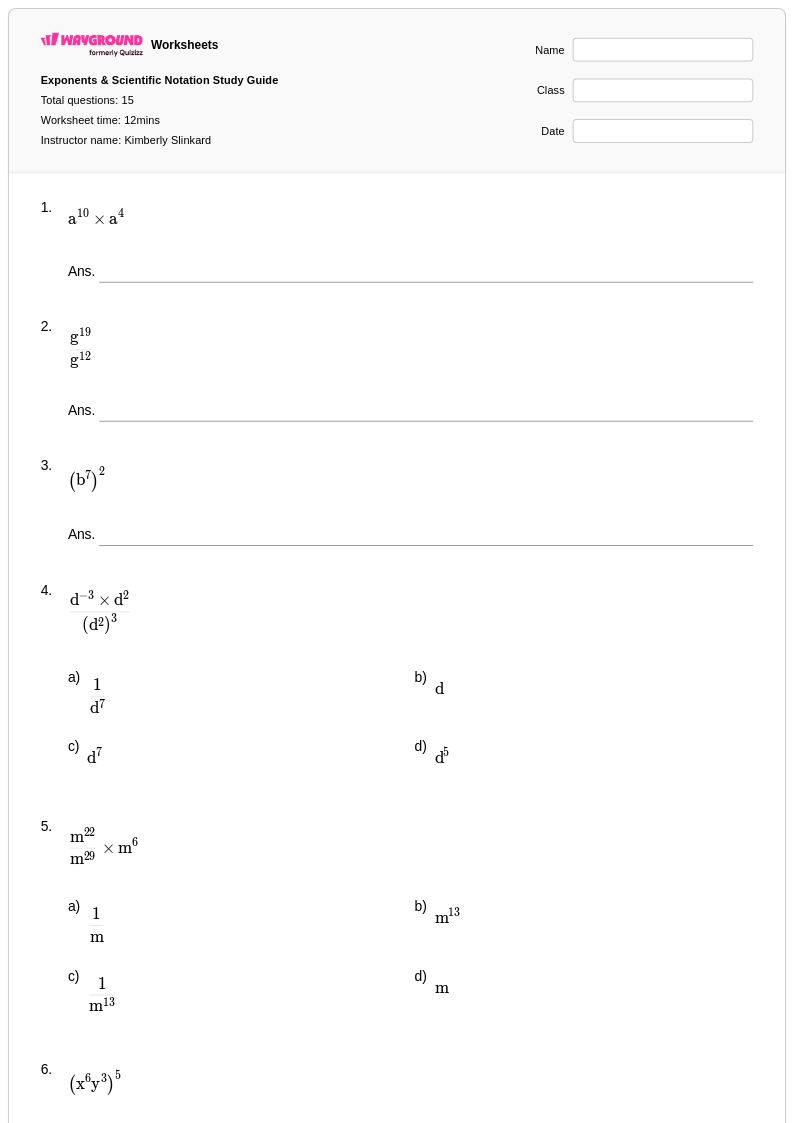
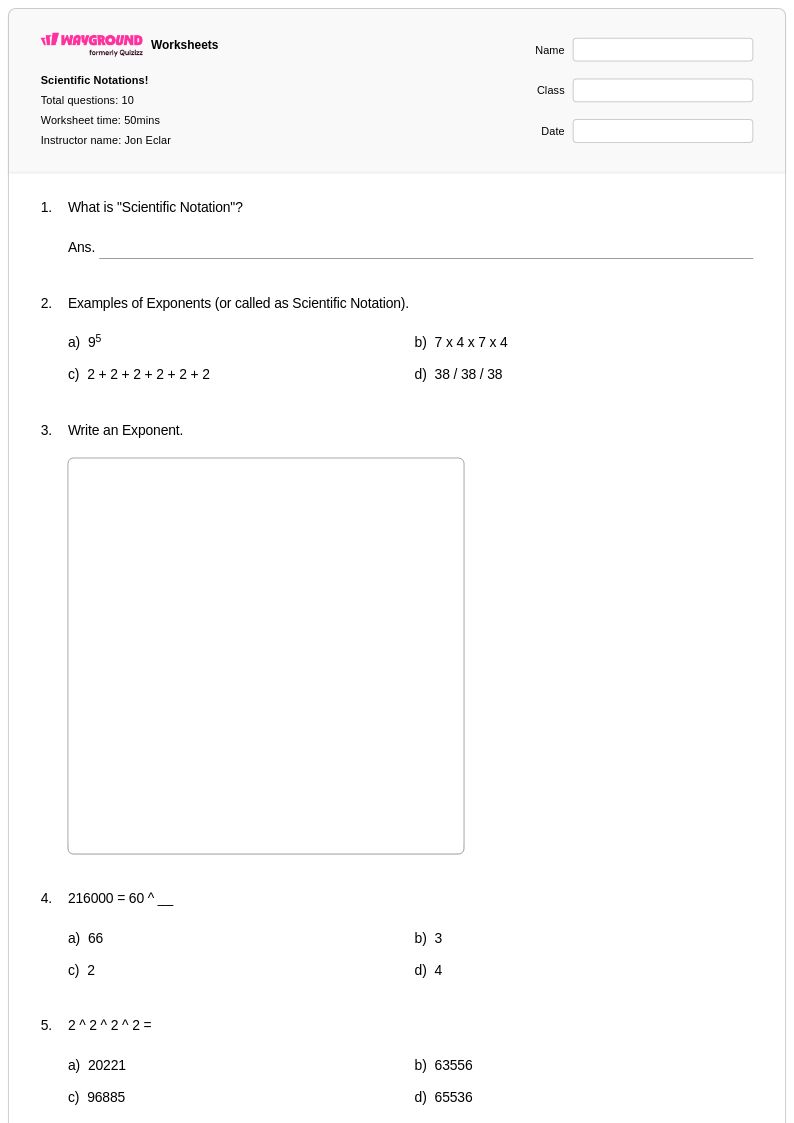
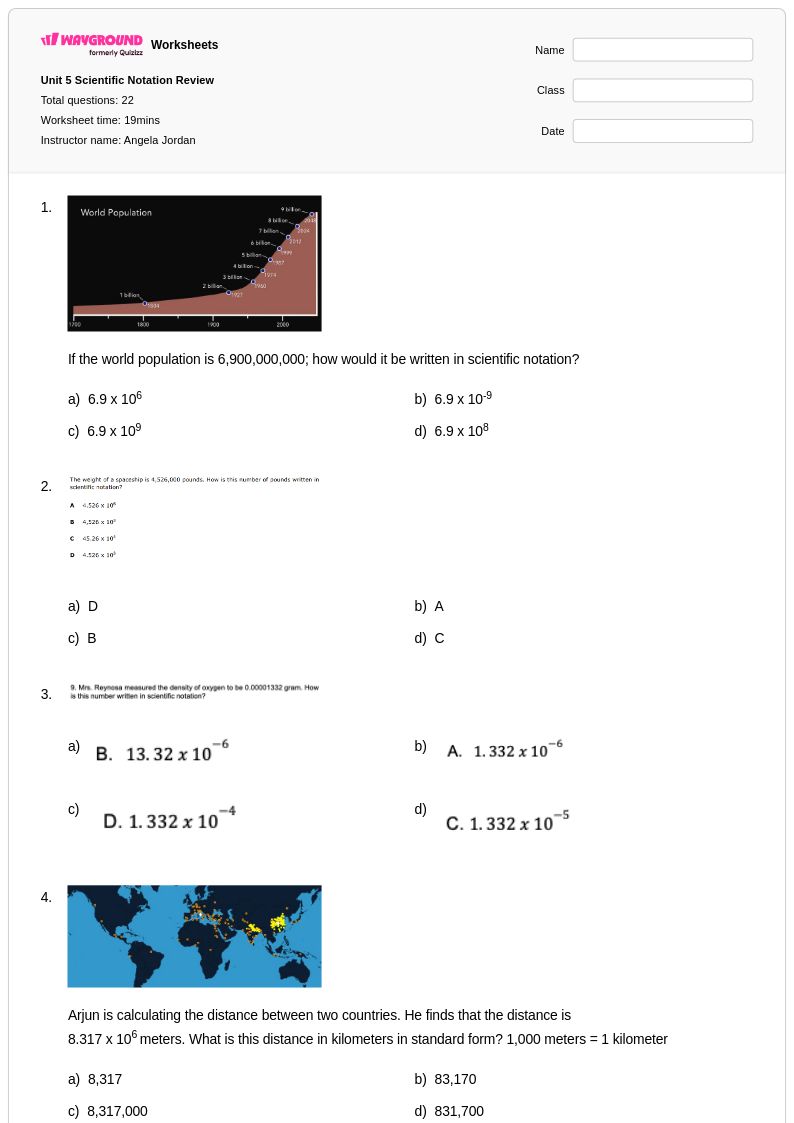
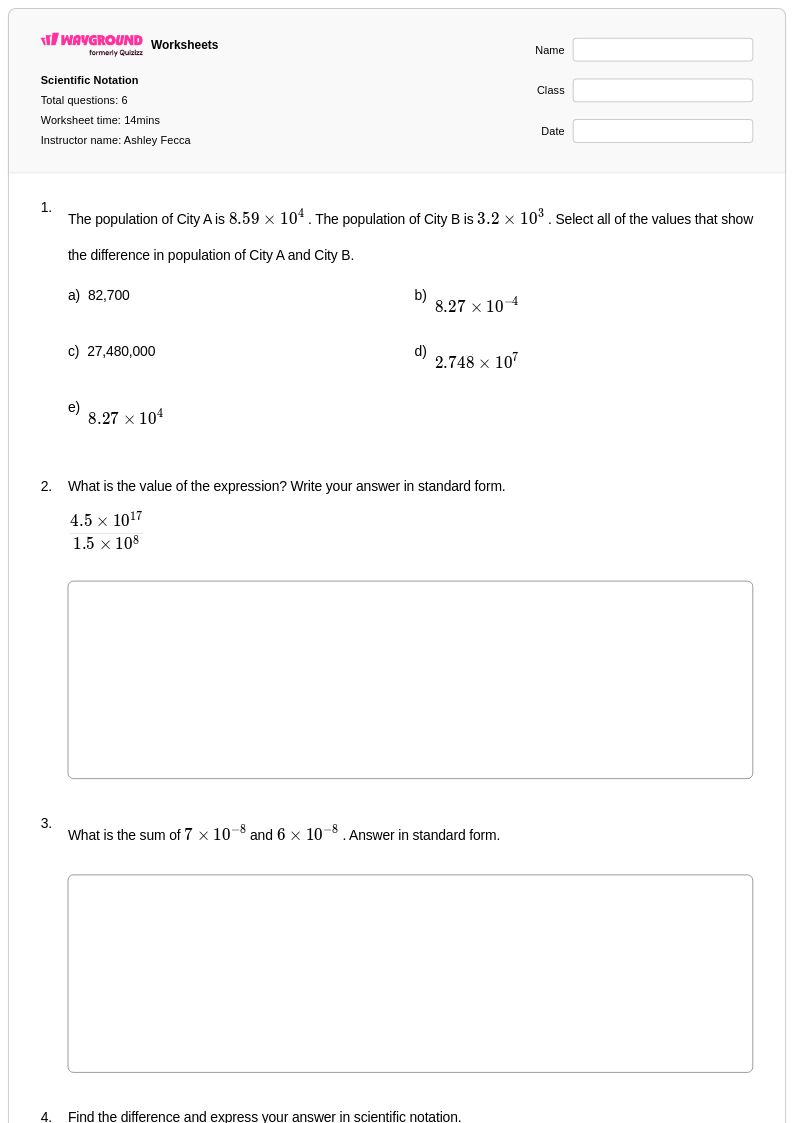
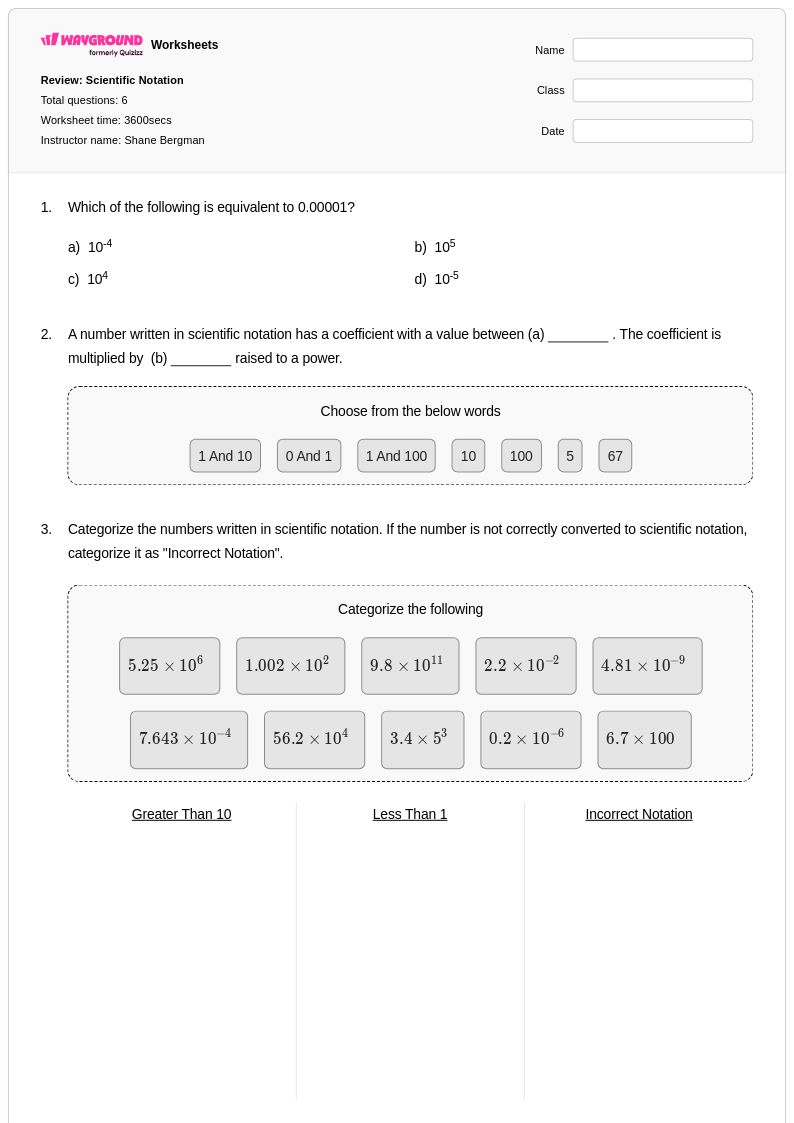
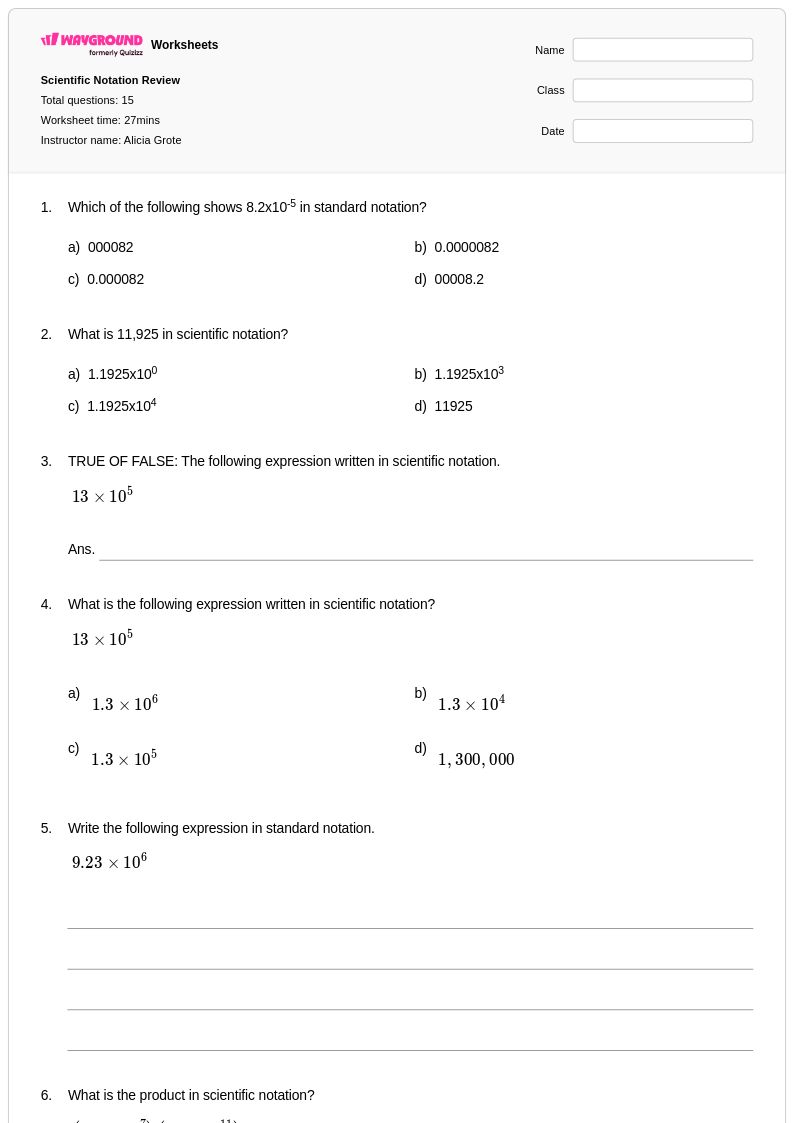
Wayground's free scientific notation worksheets provide comprehensive practice problems and answer keys to help students master converting between standard and scientific notation through engaging printable PDF exercises.
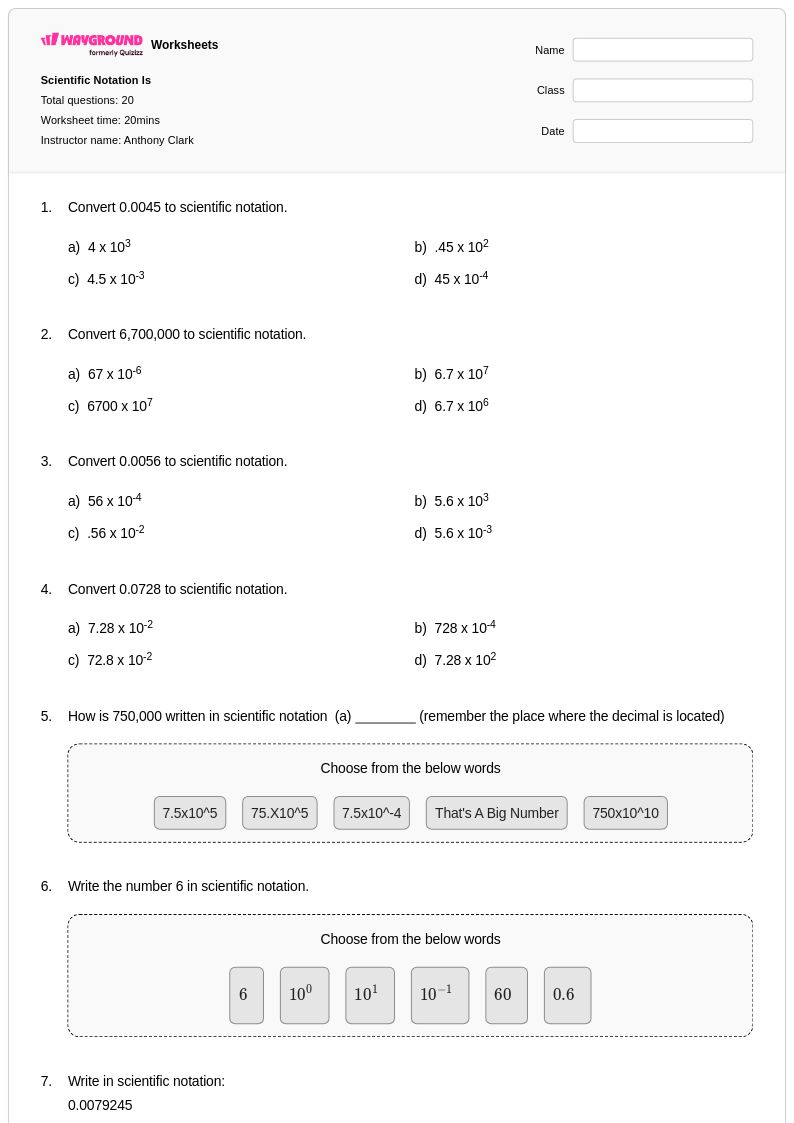
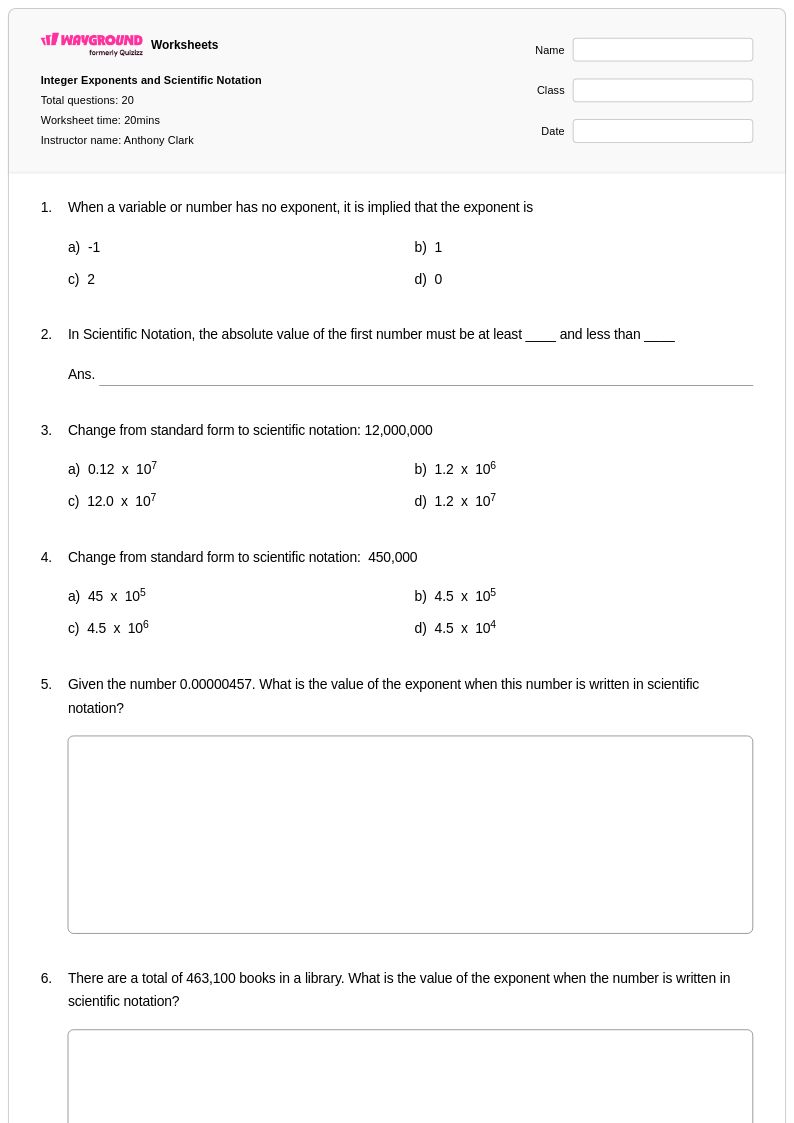
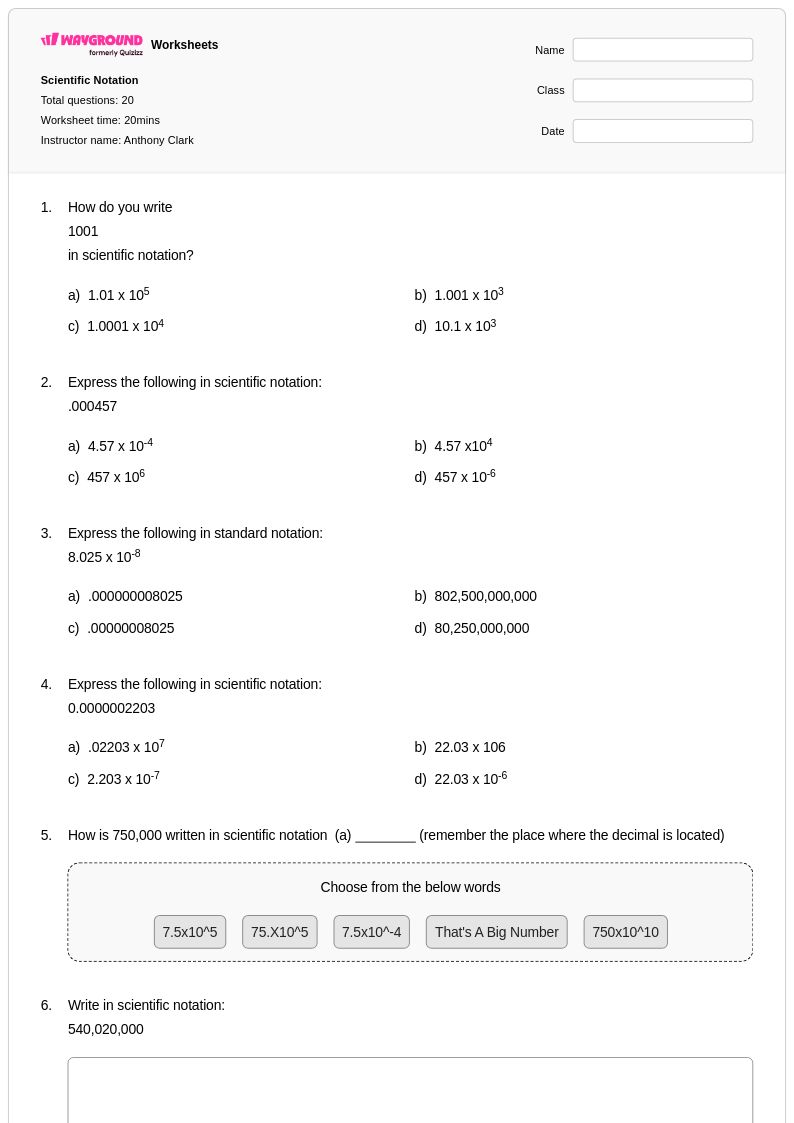
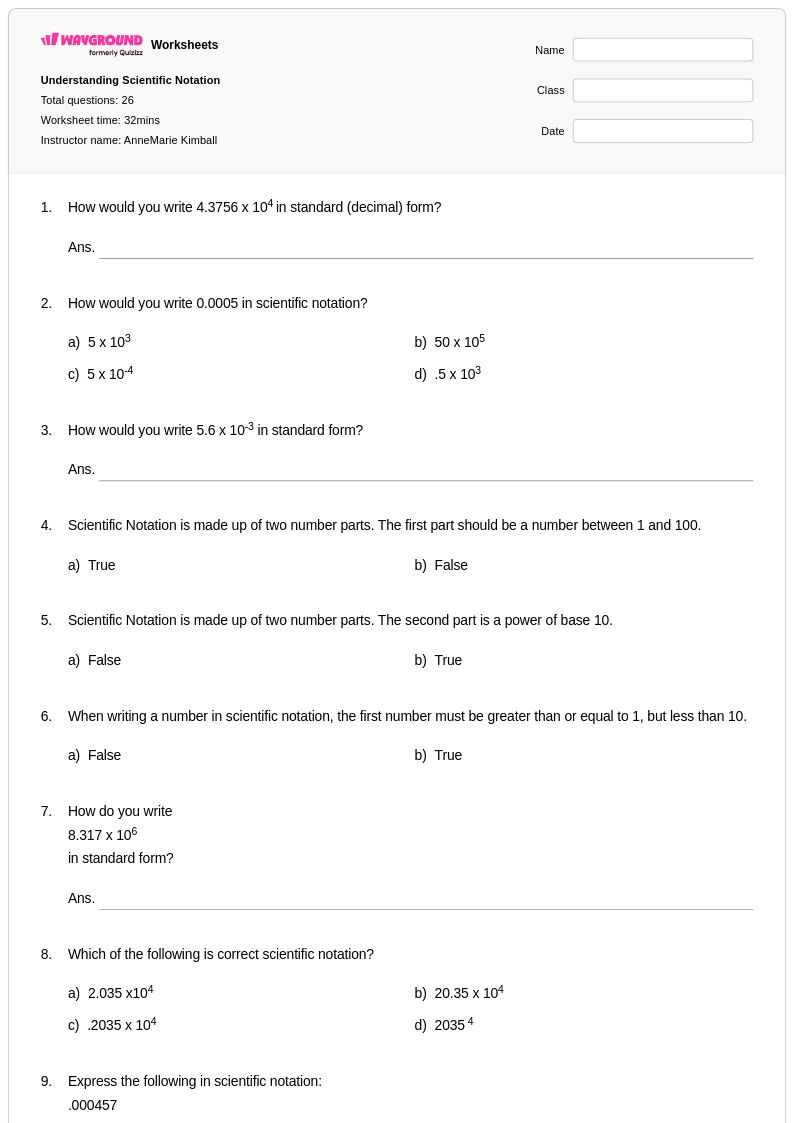
Scientific notation worksheets available through Wayground (formerly Quizizz) provide comprehensive practice opportunities for students to master the essential skill of expressing very large and very small numbers in standard exponential form. These carefully crafted educational resources strengthen students' ability to convert between standard form and scientific notation, perform arithmetic operations with numbers written in scientific notation, and apply this mathematical concept to real-world scenarios involving measurements in science and engineering. Each worksheet collection includes detailed answer keys and is available as free printable pdf resources, offering structured practice problems that progress from basic conversion exercises to more complex multi-step calculations that reinforce proper understanding of powers of ten and decimal placement.
Wayground (formerly Quizizz) empowers educators with access to millions of teacher-created scientific notation worksheet resources that can be easily searched, filtered, and customized to meet diverse classroom needs. The platform's robust differentiation tools allow teachers to modify existing worksheets or create targeted practice sets that address specific skill gaps, whether students need remediation with basic exponential concepts or enrichment through advanced applications. These scientifically accurate materials align with mathematical standards and are available in both printable pdf format and interactive digital versions, enabling seamless integration into lesson planning, homework assignments, test preparation, and individualized skill practice sessions that build mathematical confidence and computational fluency.
FAQs
How do I teach scientific notation for the first time?
Start by grounding the concept in relatable extremes, like the distance to the sun or the size of a cell. Introduce powers of 10 as a shorthand for writing these large and small numbers. Use a number line to visually demonstrate how positive exponents represent large numbers (moving the decimal right) and negative exponents represent small numbers (moving the decimal left).
What exercises help students practice scientific notation?
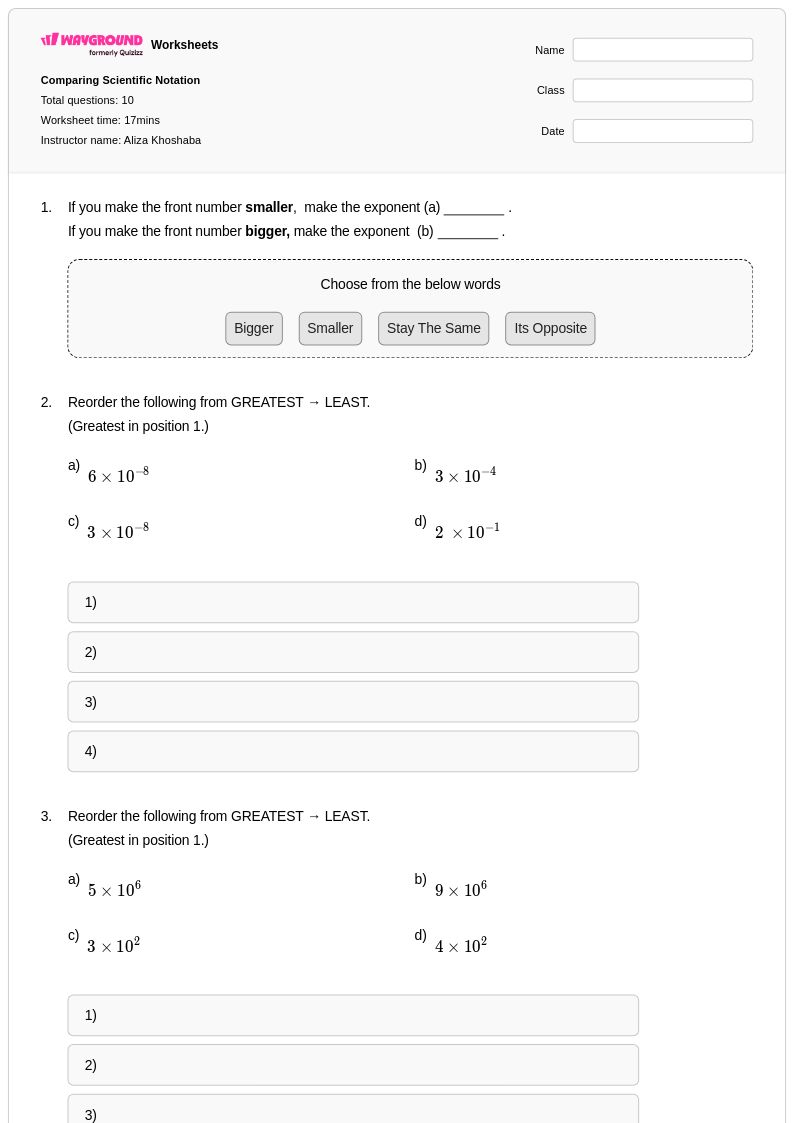
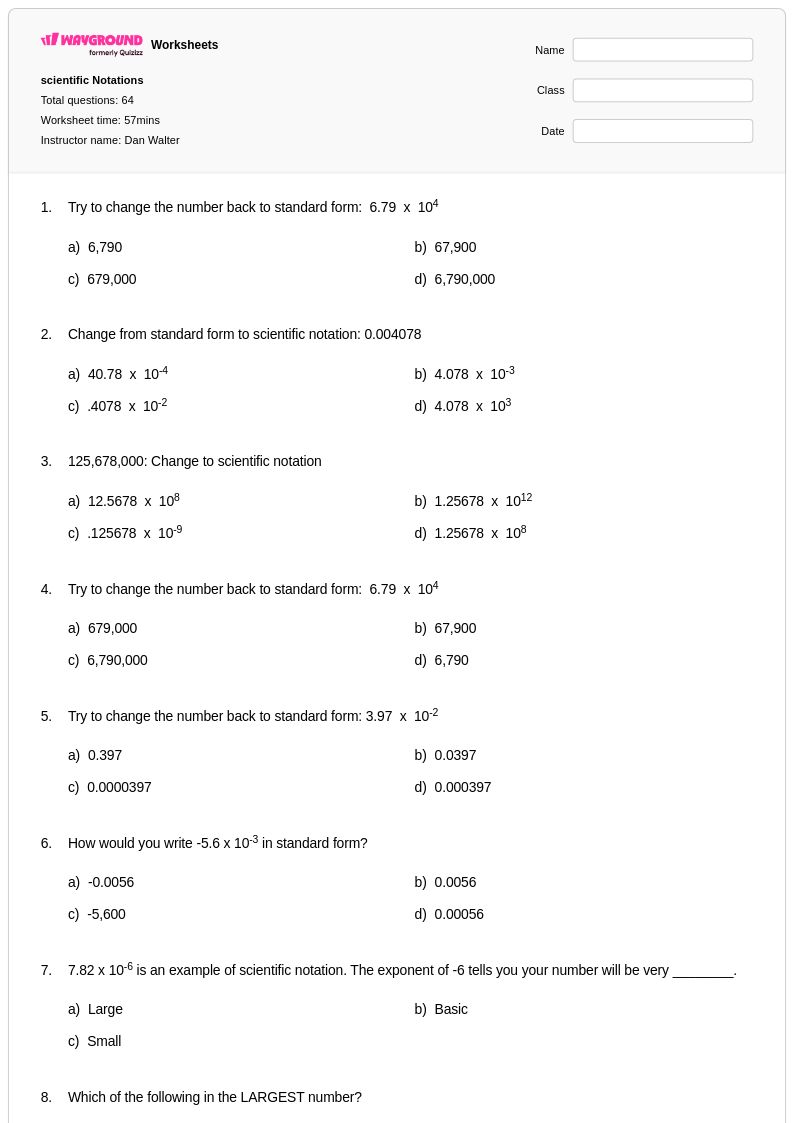
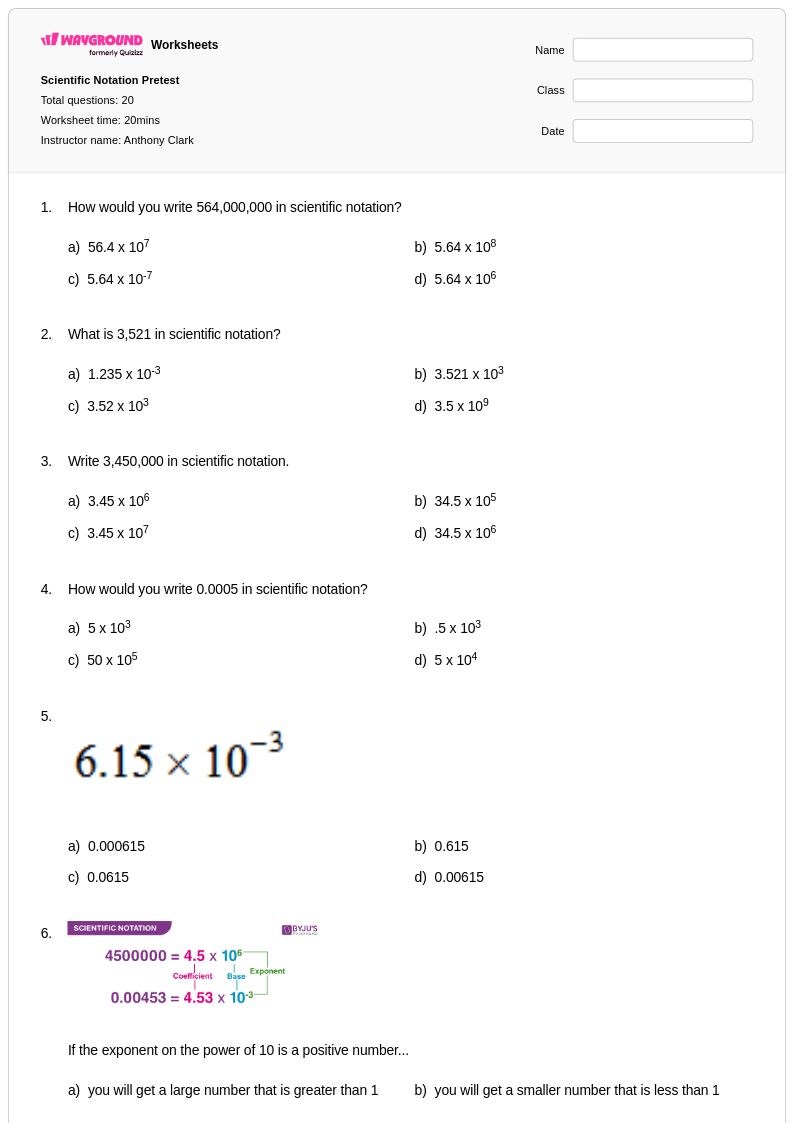
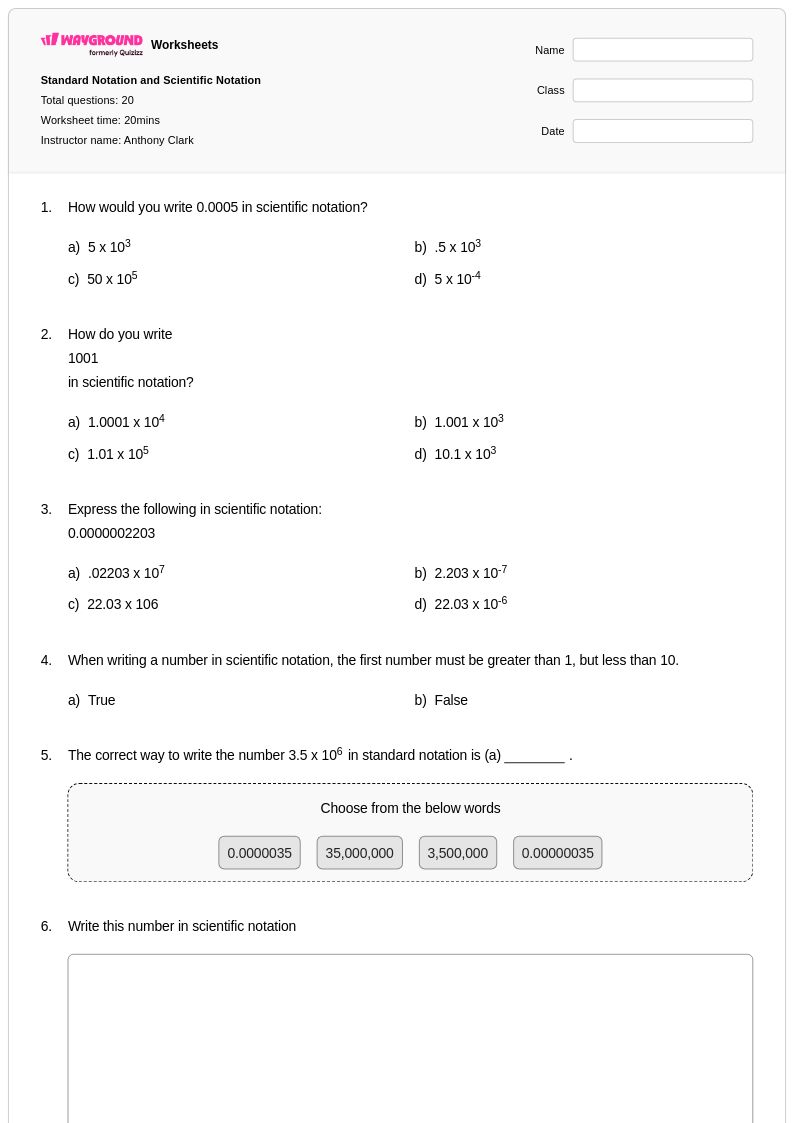
Effective practice moves from basic conversions to application. These worksheets provide exercises for converting numbers between standard and scientific notation, comparing the magnitude of numbers, and performing all four arithmetic operations (addition, subtraction, multiplication, division) with numbers in scientific notation.
What are common student mistakes with scientific notation?
Students often confuse the sign of the exponent, using a negative exponent for a large number or vice versa. When multiplying, they may multiply the exponents instead of adding them. For addition and subtraction, a frequent error is failing to adjust the exponents to be the same before performing the operation on the coefficients.
How can I use this scientific notation worksheet in my class?
This worksheet can be assigned as a printable PDF for hands-on practice or as an interactive digital quiz on the Wayground platform. The printable version allows for offline work, and you can grade submissions quickly using the Wayground for Teachers mobile app. Every worksheet, in either format, includes a complete answer key for efficient grading or student self-assessment.
How does scientific notation fit into the math curriculum?
Aligned with Common Core standards, scientific notation builds directly on students' understanding of exponents and powers of 10, typically introduced in middle school. It serves as a critical bridge to high school science and math, where students must model and interpret data from real-world contexts, such as astronomy or microbiology.
How can I differentiate this topic for diverse learners?
For students needing support, use Wayground's digital accommodation features like Read Aloud for word problems or reduced answer choices to lower cognitive load. For enrichment, challenge students to find real-world data (e.g., a planet's mass, a virus's diameter) and convert it into scientific notation, then create their own comparison problems.