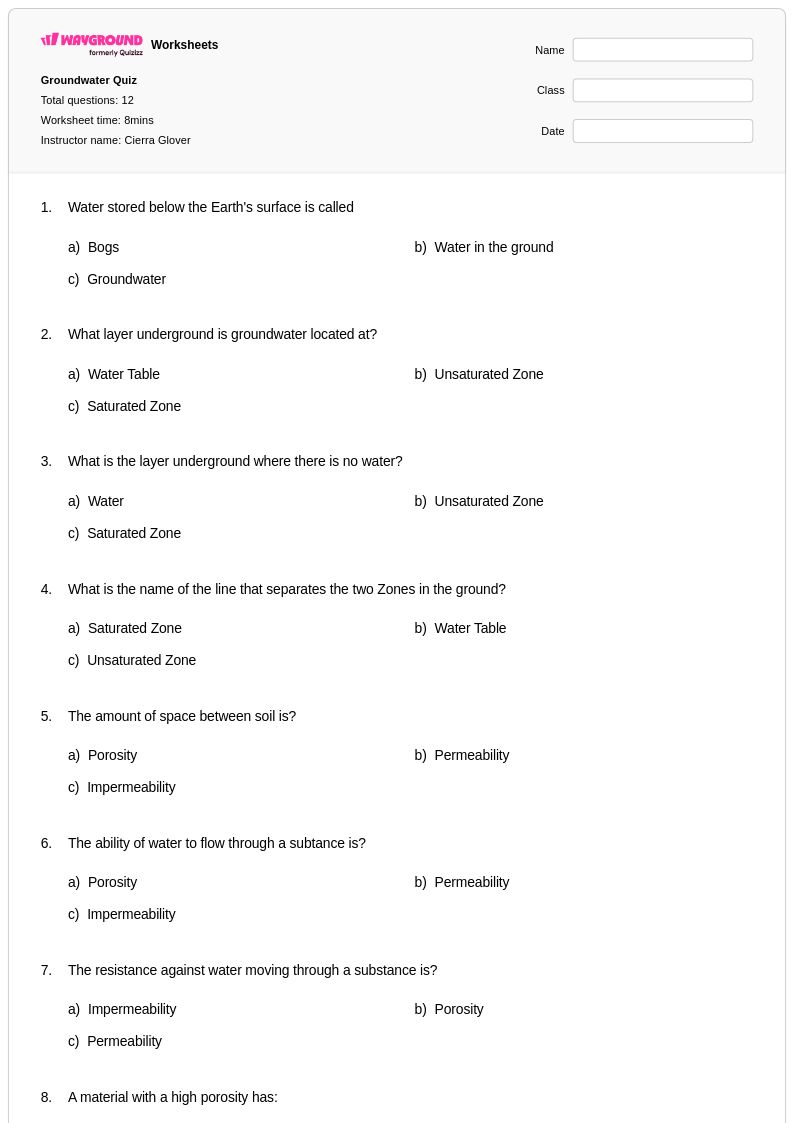
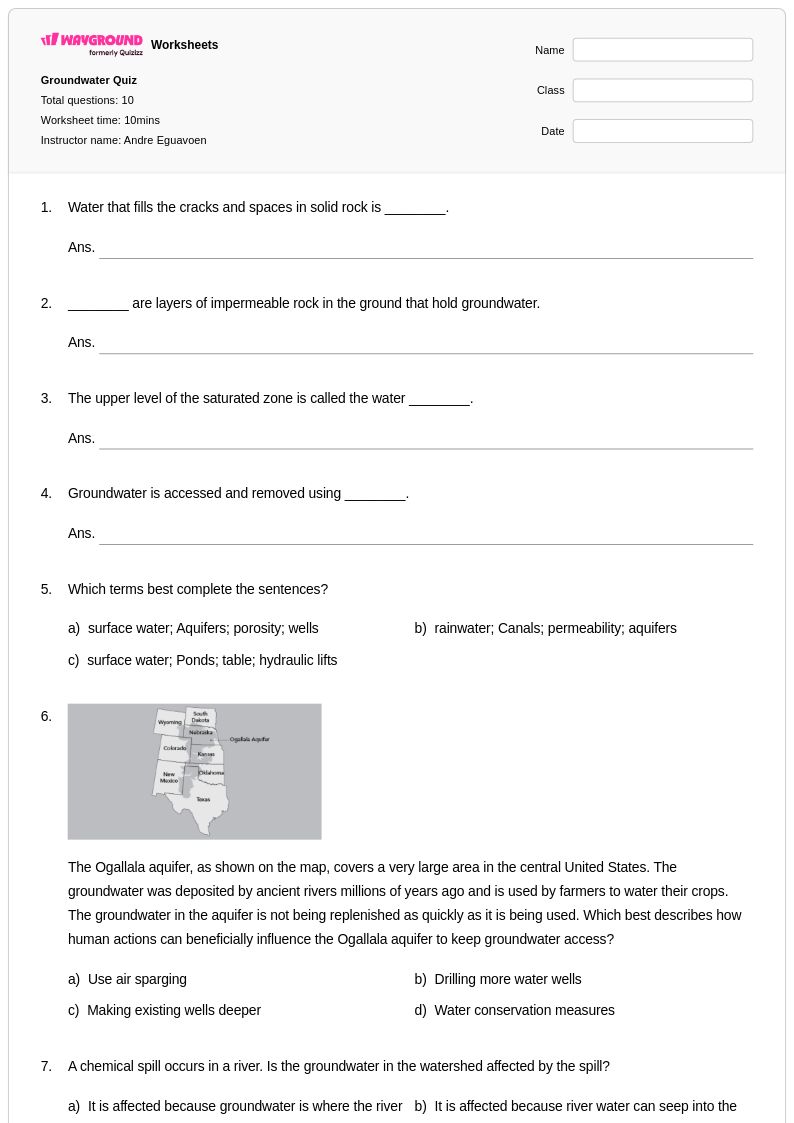
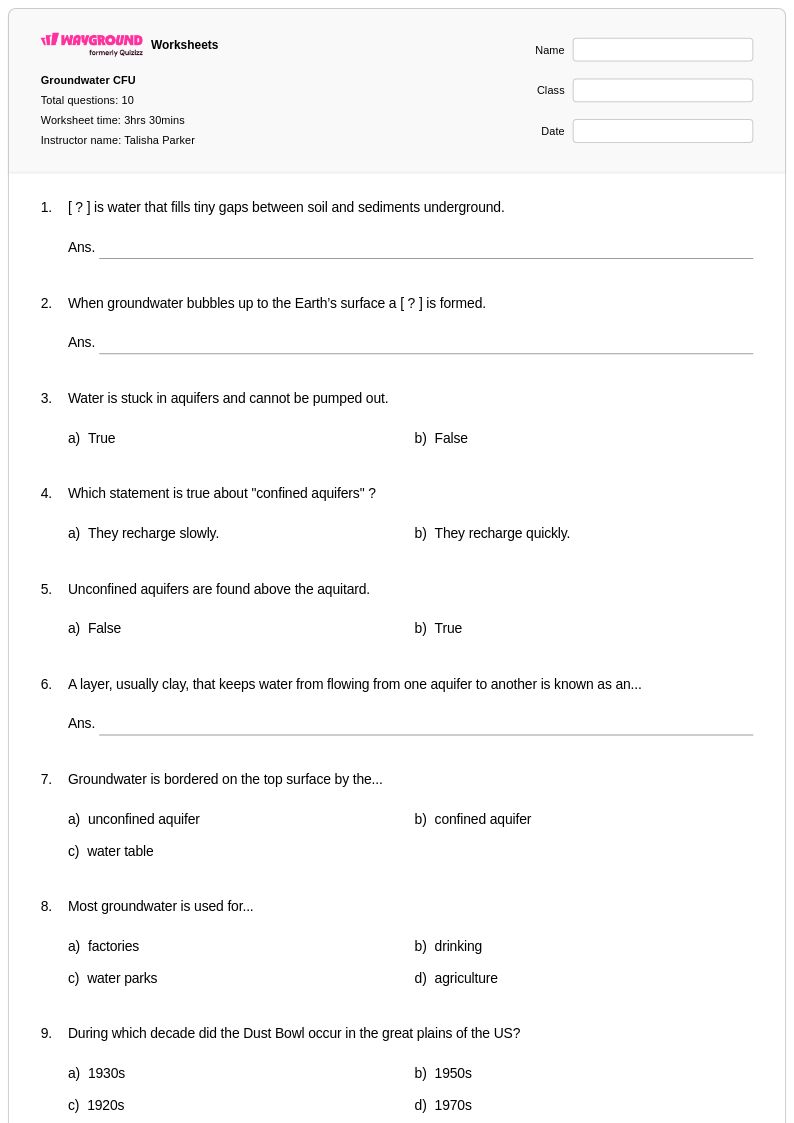
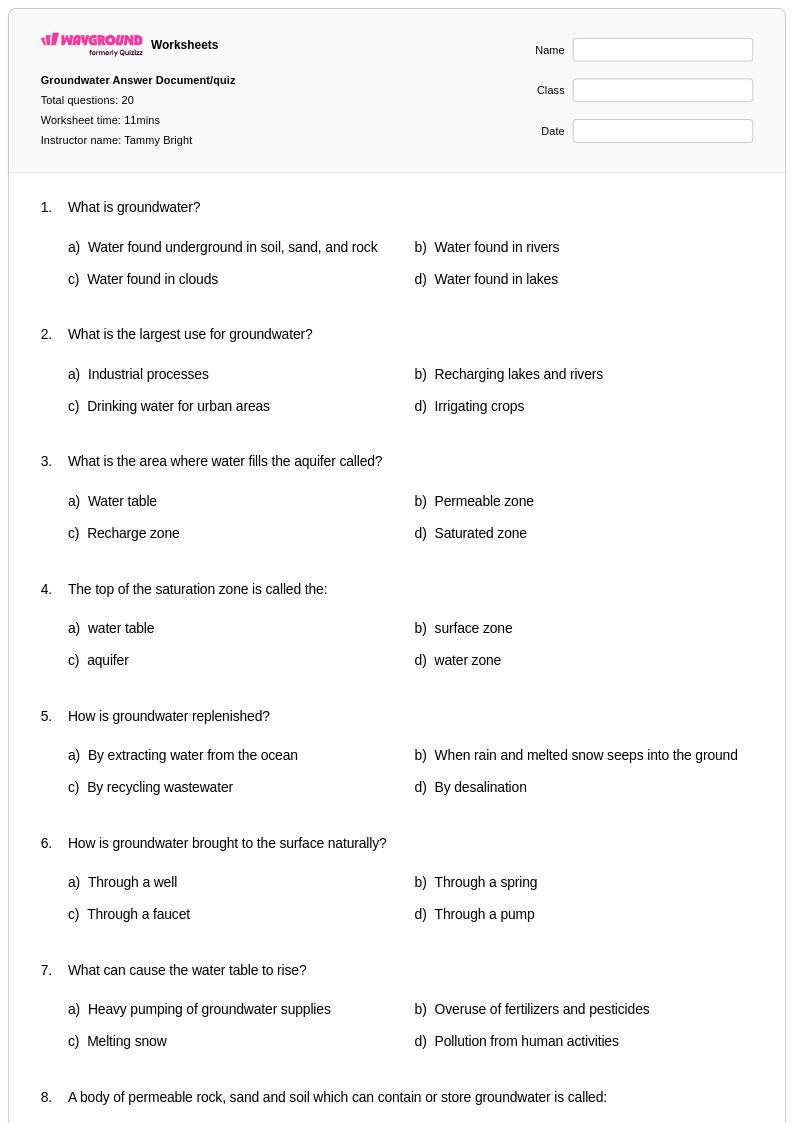
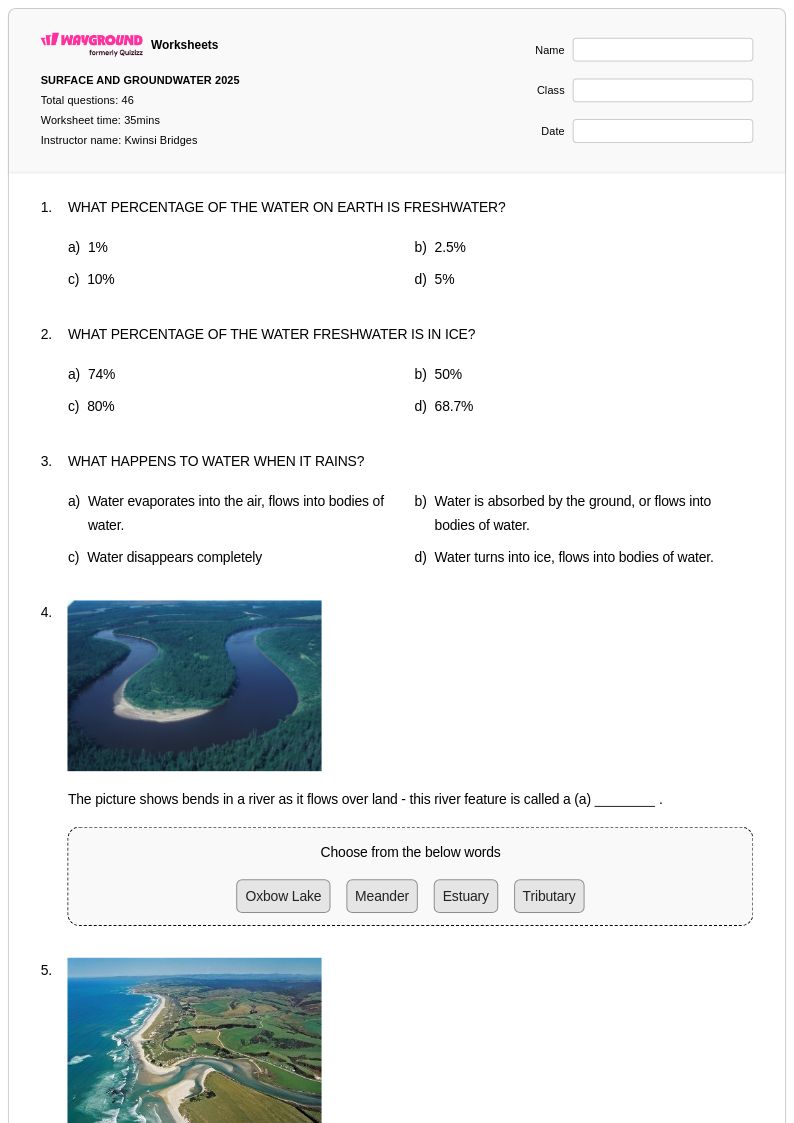
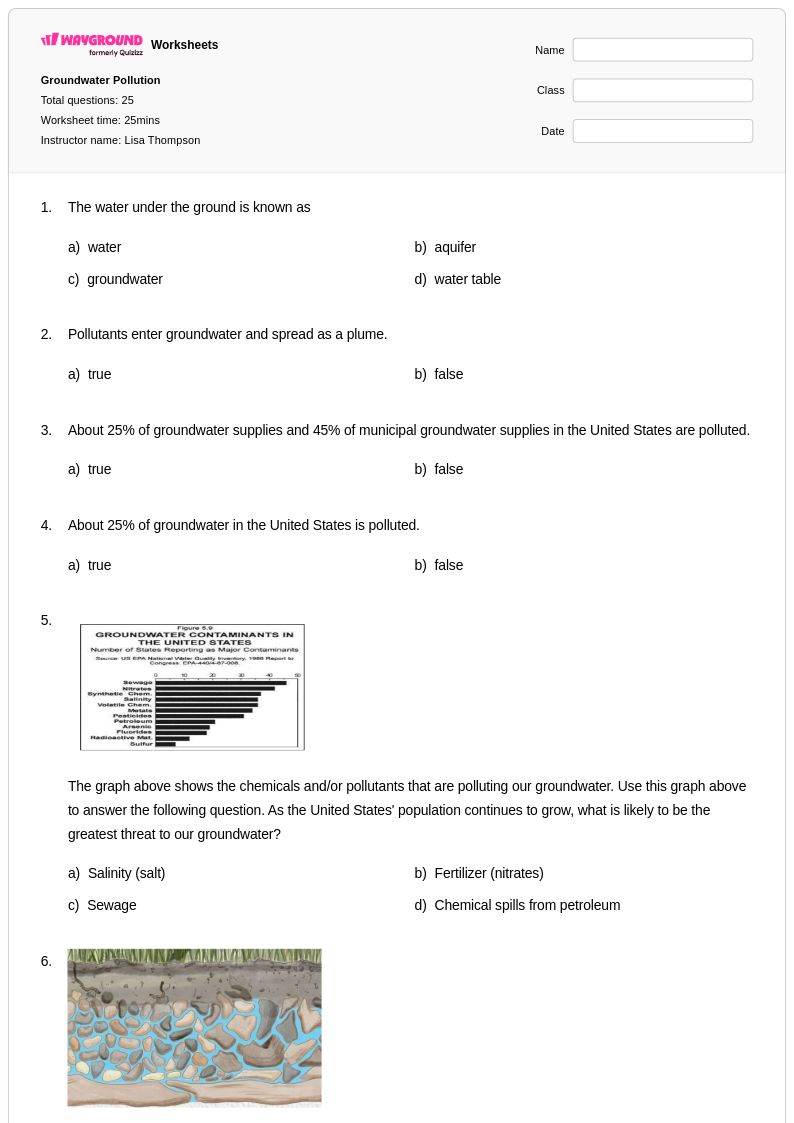
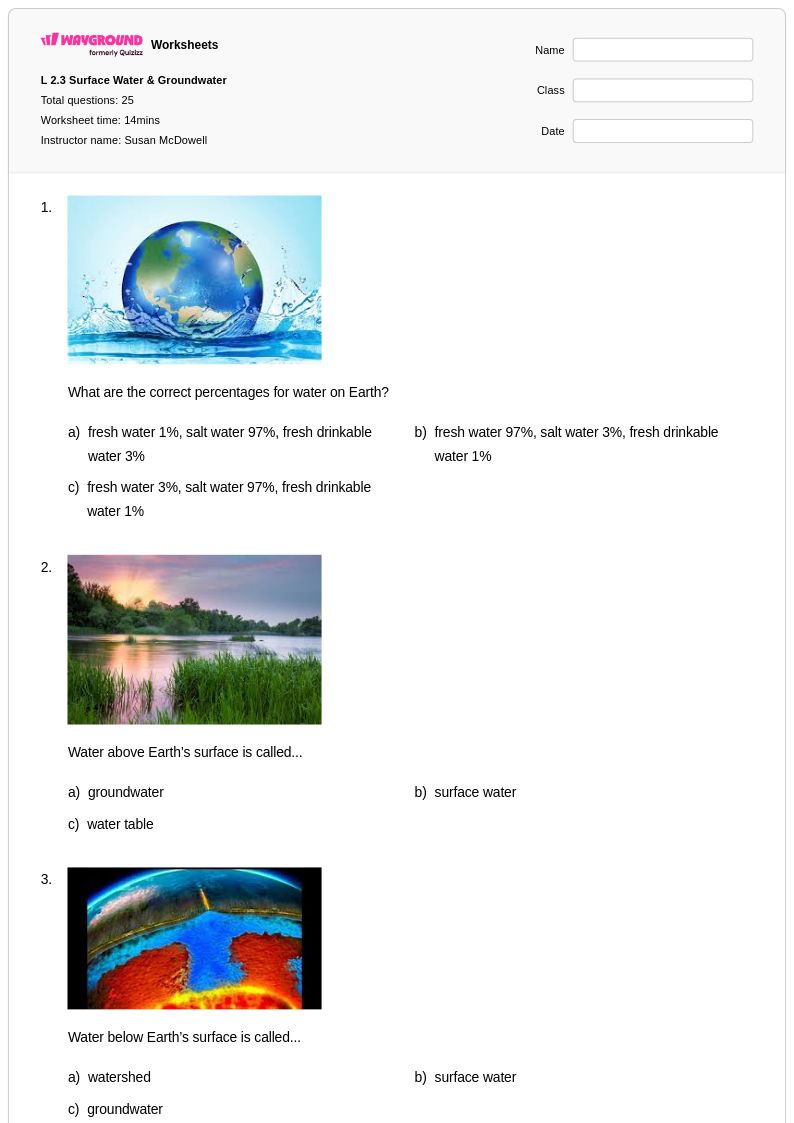
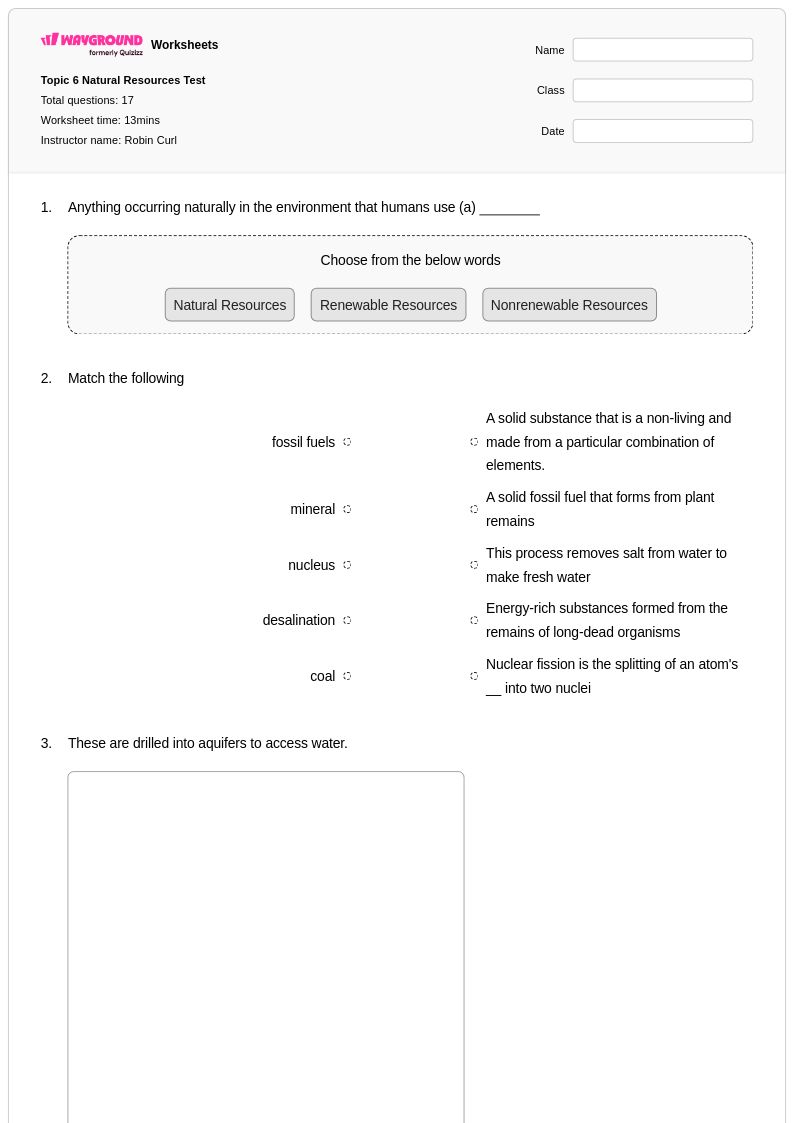
Explore Wayground's comprehensive collection of free groundwater worksheets and printables that help students understand aquifers, water tables, and underground water systems through engaging practice problems with answer keys.
Groundwater worksheets available through Wayground (formerly Quizizz) provide comprehensive educational resources that help students understand the critical concepts of subsurface water systems, aquifers, and water table dynamics. These expertly designed materials strengthen essential skills including analyzing groundwater flow patterns, interpreting well data, understanding porosity and permeability relationships, and evaluating human impacts on groundwater quality and availability. Students engage with practice problems that explore topics such as cone of depression formation, groundwater contamination scenarios, and the hydrologic cycle's underground components. Each worksheet collection includes detailed answer keys and is available as free printables in convenient pdf format, allowing educators to seamlessly integrate groundwater concepts into their Earth and space science curriculum while providing students with hands-on learning opportunities to master these fundamental hydrogeological principles.
Wayground (formerly Quizizz) supports science educators with an extensive collection of millions of teacher-created groundwater resources that can be easily accessed through powerful search and filtering capabilities. The platform's standards-aligned materials enable teachers to differentiate instruction effectively, offering flexible customization options that accommodate diverse learning needs and skill levels. These comprehensive worksheet collections are available in both printable and digital formats, including downloadable pdf versions, making them ideal for various teaching environments and learning preferences. Teachers can efficiently plan lessons, provide targeted remediation for struggling students, offer enrichment activities for advanced learners, and deliver consistent skill practice opportunities that reinforce understanding of groundwater systems, aquifer characteristics, and water resource management concepts throughout their Earth and space science instruction.
FAQs
How do I teach groundwater concepts to middle and high school students?
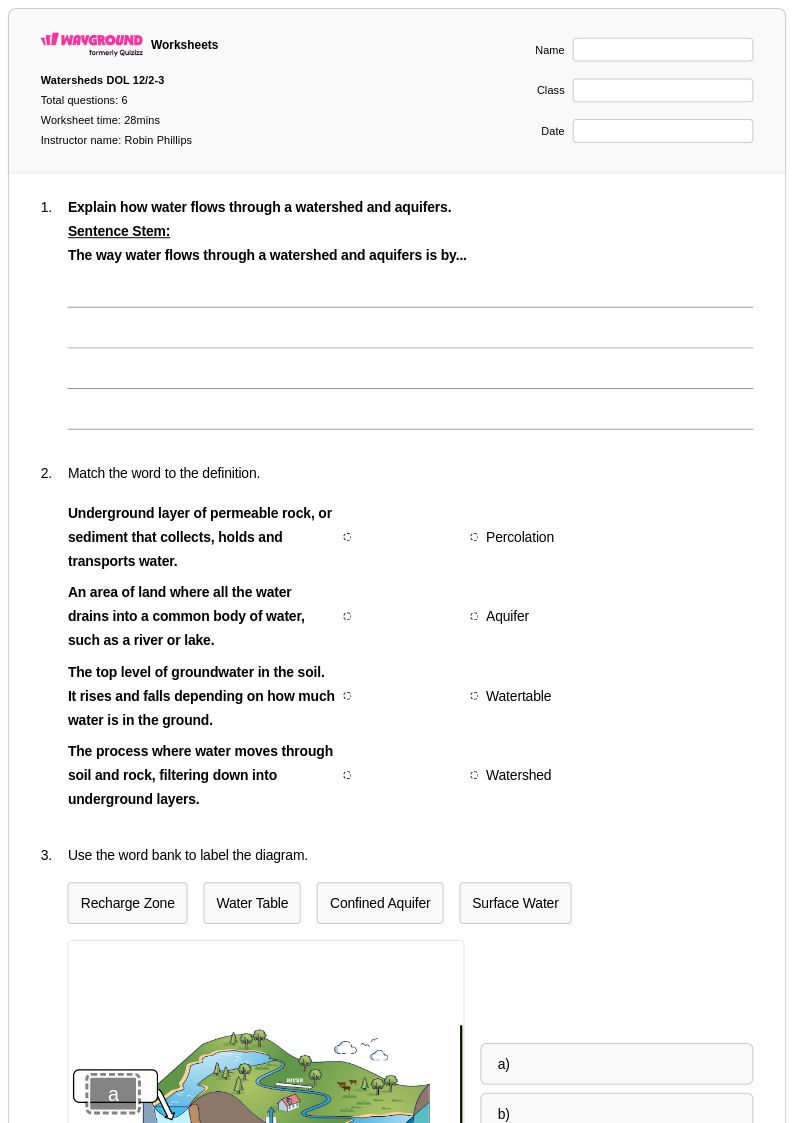
Effective groundwater instruction begins with building a concrete understanding of porosity and permeability before introducing aquifer structure and water table dynamics. Using diagrams of cross-sectional soil and rock layers helps students visualize how water moves underground and accumulates in saturated zones. Connecting groundwater to the broader hydrologic cycle gives students a framework for understanding recharge, discharge, and the relationship between surface water and subsurface systems. Introducing real-world scenarios such as groundwater contamination or cone of depression formation deepens engagement and reinforces applied reasoning skills.
What practice exercises help students understand aquifers and water tables?
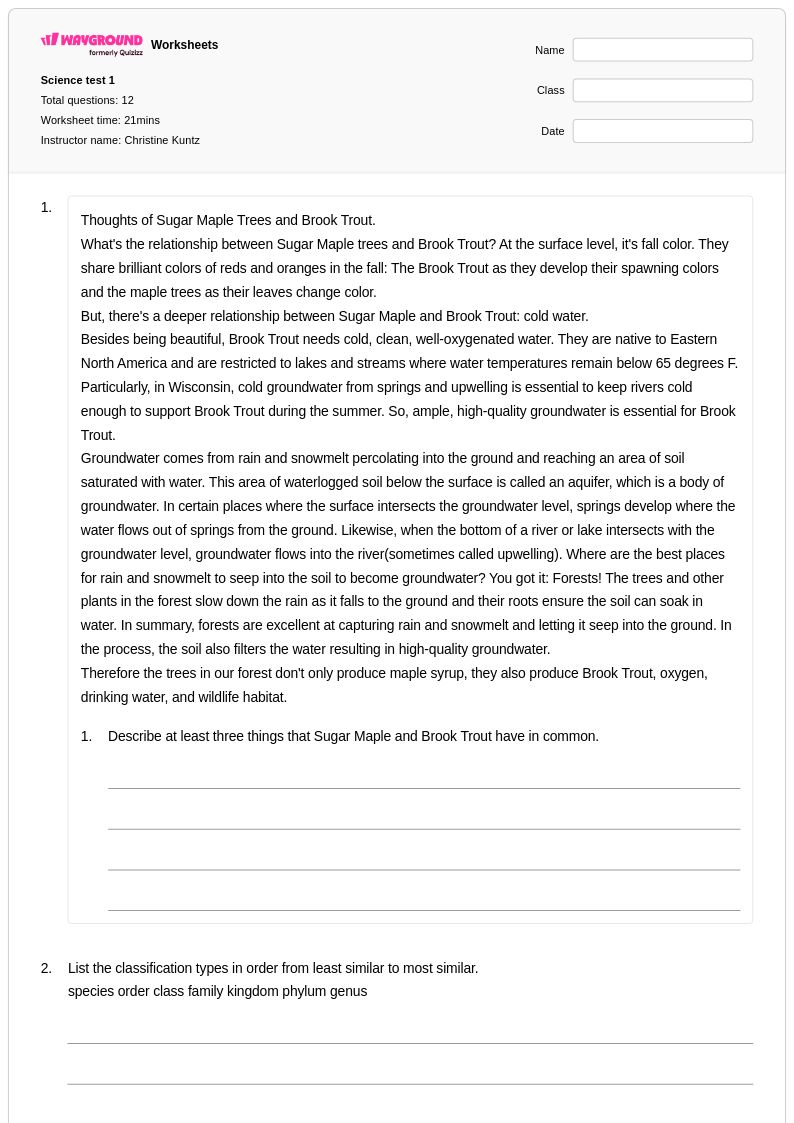
Students benefit most from exercises that require them to interpret well data, analyze groundwater flow diagrams, and calculate changes in the water table under different conditions. Practice problems involving cone of depression formation and contamination plume scenarios build applied skills that go beyond memorization. Porosity and permeability comparison activities, where students rank or evaluate different sediment or rock types, also reinforce foundational hydrogeological reasoning. Worksheets that incorporate the hydrologic cycle's underground components help students connect groundwater processes to the broader Earth science curriculum.
What mistakes do students commonly make when learning about groundwater?
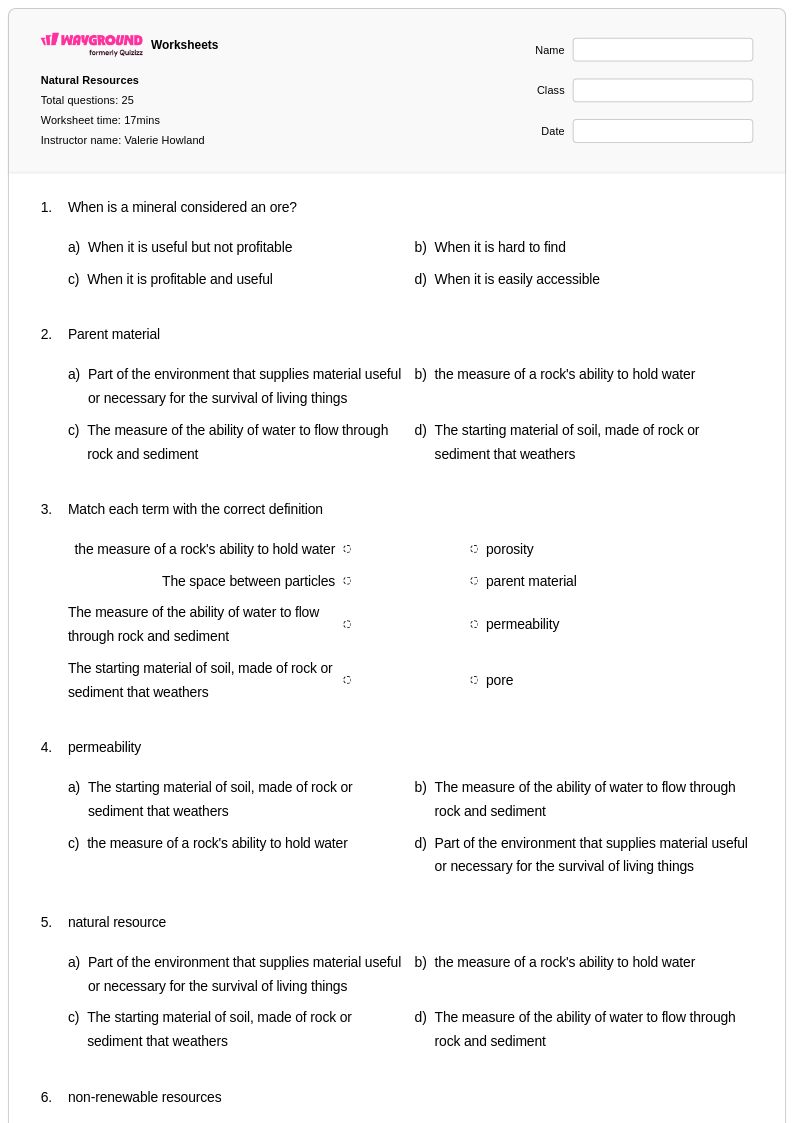
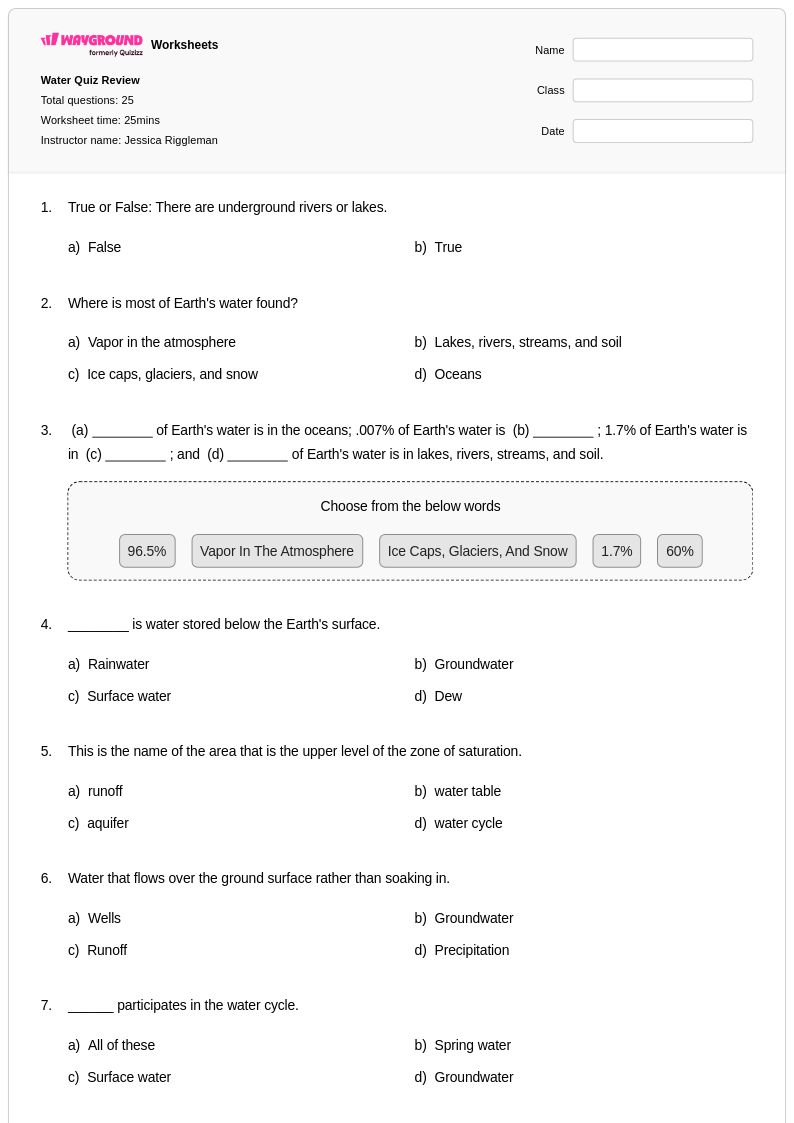
One of the most persistent misconceptions is that groundwater exists in underground rivers or large open caverns rather than in the pore spaces of rock and sediment. Students also frequently confuse porosity and permeability, not recognizing that a material can be highly porous yet have low permeability. Another common error is misidentifying the water table as a fixed boundary rather than a dynamic surface that rises and falls with recharge and withdrawal. When analyzing contamination scenarios, students often overlook the direction of groundwater flow, leading to incorrect predictions about where pollutants will travel.
How can I use Wayground's groundwater worksheets in my classroom?
Wayground's groundwater worksheets are available as free printable PDFs for traditional classroom use and in digital formats for technology-integrated or hybrid learning environments, including the option to host them as a quiz directly on Wayground. Teachers can use them for direct instruction support, independent practice, homework, or targeted remediation for students who need additional reinforcement of aquifer and water table concepts. The included answer keys make grading efficient and allow students to self-check their work during review sessions.
How do I help students understand human impacts on groundwater quality and availability?
Start by grounding students in how contamination enters the groundwater system, whether through agricultural runoff, industrial discharge, or improper waste disposal, before asking them to analyze specific scenarios. Case studies and data interpretation exercises that show how pollutants move through permeable materials toward wells make the concept tangible. Pairing contamination scenarios with discussions of water resource management, including groundwater overdraft and aquifer depletion, helps students connect environmental science to real policy and community decisions. Structured practice problems that ask students to evaluate risk or propose remediation strategies build higher-order thinking alongside content knowledge.
How can I differentiate groundwater instruction for students at different skill levels?
For students who need additional support, simplifying diagrams, reducing the number of variables in a problem, or providing sentence frames for written analysis can lower the barrier to entry without reducing conceptual rigor. Advanced learners benefit from open-ended data interpretation tasks, such as analyzing real well-log data or evaluating multiple contamination pathways in a complex scenario. On Wayground, teachers can apply individual accommodations including reduced answer choices, extended time, and read-aloud support to specific students, while the rest of the class receives default settings, allowing differentiation to happen quietly and efficiently within the same assignment.