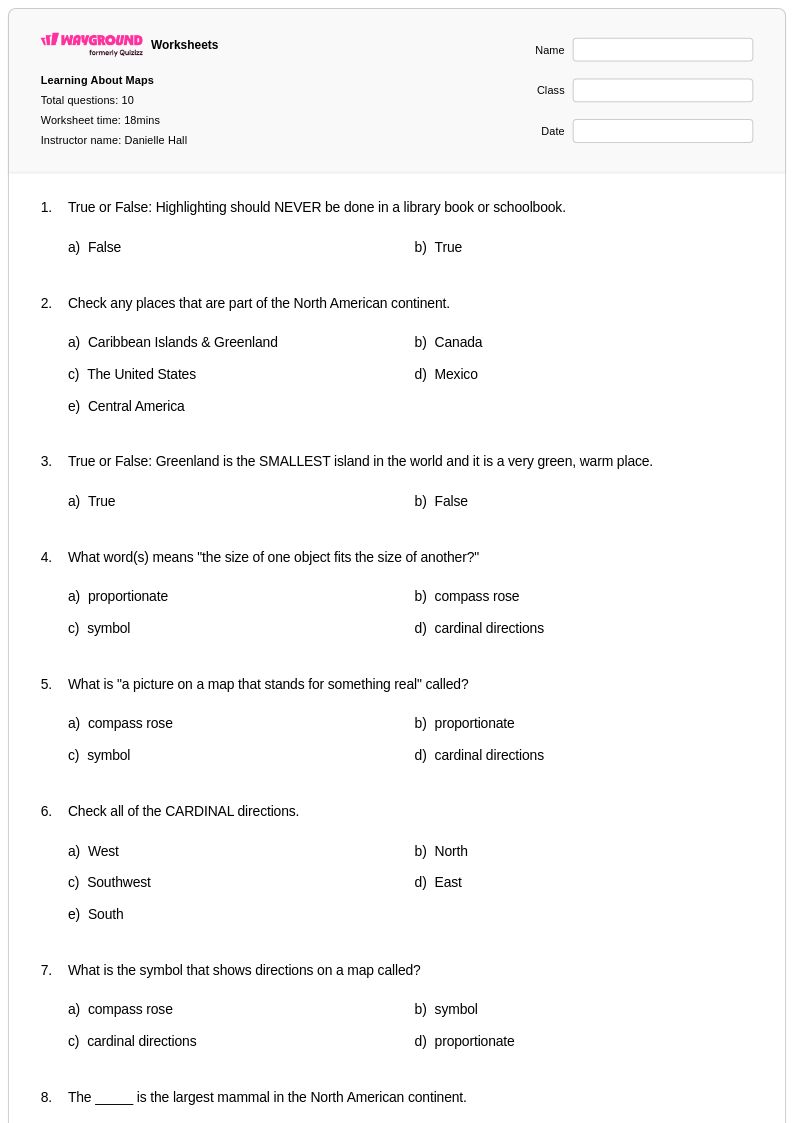
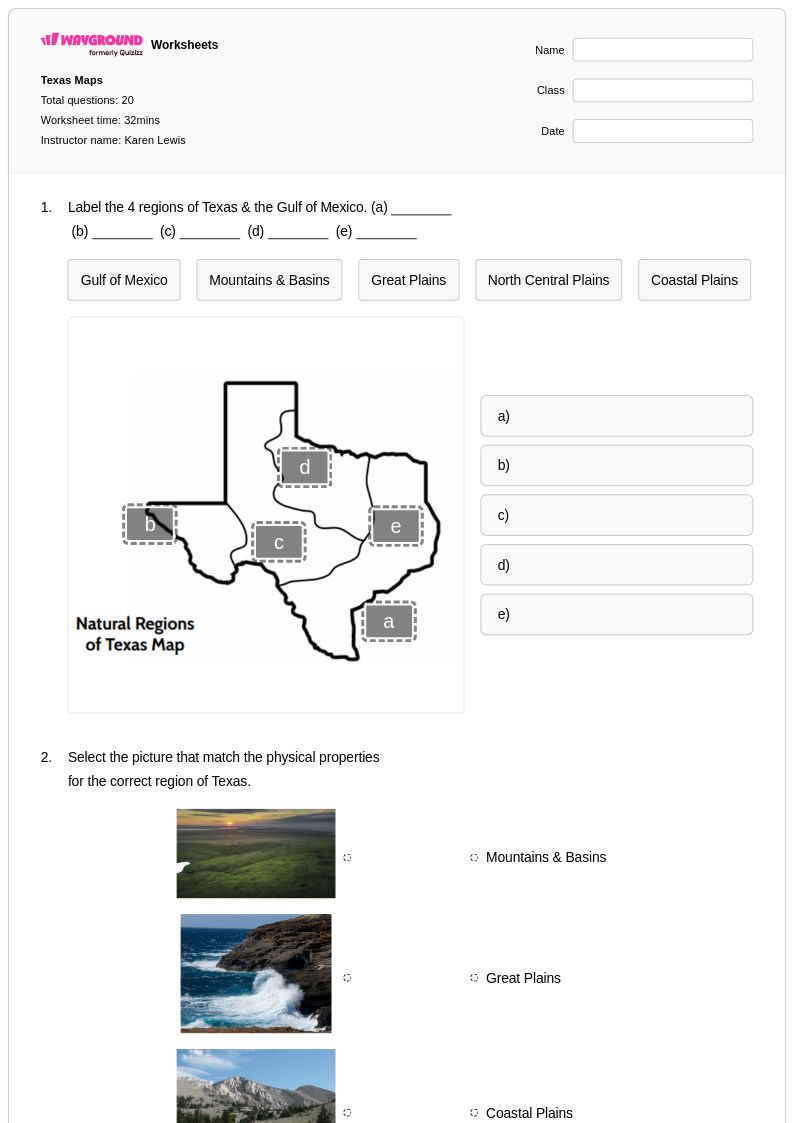
Discover free map scaling worksheets and printables from Wayground that help students master distance measurements, scale ratios, and geographic calculations through engaging practice problems with complete answer keys.
Map scaling worksheets available through Wayground (formerly Quizizz) provide students with essential practice in understanding and applying scale relationships on maps, a fundamental skill in geographic literacy. These comprehensive worksheets guide learners through interpreting scale bars, calculating actual distances using map scales, and converting between different scale representations such as verbal, graphic, and representative fraction scales. Students work through practice problems that strengthen their ability to measure distances accurately, determine real-world measurements from scaled representations, and understand the relationship between map size and the area it represents. Each worksheet includes detailed answer keys and explanations, making them valuable resources for both independent study and classroom instruction, with free printable pdf formats ensuring accessibility for all educational settings.
Wayground (formerly Quizizz) supports educators with an extensive collection of teacher-created map scaling resources, drawing from millions of worksheets and activities developed by geography educators worldwide. The platform's robust search and filtering capabilities allow teachers to quickly locate materials that align with specific curriculum standards and match their students' skill levels, while built-in differentiation tools enable customization for diverse learning needs. Teachers can access these resources in both printable pdf formats for traditional classroom use and digital formats for interactive learning experiences, providing flexibility for various instructional approaches. This comprehensive collection supports effective lesson planning by offering ready-made materials for skill practice, targeted remediation for students struggling with scale concepts, and enrichment activities for advanced learners, streamlining the process of finding high-quality geographic education resources.
FAQs
How do I teach map scaling to students?
Start by introducing the three types of map scales: verbal scales (e.g., '1 inch = 10 miles'), graphic or bar scales, and representative fraction scales (e.g., 1:50,000). Use a familiar local map so students can anchor abstract scale concepts to real places they recognize. Progress from reading pre-labeled scales to having students calculate actual distances using a ruler and scale ratio. Concrete, hands-on measurement practice before abstract calculation significantly improves conceptual retention.
What exercises help students practice map scaling?
Effective practice exercises include measuring map distances with a ruler and converting them to real-world distances using a given scale, converting between verbal, graphic, and representative fraction scale formats, and working through multi-step problems that require students to determine the area or distance between two points. Worksheets that present all three scale types in a single problem set help students build fluency across formats rather than mastering only one representation.
What mistakes do students commonly make when working with map scales?
The most common error is unit confusion: students often forget to convert units consistently, such as applying a miles-based scale to a measurement taken in centimeters. A second frequent mistake is misreading bar scales by treating the entire graphic bar as one unit rather than reading the labeled increments correctly. Students also commonly invert the representative fraction, dividing map distance by actual distance instead of the reverse. Targeted practice problems that isolate each of these error types help students self-correct before the mistakes become habitual.
How do I differentiate map scaling instruction for students at different skill levels?
For students who are still building foundational skills, start with single-step problems using verbal scales before introducing graphic or representative fraction scales. More advanced learners can tackle multi-step problems that combine scale conversion with area calculation or route planning. On Wayground, teachers can apply accommodations such as reduced answer choices for students who need lower cognitive load, read-aloud support for those with reading challenges, and extended time settings for students who need additional processing time, all configurable per individual student without disrupting the rest of the class.
How can I use Wayground's map scaling worksheets in my classroom?
Wayground's map scaling worksheets are available as printable PDFs for traditional classroom use and in digital formats for technology-integrated learning environments, giving teachers flexibility depending on their instructional setup. Teachers can also host worksheets directly as a quiz on Wayground, allowing students to complete them interactively while the platform automatically grades responses using the included answer keys. This makes the worksheets equally effective for in-class practice, homework, or low-stakes formative assessment.
What is the difference between a verbal scale, a graphic scale, and a representative fraction on a map?
A verbal scale expresses the relationship between map distance and real-world distance in plain language, such as '1 centimeter equals 5 kilometers.' A graphic or bar scale shows this relationship visually as a labeled line or bar on the map itself, which remains accurate even if the map is resized. A representative fraction (RF) expresses the ratio numerically, such as 1:500,000, meaning one unit on the map equals 500,000 of the same units in reality. Students need to be comfortable working with all three formats because maps in textbooks, atlases, and digital tools use each one.