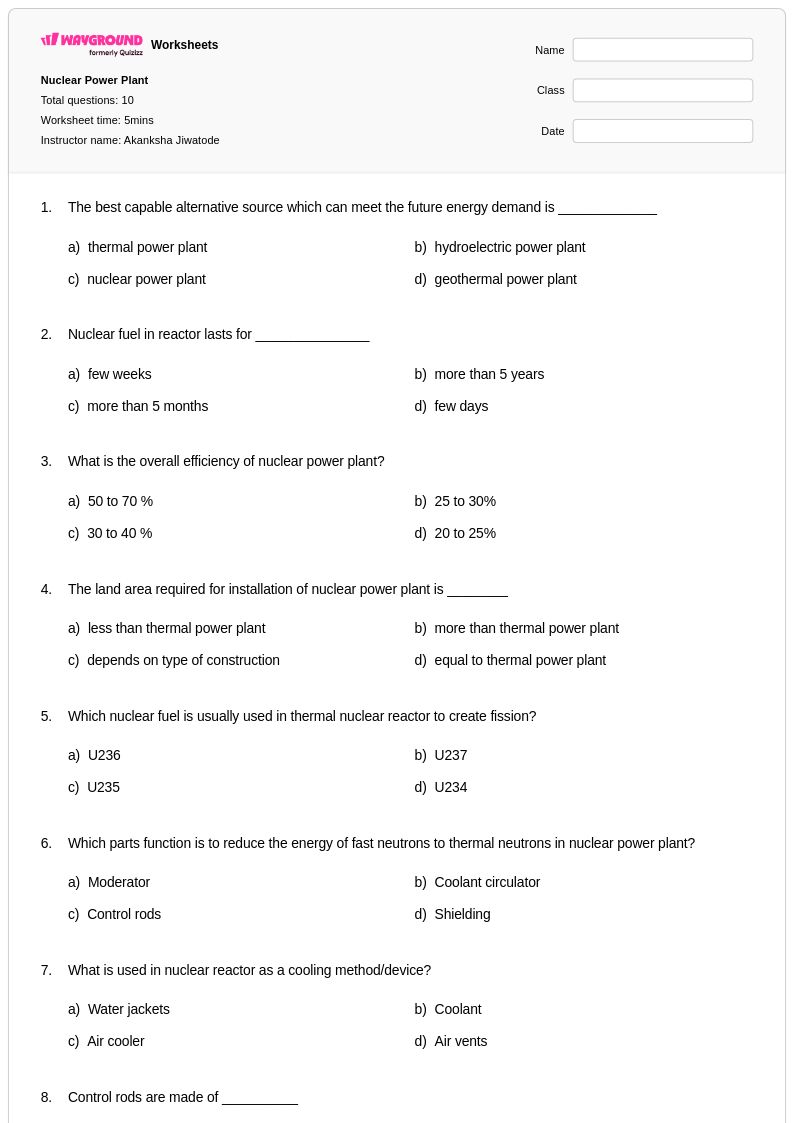
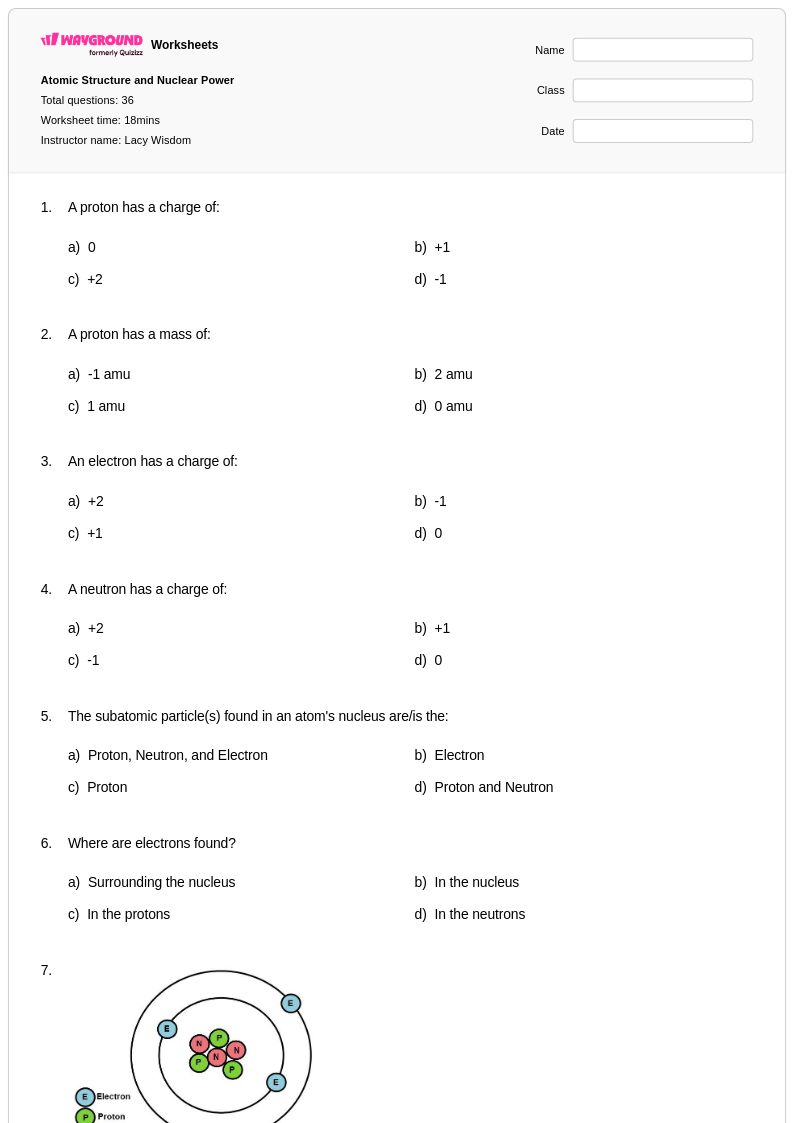
Explore Wayground's comprehensive collection of nuclear power worksheets featuring free printables and practice problems that help students understand atomic energy, reactor design, and radiation safety with detailed answer keys included.
Nuclear power worksheets available through Wayground (formerly Quizizz) provide comprehensive educational resources that explore the fundamental principles of atomic energy, reactor design, and the role of nuclear technology in modern energy production. These expertly crafted materials strengthen students' understanding of nuclear fission and fusion processes, radioactive decay, critical mass calculations, and safety protocols essential to nuclear facility operations. The collection includes detailed practice problems covering uranium enrichment, control rod mechanisms, coolant systems, and radiation shielding calculations, while accompanying answer keys enable students to verify their understanding of complex nuclear physics concepts. Free printable resources and pdf formats make these materials accessible for classroom instruction, homework assignments, and independent study sessions focused on this critical energy technology.
Wayground (formerly Quizizz) supports educators with an extensive library of millions of teacher-created nuclear power resources that streamline lesson planning and enhance student comprehension of atomic energy principles. The platform's robust search and filtering capabilities allow teachers to quickly locate materials aligned with specific physics standards and learning objectives, while differentiation tools enable customization for students with varying skill levels and academic needs. These flexible worksheet collections are available in both printable and digital formats, including downloadable pdf versions, making them ideal for remediation work with struggling students, enrichment activities for advanced learners, and regular skill practice sessions. Teachers can easily modify existing materials or create original assessments that address specific aspects of nuclear technology, from basic atomic structure to advanced reactor engineering concepts.
FAQs
How do I teach nuclear power to students who have no background in atomic physics?
Start with atomic structure and the concept of nuclear binding energy before introducing fission and fusion. Use diagrams of reactor components to make abstract processes concrete, and ground the material in real-world applications like electricity generation and medical imaging. Building from the atom outward gives students a logical scaffold before they encounter more complex topics like radioactive decay and critical mass.
What types of practice problems help students understand nuclear fission and reactor design?
Effective practice problems for nuclear fission cover half-life calculations, radioactive decay chains, uranium enrichment ratios, and energy output from fission reactions. For reactor design, problems that walk students through control rod function, coolant system behavior, and radiation shielding calculations reinforce how each component contributes to safe and stable power generation. Working through these problems systematically helps students connect theoretical physics to engineering application.
What misconceptions do students commonly have about nuclear power?
One of the most persistent misconceptions is that nuclear power plants can explode like a nuclear bomb — students often conflate reactor-grade uranium enrichment with weapons-grade material. Another common error is confusing nuclear fission with nuclear fusion, including which process is currently used in commercial power plants. Students also tend to underestimate the multi-layered safety systems in reactor design, often assuming a single failure leads to catastrophic meltdown.
How do I use nuclear power worksheets to support students at different skill levels?
For foundational learners, start with worksheets focused on atomic structure, basic radioactive decay, and vocabulary-building around nuclear terminology. Advanced students benefit from problems involving critical mass calculations, neutron moderation, and comparative analysis of reactor types. On Wayground, teachers can apply accommodations such as reduced answer choices or read-aloud support for individual students, allowing the same worksheet set to serve a differentiated classroom without requiring separate materials for each tier.
How can I use Wayground's nuclear power worksheets in my classroom?
Wayground's nuclear power worksheets are available as printable PDFs for traditional classroom use and in digital formats for technology-integrated environments, making them suitable for in-class instruction, homework, and independent study. Teachers can also host worksheets as a quiz directly on Wayground, enabling real-time student responses and built-in answer key verification. This flexibility makes them practical for both introductory lessons and targeted review sessions on specific topics like radiation safety or reactor design.
How should I sequence a nuclear power unit to build student understanding progressively?
A well-structured nuclear power unit typically begins with atomic structure and isotopes, then moves into nuclear forces and radioactive decay before introducing fission and chain reactions. Reactor design and safety systems come next, providing the engineering context for the physics students have already learned. Closing the unit with a discussion of nuclear power's role in energy policy and radiation safety protocols connects the science to real-world decision-making.