Free Printable Particle Model Worksheets for Year 10
Year 10 Physics particle model worksheets from Wayground help students master atomic theory and molecular behavior through comprehensive printables, practice problems, and answer keys in convenient PDF format.
Explore printable Particle Model worksheets for Year 10
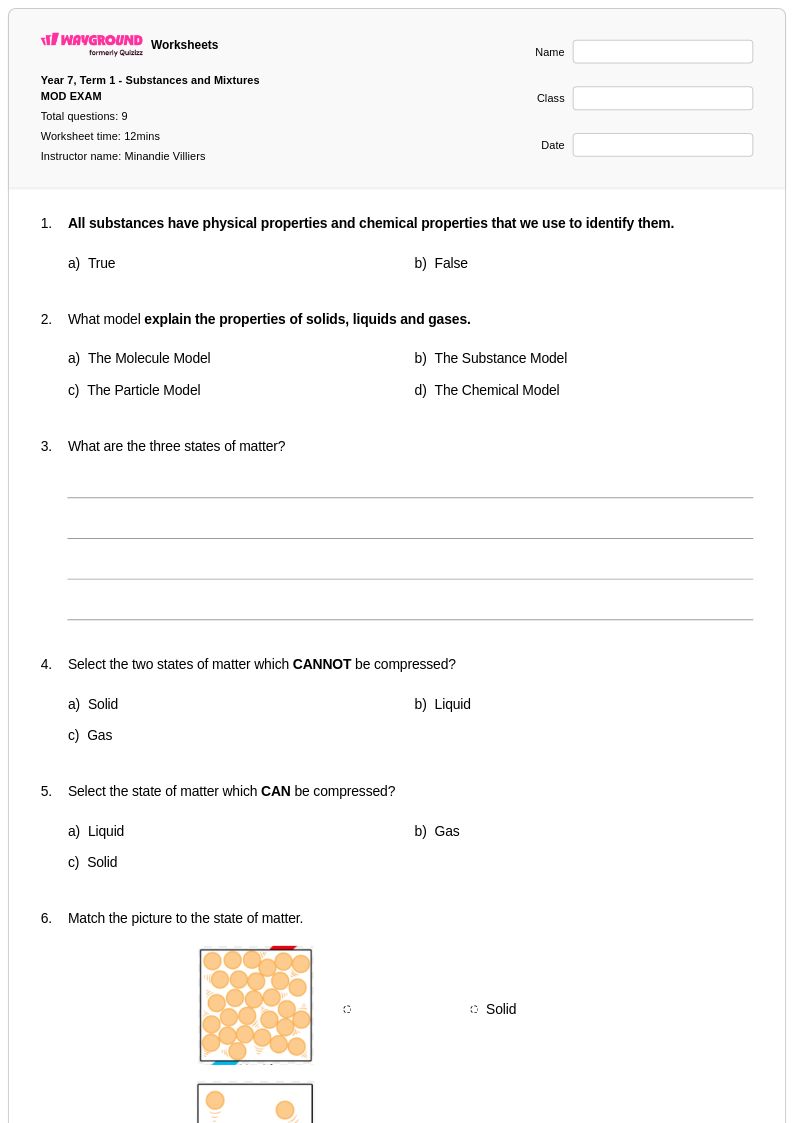
Year 10 particle model worksheets available through Wayground (formerly Quizizz) provide comprehensive coverage of the fundamental concepts that explain matter's behavior at the atomic and molecular level. These expertly designed resources strengthen students' understanding of kinetic theory, molecular motion, and the relationship between temperature and particle energy across solid, liquid, and gas phases. The worksheet collection includes detailed practice problems that challenge students to apply particle model principles to real-world scenarios, analyze phase changes, and interpret particle diagrams. Each resource comes with a complete answer key to support independent learning and self-assessment, while the free printable format ensures accessibility for all classroom environments and study situations.
Wayground (formerly Quizizz) empowers educators with millions of teacher-created particle model resources that streamline lesson planning and enhance student engagement in Year 10 physics instruction. The platform's robust search and filtering capabilities allow teachers to quickly locate worksheets aligned with specific curriculum standards and learning objectives, while built-in differentiation tools enable seamless adaptation of content for diverse learning needs. Teachers can customize these digital and printable pdf resources to target particular aspects of particle theory, whether for initial skill development, targeted remediation of misconceptions, or enrichment activities for advanced learners. The flexible format options support both traditional classroom instruction and modern blended learning environments, ensuring that particle model concepts are reinforced through consistent, high-quality practice opportunities that build scientific reasoning and analytical thinking skills.
FAQs
How do I teach the particle model of matter to my students?
Teaching the particle model effectively starts with building students' ability to visualize what they cannot see. Use diagrams and particle arrangement cards to help students compare how particles are packed, spaced, and moving in solids, liquids, and gases. From there, connect those arrangements to observable properties like compressibility and flow, so students understand the particle model as an explanatory framework rather than an abstract concept.
What exercises help students practice the particle model?
Effective practice exercises for the particle model include drawing and labeling particle diagrams for different states of matter, predicting how particle behavior changes during heating or cooling, and applying the model to explain real-world phenomena like diffusion or pressure. Worksheets that ask students to match macroscopic observations to particle-level explanations are particularly useful for reinforcing conceptual understanding.
What common mistakes do students make when learning the particle model?
One of the most frequent misconceptions is that particles themselves expand when a substance is heated, rather than understanding that the particles move faster and spread further apart. Students also commonly confuse the properties of the substance with the properties of its particles, for example, thinking that particles in a liquid are liquid themselves. Targeted practice problems that require students to distinguish between particle-level and bulk-level descriptions can help correct these errors.
How can I use particle model worksheets to support students with different learning needs?
Wayground's particle model worksheets are available in both printable PDF and digital formats, making them accessible across a range of classroom setups. In digital mode, teachers can apply accommodations to individual students, including read-aloud support for students who struggle with text-heavy questions, reduced answer choices to lower cognitive load, and extended time settings for those who need it. These accommodations are saved per student and apply automatically in future sessions without disrupting the rest of the class.
How does the particle model connect to phase transitions and changes of state?
The particle model is the foundation for explaining phase transitions: melting, freezing, evaporation, condensation, and sublimation are all reframed as changes in particle arrangement and energy rather than changes in the substance itself. Students who understand this connection can explain why boiling requires continuous energy input and why condensation releases heat. Worksheets that walk students through particle diagrams at each phase boundary help make these transitions concrete and testable.
How do I assess whether students truly understand the particle model versus just memorizing it?
Surface-level memorization of particle arrangements is easy to achieve but falls apart when students are asked to apply the model to unfamiliar situations. Strong assessment tasks ask students to use the particle model to predict, explain, or justify, for example, explaining why gases are compressible while liquids are not, or predicting what happens to particle spacing during sublimation. If students can construct explanations rather than recall labels, they have genuinely internalized the model.