Free Printable Electric Charge Field and Potential Worksheets for Class 11
Class 11 physics worksheets on electric charge, field, and potential provide comprehensive printables with practice problems and answer keys to help students master fundamental electrostatic concepts through structured learning exercises.
Explore printable Electric Charge Field and Potential worksheets for Class 11
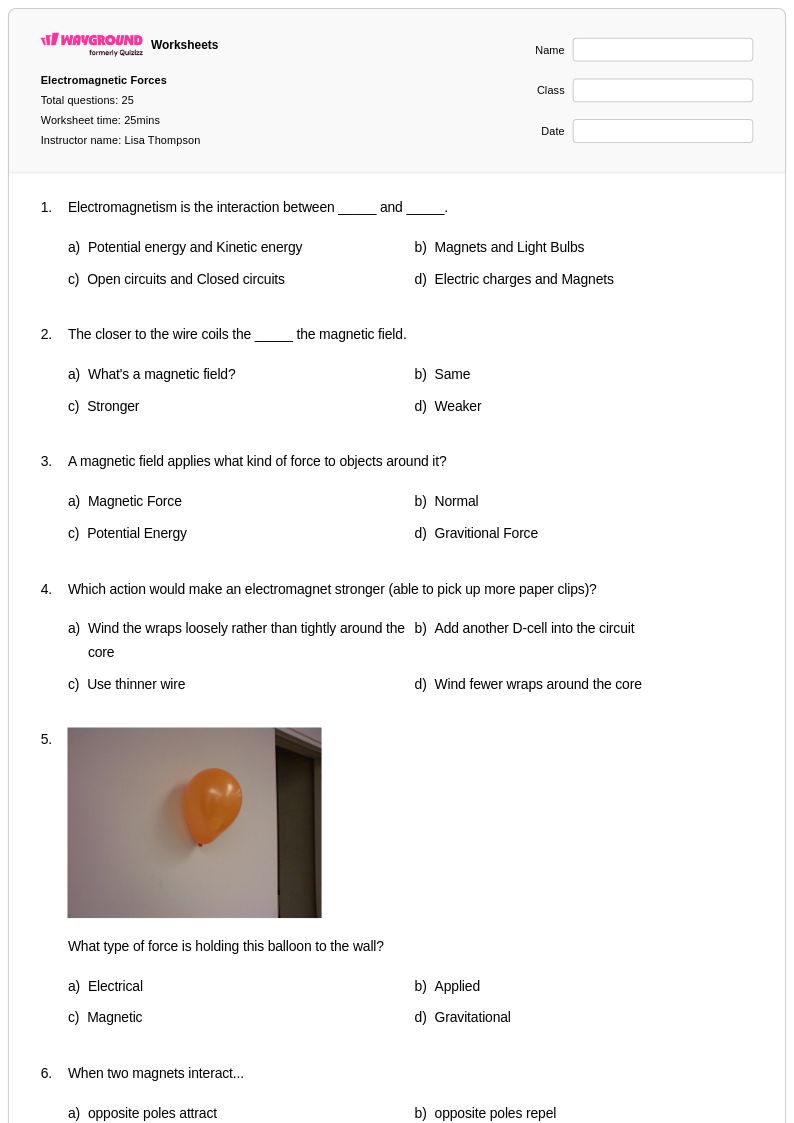
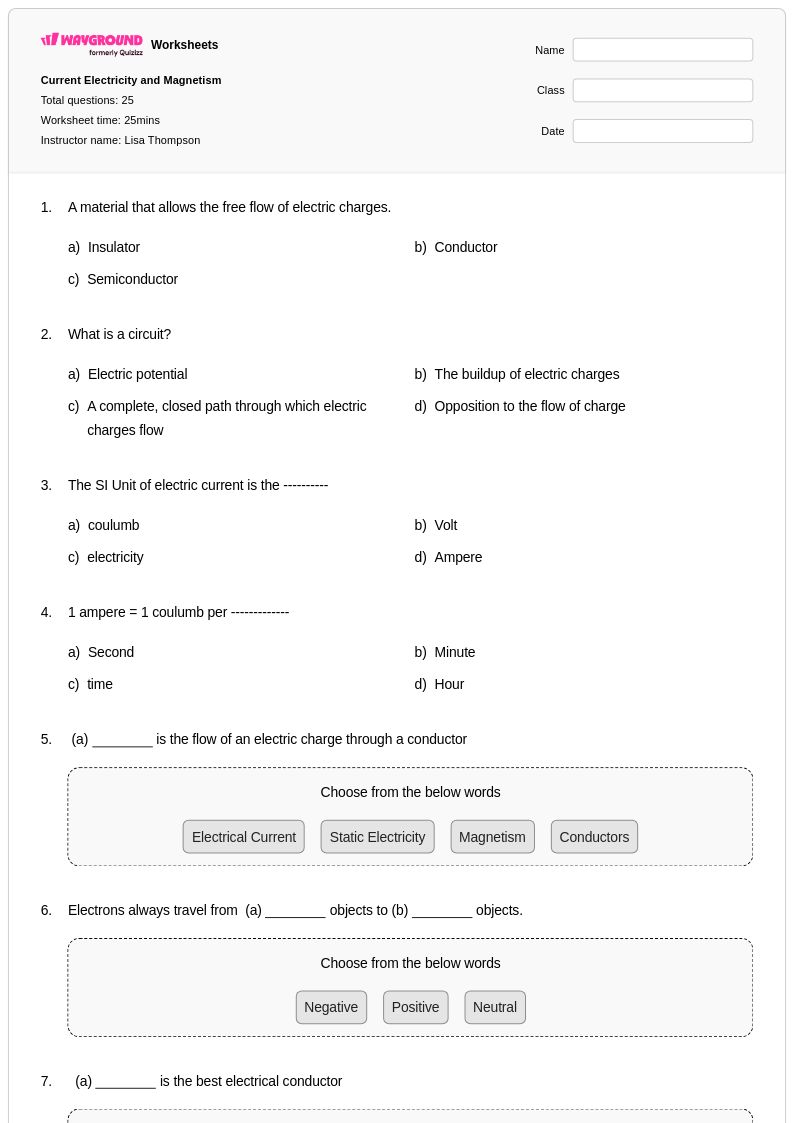
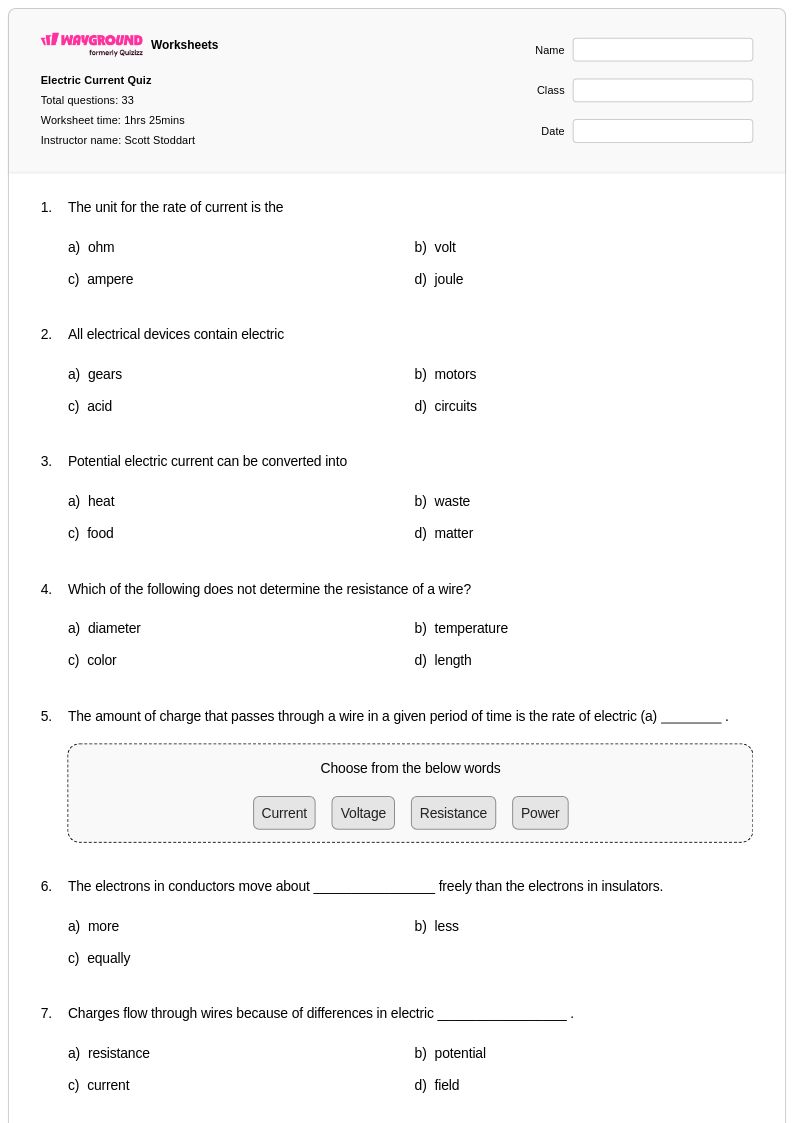
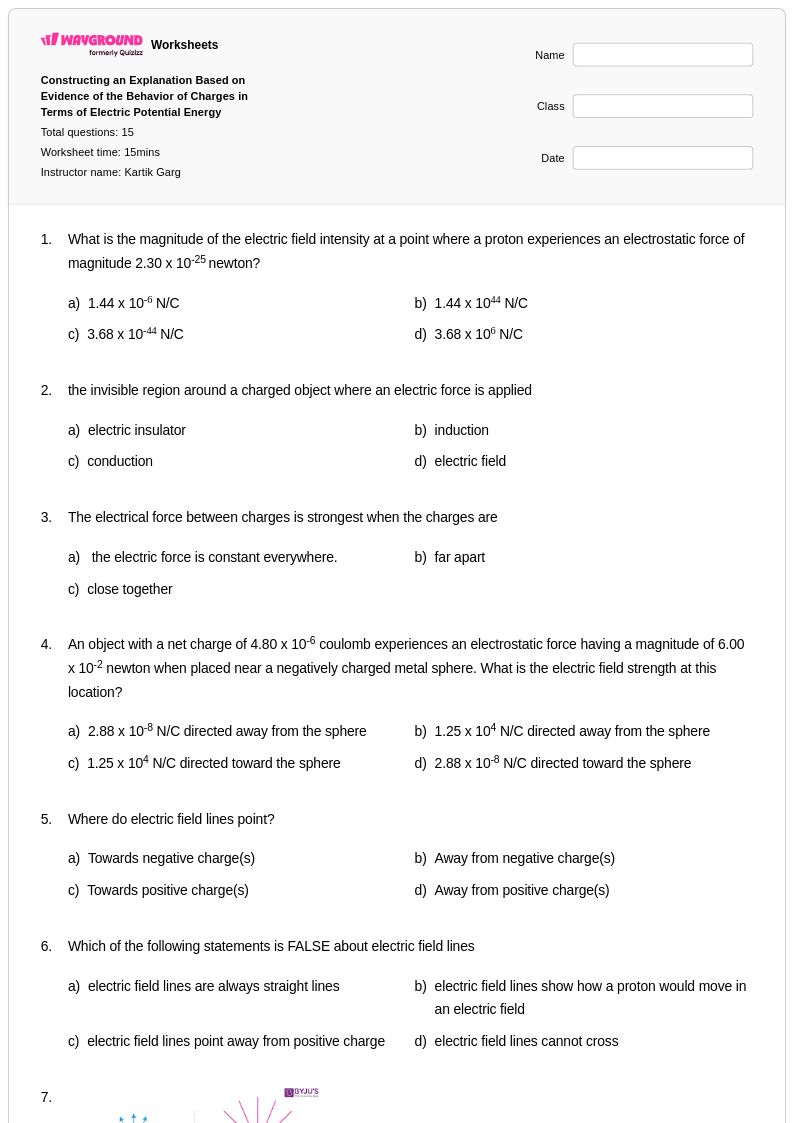
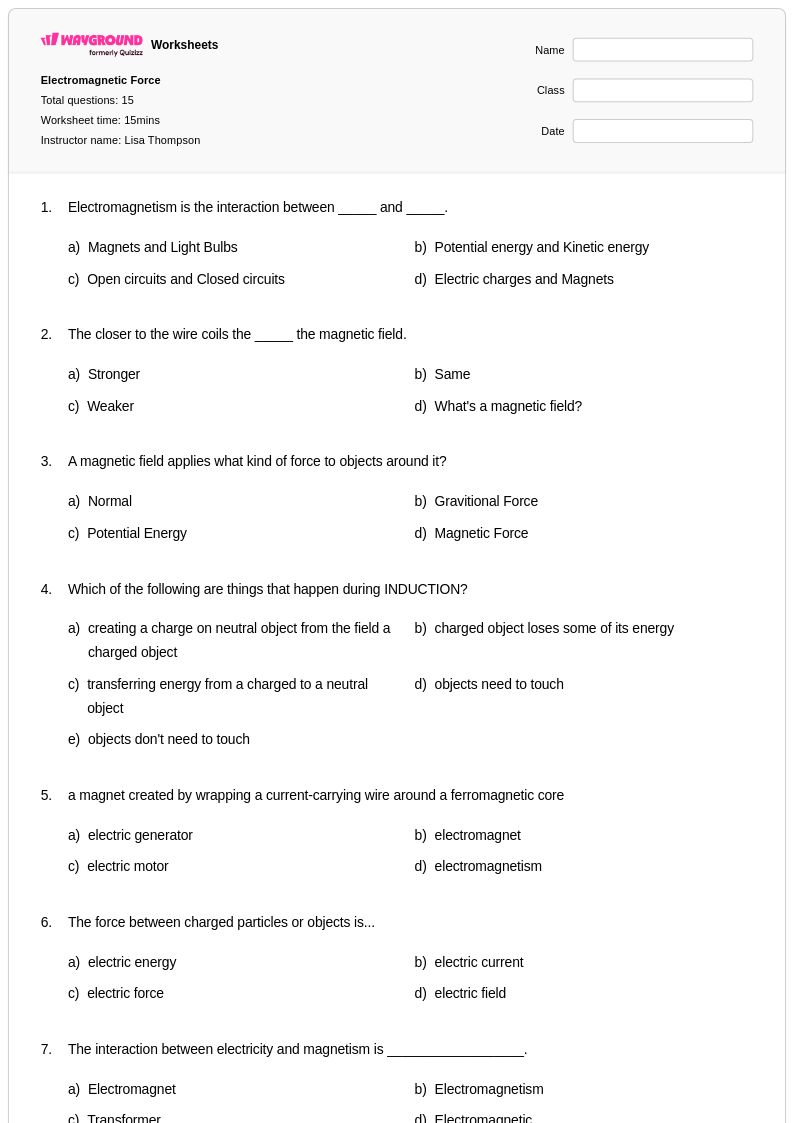
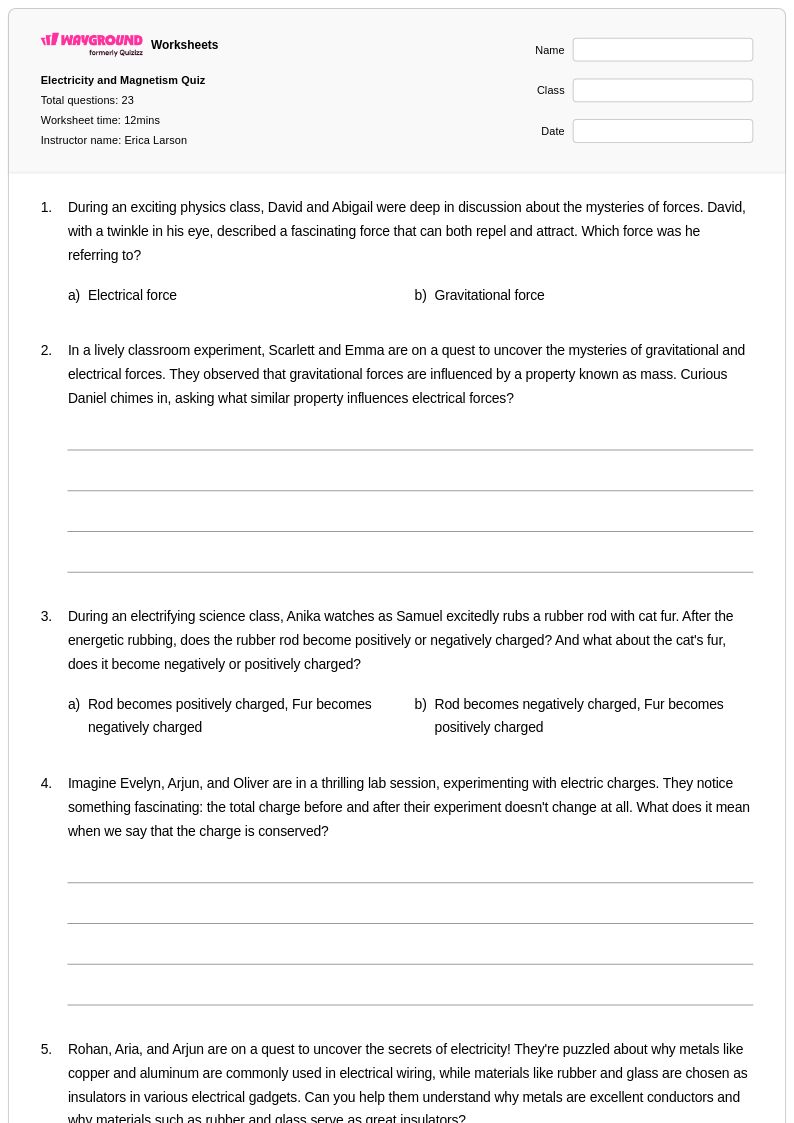
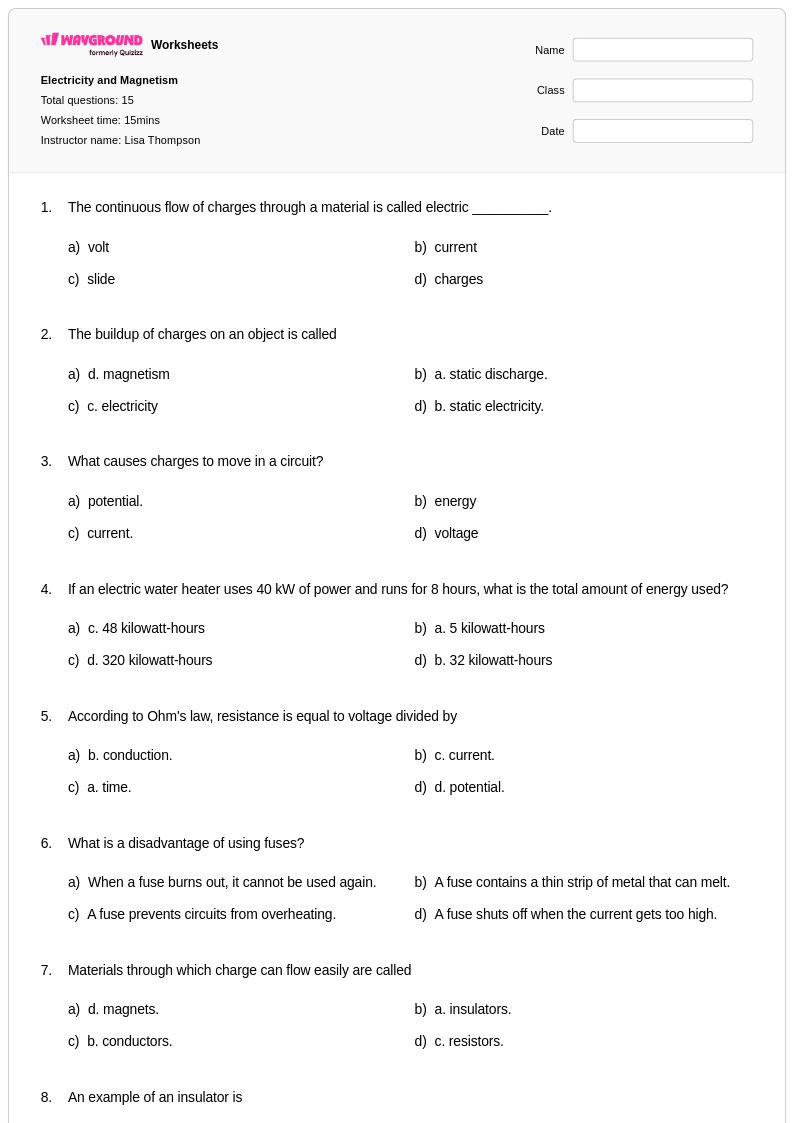
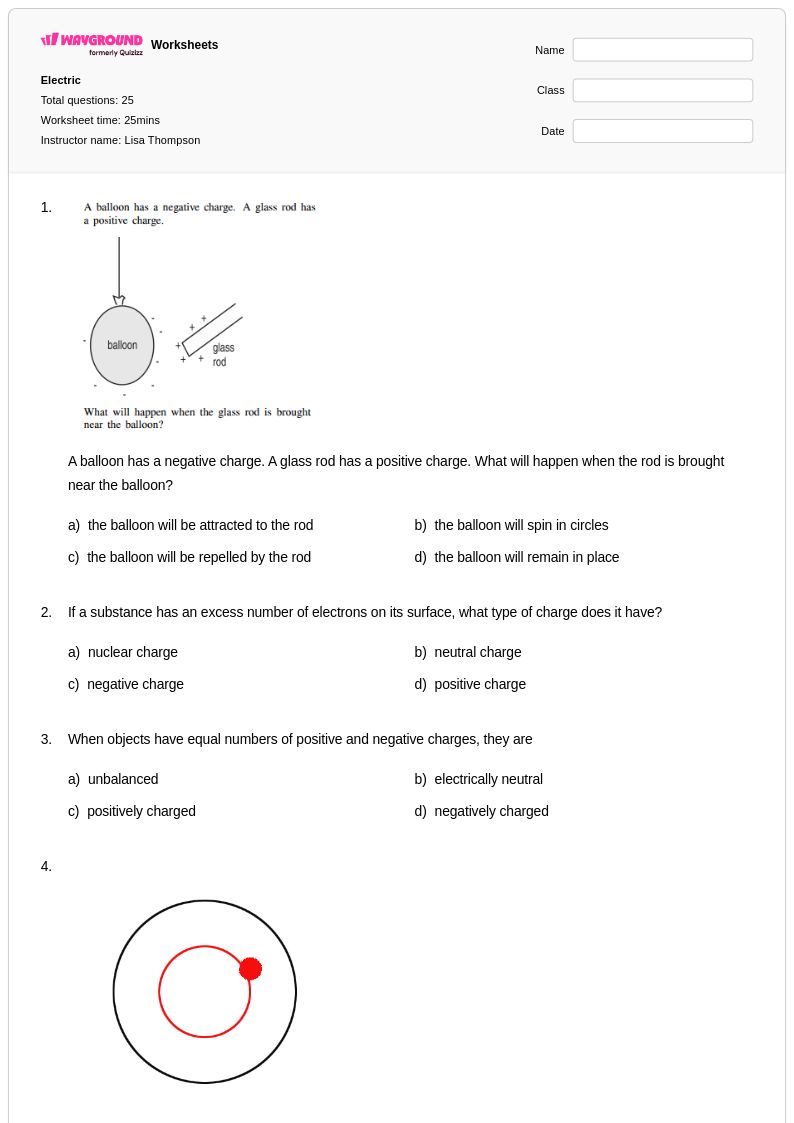
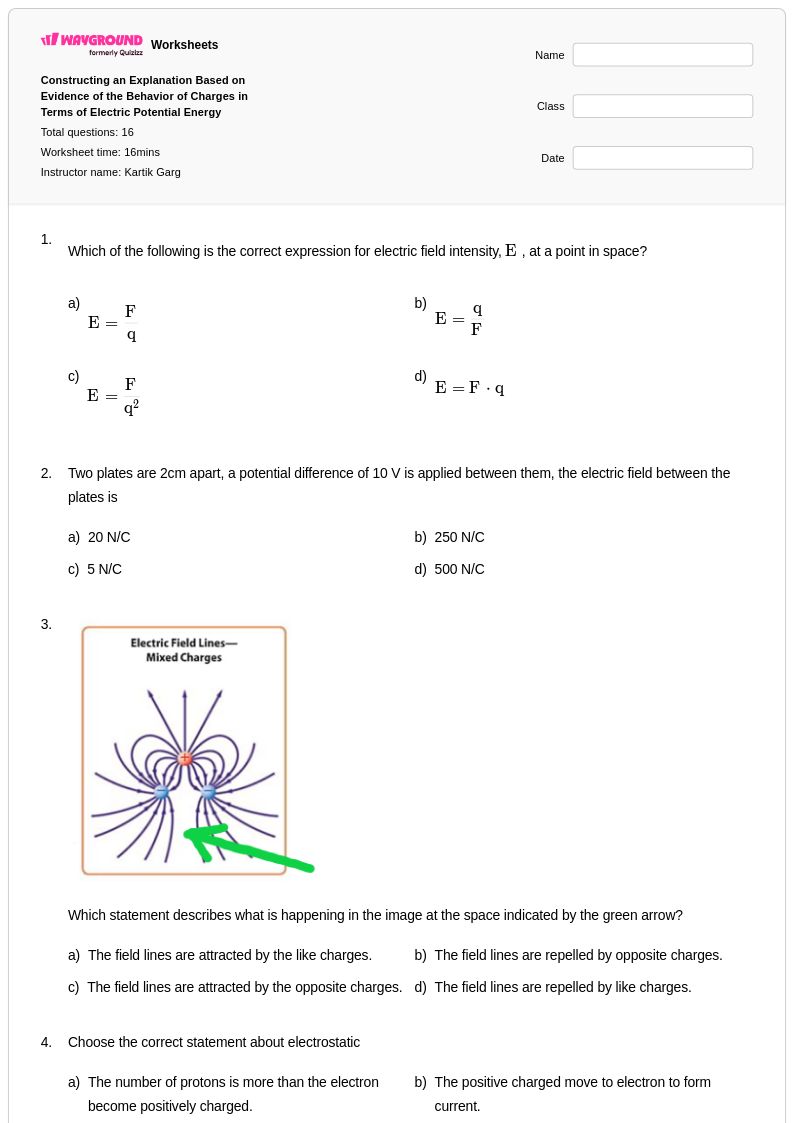
Electric charge, field, and potential worksheets for Class 11 physics students available through Wayground (formerly Quizizz) provide comprehensive coverage of electrostatics fundamentals that form the foundation of advanced electromagnetic theory. These expertly crafted worksheets strengthen critical analytical skills including calculating electric forces using Coulomb's law, mapping electric field patterns around point charges and charge distributions, and determining electric potential energy and voltage in various configurations. Students develop proficiency in applying vector principles to electric field problems, understanding the relationship between electric field strength and potential difference, and solving complex scenarios involving conductors, insulators, and capacitors. Each worksheet collection includes detailed answer keys and practice problems designed as printable pdf resources, allowing students to master concepts ranging from basic charge interactions to sophisticated potential energy calculations that prepare them for advanced physics coursework.
Wayground (formerly Quizizz) empowers educators with access to millions of teacher-created resources specifically designed for Class 11 electric charge, field, and potential instruction, featuring robust search and filtering capabilities that align with state and national physics standards. Teachers can efficiently locate worksheets that match their specific curriculum requirements, whether focusing on conceptual understanding of electric fields or quantitative problem-solving involving electric potential calculations. The platform's differentiation tools enable instructors to customize worksheet difficulty levels and problem types to accommodate diverse learning needs, while flexible formatting options provide both printable and digital pdf versions for seamless classroom integration. These comprehensive worksheet collections support strategic lesson planning by offering varied practice opportunities for remediation of fundamental electrostatic principles, enrichment activities for advanced learners exploring complex charge configurations, and targeted skill practice that bridges theoretical concepts with practical problem-solving applications essential for physics mastery.
FAQs
How do I teach electric field and electric potential in a physics class?
Start by grounding students in Coulomb's law and the concept of a test charge before introducing the electric field as a vector quantity. Once students can calculate field strength from point charges, build toward electric potential as a scalar quantity and explicitly teach the relationship between potential difference and field direction. Using equipotential surface diagrams alongside field line diagrams helps students develop spatial intuition for both quantities simultaneously.
What practice problems help students master electric charge, field, and potential?
Effective practice should progress from single point charge calculations to multi-charge superposition problems, then to continuous charge distributions and Gauss's law applications. Problems that require students to both calculate electric potential at a point and determine the corresponding field vector are especially valuable because they reinforce the mathematical relationship between the two quantities. Including equipotential surface analysis problems ensures students develop conceptual understanding alongside computational fluency.
What mistakes do students commonly make when working with electric field and potential?
The most persistent misconception is treating electric potential as a vector quantity — students frequently attempt to add potentials using directional components the way they would add field vectors. Students also routinely confuse electric field direction with the direction of increasing potential, when in fact the field points from high to low potential. A third common error is misapplying Gauss's law to charge distributions that lack the necessary symmetry, leading to incorrect field calculations.
How do I use electric charge field and potential worksheets effectively in my classroom?
These worksheets work well as structured practice following direct instruction on each subtopic, allowing students to consolidate understanding of point charges before moving to more complex distributions. Because the worksheets are available as both printable PDFs and in digital formats, they can be deployed for in-class problem sets, homework, or as hosted quizzes on Wayground depending on your teaching environment. Answer keys included with each worksheet make them suitable for independent practice, peer review, or self-paced remediation sessions.
How do I differentiate electric field and potential instruction for students at different levels?
For students who are still building foundational skills, focus problem sets on single point charges with straightforward distance values before introducing superposition. More advanced learners can be challenged with continuous charge distribution problems and Gauss's law applications in non-trivial geometries. On Wayground, teachers can also enable accommodations such as read aloud support, reduced answer choices, and extended time for individual students, ensuring all learners can engage with the material without disrupting the rest of the class.
What is the difference between electric field and electric potential, and how should I explain it to students?
Electric field is a vector quantity that describes the force per unit positive charge at a point in space, while electric potential is a scalar quantity representing the work done per unit charge to move a test charge from a reference point to that location. The field and potential are mathematically related: the electric field points in the direction of steepest decrease in potential, and its magnitude equals the rate of change of potential with distance. Helping students internalize this relationship — rather than memorizing it — is essential for success in electrostatics and later topics in electromagnetism.