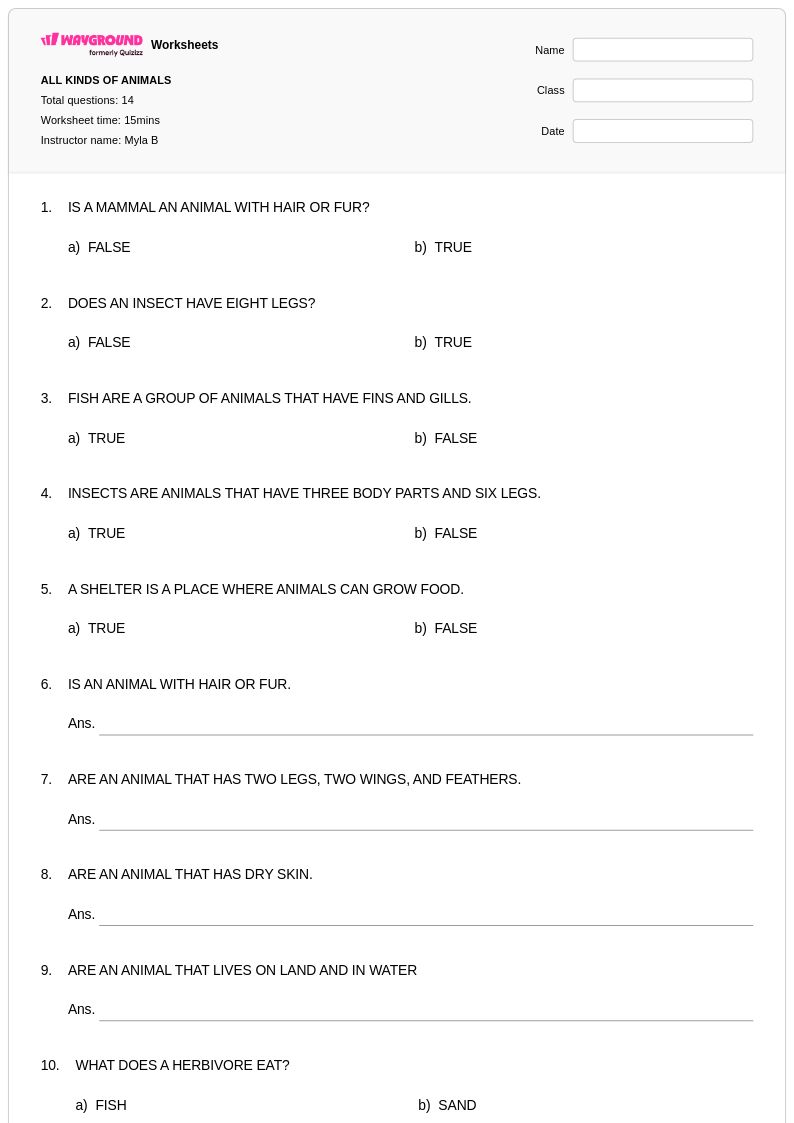
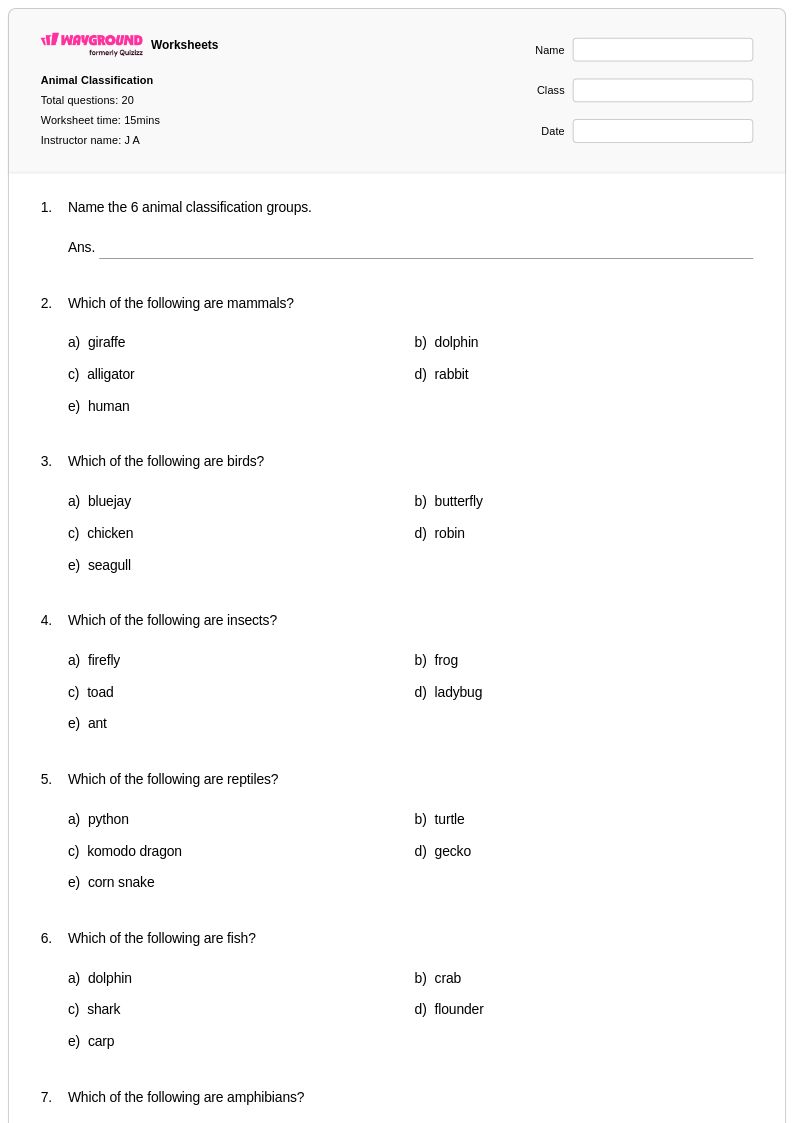
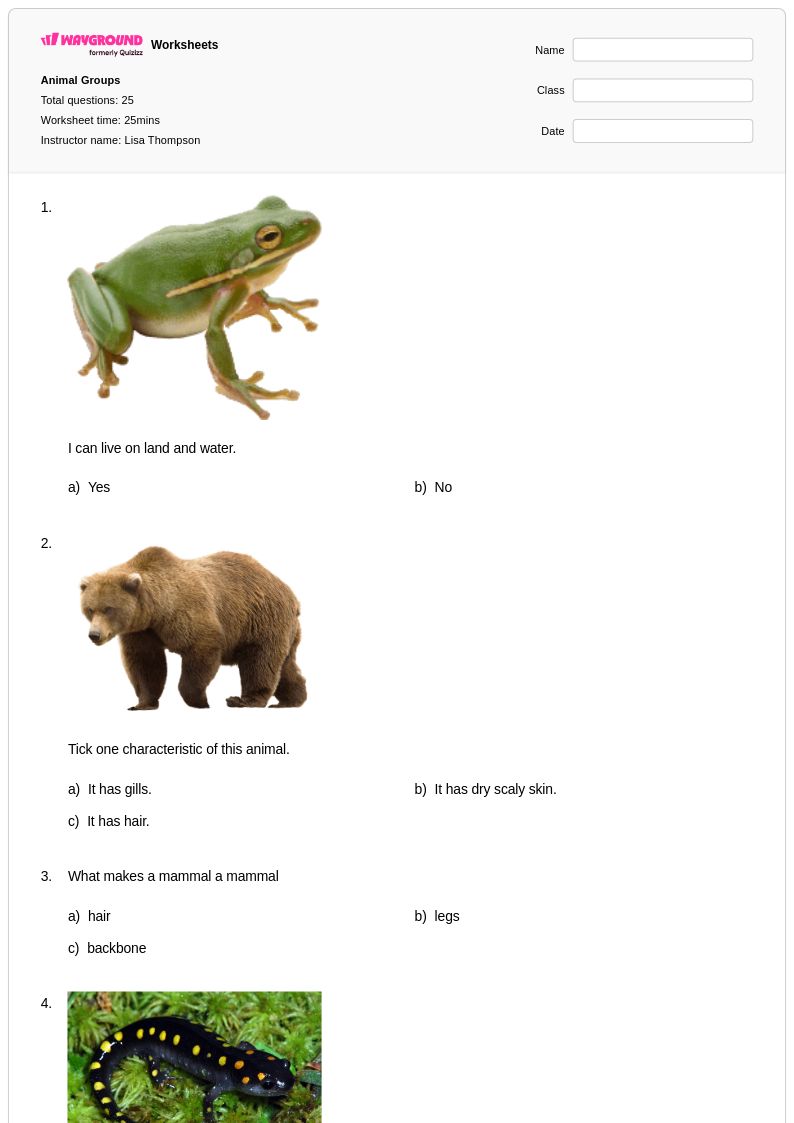
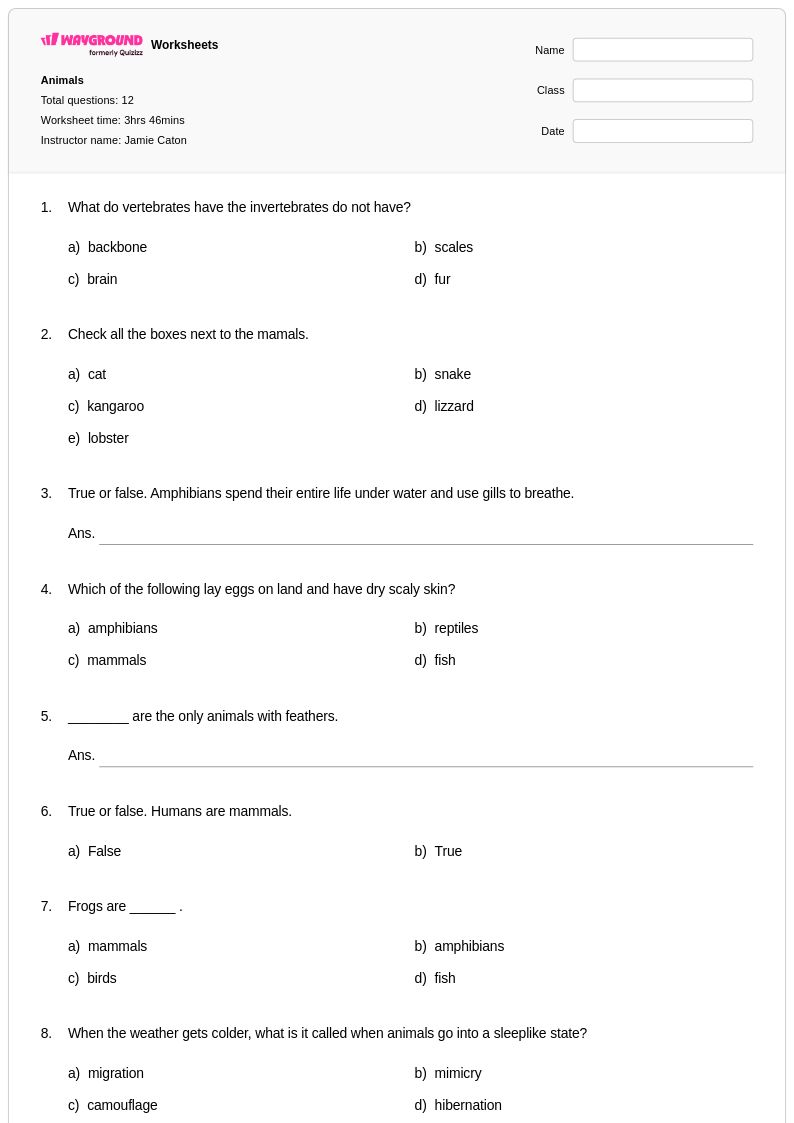
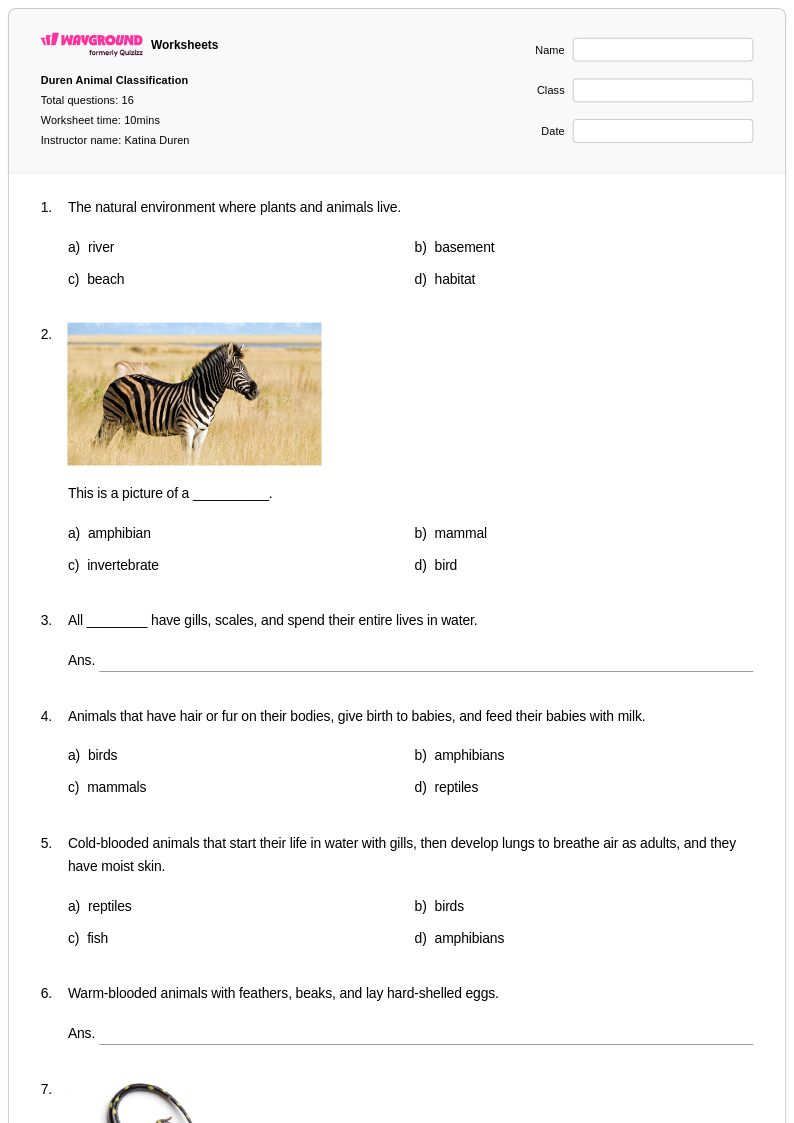
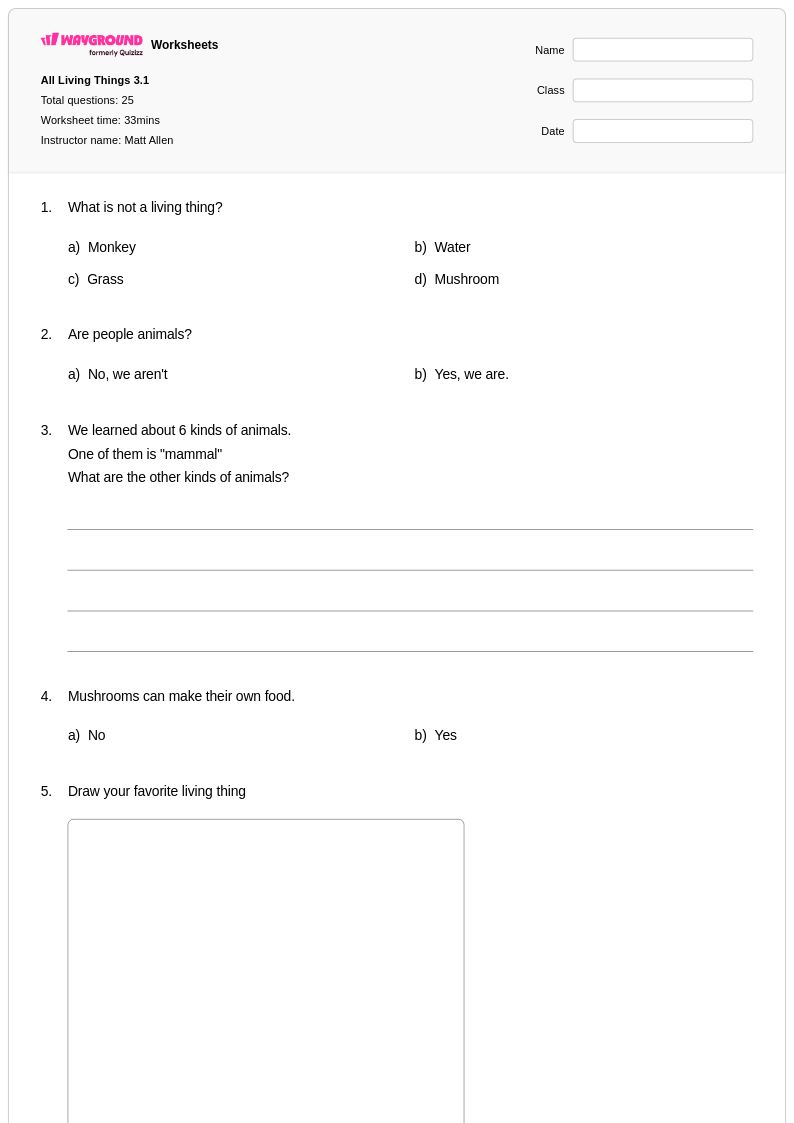
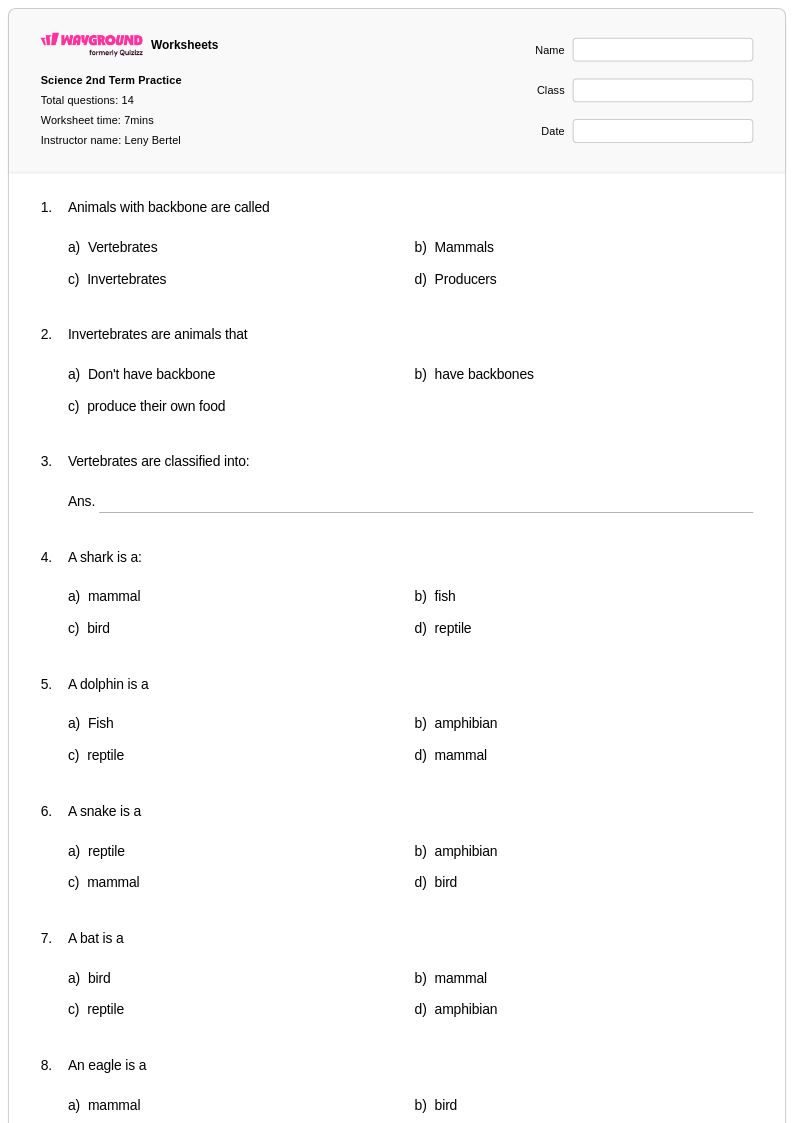
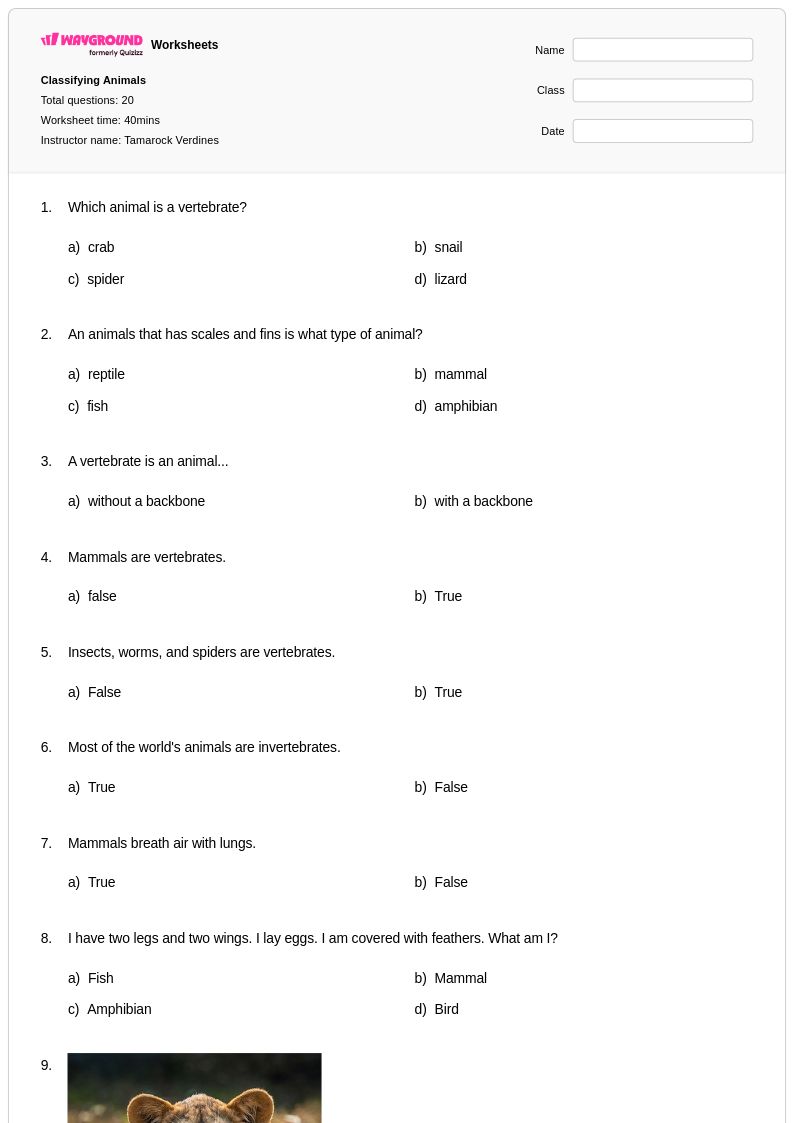
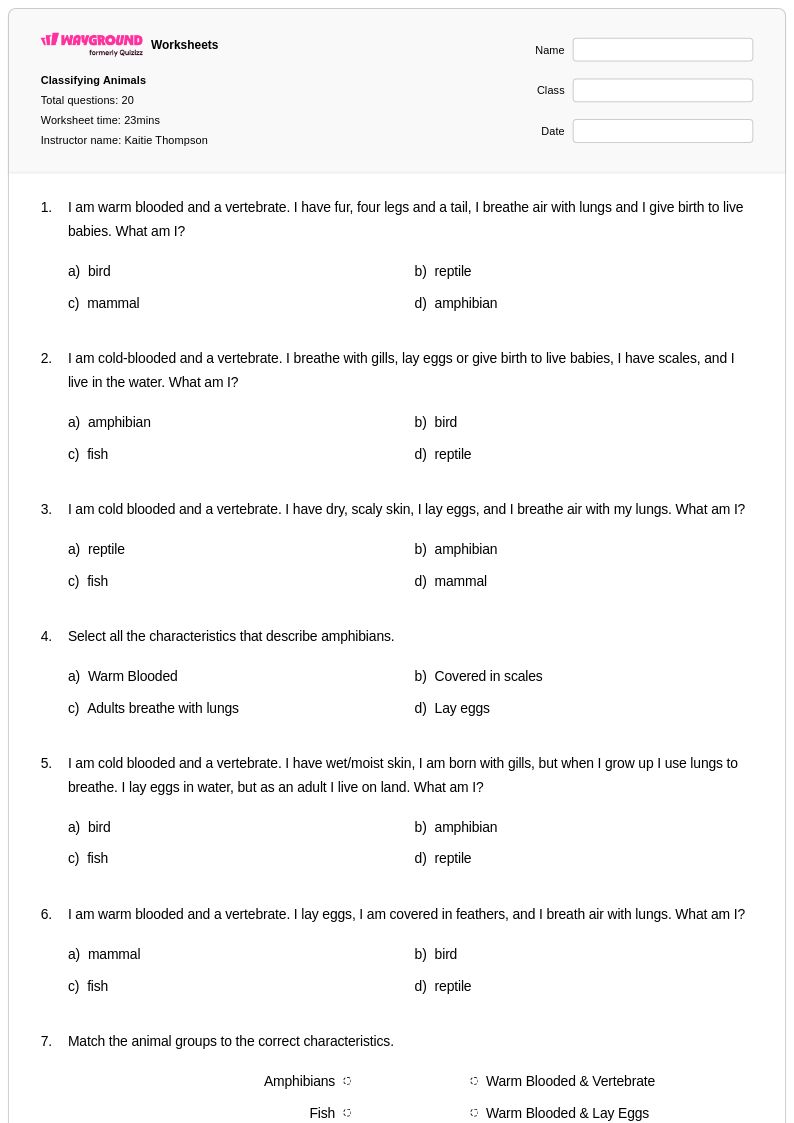
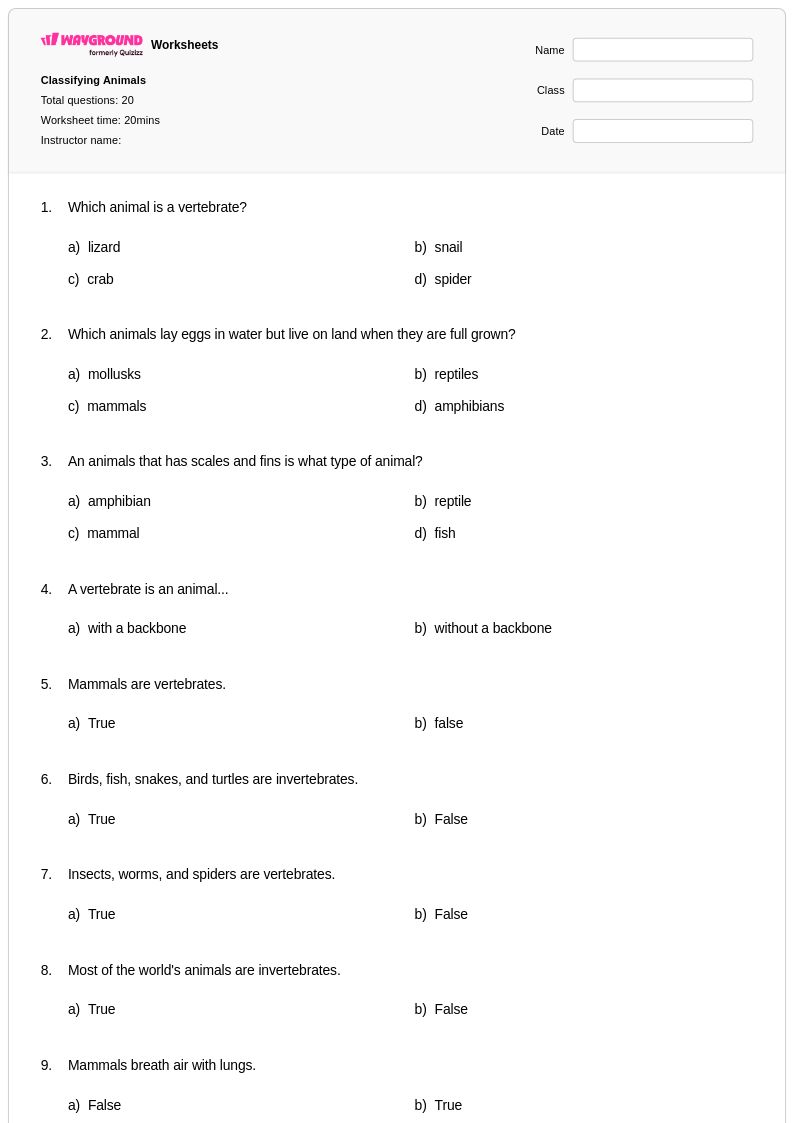
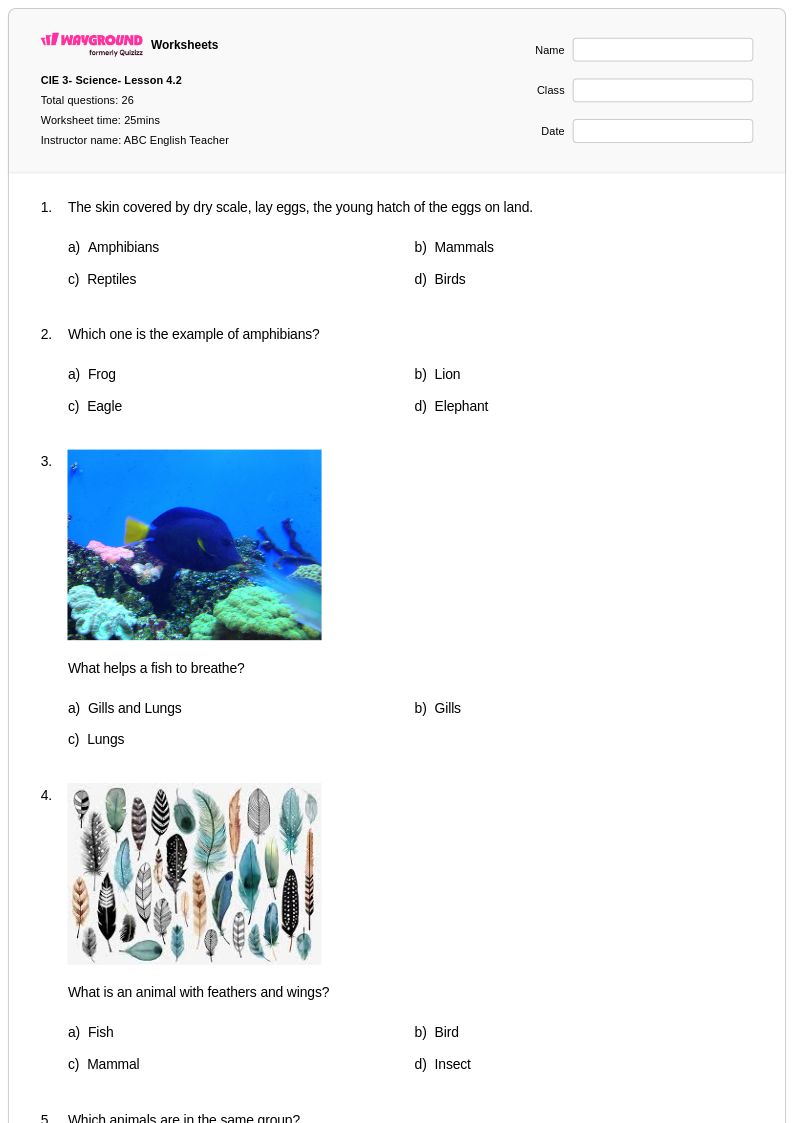
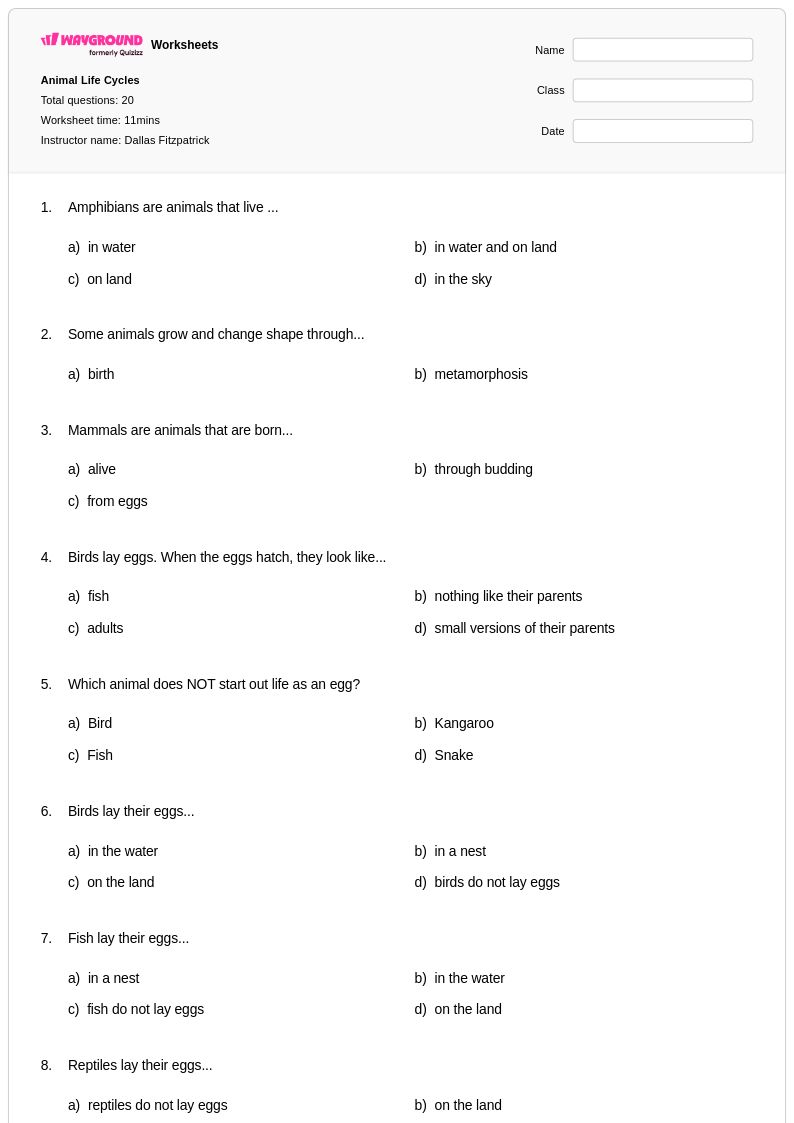
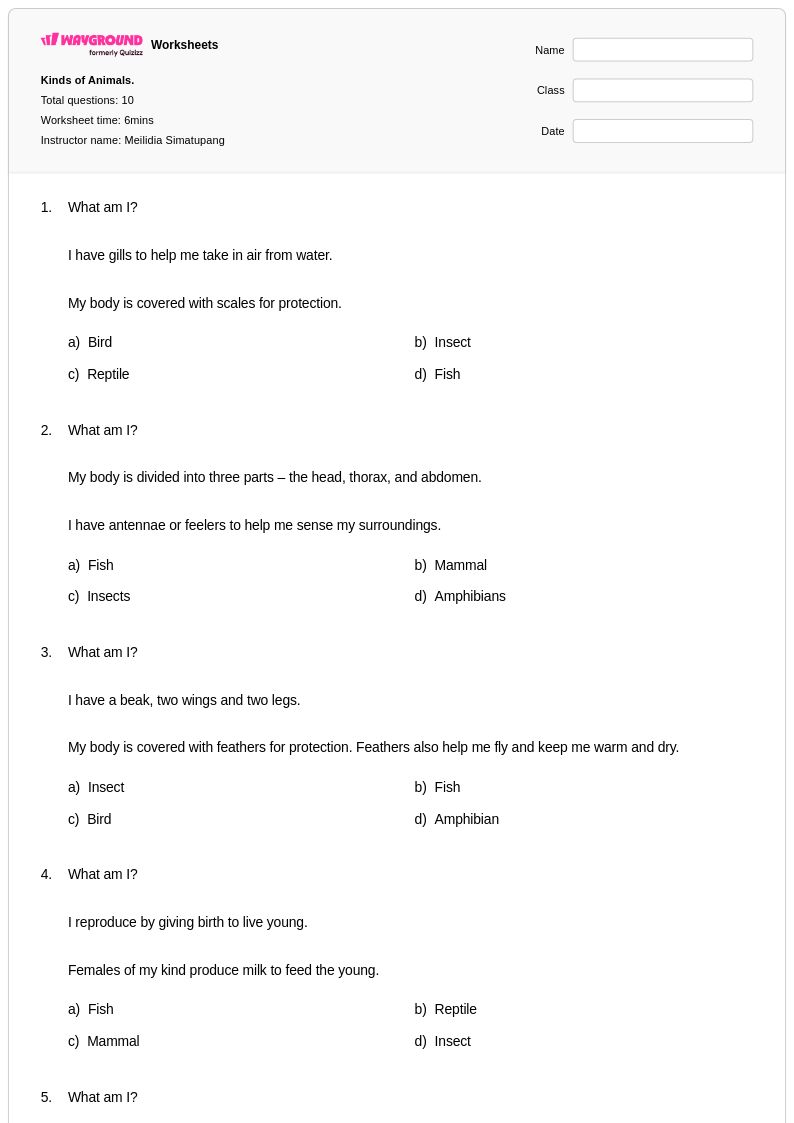
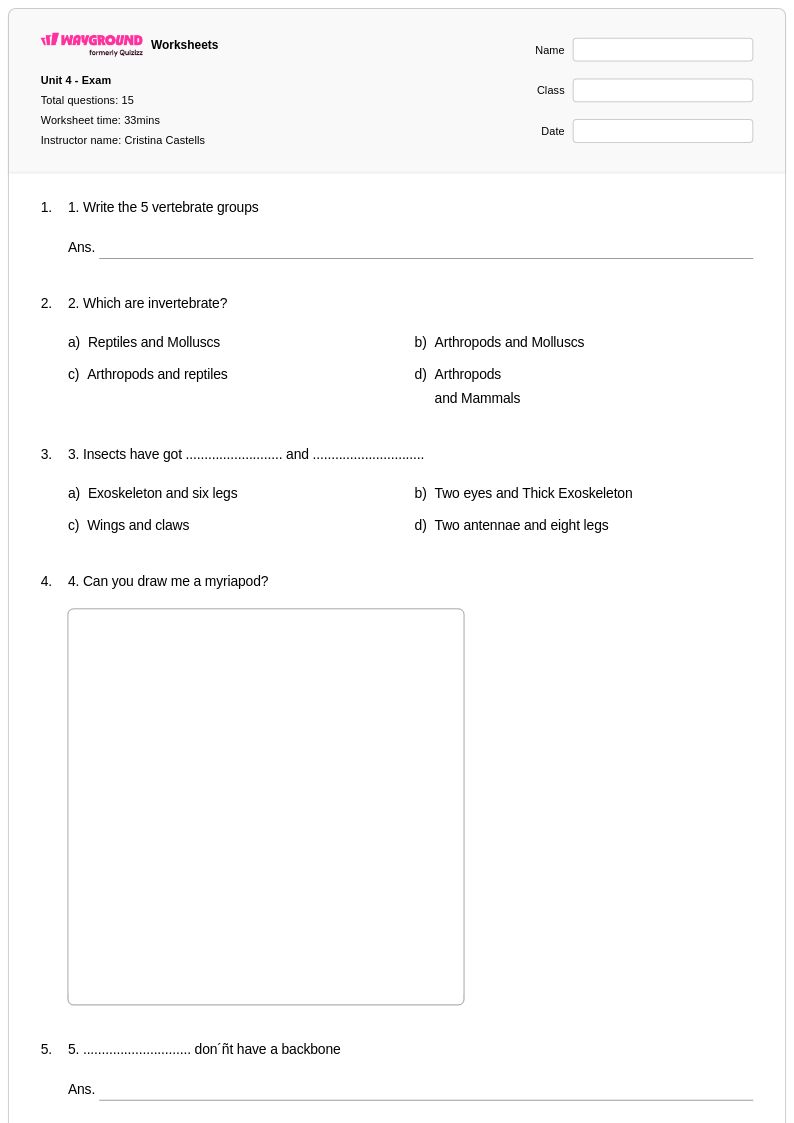
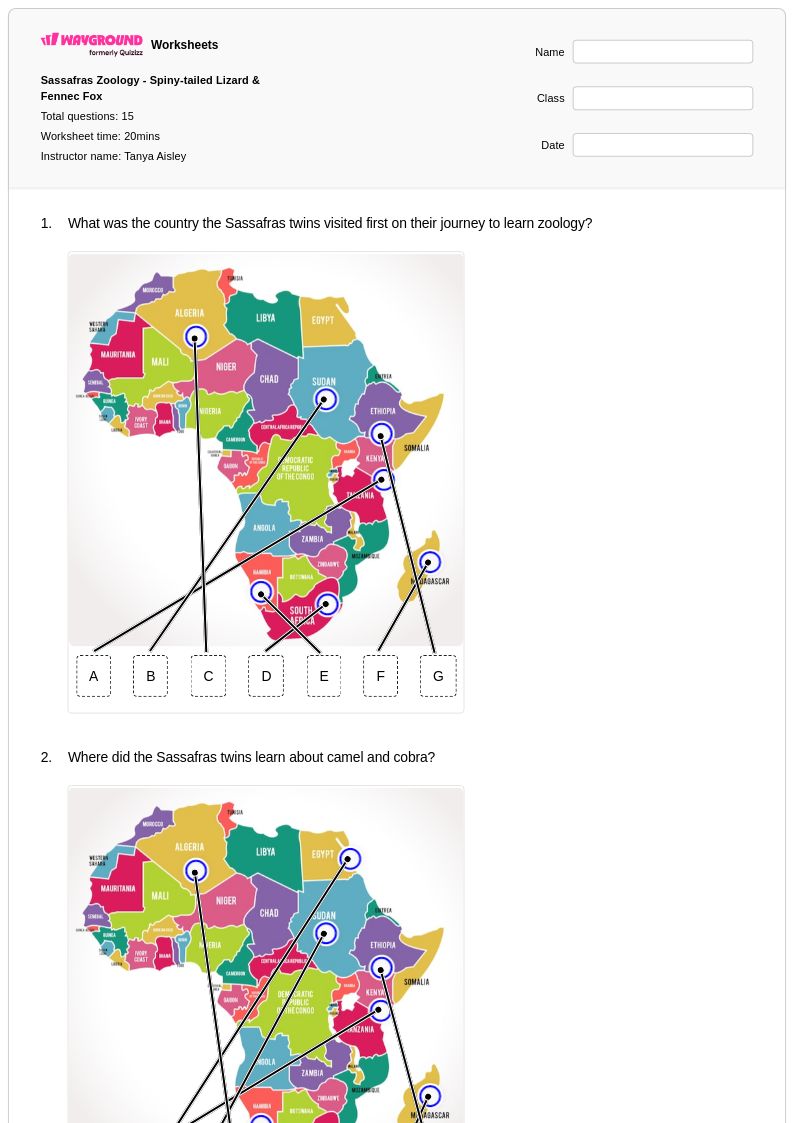
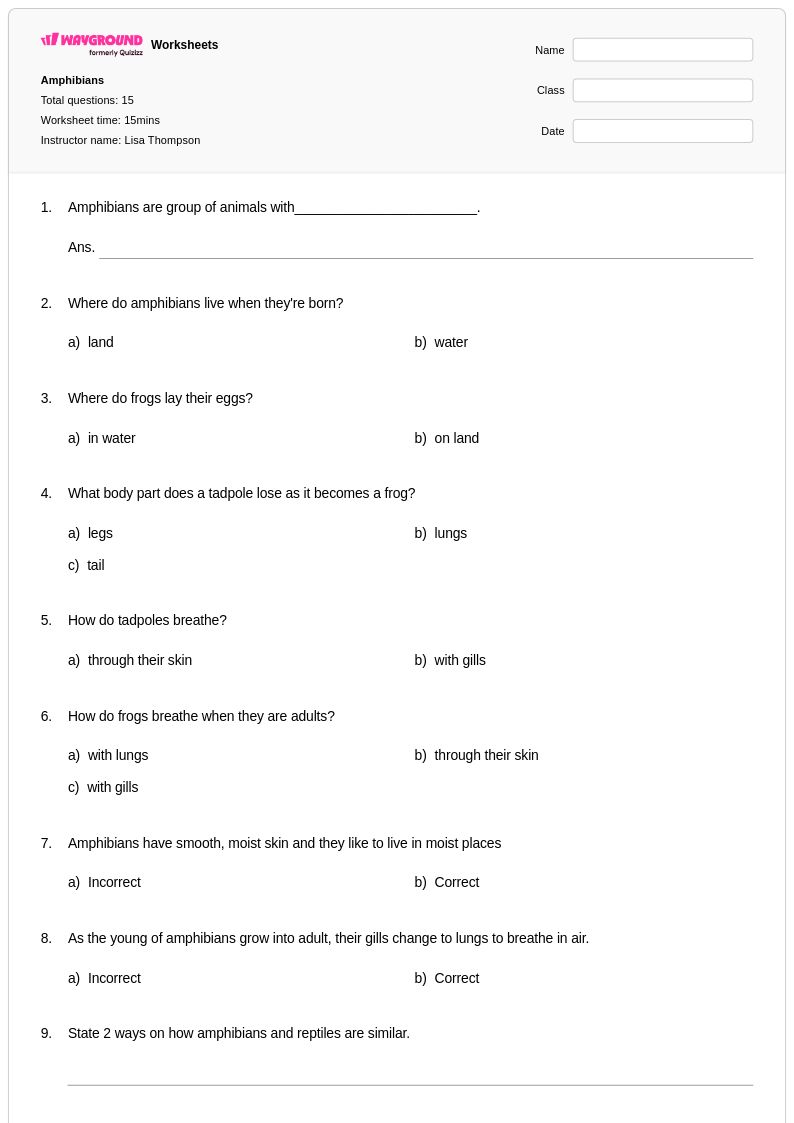
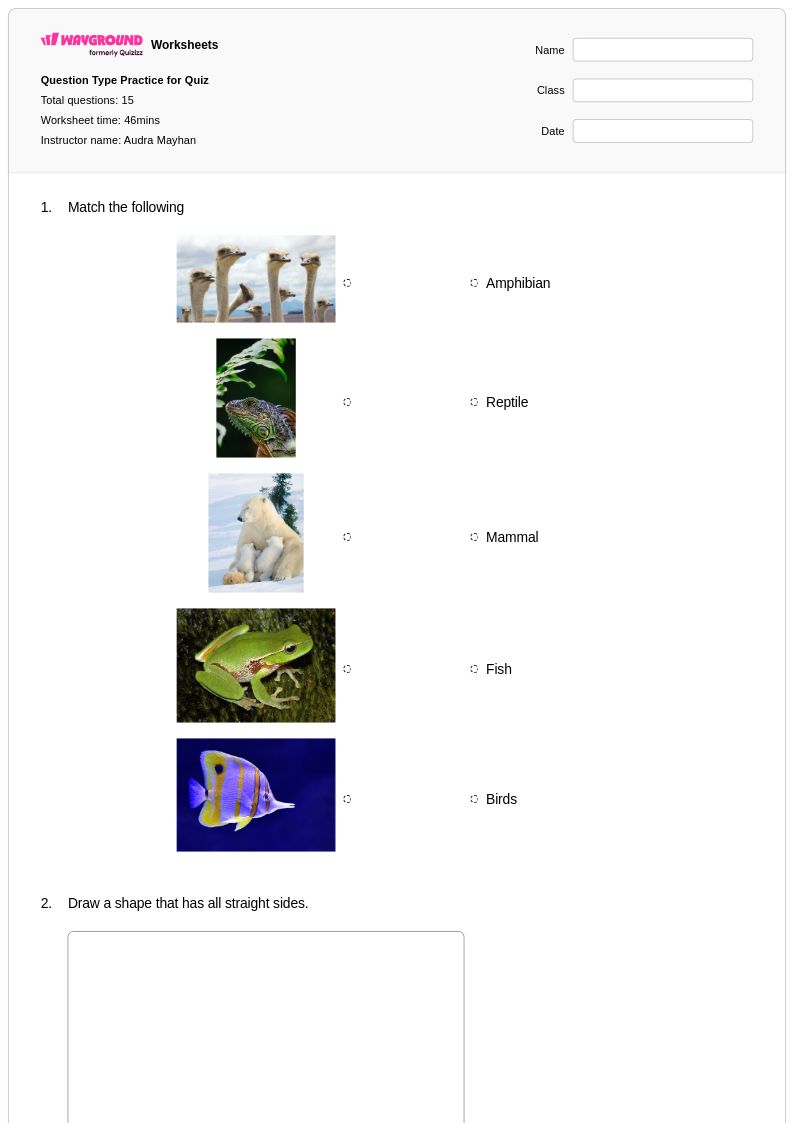
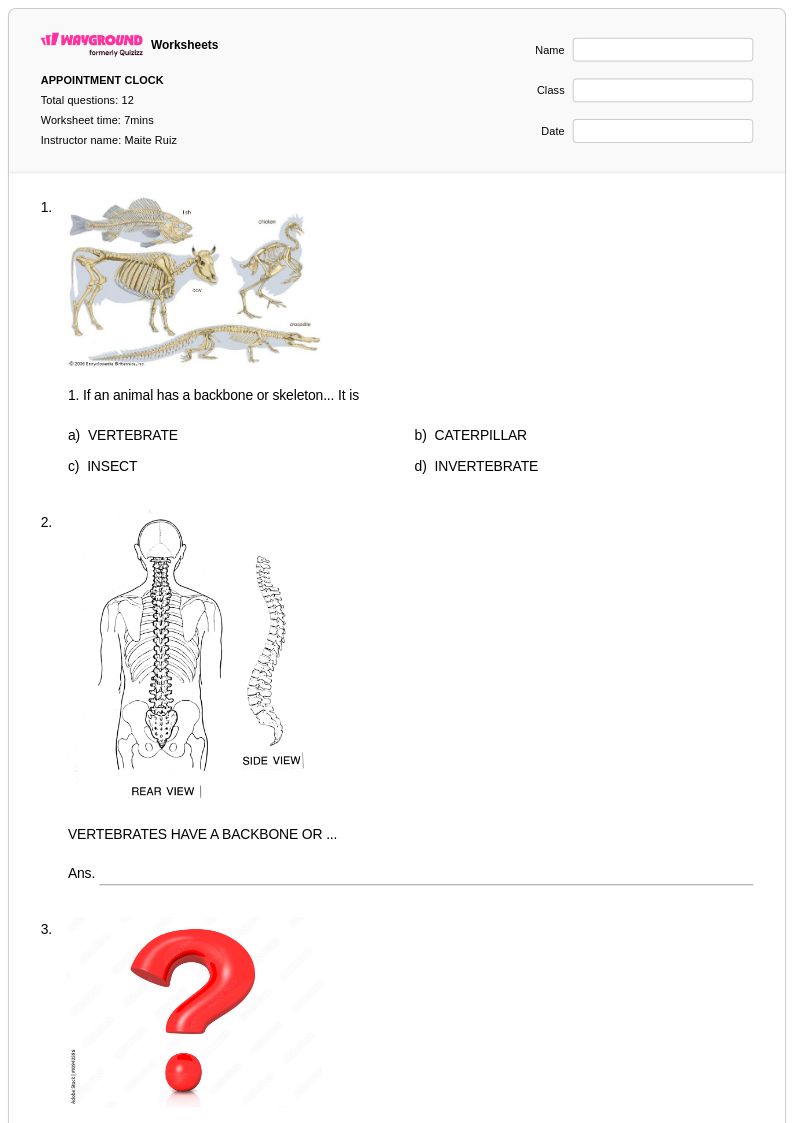
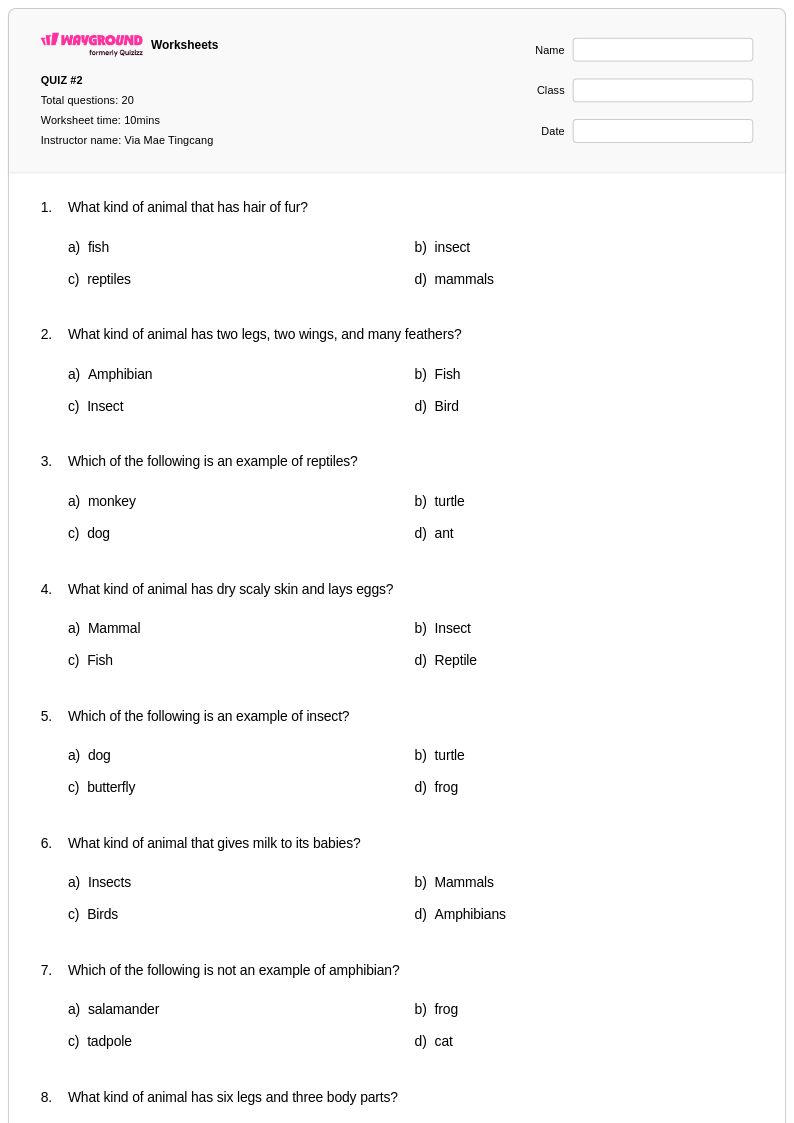
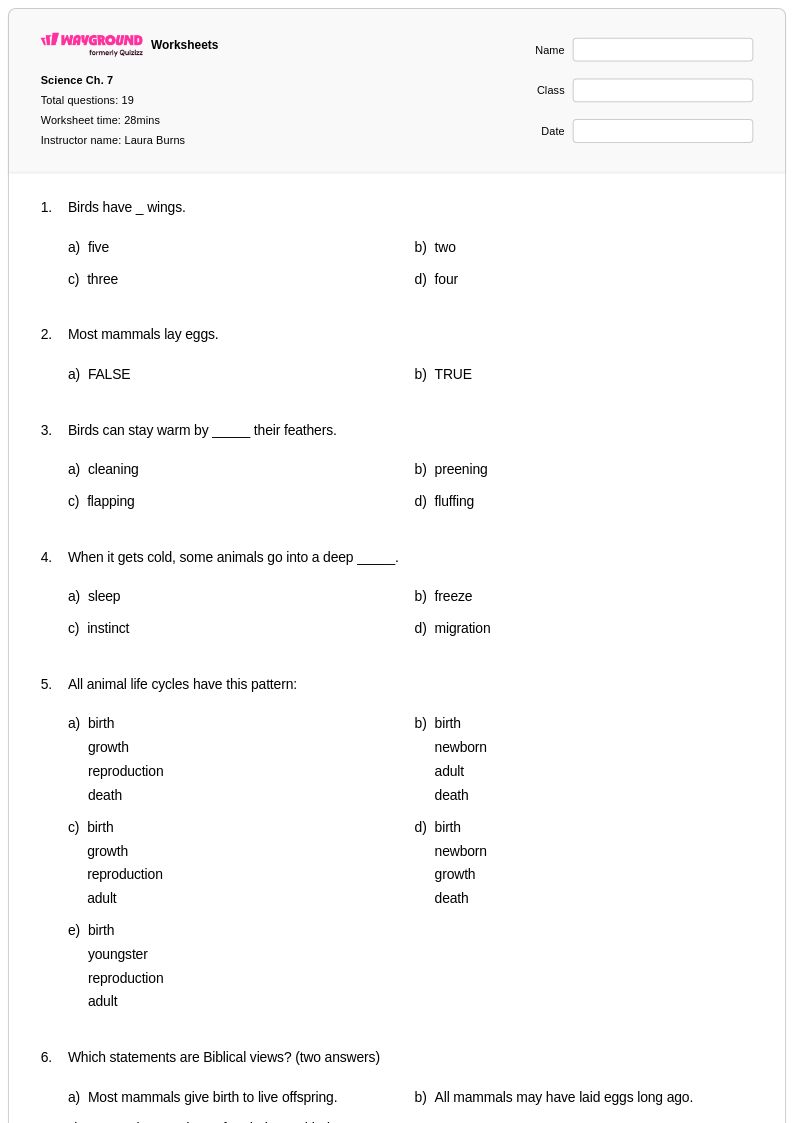
Explore Wayground's free Class 3 mammals worksheets and printables that help students learn about mammal characteristics, habitats, and classification through engaging practice problems with complete answer keys.
Class 3 mammals worksheets available through Wayground (formerly Quizizz) provide young learners with engaging opportunities to explore the fascinating world of mammalian biology through structured practice problems and interactive activities. These educational resources strengthen essential scientific observation skills, classification abilities, and critical thinking as students discover the defining characteristics that make mammals unique among animal groups. Each worksheet systematically guides third-grade students through key mammalian features such as warm-blooded metabolism, hair or fur coverings, live birth, and milk production for offspring, while incorporating age-appropriate vocabulary and concepts that build foundational zoological understanding. The comprehensive collection includes printables with detailed answer keys, allowing educators to efficiently assess student comprehension while providing immediate feedback on mammal identification, habitat recognition, and basic physiological concepts presented in accessible pdf formats.
Wayground (formerly Quizizz) empowers educators with an extensive library of millions of teacher-created mammals worksheets specifically designed for Class 3 science instruction, featuring robust search and filtering capabilities that enable quick identification of resources aligned with specific learning standards and curriculum objectives. The platform's differentiation tools allow teachers to customize worksheet difficulty levels, modify content presentation, and adapt materials to meet diverse learning needs within their classrooms, supporting both remediation for struggling students and enrichment opportunities for advanced learners. These flexible resources are available in both printable and digital formats, including downloadable pdf versions that facilitate seamless integration into lesson planning, independent practice sessions, homework assignments, and formative assessment activities that reinforce mammalian biology concepts while accommodating various instructional approaches and classroom management styles.
FAQs
How do I teach mammal characteristics to middle school students?
Start by anchoring instruction around the three defining traits that all mammals share: hair or fur, live birth (with few exceptions), and mammary glands that produce milk for offspring. Use comparative examples across familiar and unfamiliar species to help students see how these traits express differently in, say, a platypus versus a blue whale. Connecting anatomy to function — for example, explaining why warm-blooded metabolism enables mammals to thrive in extreme climates — helps students move beyond memorization toward conceptual understanding.
What exercises help students practice mammal classification?
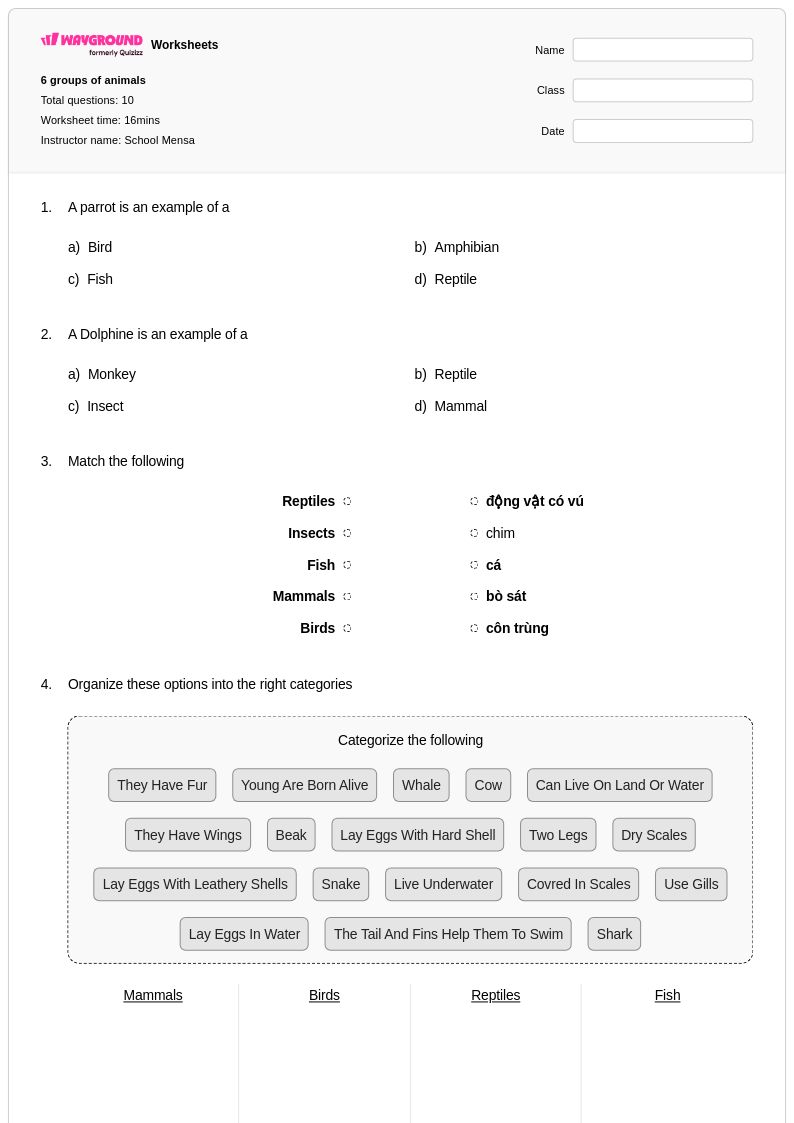
Sorting and classification activities work well — have students group mammals by order (rodents, primates, cetaceans) using physical trait cards or illustrated worksheets before checking their reasoning against taxonomy rules. Dichotomous key exercises are especially effective because they require students to apply defining characteristics systematically rather than guess. Labeling diagrams of mammalian anatomy alongside classification tasks reinforces the connection between structure and taxonomic grouping.
What misconceptions do students commonly have about mammals?
The most persistent misconception is that all mammals give birth to live young — students are often surprised to learn that monotremes like the platypus and echidna lay eggs yet are still classified as mammals. Students also frequently confuse warm-blooded with 'living in warm climates,' misunderstanding that endothermy refers to internal temperature regulation rather than habitat preference. A third common error is assuming that all large or familiar animals (like sharks or dolphins) are mammals, making cetacean examples particularly useful for challenging assumptions.
How can I use mammals worksheets to support students with different learning needs?
Wayground's mammals worksheets are available in both printable PDF format and digital interactive versions, making them adaptable across traditional and technology-integrated classrooms. In digital mode, teachers can apply individual accommodations such as read aloud for struggling readers, reduced answer choices to lower cognitive load, and extended time for students who need it — all configurable per student without disrupting the rest of the class. These settings are saved and reusable, so setup is a one-time investment that carries across future assignments.
How do I assess whether students understand mammalian adaptations versus just memorizing facts?
Effective assessment goes beyond recall by asking students to explain why a specific adaptation benefits an animal in its habitat — for example, why blubber serves the same thermal regulation function as fur in marine mammals. Application questions that present an unfamiliar species and ask students to predict its traits based on its environment reveal whether students understand adaptive logic rather than just a list of features. Worksheet questions that require students to compare two species across multiple trait categories are particularly useful for surfacing surface-level versus deep understanding.
What is the difference between mammal orders and how should I introduce them to students?
Mammal orders are taxonomic groupings within the class Mammalia, organized primarily by skeletal structure, reproductive strategy, and evolutionary lineage — so rodents (Rodentia), bats (Chiroptera), and primates (Primates) each share distinct anatomical features that distinguish them from one another. Introduce orders by starting with the most species-rich or student-familiar groups, such as rodents and primates, before moving to less familiar ones like insectivores or marsupials. A visual cladogram or tree diagram helps students see how orders branch from common ancestors, which frames classification as a story of evolutionary relationship rather than an arbitrary label system.