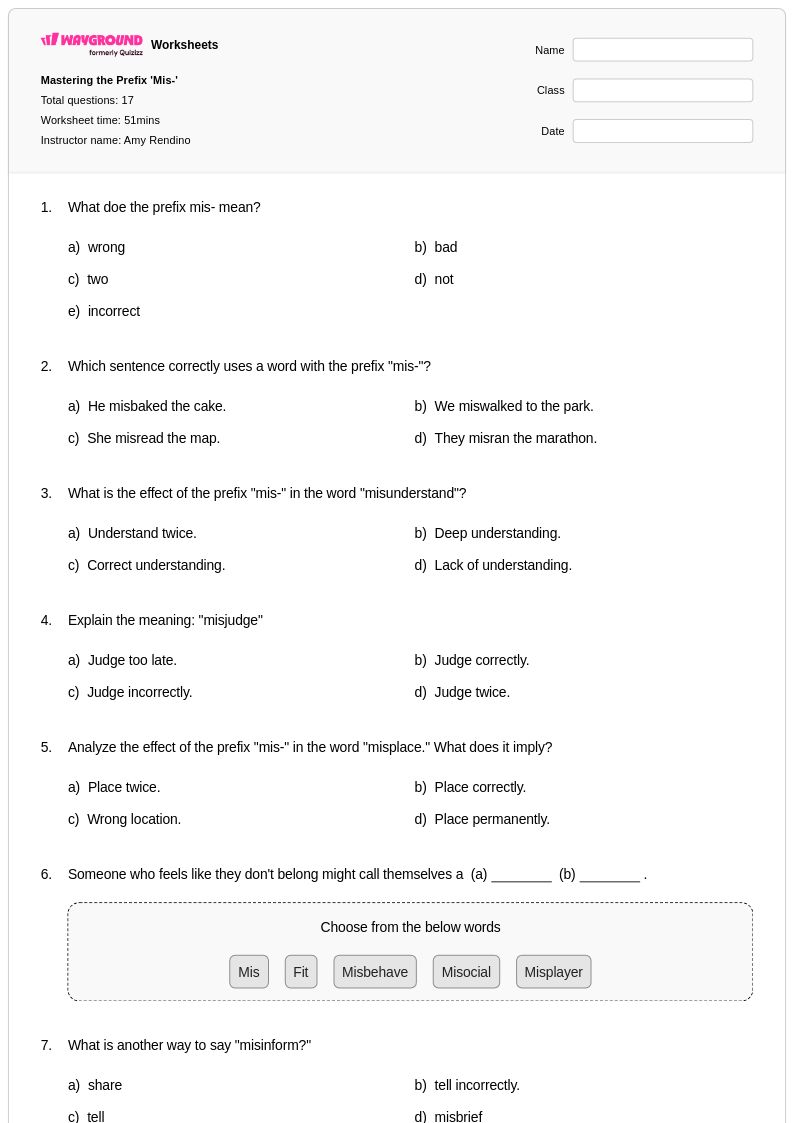
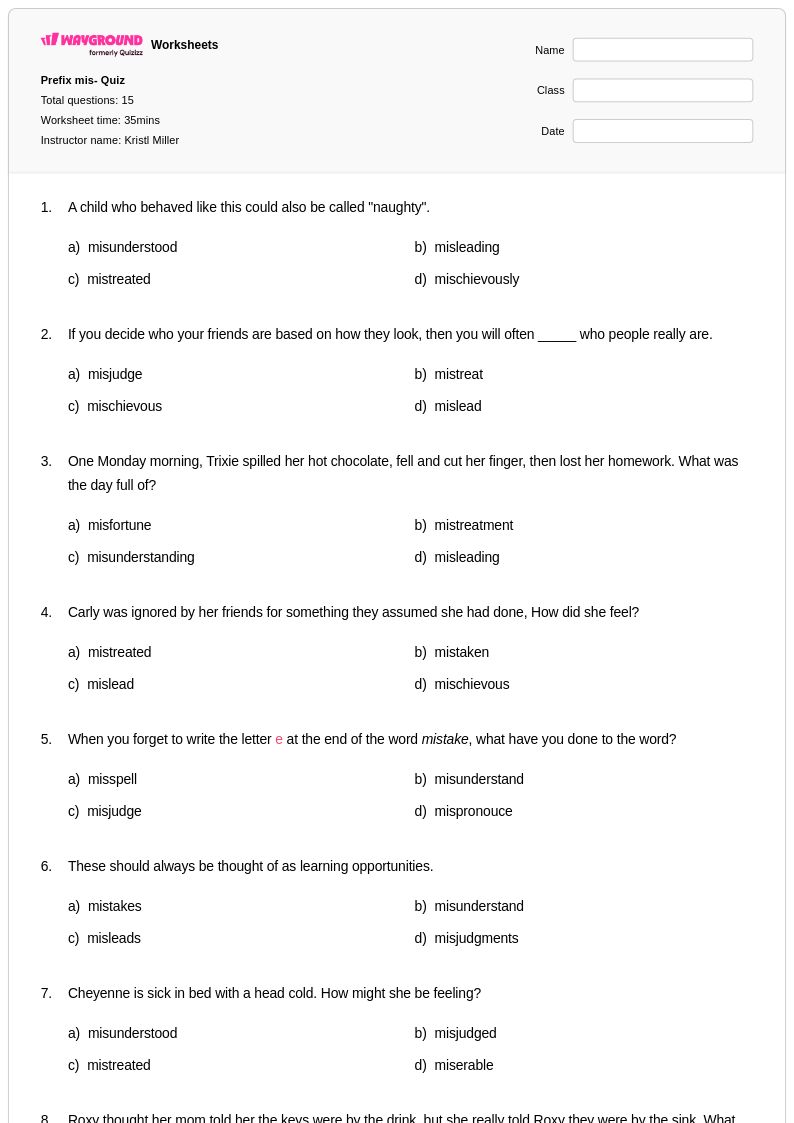
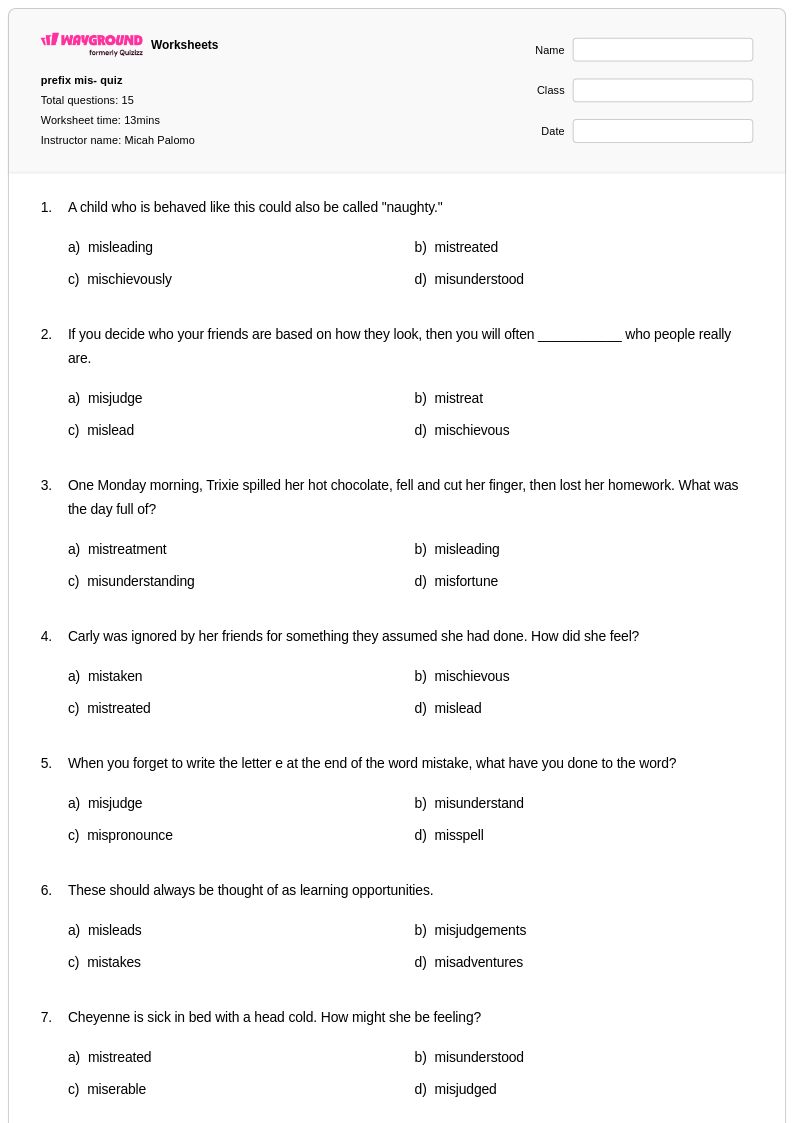
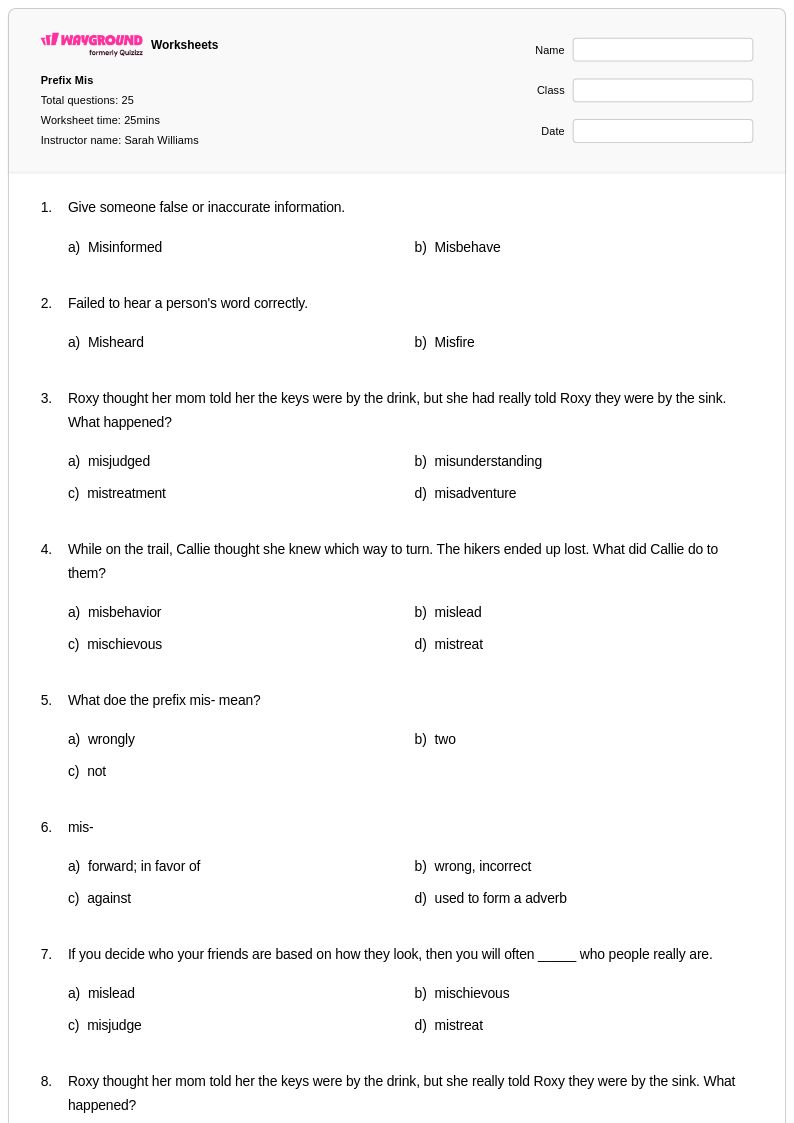
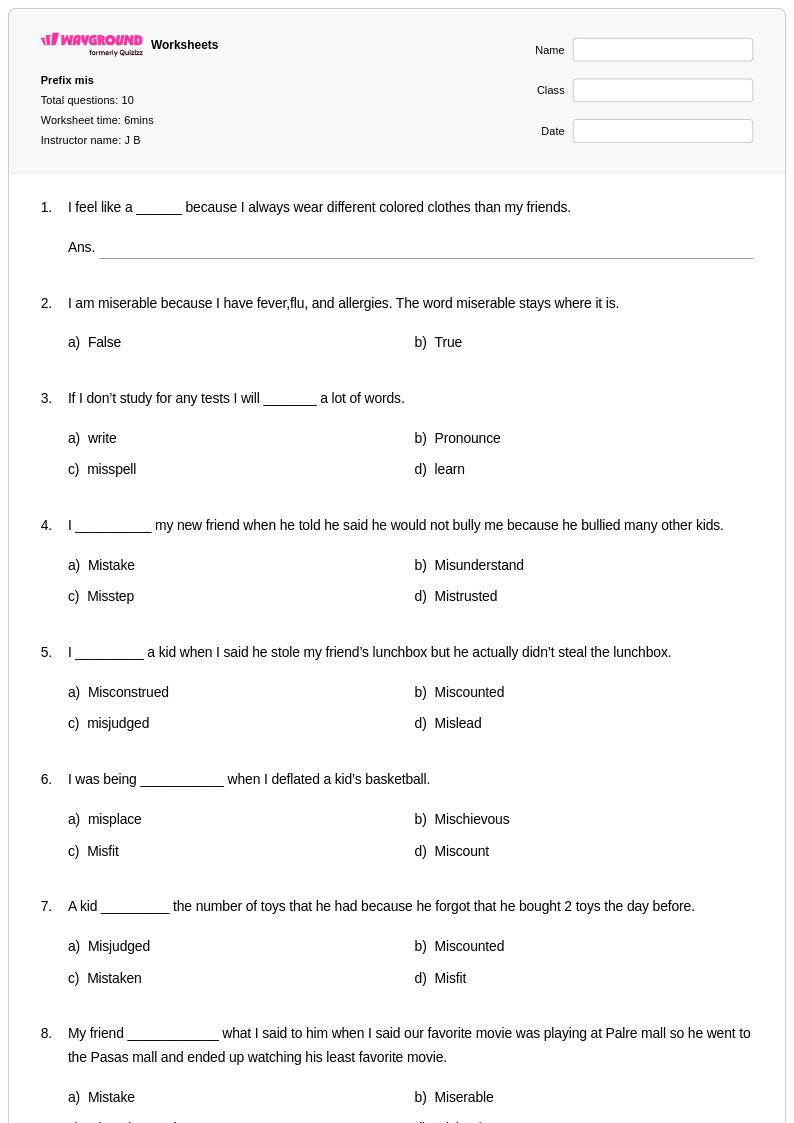
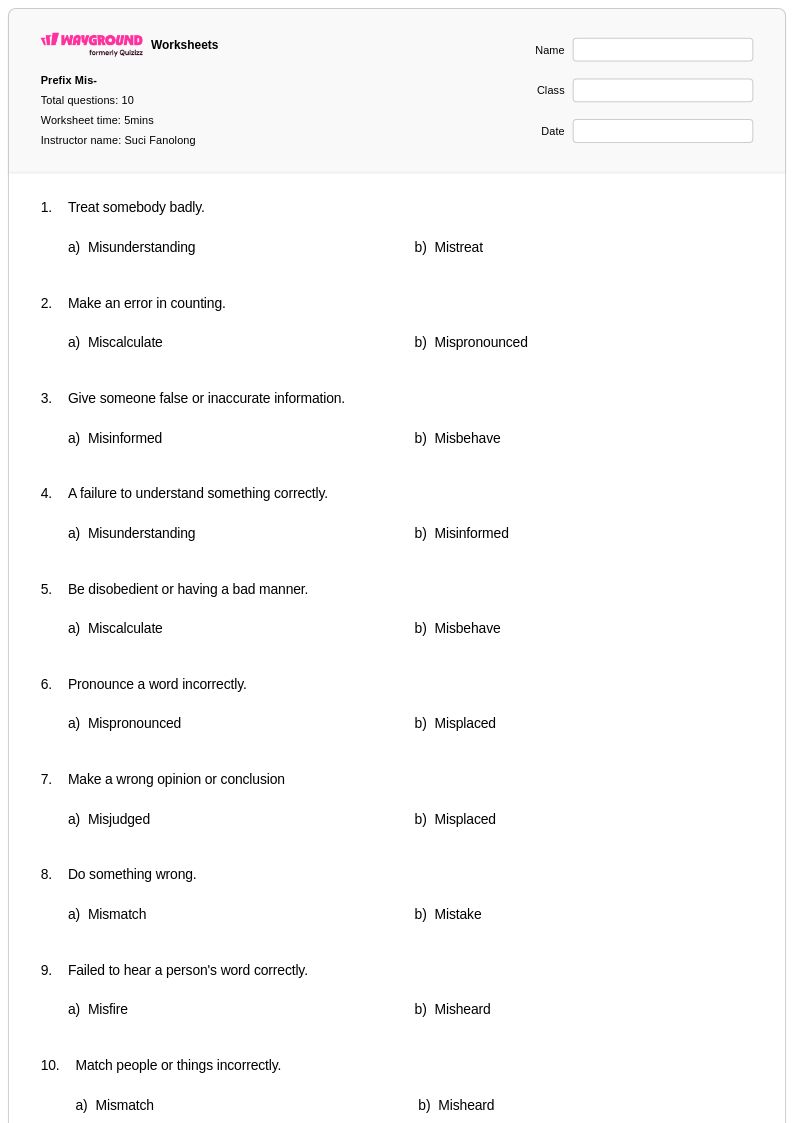
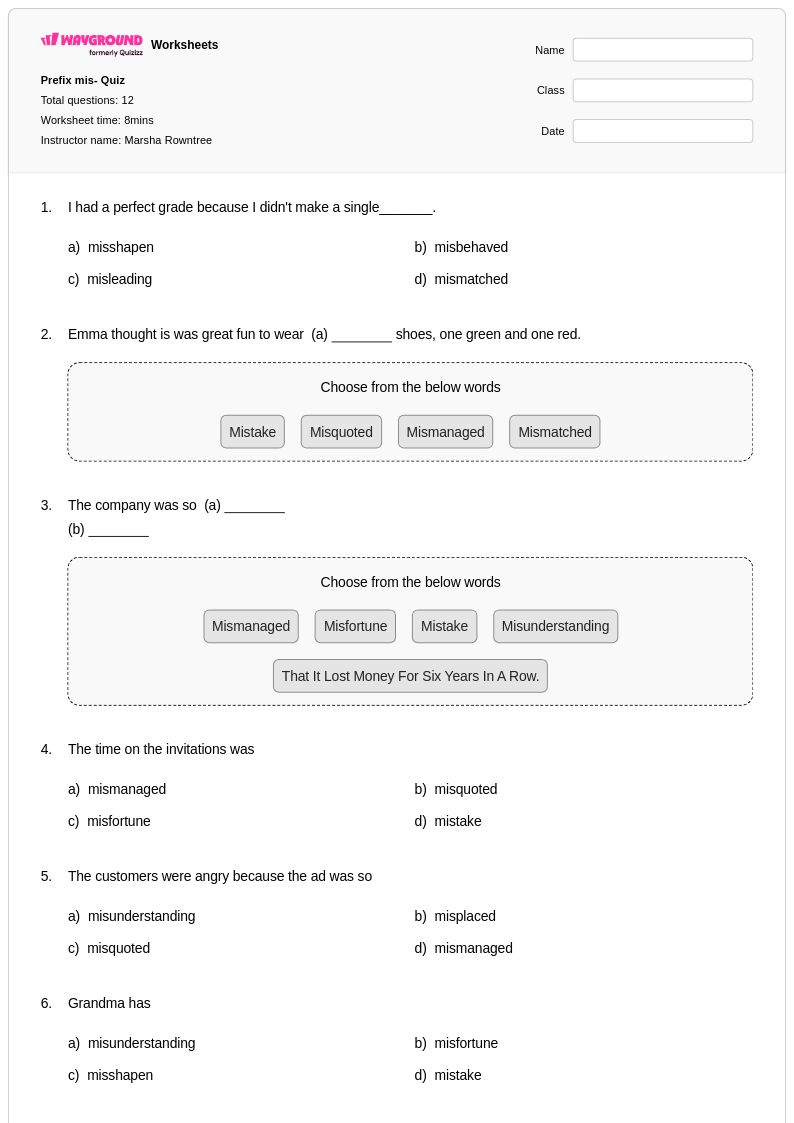
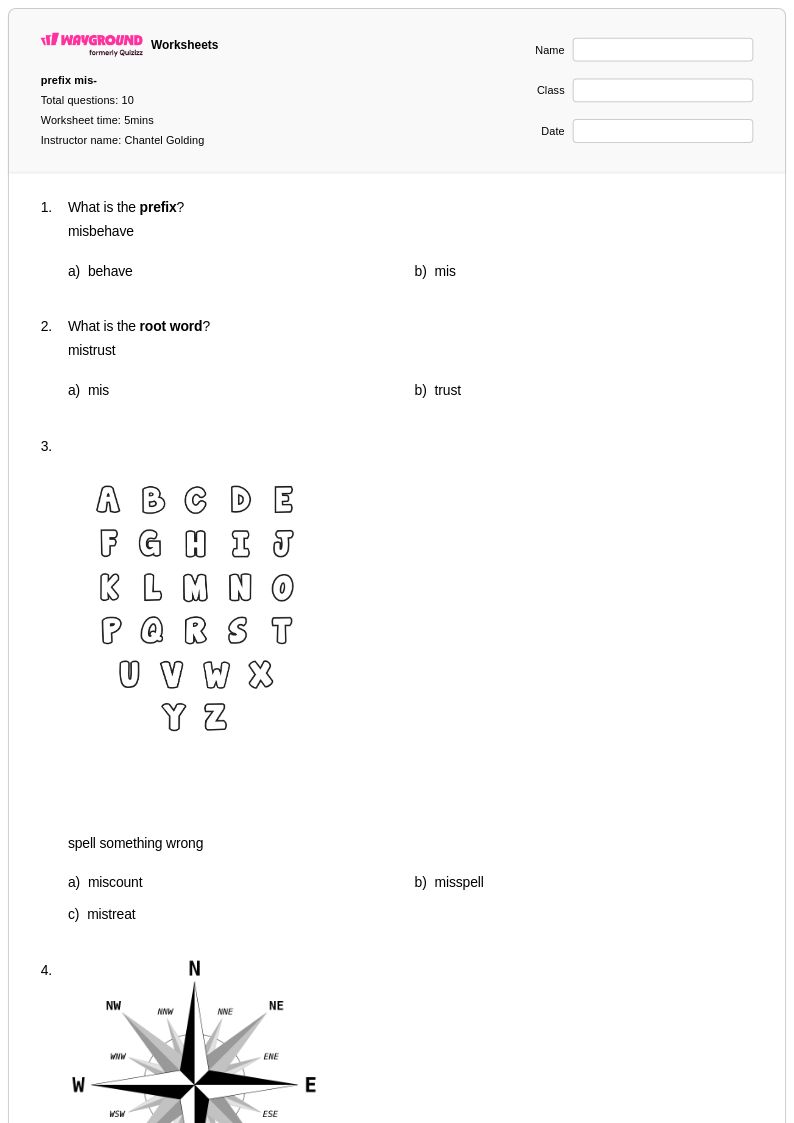
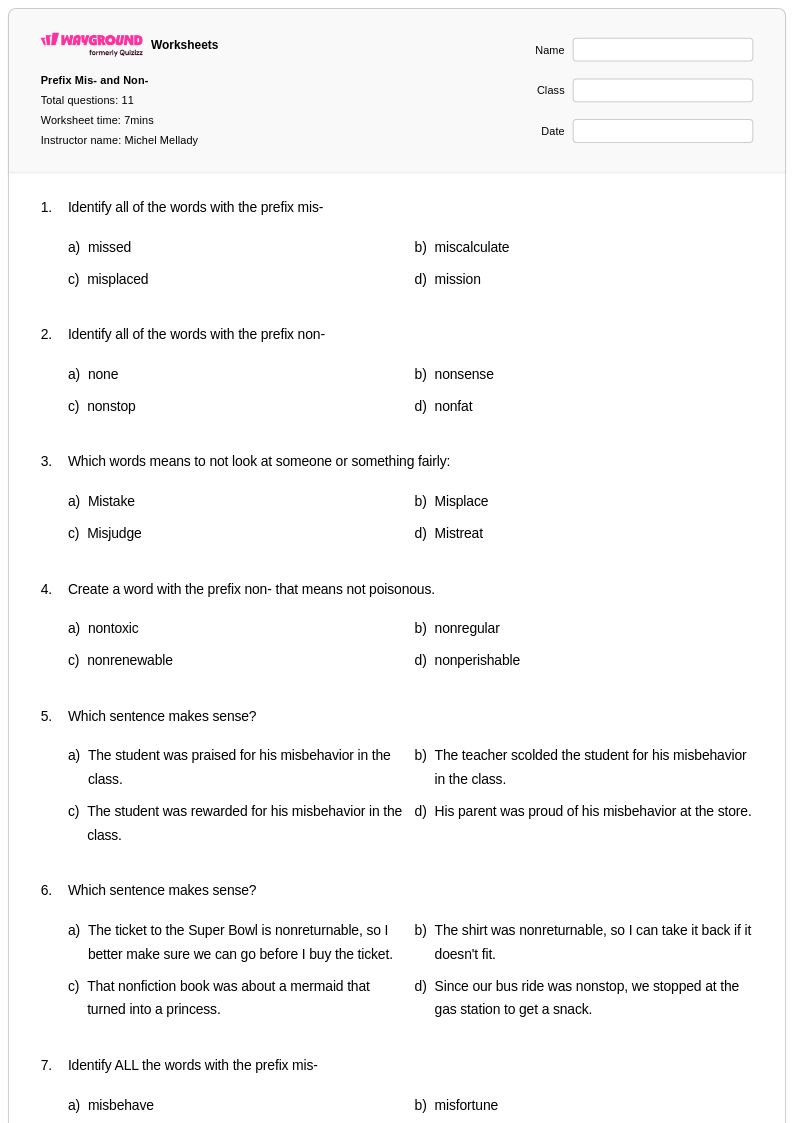
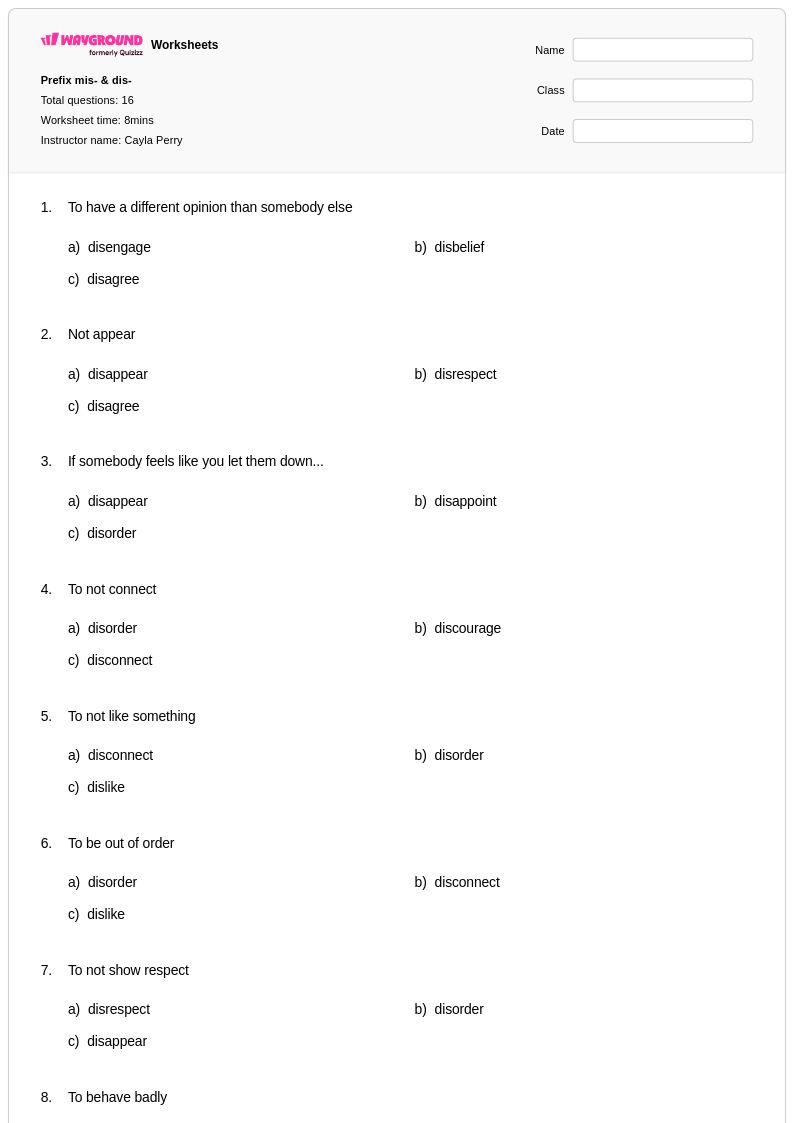
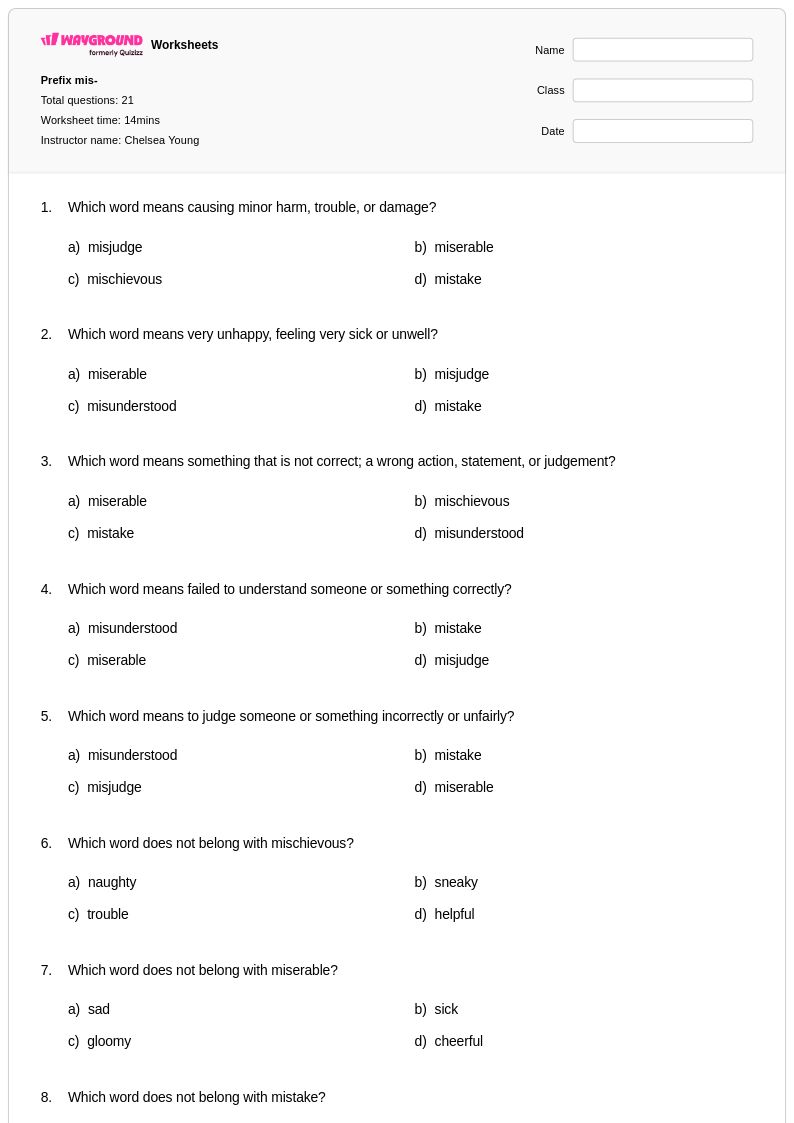
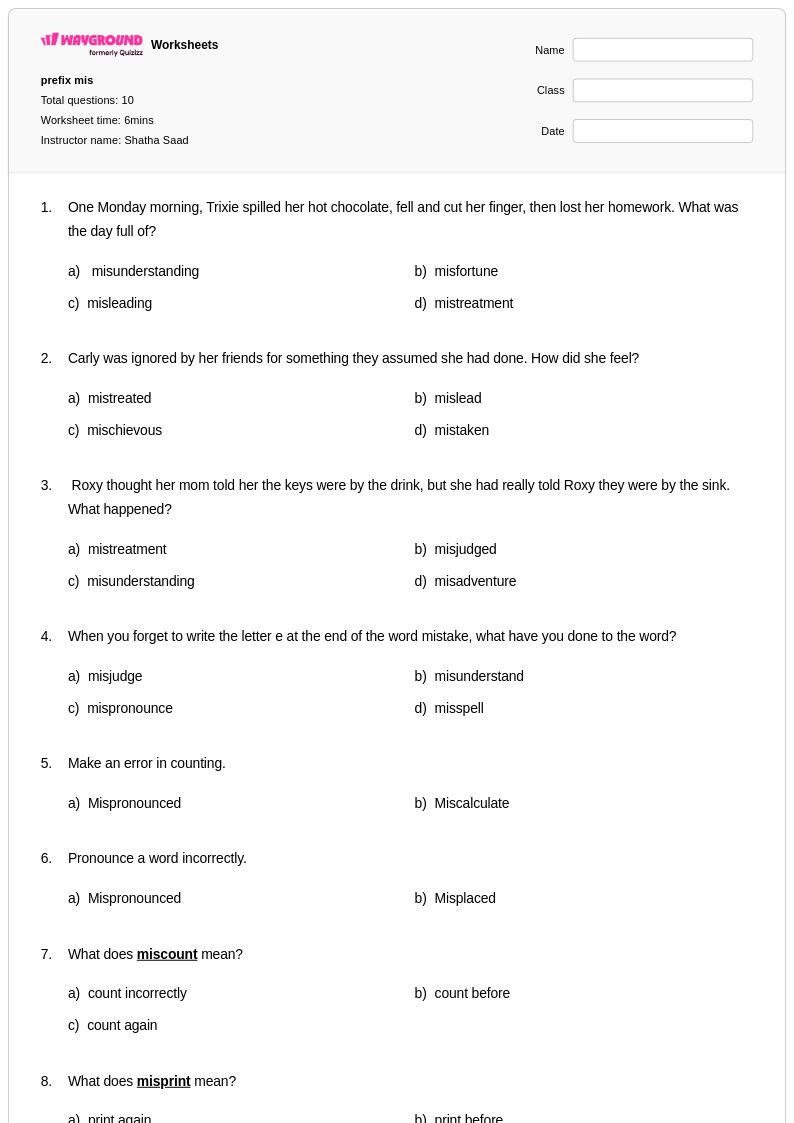
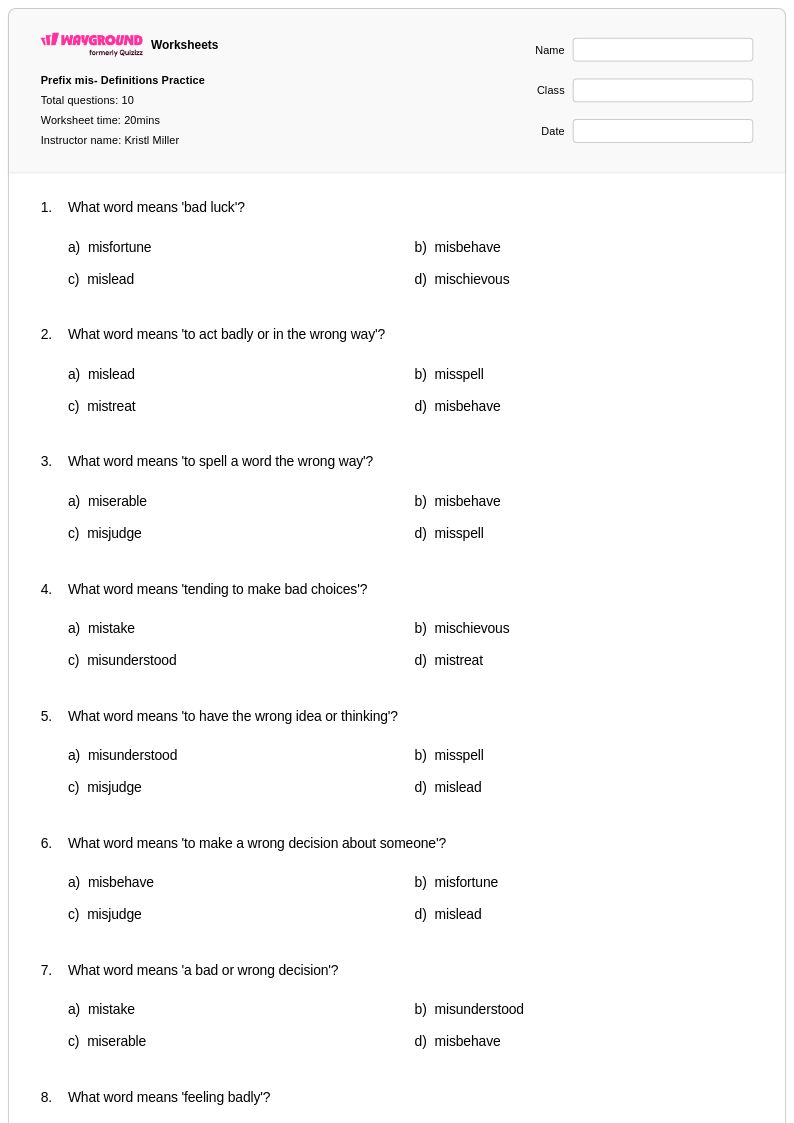
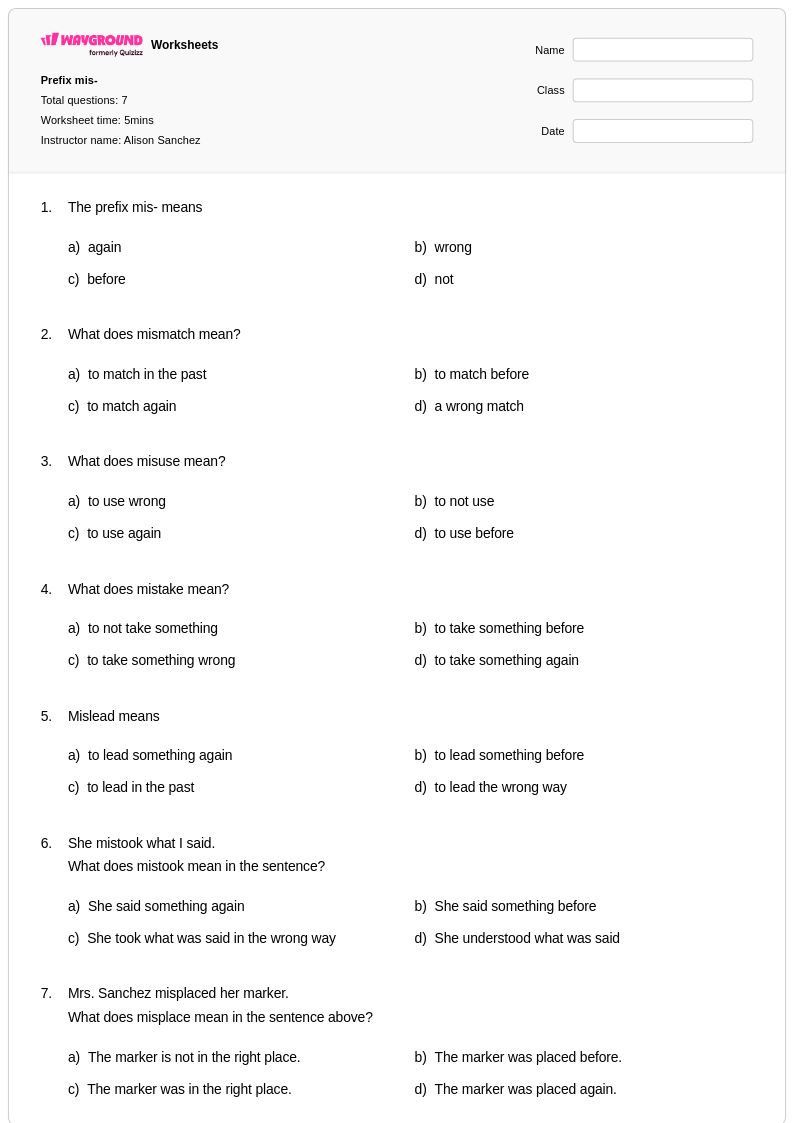
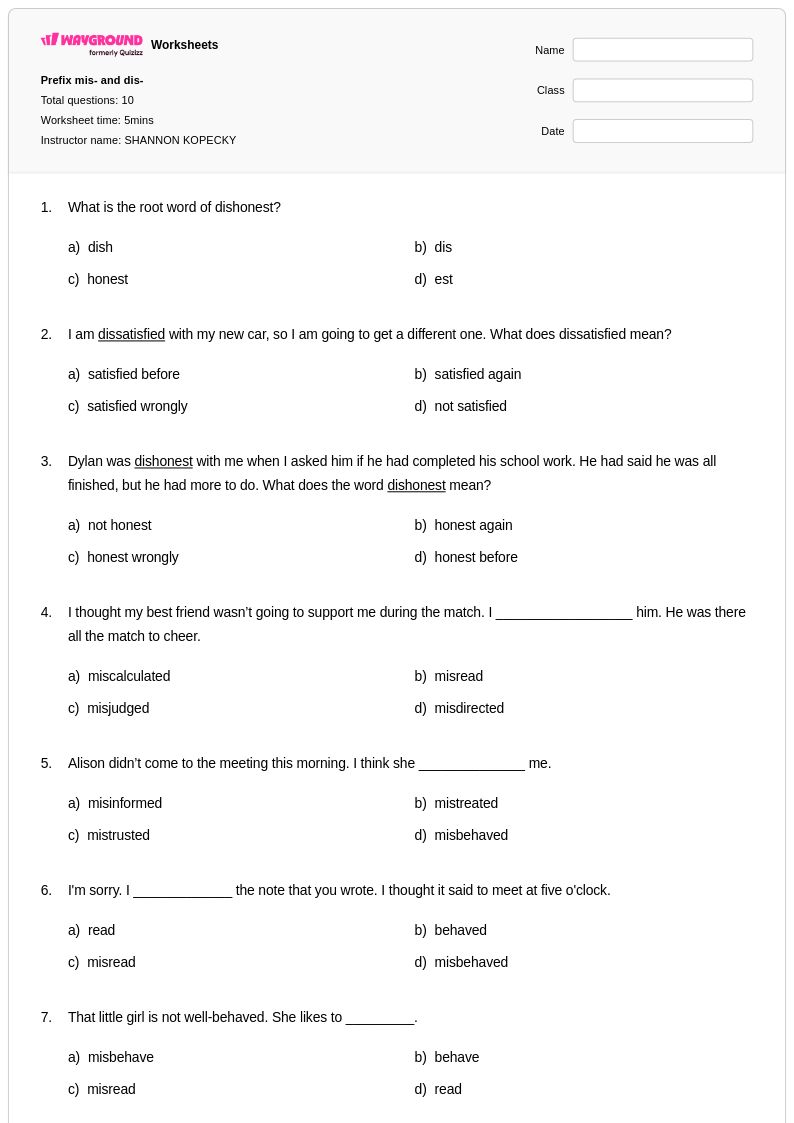
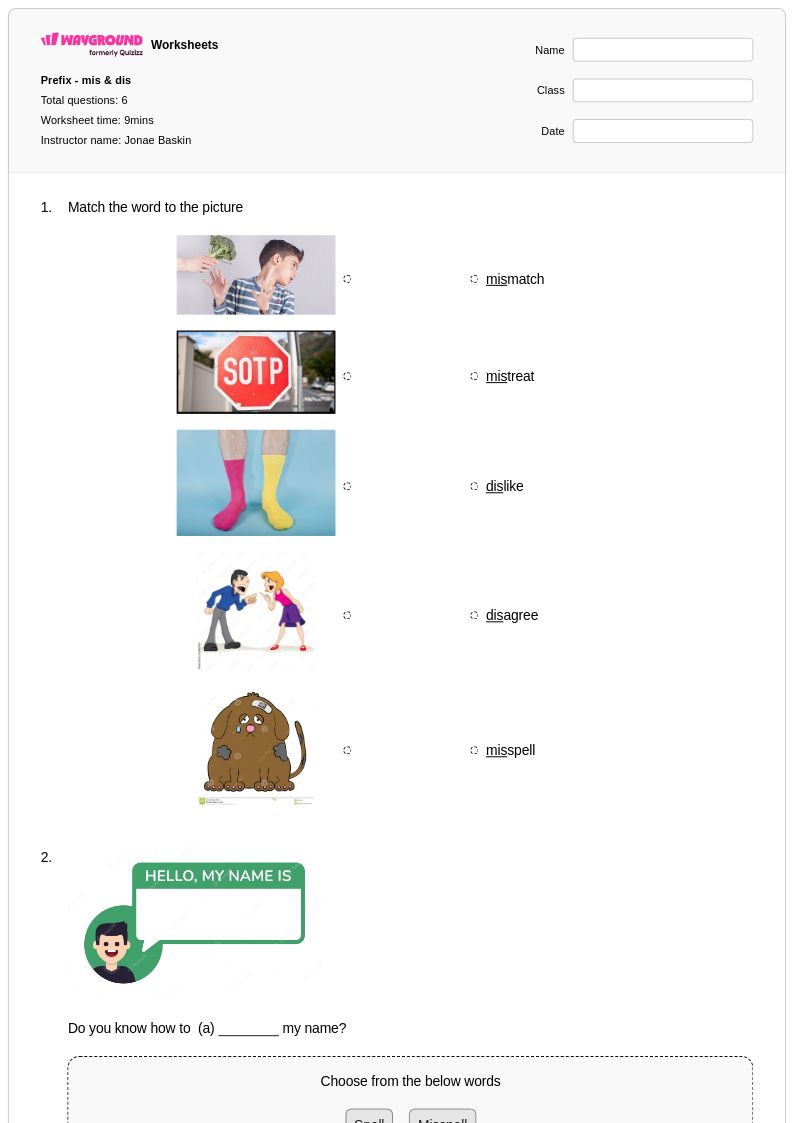
Master the prefix "mis-" with Wayground's comprehensive collection of free worksheets and printables that help students practice identifying, understanding, and applying this common word pattern through engaging exercises, practice problems, and detailed answer keys.
Prefix "mis-" worksheets available through Wayground (formerly Quizizz) provide comprehensive practice opportunities for students to master this essential word pattern that indicates "wrong," "badly," or "incorrectly." These expertly designed educational resources strengthen vocabulary development, reading comprehension, and morphological awareness by helping learners recognize how the prefix "mis-" transforms root words to create new meanings. Students engage with practice problems that challenge them to identify, decode, and apply words like "misunderstand," "misbehave," and "misplace" in various contexts. Each worksheet collection includes detailed answer keys and is available as free printables in convenient PDF format, making it easy for educators to implement structured vocabulary instruction that builds students' word recognition skills and enhances their ability to tackle unfamiliar words containing this common prefix.
Wayground (formerly Quizizz) supports educators with an extensive library of millions of teacher-created prefix "mis-" worksheet resources that feature robust search and filtering capabilities, standards alignment, and comprehensive differentiation tools. Teachers can easily customize these materials to match their specific classroom needs, whether planning whole-group instruction, targeted remediation sessions, or enrichment activities for advanced learners. The platform offers flexible access to both printable and digital formats, including downloadable PDFs, ensuring seamless integration into any learning environment. These thoughtfully curated worksheet collections enable educators to provide systematic skill practice that progresses from basic prefix recognition to complex application exercises, supporting diverse learning styles and helping students develop the morphological awareness essential for vocabulary expansion and reading success.
FAQs
How do I teach the prefix mis- to students?
Start by explicitly teaching that 'mis-' means wrong, badly, or incorrectly, and show students how it changes the meaning of a root word — for example, 'lead' becomes 'mislead.' Use word-sorting activities where students match mis- words to their definitions, then move to sentence-level practice where they apply those words in context. Anchoring instruction in high-frequency examples like 'misunderstand,' 'misbehave,' and 'misplace' helps students build a mental model they can transfer to unfamiliar words.
What exercises help students practice the prefix mis-?
Effective practice exercises include fill-in-the-blank sentences using mis- words, word-building tasks where students attach mis- to given root words, and definition-matching activities. Having students decode unfamiliar mis- words in short reading passages bridges isolated practice to real reading comprehension. Worksheets that progress from identification to application give students the repeated exposure needed to internalize this word pattern.
What mistakes do students commonly make with the prefix mis-?
A frequent error is misidentifying the prefix boundary — students sometimes split a word incorrectly, treating the first two letters of a non-prefixed word as 'mis-' (for example, seeing 'mist' or 'miss' as containing the prefix). Another common misconception is assuming any negative-sounding word uses mis-, which leads to confusion with other prefixes like 'un-' or 'dis-.' Direct comparison activities that contrast mis- with related prefixes help students sharpen this distinction.
How can I differentiate prefix mis- instruction for struggling readers?
For students who need additional support, reduce cognitive load by starting with a small set of high-frequency mis- words before expanding the word bank. Visual anchors — such as a color-coded chart showing the prefix separated from the root — reinforce word structure. On Wayground, teachers can enable the Read Aloud accommodation so students hear words and sentences read to them, and can reduce answer choices to lower the difficulty of multiple-choice questions for individual students.
How do I use Wayground's prefix mis- worksheets in my classroom?
Wayground's prefix mis- worksheets are available as free printable PDFs for traditional classroom use and in digital formats for technology-integrated environments, so they fit whole-group lessons, literacy centers, and homework assignments. Teachers can also host them as a quiz directly on Wayground, giving students an interactive experience with instant feedback. Each worksheet includes a detailed answer key, making it straightforward to review responses and identify students who need additional practice.