Explore Wayground's comprehensive collection of acid base theories worksheets featuring free printables and practice problems with answer keys to help students master fundamental chemistry concepts including Arrhenius, Bronsted-Lowry, and Lewis theories.
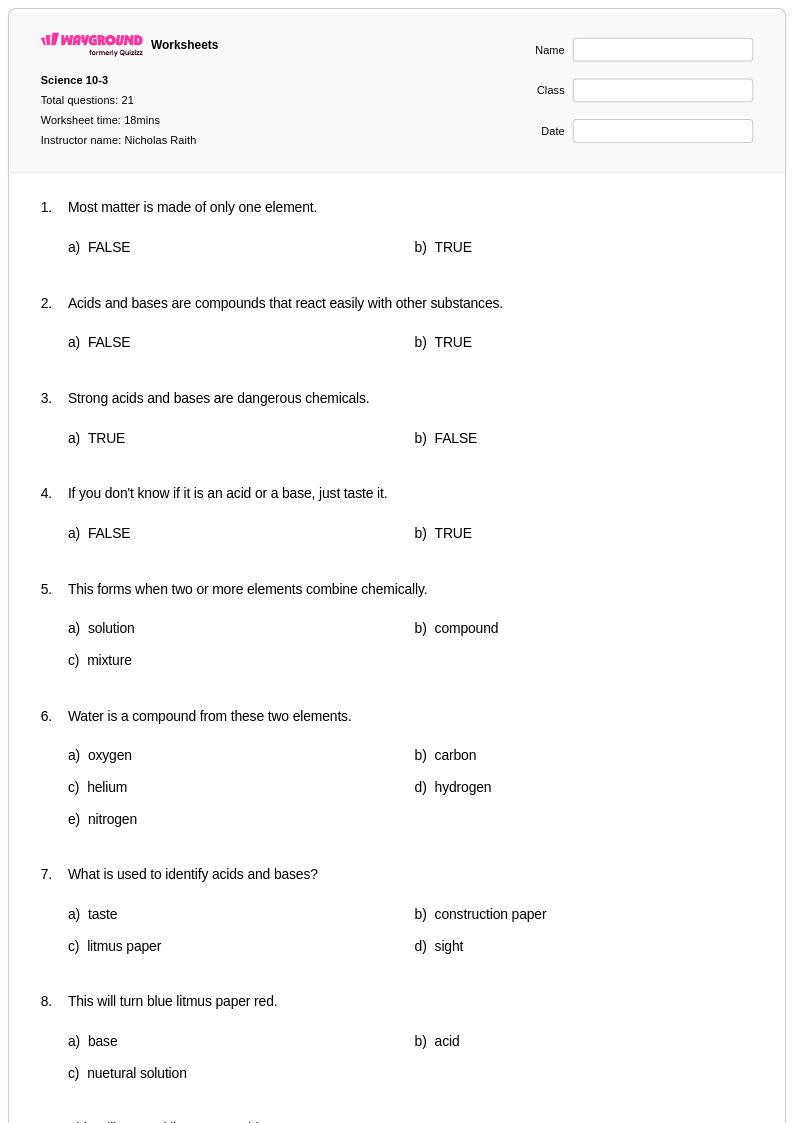
Acid base theories worksheets available through Wayground (formerly Quizizz) provide comprehensive coverage of fundamental chemical concepts that form the cornerstone of modern chemistry education. These expertly designed worksheets guide students through the evolution of acid-base understanding, from Arrhenius's pioneering definitions to Brønsted-Lowry proton transfer concepts and Lewis electron pair theory. Each worksheet strengthens critical analytical skills by presenting practice problems that require students to identify acids and bases according to different theoretical frameworks, predict reaction outcomes, and understand the limitations and applications of each theory. The collection includes detailed answer keys that support independent learning and self-assessment, while printable pdf formats ensure accessibility across diverse classroom environments. These free educational resources systematically build conceptual understanding through carefully sequenced problems that progress from basic definitions to complex comparative analysis of theoretical models.
Wayground's extensive collection of acid base theories worksheets draws from millions of teacher-created resources, offering educators unprecedented flexibility in curriculum planning and student support. The platform's robust search and filtering capabilities enable teachers to quickly locate materials that align with specific learning standards and match their students' developmental needs. Advanced differentiation tools allow instructors to customize worksheet difficulty levels, ensuring appropriate challenge for both remediation and enrichment activities. Whether delivered in traditional printable formats or interactive digital versions, these worksheets seamlessly integrate into diverse teaching approaches, from structured skill practice sessions to independent study assignments. The comprehensive nature of the collection supports teachers in addressing varying learning styles and pacing requirements, while the quality assurance inherent in peer-reviewed, educator-developed content ensures that students receive accurate, pedagogically sound instruction in these essential chemical principles.
FAQs
How do I teach the three acid-base theories in sequence?
Start with Arrhenius theory as the foundation, since it defines acids as hydrogen ion producers and bases as hydroxide ion producers in aqueous solution. Then introduce Brønsted-Lowry theory to expand students' understanding to proton transfer reactions, which covers non-aqueous contexts Arrhenius cannot explain. Finally, present Lewis theory as the broadest framework, focused on electron pair donation and acceptance. Moving through the theories chronologically helps students see why each new model was developed and where the previous one fell short.
What exercises help students practice identifying conjugate acid-base pairs?
Practice problems that show a proton transfer reaction and ask students to label the acid, base, conjugate acid, and conjugate base are most effective for reinforcing Brønsted-Lowry concepts. Exercises that require students to write the conjugate base of a given acid, or the conjugate acid of a given base, build fluency with the relationship between paired species. Including both strong and weak acid examples prevents students from overgeneralizing. Acid-base theory worksheets that progress from single-step identification to predicting the direction of equilibrium provide structured scaffolding for this skill.
What mistakes do students commonly make when comparing acid-base theories?
The most common misconception is treating the three theories as contradictory rather than as progressively broader frameworks. Students often struggle to accept that a substance can be an acid under Lewis theory without donating a proton, which conflicts with their Brønsted-Lowry understanding. Another frequent error is applying Arrhenius definitions outside aqueous solutions, where the theory does not apply. Students also confuse Lewis acids with Lewis bases by misremembering which species donates and which accepts the electron pair.
How do I differentiate acid-base theory instruction for students at different levels?
For students who need additional support, focus initial practice on Arrhenius definitions using familiar strong acids and bases before introducing proton transfer language. Advanced students can be challenged with problems that require them to classify the same compound under all three theories and explain any discrepancies. On Wayground, teachers can apply accommodations such as reduced answer choices for students who need lower cognitive load, or enable Read Aloud for students who benefit from audio support, without other students being aware of those individual settings.
How can I use Wayground's acid-base theories worksheets in my classroom?
Wayground's acid-base theories worksheets are available as printable PDFs for traditional classroom use and in digital formats for technology-integrated learning environments, making them flexible for both in-person and remote instruction. Teachers can also host the worksheets as a quiz directly on Wayground, which allows for real-time student responses and built-in answer key support. The digital format is well-suited for assigning independent practice or review ahead of a unit test on acid-base chemistry.
How do I assess whether students truly understand Lewis acid-base theory versus just memorizing definitions?
Assessment problems should go beyond definition recall and require students to identify Lewis acids and bases in unfamiliar compounds, particularly those that lack an obvious proton to donate. Ask students to draw electron pair diagrams showing the donation and acceptance in a Lewis acid-base reaction, which exposes whether they understand the mechanism rather than just the label. Problems involving transition metal complexes or boron compounds are especially useful because they cannot be explained by Arrhenius or Brønsted-Lowry frameworks, forcing students to apply Lewis theory specifically.