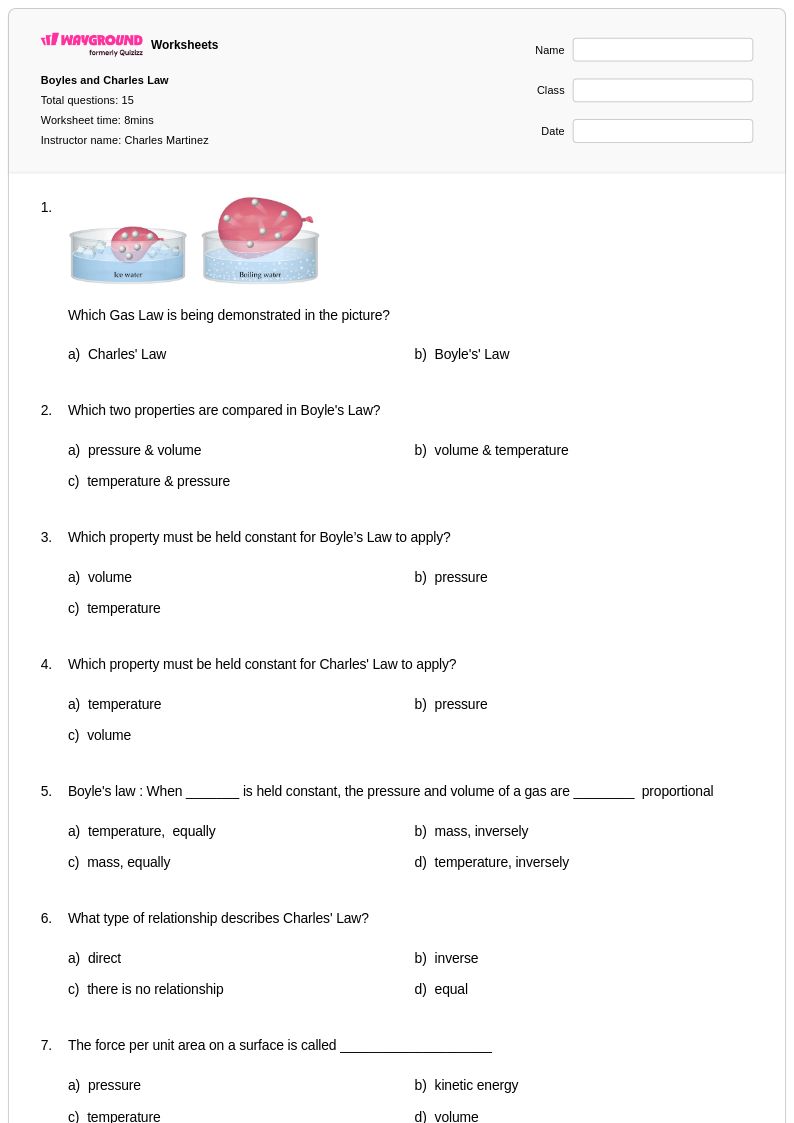
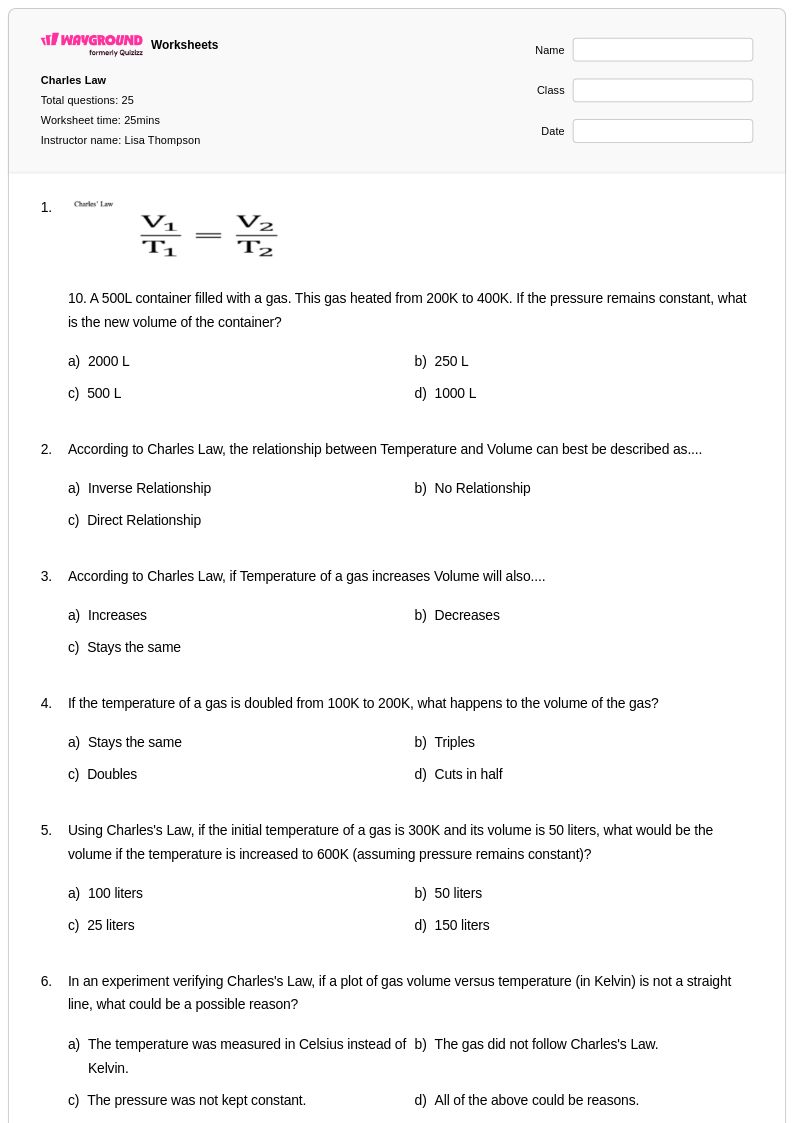
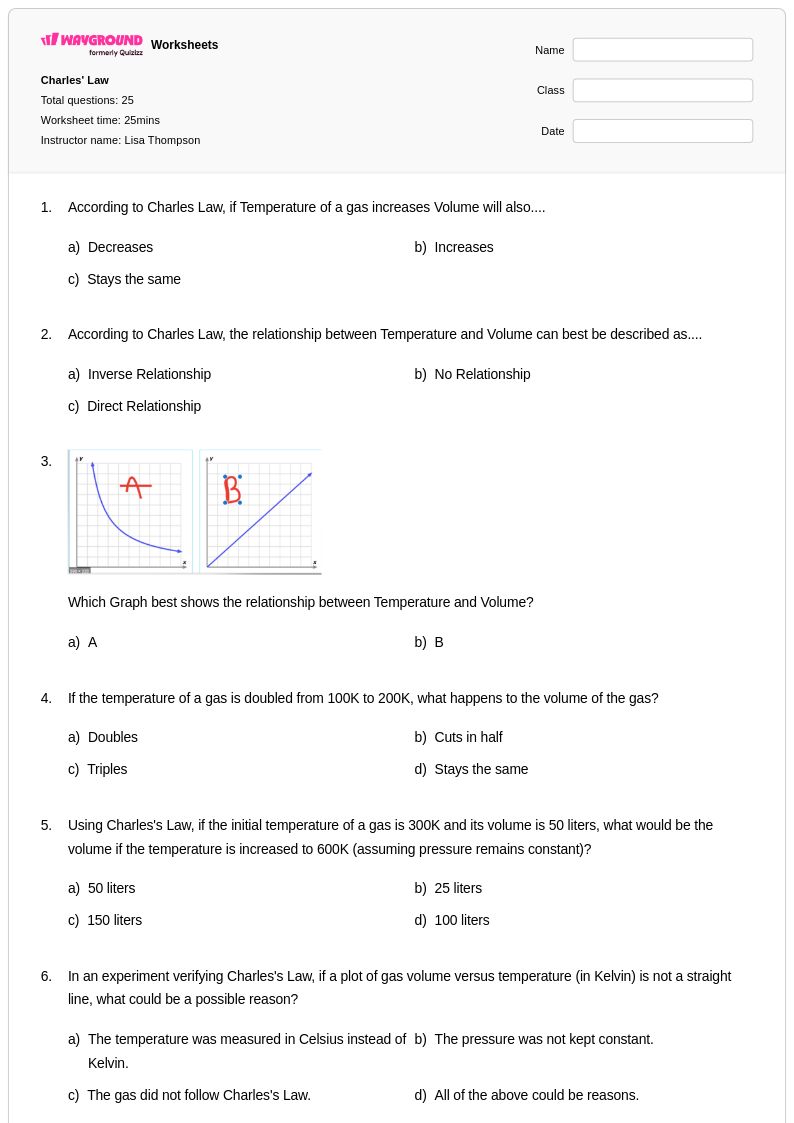
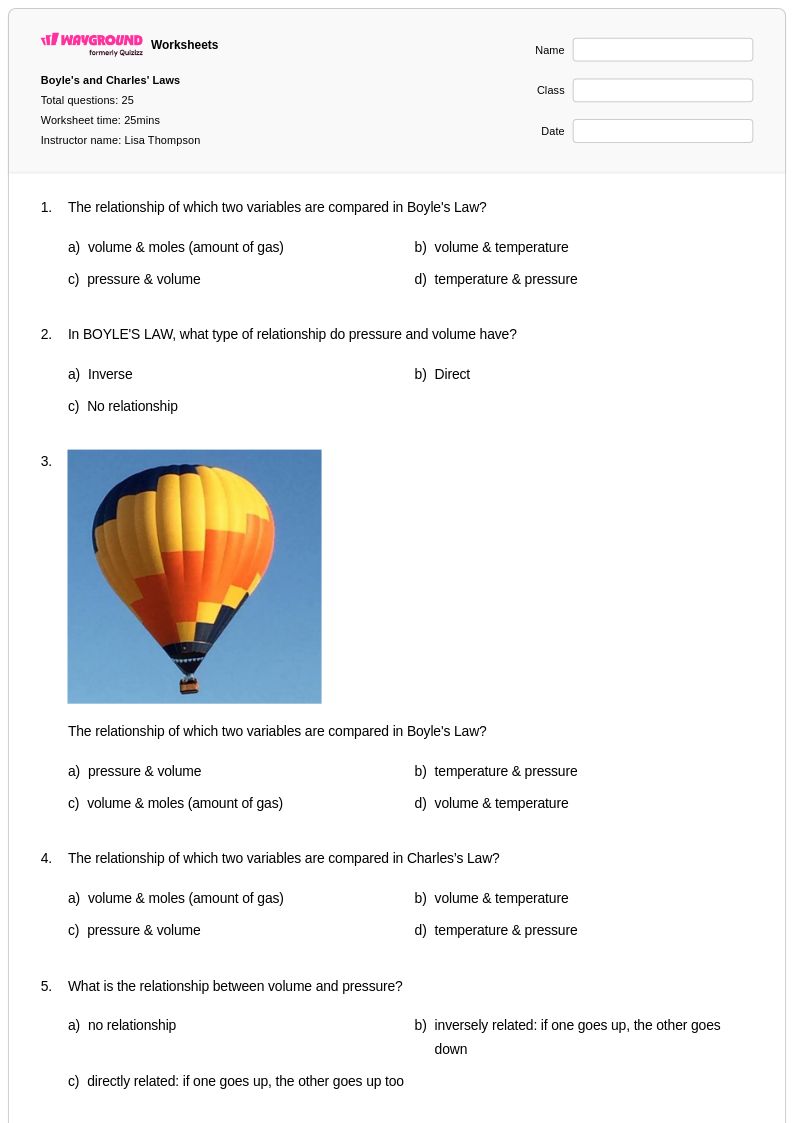
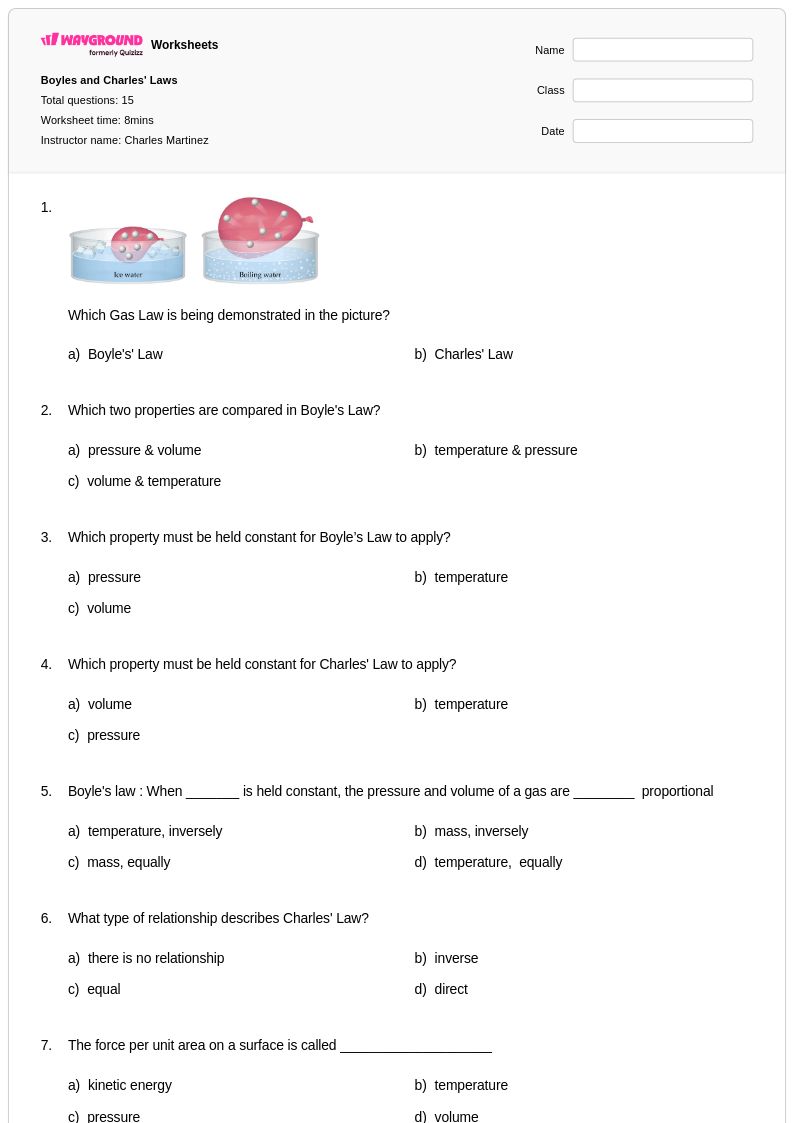
Explore Wayground's free Charles' Law worksheets and printables with practice problems and answer keys to help students master the relationship between gas volume and temperature in chemistry.
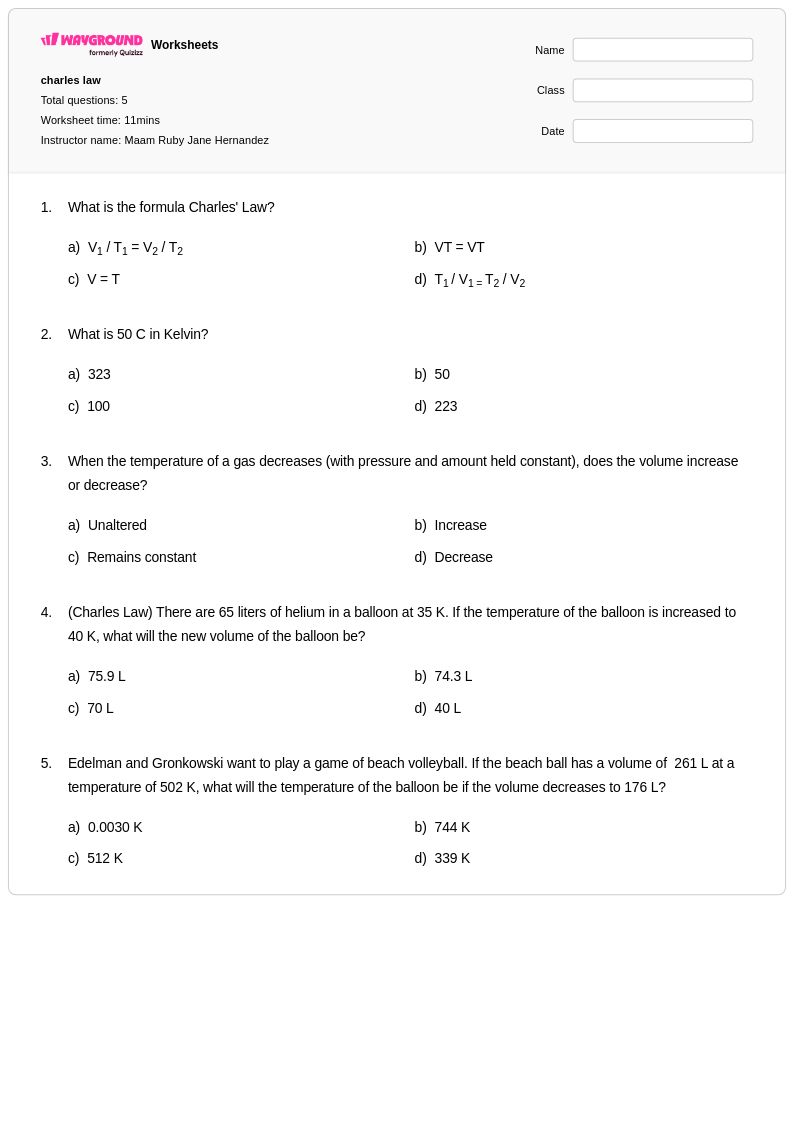
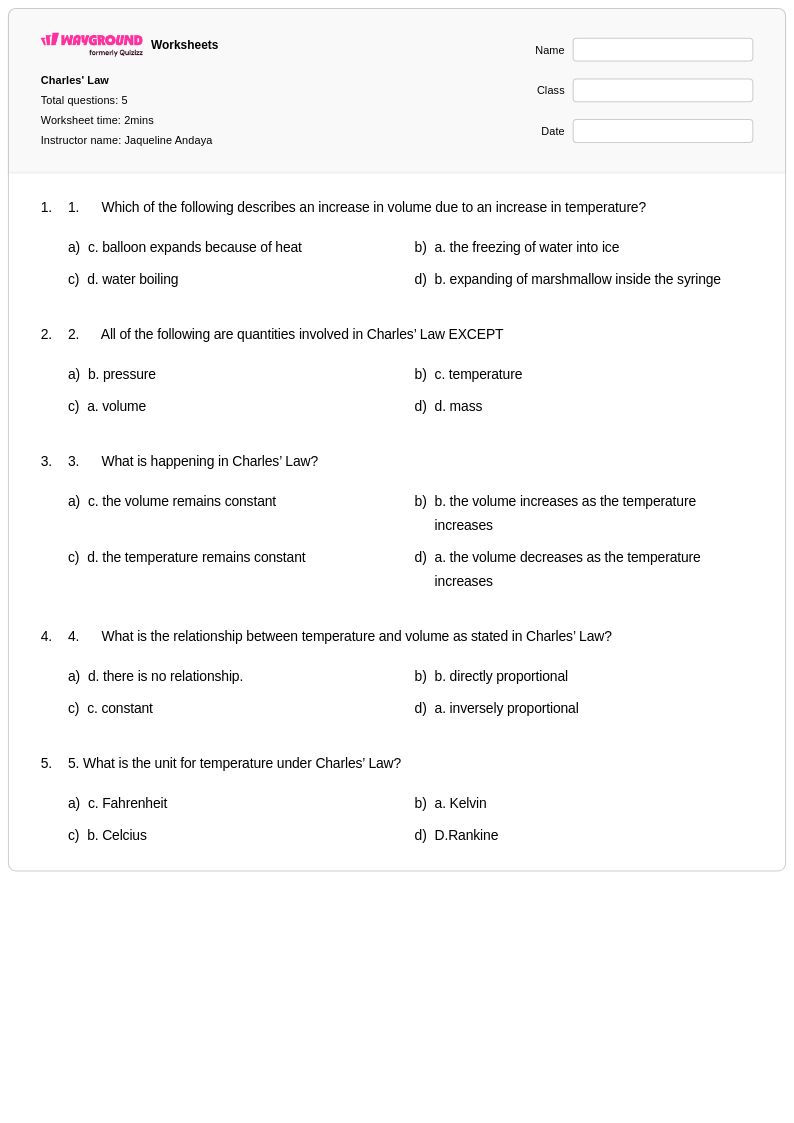
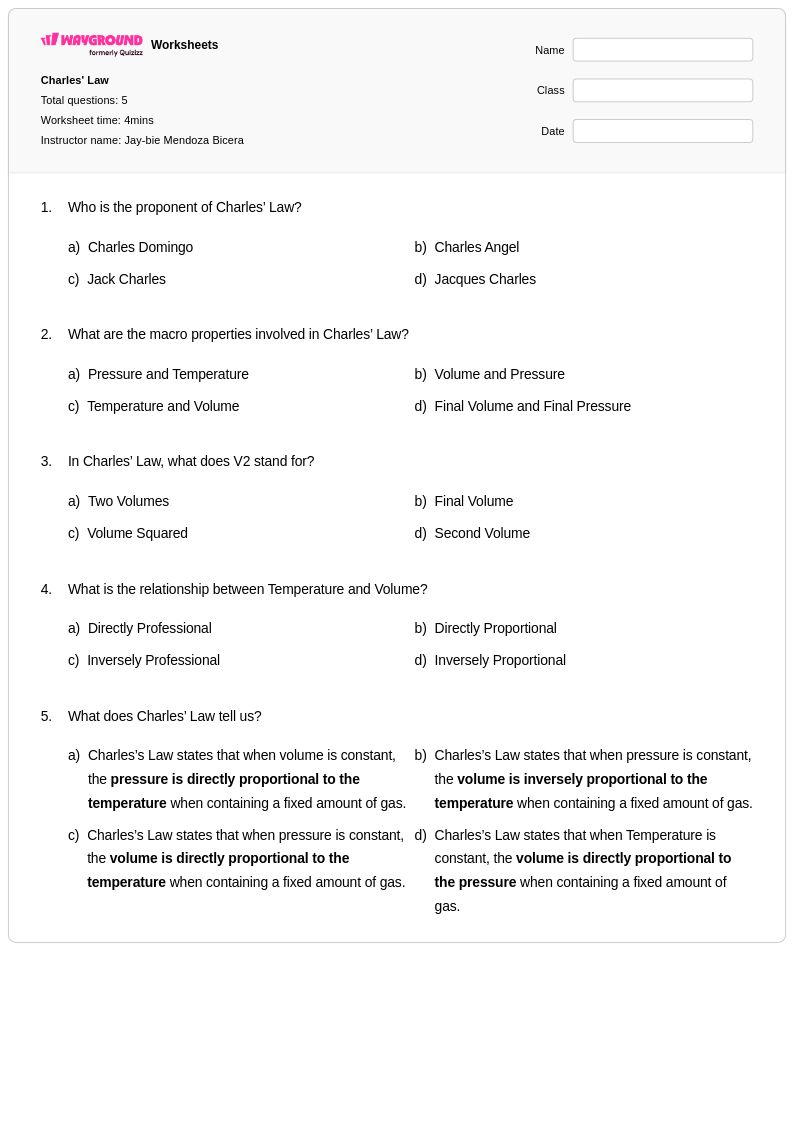
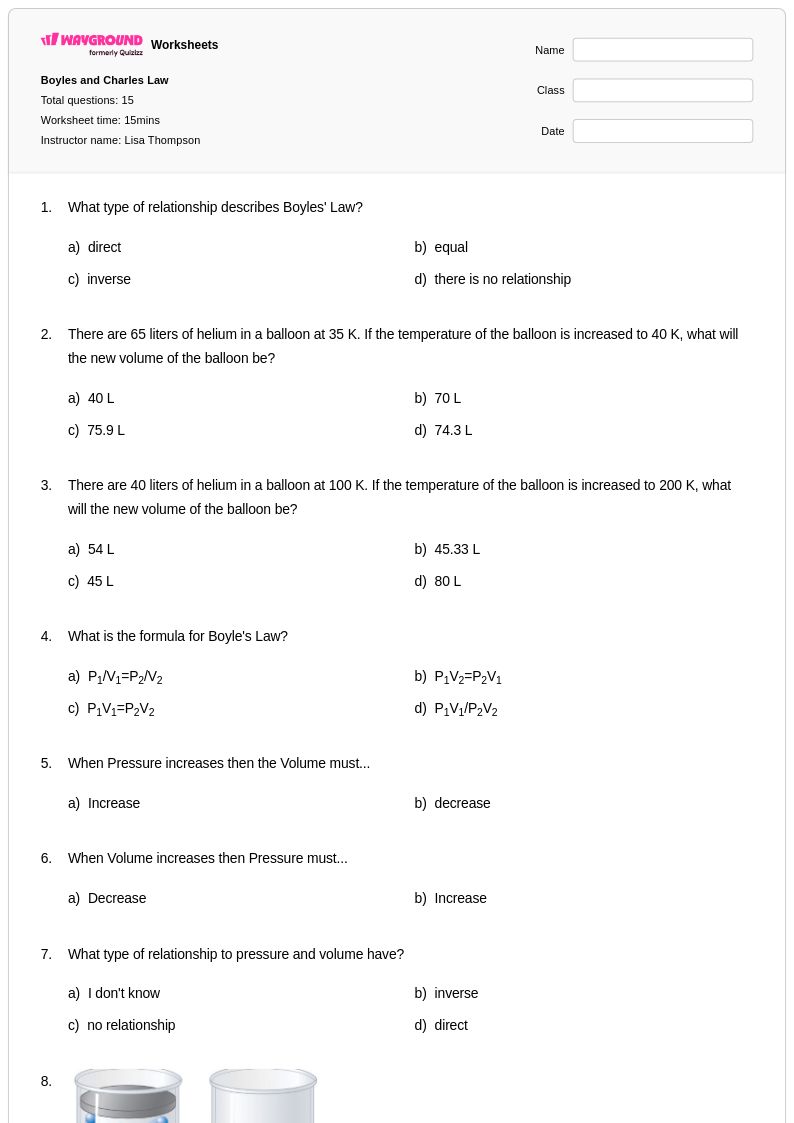
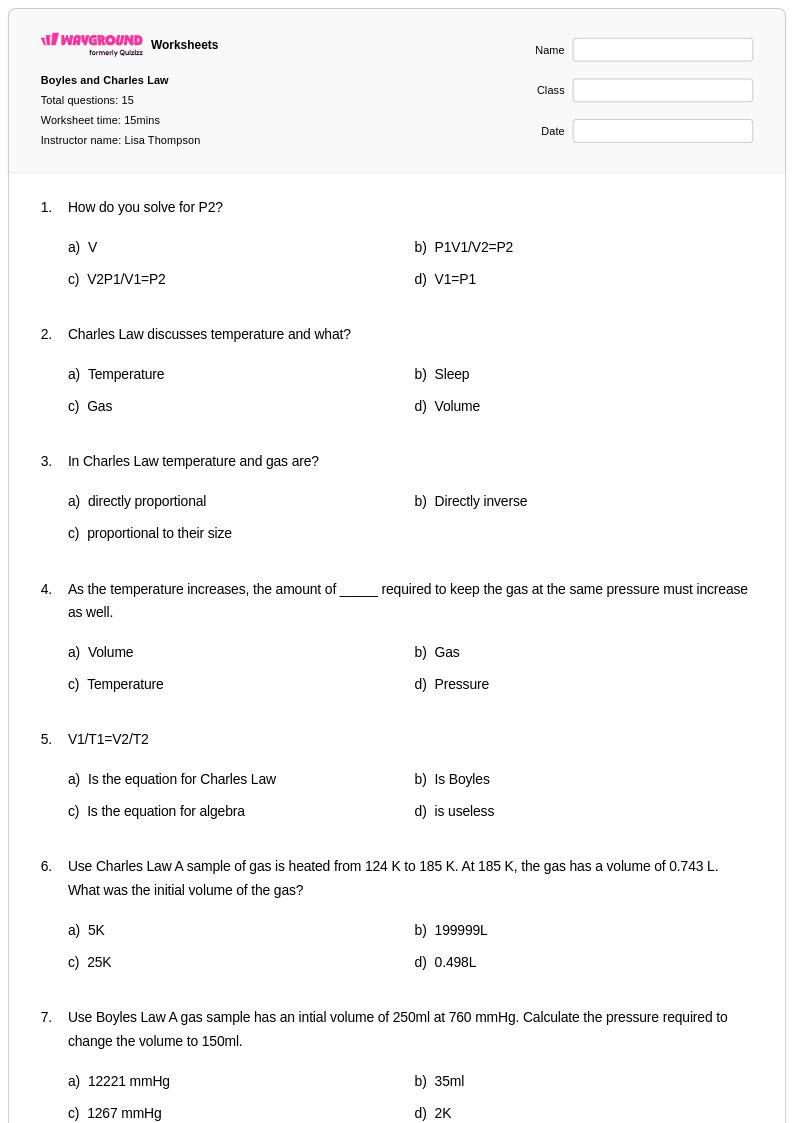
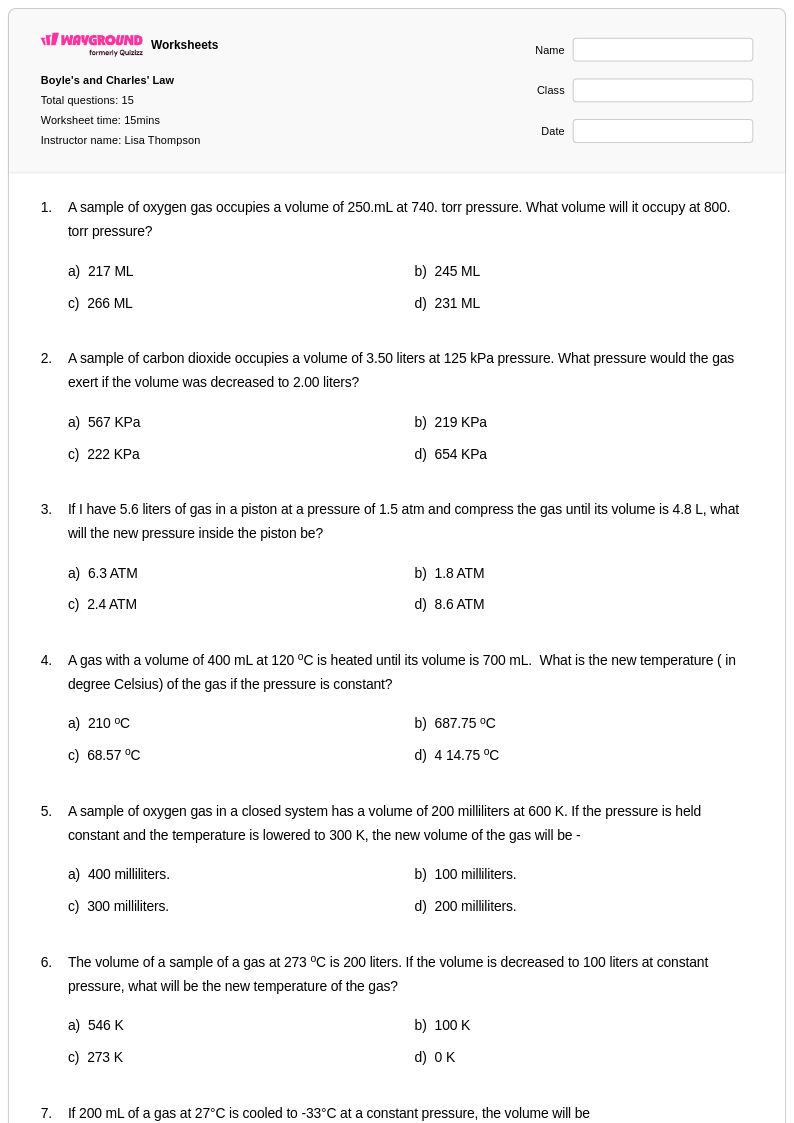
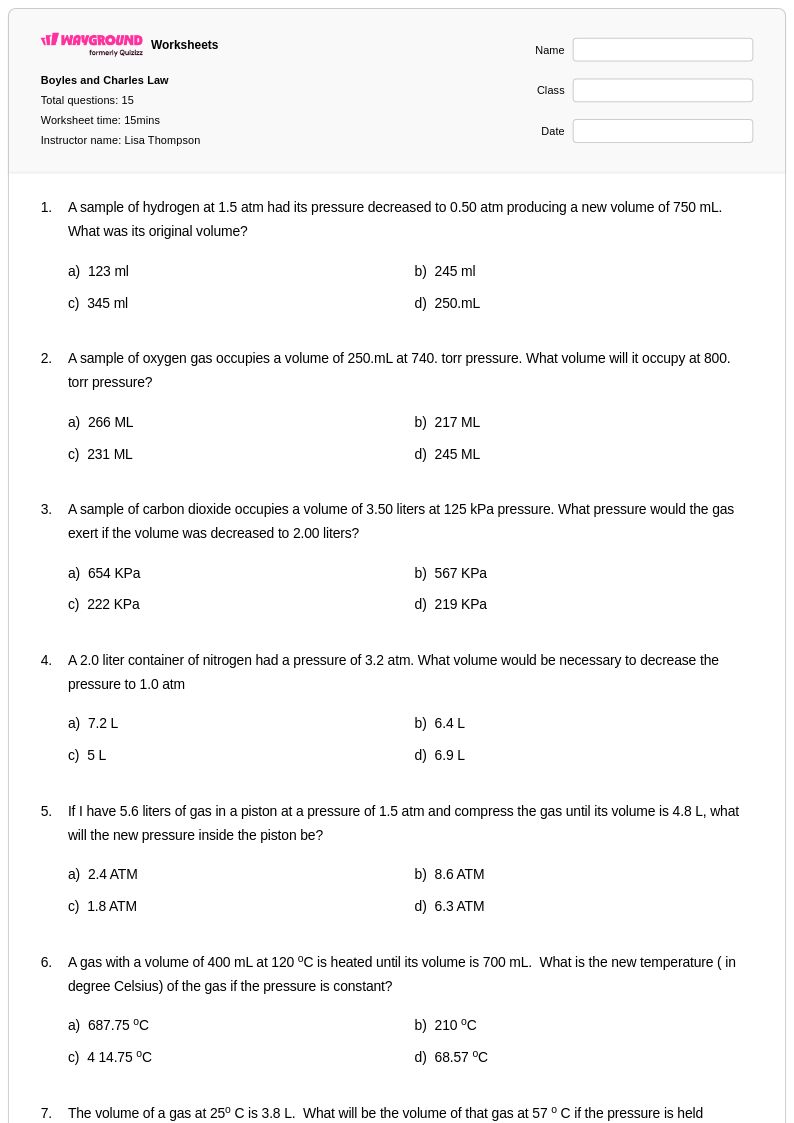
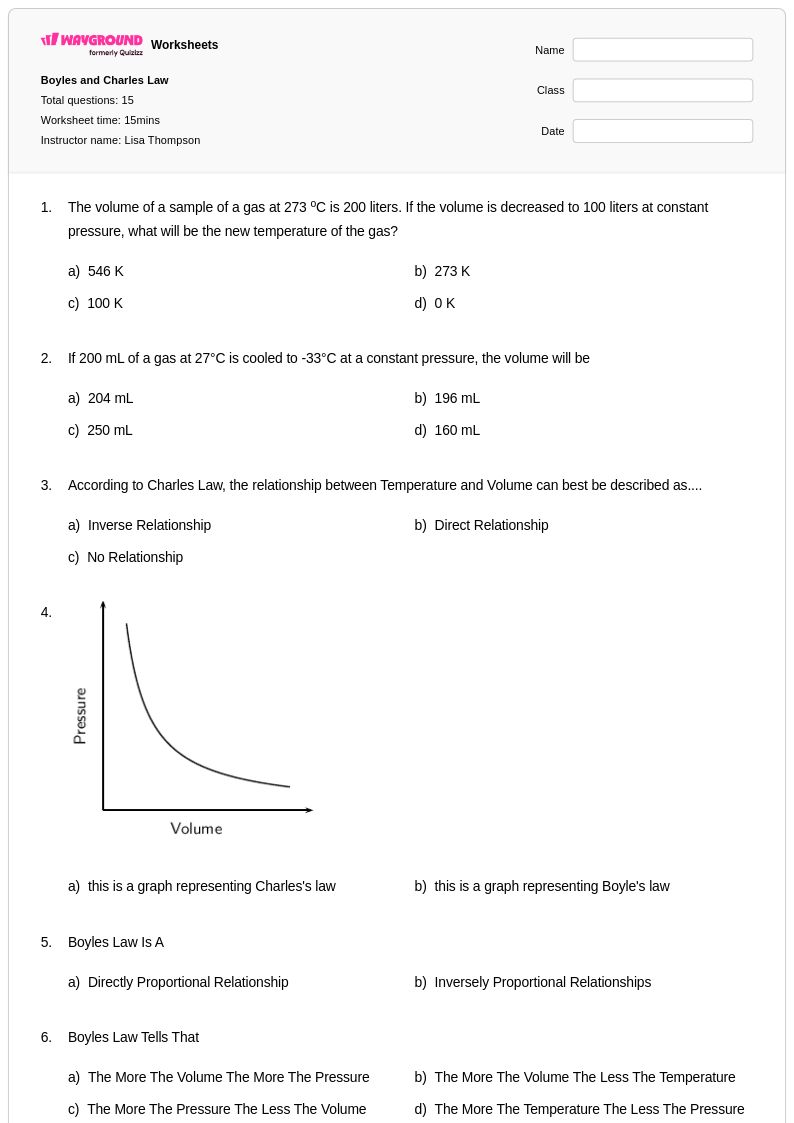
Charles' Law worksheets available through Wayground (formerly Quizizz) provide comprehensive practice opportunities for students to master this fundamental gas law principle in chemistry. These educational resources focus on the direct relationship between gas volume and temperature at constant pressure, helping students understand how gases expand when heated and contract when cooled. The worksheets strengthen critical scientific skills including data analysis, graphing proportional relationships, mathematical problem-solving with gas law equations, and applying theoretical concepts to real-world scenarios. Students work through practice problems that range from basic calculations using the V₁/T₁ = V₂/T₂ formula to more complex applications involving temperature conversions between Celsius and Kelvin scales. Each worksheet collection includes detailed answer keys and is available as free printables in pdf format, making them accessible for both classroom instruction and independent study.
Wayground (formerly Quizizz) supports chemistry educators with an extensive collection of millions of teacher-created Charles' Law resources that can be easily searched and filtered to match specific curriculum needs and learning objectives. The platform's robust differentiation tools allow teachers to customize worksheets for various skill levels, from introductory gas law concepts to advanced applications in thermodynamics. These materials align with chemistry standards and are available in both printable pdf formats for traditional paper-based learning and digital formats for interactive online practice. Teachers can efficiently plan lessons using these ready-made resources while also accessing materials for targeted remediation when students struggle with gas law calculations or for enrichment activities that challenge advanced learners to explore real-world applications like hot air balloons, automotive engines, and atmospheric science. The flexible customization options enable educators to modify existing worksheets or combine multiple resources to create comprehensive skill practice sessions that meet their specific classroom requirements.
FAQs
How do I teach Charles' Law to chemistry students?
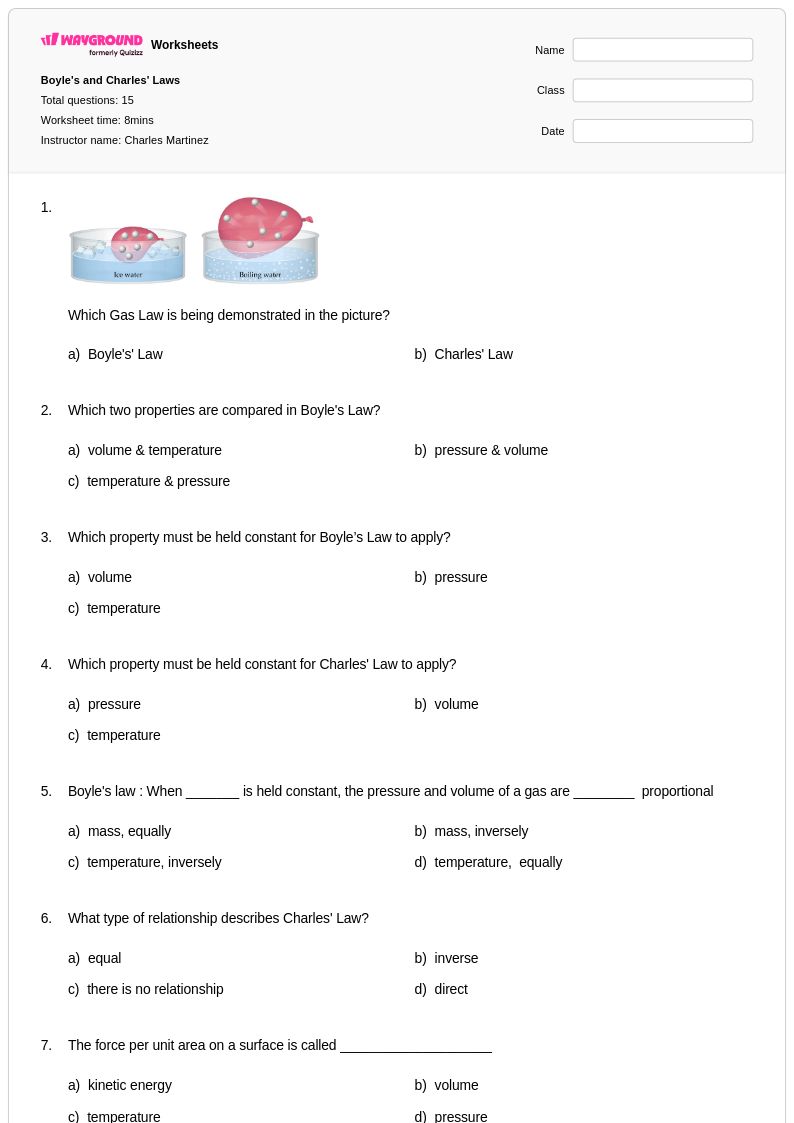
Start by building conceptual understanding before introducing the formula: use a balloon placed in hot and cold water to demonstrate how gas volume changes with temperature at constant pressure. Once students observe the relationship visually, introduce the direct proportionality and connect it to the V₁/T₁ = V₂/T₂ equation. Anchoring the math in a physical demonstration significantly reduces confusion about why temperature must be in Kelvin, not Celsius.
What practice problems should students work through to master Charles' Law?
Students should progress from straightforward calculations using V₁/T₁ = V₂/T₂ with values already in Kelvin, to problems that require converting Celsius to Kelvin first, and finally to multi-step word problems involving real-world contexts like hot air balloons or automotive engines. Graphing proportional relationships between volume and temperature is also valuable, as it reinforces the linear, direct relationship and builds data analysis skills alongside the algebraic practice.
What mistakes do students commonly make when solving Charles' Law problems?
The most frequent error is using Celsius temperatures directly in the formula instead of converting to Kelvin first, which produces incorrect answers because Charles' Law requires an absolute temperature scale. Students also commonly misidentify which variable is V₁ versus V₂ when problems are written out of order. A reliable strategy is to require students to list all known and unknown variables before setting up the equation, which catches both types of errors before any calculation begins.
How do I help students understand why temperature must be in Kelvin for Charles' Law?
Explain that Kelvin is an absolute scale where zero represents the complete absence of molecular motion, which means volume and temperature are truly proportional from zero. Celsius, by contrast, has an arbitrary zero point, so using it breaks the proportionality the equation depends on. A quick illustration: ask students what V₁/T₁ = V₂/T₂ would predict if temperature were 0°C — the math breaks down immediately, which makes the conceptual reason for Kelvin concrete and memorable.
How can I use Charles' Law worksheets in my chemistry class?
Charles' Law worksheets on Wayground are available as printable PDFs for traditional paper-based instruction and in digital formats for online or technology-integrated classrooms, including the option to host them as a quiz directly on Wayground. Teachers can use them for guided practice after direct instruction, as independent homework assignments, or as targeted remediation for students who struggle with gas law calculations. Each worksheet includes a complete answer key, which makes them efficient to deploy without requiring additional prep time.
How do I differentiate Charles' Law instruction for students at different skill levels?
For students who are still developing fluency, start with problems where temperatures are already in Kelvin and only one variable is unknown, reducing the number of steps required. More advanced students can work through multi-step problems involving temperature conversions, graphing tasks, or applied scenarios in thermodynamics and atmospheric science. When using Wayground's digital format, teachers can apply individual accommodations such as read aloud, extended time, or reduced answer choices for students who need additional support, without disrupting the experience for the rest of the class.