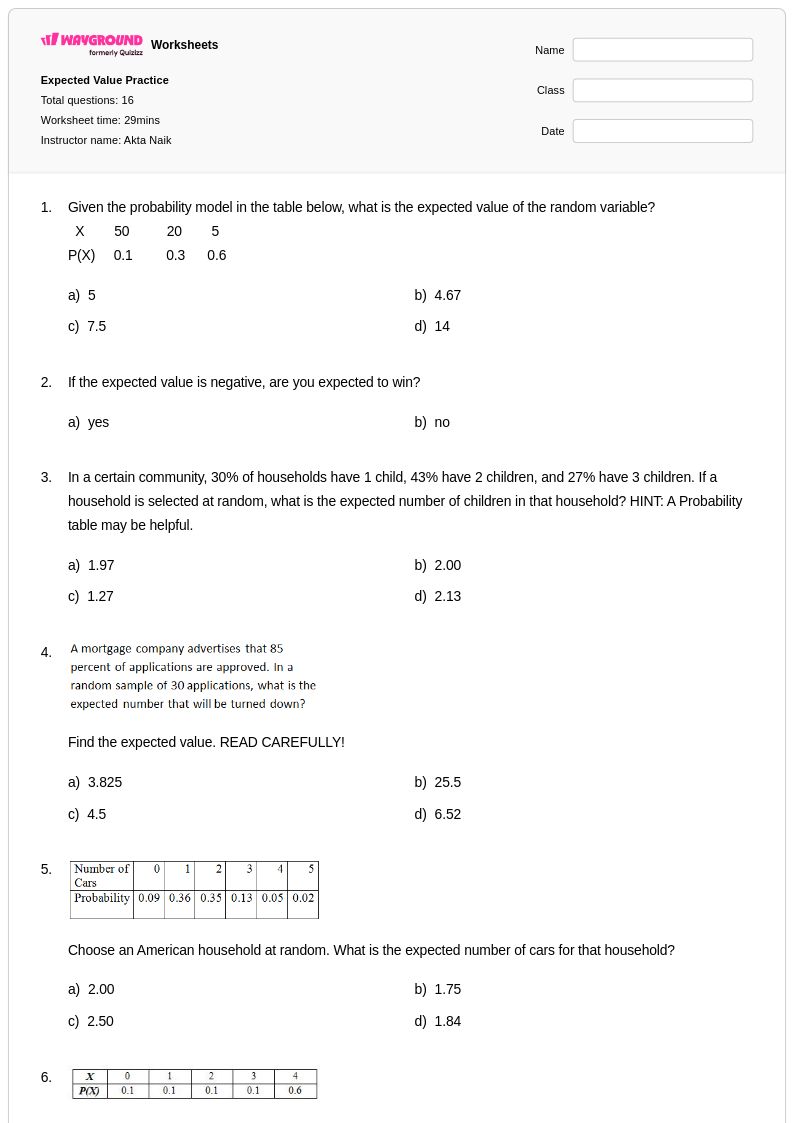
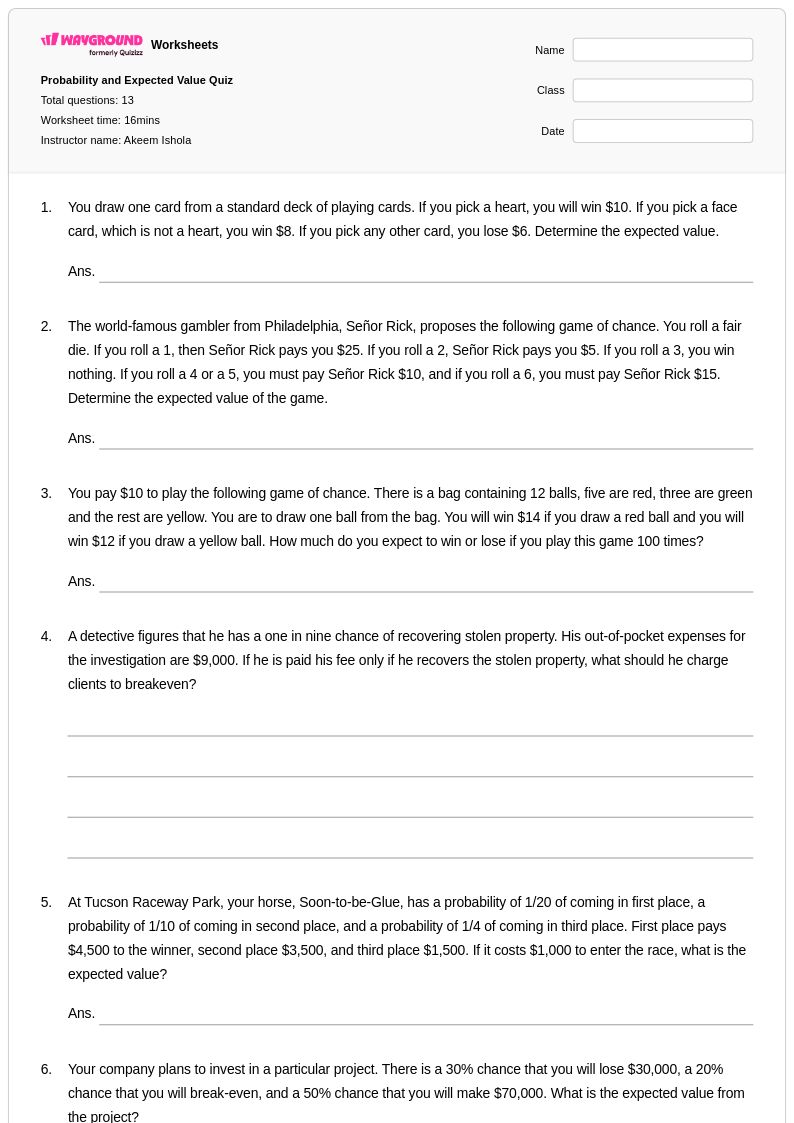
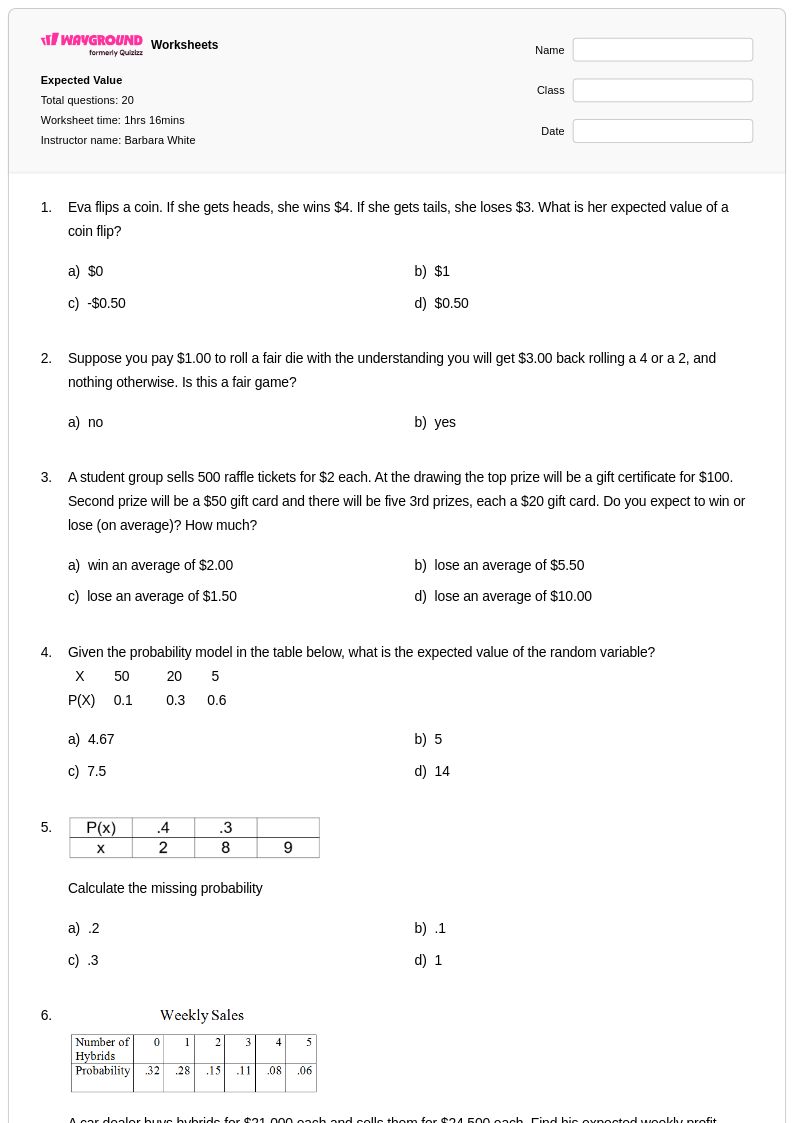
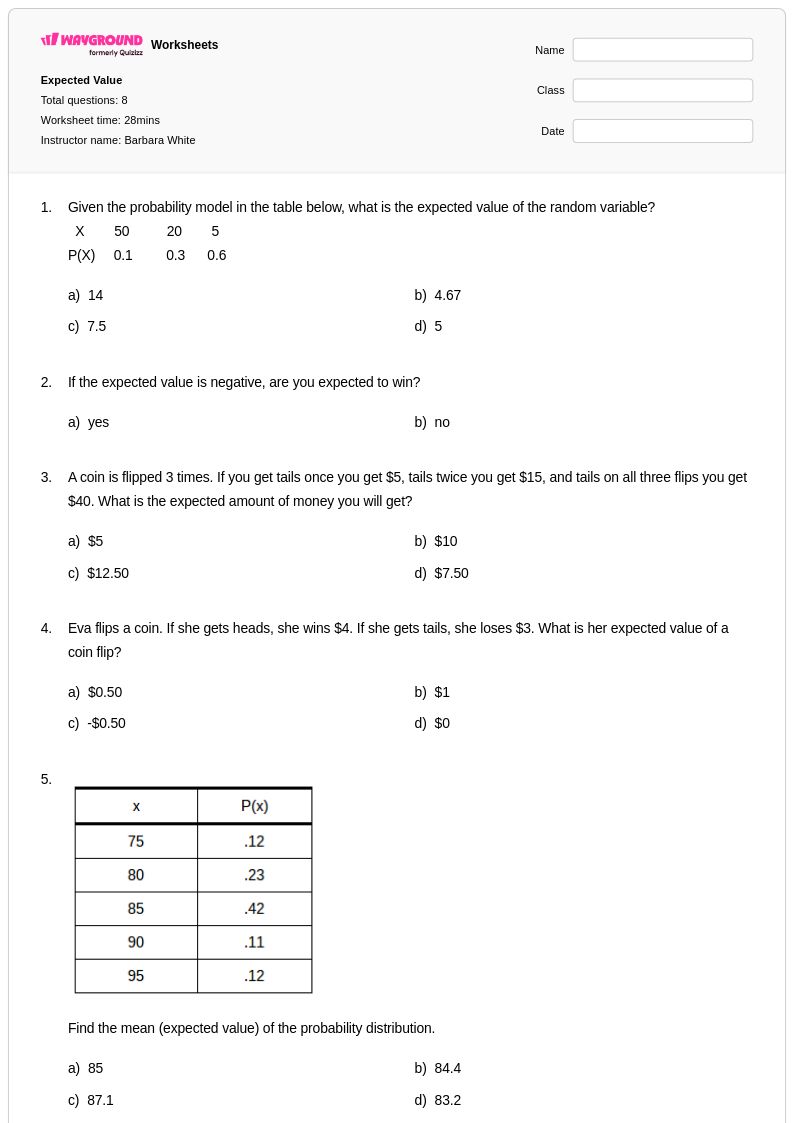
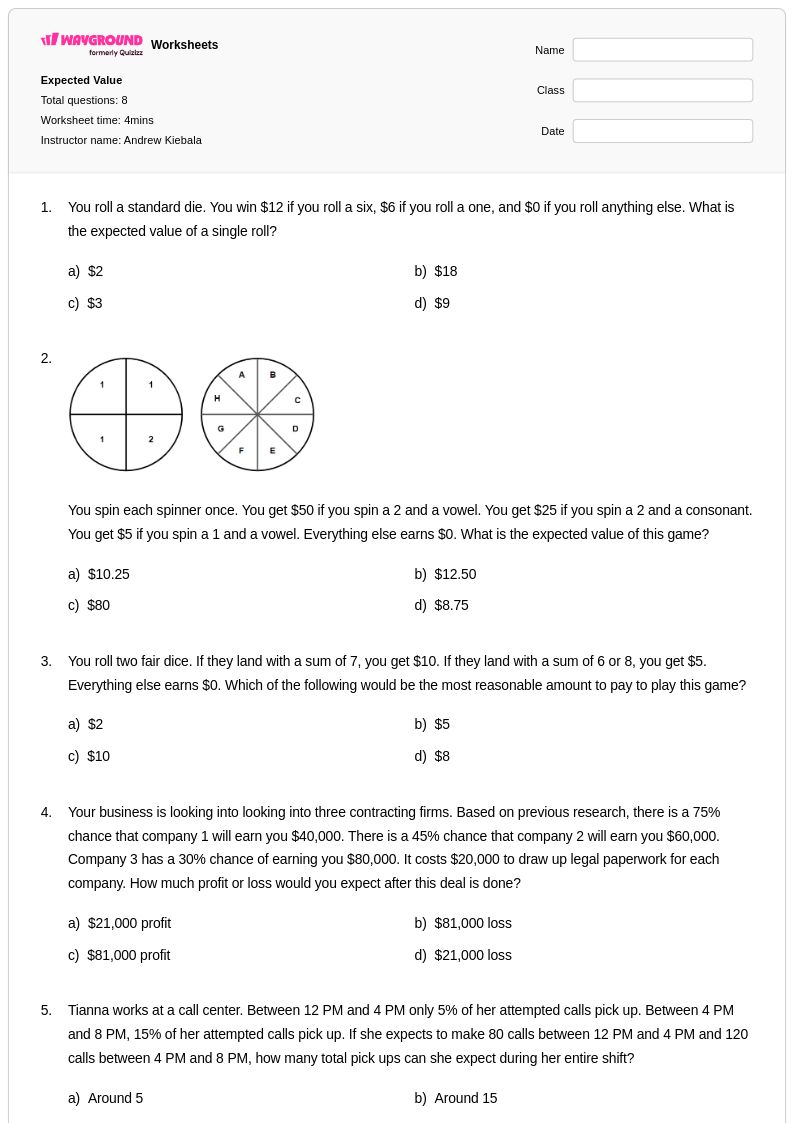
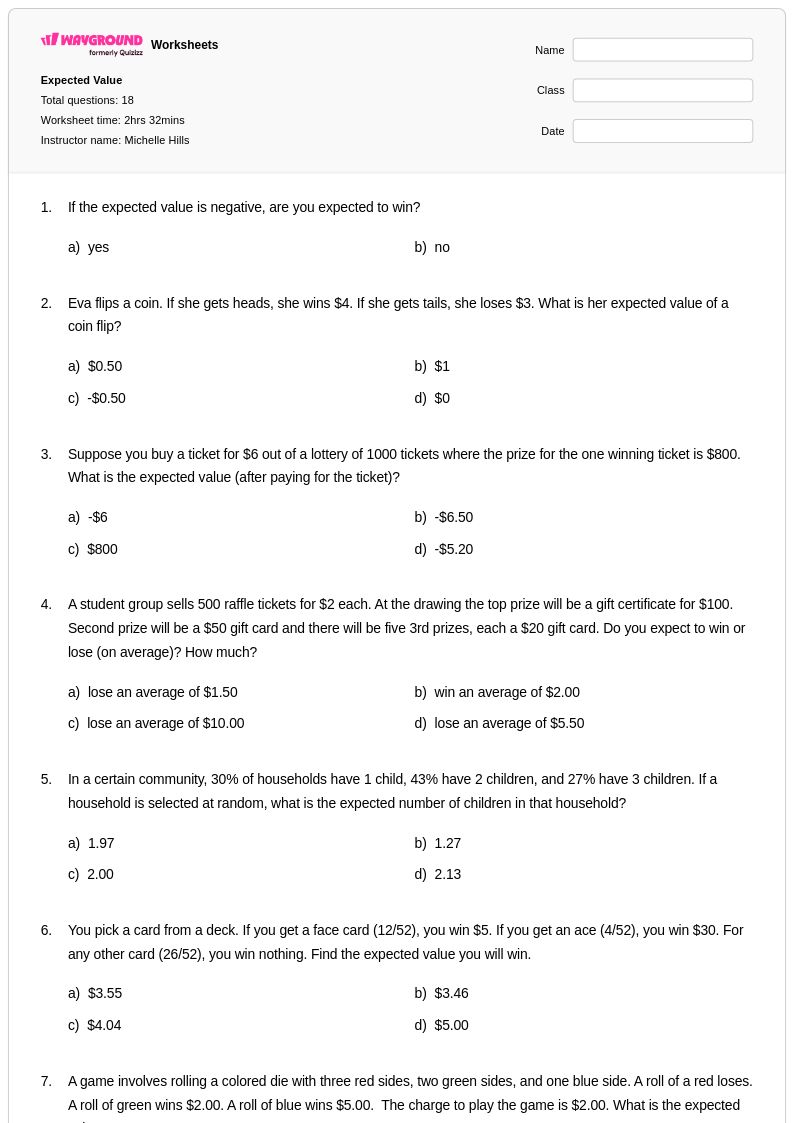
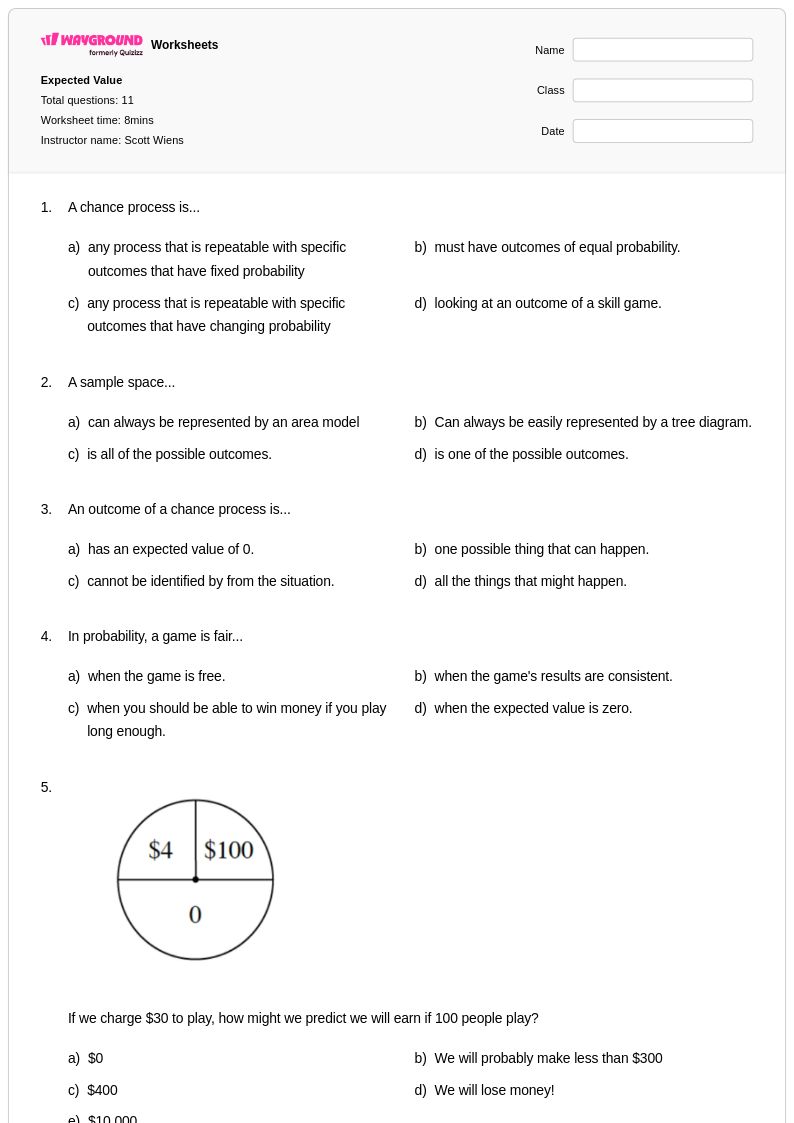
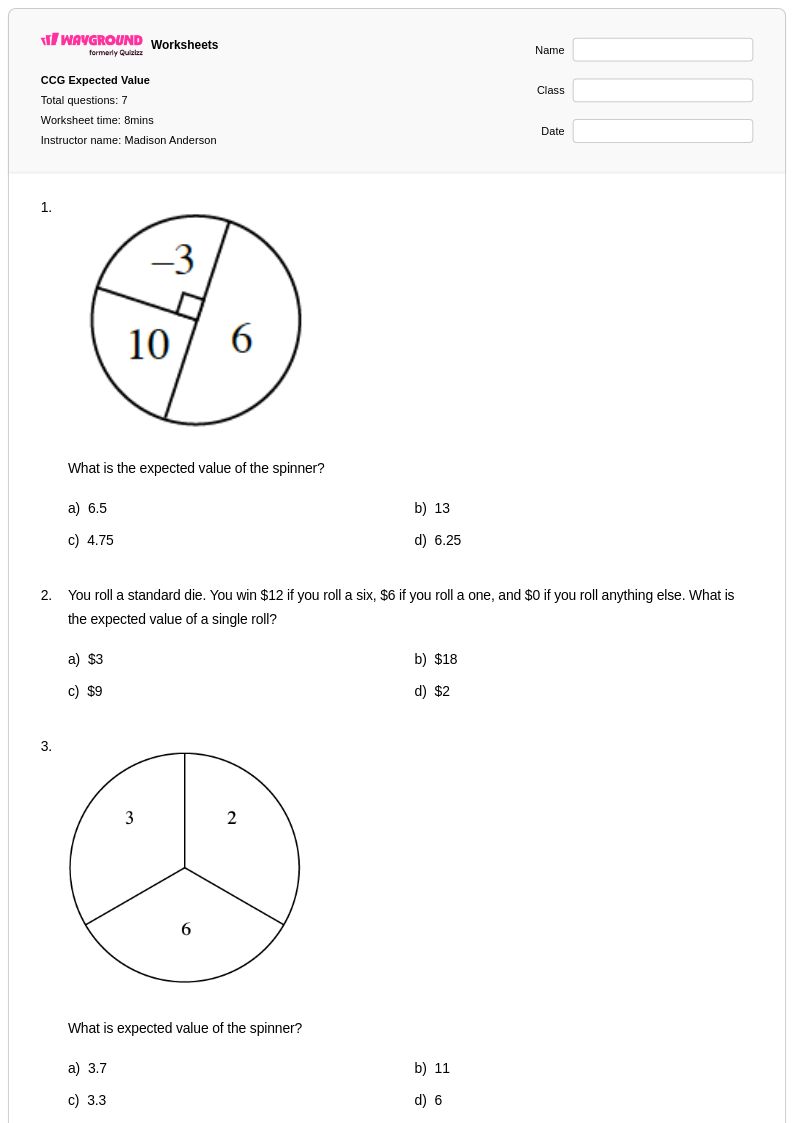
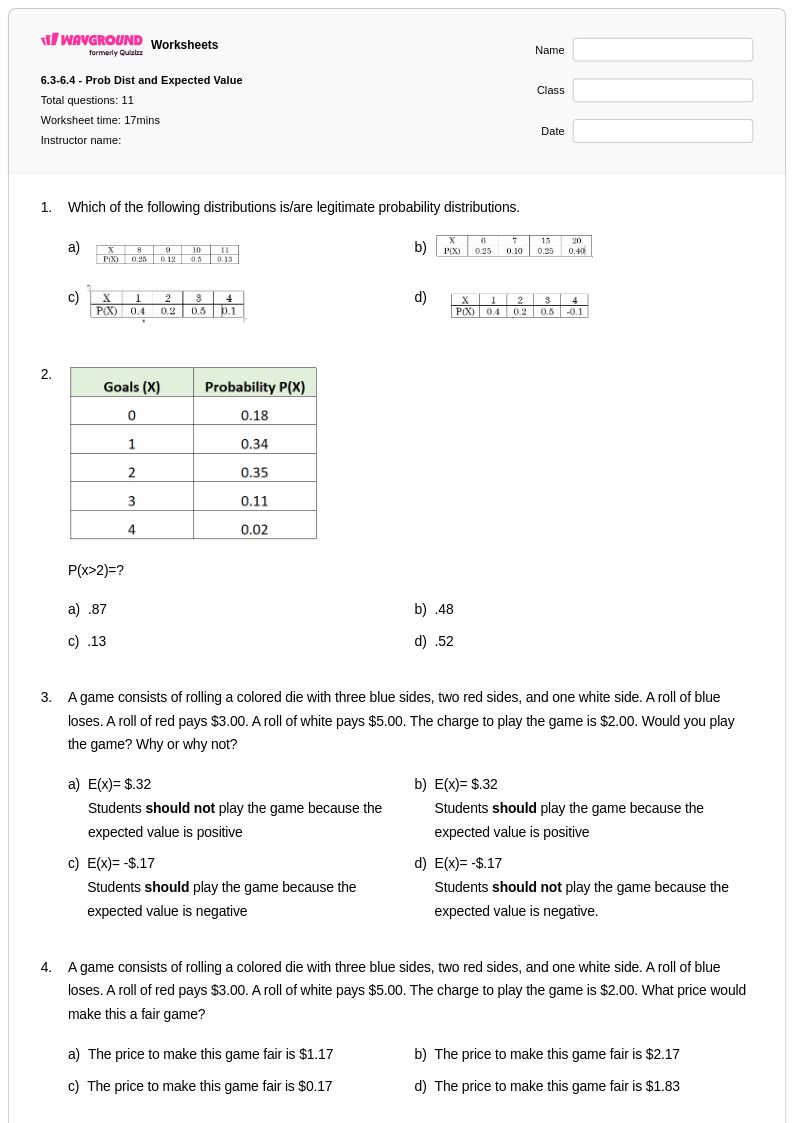
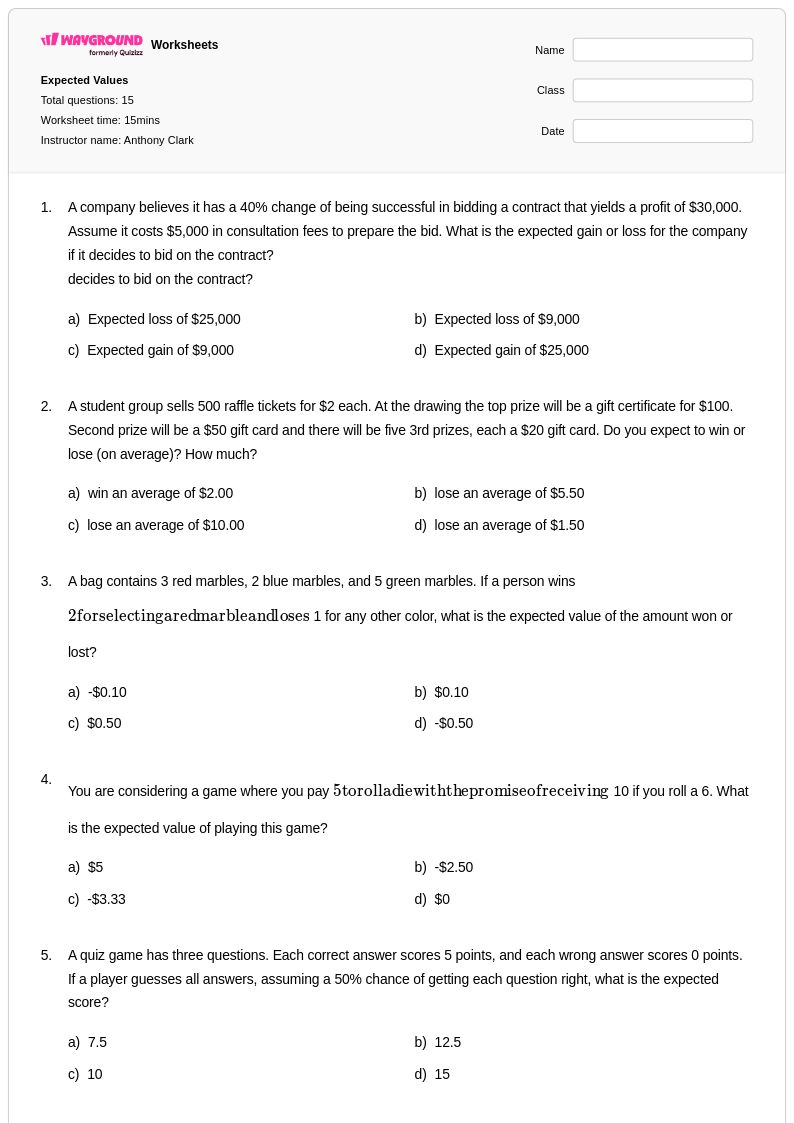
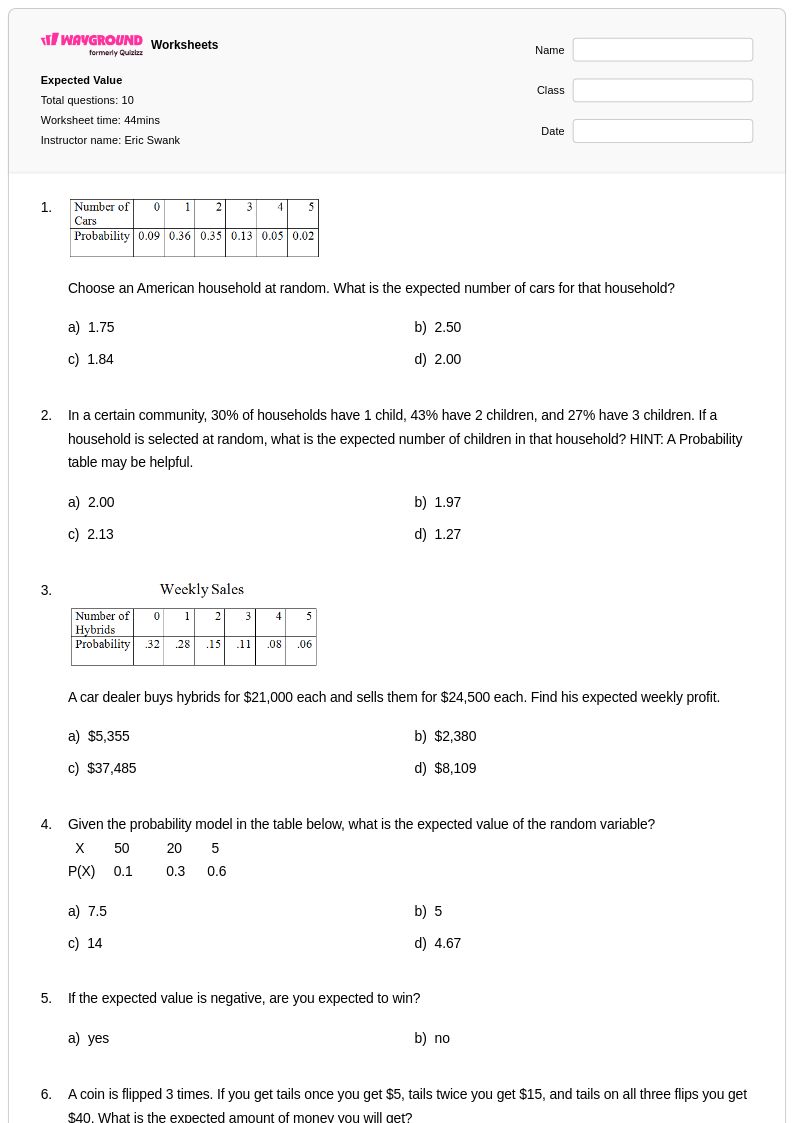
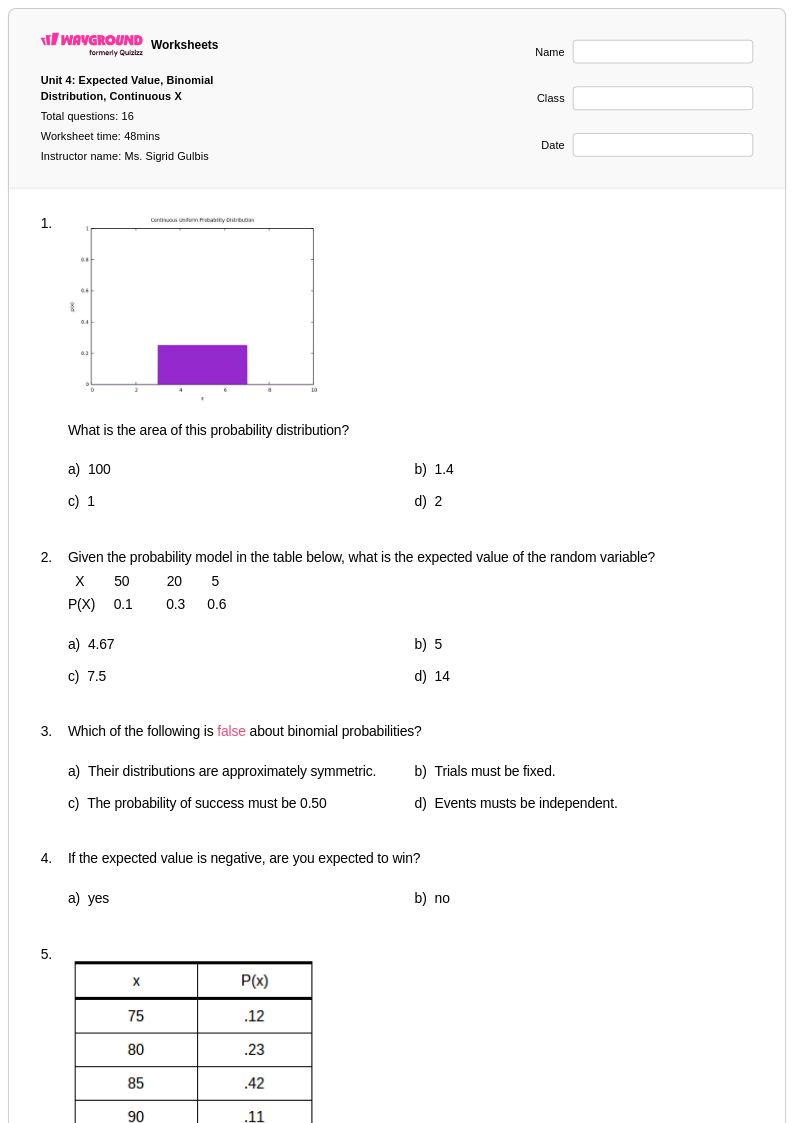
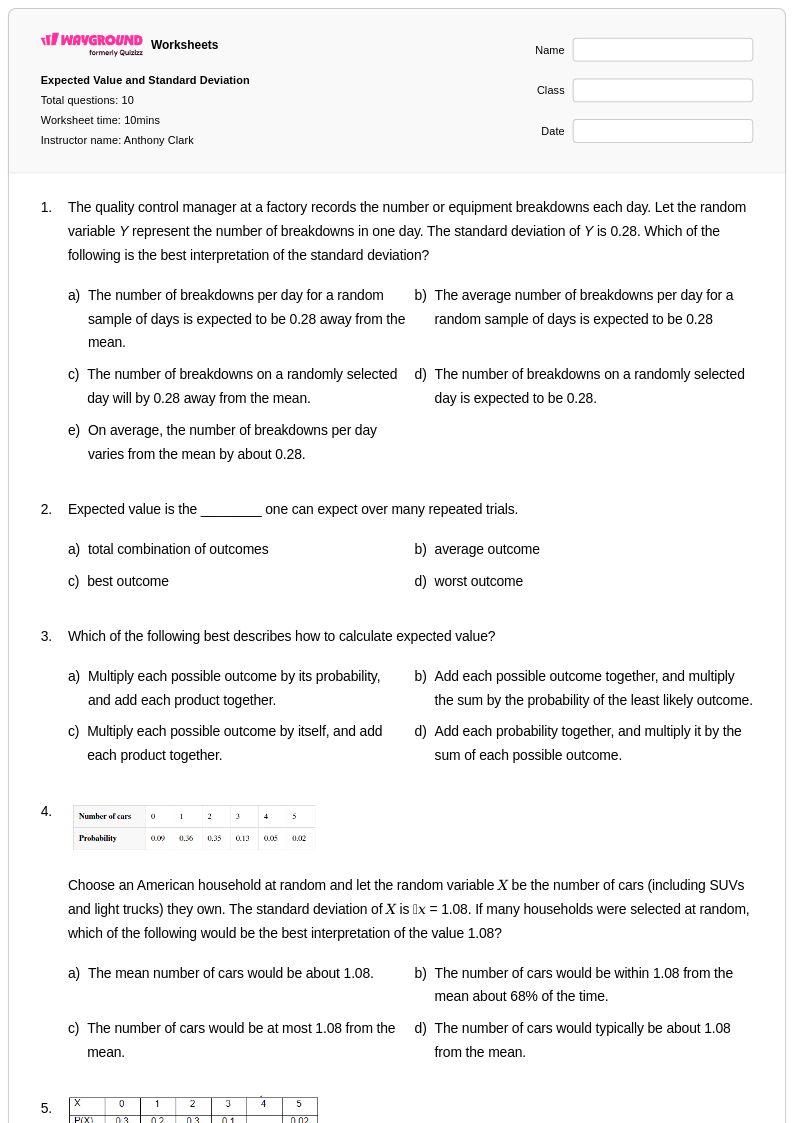
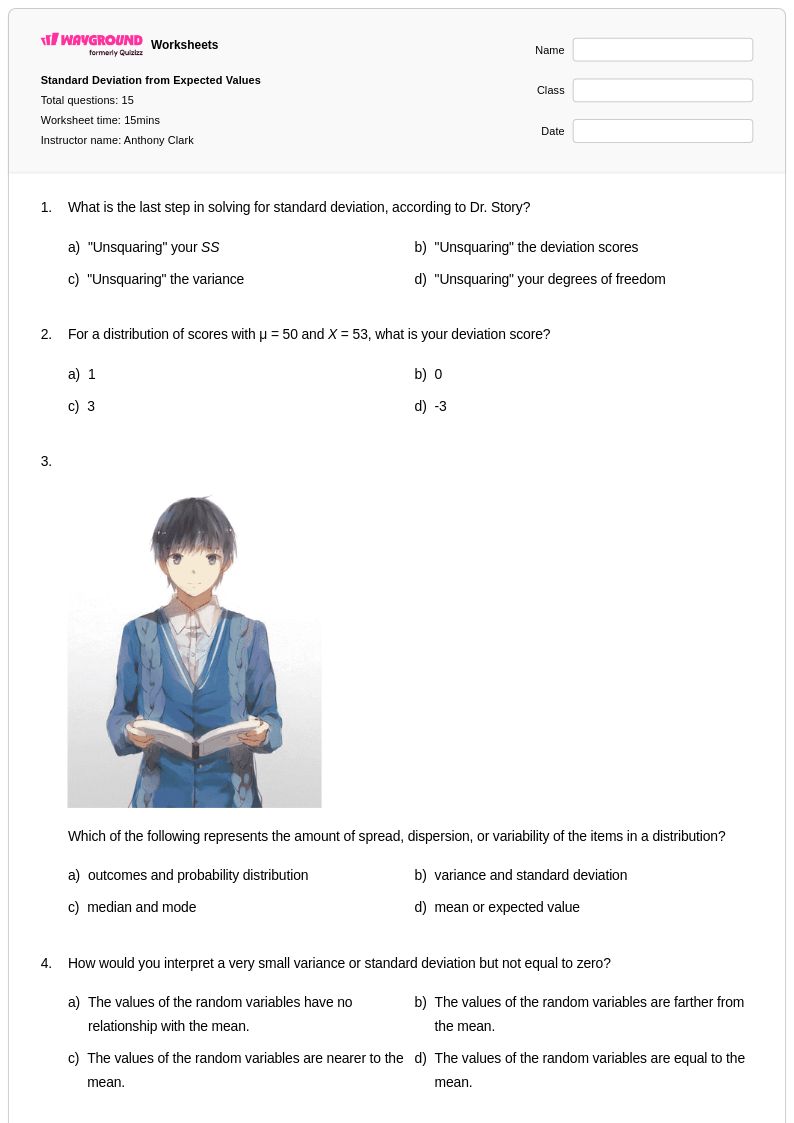
Discover comprehensive expected value worksheets and printables that help students master probability calculations through engaging practice problems, complete with detailed answer keys and free PDF downloads.
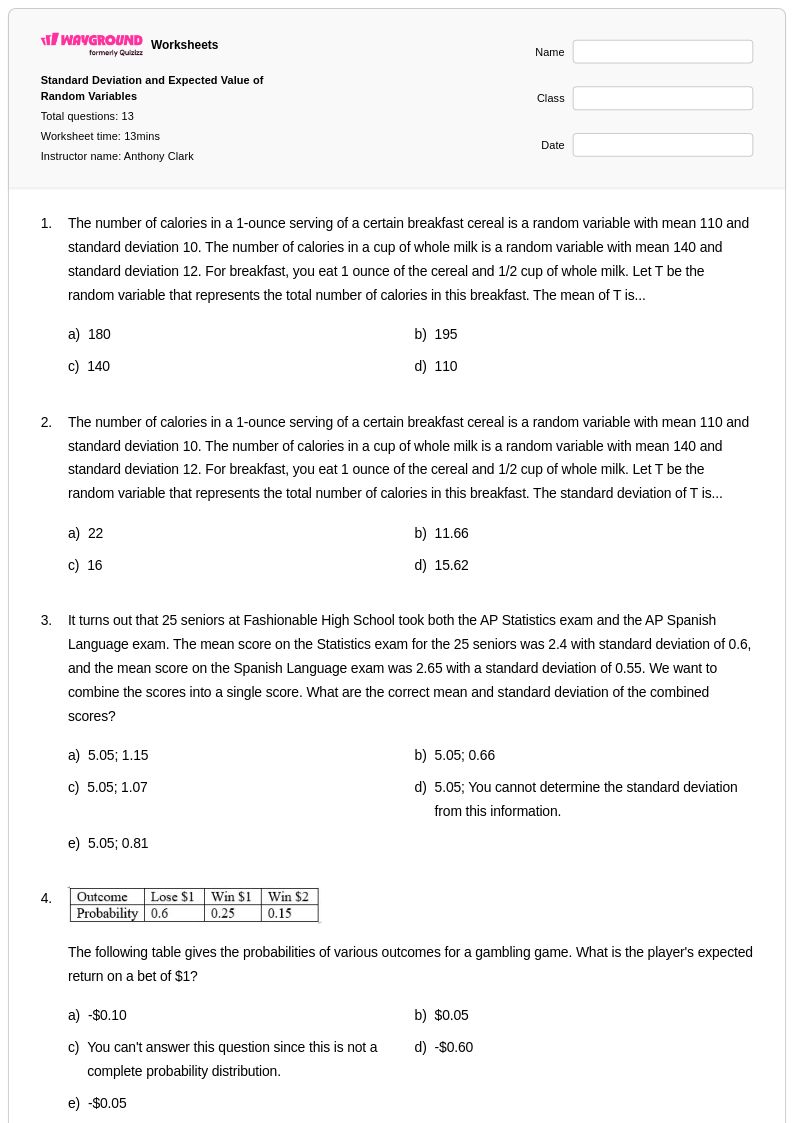
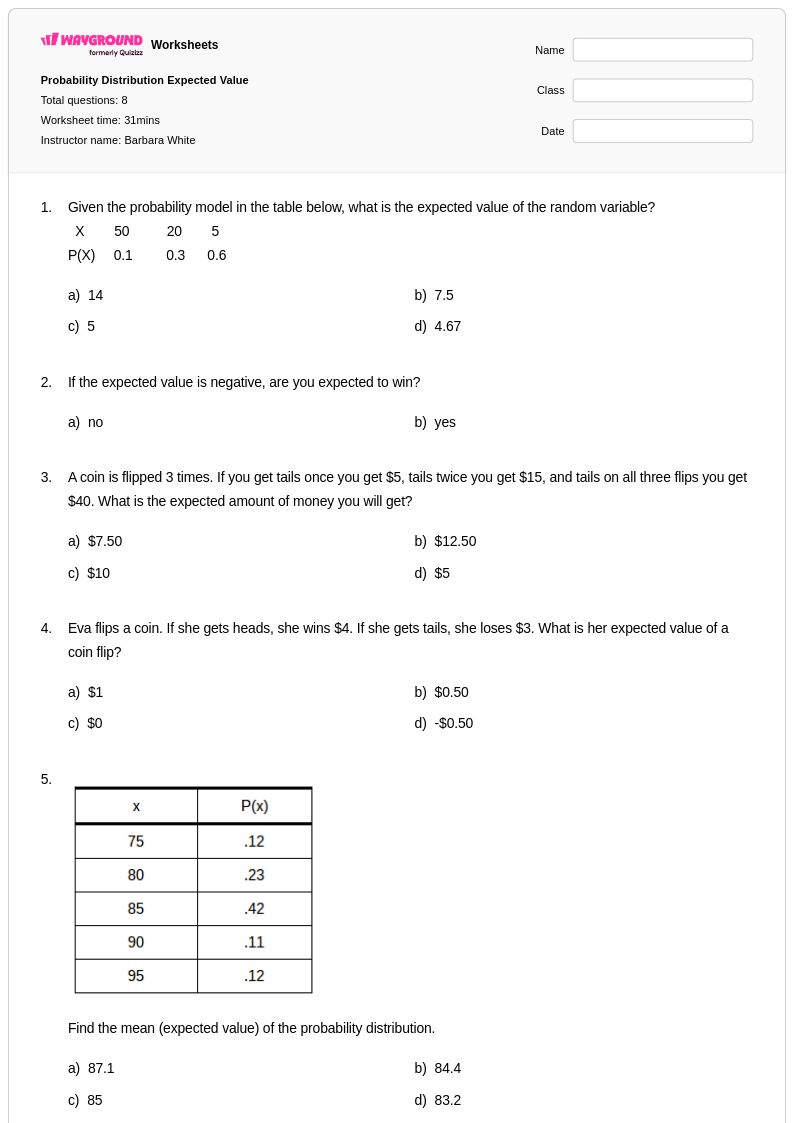
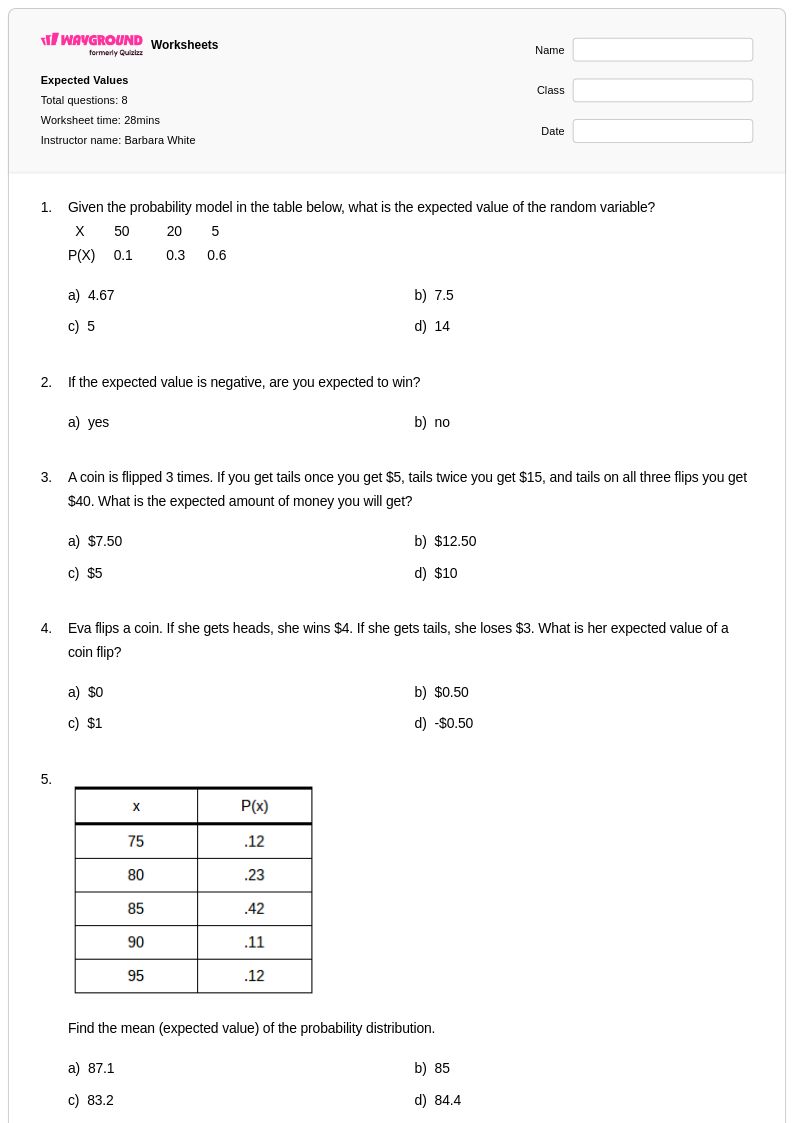
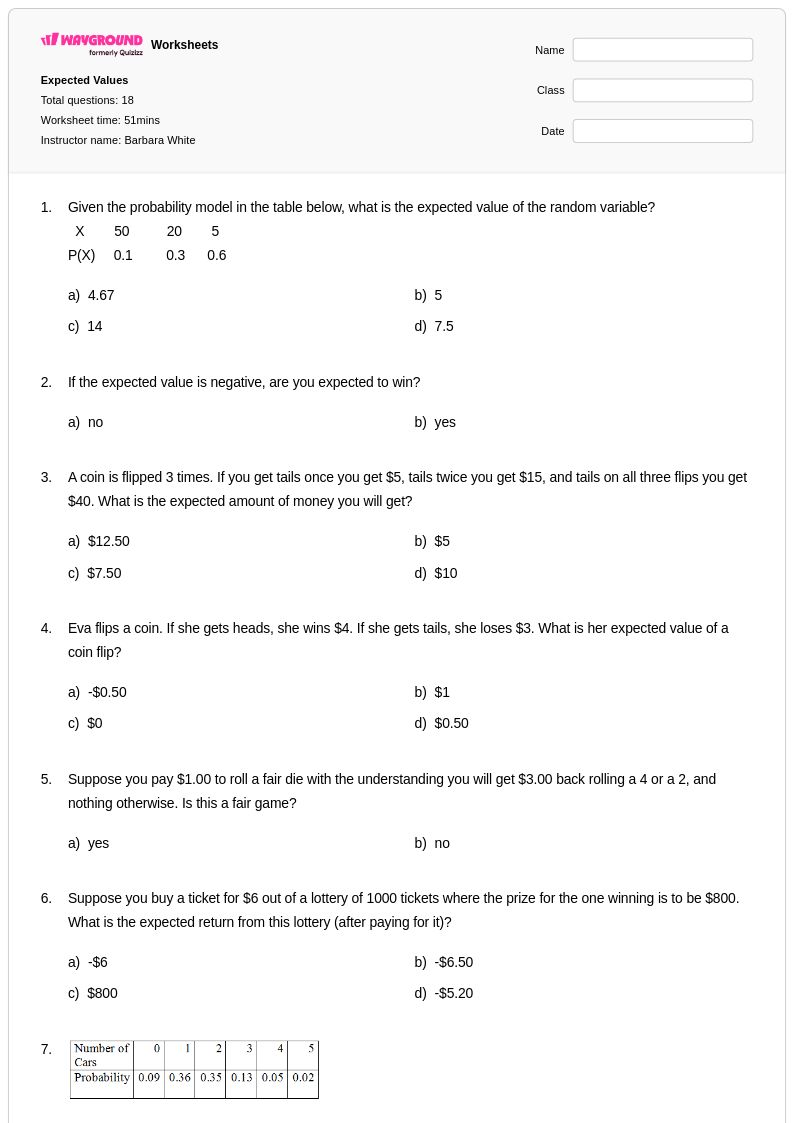
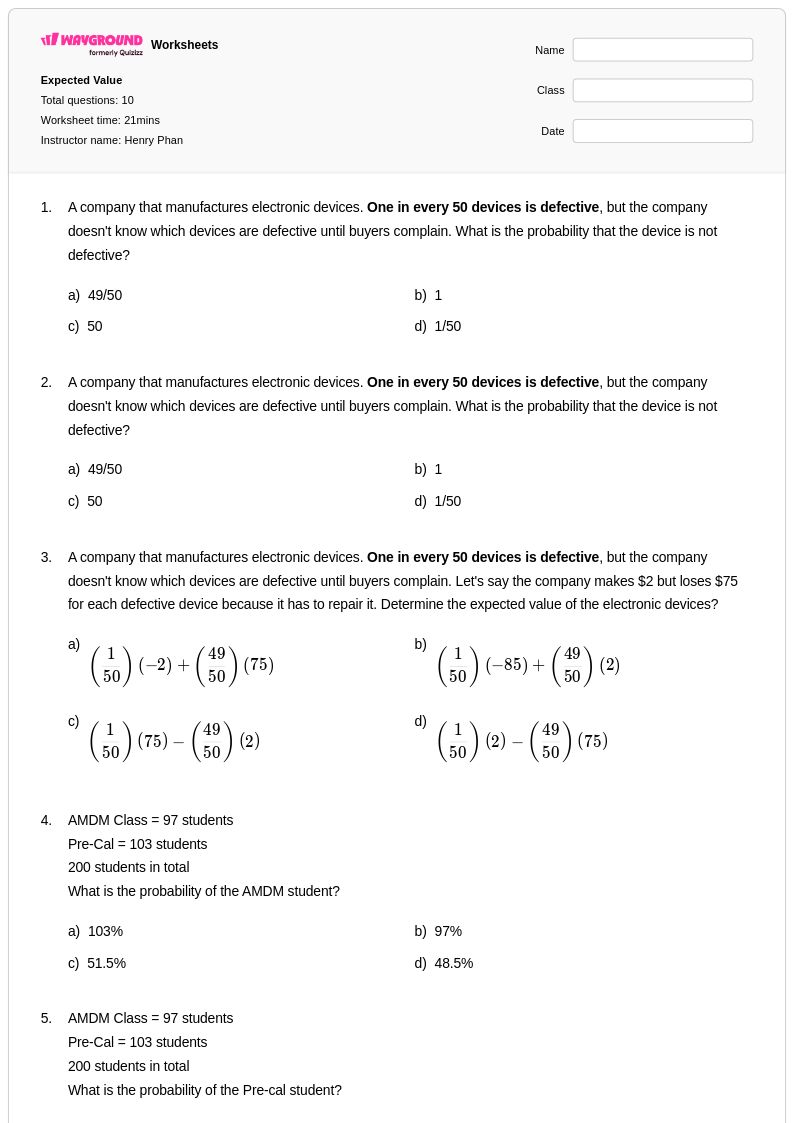
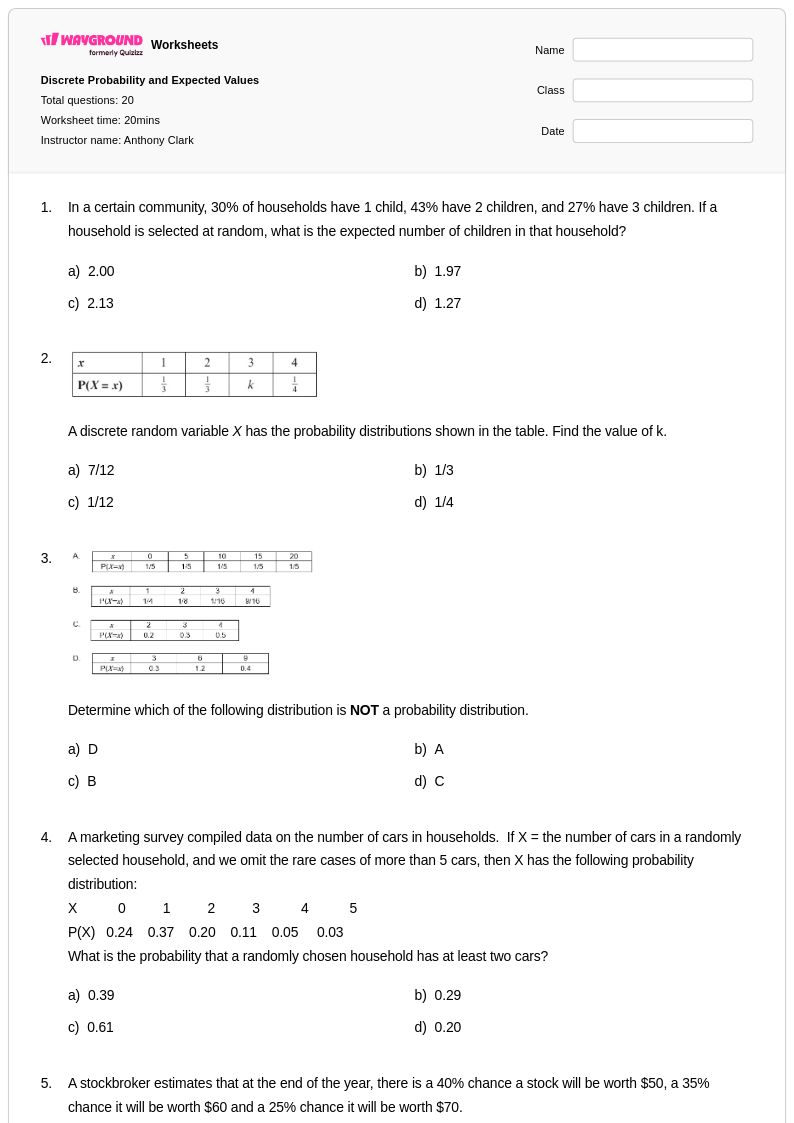
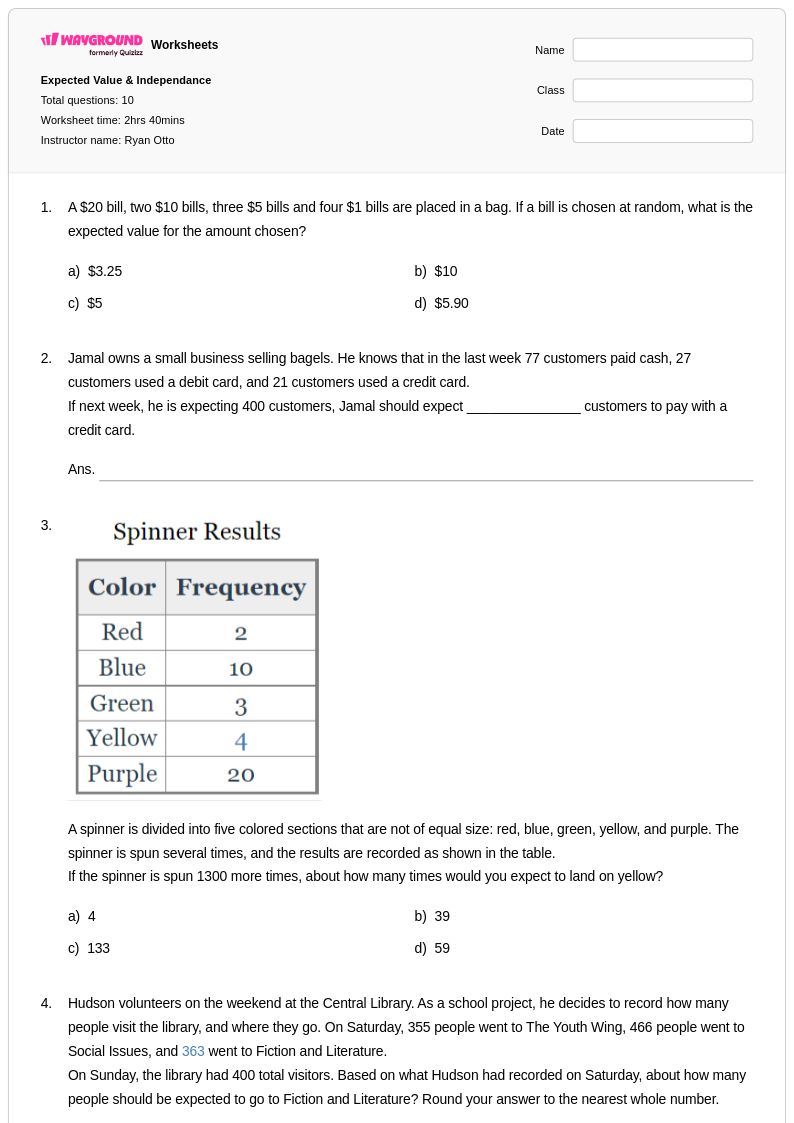
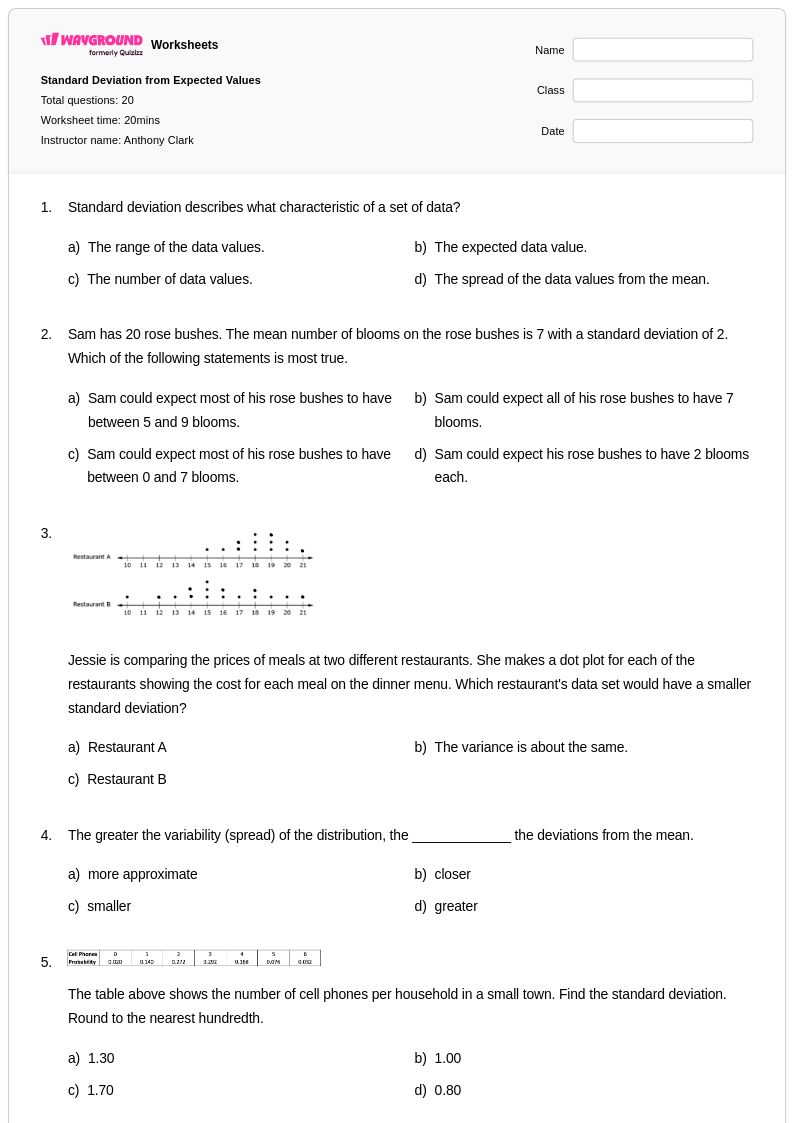
Expected value worksheets available through Wayground (formerly Quizizz) provide comprehensive practice opportunities for students to master this fundamental concept in probability and statistics. These carefully designed resources help students develop critical analytical skills by working through problems that involve calculating the mean of probability distributions, determining long-term outcomes in random processes, and applying expected value concepts to real-world scenarios such as games of chance, insurance calculations, and investment analysis. Each worksheet includes structured practice problems that progress from basic computational exercises to complex application questions, with accompanying answer keys that allow students to verify their understanding and identify areas needing additional focus. The printables are available in convenient pdf format, offering free access to high-quality mathematical content that reinforces theoretical knowledge through hands-on problem solving.
Wayground (formerly Quizizz) supports mathematics educators with an extensive collection of teacher-created expected value resources that can be easily discovered through robust search and filtering capabilities. The platform's millions of worksheets align with educational standards and provide differentiation tools that enable teachers to customize content for diverse learning needs, whether for remediation with struggling students or enrichment for advanced learners. These flexible resources are available in both printable and digital formats, including downloadable pdf versions, making them ideal for classroom instruction, homework assignments, or independent study sessions. Teachers can efficiently plan lessons around specific probability and statistics objectives, create targeted skill practice opportunities, and provide immediate feedback through the comprehensive answer keys, ultimately streamlining the process of delivering effective mathematics instruction focused on expected value concepts.
FAQs
How do I teach expected value to students?
Start with a concrete scenario students already have intuition about — a simple dice game or a coin flip with payouts. Have students list every possible outcome, assign a probability to each, and multiply. Once they've summed those products by hand a few times, the formula stops feeling abstract. From there, move to messier real-world contexts like insurance deductibles or raffle tickets, where the expected value is negative and the point is understanding why people still participate.
What kinds of practice problems help students get better at expected value?
Students need three types of problems: pure computation (given a probability distribution, find E(X)), interpretation (what does this expected value actually mean for a repeated decision?), and comparison (which of these two games is the better bet?). Worksheets that mix all three — rather than drilling only calculation — build the reasoning skills that show up on assessments.
What mistakes do students commonly make when calculating expected value?
The most common error is forgetting to weight each outcome by its probability — students add up the outcomes and divide, treating it like a simple average. A close second is using percentages inconsistently (mixing 0.25 and 25% in the same calculation). Watch also for students who get the right number but can't explain what it means: expected value is a long-run average, not a prediction of any single outcome, and that distinction matters.
How do I use Wayground's expected value worksheets in my class?
You can run these as a digital quiz hosted on Wayground — students work through problems on their devices and results come back to you immediately. If you'd rather go paper, download the printable PDF and assign it in class or as homework; every worksheet includes a complete answer key so students can self-check. For grading paper submissions, the Wayground for Teachers app lets you scan or capture student work directly.
Is expected value part of Common Core math standards?
Yes. Common Core addresses expected value within its high school Statistics and Probability domain. The progression builds from understanding probability distributions in earlier high school work to calculating the mean of a discrete random variable — which is exactly what expected value is — and applying it to interpret outcomes in context. Students are expected to move from computing E(X) mechanically to using it to evaluate decisions, such as determining whether a game is fair.
How can I differentiate expected value practice for students at different levels?
For students who are still shaky on the mechanics, Wayground lets you reduce the number of answer choices displayed, which lowers cognitive load while they build confidence with the calculation steps. For students who struggle with reading-heavy word problems — which expected value scenarios almost always are — the Read Aloud accommodation has questions read to them so the barrier is the math, not the text. At the worksheet level, you can also apply a larger font size or wider spacing to make dense probability tables easier to parse.
What real-world contexts work best for expected value problems?
Games of chance (lotteries, carnival games) work well because students can immediately check whether the game favors the player or the house. Insurance and extended warranties are equally effective — and arguably more useful — because they show students why a negative expected value can still be a rational purchase. Investment scenarios work for older or more advanced students but require more background knowledge to set up meaningfully.