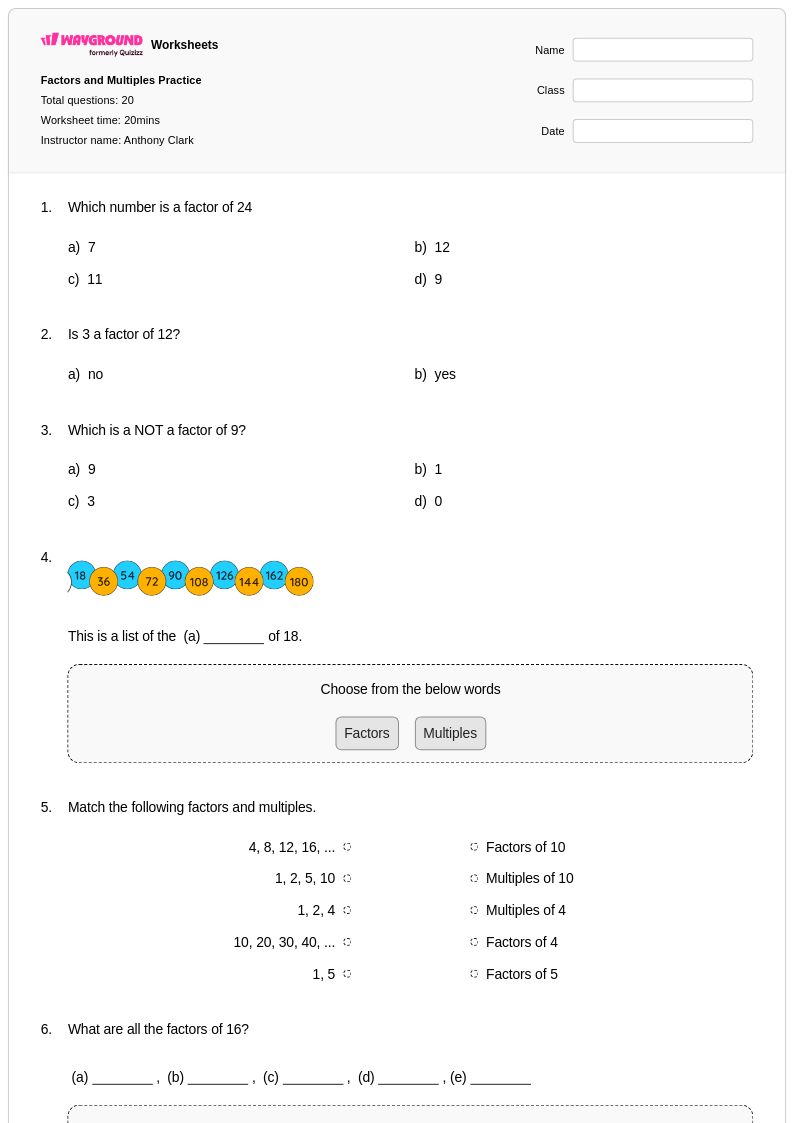
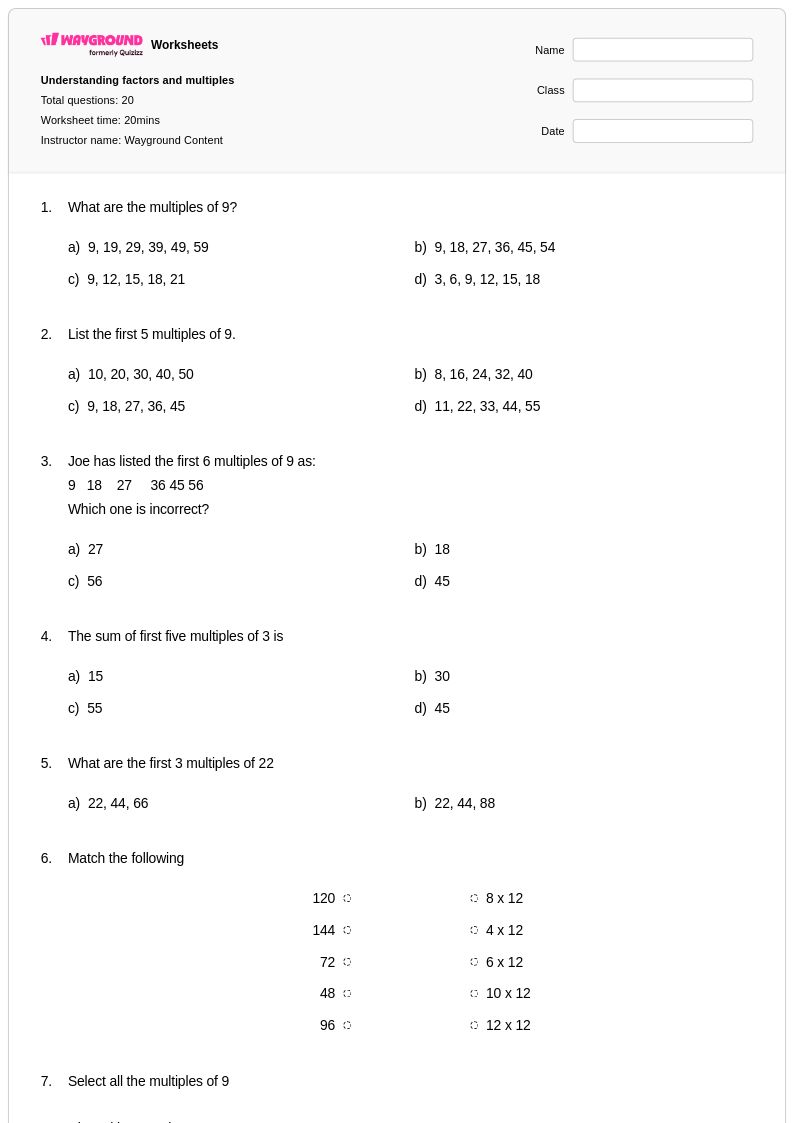
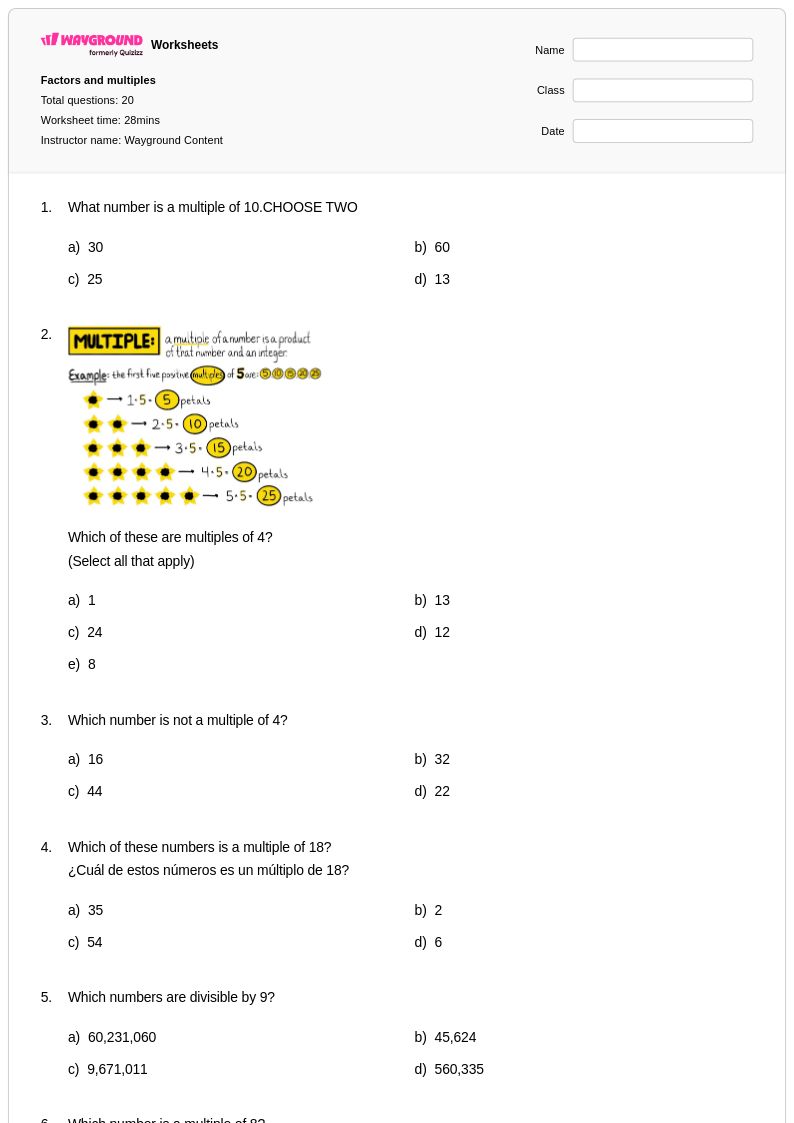
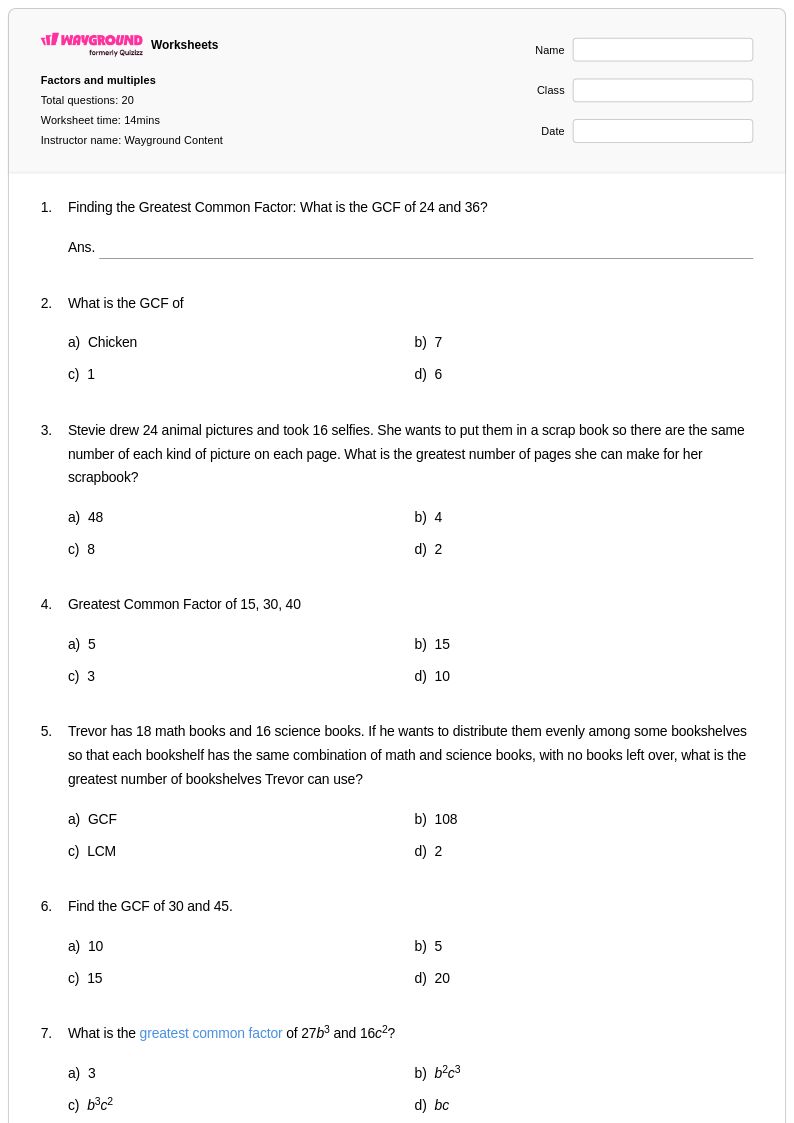
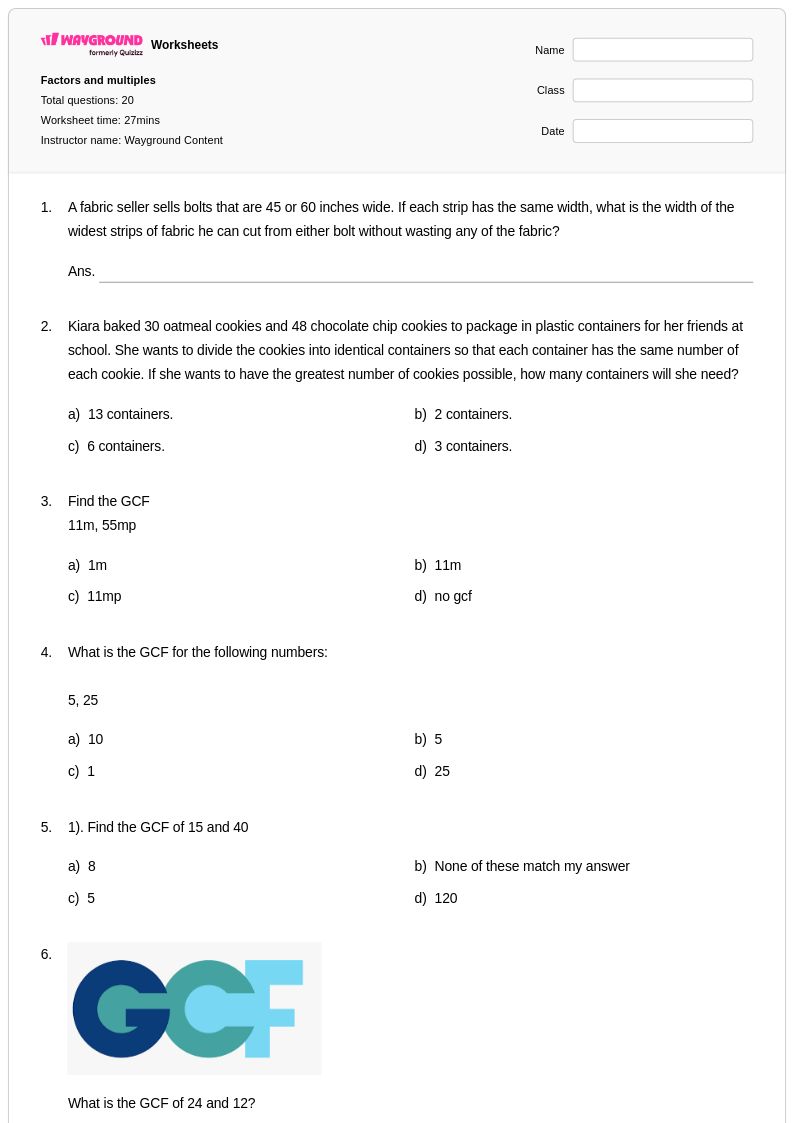
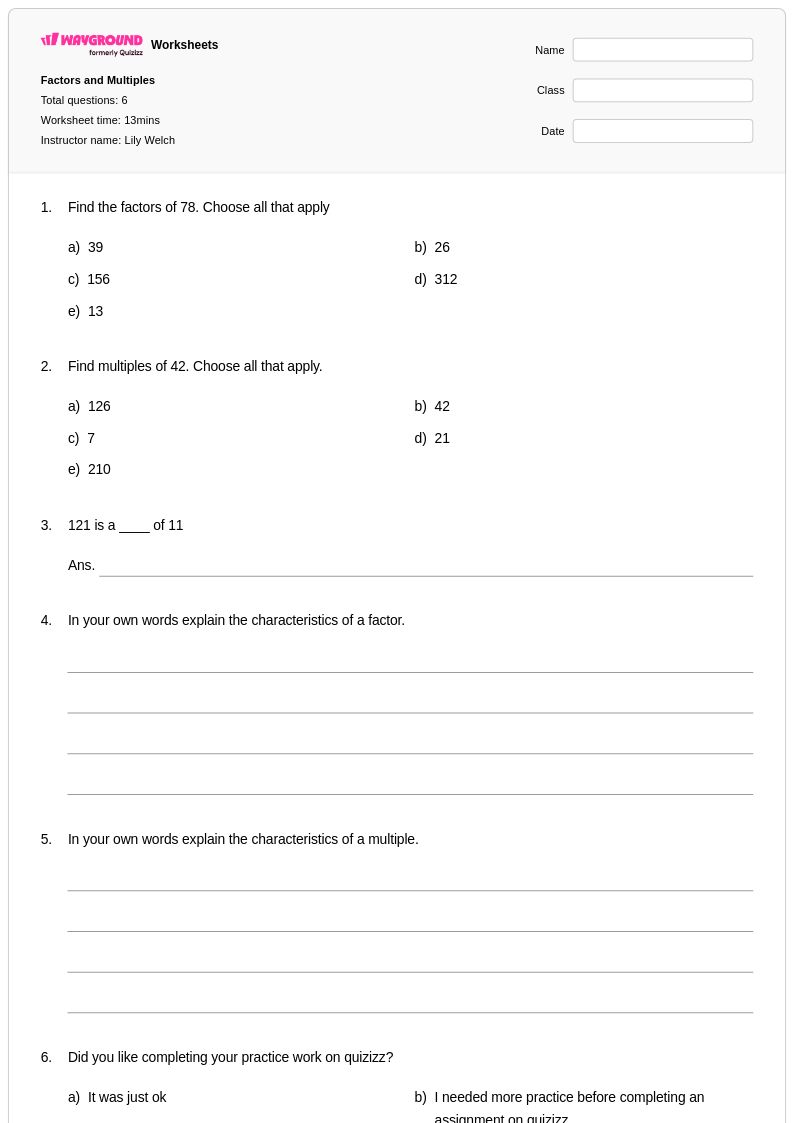
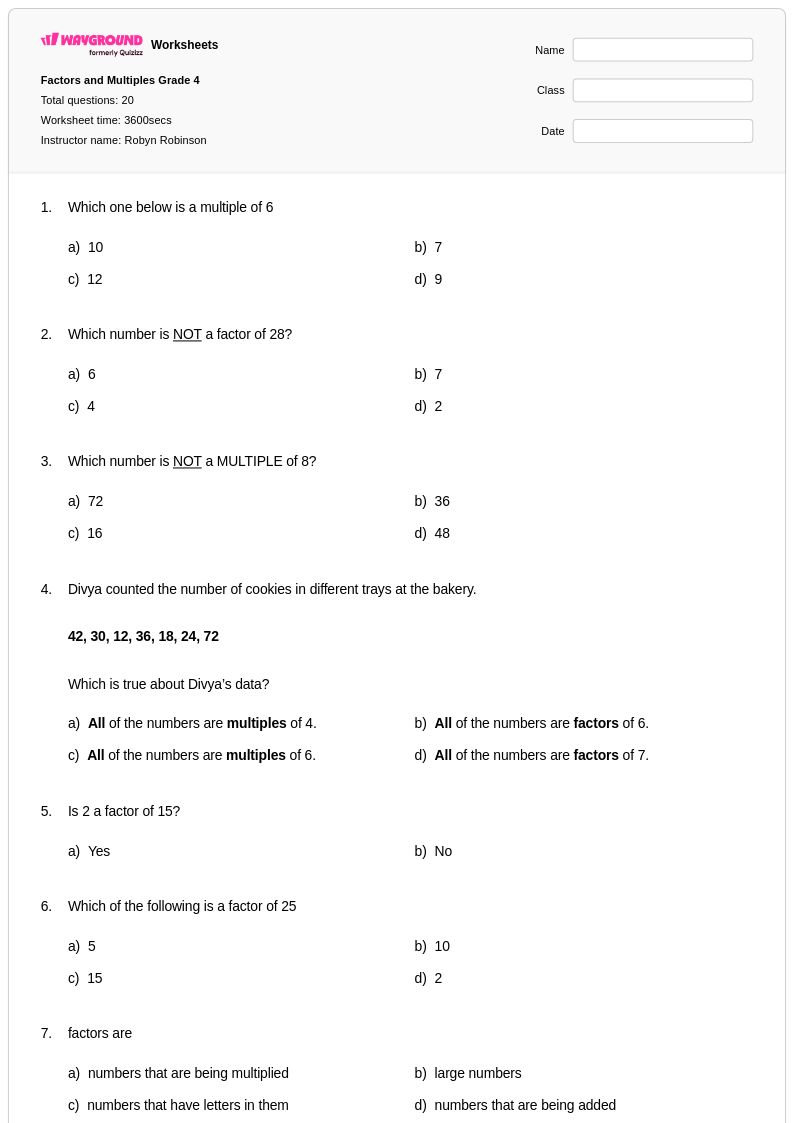
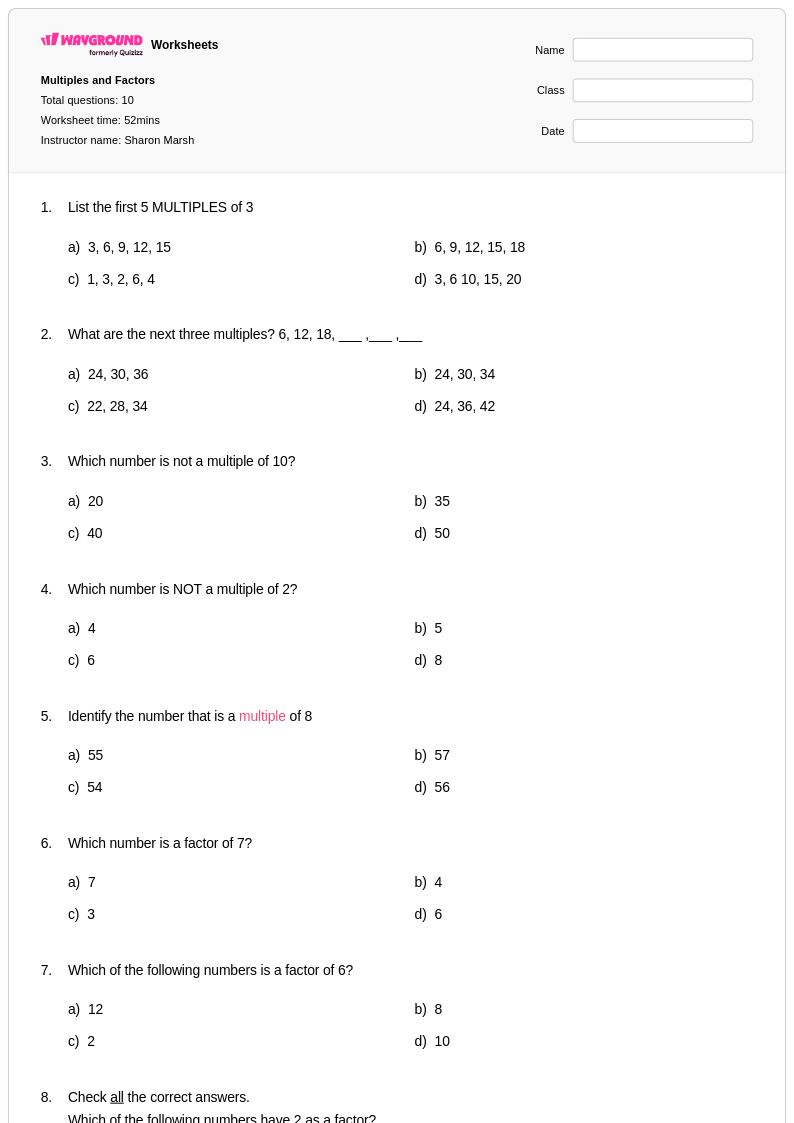
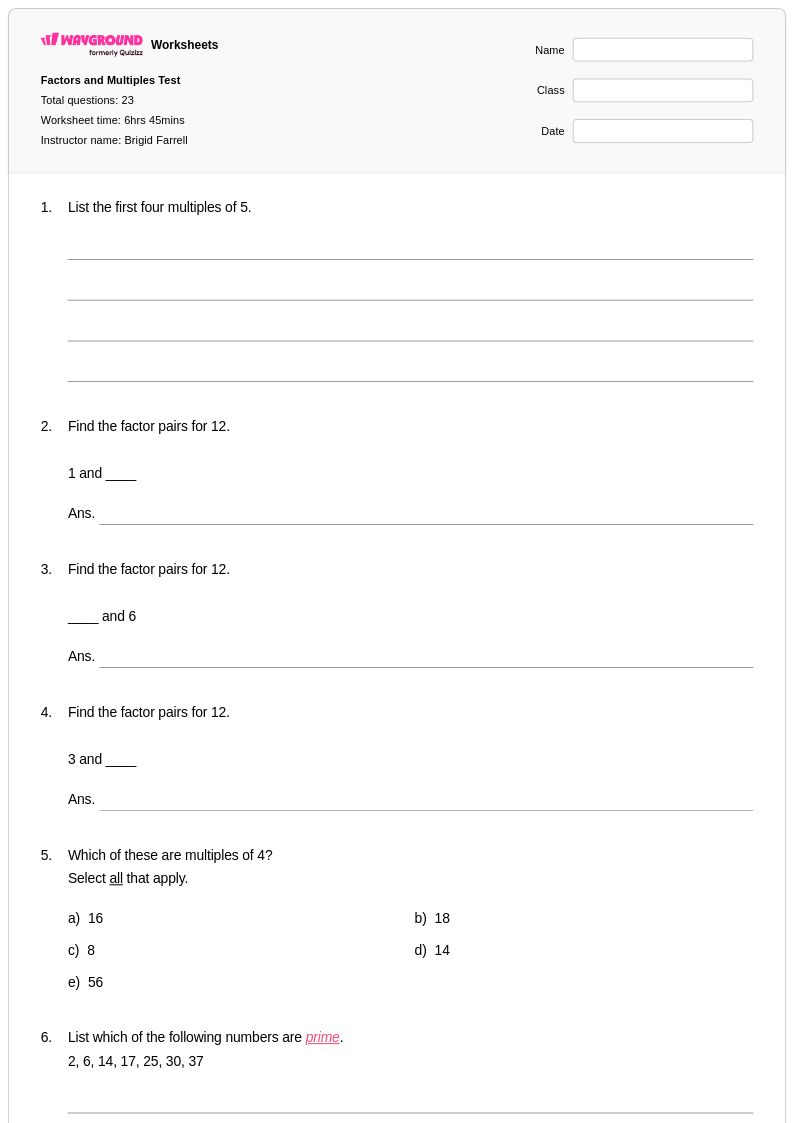
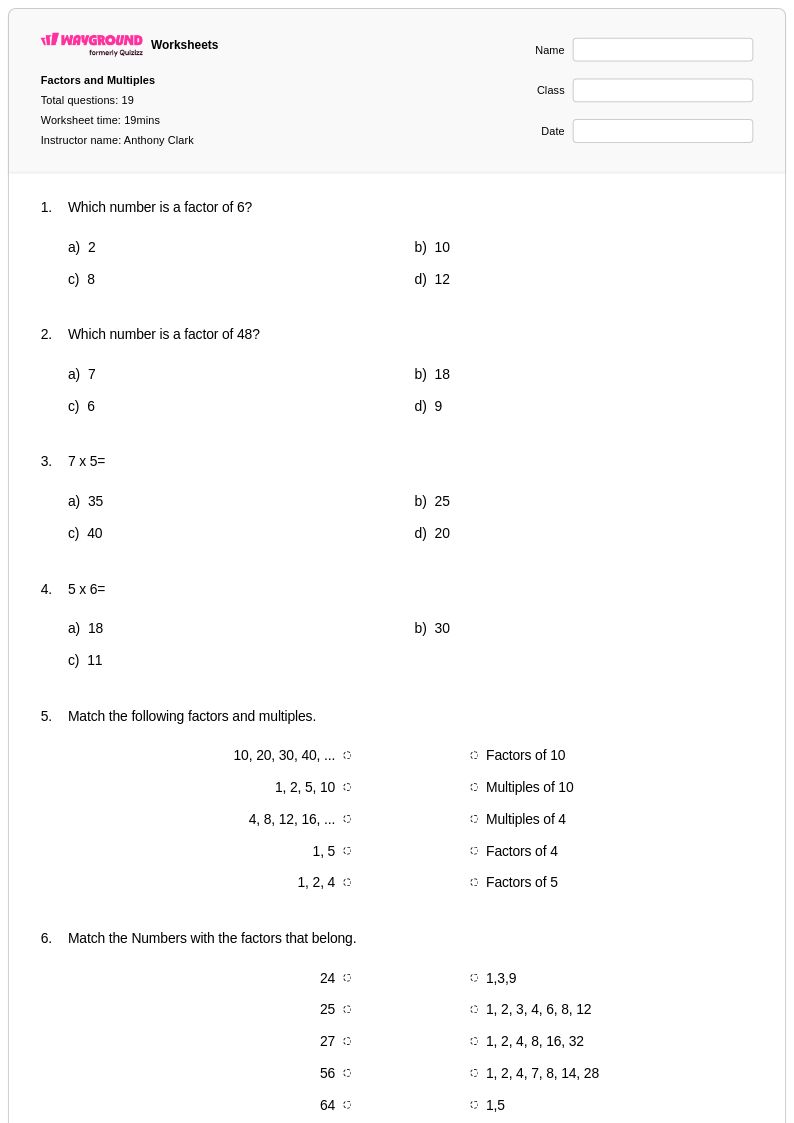
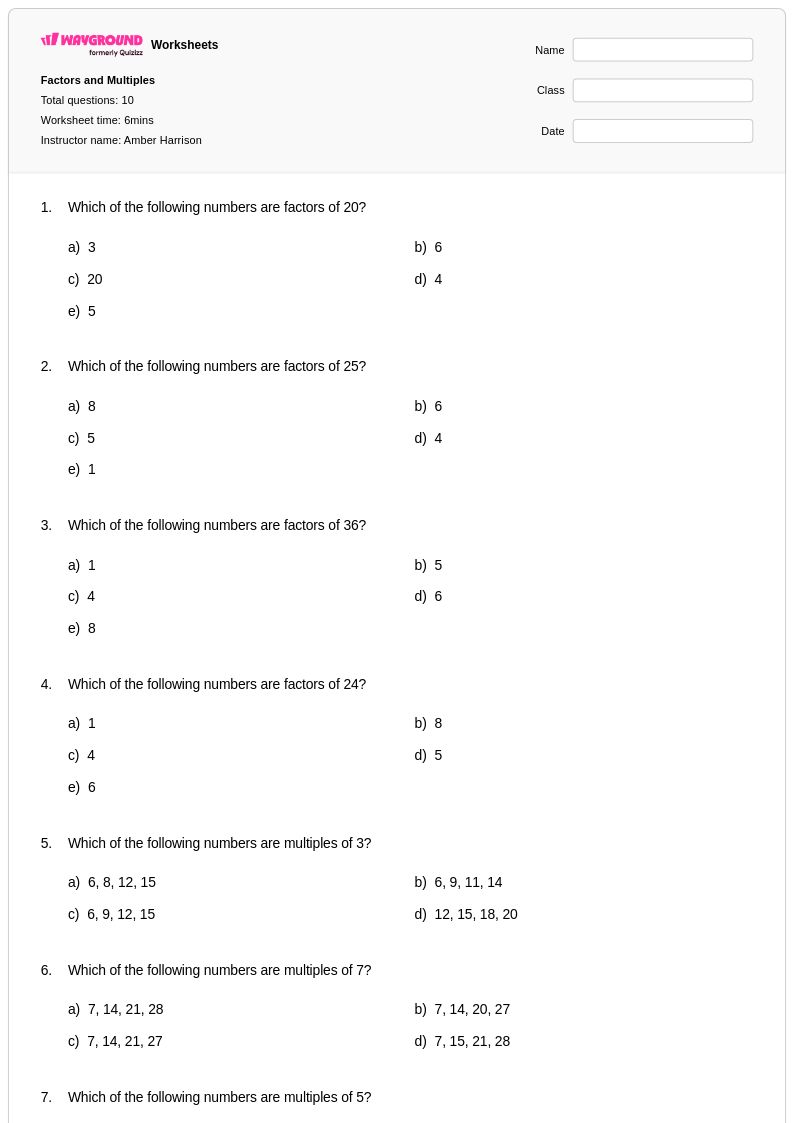
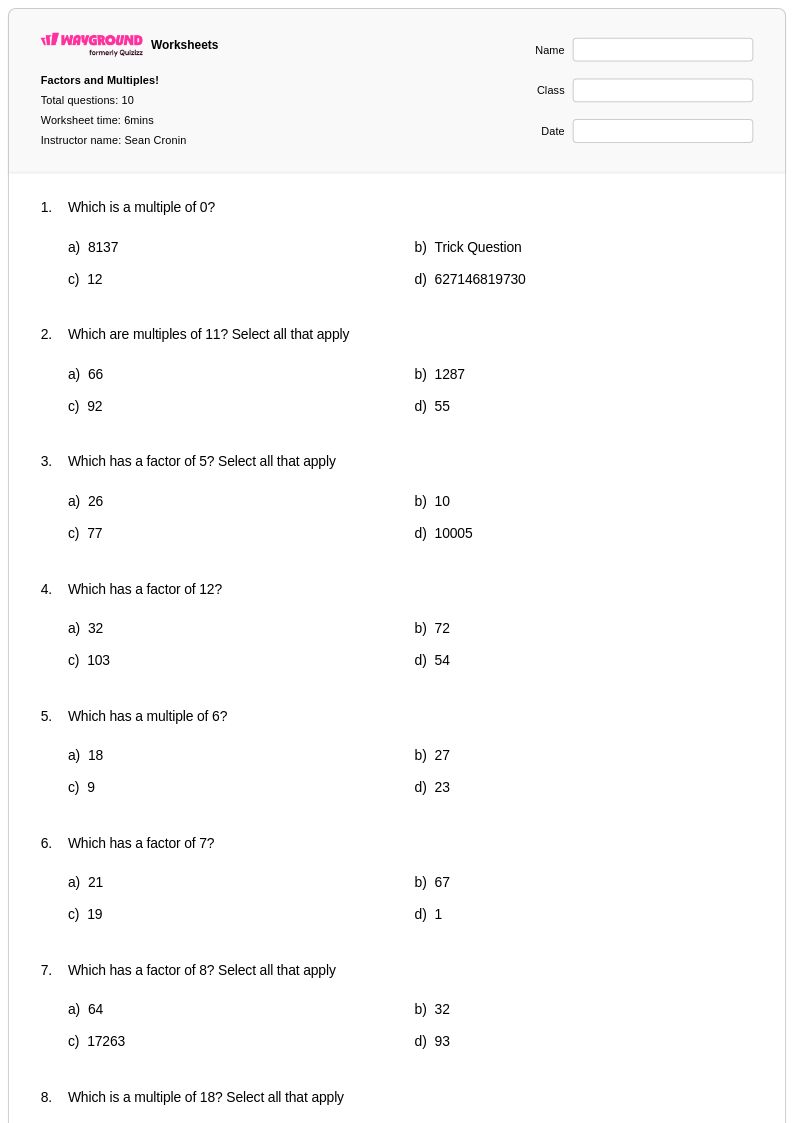
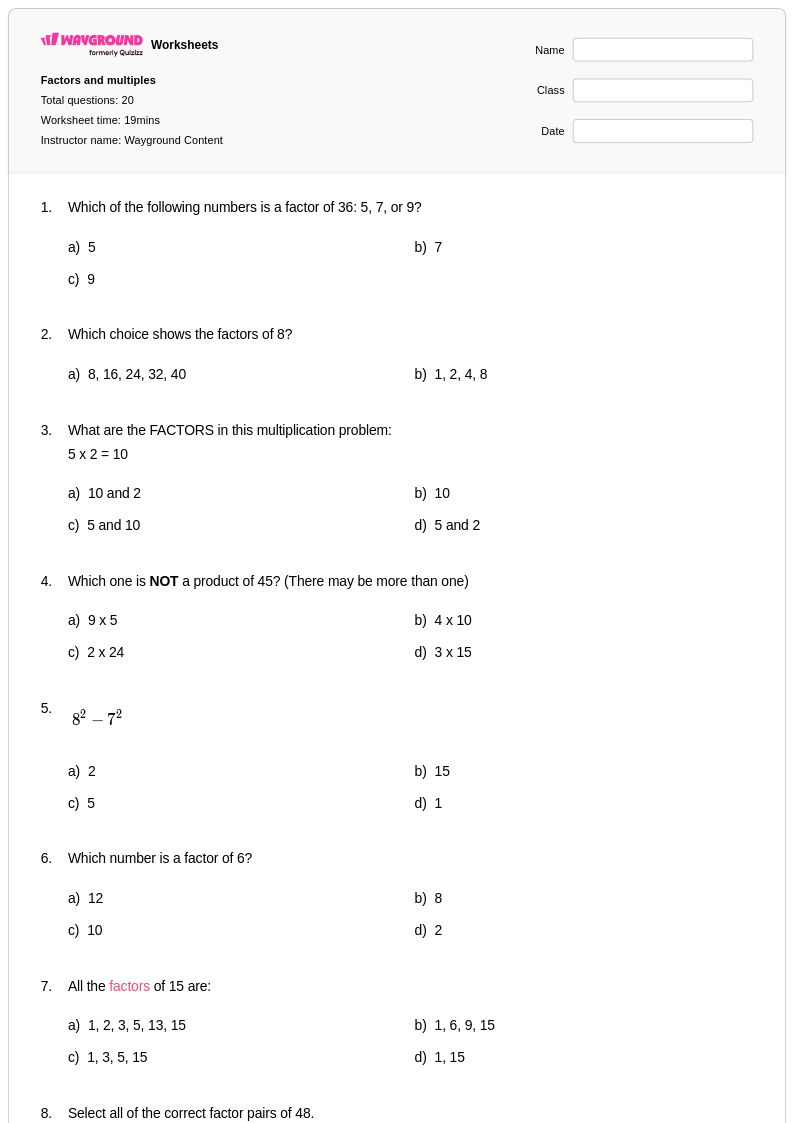
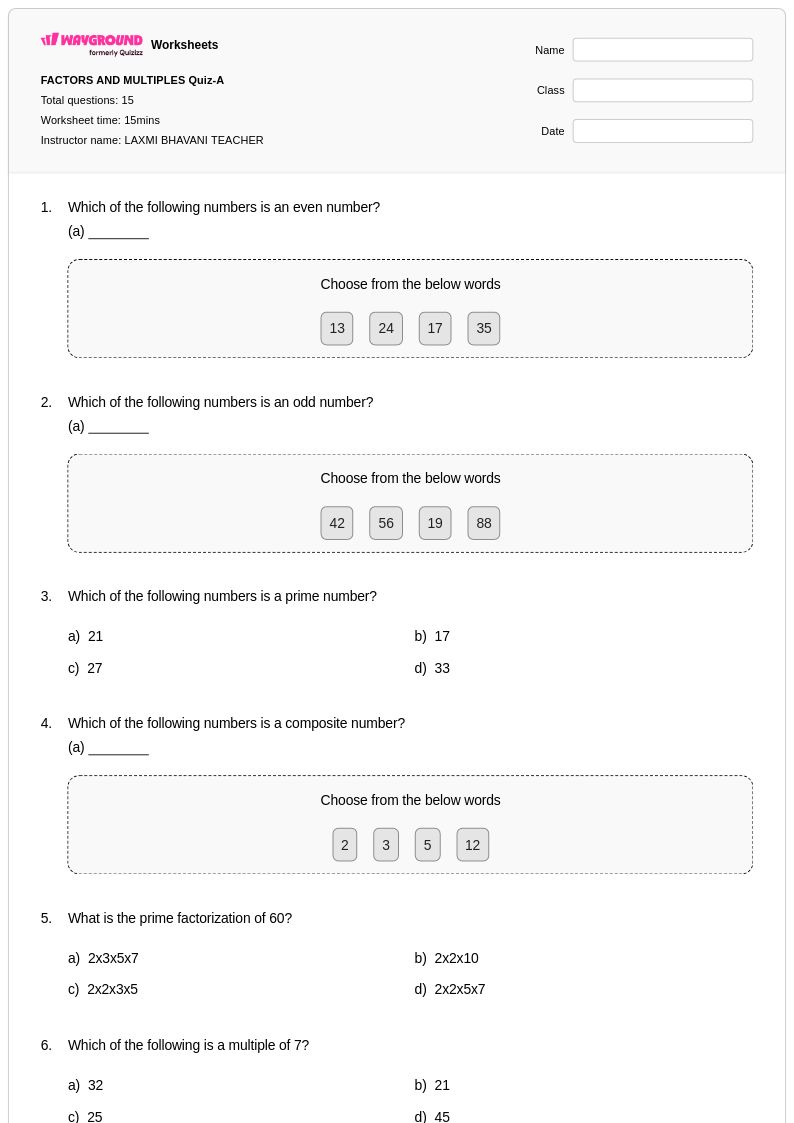
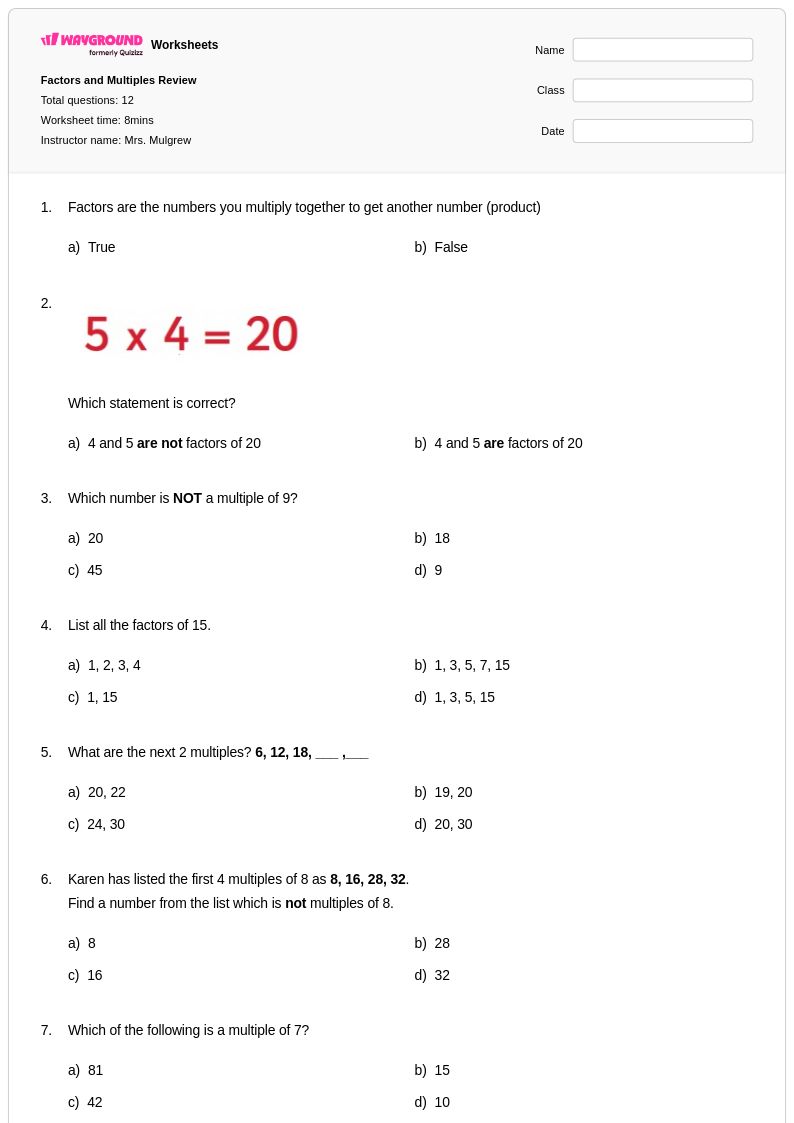
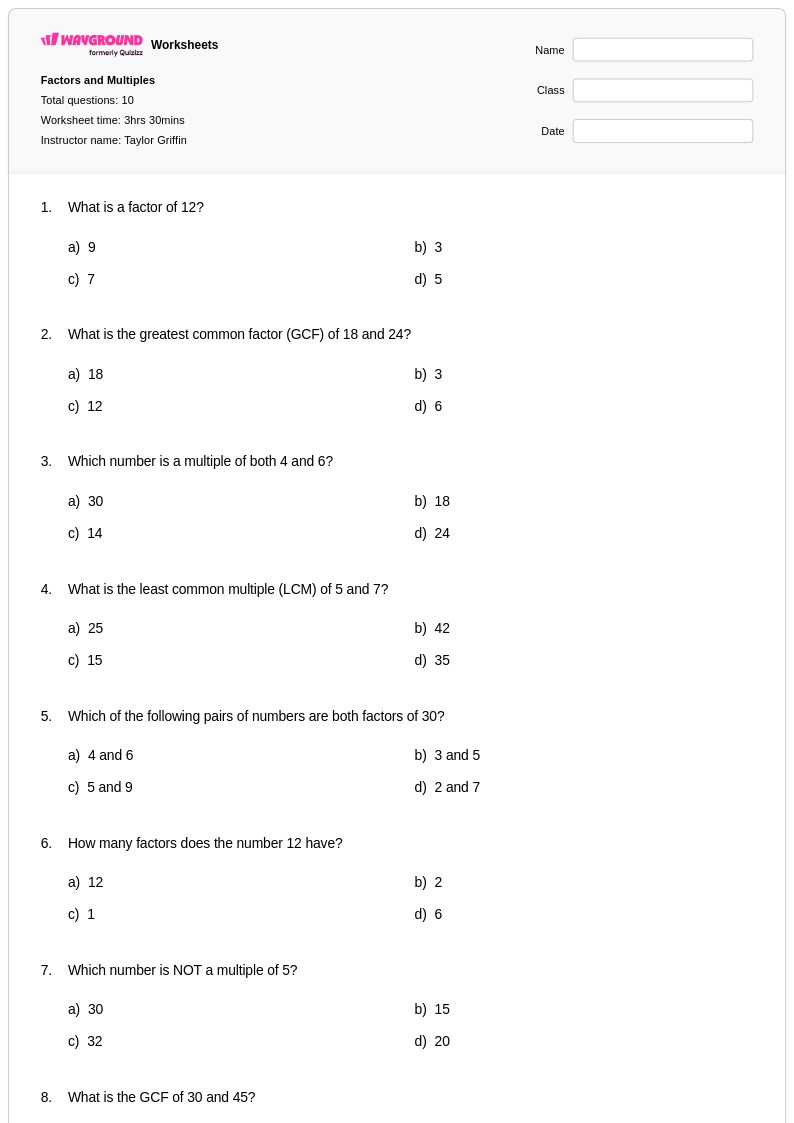
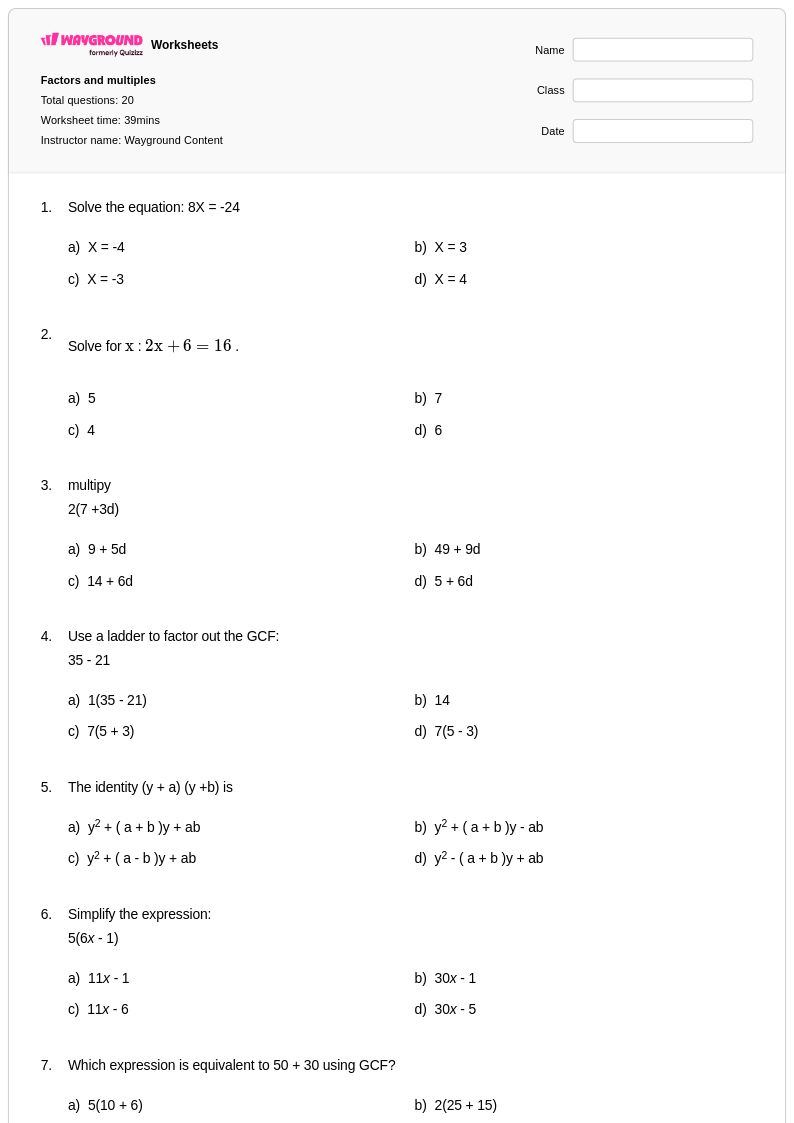
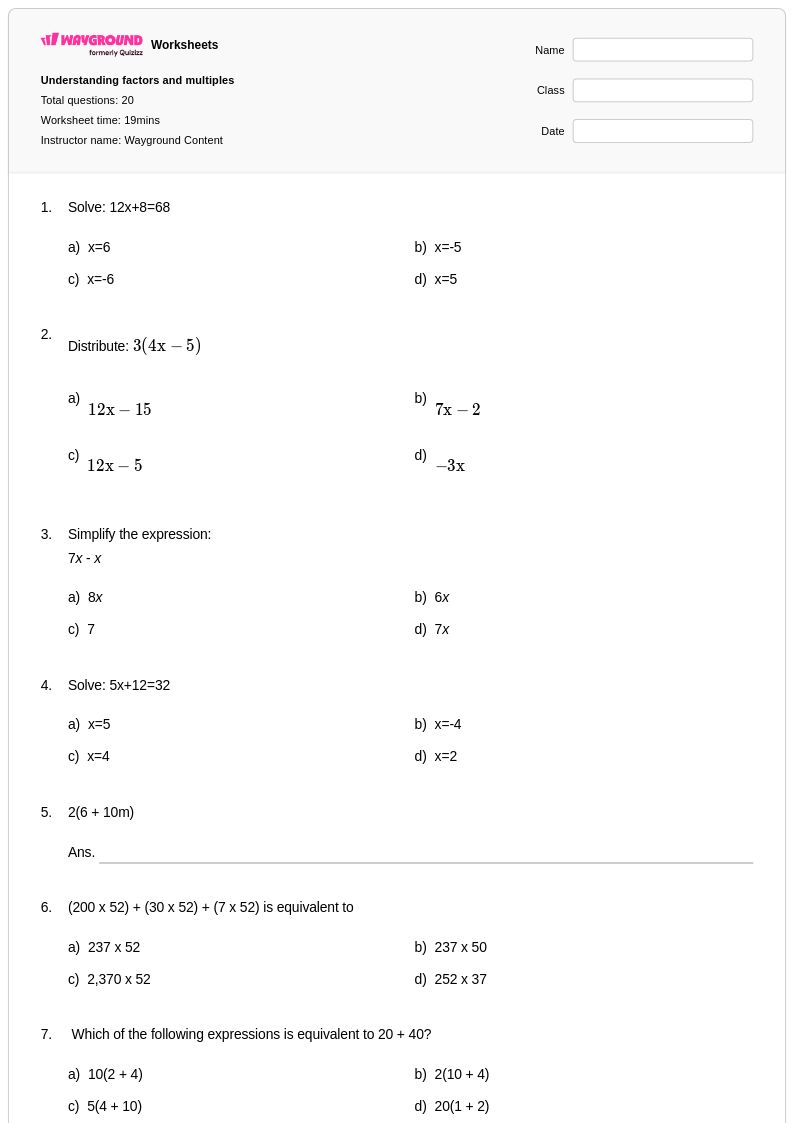
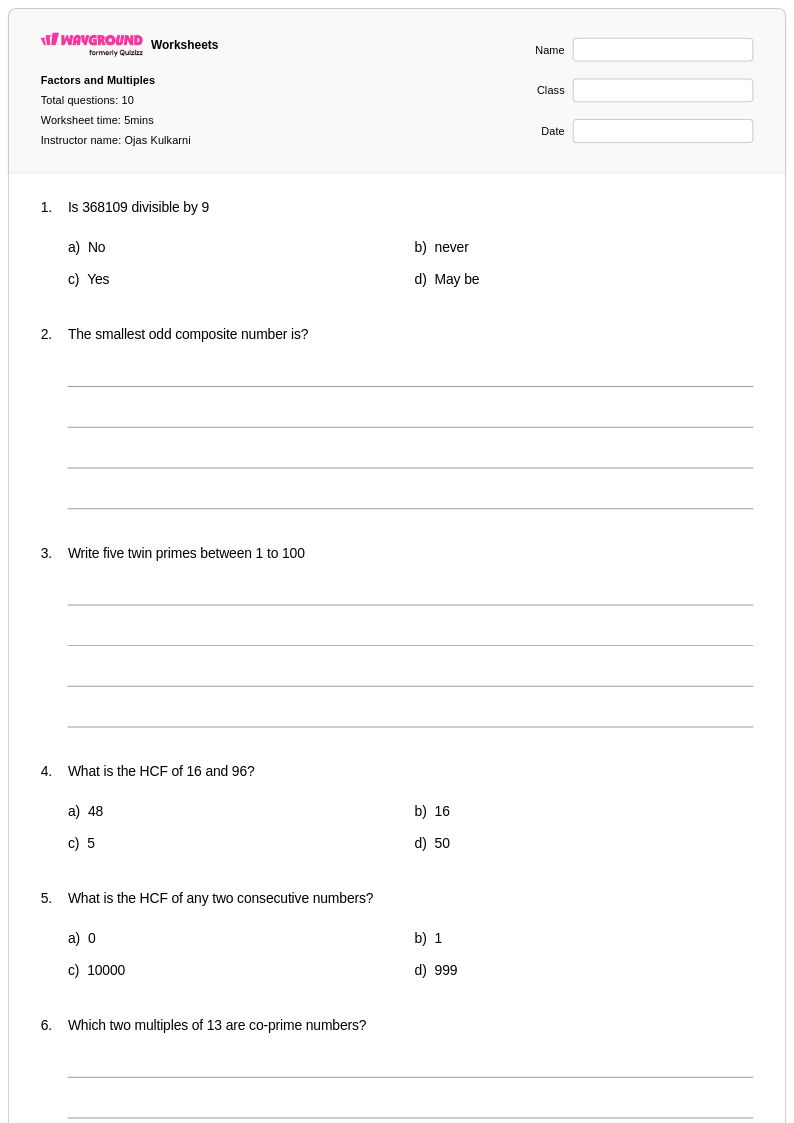
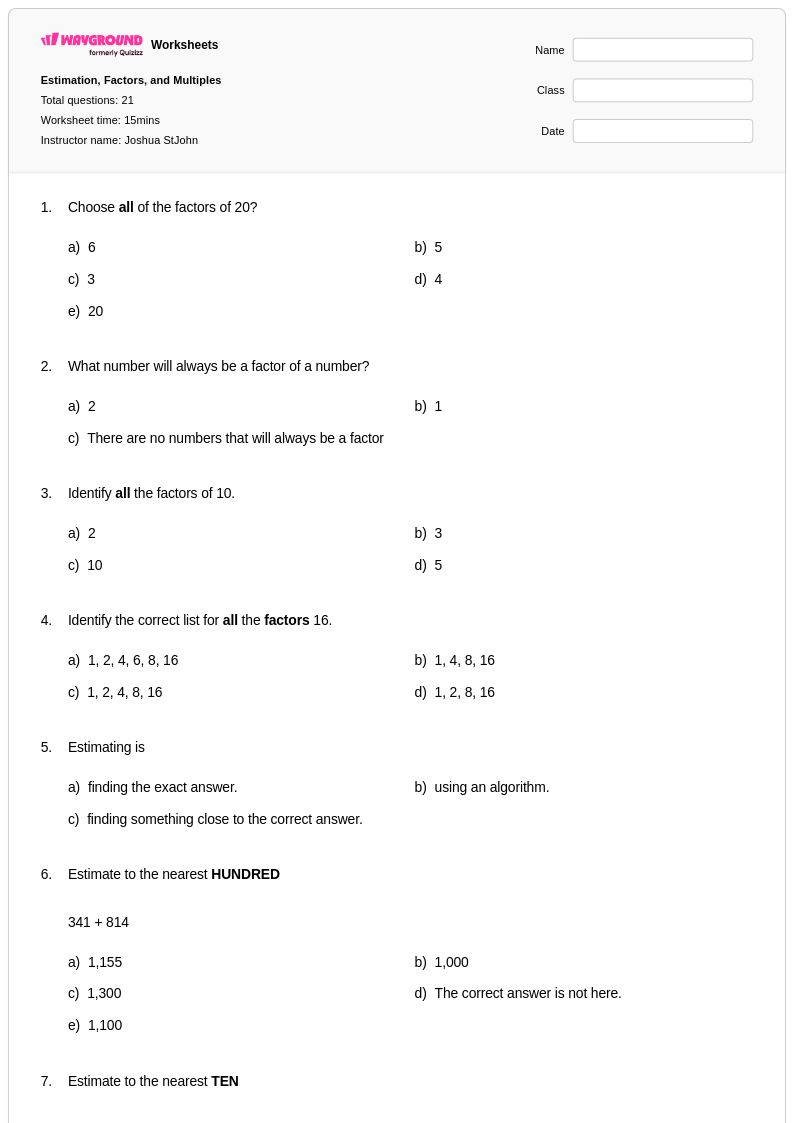
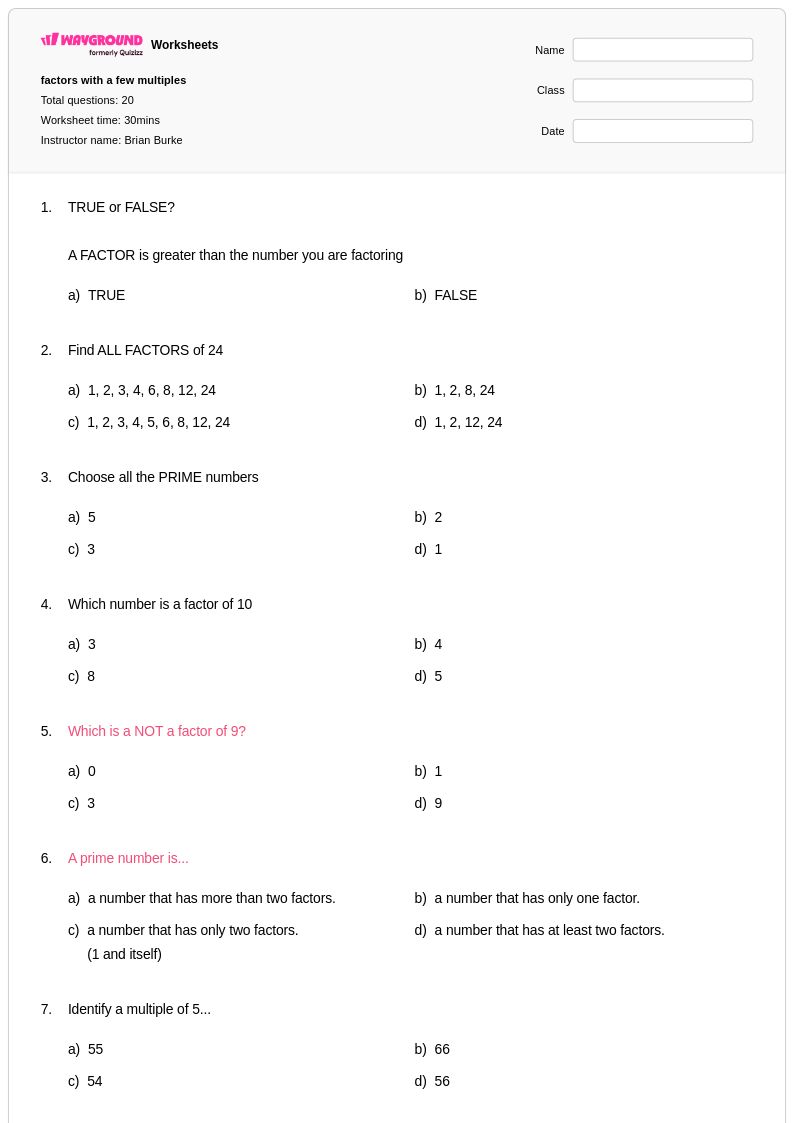
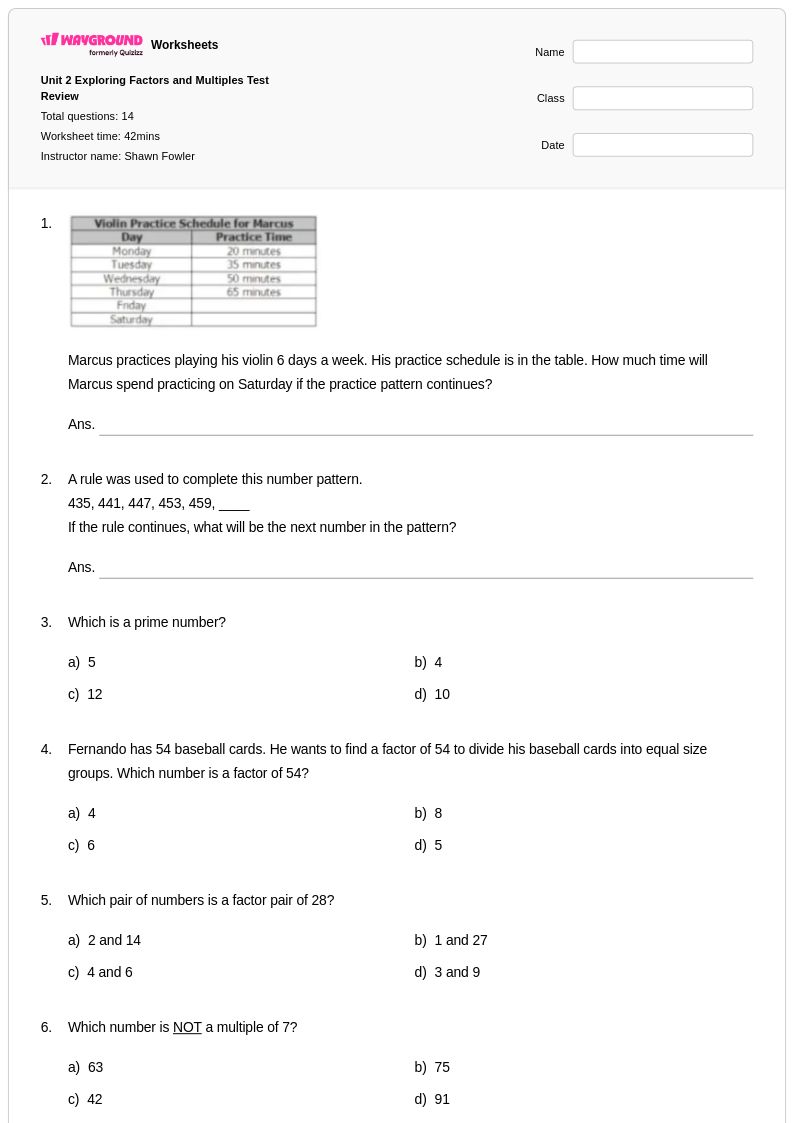
Free printable factors and multiples worksheets with answer keys help students master finding factors, identifying multiples, and understanding their relationships through engaging practice problems and comprehensive PDF exercises.
Explore printable Factors and Multiples worksheets
Factors and multiples worksheets available through Wayground (formerly Quizizz) provide comprehensive practice opportunities for students to master fundamental number theory concepts. These educational resources systematically develop critical mathematical reasoning skills, including identifying factor pairs, finding greatest common factors, determining least common multiples, and recognizing prime and composite numbers. The worksheets feature carefully sequenced practice problems that progress from basic factor identification to complex applications involving multiple numbers and real-world scenarios. Each worksheet collection includes detailed answer keys and explanatory solutions, making them valuable resources for both independent study and classroom instruction. These free printables offer flexible pdf formats that accommodate diverse learning environments and teaching approaches.
Wayground (formerly Quizizz) empowers educators with millions of teacher-created factors and multiples worksheet resources that streamline lesson planning and enhance mathematical instruction. The platform's robust search and filtering capabilities enable teachers to quickly locate worksheets aligned with specific learning objectives and curriculum standards, while built-in differentiation tools support personalized learning approaches for students at varying skill levels. Teachers can customize existing worksheets or create new variations to address specific classroom needs, with all resources available in both printable pdf and interactive digital formats. These comprehensive worksheet collections facilitate targeted skill practice, enable efficient remediation of conceptual gaps, and provide enrichment opportunities for advanced learners, ultimately supporting more effective mathematics instruction and improved student outcomes in number theory fundamentals.
FAQs
How do I teach factors and multiples?
Start with multiplication arrays and factor rainbows to make factor pairs concrete before moving to abstract notation. Once students can reliably list all factors of a number, introduce multiples as skip-counting sequences, then connect the two ideas by showing that if 4 is a factor of 12, then 12 is a multiple of 4. From there, GCF and LCM follow naturally rather than feeling like separate procedures to memorize.
What exercises help students practice factors and multiples?
The most effective practice moves from identification to application. Factor pair charts and Venn diagrams for GCF/LCM build the foundational skills, while word problems that ask students to find the largest group size or the next shared event date force them to decide which concept applies. Wayground's worksheets sequence problems this way, progressing from basic factor identification through prime and composite classification to multi-number GCF and LCM applications.
What mistakes do students commonly make with factors and multiples?
Three errors come up constantly. First, students confuse factors with multiples — they know the words but swap them under pressure. Second, when listing factors they stop early and miss pairs near the square root (listing 1, 2, 3 for 36 but forgetting 4, 6, 9, 12, 18). Third, they conflate GCF and LCM, choosing the wrong one in word problems because they haven't internalized what each is actually asking for.
How do I use Wayground's factors and multiples worksheets in my class?
You can run any worksheet as a digital quiz hosted on Wayground — students work through it on their devices and results come back to you automatically. If you'd rather go paper, download the printable PDF and distribute it in class; every worksheet includes a complete answer key so you're not building one from scratch. After collecting paper submissions, the Wayground for Teachers app lets you scan or capture student work to grade it without re-entering everything by hand.
How are factors and multiples sequenced in the Common Core math curriculum?
Common Core introduces factor pairs and multiples in Grade 4, where students find all factor pairs for numbers up to 100 and determine whether a number is prime or composite. Grade 5 extends this to GCF and LCM, which then become the engine for adding and subtracting fractions with unlike denominators. By Grade 6, prime factorization and fluent GCF/LCM work are expected prerequisites for ratio reasoning and fraction operations — so gaps here tend to surface as fraction struggles rather than number theory struggles.
How can I differentiate factors and multiples practice for mixed-ability classes?
For students who struggle with the volume of text in word problems, Wayground's Read Aloud accommodation reads questions aloud, and reduced answer choices can lower the cognitive load on multiple-choice items while they build confidence. For students with visual processing needs, you can generate an alternate version of the same worksheet with a dyslexia-friendly font or larger text — same problems, more accessible format. Advanced students can be pushed toward multi-number GCF/LCM problems and prime factorization without any of these supports applied to their version.
What grade level covers factors and multiples?
Factors and multiples are formally introduced in Grade 4 and developed through Grade 6. Grade 4 focuses on factor pairs and basic multiples; Grade 5 adds GCF, LCM, and prime vs. composite; Grade 6 brings in prime factorization and applies GCF/LCM to fraction work. Grade 7 revisits these concepts as tools for algebraic reasoning rather than as standalone topics.