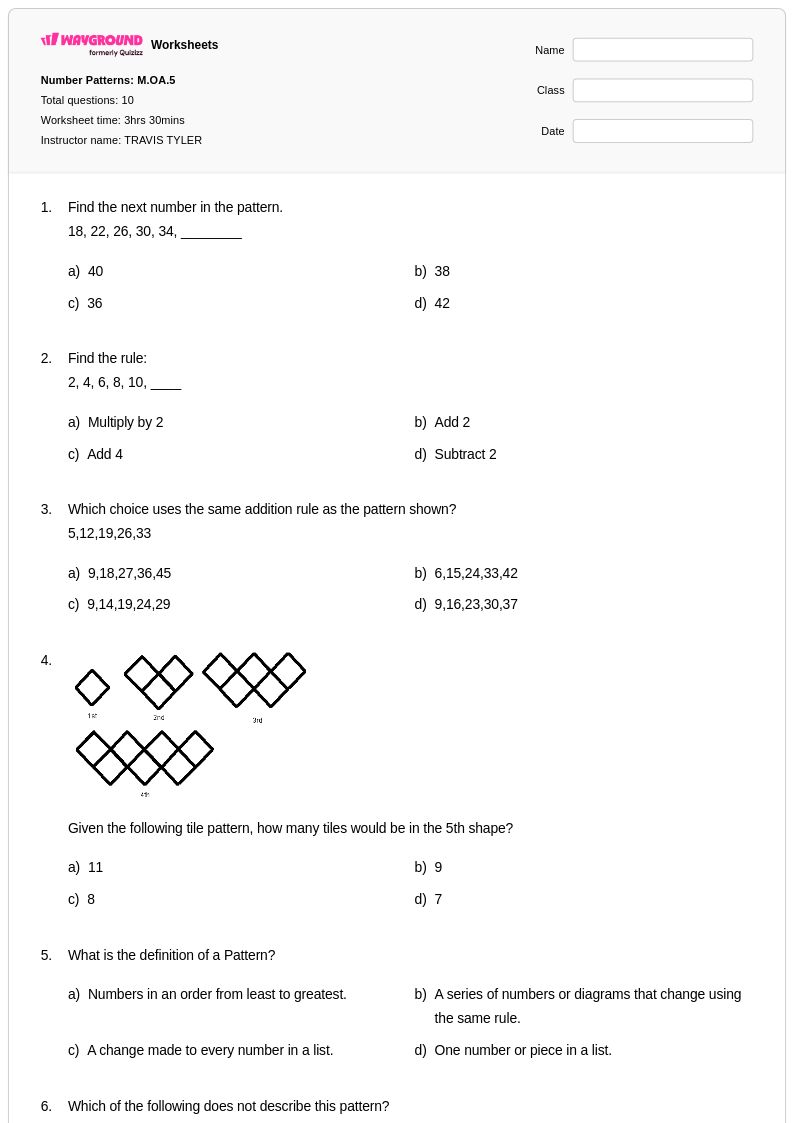
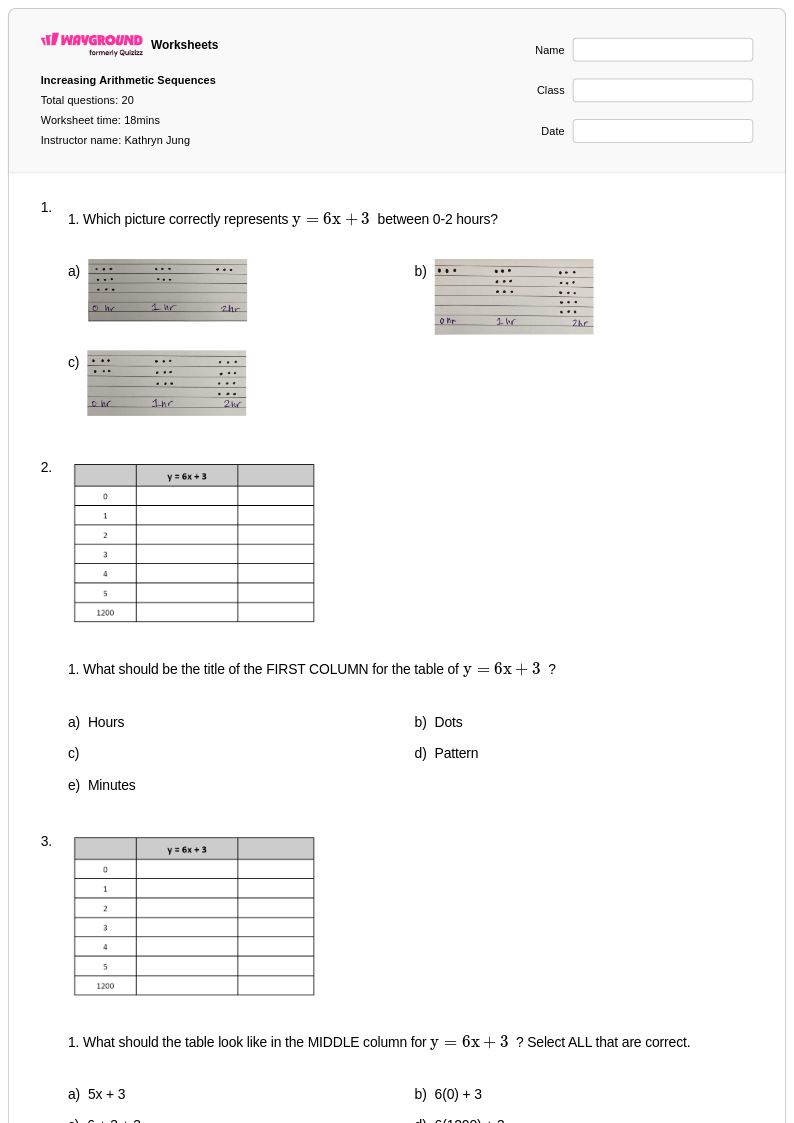
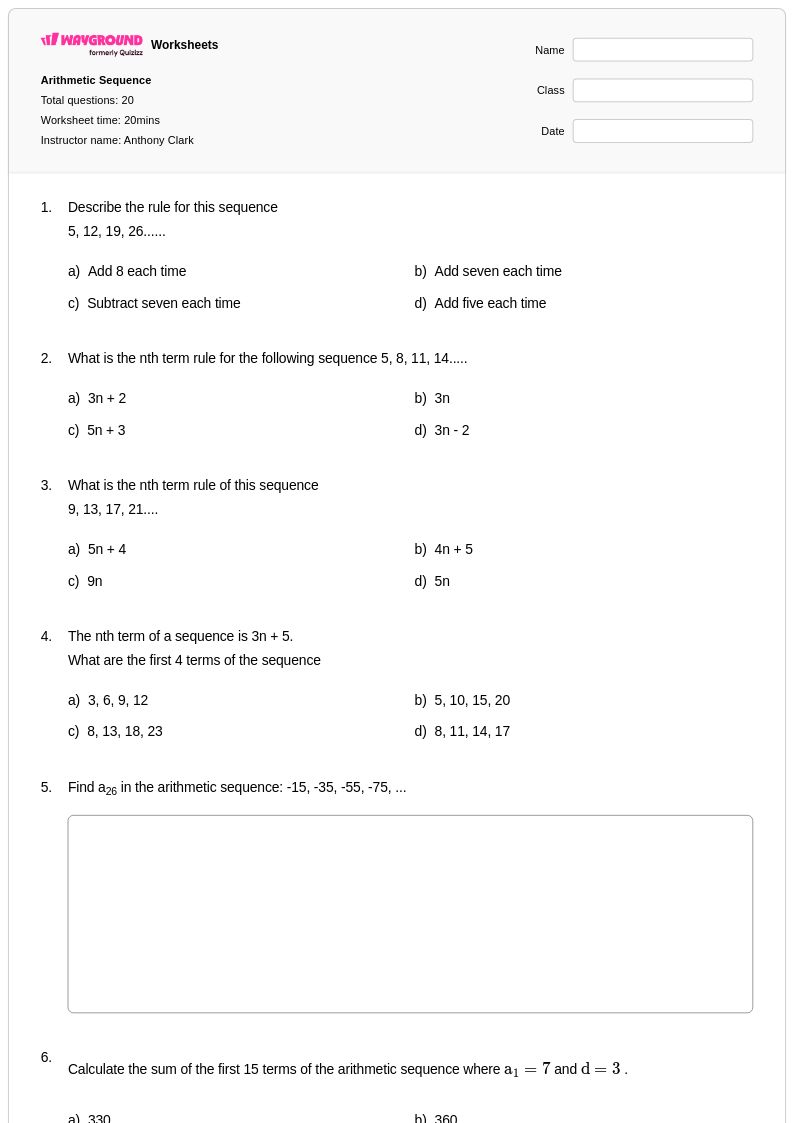
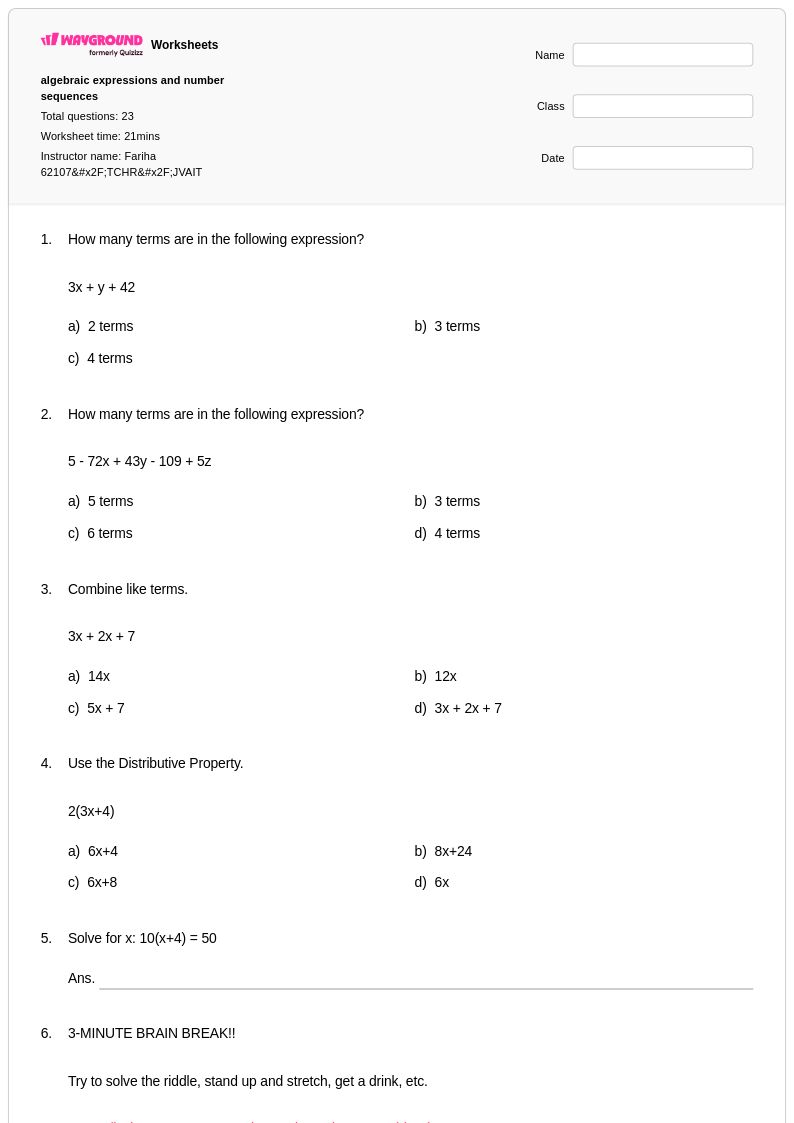
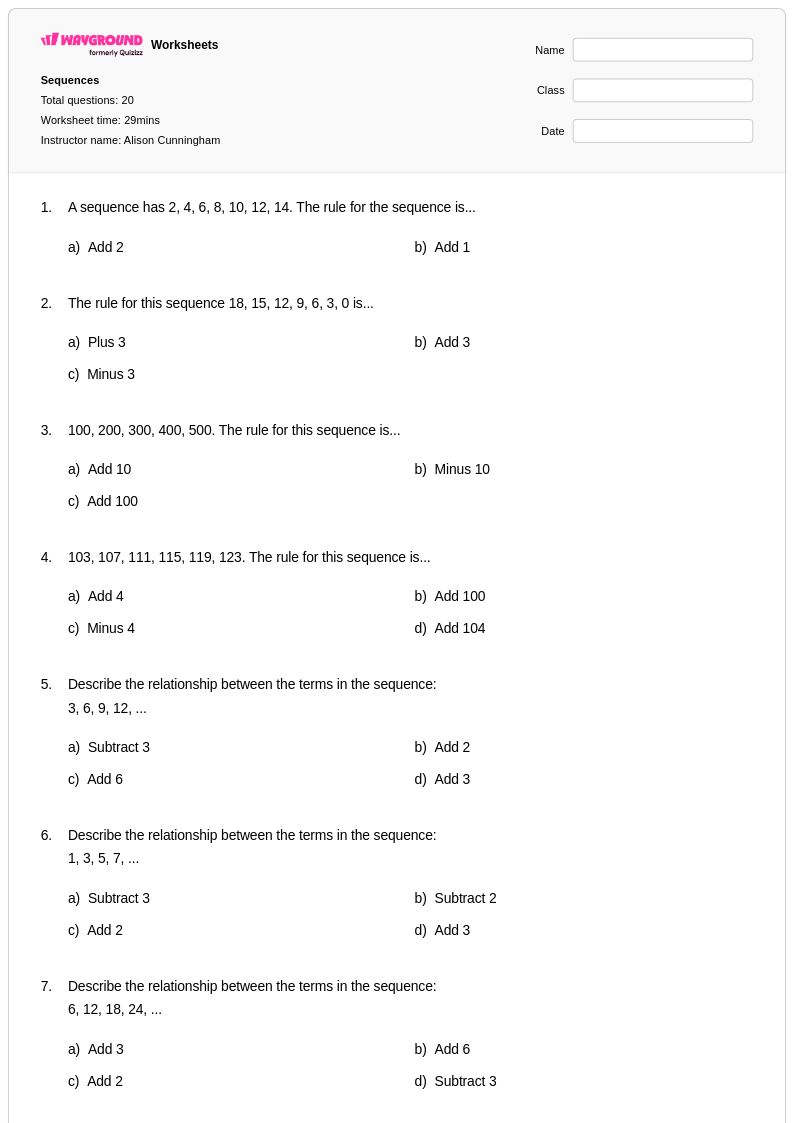
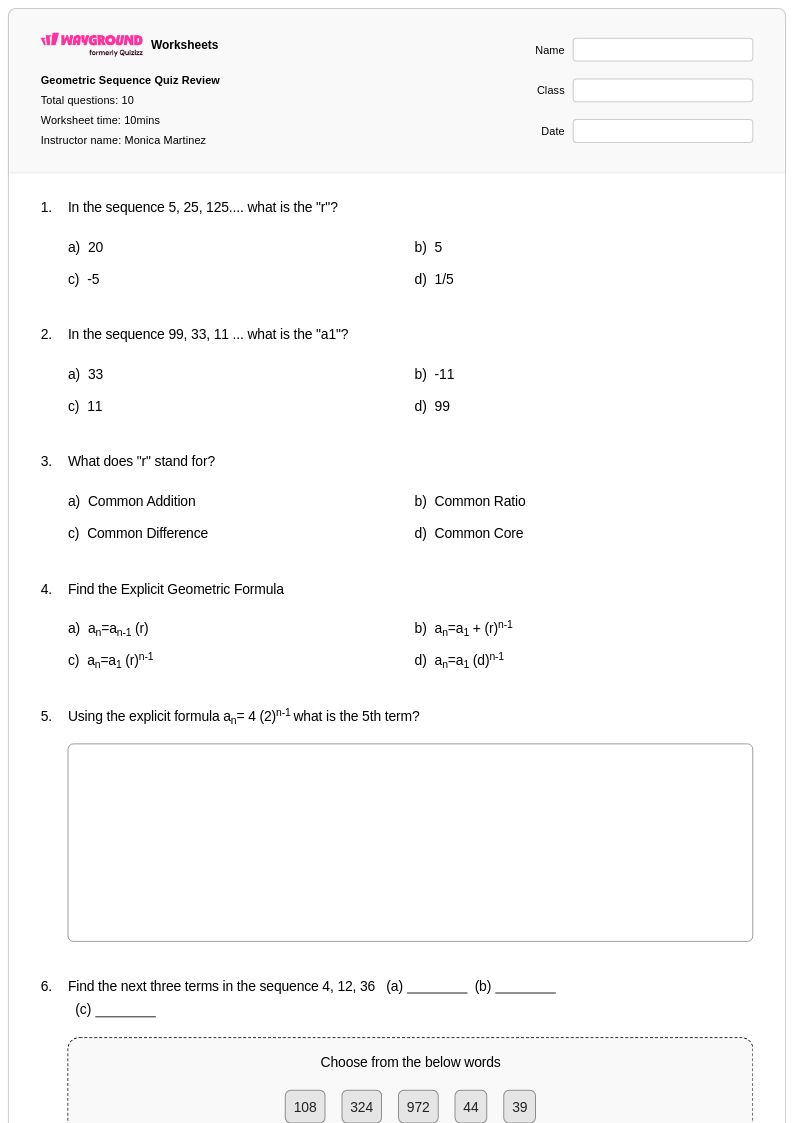
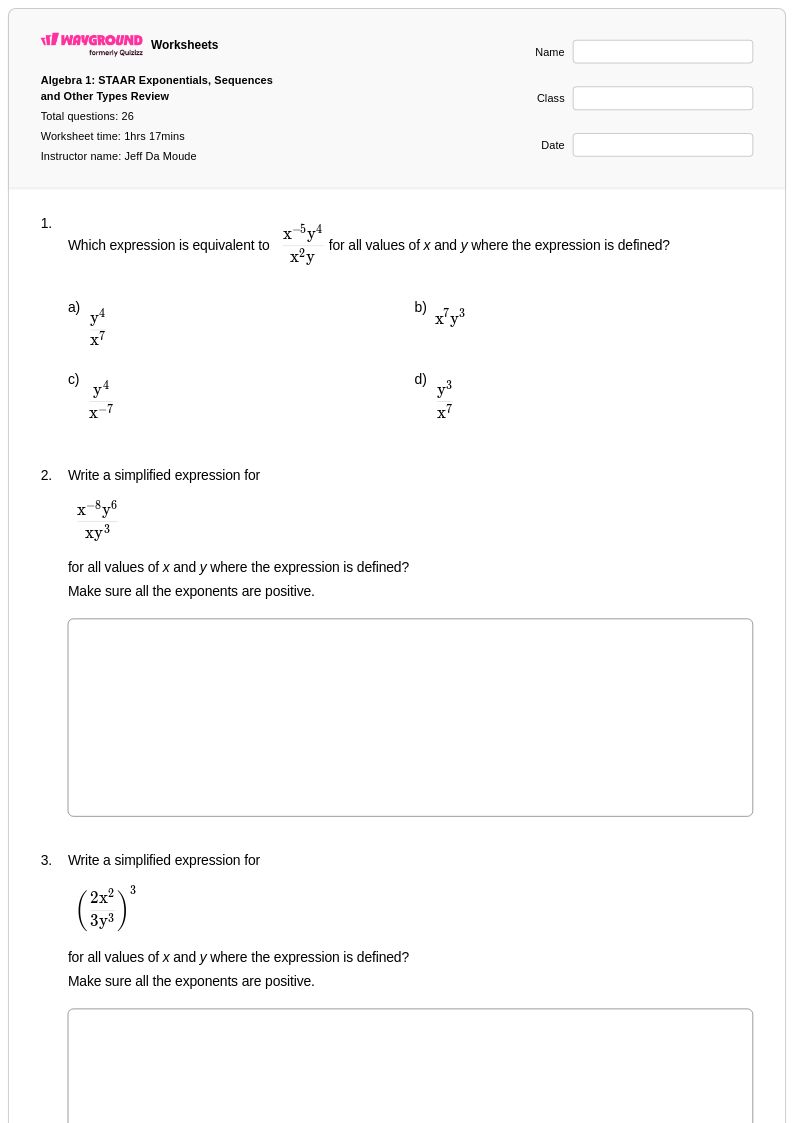
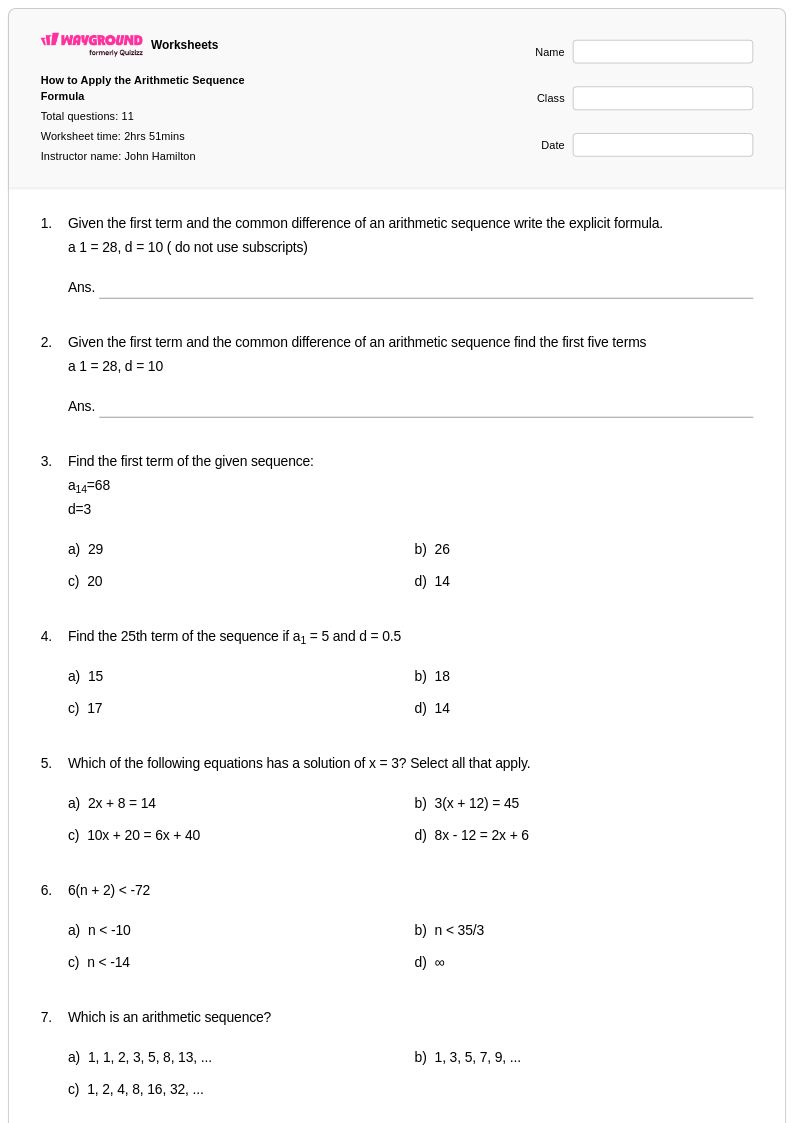
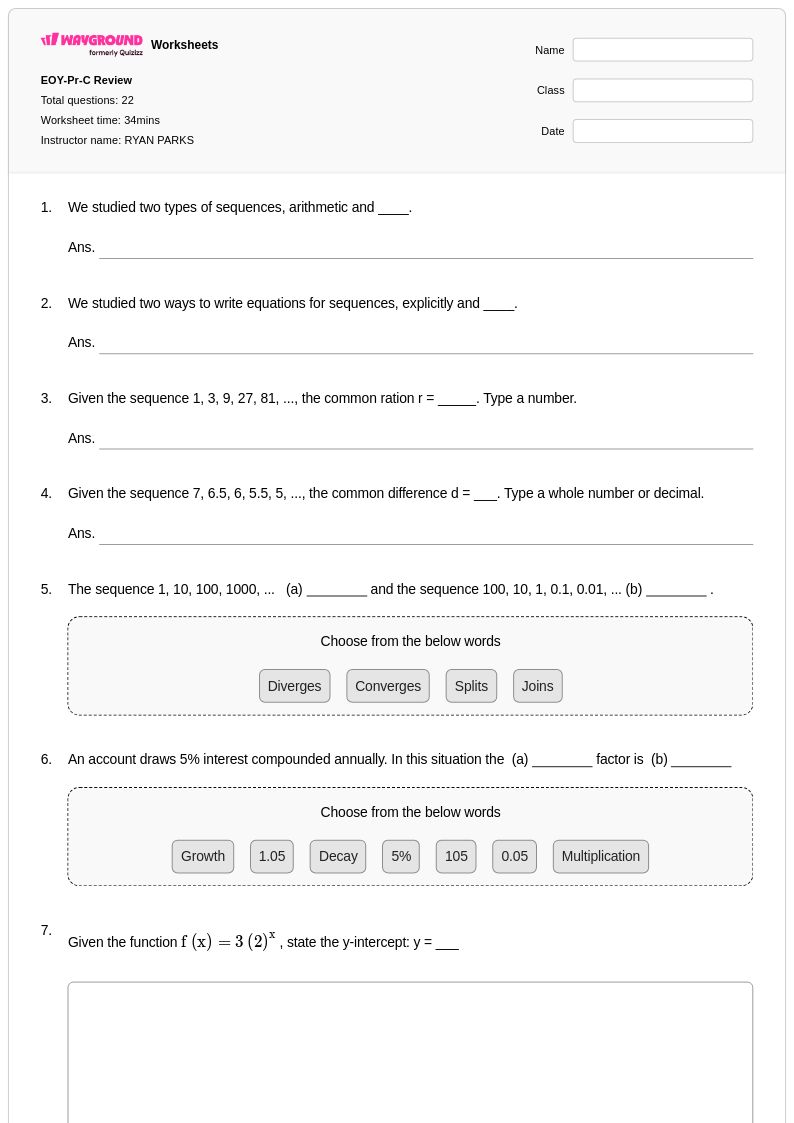
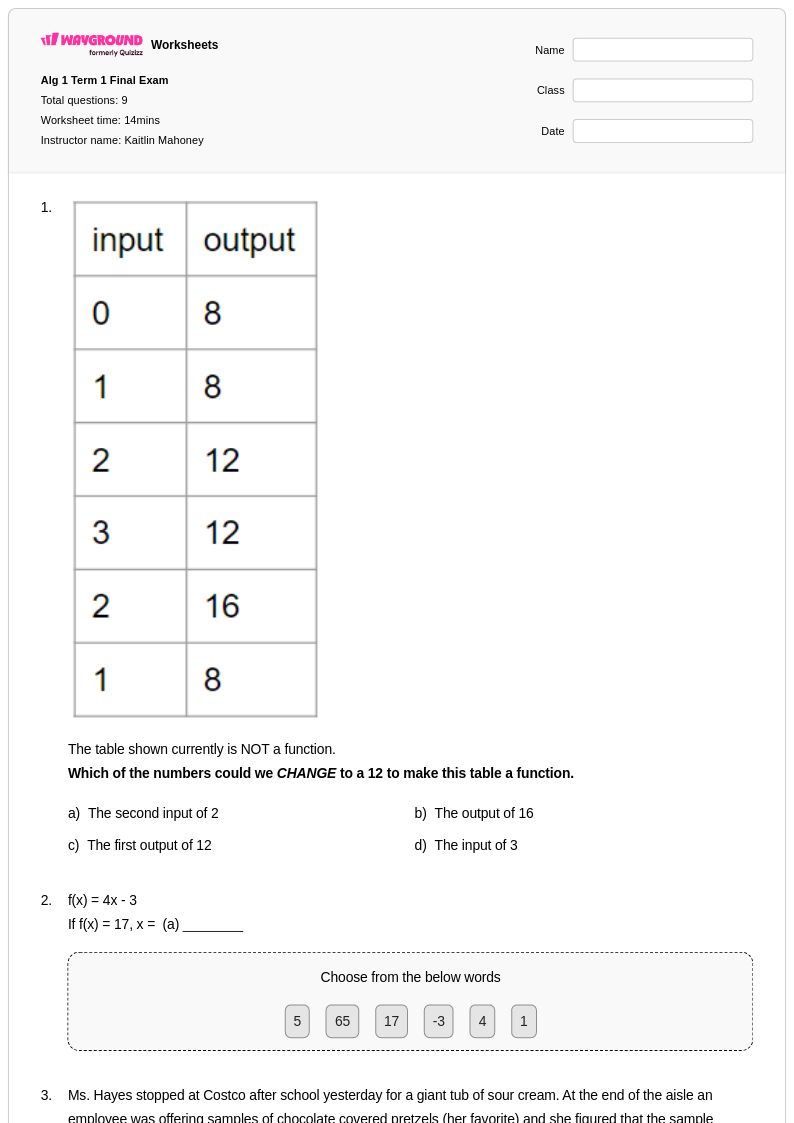
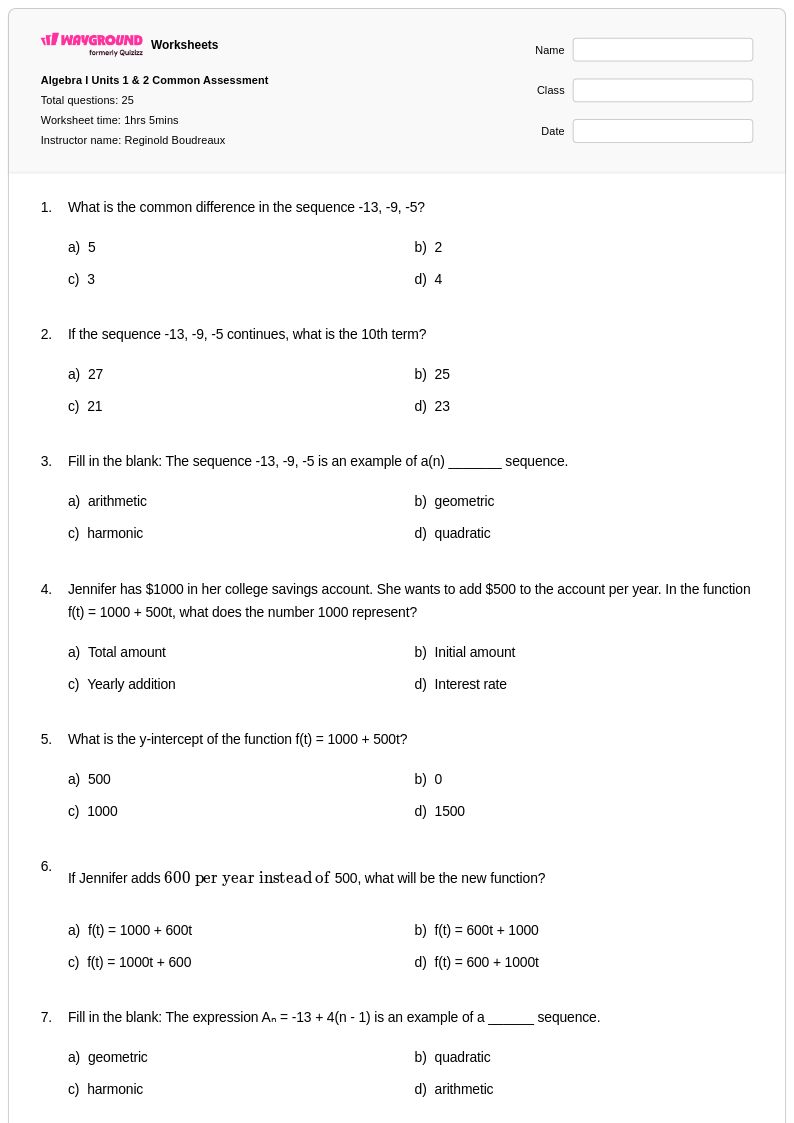
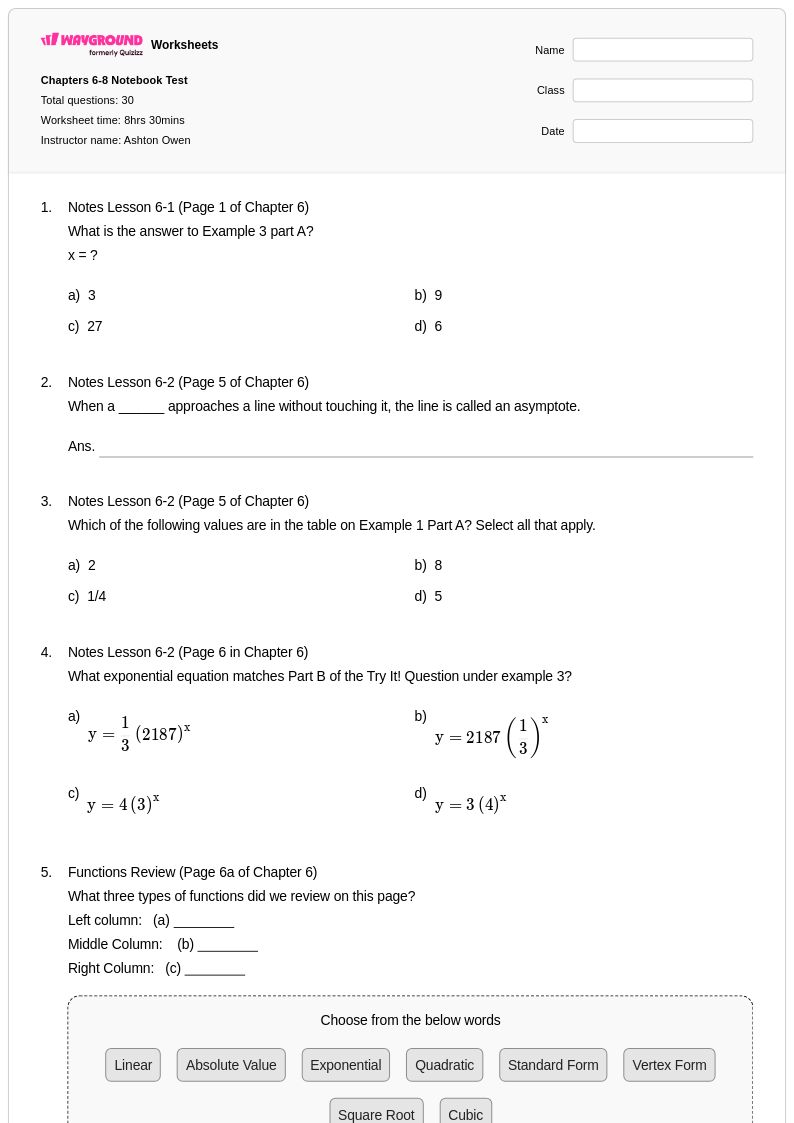
Enhance students' understanding of number sequences with Wayground's comprehensive collection of free worksheets and printables, featuring engaging practice problems and complete answer keys to build strong mathematical reasoning skills.
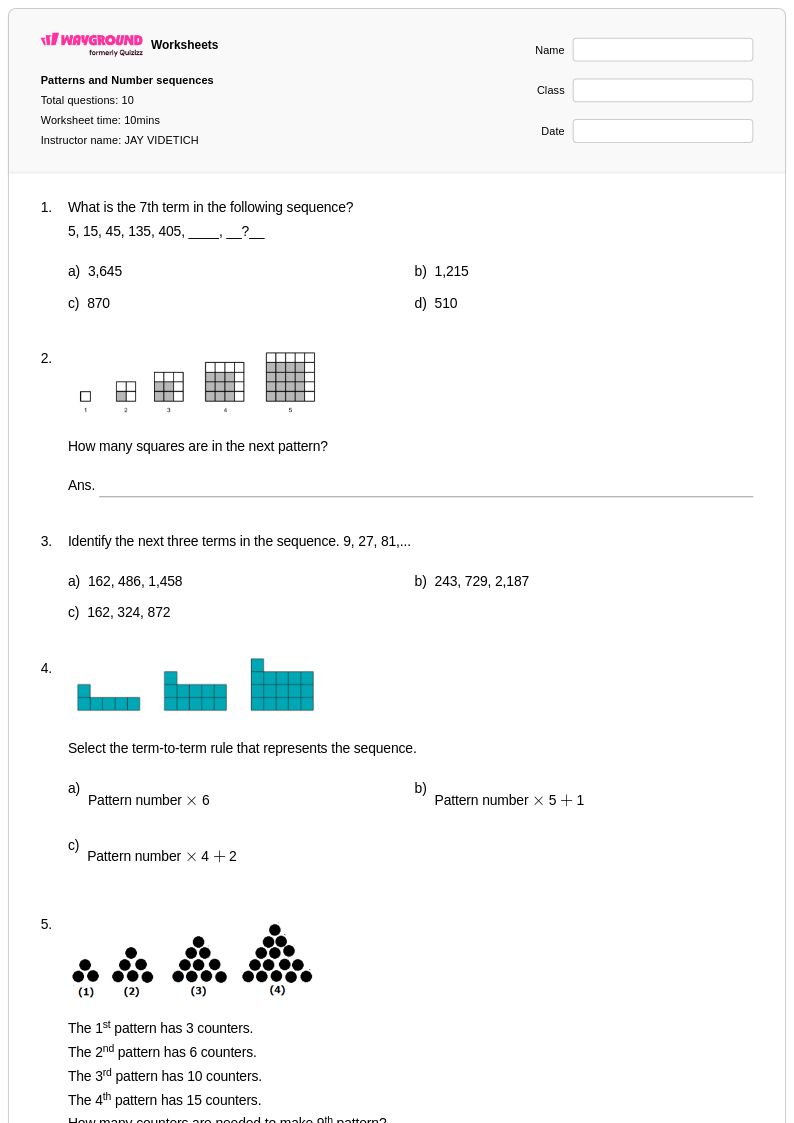
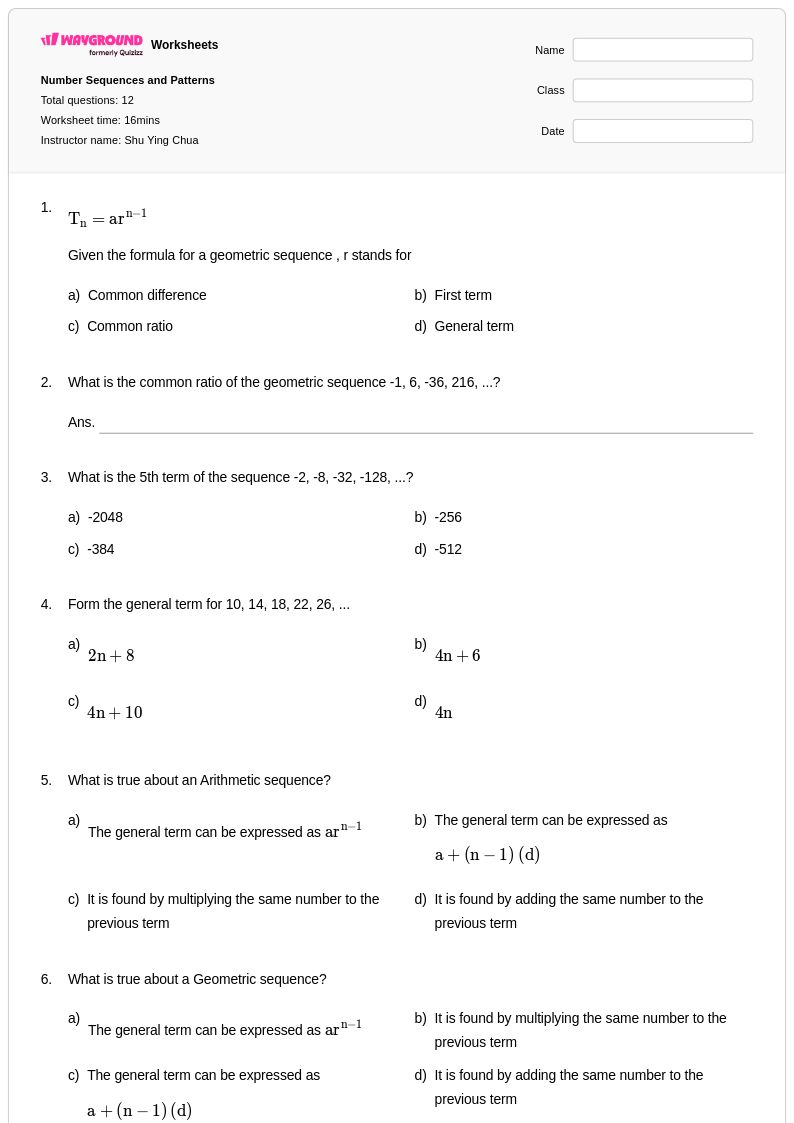
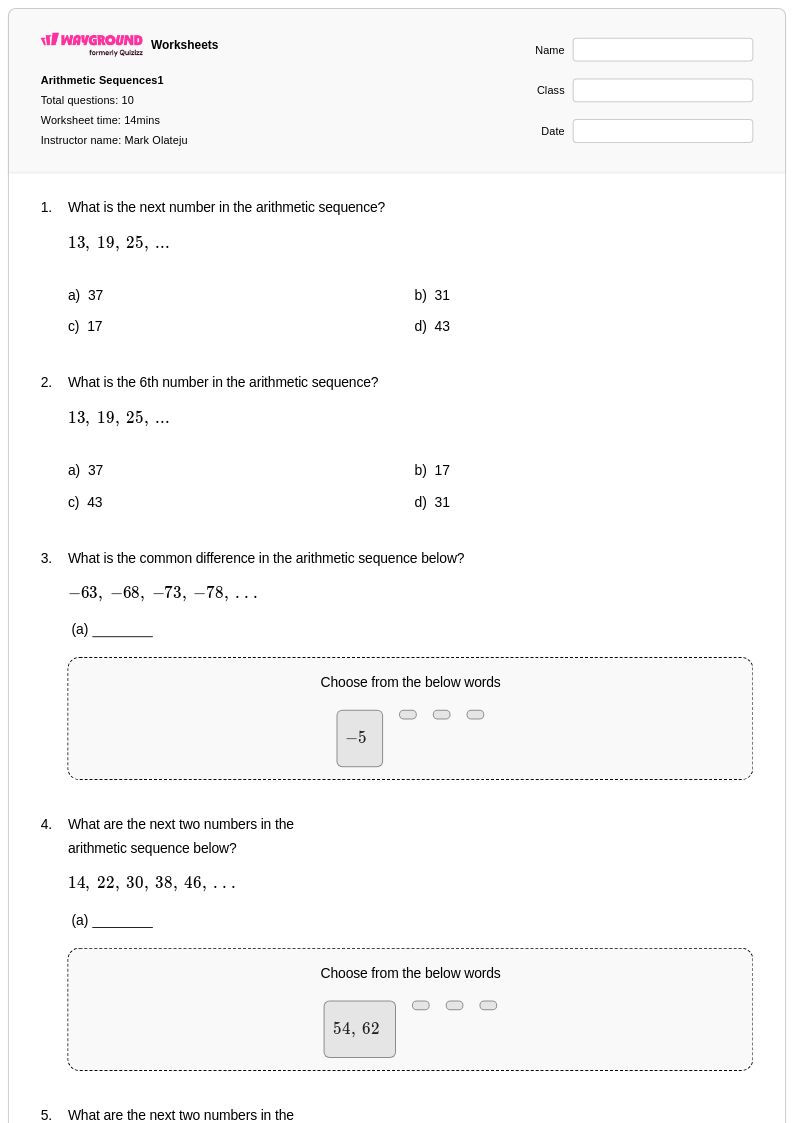
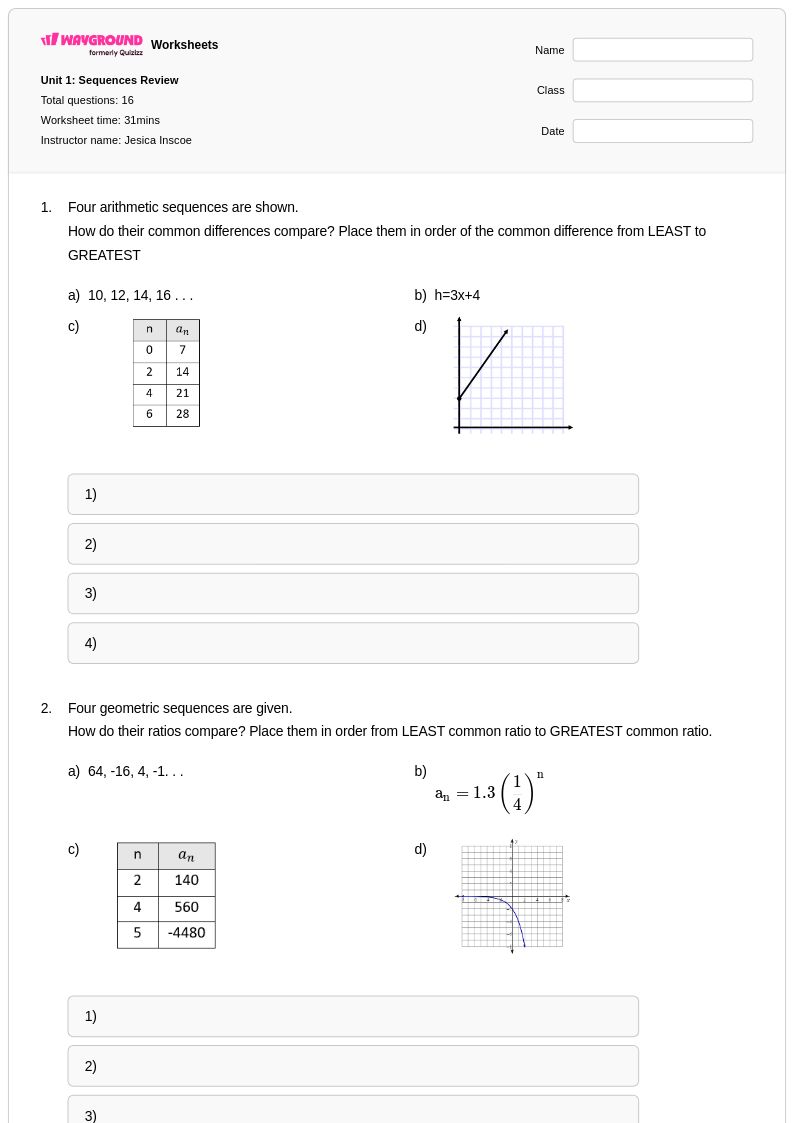
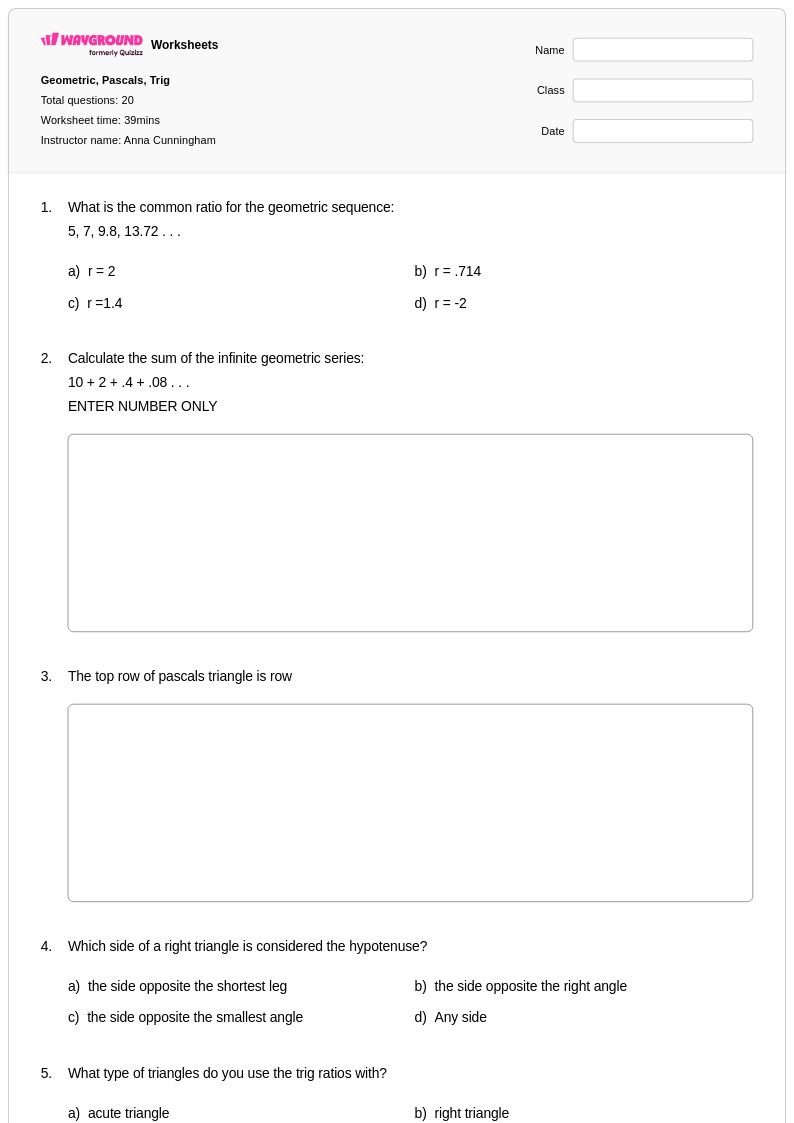
Number sequences worksheets available through Wayground (formerly Quizizz) provide comprehensive practice for students developing pattern recognition and mathematical reasoning skills. These educational resources focus on helping learners identify, extend, and analyze various types of numerical patterns, from simple arithmetic sequences to more complex geometric progressions and Fibonacci-style patterns. The worksheets strengthen critical thinking abilities by challenging students to discover underlying rules, predict subsequent terms, and articulate the mathematical relationships governing each sequence. Each resource includes detailed practice problems that progress systematically in difficulty, accompanied by answer keys that enable independent learning and self-assessment. These free printables cover essential concepts such as skip counting patterns, missing number identification, and sequence rule determination, making them invaluable tools for building foundational number sense skills that support advanced mathematical learning.
Wayground (formerly Quizizz) empowers educators with an extensive collection of millions of teacher-created number sequence worksheets designed to meet diverse classroom needs. The platform's robust search and filtering capabilities allow teachers to quickly locate resources aligned with specific learning standards and student skill levels, facilitating efficient lesson planning and targeted skill practice. These differentiation tools enable instructors to customize worksheets for individual learners, supporting both remediation for students requiring additional support and enrichment activities for advanced learners. Available in both printable pdf format and interactive digital versions, these resources offer flexibility for various teaching environments and learning preferences. Teachers can seamlessly integrate these materials into their mathematics curriculum to reinforce number pattern concepts, assess student understanding, and provide engaging practice opportunities that develop logical reasoning and analytical thinking skills essential for mathematical success.
FAQs
How do I teach number sequences?
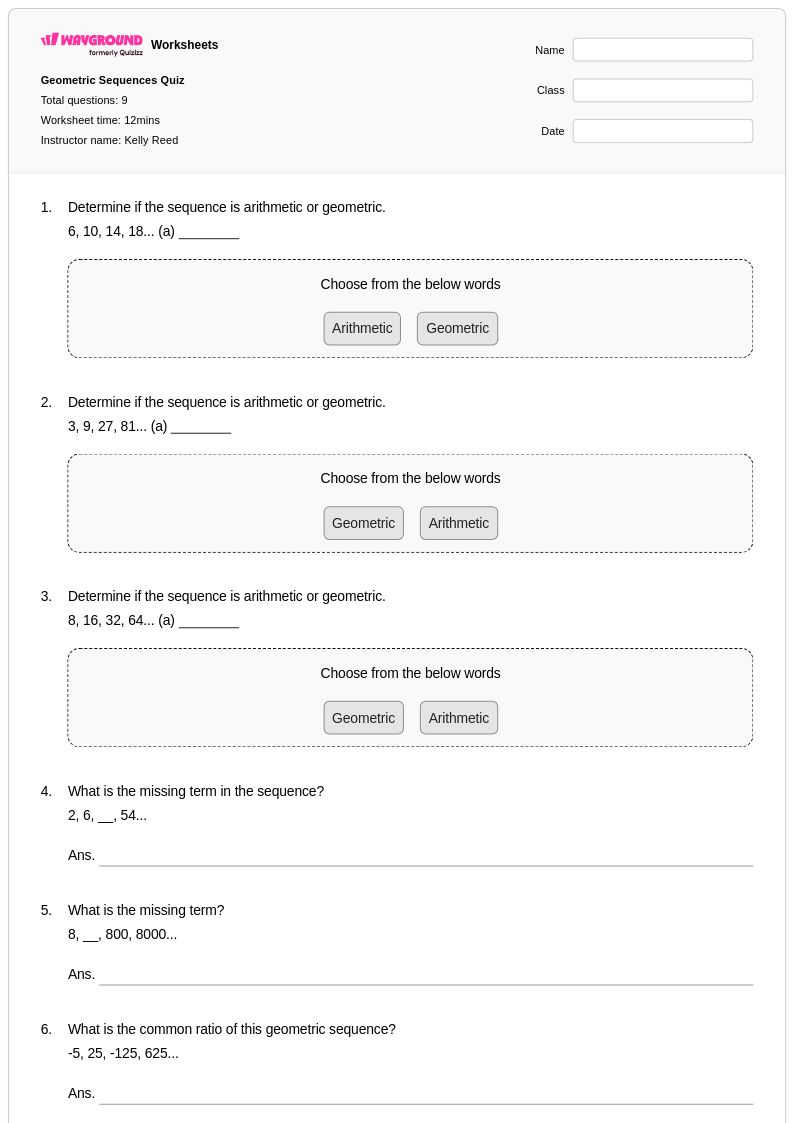
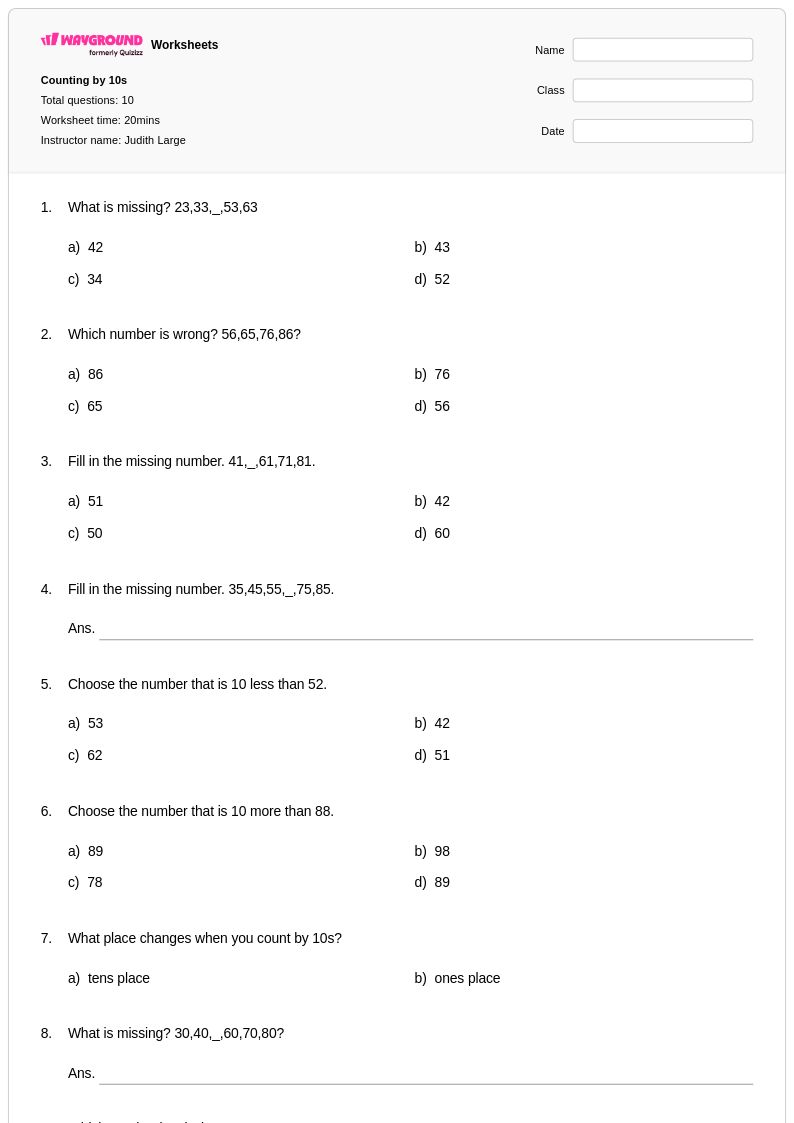
Start with concrete examples students already know, like skip counting by 2s, 5s, or 10s. Use a number line or hundred chart to visualize the 'jumps.' Once they are comfortable with simple arithmetic patterns, introduce sequences with more complex rules, such as geometric (multiplying) or Fibonacci-style (adding the previous two terms) sequences.
What exercises help students practice number sequences?
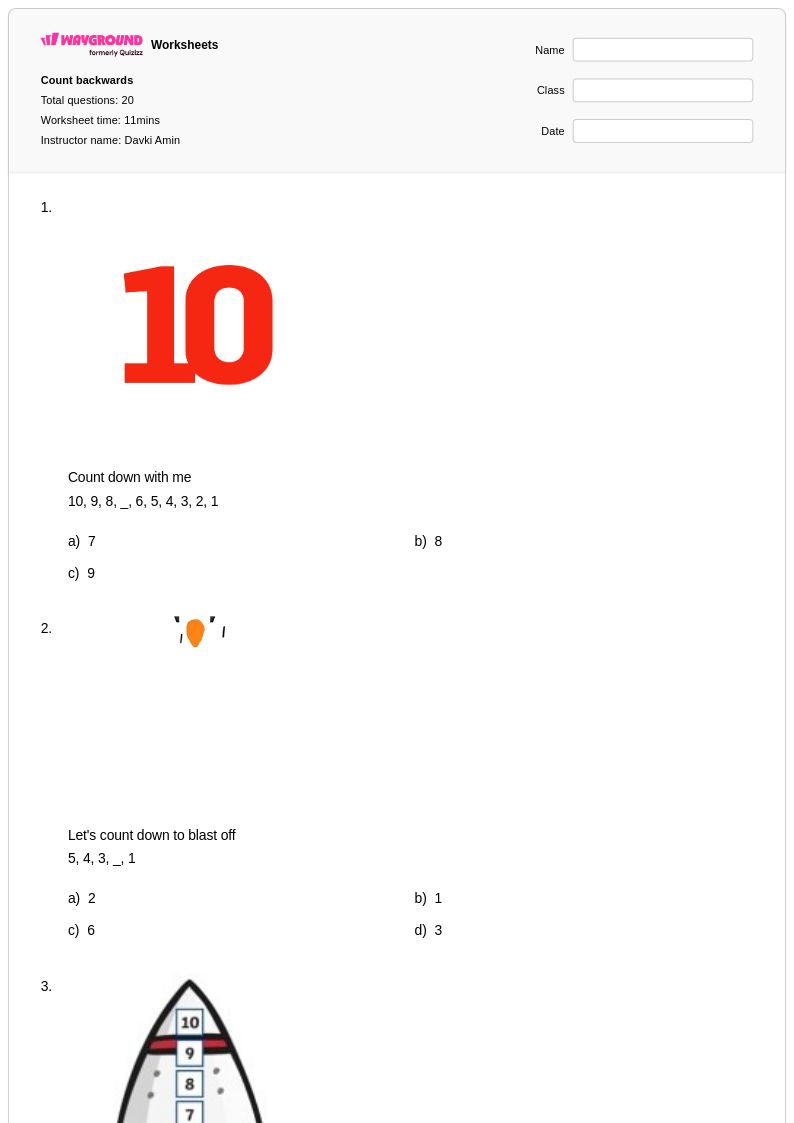
Effective practice involves a variety of tasks. Start with 'what comes next?' problems to build pattern recognition. Then, move to 'fill in the missing number' exercises, which require students to identify the rule and work forwards or backwards. Finally, challenge them with 'what is the rule?' problems, where they must describe the pattern algebraically or in words.
What grade do students learn about number sequences?
Students begin exploring number sequences as early as Kindergarten and 1st grade with simple skip counting. The concept is formalized in Grades 3-5, where they analyze arithmetic and geometric patterns. In middle school (Grades 6-8), this understanding serves as a crucial foundation for learning about functions and algebraic expressions.
What are common mistakes students make with number sequences?
A frequent error is misidentifying the pattern's rule, often assuming it's additive when it's multiplicative. Students may also struggle with multi-step patterns (e.g., multiply by 2, then add 1) or make simple calculation errors when extending a sequence. For decreasing sequences, they sometimes have trouble consistently applying subtraction or division.
How do number sequences fit into the math curriculum?
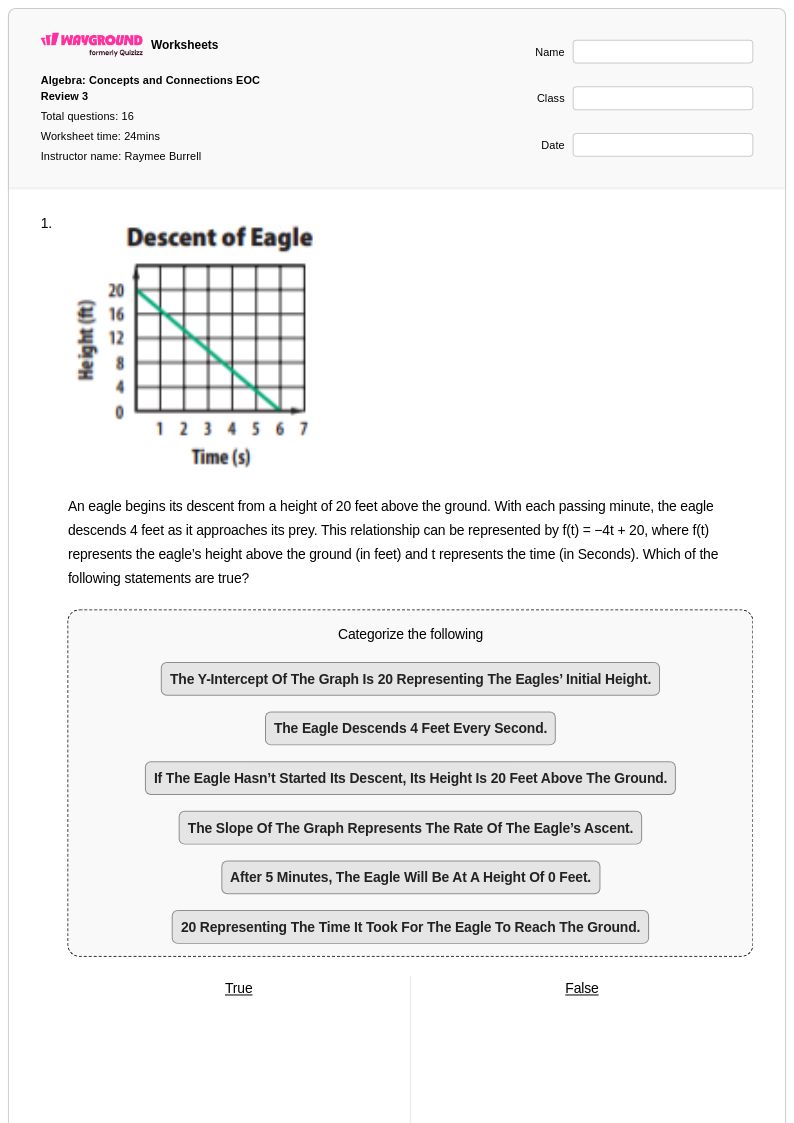
Aligned with Common Core principles, number sequences form a critical bridge from arithmetic to algebra. In early grades (K-2), they appear as skip counting. In grades 3-5, under Operations and Algebraic Thinking, students formally generate and analyze patterns. This work directly prepares them for middle school, where they will represent these patterns as functions with independent and dependent variables.
How can I use this number sequences worksheet?
This worksheet can be assigned as a printable PDF for hands-on practice or as an interactive digital quiz on the Wayground platform. The printable version allows you to grade student work quickly using the Wayground for Teachers mobile app. Every worksheet, in either format, includes a complete answer key for efficient grading or self-assessment.
How can I differentiate practice for number sequences?
For students needing support, use Wayground's features to reduce the number of answer choices on digital assignments or provide extended time. You can also use a worksheet version with a dyslexia-friendly font or wider spacing. For enrichment, challenge advanced learners to create their own complex sequences and write the corresponding rules.