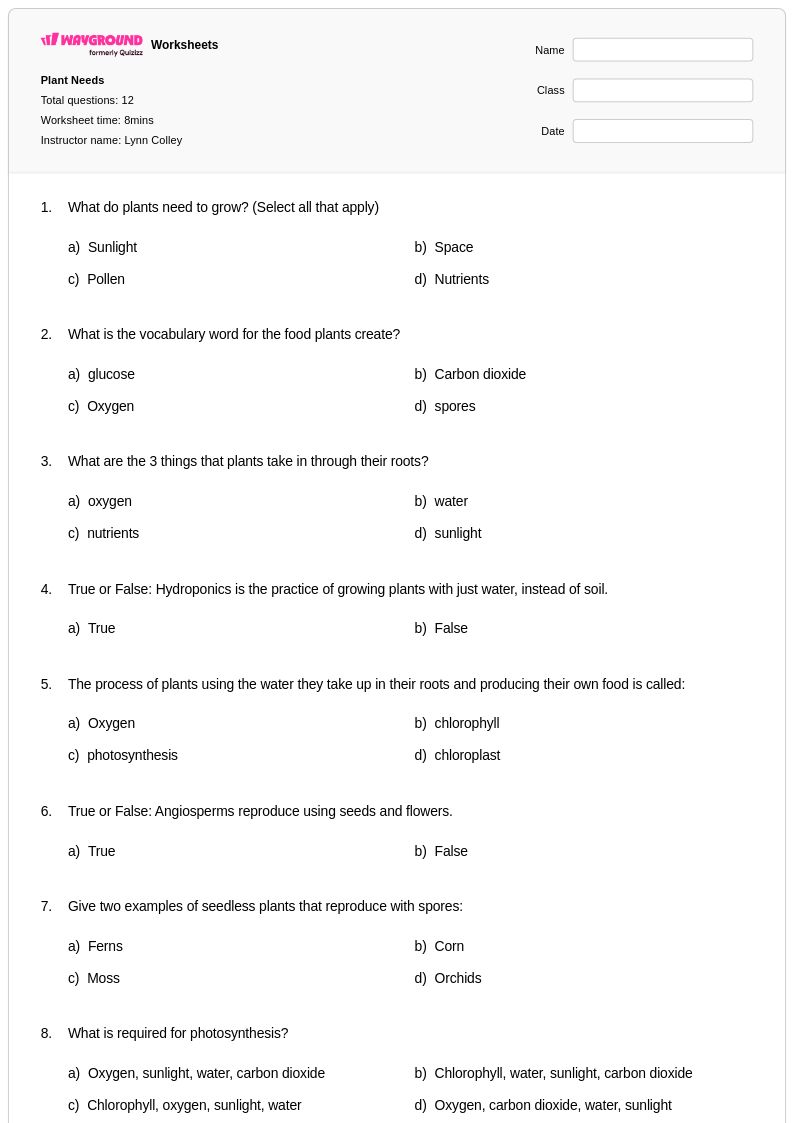
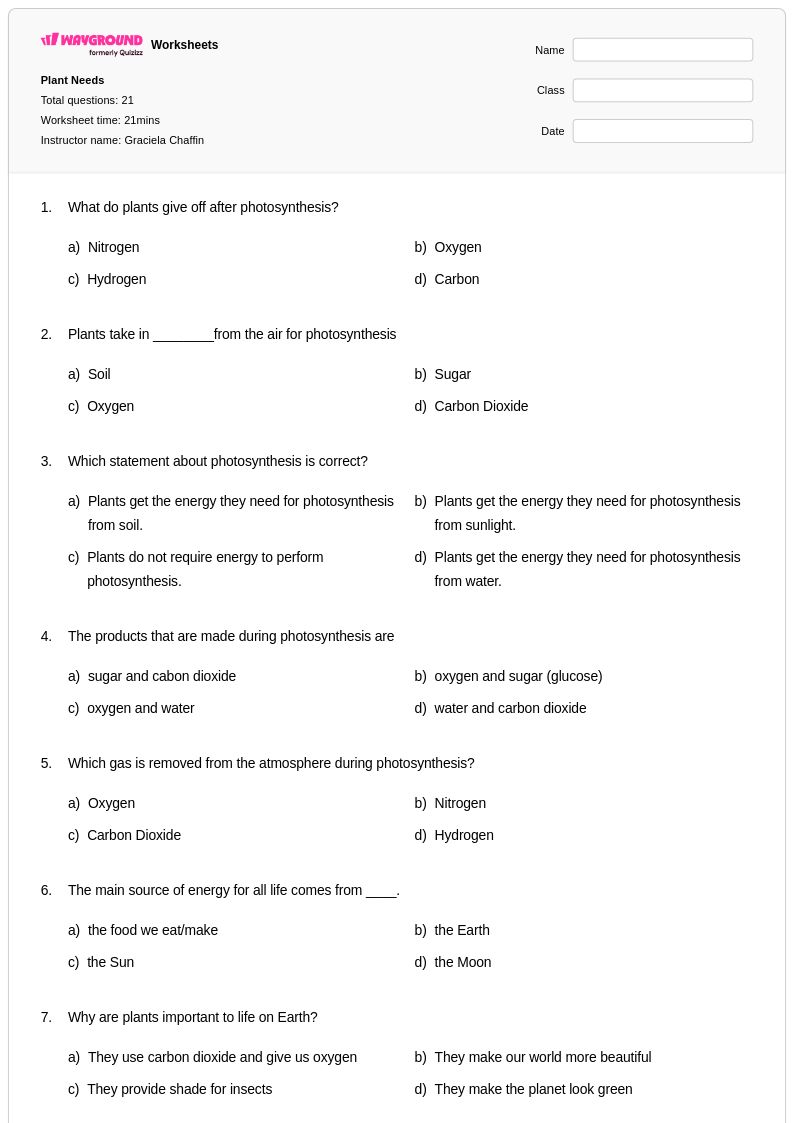
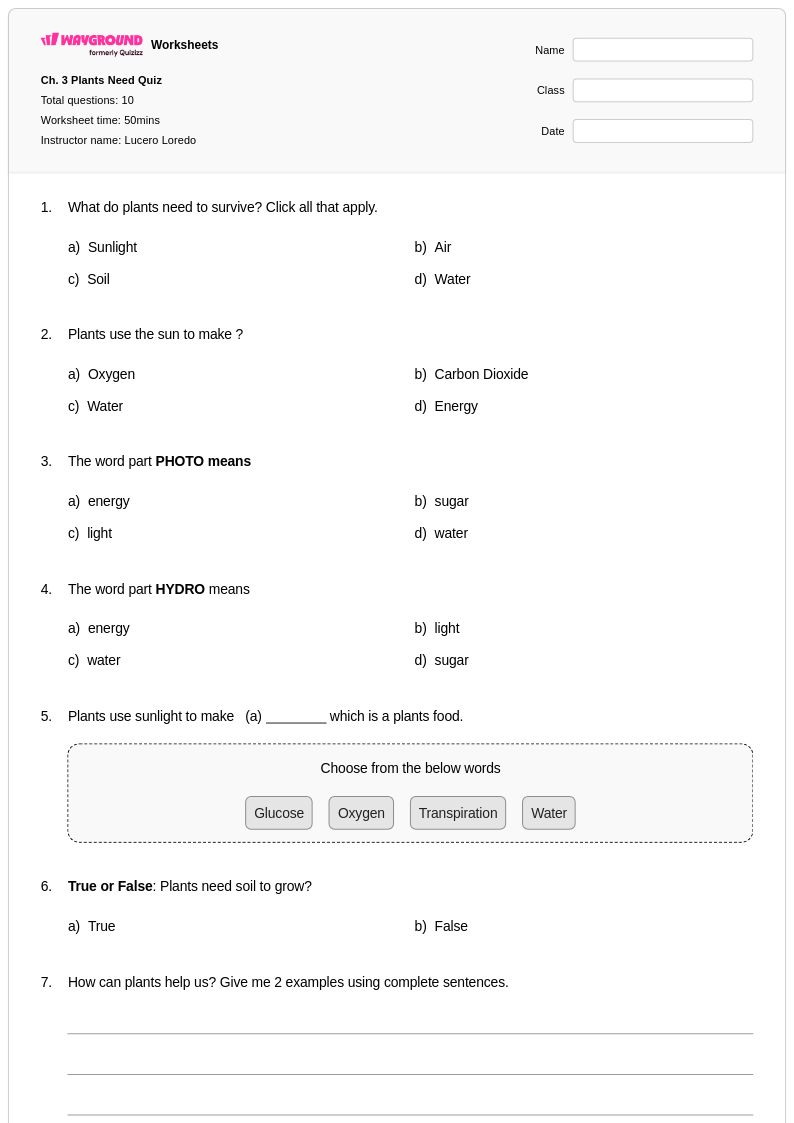
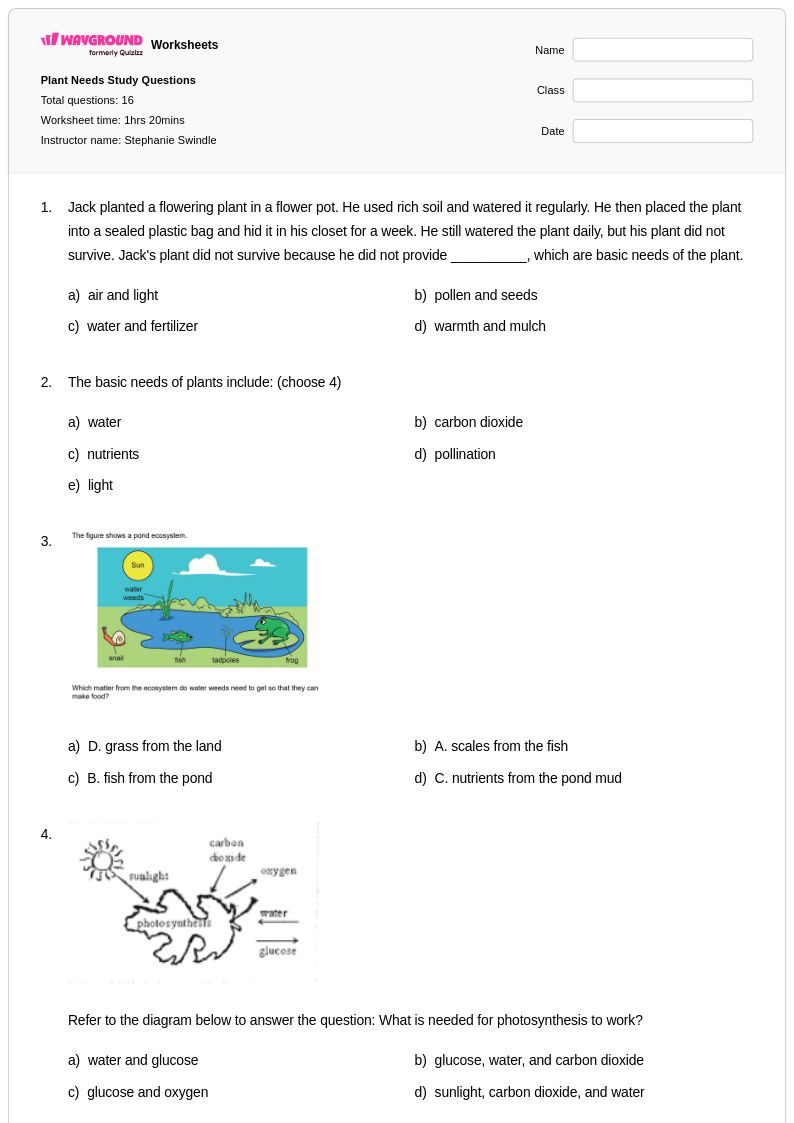
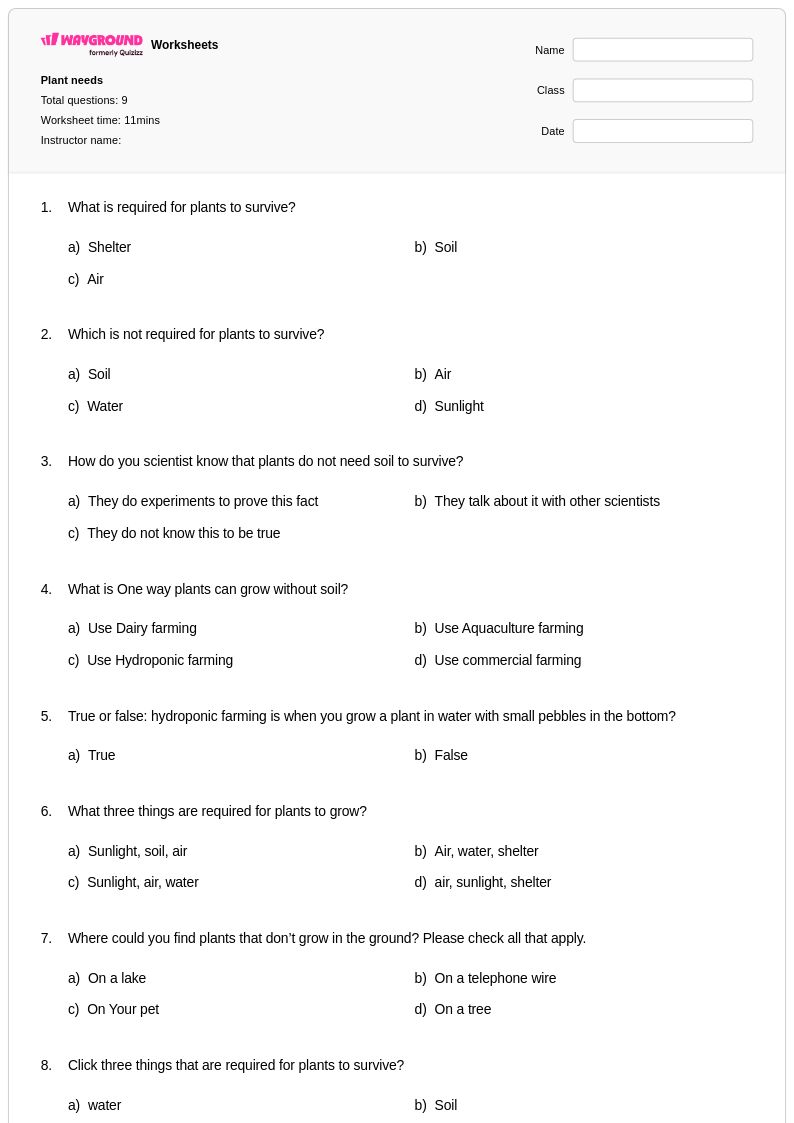
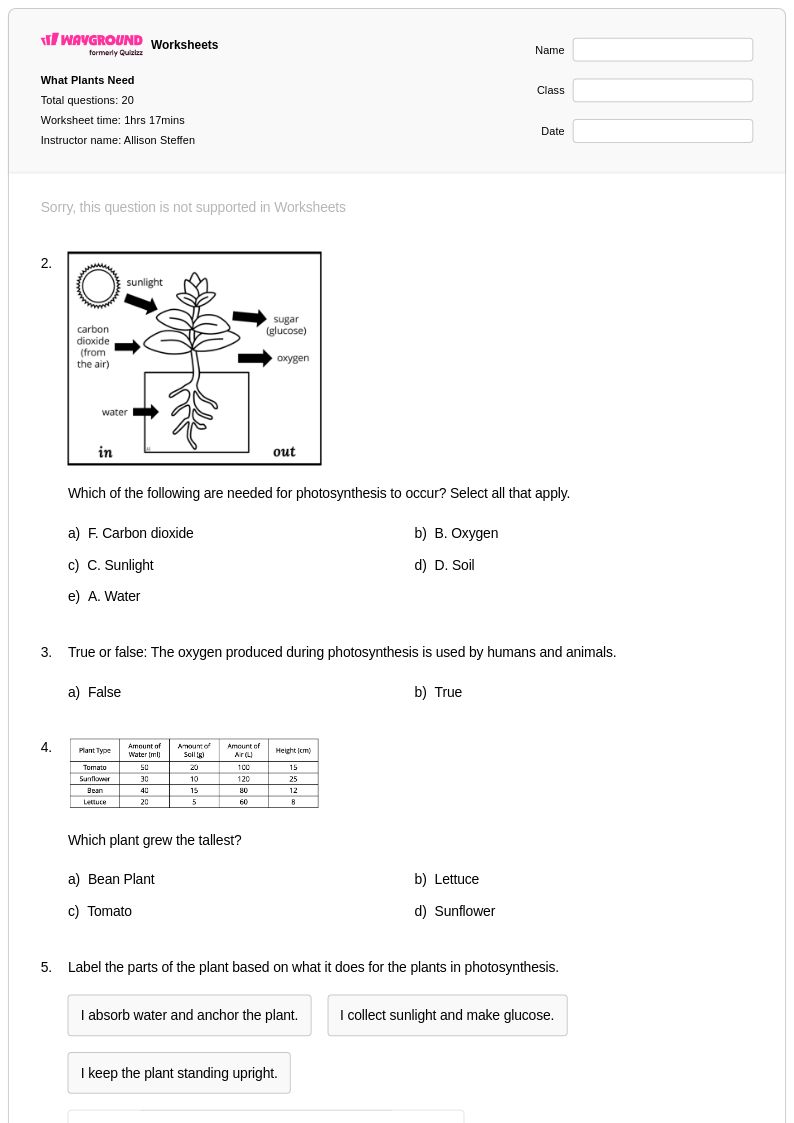
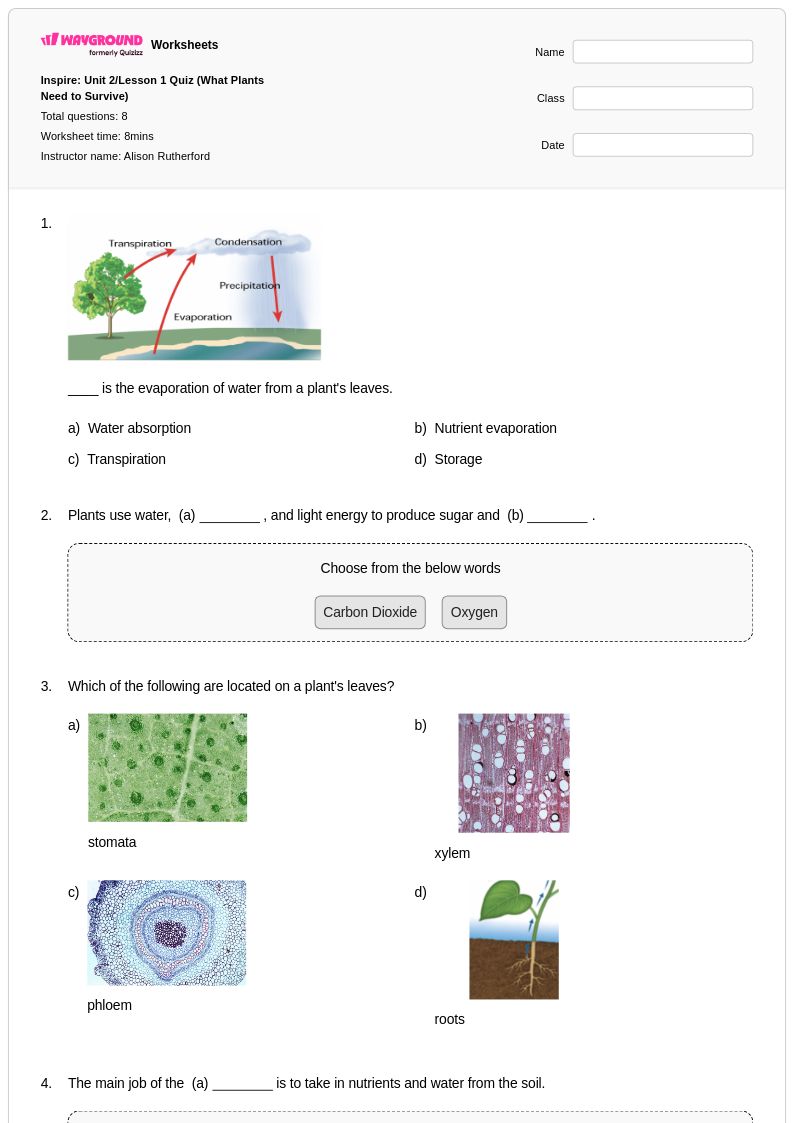
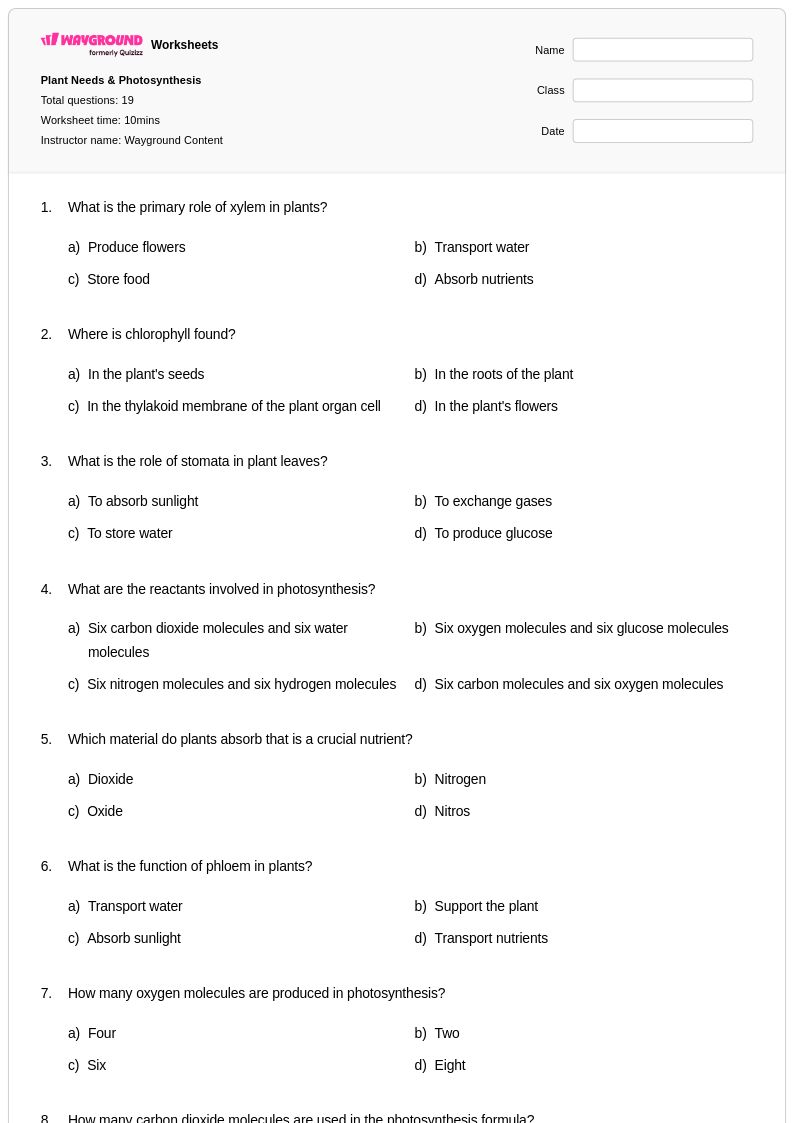
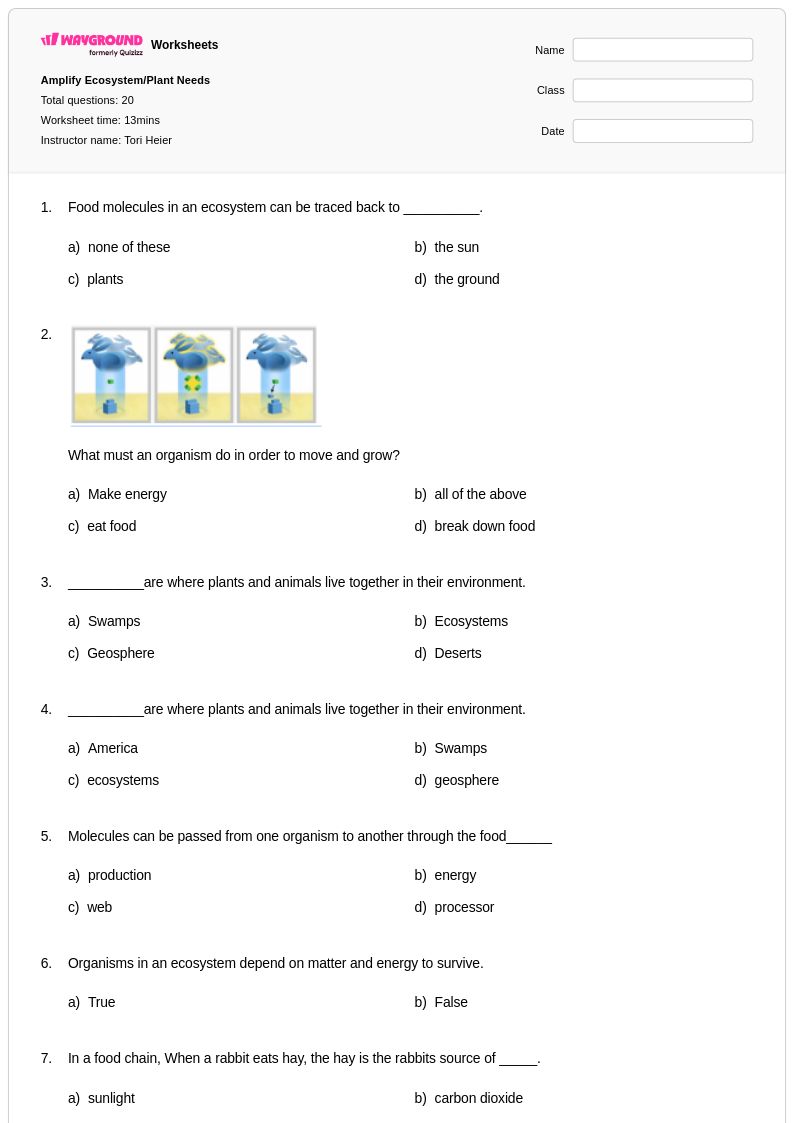
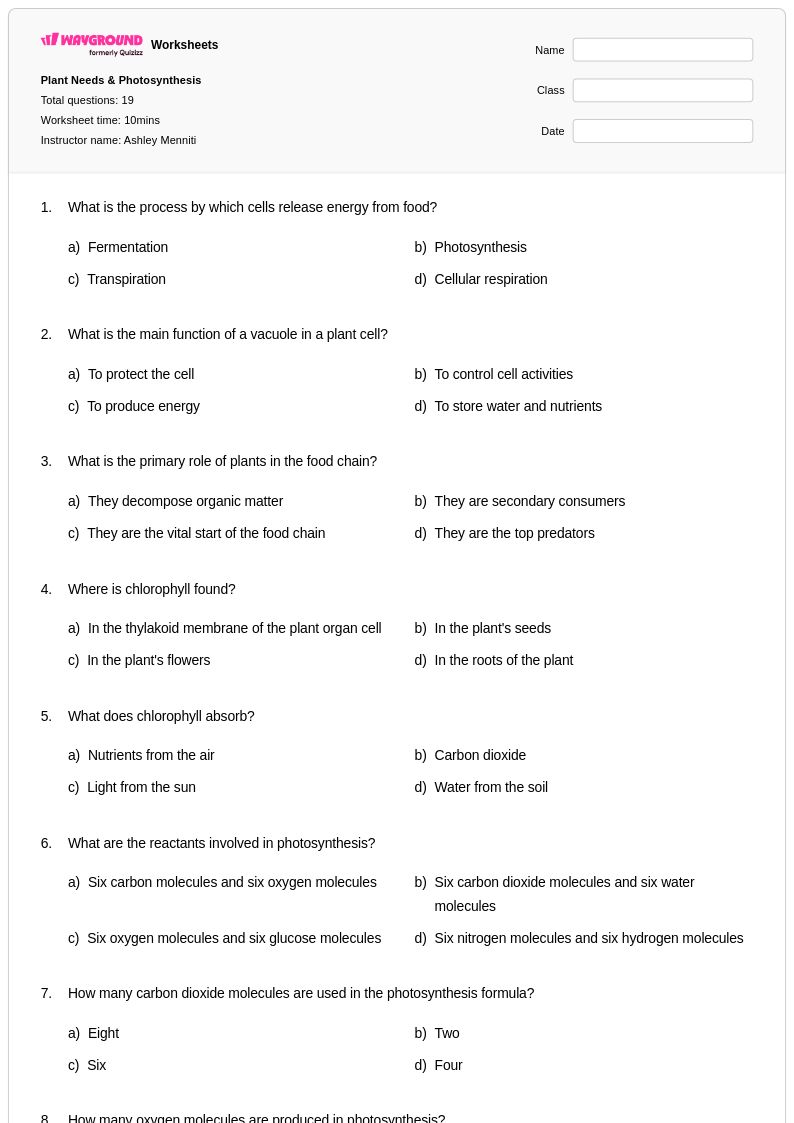
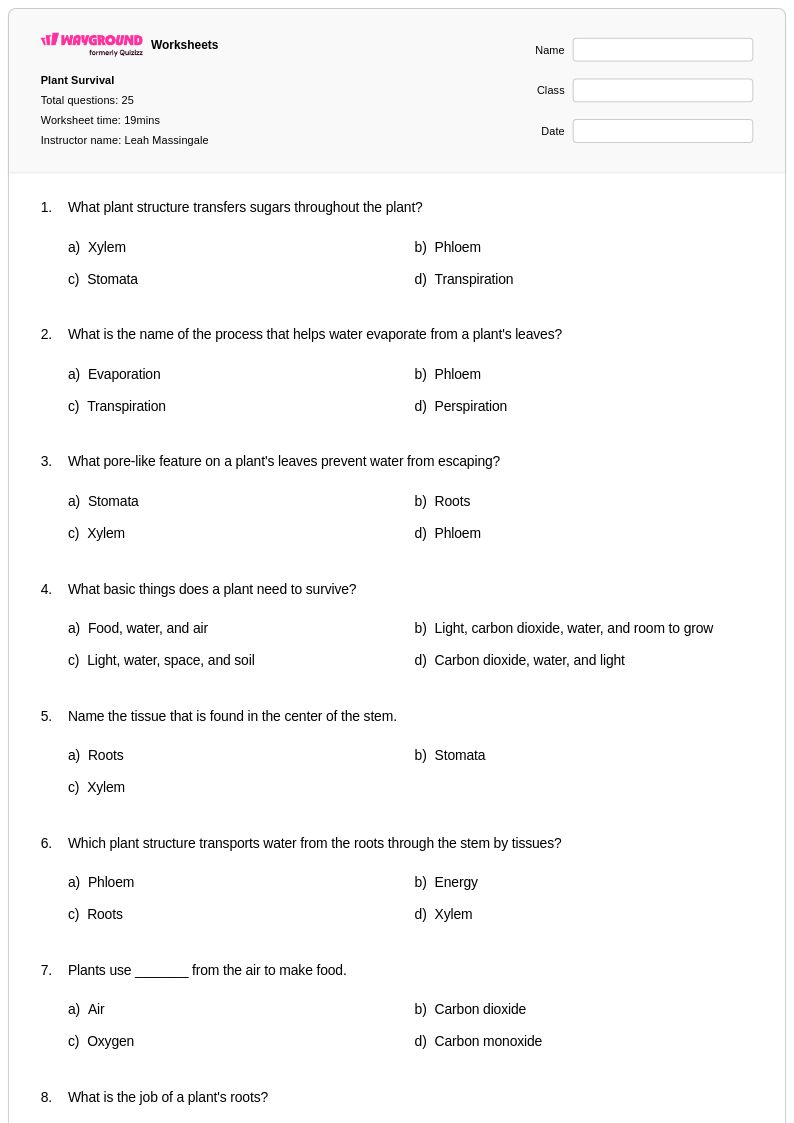
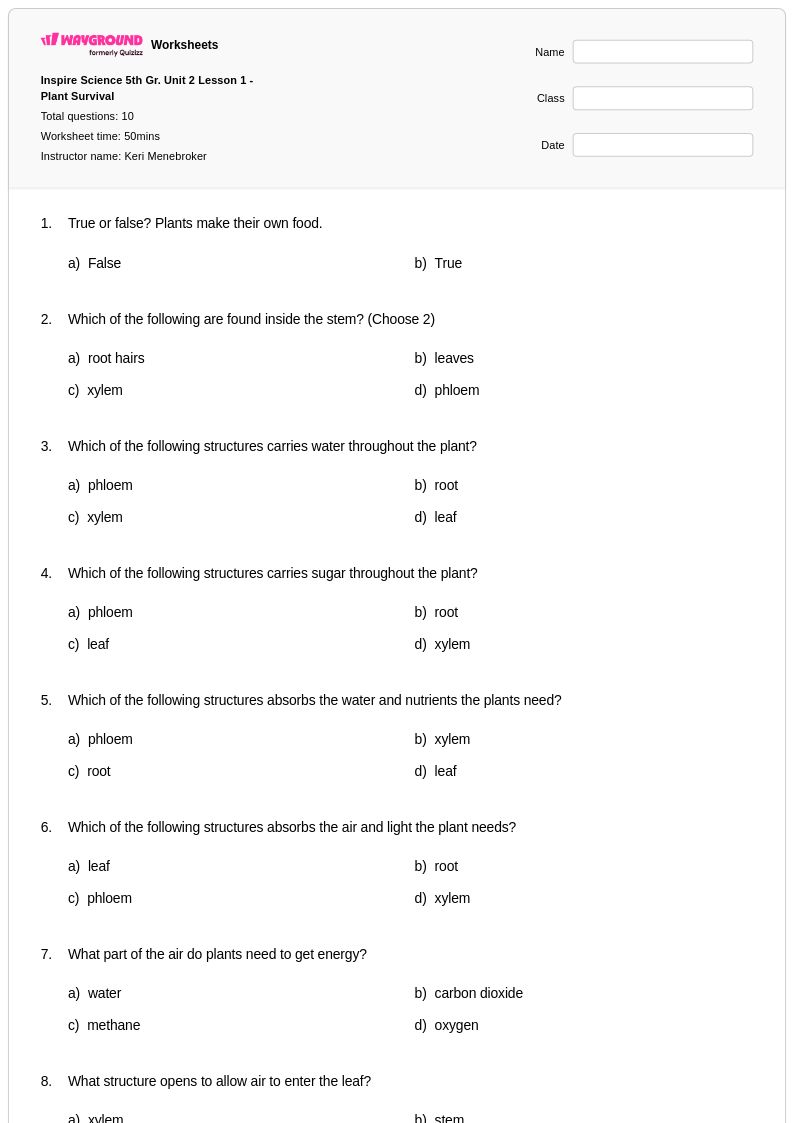
Free Grade 5 plant needs worksheets and printables help students explore essential requirements for plant growth and survival through engaging practice problems and activities with answer keys.
Explore printable Plant Needs worksheets for Grade 5
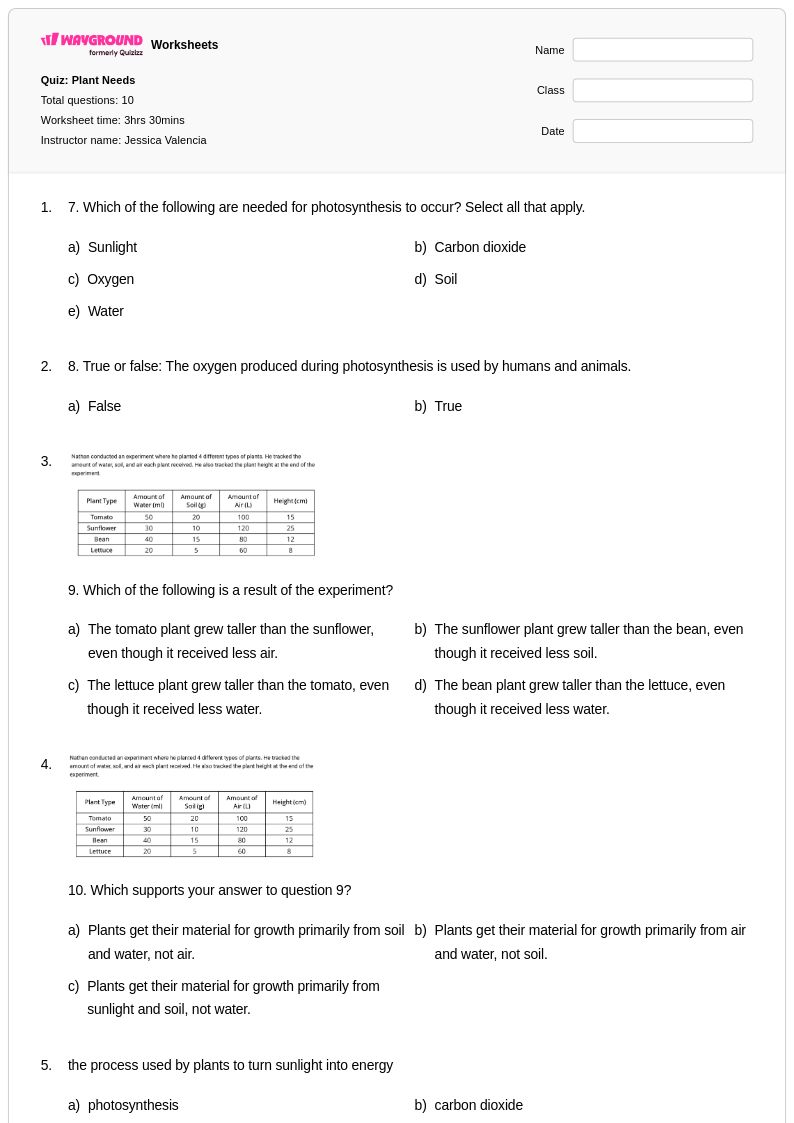
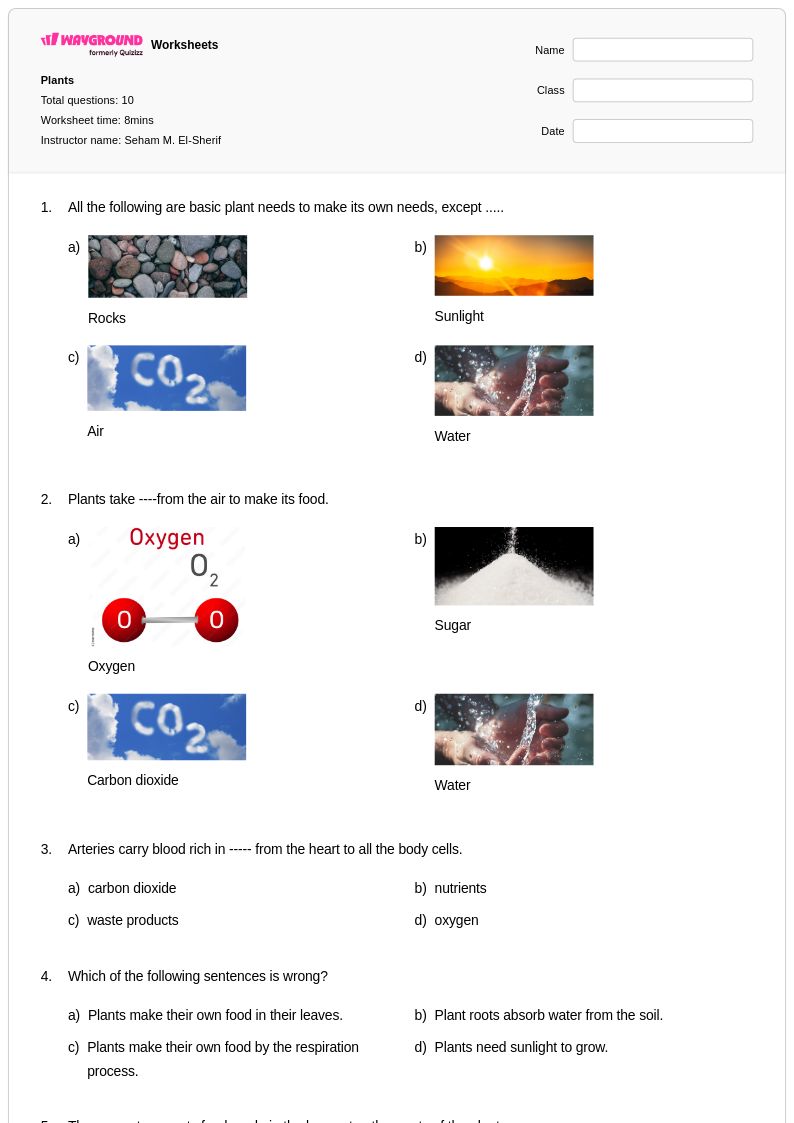
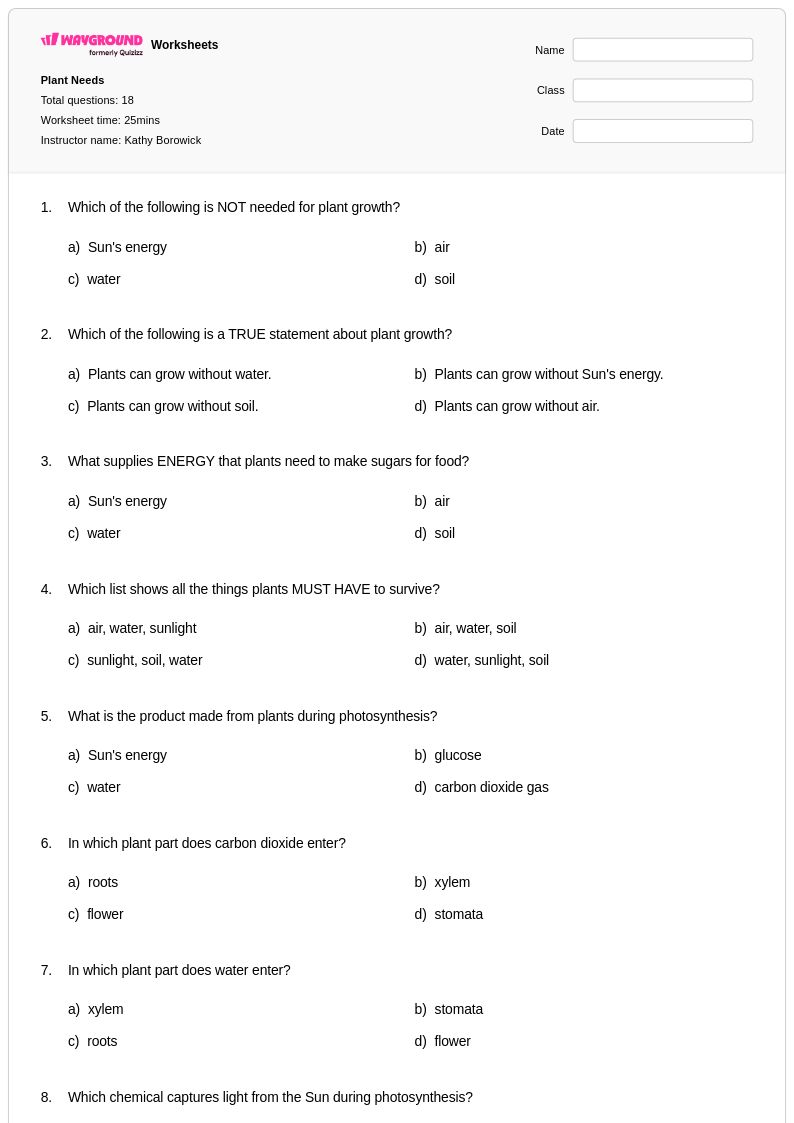
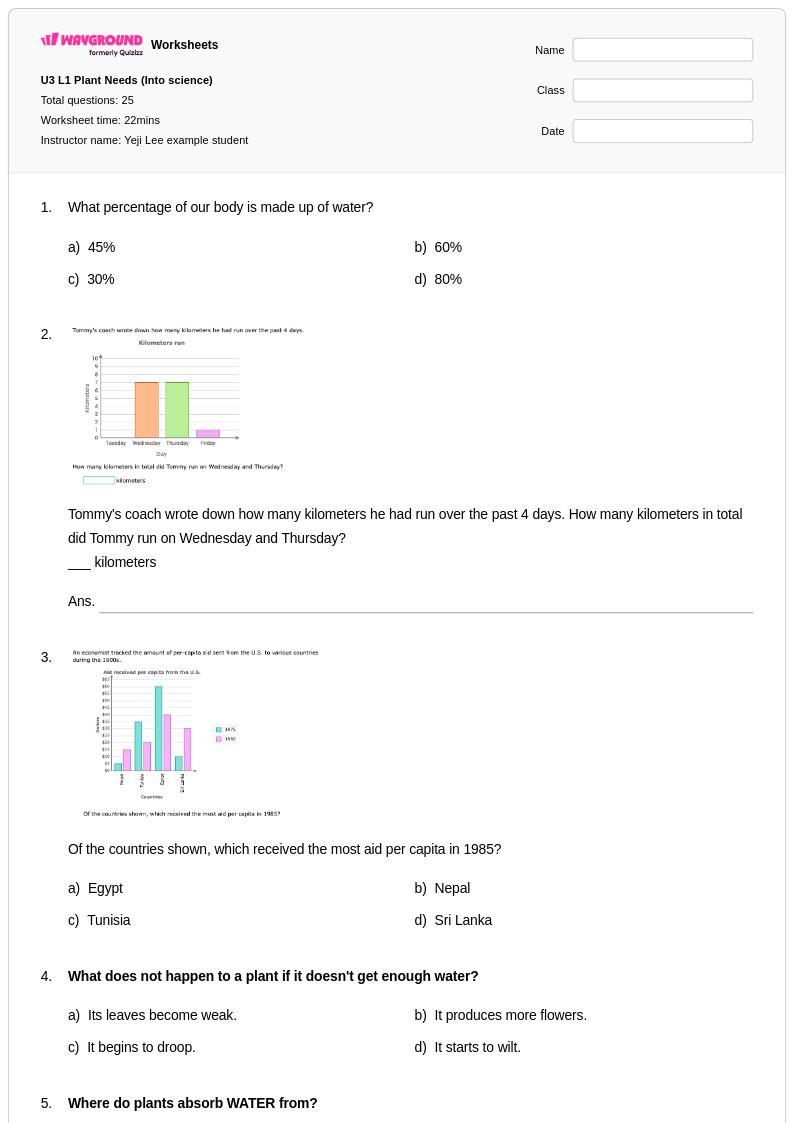
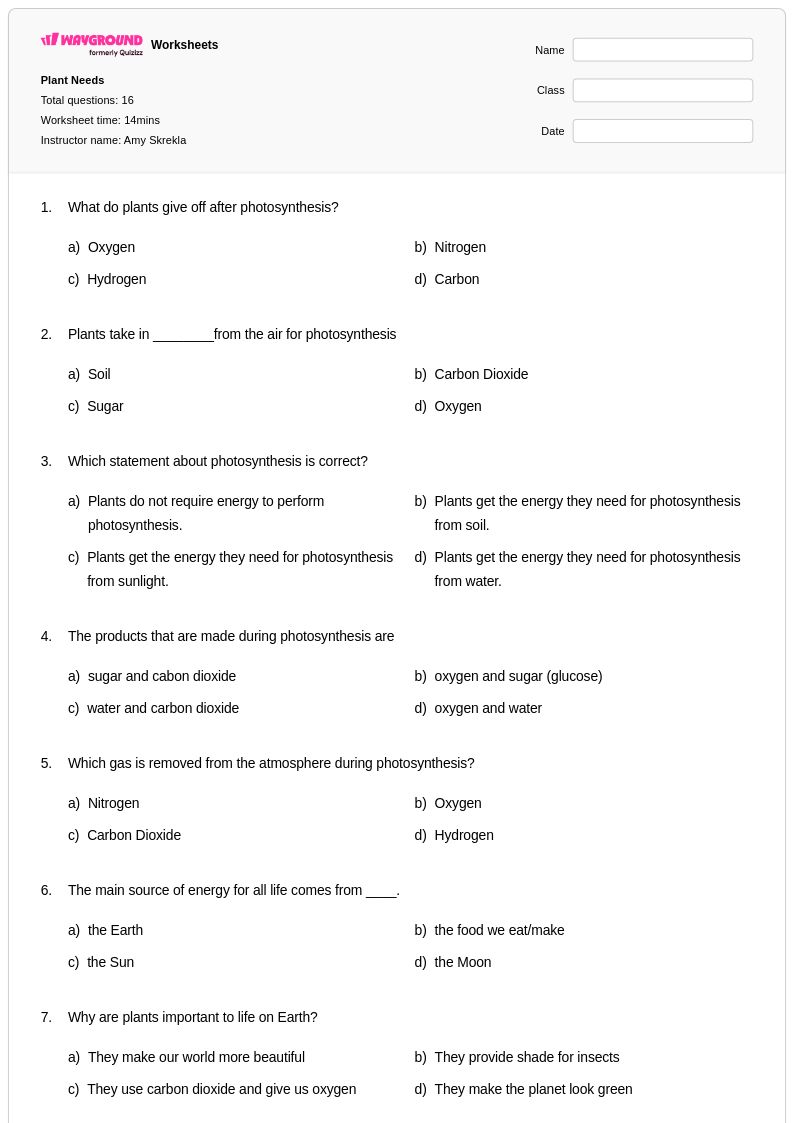
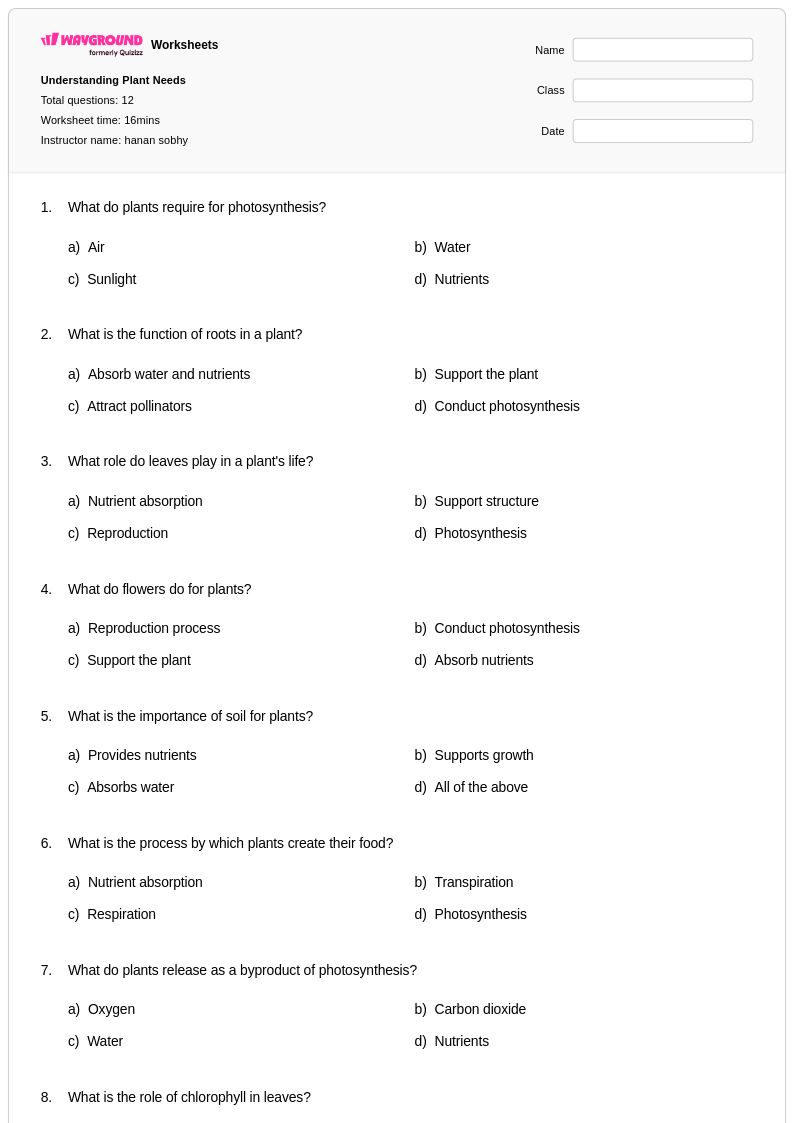
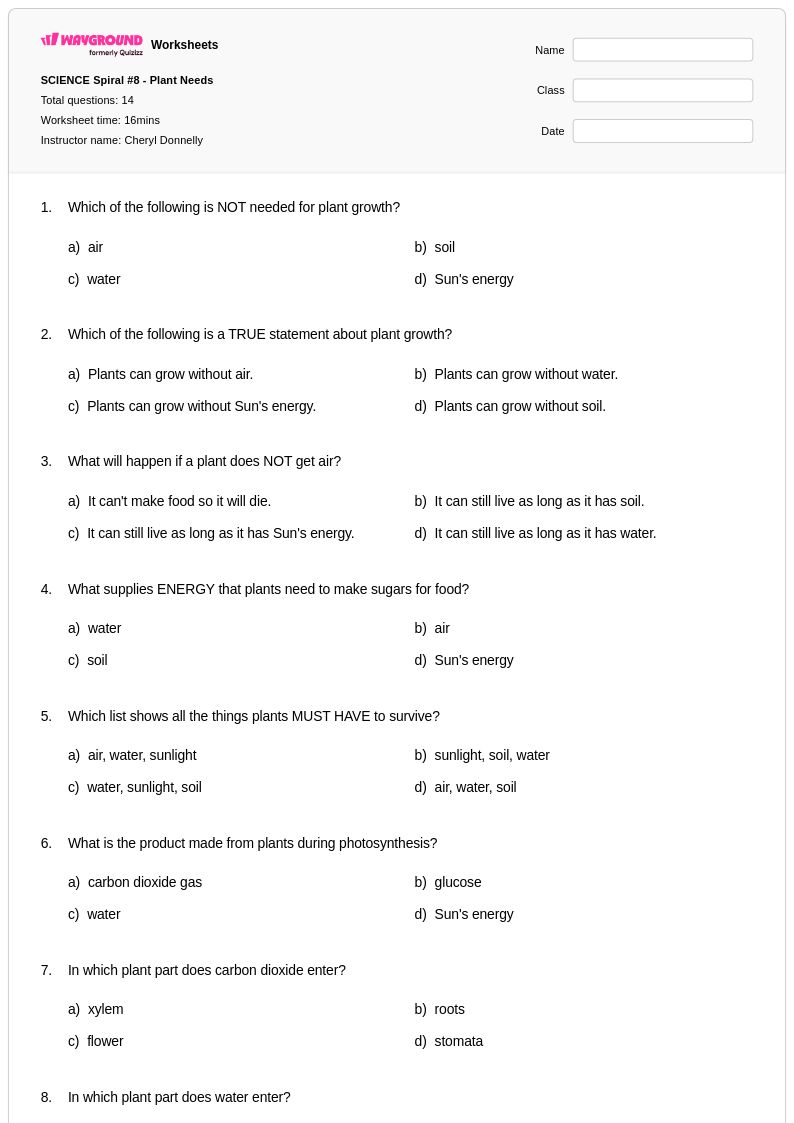
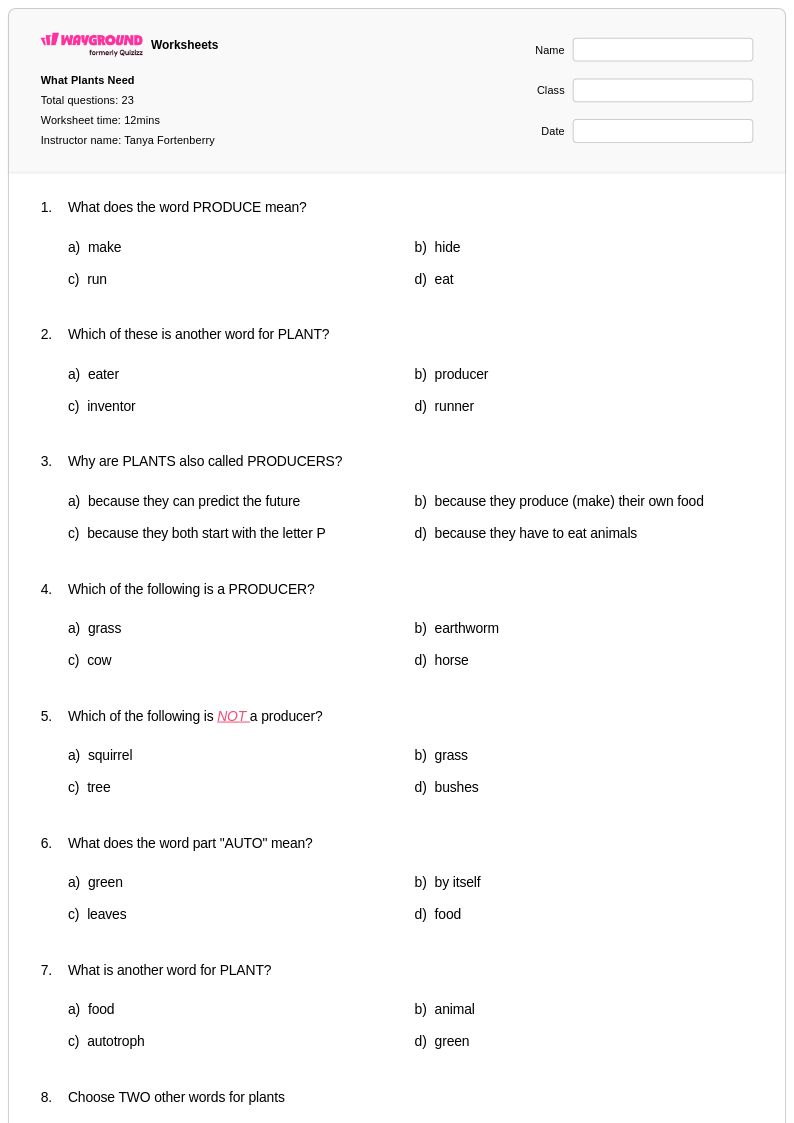
Grade 5 plant needs worksheets available through Wayground (formerly Quizizz) provide comprehensive coverage of the essential requirements that enable plants to survive and thrive in their environments. These educational resources strengthen students' understanding of fundamental biological concepts including photosynthesis, water absorption, nutrient uptake, and the critical role of sunlight in plant growth and development. The worksheet collection features diverse practice problems that challenge fifth-grade learners to identify, analyze, and explain how plants obtain and utilize water, minerals, carbon dioxide, and light energy to carry out vital life processes. Each printable resource includes detailed answer keys that support both independent study and teacher-guided instruction, while the free pdf format ensures easy accessibility for classroom use and home practice.
Wayground (formerly Quizizz) empowers educators with millions of teacher-created resources specifically designed to enhance plant biology instruction at the Grade 5 level. The platform's robust search and filtering capabilities enable teachers to quickly locate worksheets that align with specific learning standards and curriculum requirements, while built-in differentiation tools allow for seamless adaptation of content to meet diverse student needs and ability levels. These flexible customization features support comprehensive lesson planning by providing materials suitable for initial concept introduction, targeted skill practice, remediation for struggling learners, and enrichment activities for advanced students. Available in both printable and digital formats including downloadable pdfs, these plant needs worksheets integrate seamlessly into various instructional approaches, from traditional classroom settings to hybrid and remote learning environments.
FAQs
How do I teach plant needs to elementary students?
Start by anchoring instruction in concrete, observable examples — have students examine real plants and discuss what they notice about sunlight exposure, watering schedules, and soil conditions. From there, introduce the five core plant needs: sunlight, water, air, nutrients, and space. Connecting each need to a real-world consequence (e.g., a wilting plant lacks water) helps students build cause-and-effect reasoning before moving to more abstract content like nutrient absorption.
What exercises help students practice identifying plant needs?
Scenario-based practice is especially effective — give students descriptions of plants in different conditions and ask them to identify which need is unmet and predict what will happen. Worksheets that ask students to analyze the effects of missing sunlight, poor soil nutrients, or insufficient water reinforce both factual recall and scientific reasoning. Connecting these scenarios to gardening or agriculture contexts makes the practice feel purposeful and relevant.
What mistakes do students commonly make when learning about plant needs?
A common misconception is that plants get their food from soil rather than producing it through photosynthesis — students often confuse nutrients absorbed from soil with the food plants manufacture using sunlight, water, and carbon dioxide. Another frequent error is treating all plant needs as equally important in all contexts, without recognizing that deficiency in any single need can limit growth regardless of the others. Explicitly contrasting these ideas during instruction helps correct the confusion before it becomes entrenched.
How can I differentiate plant needs instruction for students at different levels?
For foundational learners, focus on the five core needs with visual supports and simple matching or labeling tasks. For more advanced students, introduce variables like what happens when one need is present in excess or when multiple needs are unmet simultaneously. On Wayground, teachers can apply individual accommodations such as read aloud support, reduced answer choices, and extended time to specific students, so every learner engages with the content at an appropriate level without disrupting the rest of the class.
How do I use Wayground's plant needs worksheets in my classroom?
Wayground's plant needs worksheets are available as printable PDFs for traditional classroom use and in digital formats for technology-integrated learning environments, including the option to host them as a quiz directly on Wayground. Each worksheet includes a complete answer key, making them practical for independent practice, homework assignments, or guided group work. The digital format also allows teachers to assign accommodations to individual students, such as read aloud or extended time, without disrupting the experience for the rest of the class.
How do plant needs worksheets connect to real-world science applications?
Plant needs content connects directly to gardening, agriculture, and environmental science — areas where understanding resource requirements has practical consequences. Worksheets that ask students to analyze what a struggling plant needs, or to design an ideal growing environment, build the same observation and reasoning skills used in real agricultural and ecological contexts. These connections help students see biology as a living subject rather than a list of facts to memorize.