Free Printable Spiders Worksheets for Kindergarten
Discover free kindergarten spider worksheets and printables from Wayground that help young students learn about these fascinating creatures through engaging practice problems, colorful activities, and comprehensive answer keys.
Explore printable Spiders worksheets for Kindergarten
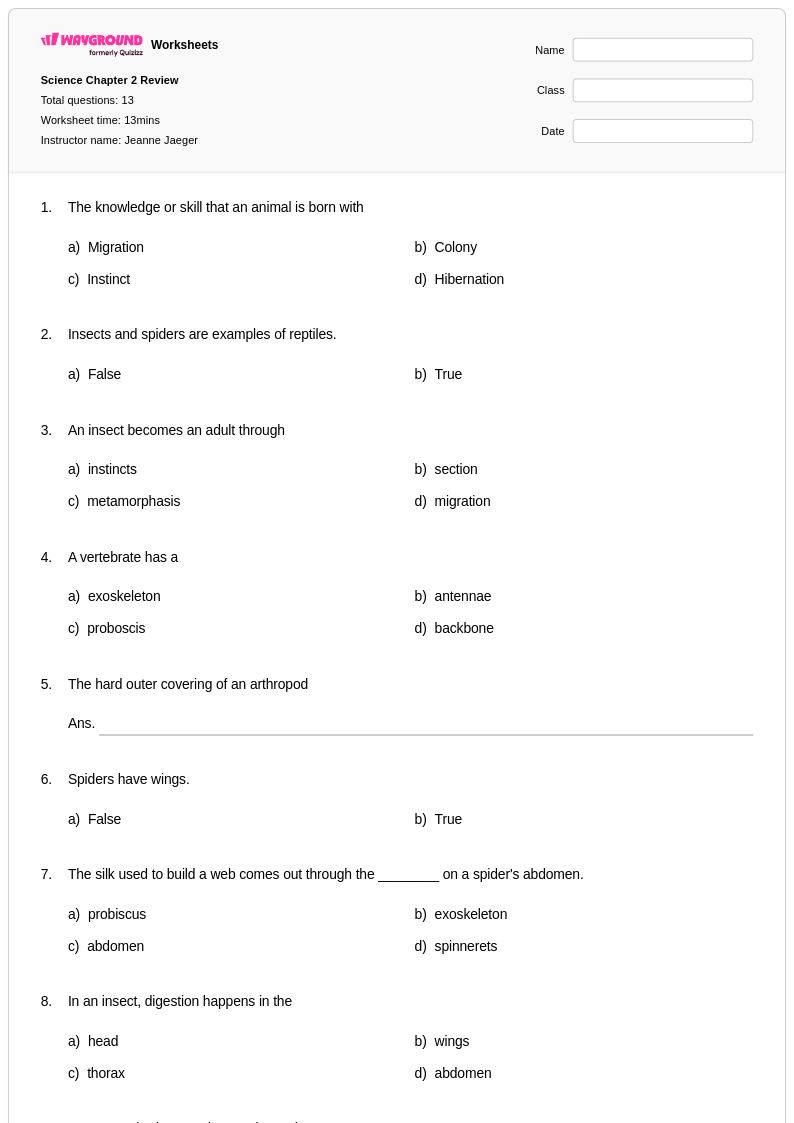
Spider worksheets for kindergarten students available through Wayground provide an engaging introduction to arachnid biology while building essential scientific observation and classification skills. These carefully designed printables help young learners explore basic spider anatomy, including body parts like the cephalothorax and abdomen, while developing counting abilities through activities that focus on spider legs and eyes. The free worksheet collection includes age-appropriate practice problems that encourage students to identify different spider characteristics, compare web patterns, and understand the role spiders play in their environment. Each worksheet comes with a comprehensive answer key to support both independent learning and guided instruction, making these pdf resources invaluable for building foundational biology knowledge in early elementary students.
Wayground (formerly Quizizz) supports kindergarten teachers with an extensive collection of millions of teacher-created spider biology worksheets that can be easily searched and filtered by specific learning objectives and skill levels. The platform's robust differentiation tools allow educators to customize content complexity, ensuring that each student receives appropriately challenging material whether they need additional support or enrichment opportunities. These standards-aligned resources are available in both printable and digital pdf formats, providing flexibility for classroom instruction, homework assignments, and remediation activities. Teachers can efficiently plan comprehensive spider-themed biology units while accessing ready-made materials that seamlessly integrate scientific vocabulary development, critical thinking skills, and hands-on observation practice essential for kindergarten science education.
FAQs
How do I teach spider biology to students?
Start with spider anatomy by introducing the two main body segments (cephalothorax and abdomen), eight legs, and specialized structures like spinnerets and chelicerae. From there, build outward into behavior, web construction, and hunting strategies before connecting spiders to their role in food webs and ecosystems. Using labeled diagrams and comparative activities helps students distinguish spiders from other arthropods and understand what makes arachnids a distinct class.
What are good activities for practicing spider classification and anatomy?
Labeling diagrams of spider body parts is one of the most effective practice formats for reinforcing anatomical vocabulary, including structures like the pedipalps, silk glands, and book lungs. Comparative exercises that ask students to match spider families to their web types or hunting strategies deepen understanding of species diversity. Practice problems that connect anatomy to function, such as explaining how spinnerets relate to web construction, push students beyond memorization into applied thinking.
What misconceptions do students commonly have about spiders?
One of the most persistent misconceptions is that spiders are insects. Students often need explicit instruction that spiders are arachnids with eight legs and two body segments, not six legs and three body segments like insects. Another common error is assuming all spiders build webs to catch prey, when many species are active hunters that use silk only for egg sacs or burrow lining. Addressing these early helps students build accurate mental models of arthropod classification.
How can I use spider worksheets to support different learners in my class?
Spider worksheets on Wayground can be assigned digitally, which allows teachers to apply individual accommodations for students who need them. Features such as Read Aloud support students who struggle with dense scientific vocabulary, while reduced answer choices can lower cognitive load for students working on classification tasks. Extended time settings can be applied per student without affecting the rest of the class, making it straightforward to differentiate without creating separate lesson plans.
How do I use Wayground's spider worksheets in my classroom?
Wayground's spider worksheets are available as printable PDFs for traditional classroom use and in digital formats for technology-integrated environments, including the option to host them as a quiz directly on Wayground. Teachers can use them for direct instruction support, independent practice, homework, or targeted remediation when students show gaps in understanding arachnid biology. Each worksheet includes a complete answer key, reducing prep time and making it easy to give students immediate feedback.
How do spiders fit into a broader science curriculum?
Spiders are an effective entry point into arthropod classification, predator-prey relationships, and ecosystem roles, making them relevant to life science units at multiple grade levels. Their anatomy supports lessons on adaptation, while their place in food webs connects directly to ecology standards. Because spiders are observable in everyday environments, they also offer strong opportunities for student-led inquiry and real-world application of scientific vocabulary.