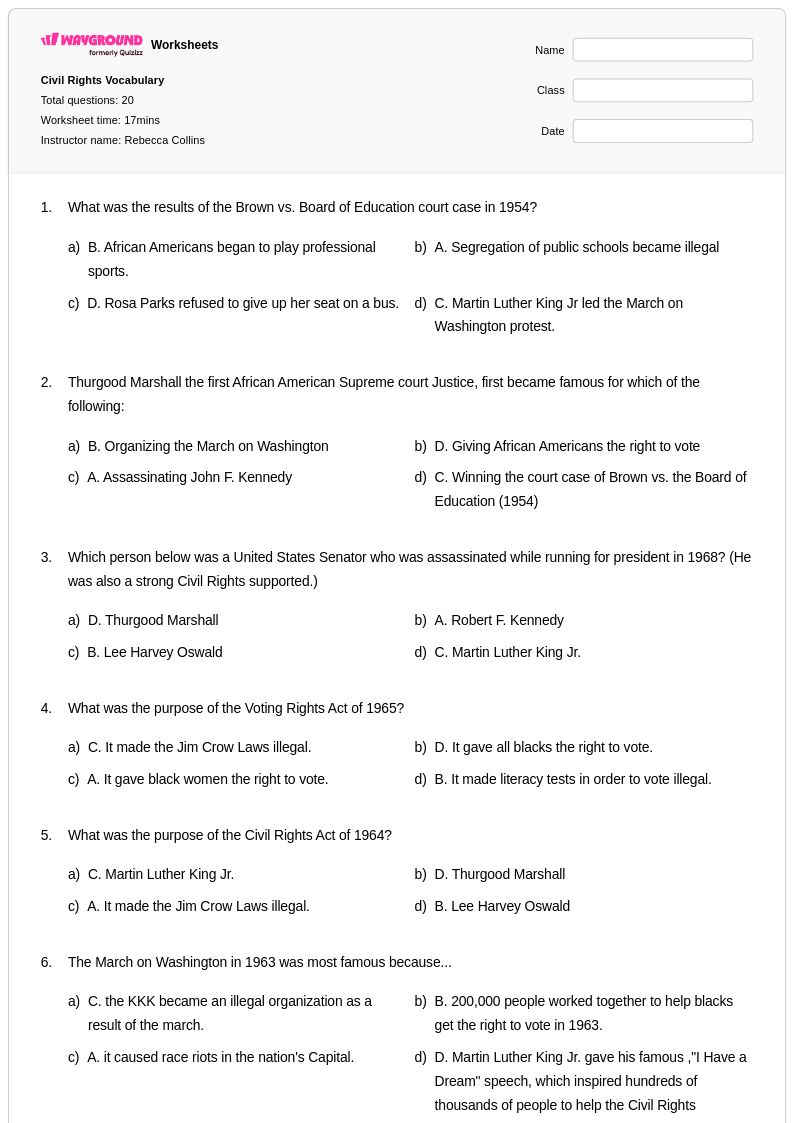
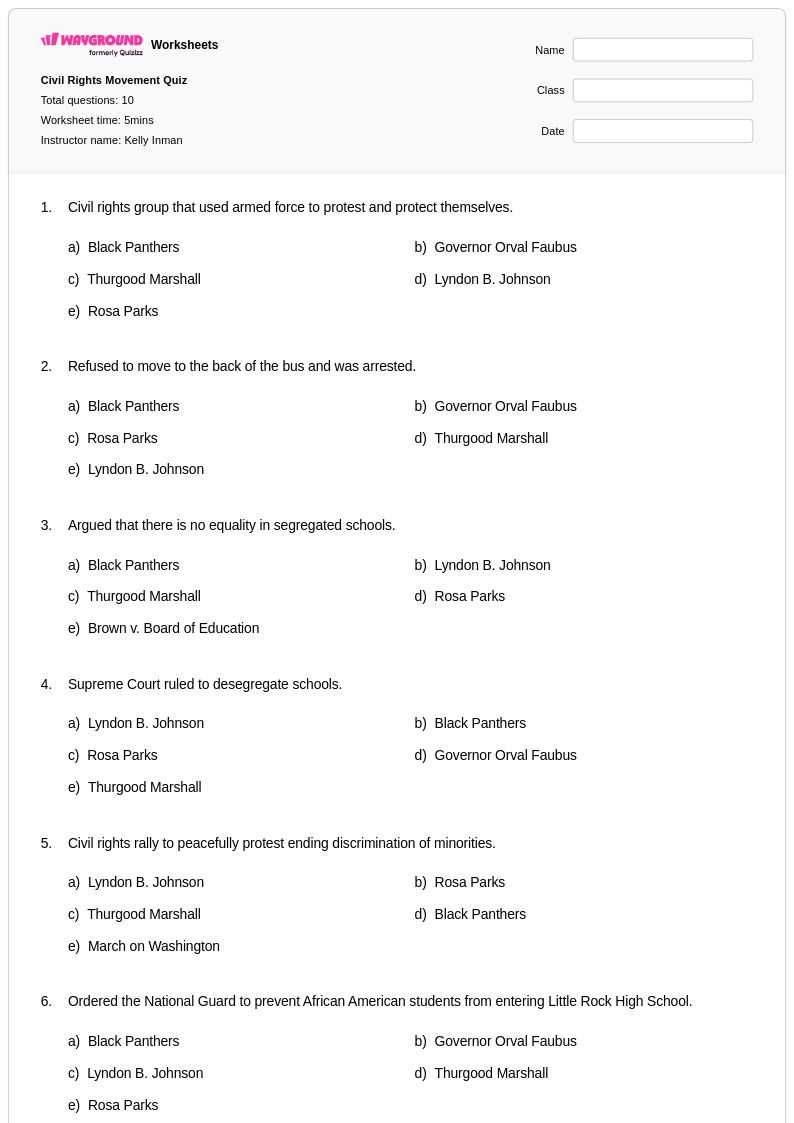
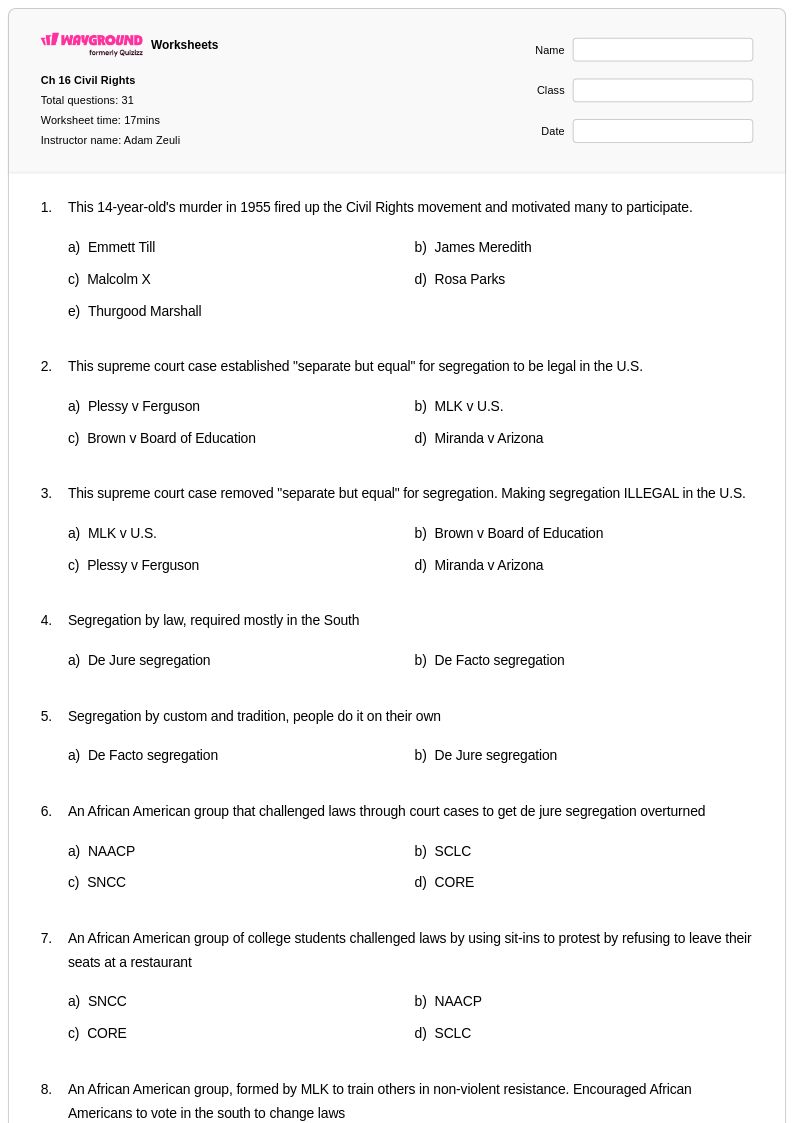
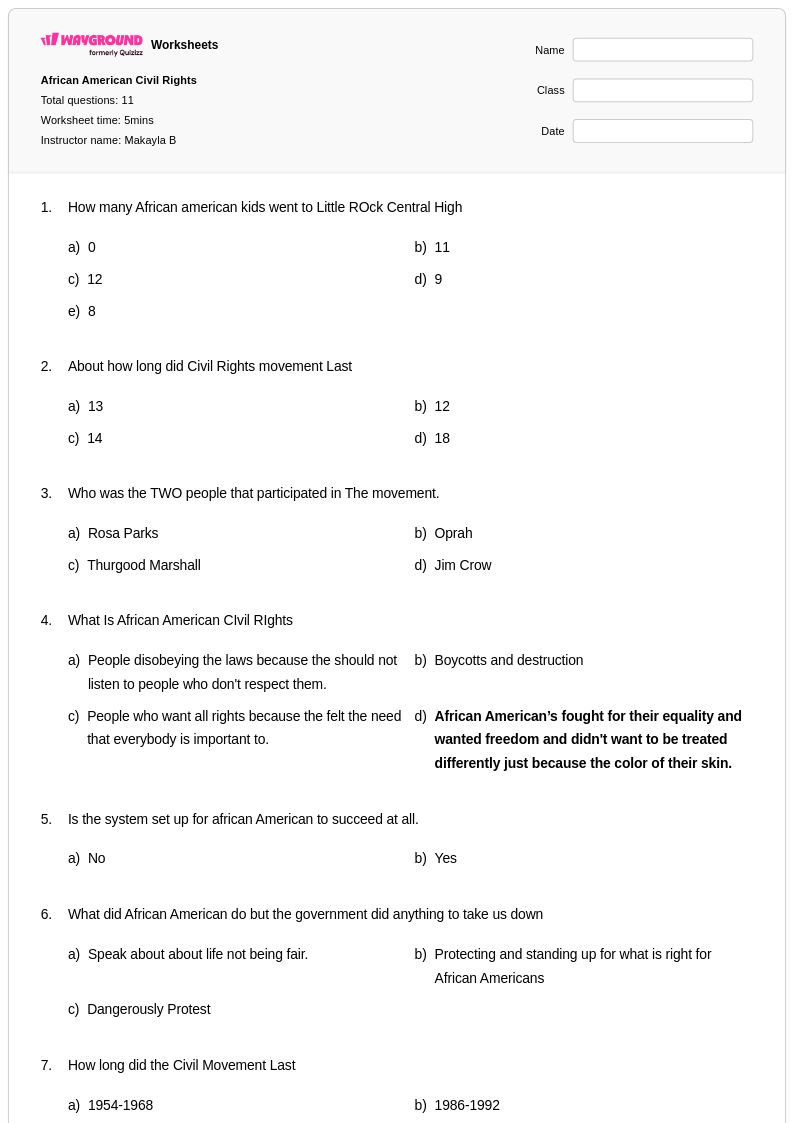
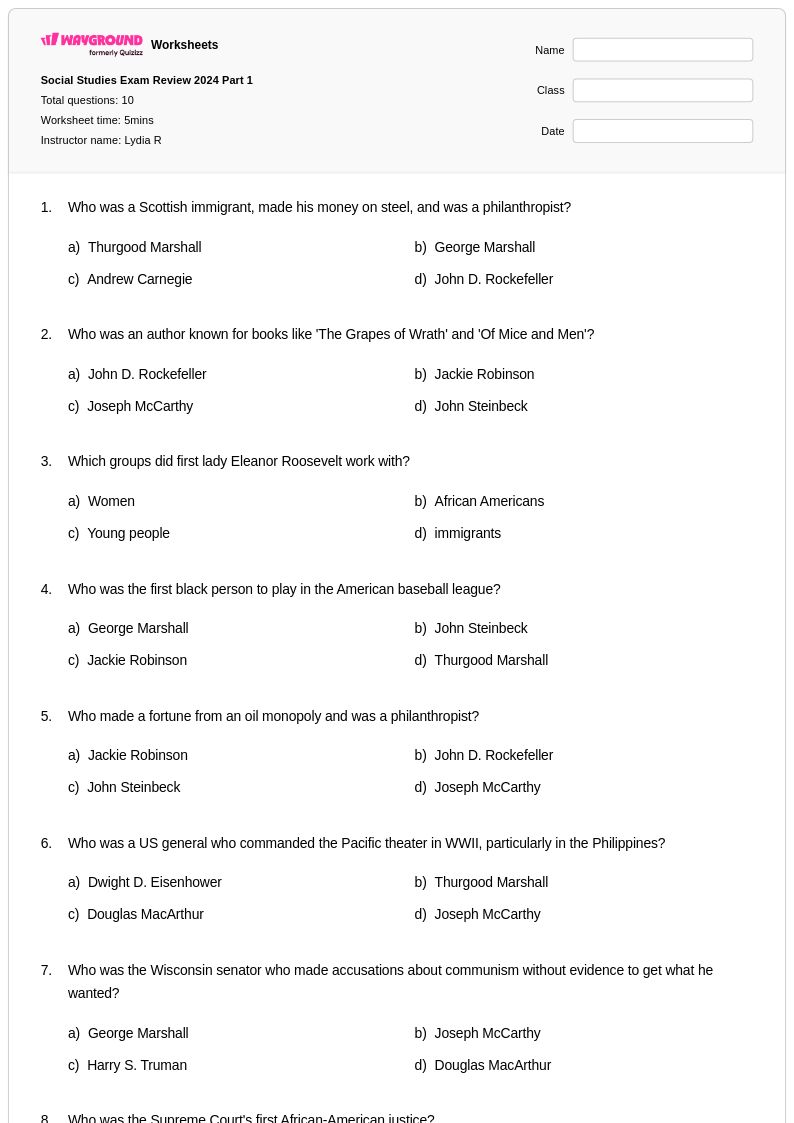
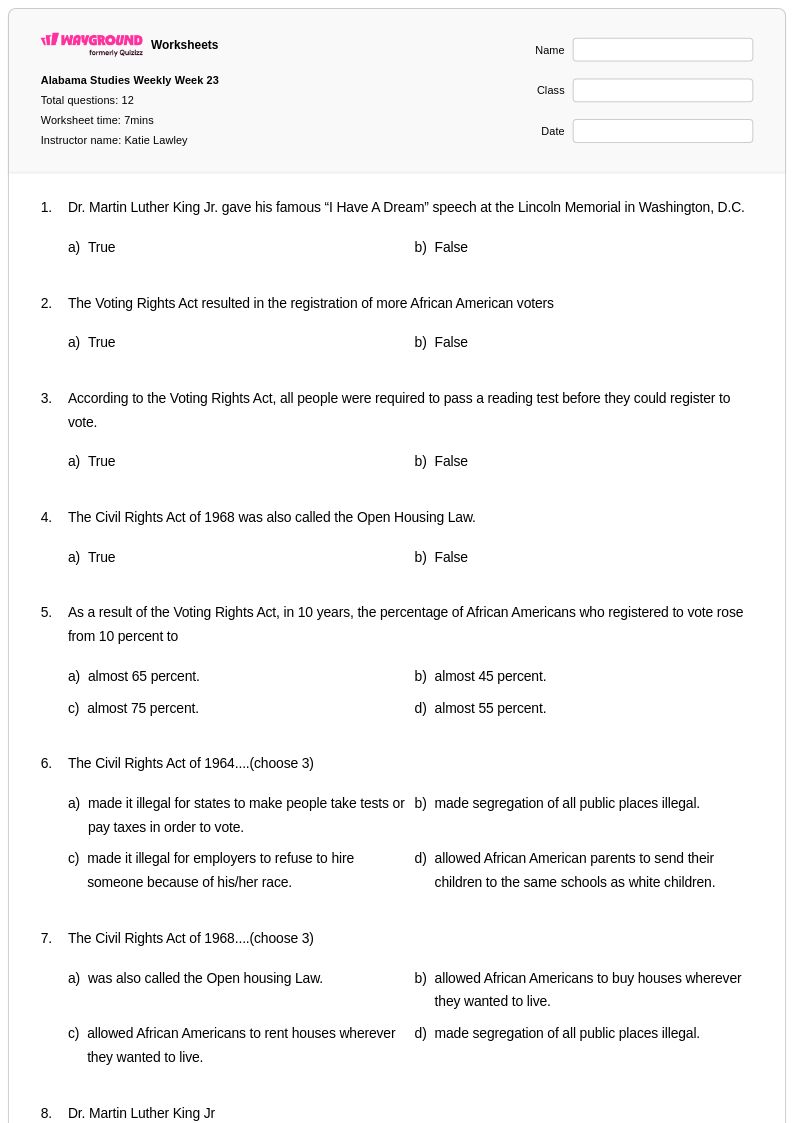
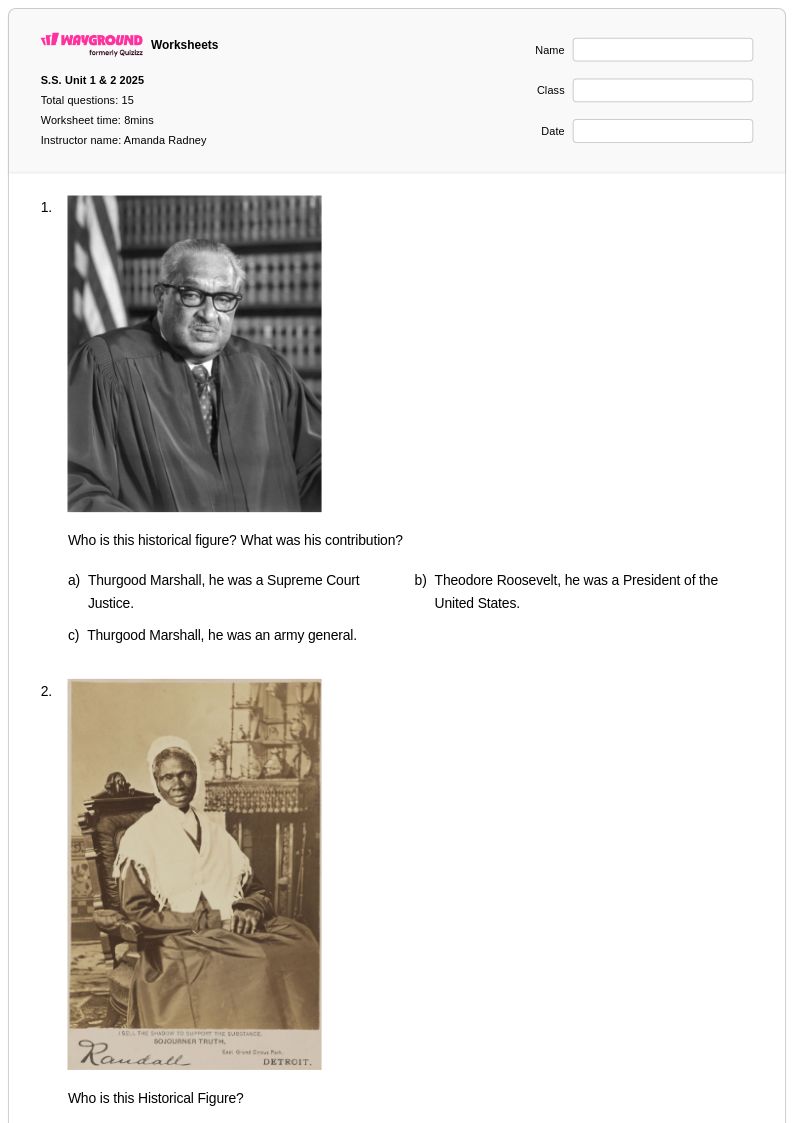
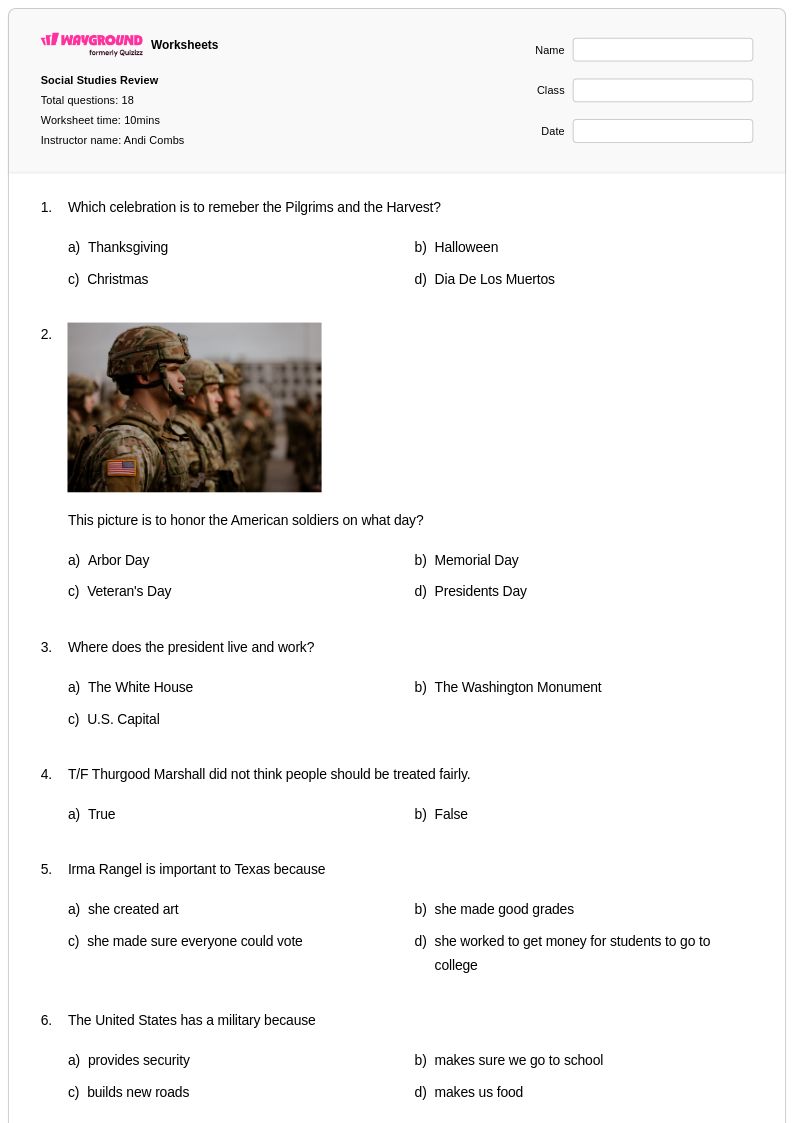
Explore Wayground's comprehensive collection of free Thurgood Marshall worksheets and printables that help students learn about this groundbreaking Supreme Court Justice's impact on civil rights through engaging practice problems and detailed answer keys.
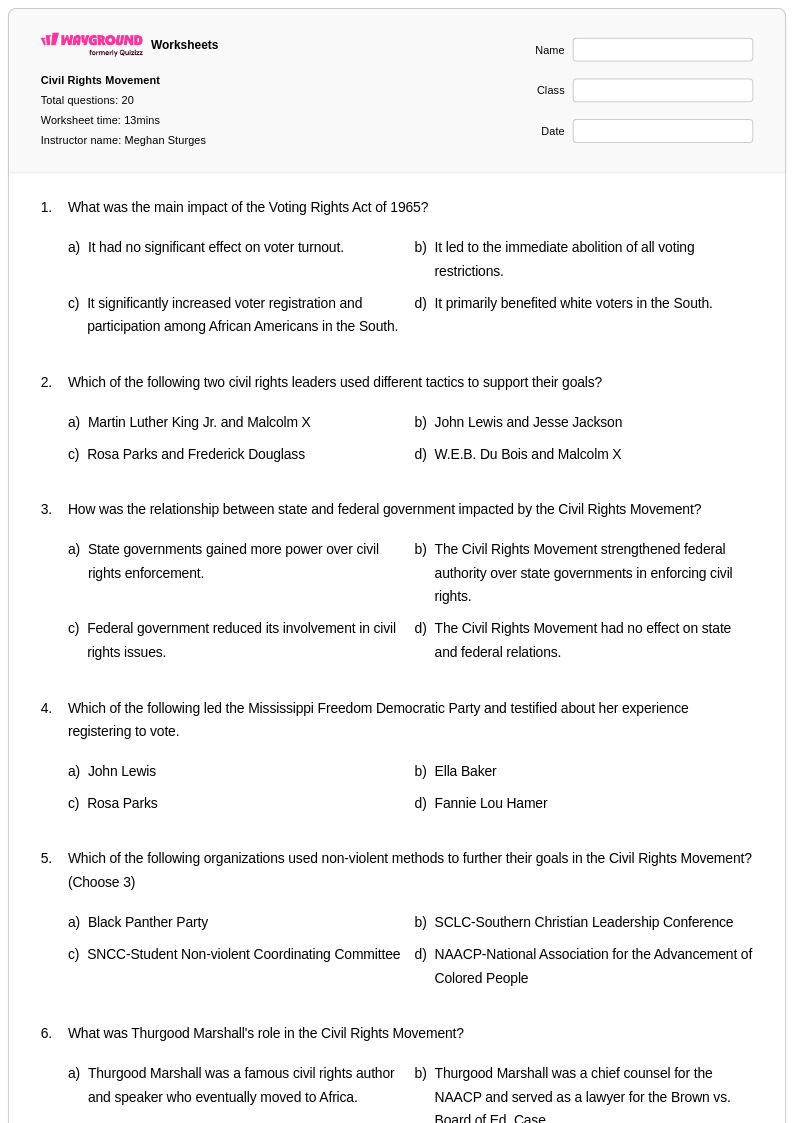
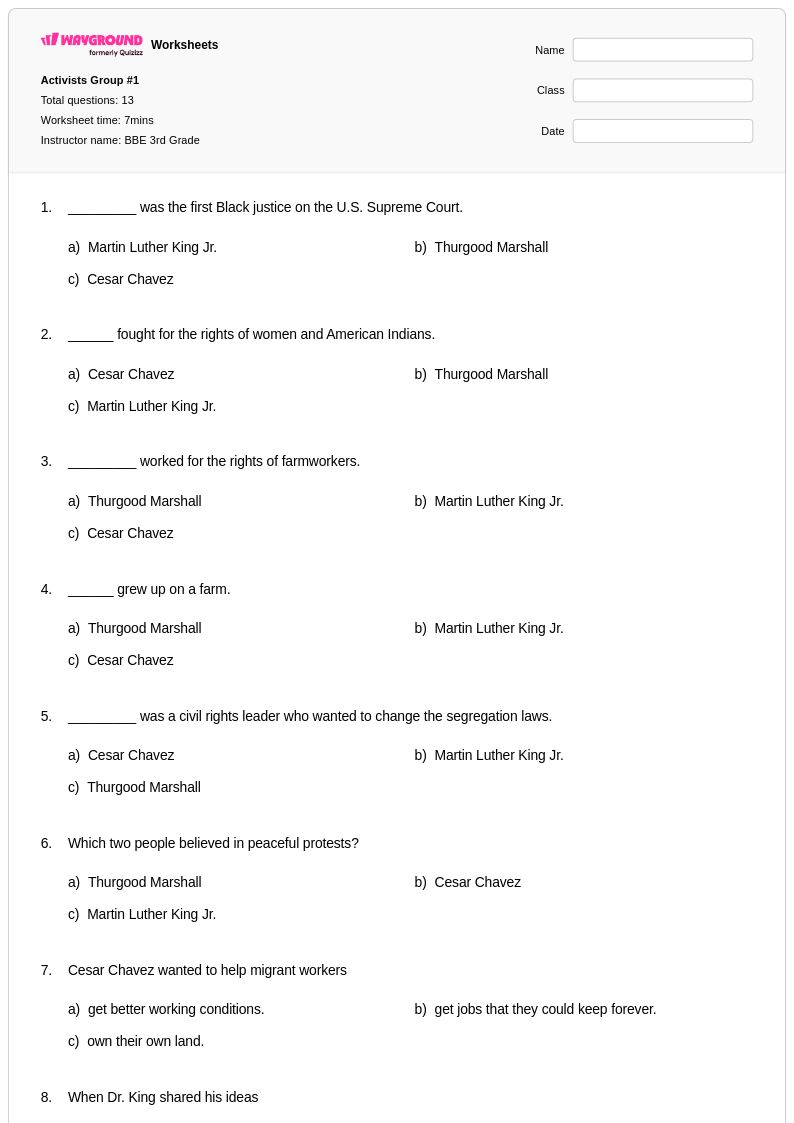
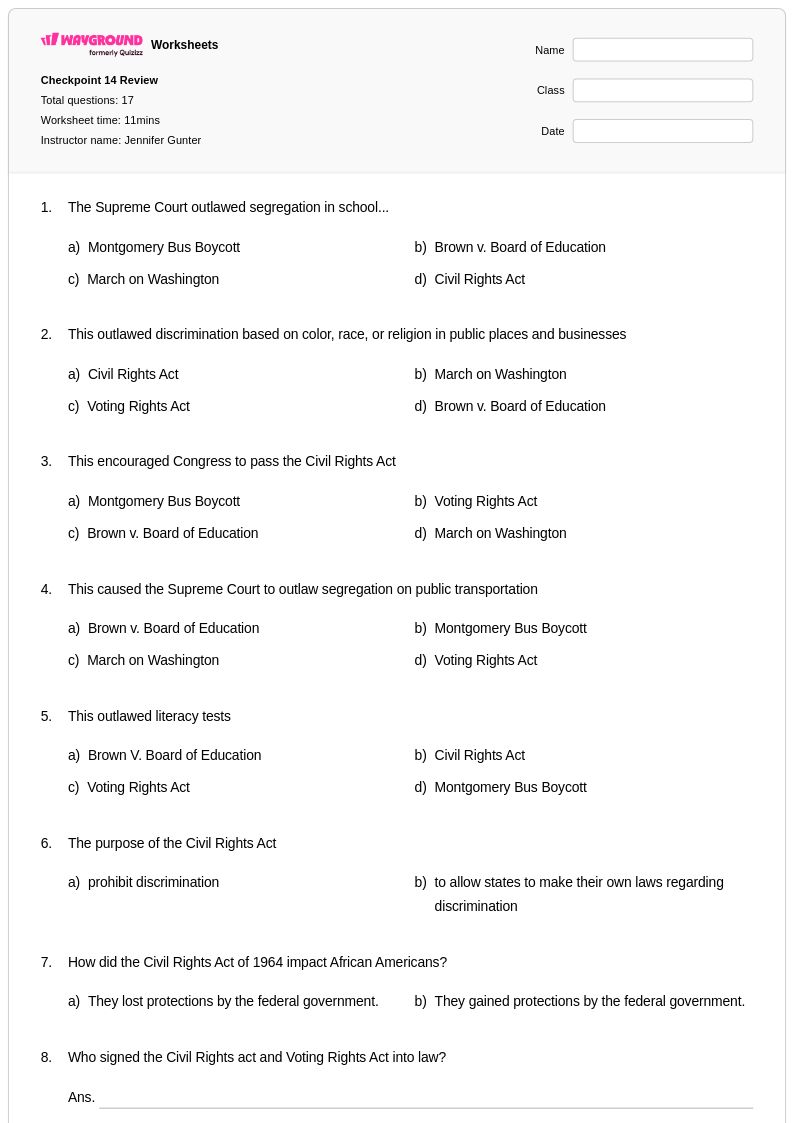
Thurgood Marshall worksheets available through Wayground provide comprehensive educational resources that explore the remarkable life and lasting impact of America's first African American Supreme Court Justice. These carefully crafted materials guide students through Marshall's transformative journey from civil rights attorney to Supreme Court Justice, emphasizing his pivotal role in landmark cases like Brown v. Board of Education and his unwavering commitment to racial equality and constitutional law. The worksheets strengthen critical thinking skills through analysis of primary sources, legal documents, and historical evidence while developing students' understanding of the judicial system, civil rights movement, and constitutional interpretation. Each resource includes detailed answer keys and is available as free printable pdf materials, featuring practice problems that encourage students to examine Marshall's legal strategies, analyze the broader social context of his work, and evaluate his lasting contributions to American jurisprudence and civil rights.
Wayground's extensive collection of Thurgood Marshall educational materials draws from millions of teacher-created resources, offering educators powerful search and filtering capabilities to locate content perfectly aligned with curriculum standards and learning objectives. The platform's differentiation tools enable teachers to customize worksheets for diverse learning needs, while flexible formatting options provide both printable and digital pdf versions to accommodate various classroom environments and teaching preferences. These comprehensive resources support effective lesson planning by offering ready-to-use materials for introducing new concepts, provide targeted practice for skill development, and serve as valuable tools for both remediation and enrichment activities. Teachers can seamlessly integrate these standards-aligned materials into their U.S. History curriculum to deepen students' appreciation for Marshall's constitutional legacy and his profound influence on American civil rights law.
FAQs
How do I teach Thurgood Marshall to my students?
Teaching Thurgood Marshall is most effective when framed around his dual identity as a civil rights attorney and Supreme Court Justice. Start with his legal work on Brown v. Board of Education before moving to his appointment as the first African American Supreme Court Justice, so students understand how his advocacy shaped his judicial philosophy. Connecting his career to the broader civil rights movement gives students the historical context needed to appreciate the significance of his constitutional legacy.
What kinds of activities help students practice what they've learned about Thurgood Marshall?
Effective practice activities include analyzing primary source excerpts from landmark cases Marshall argued or decided, such as Brown v. Board of Education, and responding to structured questions about his legal reasoning. Document-based questions that ask students to connect Marshall's arguments to constitutional principles reinforce critical thinking and close-reading skills. Practice problems that ask students to evaluate his contributions to civil rights law from multiple perspectives help move understanding beyond simple recall.
What misconceptions do students commonly have about Thurgood Marshall?
A common misconception is that Marshall's impact was limited to a single case rather than spanning decades of legal advocacy and judicial service. Students often conflate his role as an attorney arguing before the Supreme Court with his later role as a Justice sitting on it, so explicitly teaching both phases of his career is important. Some students also underestimate the personal risk Marshall took as a Black attorney in the Jim Crow South, which is critical context for understanding the full weight of his achievements.
How do I use Thurgood Marshall worksheets effectively in my classroom?
Thurgood Marshall worksheets work well as structured companions to primary source readings, documentary viewing, or direct instruction on the civil rights movement and the judicial system. Use them to scaffold analysis of legal documents or historical evidence, then move students toward independent evaluation of Marshall's broader impact. These worksheets are available as printable PDFs for traditional classroom use and in digital formats for technology-integrated environments, and can also be hosted as a quiz directly on Wayground to streamline assessment.
How does learning about Thurgood Marshall support U.S. History and civics standards?
Thurgood Marshall's career directly addresses standards related to the civil rights movement, constitutional law, and the role of the Supreme Court in American democracy. His work on Brown v. Board of Education provides a concrete case study for teaching equal protection under the Fourteenth Amendment, while his Supreme Court tenure connects to lessons on judicial interpretation and the separation of powers. Studying Marshall helps students link legal history to lived social change, which is a core expectation in most U.S. History and civics curricula.
How can I differentiate Thurgood Marshall lessons for students with different learning needs?
For students who need additional support, simplified primary source excerpts paired with guiding questions can make Marshall's legal arguments more accessible without reducing rigor. Wayground's platform supports differentiation tools such as read aloud for students who need audio support, reduced answer choices to lower cognitive load, and adjustable reading modes with font size and theme options. More advanced students can be challenged to compare Marshall's arguments in multiple cases or evaluate his judicial opinions against those of other Justices.