Free Printable Alphabet Agencies Worksheets for Class 12
Explore Class 12 Alphabet Agencies free worksheets and printables from Wayground that help students master New Deal programs through engaging practice problems and comprehensive answer keys.
Explore printable Alphabet Agencies worksheets for Class 12
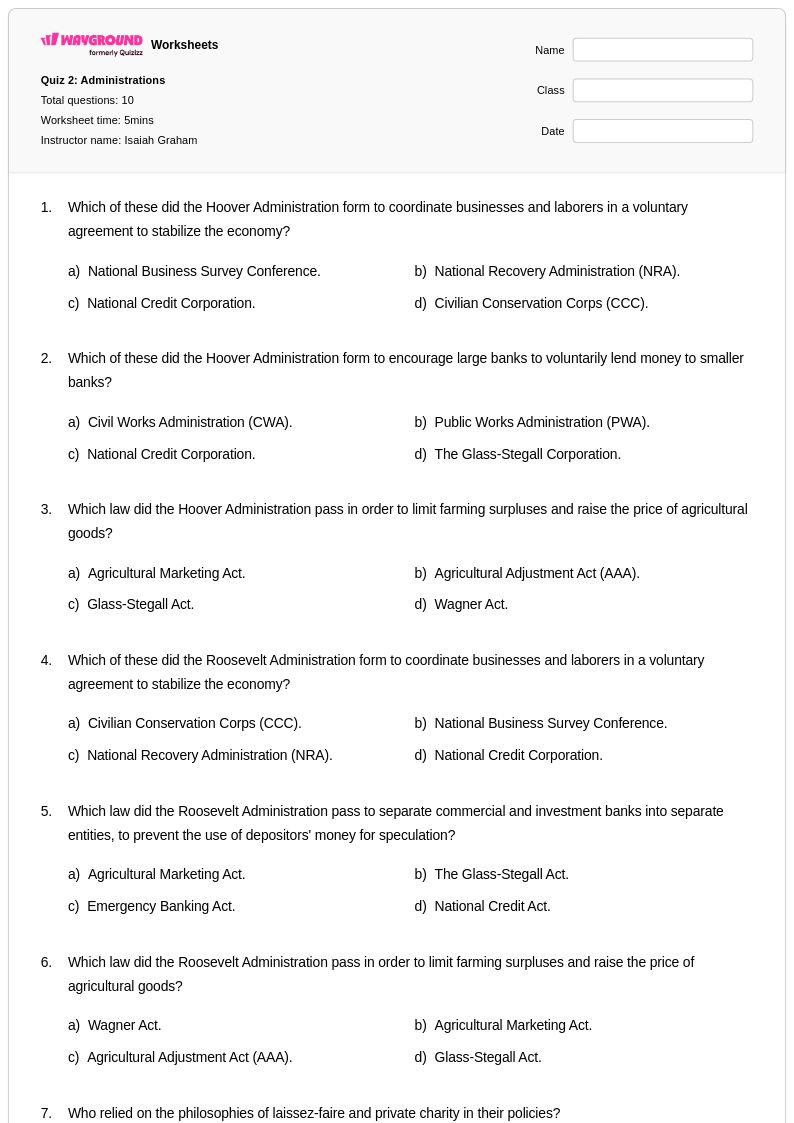
Alphabet Agencies worksheets for Class 12 students provide comprehensive coverage of the New Deal programs created during Franklin D. Roosevelt's presidency to combat the Great Depression. These educational resources help students analyze the formation, purposes, and effectiveness of key agencies such as the Works Progress Administration (WPA), Civilian Conservation Corps (CCC), Agricultural Adjustment Administration (AAA), and Social Security Administration (SSA). Through Wayground's extensive collection of printables and practice problems, students develop critical thinking skills by examining primary source documents, evaluating the constitutional debates surrounding these programs, and assessing their long-term impact on American government and society. Each worksheet includes a detailed answer key and is available as a free pdf download, enabling students to explore complex historical concepts such as federal intervention in the economy, the expansion of government power, and the precedent these agencies set for modern social programs.
Wayground, formerly Quizizz, empowers educators with millions of teacher-created resources specifically designed to support Class 12 U.S. History instruction on Alphabet Agencies and New Deal legislation. The platform's robust search and filtering capabilities allow teachers to quickly locate materials that align with state and national social studies standards, while differentiation tools enable customization for diverse learning needs and academic levels. These comprehensive worksheet collections are available in both printable and digital formats, including downloadable pdfs, providing flexibility for classroom instruction, homework assignments, and independent study. Teachers can seamlessly integrate these resources into lesson planning for skill practice, targeted remediation for struggling students, and enrichment activities for advanced learners, ensuring that all students master the complex historical analysis skills required to understand this pivotal period in American history.
FAQs
How do I teach Alphabet Agencies to my U.S. History students?
Teaching Alphabet Agencies effectively starts with grounding students in the economic crisis of the Great Depression before introducing the New Deal programs Roosevelt created in response. Organize the agencies thematically — relief, recovery, and reform — so students can categorize the CCC, WPA, SSA, and others by purpose rather than memorizing them as an undifferentiated list. Primary source analysis, such as examining WPA posters or CCC enrollment records, helps students evaluate effectiveness and lasting impact rather than simply recalling acronyms.
What exercises help students practice identifying and understanding New Deal Alphabet Agencies?
Effective practice exercises include matching agencies to their purposes, analyzing historical data on unemployment and economic output before and after key New Deal programs, and interpreting primary sources such as government reports or political cartoons. Students also benefit from compare-and-contrast tasks that ask them to connect specific agencies to modern federal programs, reinforcing the idea that many New Deal structures still shape American governance today. These activities move students beyond rote memorization toward analytical thinking about policy and its consequences.
What mistakes do students commonly make when studying Alphabet Agencies?
The most common error is treating the Alphabet Agencies as a single unified policy rather than a series of distinct programs with different goals, funding mechanisms, and target populations. Students frequently confuse relief agencies (which provided immediate assistance) with reform agencies (which restructured financial and labor systems), leading to shallow analysis on assessments. Another recurring misconception is assuming all New Deal programs were universally successful or popular — teachers should prompt students to evaluate contemporary criticism and uneven outcomes across regions and demographics.
How can I use Alphabet Agencies worksheets in my classroom?
Alphabet Agencies worksheets on Wayground are available as printable PDFs for traditional classroom use and in digital formats for technology-integrated or remote learning environments, including the option to host them as a quiz directly on Wayground. Teachers can use them for initial instruction on New Deal programs, targeted review before assessments, or enrichment tasks that ask students to connect historical agencies to contemporary policy. Each worksheet includes answer keys, supporting both independent student work and guided classroom instruction.
How do I differentiate Alphabet Agencies instruction for students at different ability levels?
For struggling learners, simplify the entry point by focusing on three or four major agencies — CCC, WPA, SSA, and FDIC — before expanding to the broader network. For advanced students, assign primary source evaluation or ask them to argue whether the New Deal represented a fundamental shift in the role of federal government. On Wayground, teachers can apply accommodations such as read aloud, reduced answer choices, and extended time on a per-student basis, ensuring that differentiation happens seamlessly without disrupting the rest of the class.
How do I connect Alphabet Agencies to broader U.S. History standards?
Alphabet Agencies sit at the intersection of several core U.S. History standards, including the causes and consequences of the Great Depression, the expansion of federal power during the New Deal era, and the long-term development of the American welfare state. Teachers can align instruction to standards addressing economic history, constitutional debates over federal authority, and the role of the executive branch in times of national crisis. Connecting specific agencies to their modern equivalents — for example, linking the FDIC to current banking regulation — helps students see historical continuity and meet standards requiring analysis of how past policy shapes present institutions.