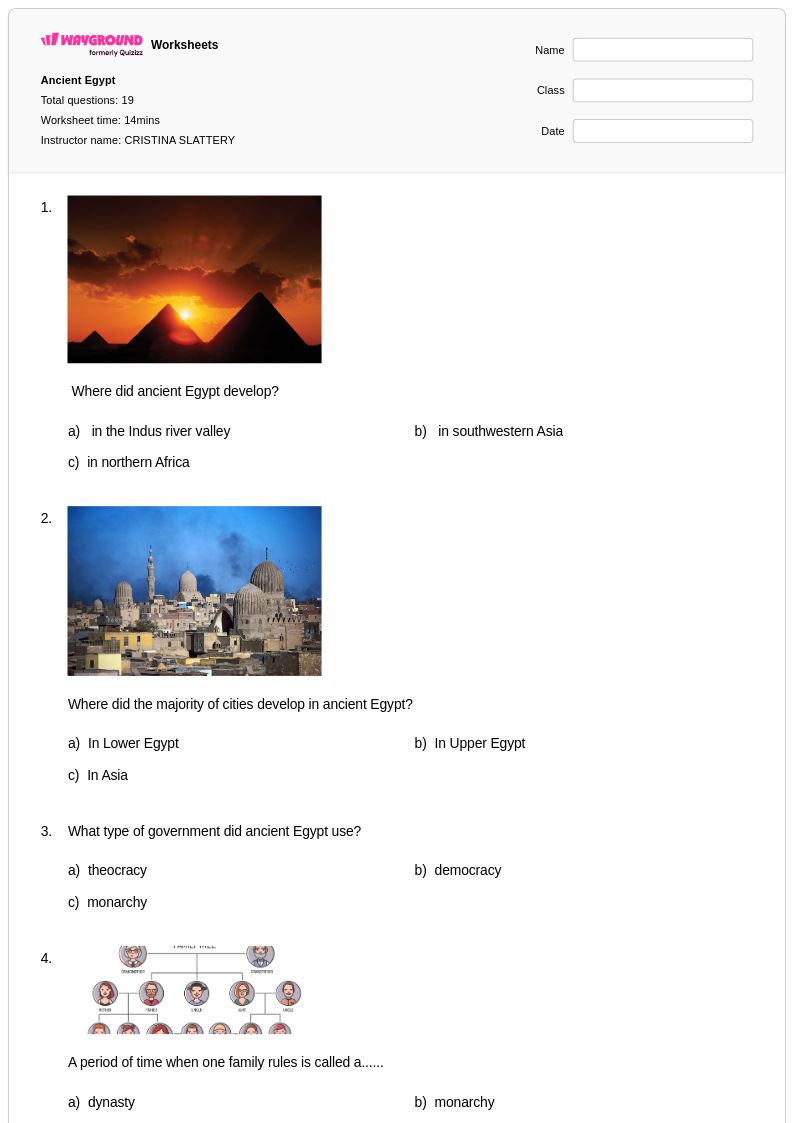
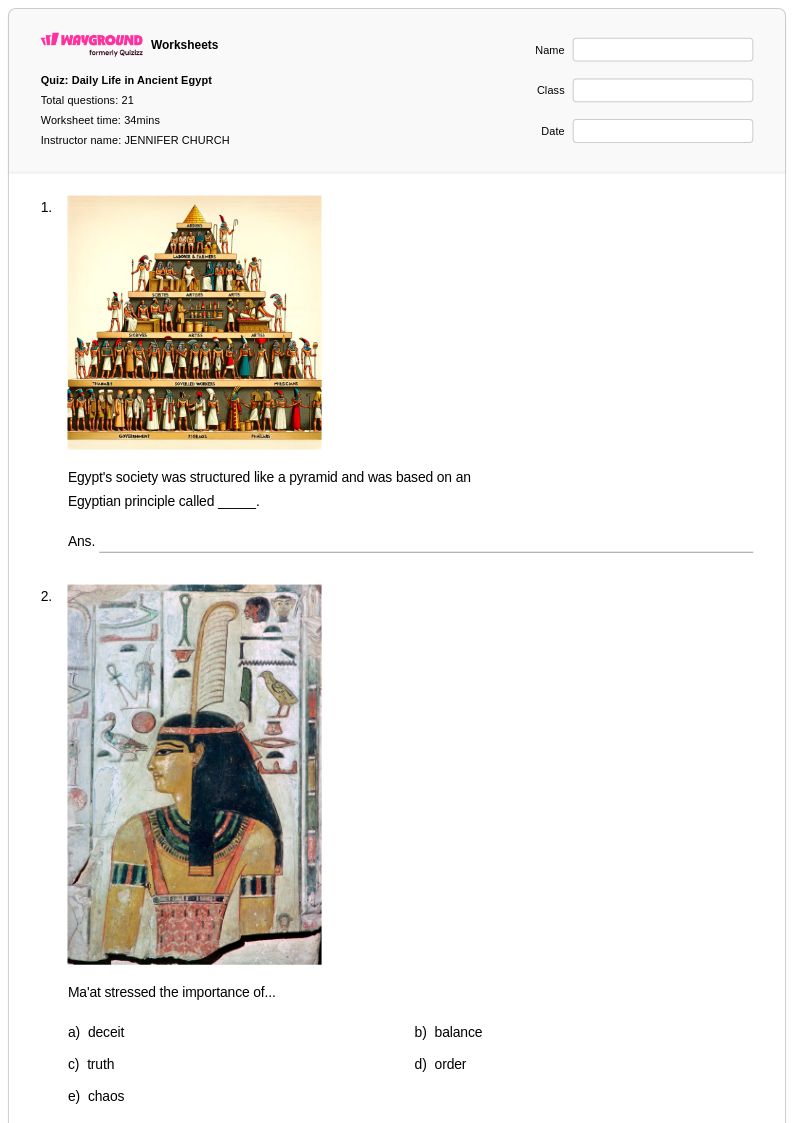
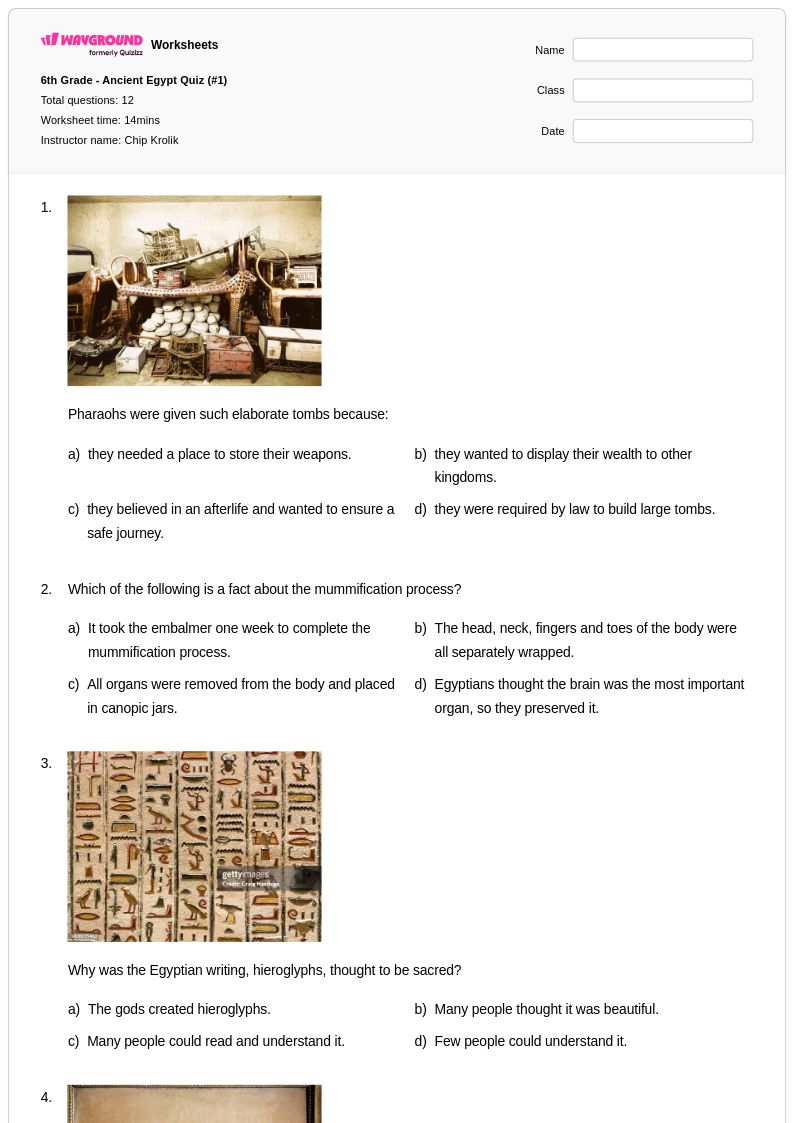
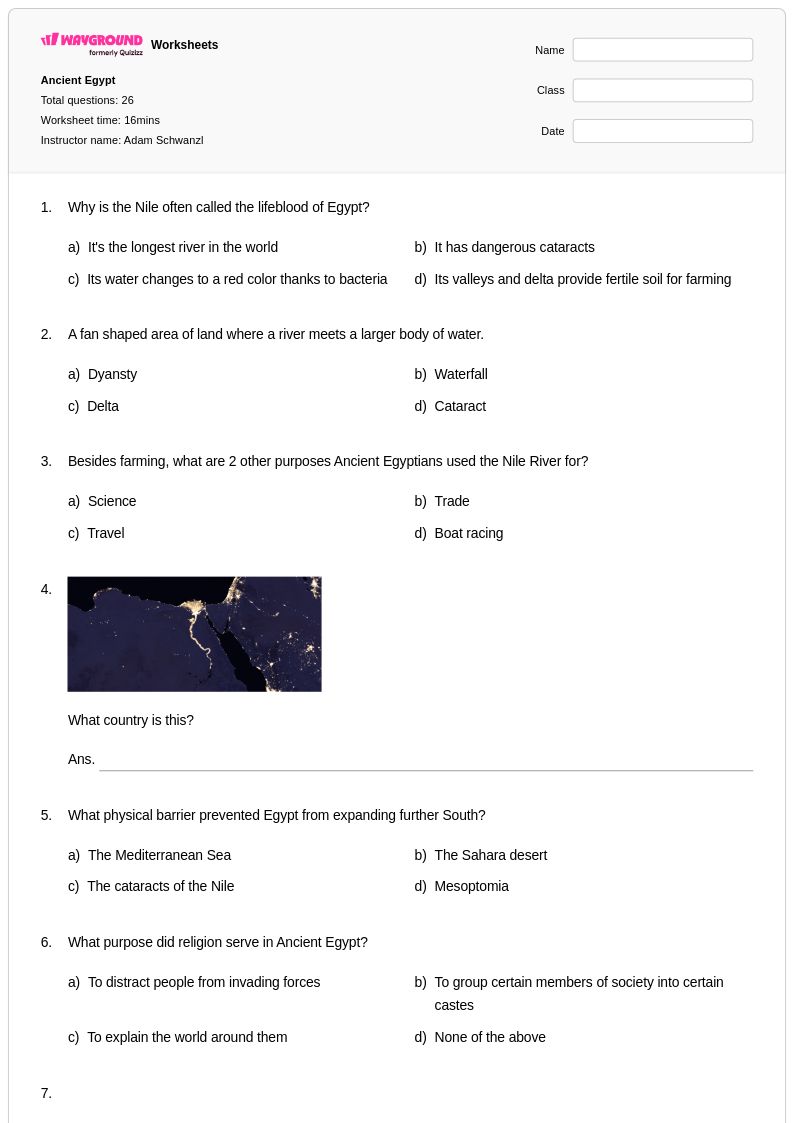
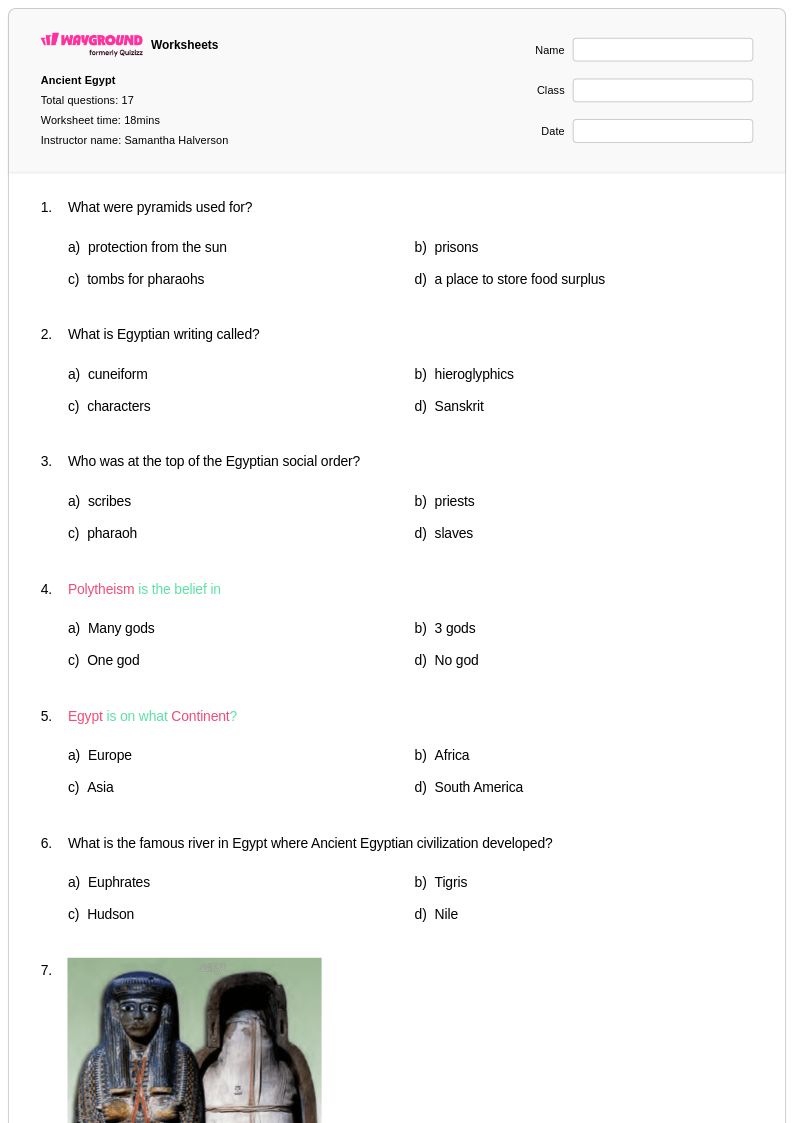
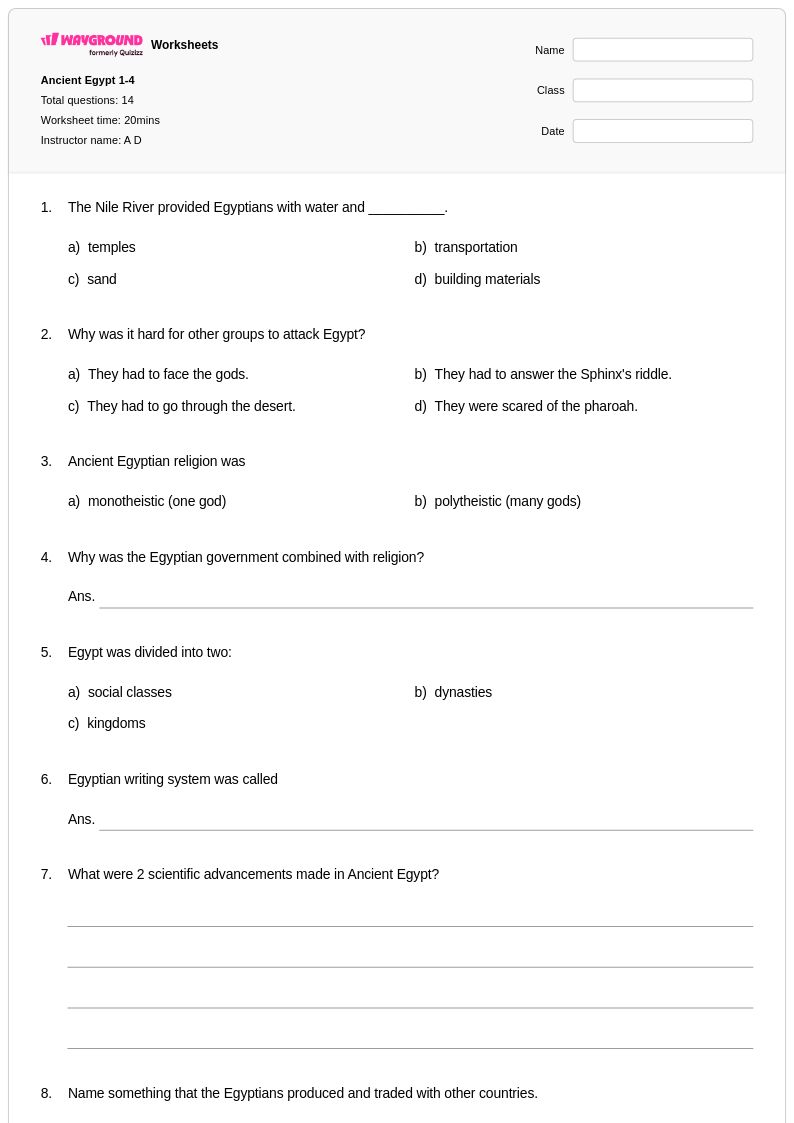
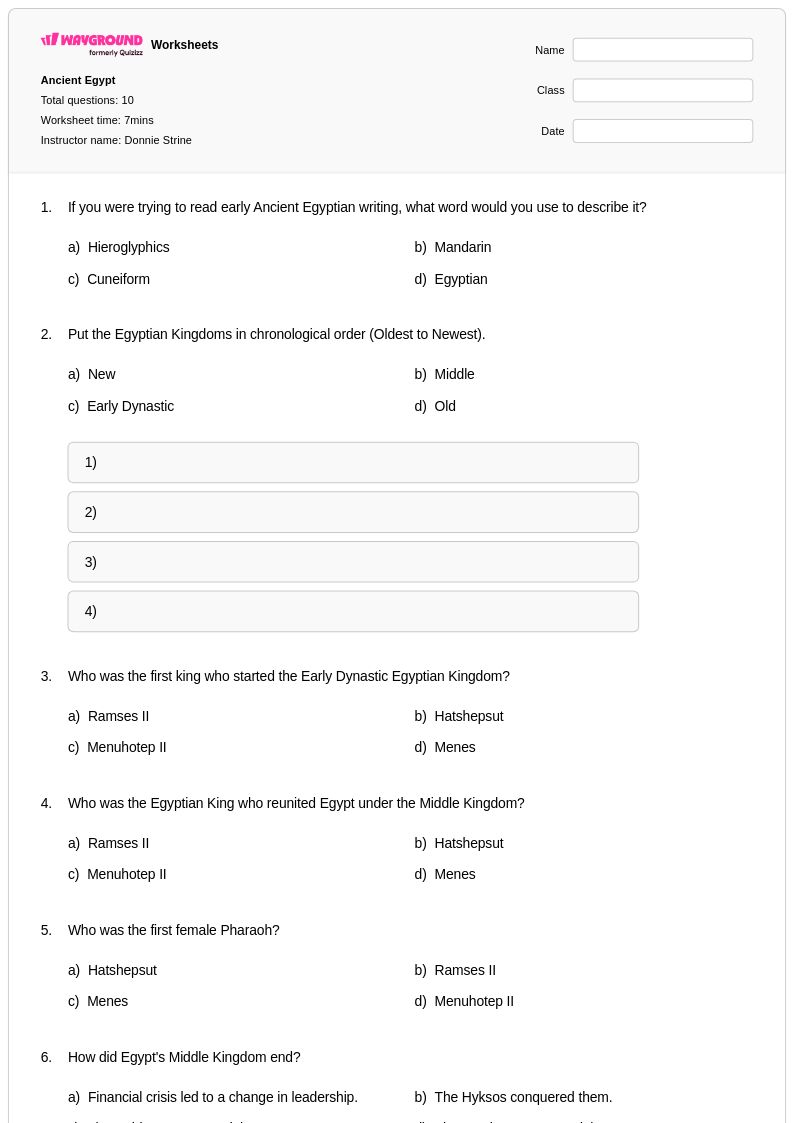
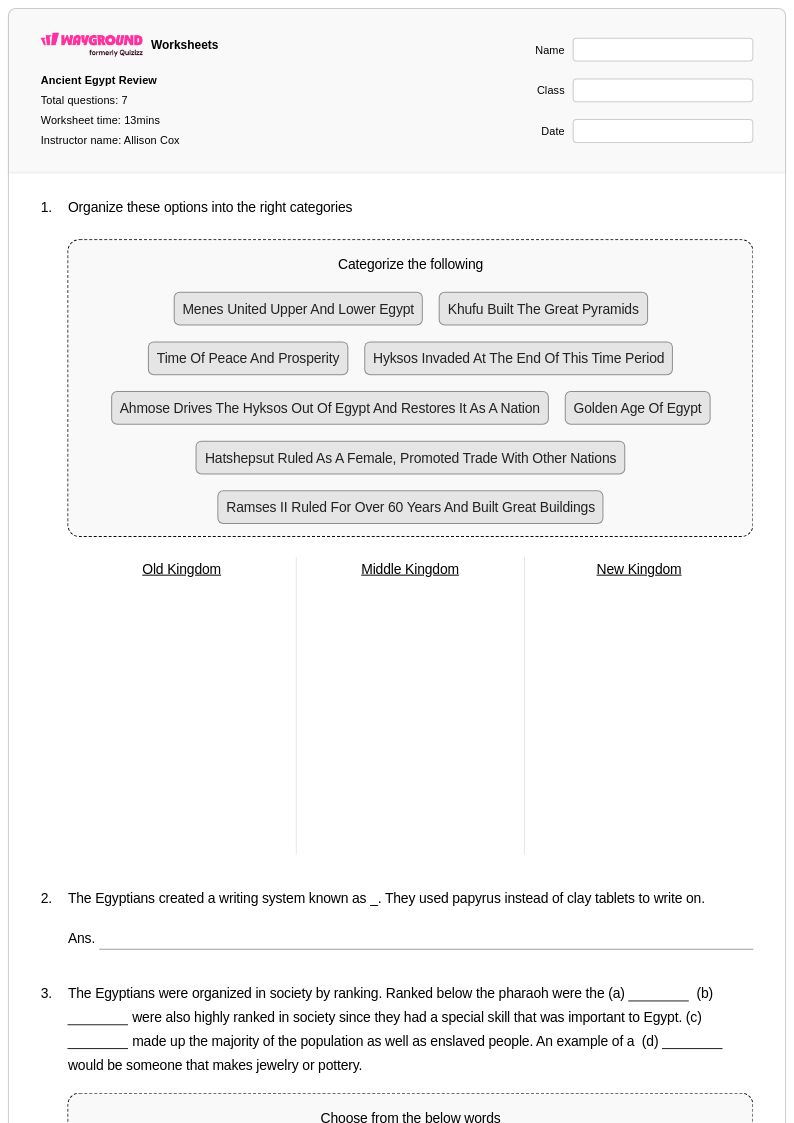
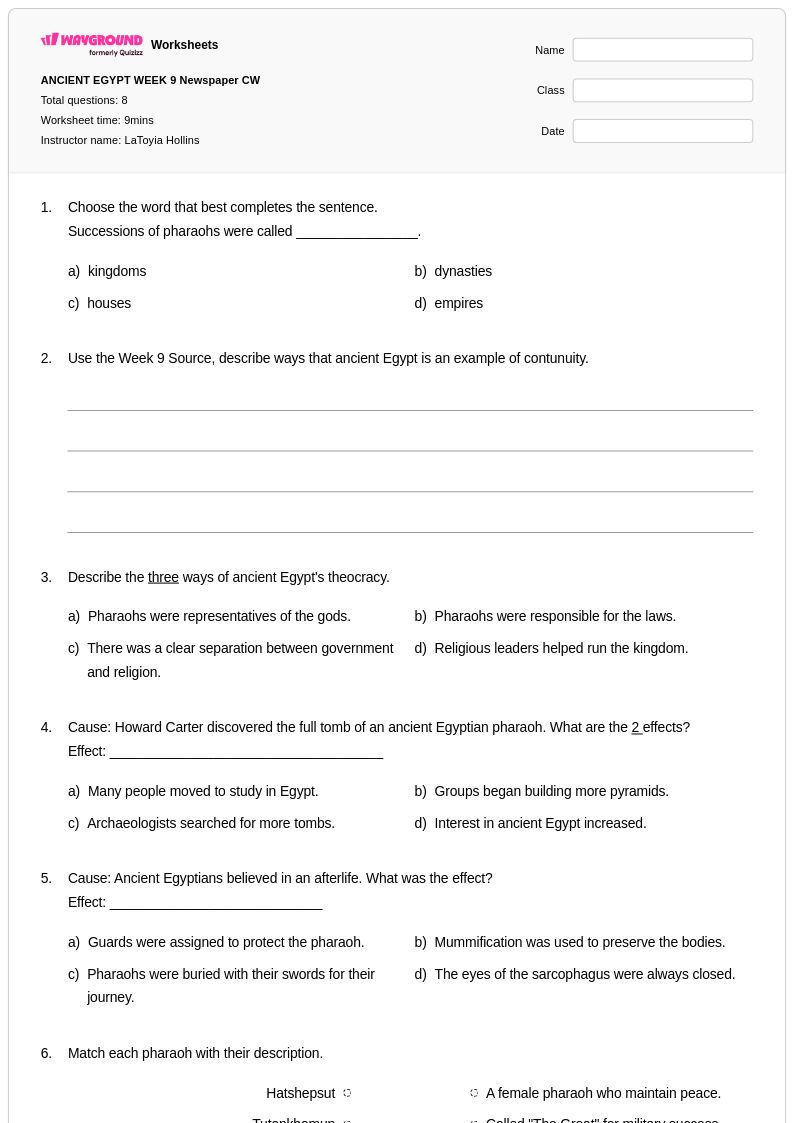
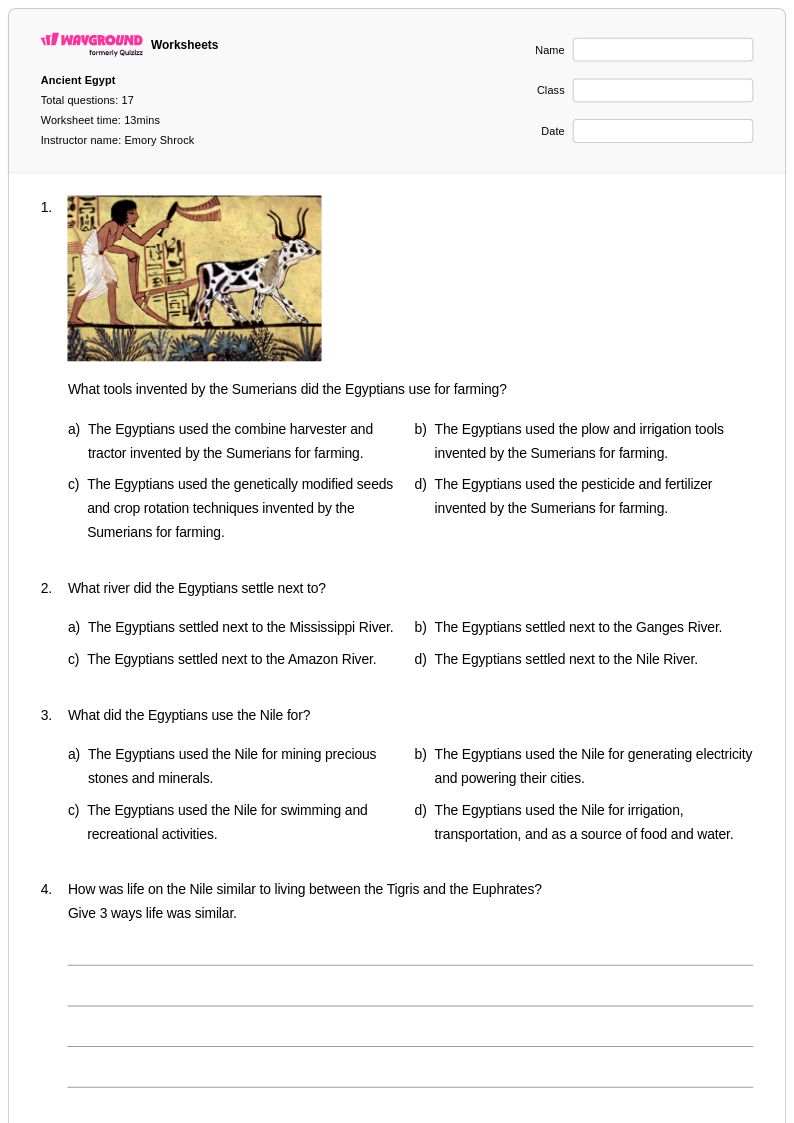
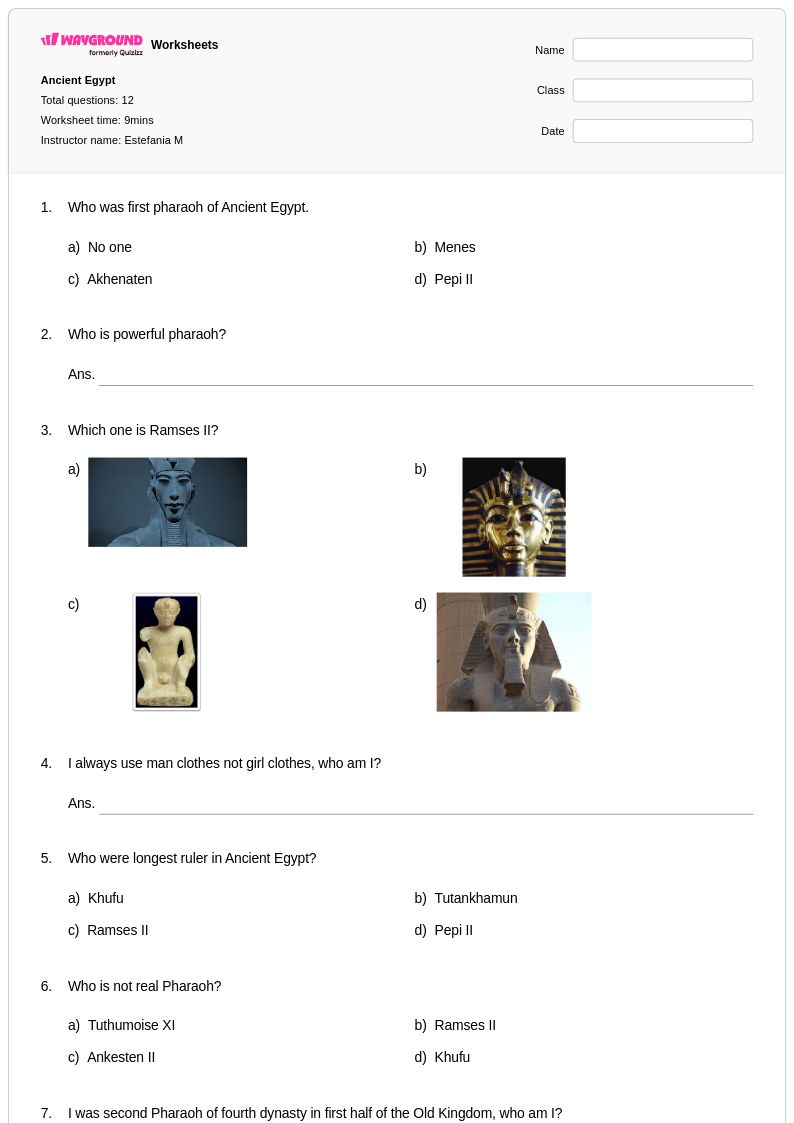
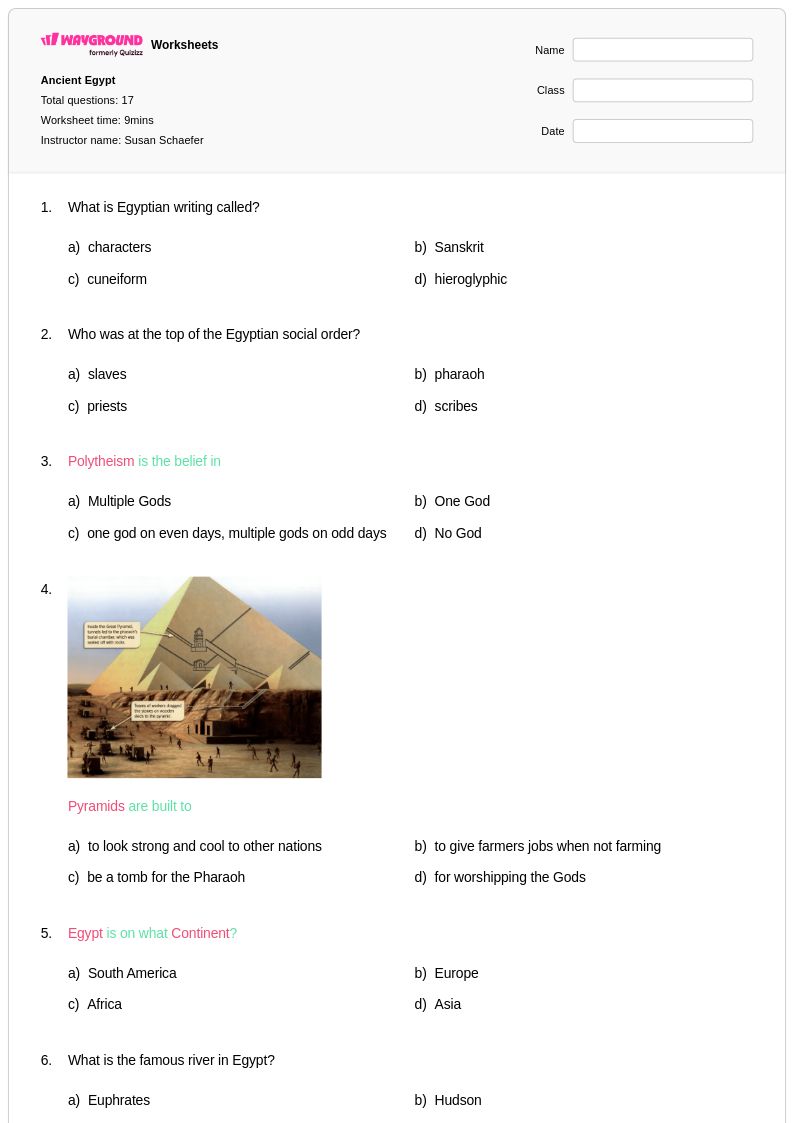
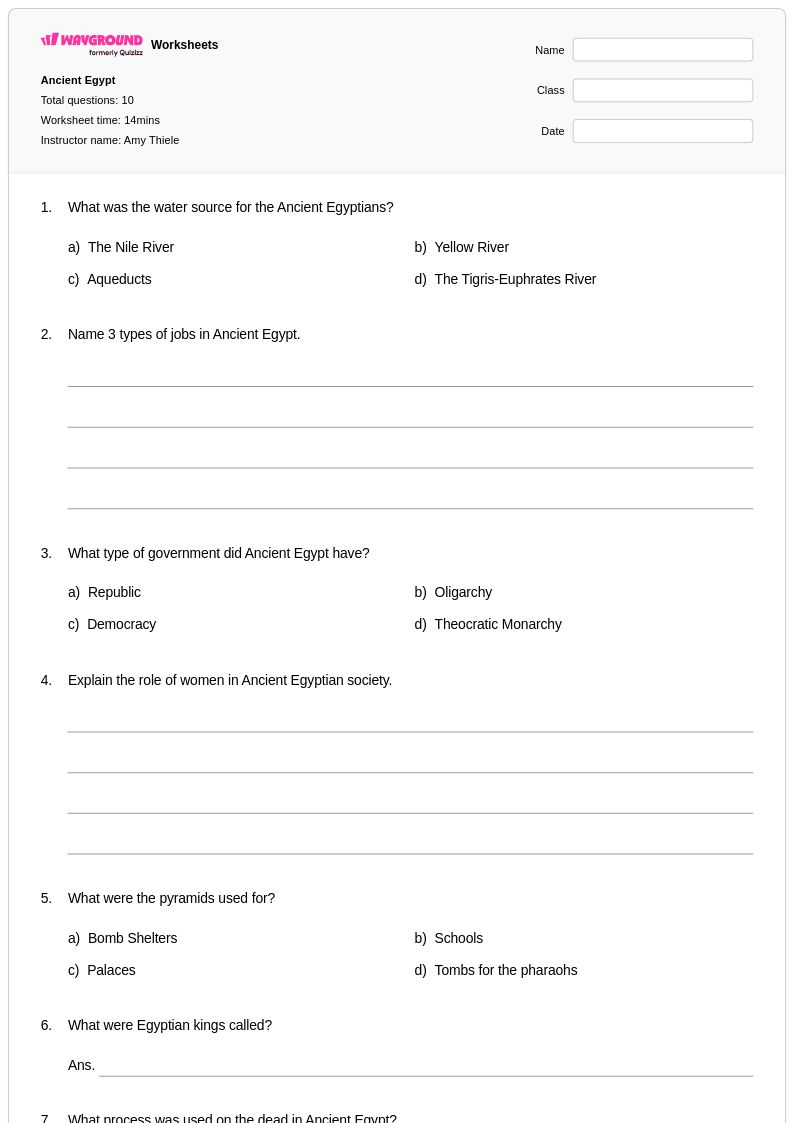
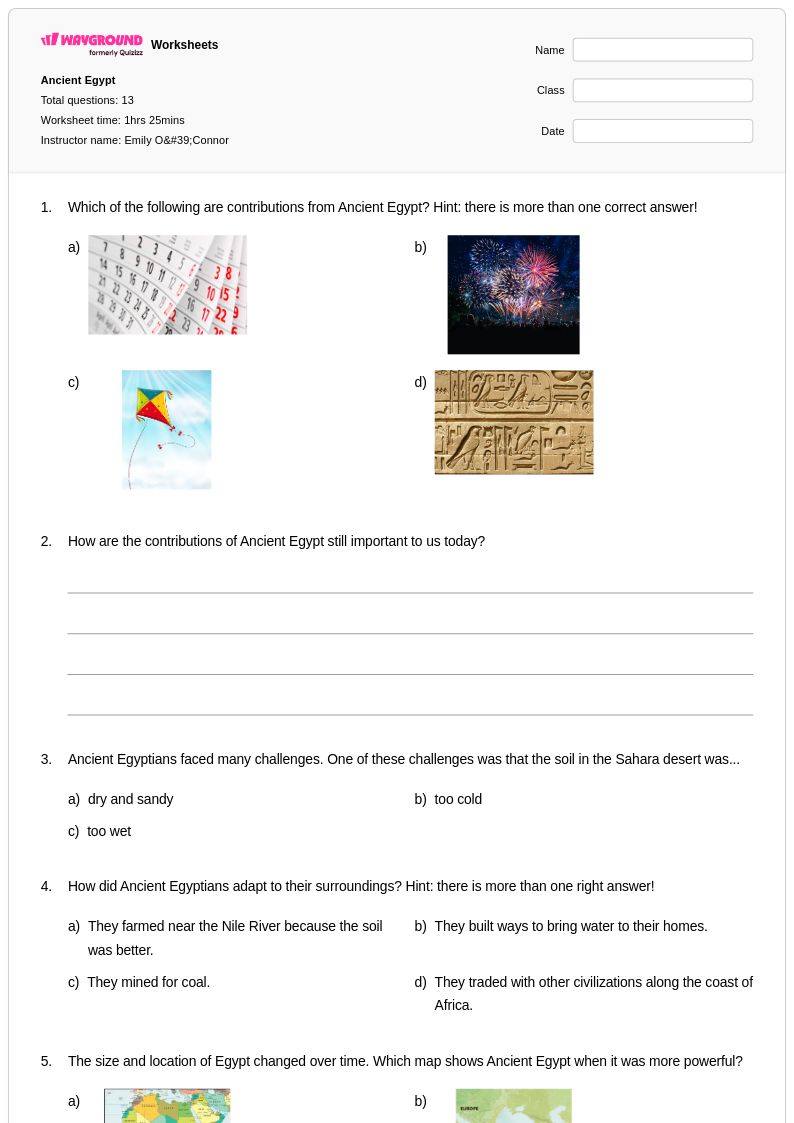
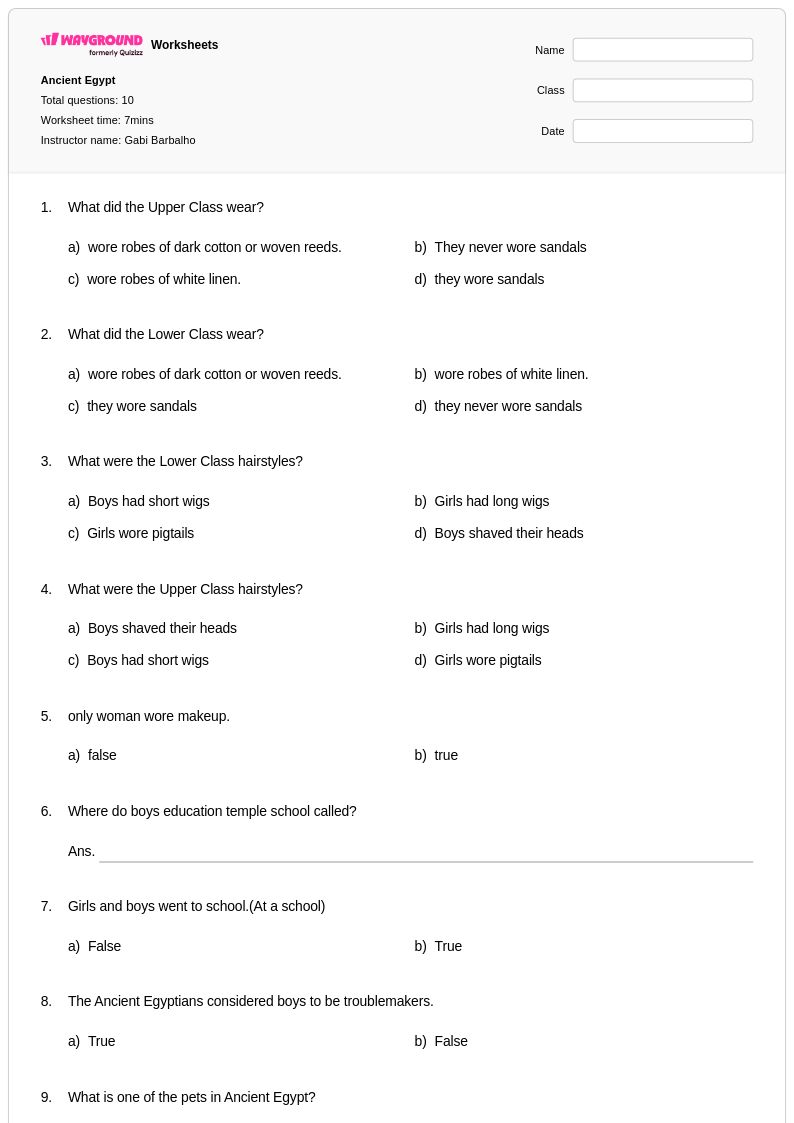
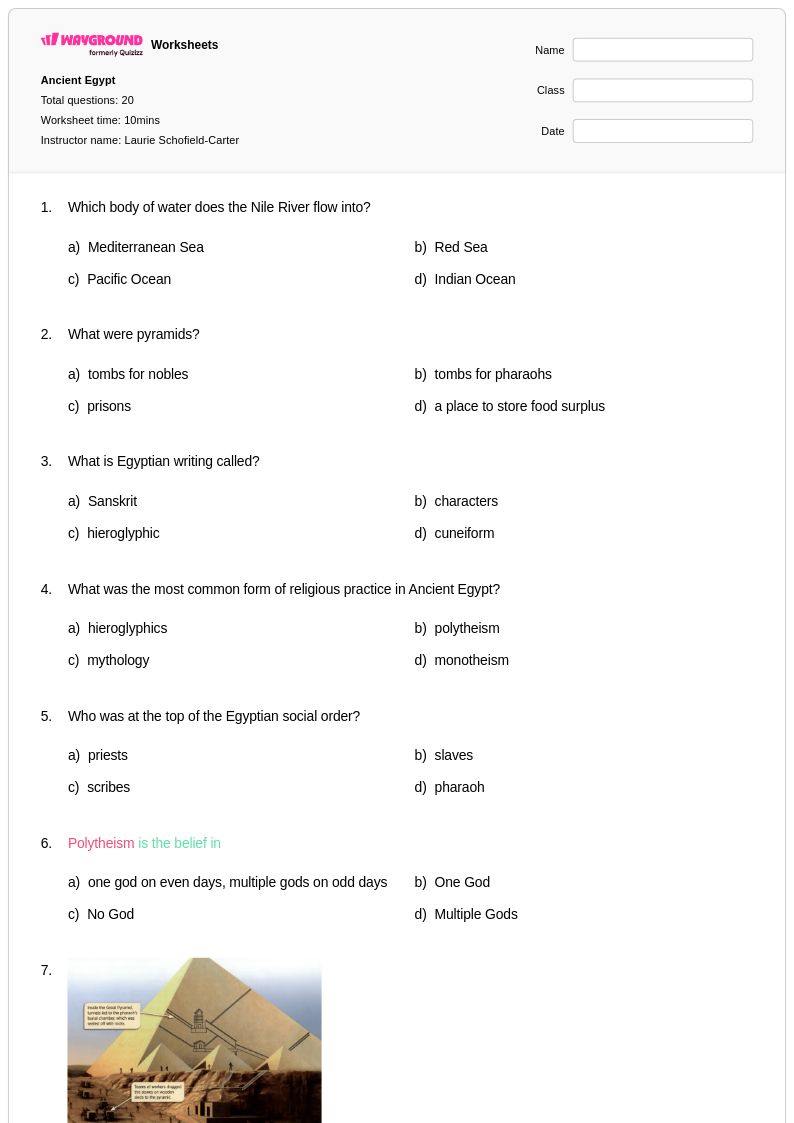
Discover free Ancient Egypt worksheets and printables that help students explore pharaohs, pyramids, hieroglyphics, and Egyptian civilization through engaging practice problems with comprehensive answer keys.
Ancient Egypt worksheets available through Wayground (formerly Quizizz) provide comprehensive educational resources that immerse students in one of history's most fascinating civilizations. These carefully crafted materials cover essential topics including pharaohs and dynasties, pyramid construction and burial practices, hieroglyphic writing systems, daily life along the Nile River, and the remarkable achievements of ancient Egyptian society. The worksheets strengthen critical thinking skills through analysis of primary sources, develop reading comprehension through engaging historical narratives, and build research abilities as students explore archaeological discoveries and cultural traditions. Each resource includes detailed answer keys to support both independent study and classroom instruction, with free printables available in convenient pdf format alongside interactive practice problems that reinforce key concepts about Egyptian religion, government, art, and technological innovations.
Wayground (formerly Quizizz) empowers educators with an extensive collection of millions of teacher-created Ancient Egypt resources, featuring robust search and filtering capabilities that allow instructors to quickly locate materials aligned with specific curriculum standards and learning objectives. The platform's differentiation tools enable teachers to customize worksheets for diverse learning needs, offering both printable pdf versions for traditional classroom use and digital formats for technology-integrated instruction. These flexible resources support comprehensive lesson planning by providing materials suitable for initial concept introduction, skill practice during guided instruction, targeted remediation for struggling learners, and enrichment activities for advanced students. The seamless integration of assessment tools with instructional content allows educators to monitor student progress while building deep understanding of Ancient Egyptian civilization's lasting impact on world history.
FAQs
How do I teach Ancient Egypt to elementary and middle school students?
Teaching Ancient Egypt works best when anchored to concrete, visual content — maps of the Nile, images of pyramids, and examples of hieroglyphics give students tangible entry points into an abstract ancient world. Start with geography and the role of the Nile before moving into government, religion, and daily life, so students build context before encountering complex topics like mummification or the pharaonic system. Primary source analysis, even simplified versions, helps students think like historians rather than just memorizing facts.
What topics should Ancient Egypt worksheets cover?
Effective Ancient Egypt worksheets should cover pharaohs and dynasties, pyramid construction and burial practices, hieroglyphic writing, daily life along the Nile, religious beliefs, and the achievements of Egyptian civilization in art, architecture, and government. Including a range of topics ensures students develop both broad knowledge of the civilization and the ability to analyze specific aspects in depth. Worksheets that incorporate primary source excerpts and archaeological context help students move beyond surface-level recall.
What exercises help students practice their knowledge of Ancient Egypt?
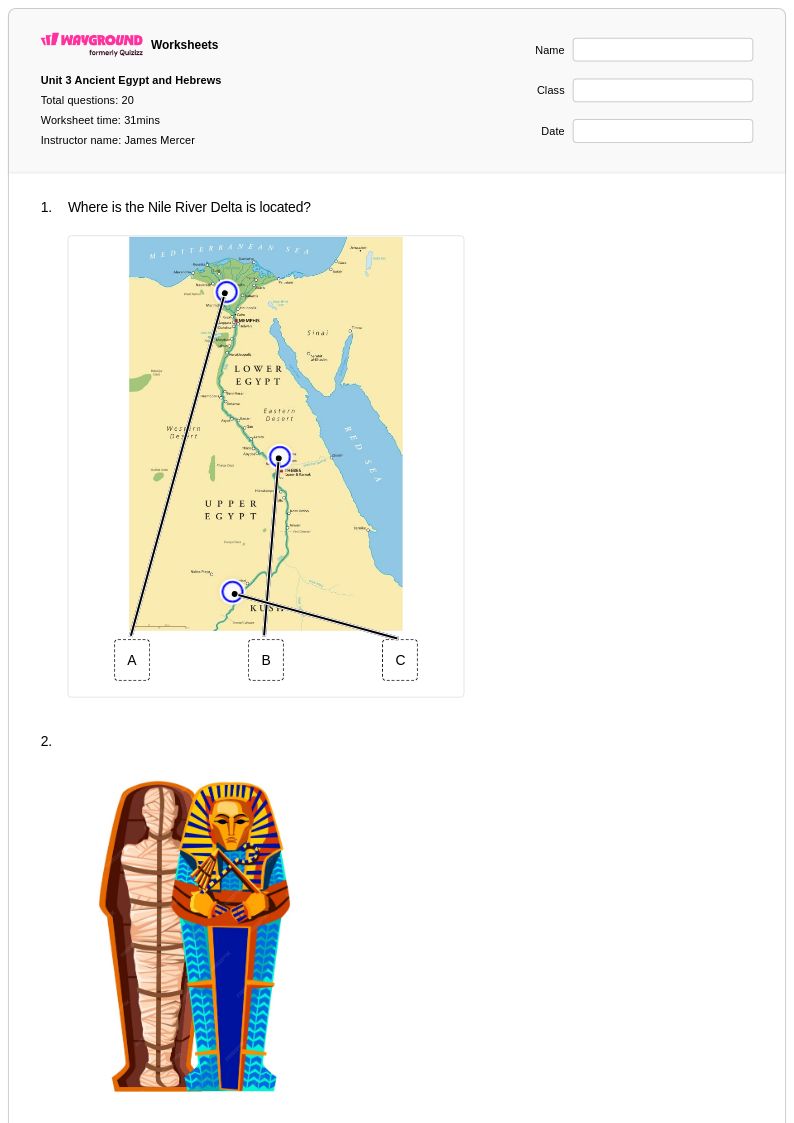
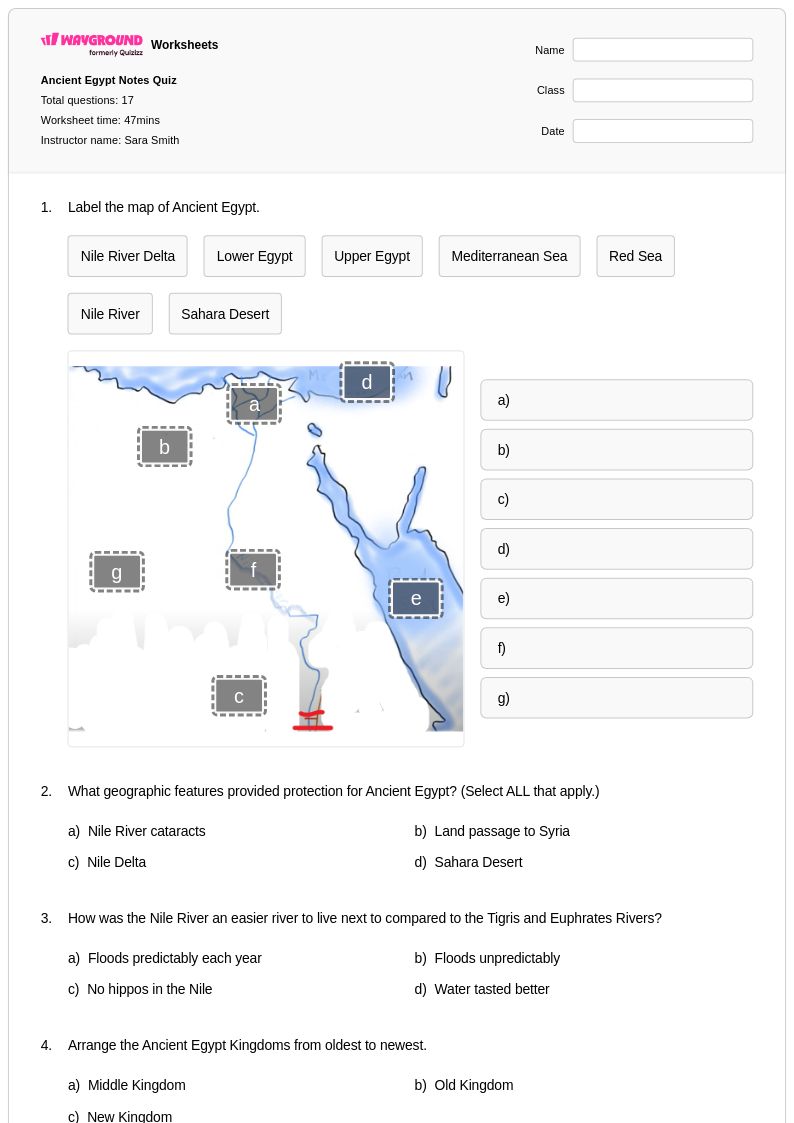
Practice activities for Ancient Egypt should mix reading comprehension passages about specific topics — such as pyramid construction or the role of pharaohs — with short-answer questions that require students to explain relationships and causes rather than just recall names and dates. Hieroglyphics decoding activities, map labeling exercises for the Nile River region, and sequencing tasks for Egyptian dynasties all reinforce key concepts through active engagement. Varied formats help students retain content across visual, textual, and analytical modes.
What mistakes do students commonly make when learning about Ancient Egypt?
One of the most common misconceptions is that ancient Egyptians were a monolithic culture unchanged over thousands of years — students often fail to recognize that Egyptian civilization spanned multiple distinct periods with significant political and cultural shifts. Students also frequently conflate Egyptian mythology with historical fact, particularly around mummification and the afterlife, which requires careful scaffolding to separate. Another common error is misunderstanding the geographic role of the Nile, leading students to underestimate how central the river was to every aspect of Egyptian society, from agriculture to religion.
How do I use Wayground's Ancient Egypt worksheets in my classroom?
Wayground's Ancient Egypt worksheets are available as printable PDFs for traditional classroom use and in digital formats for technology-integrated instruction, making them flexible for in-person, hybrid, or remote learning environments. Teachers can also host the worksheets as a quiz directly on Wayground, enabling real-time student responses and progress monitoring. Each worksheet includes a comprehensive answer key, supporting both teacher-led instruction and independent student study. Wayground also offers differentiation tools — including read aloud, extended time, and reduced answer choices — so teachers can tailor the experience for diverse learners without disrupting the rest of the class.
How can I differentiate Ancient Egypt instruction for struggling or advanced learners?
For struggling learners, simplifying text complexity in reading passages and reducing the number of answer choices on questions can lower cognitive load while keeping students engaged with grade-level content. Advanced students benefit from open-ended analysis tasks — such as comparing Egyptian government structures to other ancient civilizations or evaluating the historical significance of specific pharaohs. On Wayground, teachers can apply individual accommodations like extended time or read aloud to specific students while the rest of the class receives standard settings, making differentiation seamless and private.