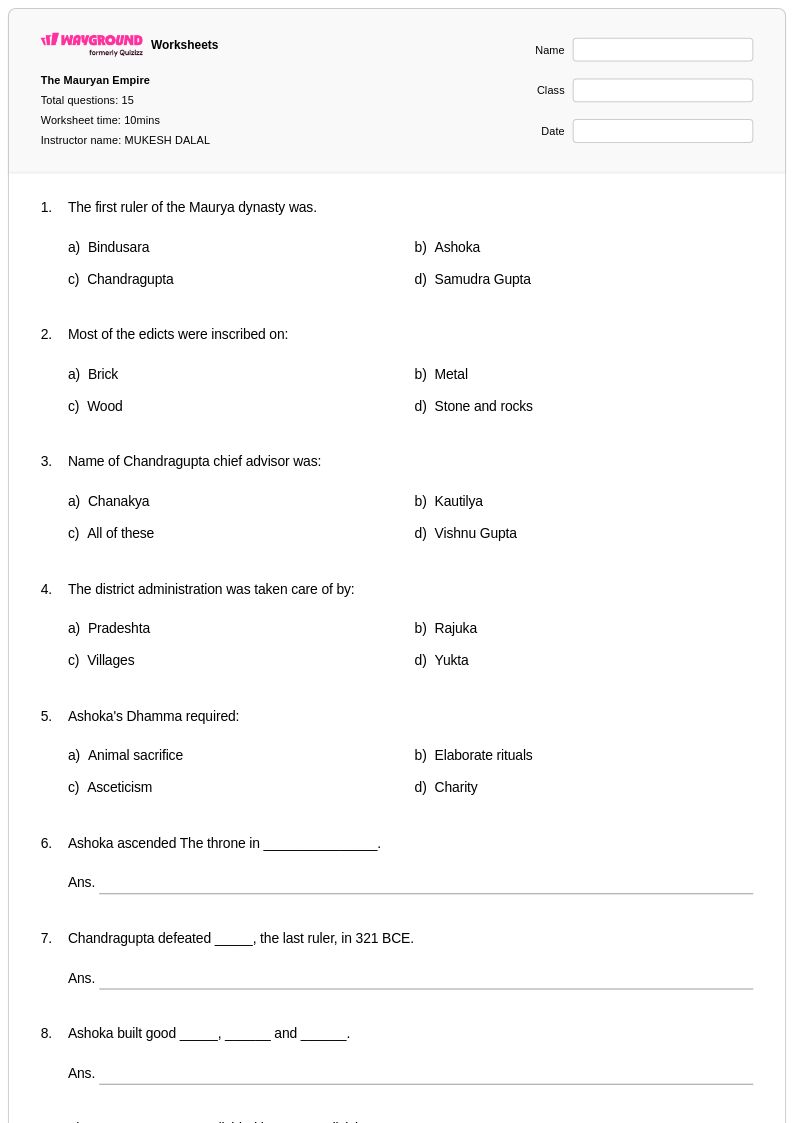
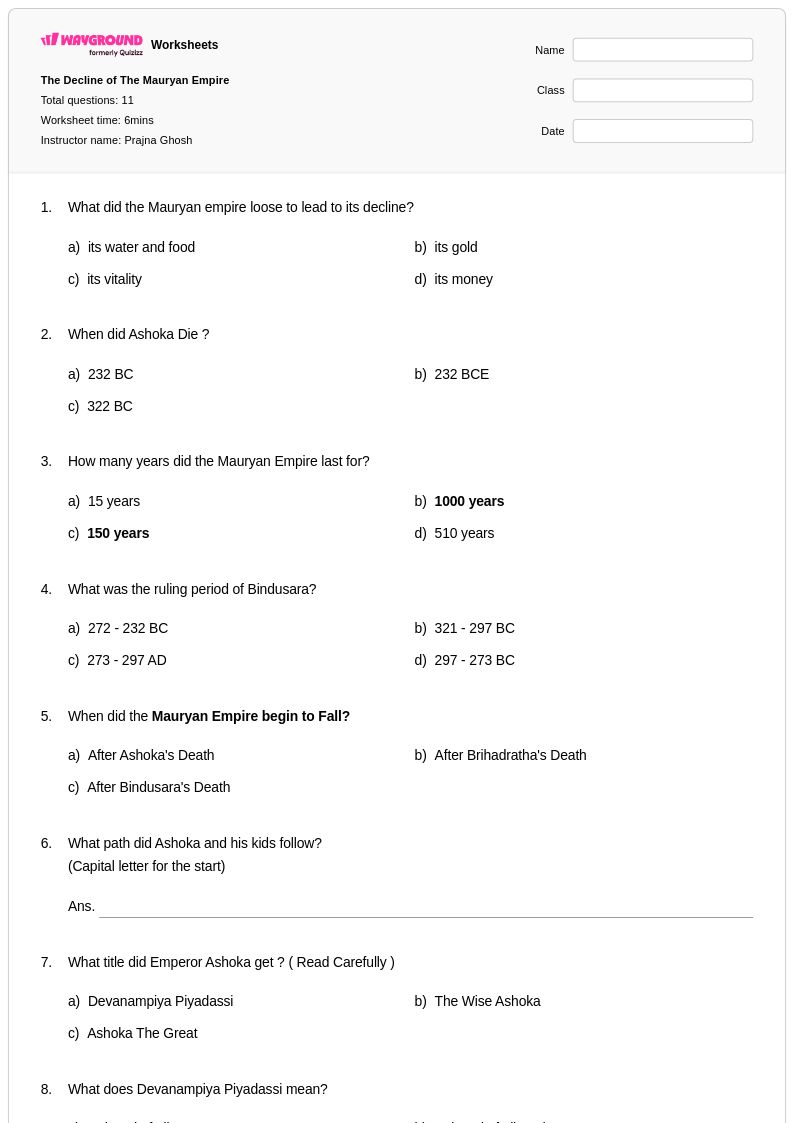
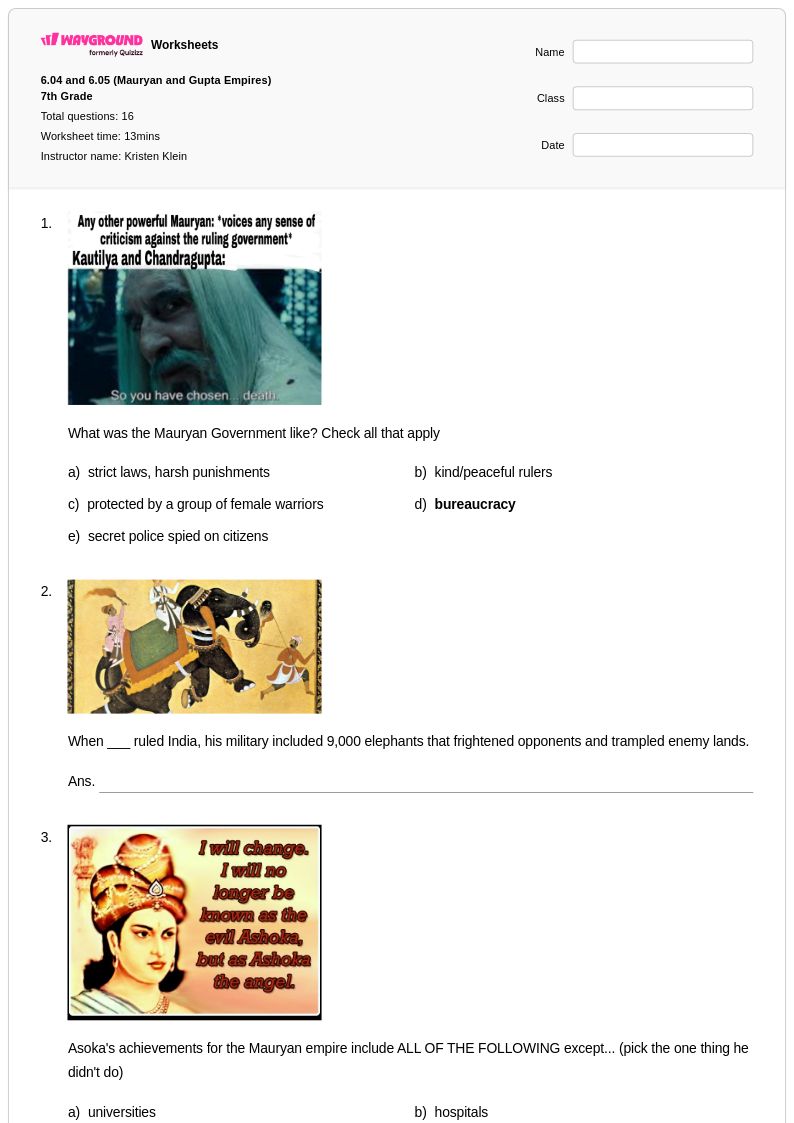
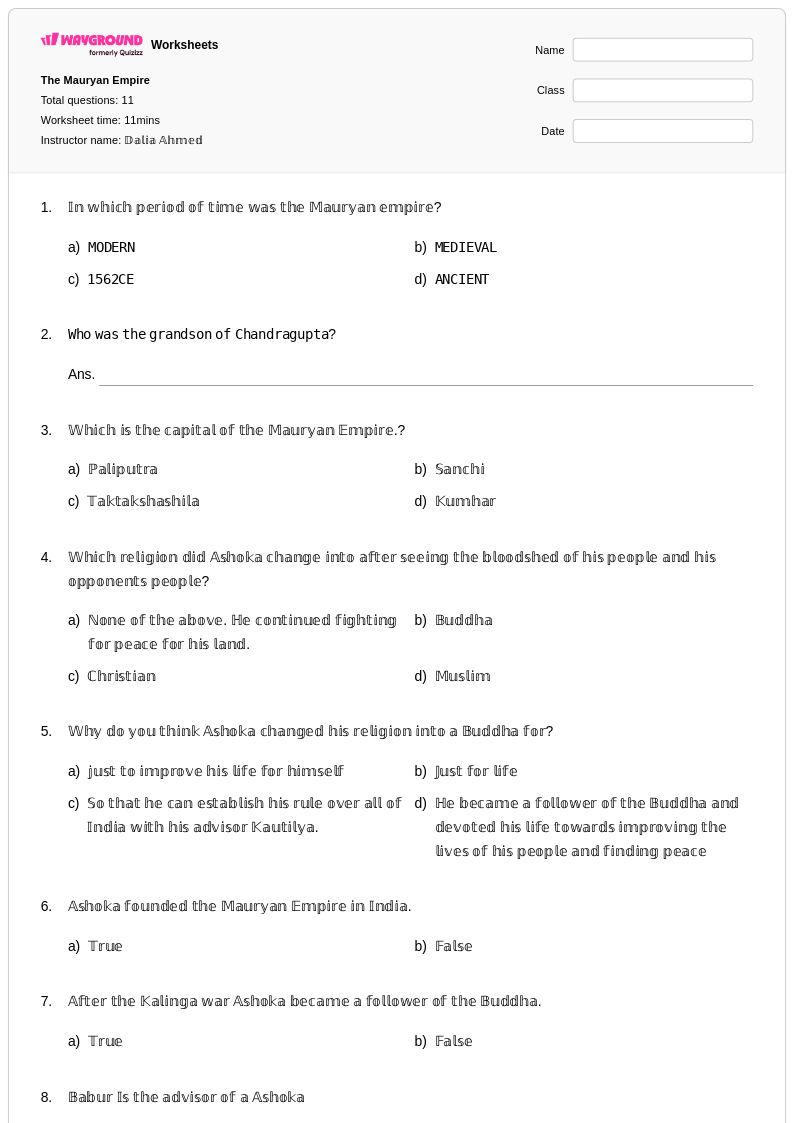
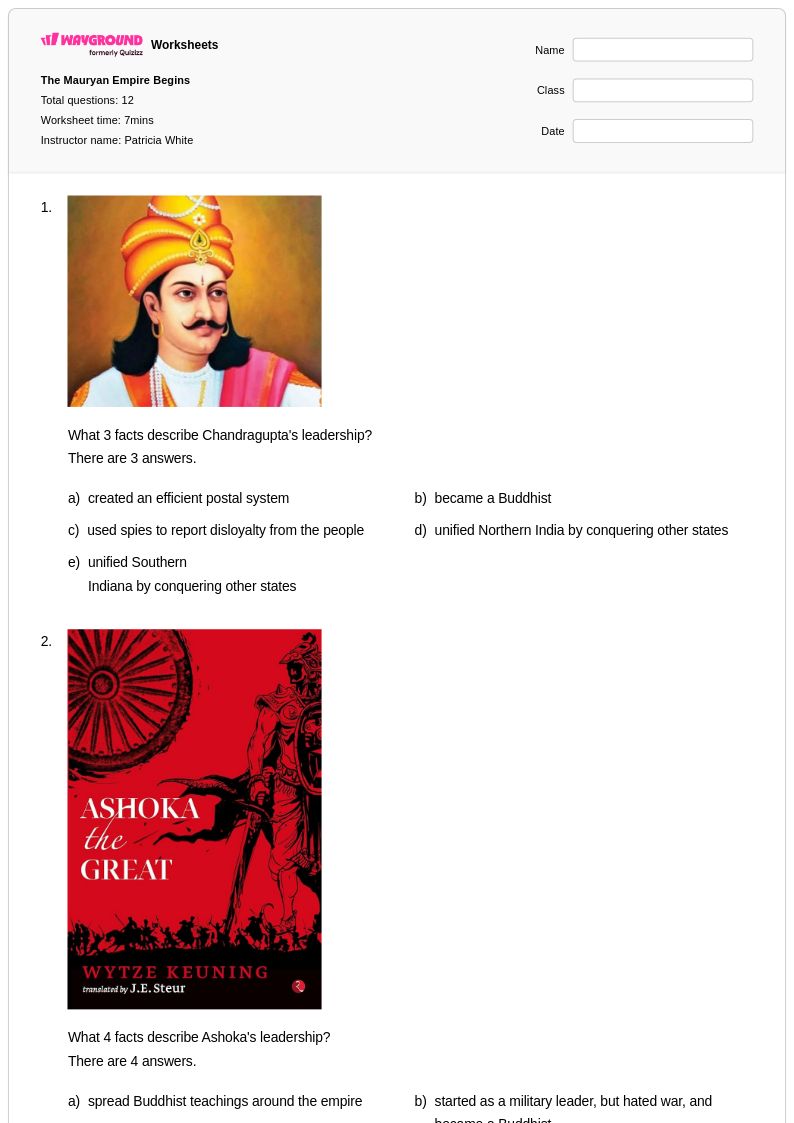
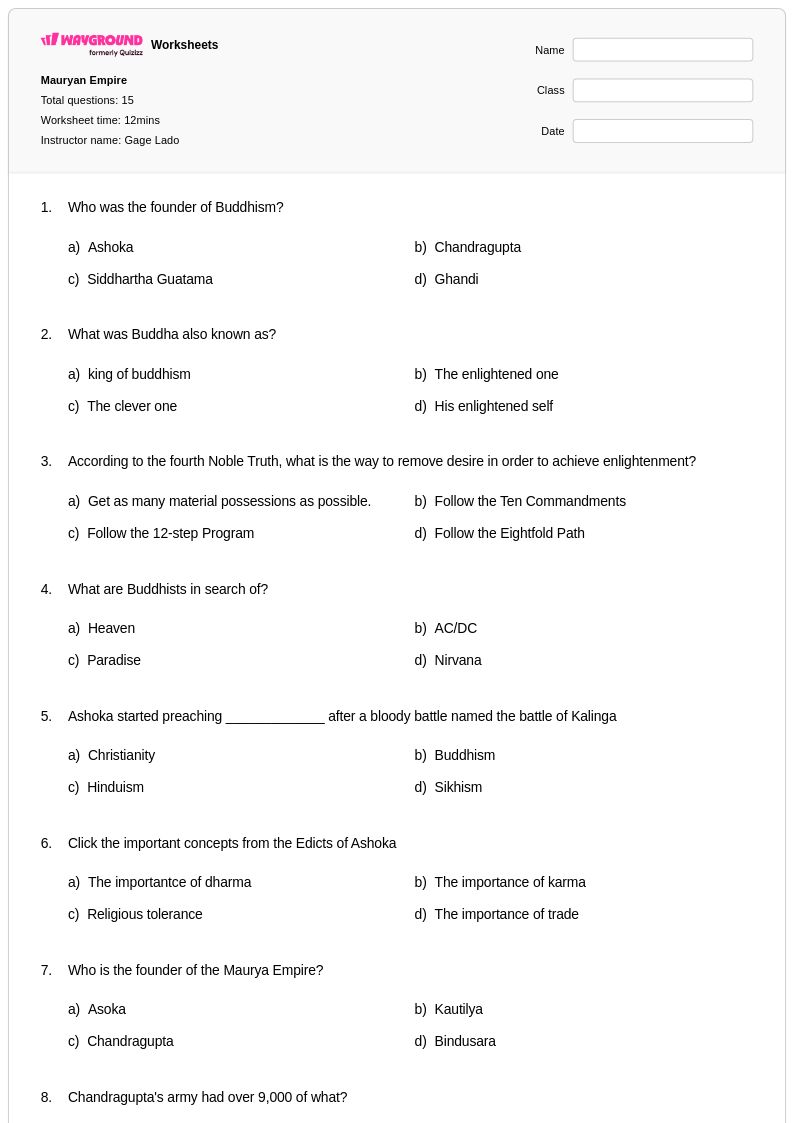
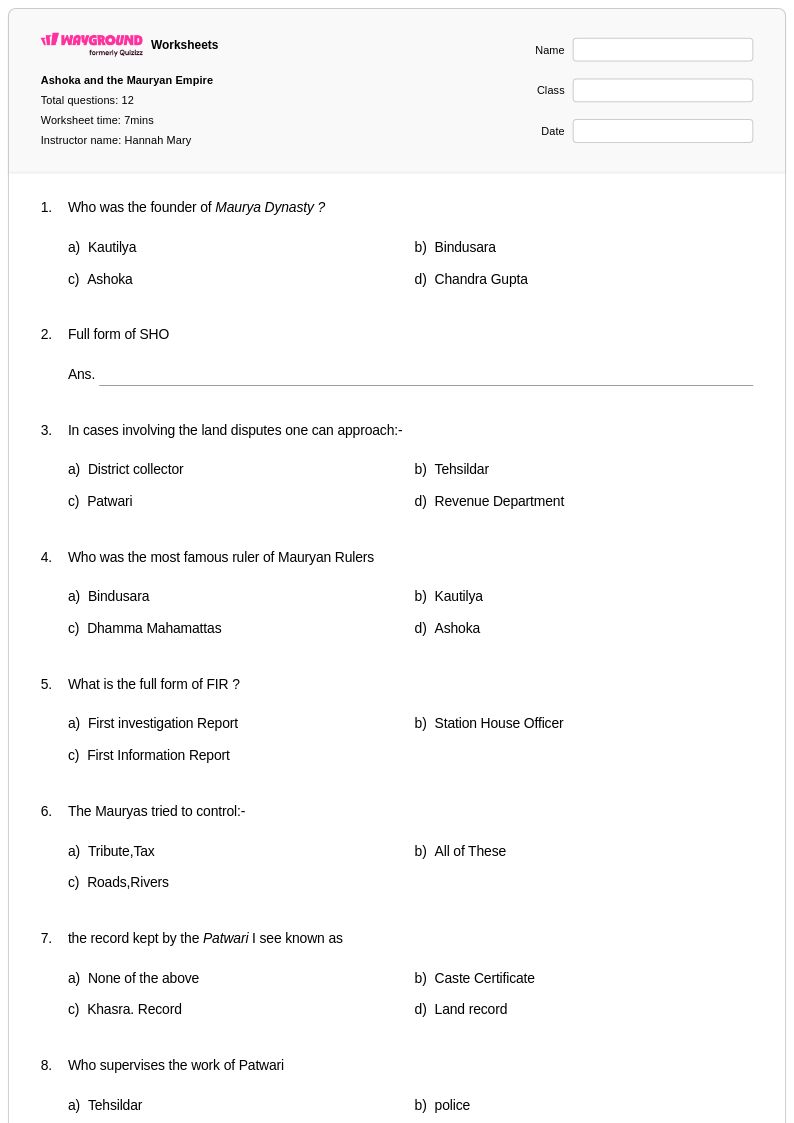
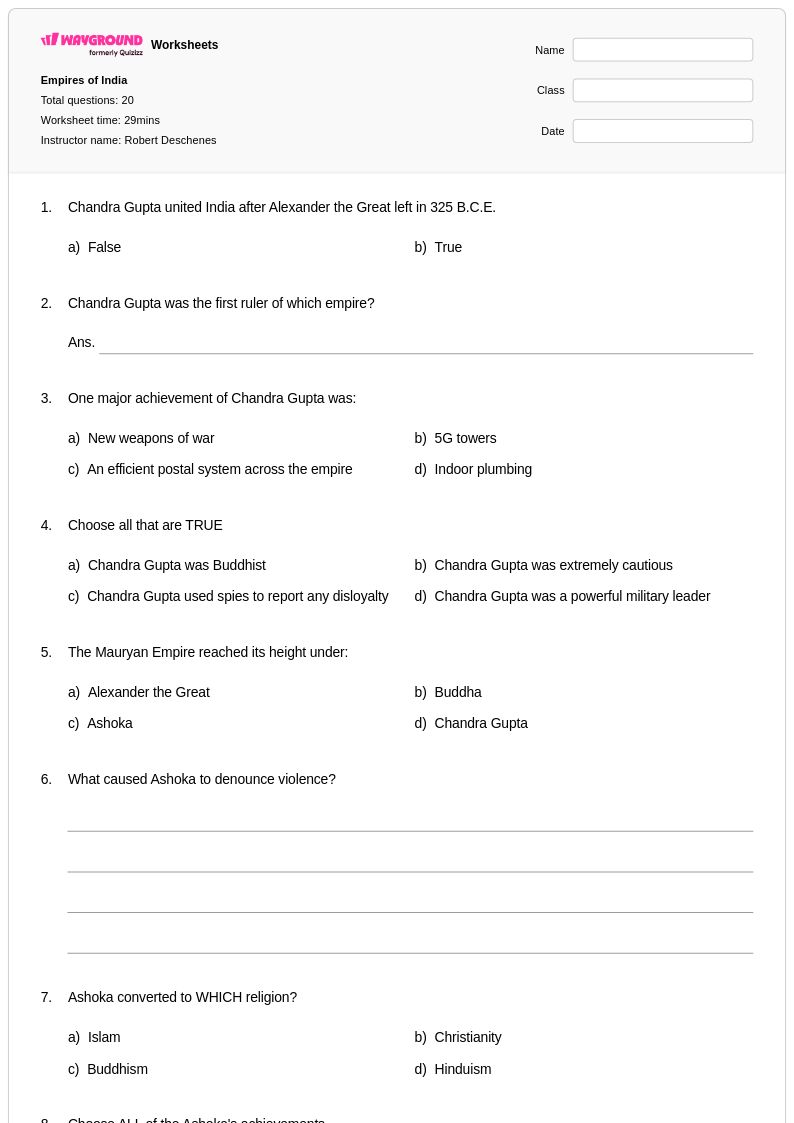
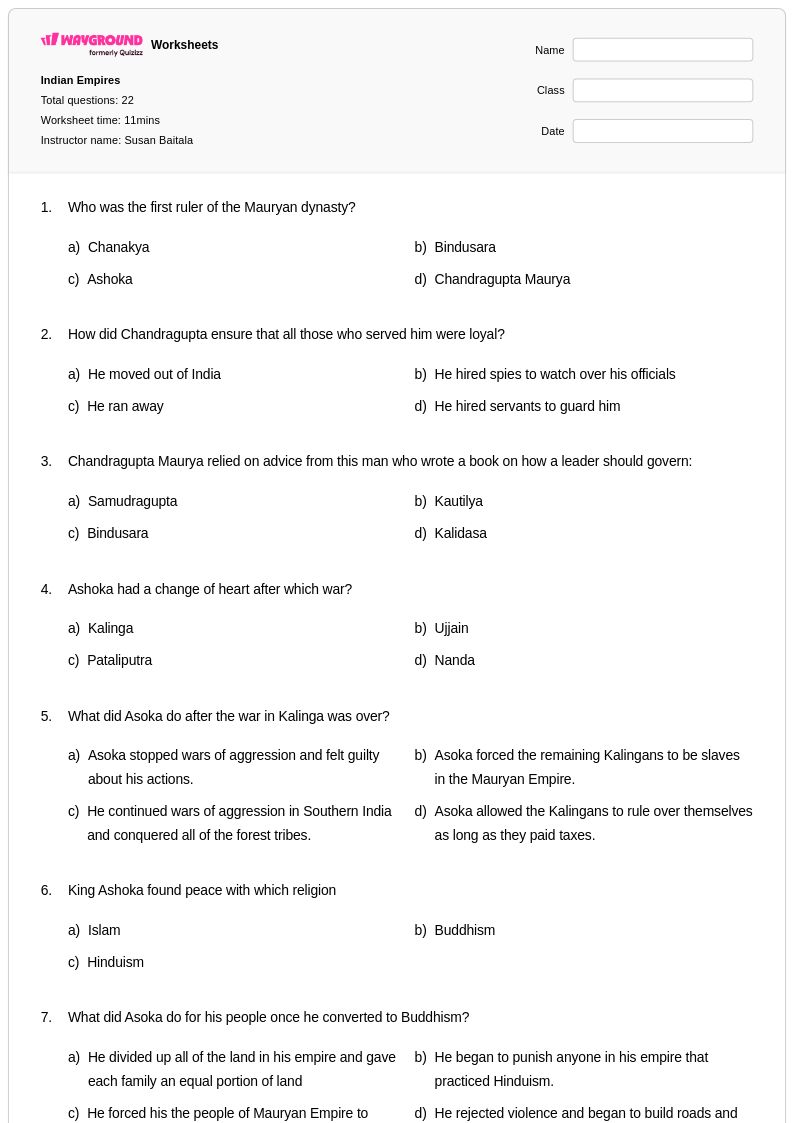
Explore Wayground's comprehensive collection of free Mauryan Empire worksheets and printables that help students master ancient Indian history through engaging practice problems, detailed answer keys, and downloadable PDF resources.
The Mauryan Empire worksheets available through Wayground (formerly Quizizz) provide comprehensive educational resources that explore one of ancient India's most significant dynasties, spanning from 322 to 185 BCE. These expertly crafted materials strengthen students' understanding of key historical concepts including Chandragupta Maurya's rise to power, Ashoka's transformation after the Kalinga War, and the empire's sophisticated administrative systems that unified the Indian subcontinent. The worksheets feature practice problems that challenge learners to analyze primary sources, interpret archaeological evidence, and evaluate the lasting impact of Mauryan policies on trade, religion, and governance. Each resource includes a detailed answer key to support both independent study and classroom instruction, with free printables available in convenient pdf format for immediate classroom implementation.
Wayground (formerly Quizizz) empowers educators with millions of teacher-created resources specifically designed to bring The Mauryan Empire to life in the classroom through comprehensive worksheet collections. The platform's robust search and filtering capabilities enable teachers to quickly locate materials aligned with specific curriculum standards, while differentiation tools allow for seamless customization to meet diverse learning needs and academic levels. These flexible resources are available in both printable and digital formats, including downloadable pdf versions, making them ideal for traditional classroom instruction, remote learning environments, or hybrid educational approaches. Teachers can strategically deploy these worksheets for lesson planning, targeted remediation of historical thinking skills, enrichment activities for advanced learners, and regular skill practice that reinforces understanding of this pivotal period in South Asian history.
FAQs
How do I teach the Mauryan Empire to middle or high school students?
Teaching the Mauryan Empire effectively means anchoring instruction around three key turning points: Chandragupta Maurya's founding of the dynasty around 322 BCE, Ashoka's moral transformation following the Kalinga War, and the empire's eventual decline by 185 BCE. Pairing a chronological overview with primary source analysis, such as Ashoka's rock edicts, gives students both a narrative framework and practice with historical evidence. Connecting Mauryan administrative innovations, like a centralized bureaucracy and standardized trade routes, to broader themes of empire-building helps students see why this dynasty matters beyond South Asian history.
What are common misconceptions students have about the Mauryan Empire?
A frequent misconception is that Ashoka's conversion to Buddhism meant he immediately dismantled the empire's military and political structures, when in reality the empire continued to function as a centralized state under his rule. Students also often conflate Ashoka's personal religious beliefs with an official state religion, whereas Buddhism under Ashoka functioned more as a moral and ethical framework promoted through edicts rather than an imposed creed. Another common error is underestimating the geographic scale of the Mauryan Empire, which at its height stretched from modern-day Afghanistan to southern India.
What exercises help students practice analyzing Mauryan Empire history?
Effective practice exercises for the Mauryan Empire include analyzing excerpts from Ashoka's edicts to evaluate shifts in governance and ethics, comparing Chandragupta Maurya's rise to power with other ancient empire-builders, and interpreting archaeological evidence such as Mauryan pillar inscriptions. Cause-and-effect mapping around the Kalinga War and its political aftermath strengthens historical thinking skills, while short-answer questions that ask students to evaluate the empire's administrative systems reinforce content knowledge. These types of tasks push students beyond recall toward analysis and evaluation, which are essential skills for any ancient history unit.
How do I use Mauryan Empire worksheets in my classroom?
Mauryan Empire worksheets on Wayground are available as printable PDFs for traditional classroom use and in digital formats for technology-integrated or remote learning environments, giving teachers flexibility in how they deploy them. Teachers can host these worksheets as quizzes directly on Wayground, making them suitable for formative assessment, independent practice, or structured review sessions. Each worksheet includes a detailed answer key, which supports both self-directed student study and efficient teacher grading.
How can I differentiate Mauryan Empire instruction for students at different levels?
For students who need additional support, reducing the complexity of source analysis tasks and providing sentence starters for written responses can lower the barrier to engagement without removing rigor. On Wayground, teachers can apply individual accommodations such as read aloud, reduced answer choices, and extended time to specific students, while the rest of the class receives standard settings without disruption. Advanced learners benefit from extension tasks that ask them to compare Mauryan governance with contemporaneous empires like the Achaemenid Persian or Qin Chinese dynasties, deepening their cross-cultural historical analysis.
What primary sources are useful when teaching the Mauryan Empire?
Ashoka's Major Rock Edicts and Pillar Edicts are the most accessible and historically significant primary sources for classroom use, offering direct insight into Mauryan governance, Buddhist ethics, and the emperor's self-presentation after Kalinga. Kautilya's Arthashastra, a treatise on statecraft attributed to Chandragupta Maurya's advisor, provides a valuable counterpoint that reveals the pragmatic, often ruthless logic behind Mauryan administrative policy. Pairing these texts with archaeological evidence, such as the Lion Capital of Ashoka, helps students triangulate historical claims and practice source corroboration.