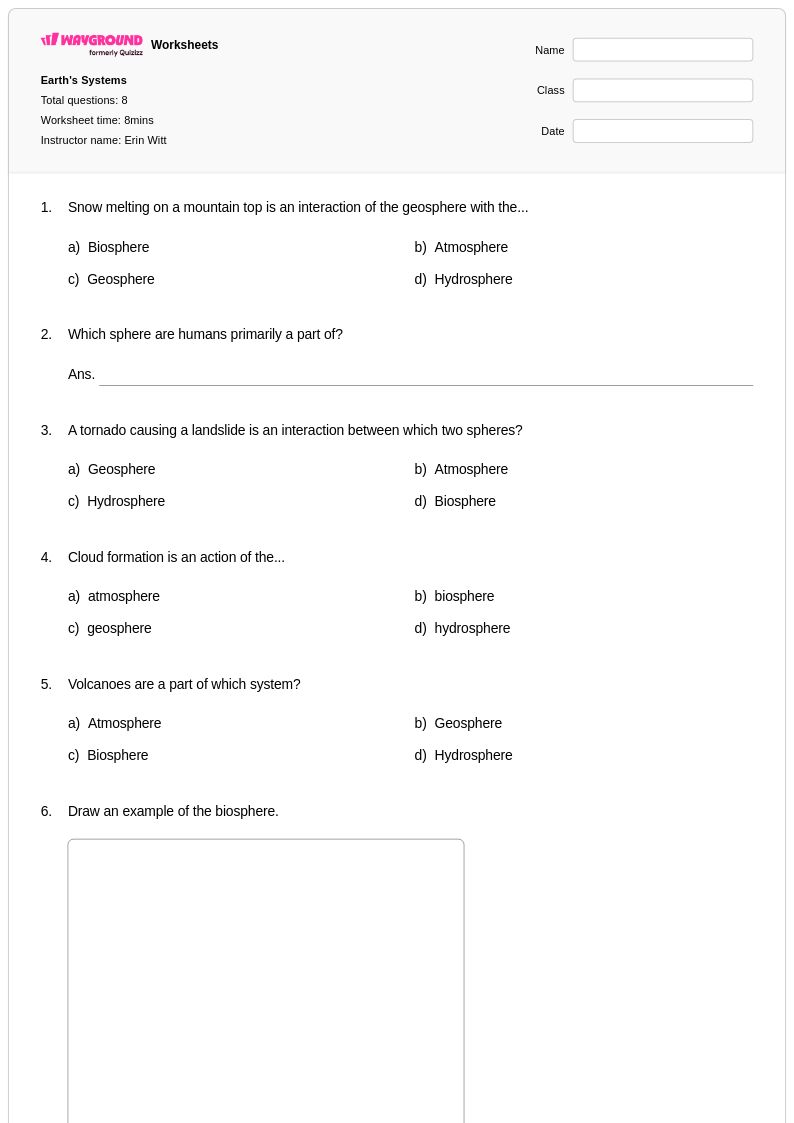
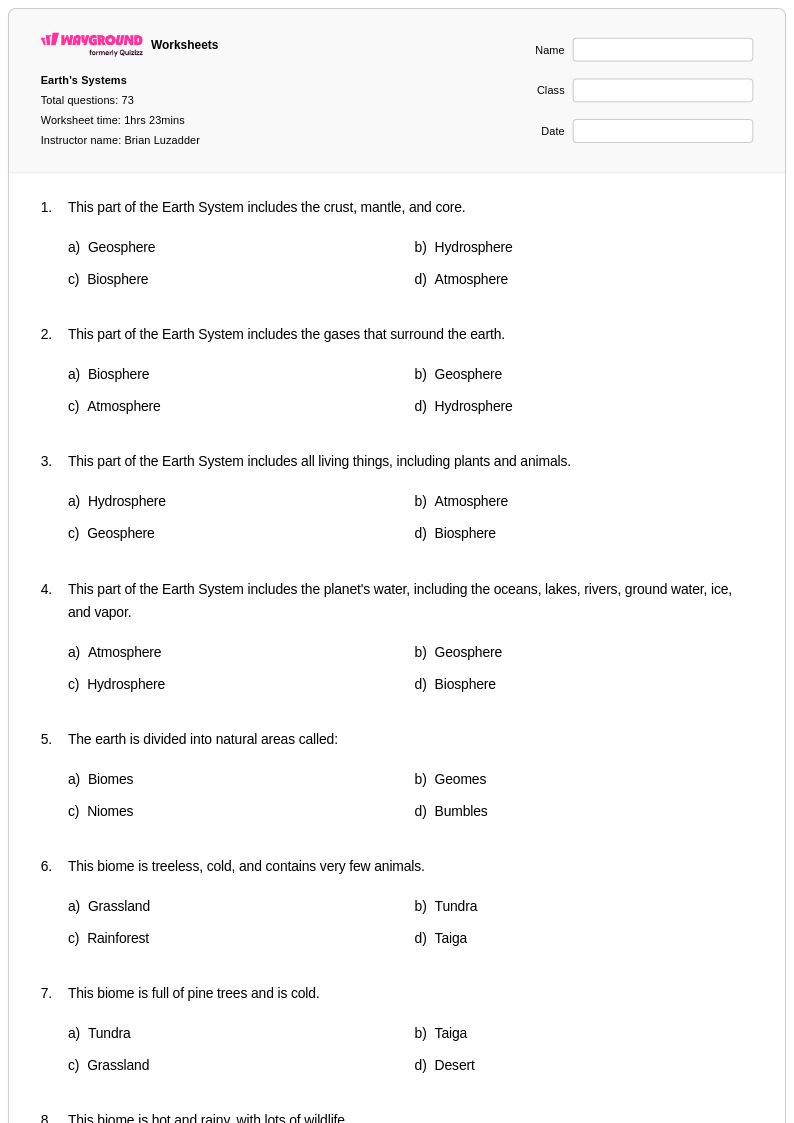
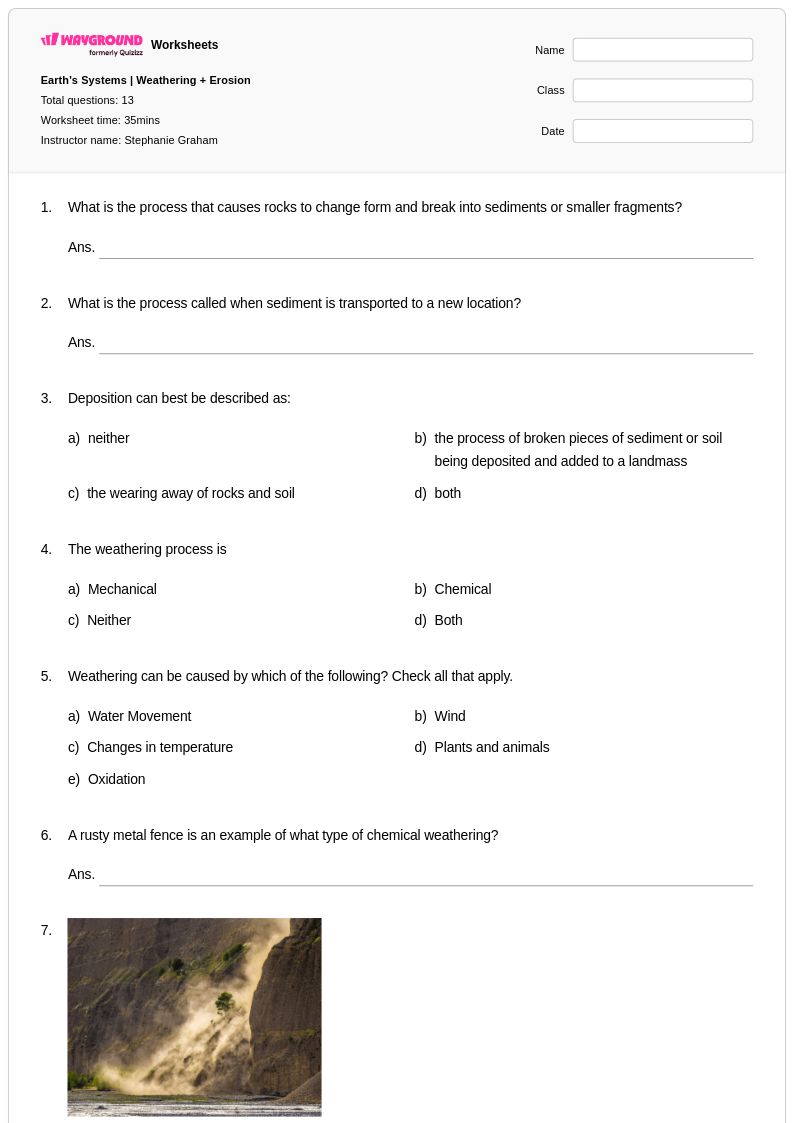
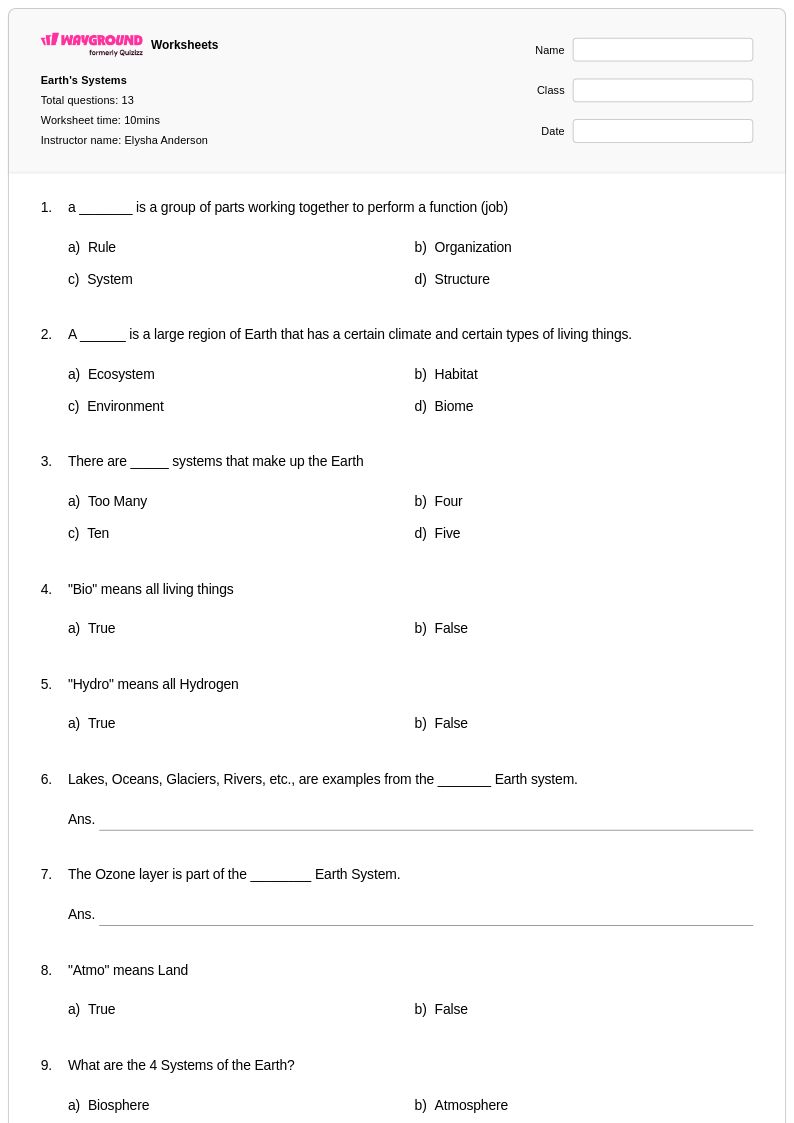
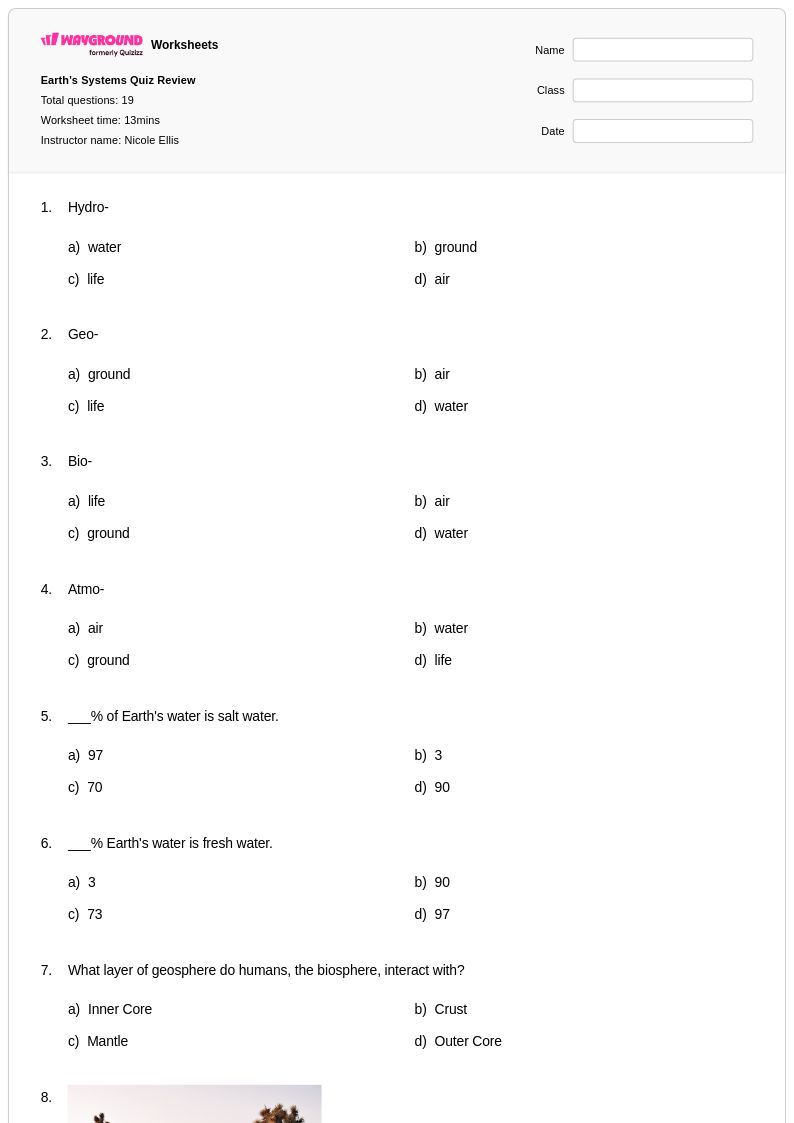
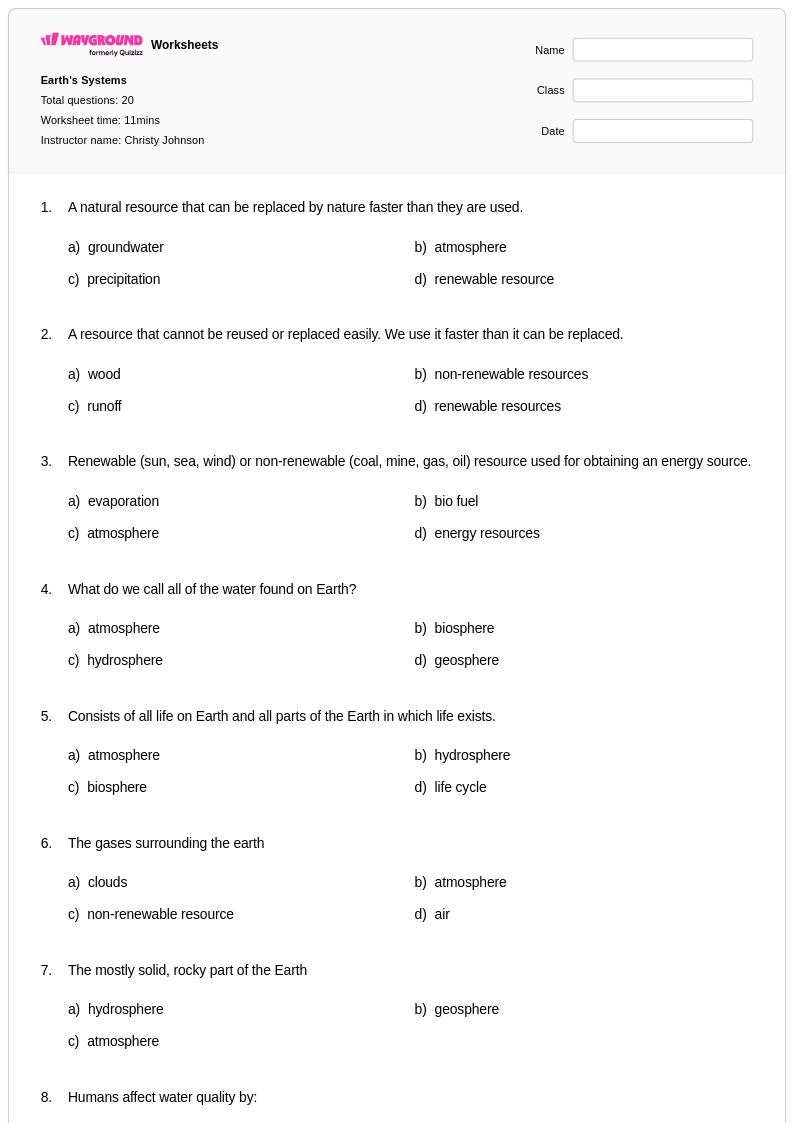
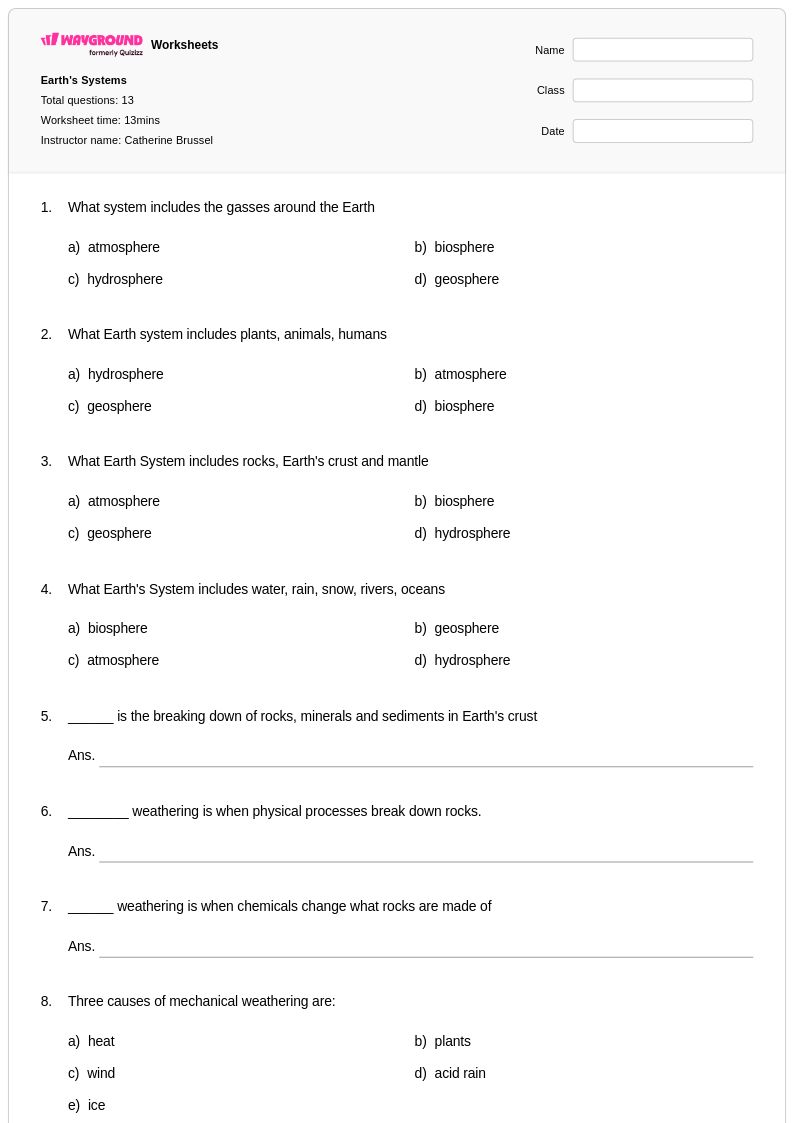
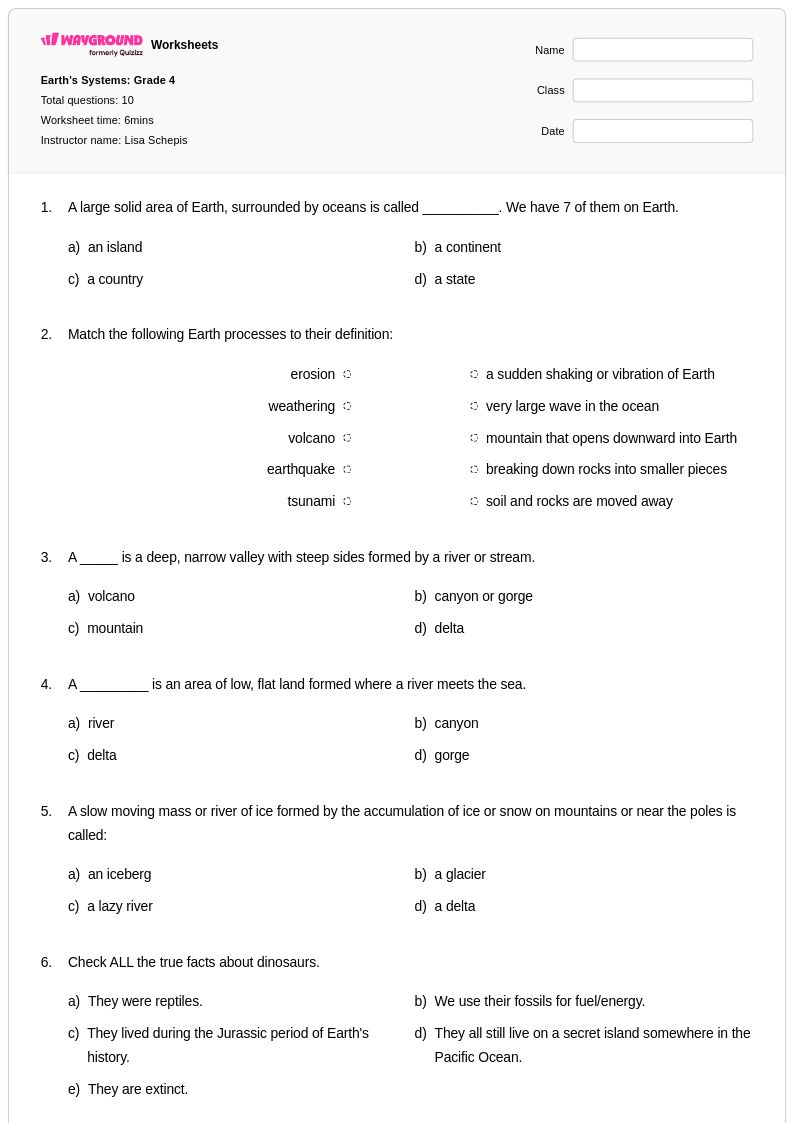
Explore Wayground's free Earth's Systems worksheets and printables that help students understand the interactions between the geosphere, hydrosphere, atmosphere, and biosphere through engaging practice problems with complete answer keys.
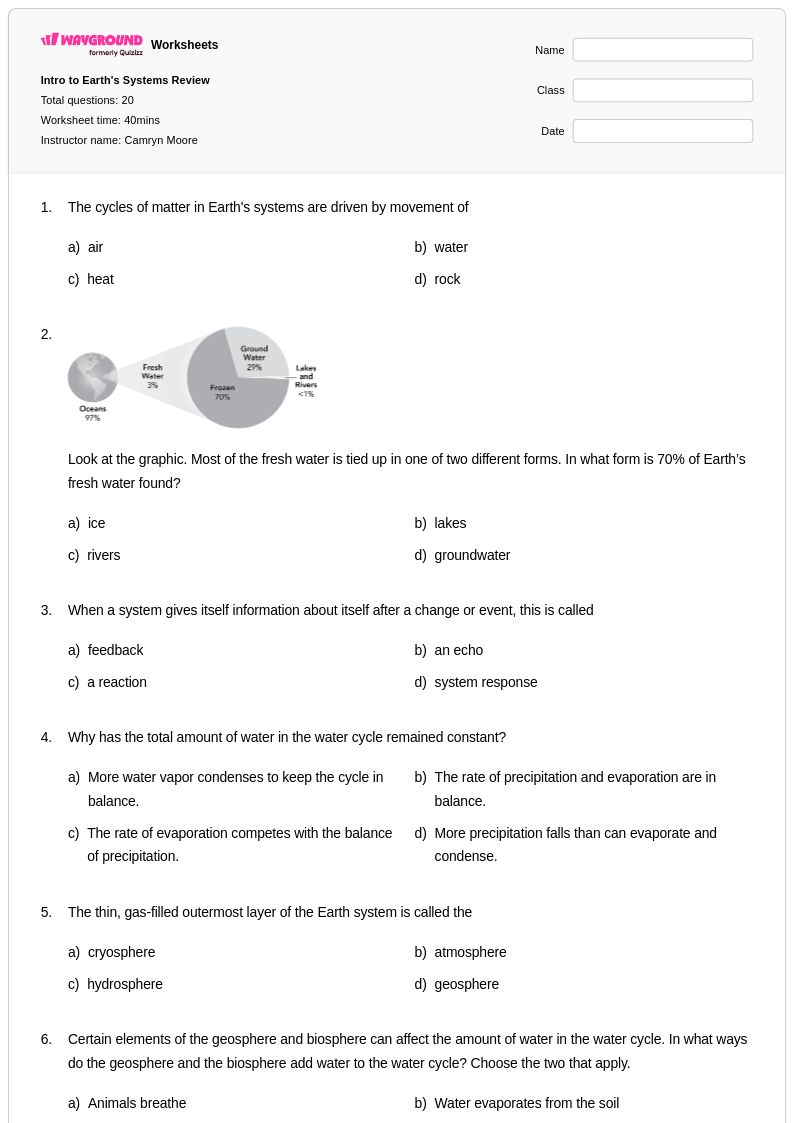
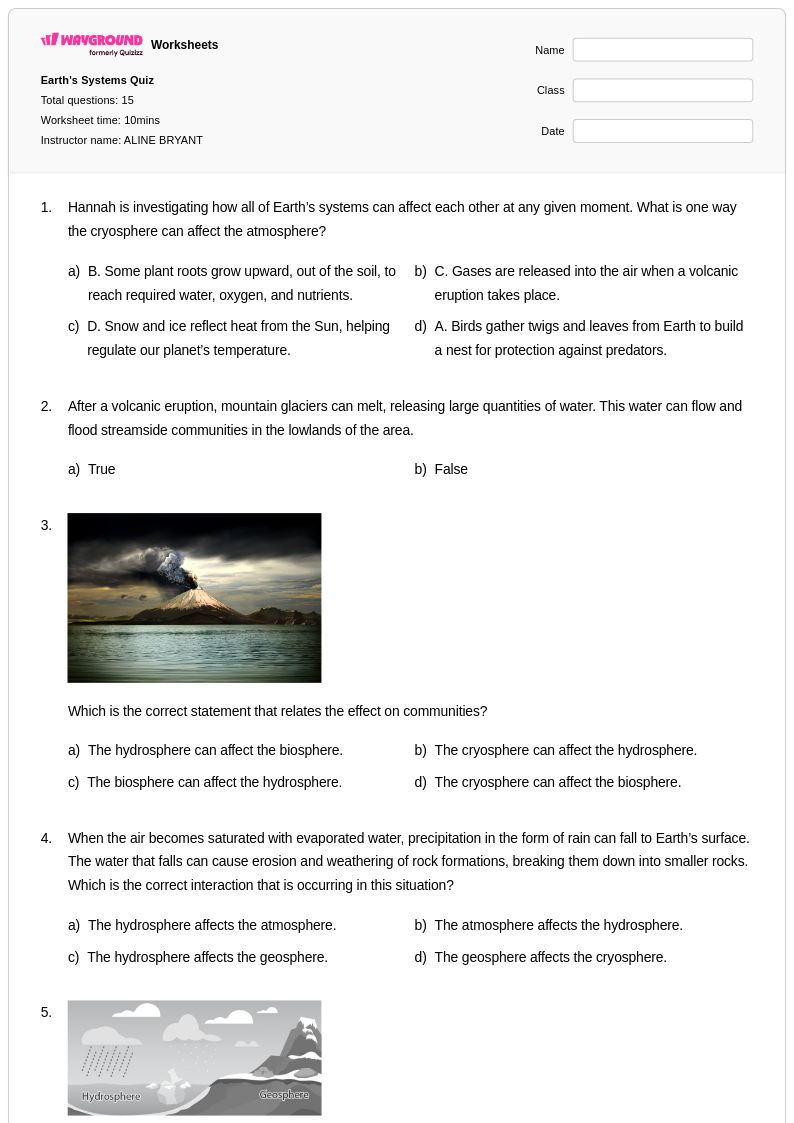
Earth's Systems worksheets available through Wayground (formerly Quizizz) provide comprehensive practice materials that help students understand the complex interactions between the geosphere, hydrosphere, atmosphere, and biosphere. These expertly designed resources strengthen critical thinking skills as students analyze how Earth's four major systems interconnect and influence one another through processes like the water cycle, weathering, and energy transfer. The collection includes detailed practice problems that guide learners through examining real-world examples of system interactions, from how volcanic eruptions affect atmospheric composition to how ocean currents redistribute heat energy globally. Each worksheet comes with a complete answer key and is available as a free printable pdf, making it easy for educators to incorporate hands-on learning experiences that demonstrate the dynamic nature of our planet's interconnected systems.
Wayground (formerly Quizizz) supports science educators with an extensive library of millions of teacher-created Earth's Systems resources that can be easily searched and filtered to match specific curriculum needs and standards alignment requirements. The platform's robust differentiation tools allow teachers to customize worksheets for various skill levels, ensuring that both struggling learners and advanced students can engage meaningfully with concepts like biogeochemical cycles, plate tectonics, and climate systems. These flexible resources are available in both printable and digital formats, including downloadable pdfs, enabling seamless integration into lesson planning whether for in-class activities, homework assignments, or targeted remediation. Teachers can efficiently locate materials for skill practice and enrichment that address specific learning objectives, from basic system identification to complex analysis of feedback loops and system equilibrium, streamlining their preparation while providing students with rigorous, standards-based practice opportunities.
FAQs
How do I teach Earth's systems to middle or high school students?
Start by establishing the four major systems — geosphere, hydrosphere, atmosphere, and biosphere — as distinct but interconnected components before moving into interactions. Use concrete, observable examples like the water cycle, volcanic eruptions, or coastal erosion to show how changes in one system trigger responses in others. Building from individual systems to feedback loops and equilibrium helps students develop the systems thinking needed for deeper analysis.
What activities help students practice understanding interactions between Earth's systems?
Practice activities that ask students to trace cause-and-effect chains across systems are most effective — for example, analyzing how a volcanic eruption alters atmospheric composition, which in turn affects climate and biosphere health. Diagram-labeling tasks, case study analysis, and process-sequencing problems all reinforce how the geosphere, hydrosphere, atmosphere, and biosphere influence one another. Worksheets that embed real-world scenarios give students the context they need to apply abstract concepts meaningfully.
What misconceptions do students commonly have about Earth's systems?
A common misconception is that Earth's systems operate independently rather than as a continuously interacting whole. Students often treat the water cycle as a hydrosphere-only phenomenon, missing its connections to the atmosphere and biosphere. Another frequent error is conflating the geosphere with just rocks or land, overlooking how it includes soil, sediment, and tectonic processes that feed into other systems.
How can I assess whether students understand biogeochemical cycles and system feedback loops?
Look for whether students can identify the input, output, and feedback components of a cycle rather than simply labeling its stages. Students who truly understand feedback loops can explain why a disruption — such as deforestation — produces cascading effects across multiple systems, not just the one directly affected. Exit tickets or short written-response problems that require students to predict system responses to a given change are reliable formative assessment tools for this skill.
How do I use Wayground's Earth's Systems worksheets in my classroom?
Wayground's Earth's Systems worksheets are available as printable PDFs for traditional classroom use and in digital formats for technology-integrated environments, so they work equally well as in-class activities, homework assignments, or targeted remediation tasks. You can also host them as a quiz directly on Wayground, giving you instant access to student response data. Every worksheet includes a complete answer key, reducing prep time and making self-paced or independent work straightforward for students.
How can I differentiate Earth's systems instruction for students at different skill levels?
For students still building foundational understanding, focus on single-system identification and basic vocabulary before introducing multi-system interactions. Wayground supports differentiation through student-level accommodations including reduced answer choices to lower cognitive load, read-aloud support for students who need it, and extended time settings — all configurable per student without notifying the rest of the class. Advanced students can engage with more complex tasks like analyzing biogeochemical cycles or evaluating climate feedback loops.