Explore comprehensive rain shadow effect worksheets and printables that help students understand how mountains influence precipitation patterns through engaging practice problems and detailed answer keys.
Rain shadow effect worksheets available through Wayground (formerly Quizizz) provide comprehensive educational resources that help students understand this critical meteorological phenomenon where mountain ranges create distinct precipitation patterns on their windward and leeward sides. These expertly designed worksheets strengthen essential skills in atmospheric science, topographic analysis, and climate pattern recognition by guiding students through the complex interactions between air masses, elevation changes, and moisture distribution. Each worksheet collection includes detailed answer keys and is available as free printable pdf resources, featuring practice problems that challenge students to analyze real-world examples of rain shadow effects in mountain regions like the Sierra Nevada, Rocky Mountains, and Cascade Range, while developing their ability to interpret weather maps, elevation profiles, and precipitation data.
Wayground (formerly Quizizz) supports educators with millions of teacher-created rain shadow effect worksheet resources that feature robust search and filtering capabilities, enabling instructors to quickly locate materials aligned with specific learning objectives and educational standards. The platform's differentiation tools and flexible customization options allow teachers to modify content difficulty levels, adjust problem complexity, and tailor assignments to meet diverse student needs, whether for remediation of basic atmospheric concepts or enrichment activities involving advanced meteorological analysis. Available in both printable and digital formats including downloadable pdf versions, these worksheet collections streamline lesson planning while providing versatile resources for skill practice, formative assessment, and reinforcement of key Earth and space science concepts related to orographic precipitation, adiabatic processes, and regional climate variations.
FAQs
How do I teach the rain shadow effect to middle or high school students?
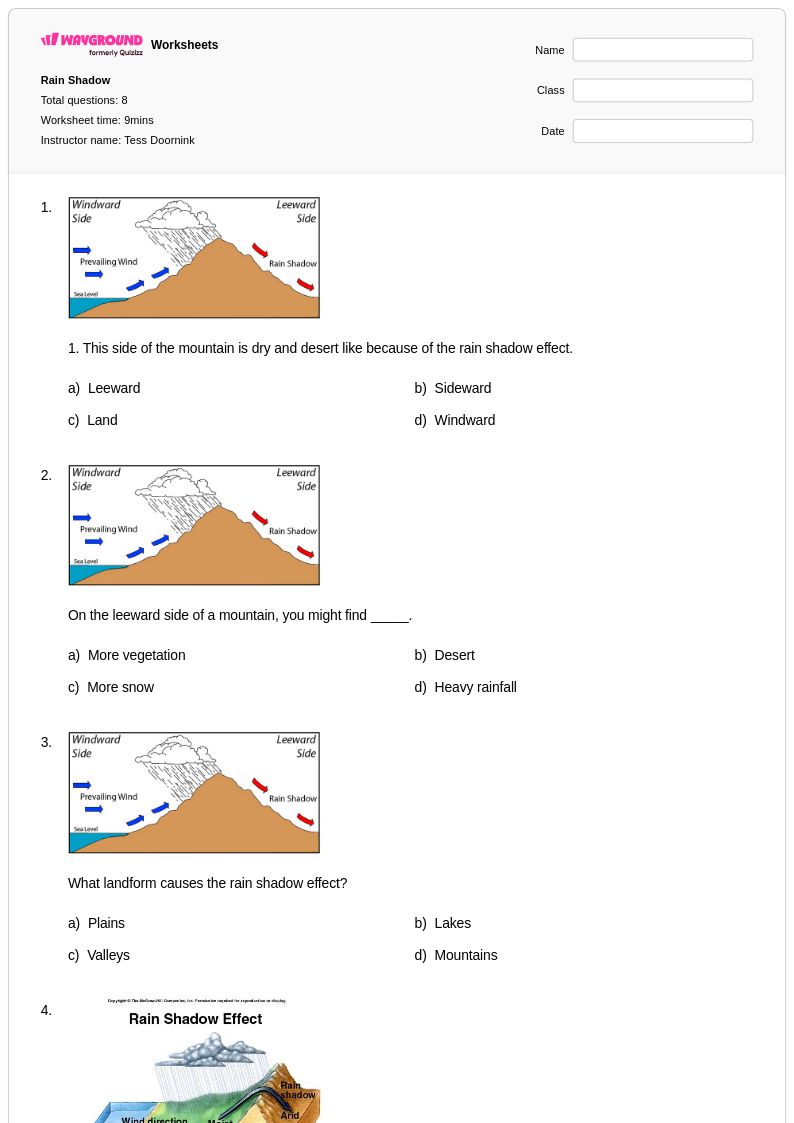
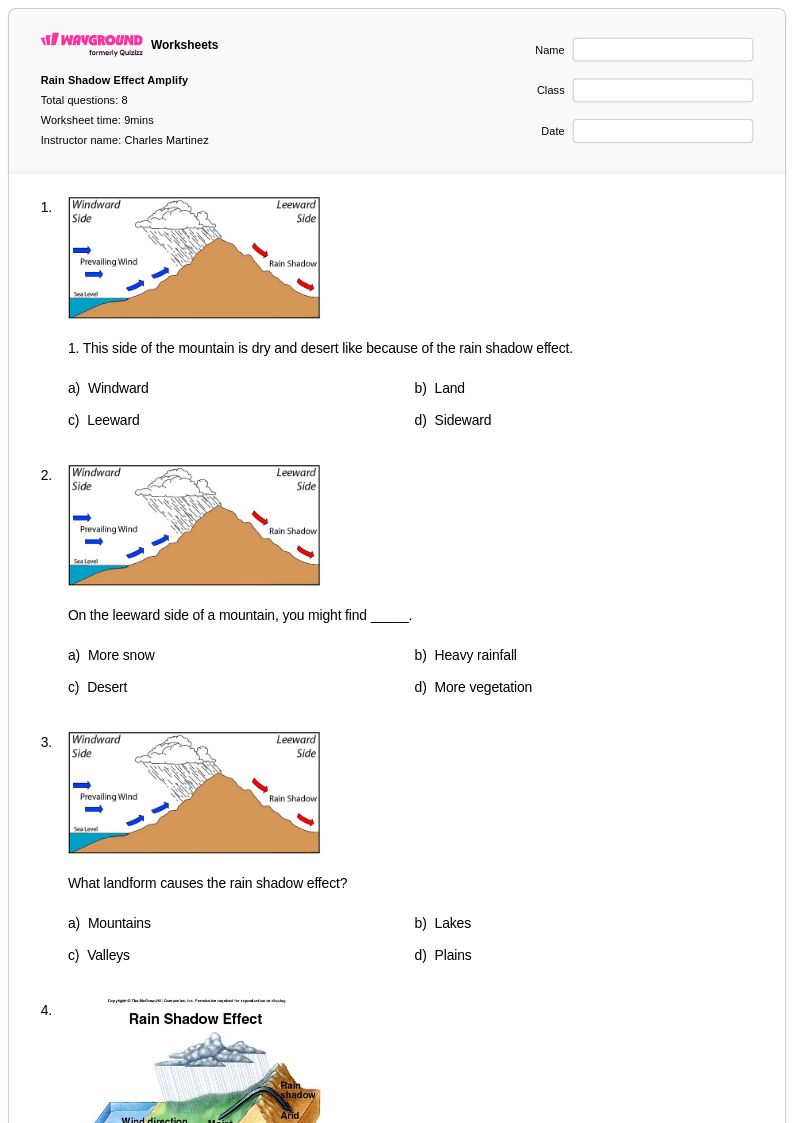
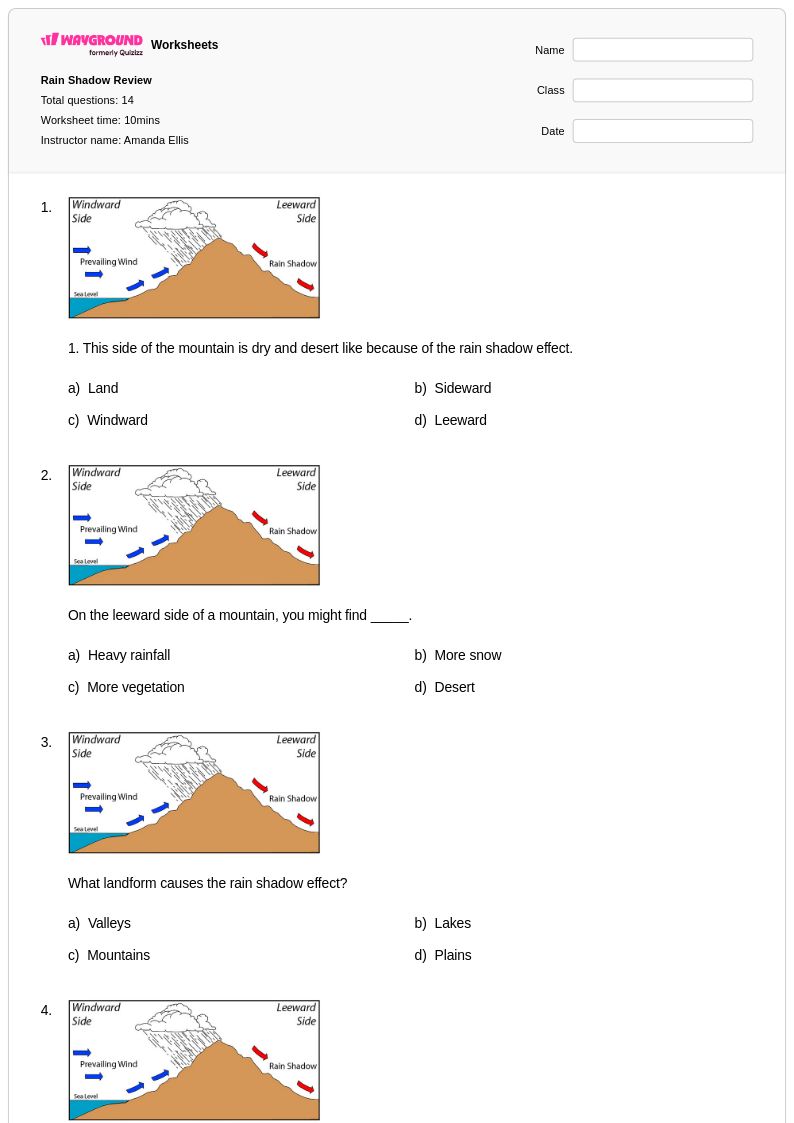
Start by grounding students in the orographic lift process: as moist air is forced up a mountain's windward side, it cools, condenses, and releases precipitation, then descends on the leeward side as dry, warm air. Using real-world examples like the Sierra Nevada and Cascade Range makes the concept concrete and memorable. Pairing elevation profile diagrams with precipitation data lets students see the pattern rather than just memorize it. A brief class discussion comparing the windward and leeward climates of a specific mountain range helps solidify the contrast before students move to independent practice.
What exercises help students practice understanding the rain shadow effect?
Effective practice exercises include analyzing elevation profiles alongside precipitation maps to identify windward and leeward sides, labeling diagrams of orographic lift and adiabatic cooling, and interpreting real precipitation data from mountain regions like the Rocky Mountains or Cascades. Problems that ask students to predict which side of a mountain will be wetter, and why, build both conceptual understanding and data literacy. Worksheets that incorporate weather map reading add an applied layer that connects atmospheric science to geographic analysis.
What misconceptions do students commonly have about the rain shadow effect?
A frequent misconception is that mountains simply block rain rather than actively triggering precipitation through orographic lift and adiabatic cooling. Students also tend to conflate the windward side being wet with it being the side facing the prevailing wind, not always understanding why prevailing wind direction determines which side receives moisture. Another common error is assuming the leeward side is always a desert, when in reality the degree of aridity depends on factors like elevation, distance, and the moisture content of the original air mass.
How do I use rain shadow effect worksheets in my classroom?
Rain shadow effect worksheets on Wayground are available as printable PDFs for traditional classroom use and in digital formats for technology-integrated environments, so they work whether students are at desks or on devices. Teachers can also host worksheets as a quiz directly on Wayground, which allows for immediate feedback and easy progress tracking. Each worksheet includes a complete answer key, making them efficient tools for guided practice, independent work, or formative assessment without requiring additional prep time.
How does the rain shadow effect connect to broader Earth science standards?
The rain shadow effect sits at the intersection of several core Earth science concepts, including atmospheric processes, topography, climate systems, and the water cycle, making it highly relevant to NGSS and state-level Earth and space science standards. Teaching it gives students a concrete, visual case study for abstract processes like adiabatic lapse rates and condensation. It also provides a natural entry point for comparing regional climates, which supports cross-curricular connections to geography and environmental science.
How can I support students who struggle with interpreting elevation and precipitation diagrams?
For students who find diagram interpretation challenging, start with simplified cross-section illustrations that label only the key features: windward slope, leeward slope, cloud formation zone, and rain shadow zone. Wayground's Read Aloud feature can support students who need text read to them during digital activities, and Reduced Answer Choices can lower cognitive load for students who feel overwhelmed by complex multiple-choice items. Pairing diagram-based questions with brief written explanations also helps students connect visual information to scientific reasoning rather than guessing from images alone.