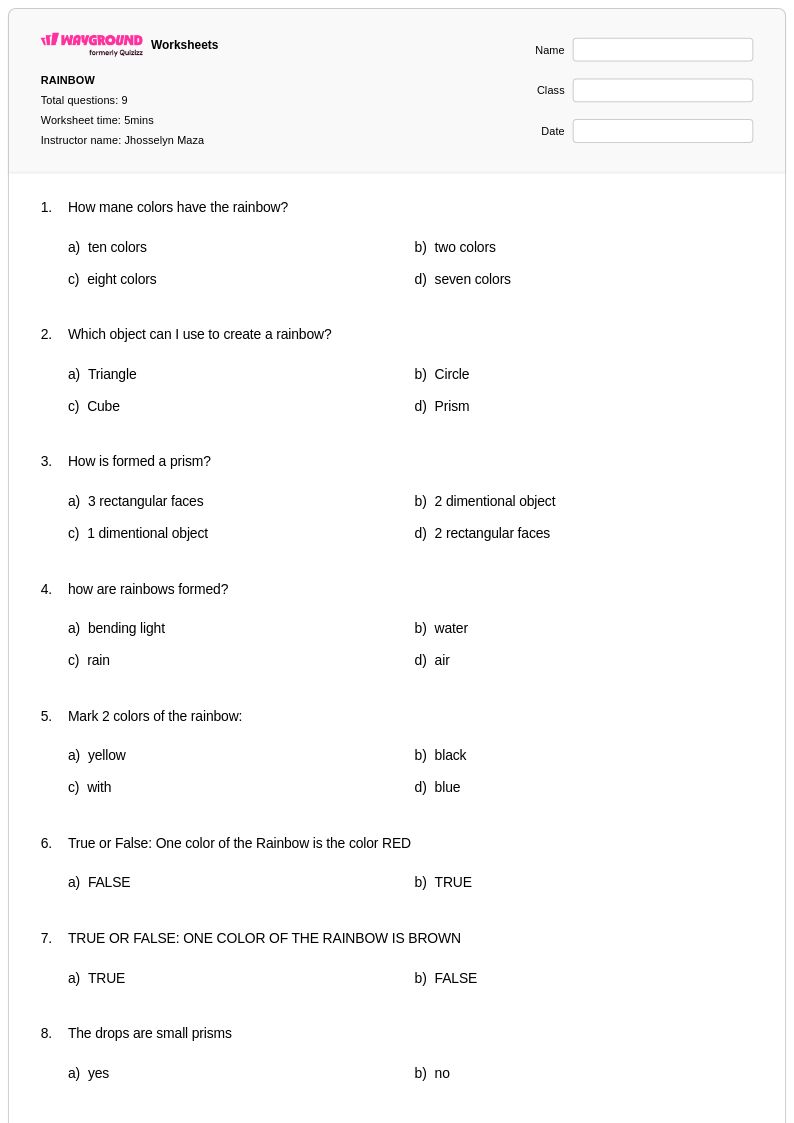
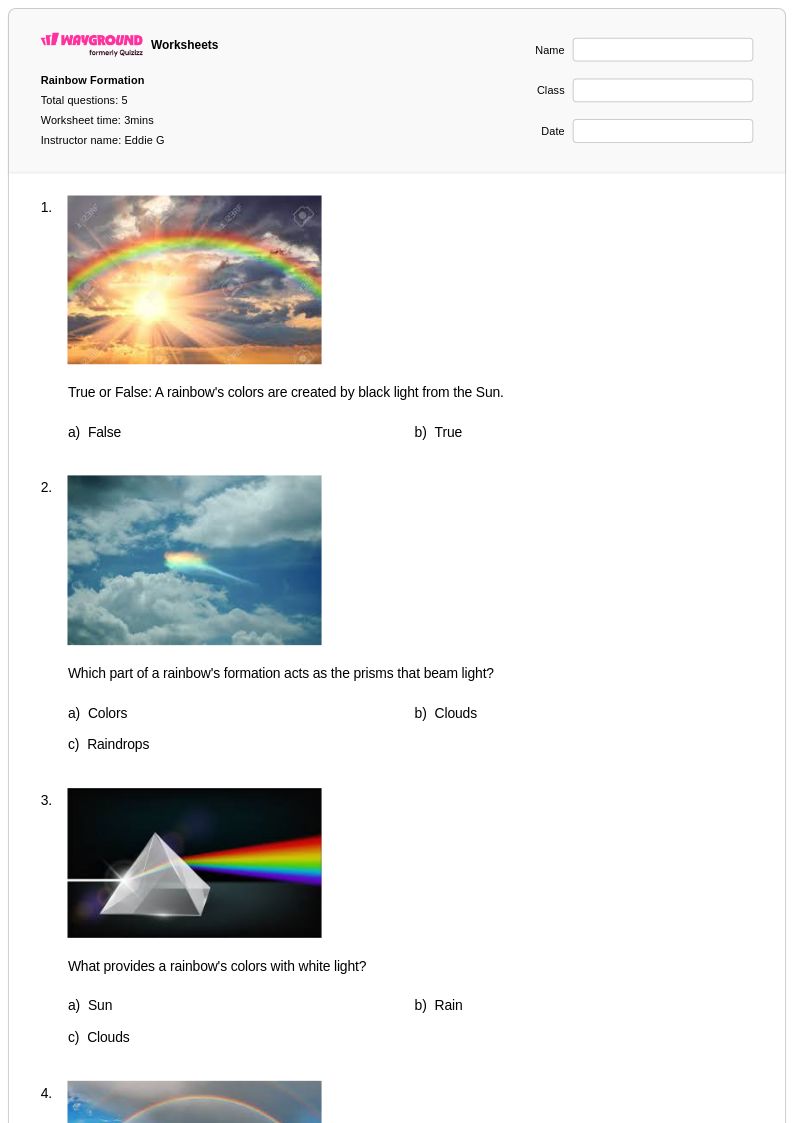
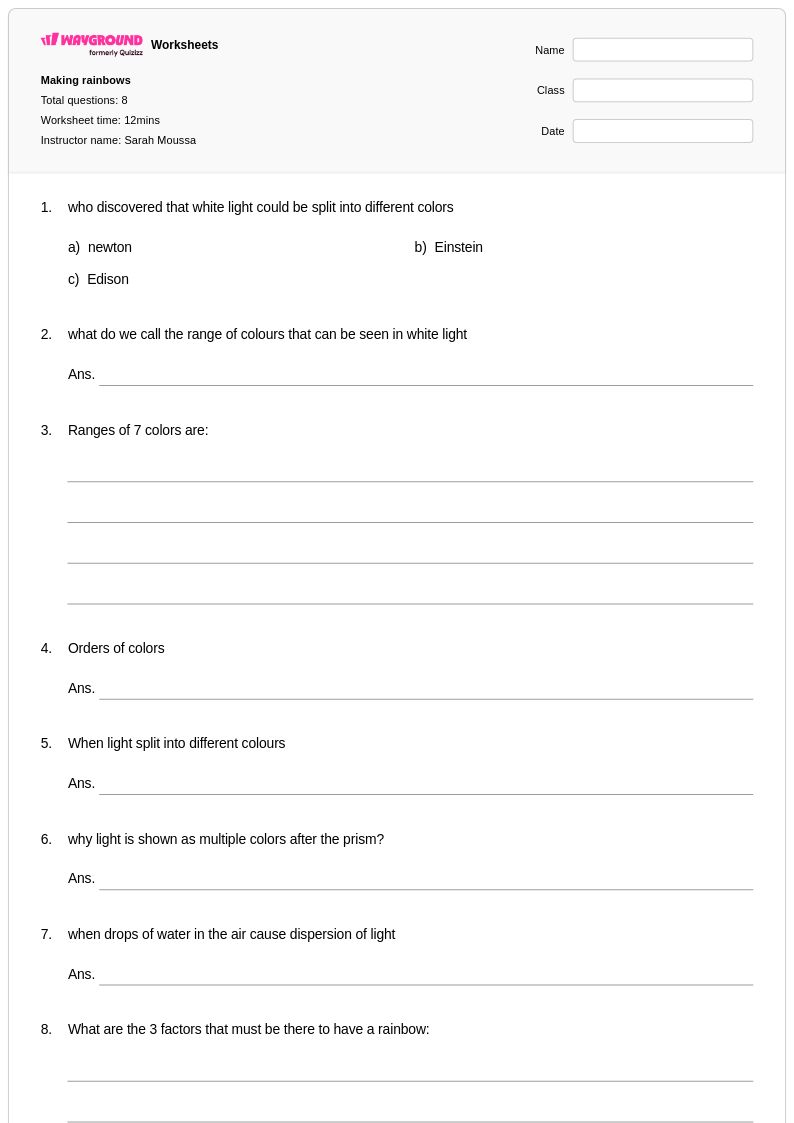
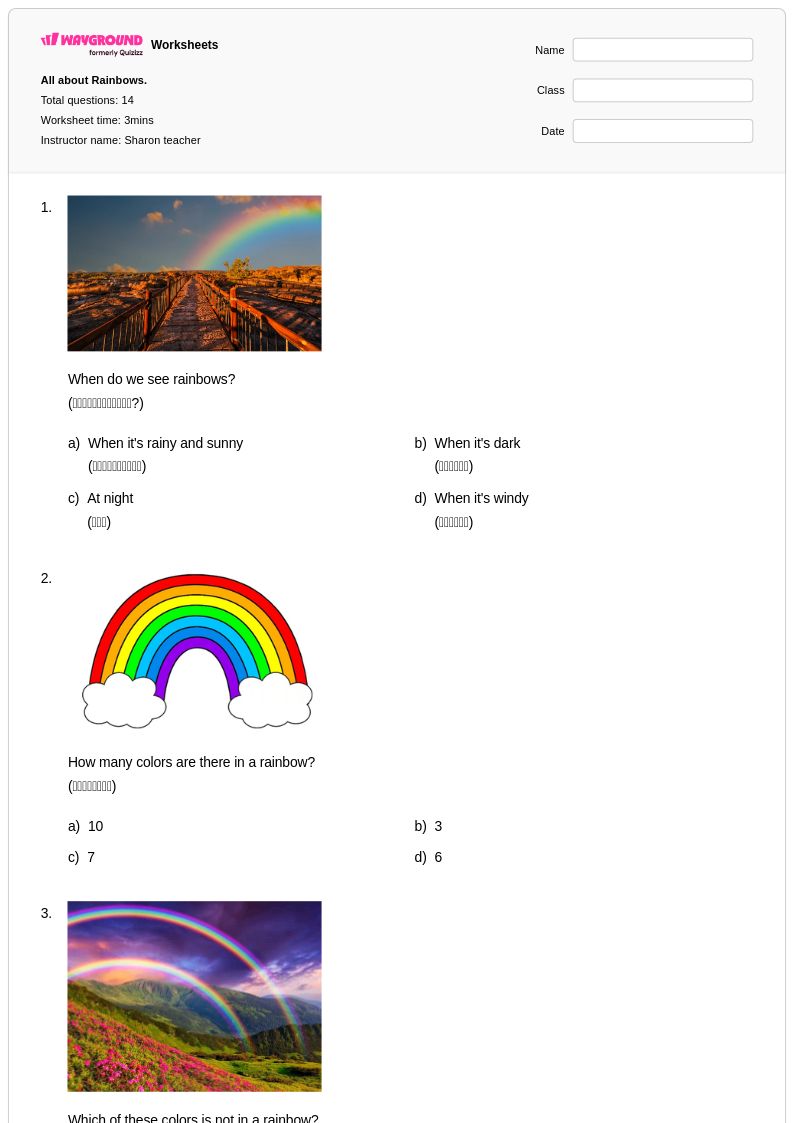
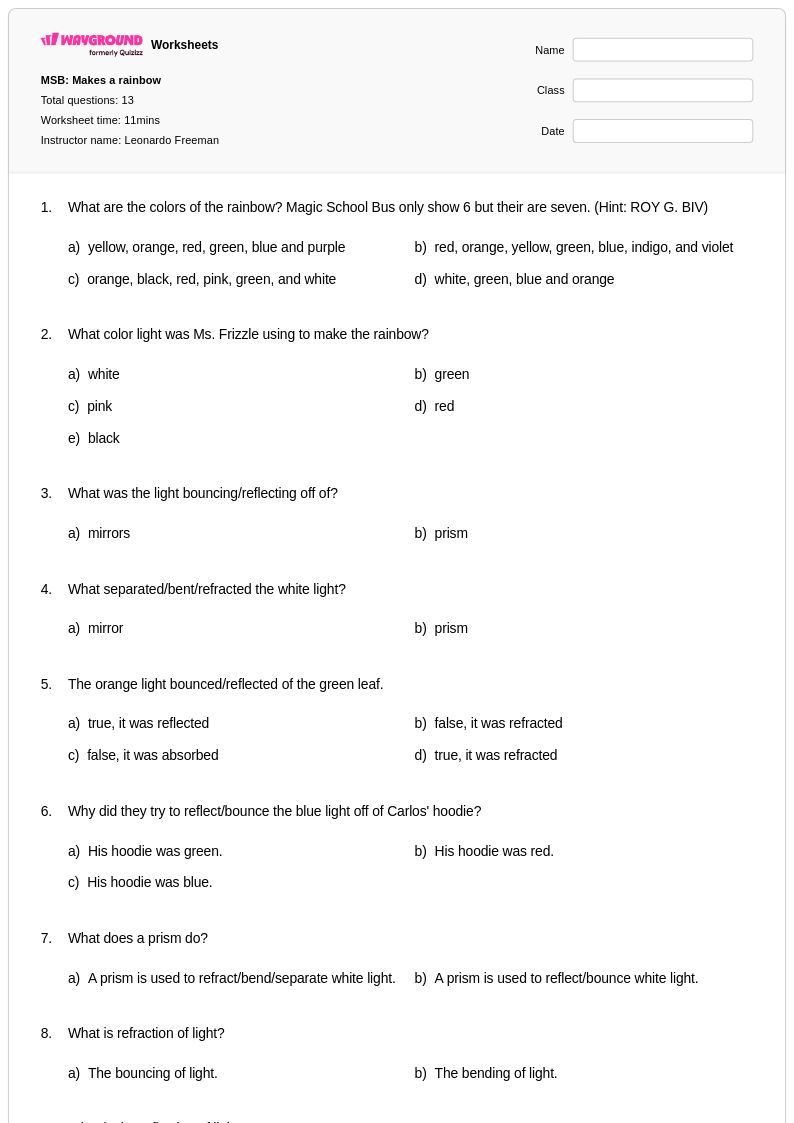
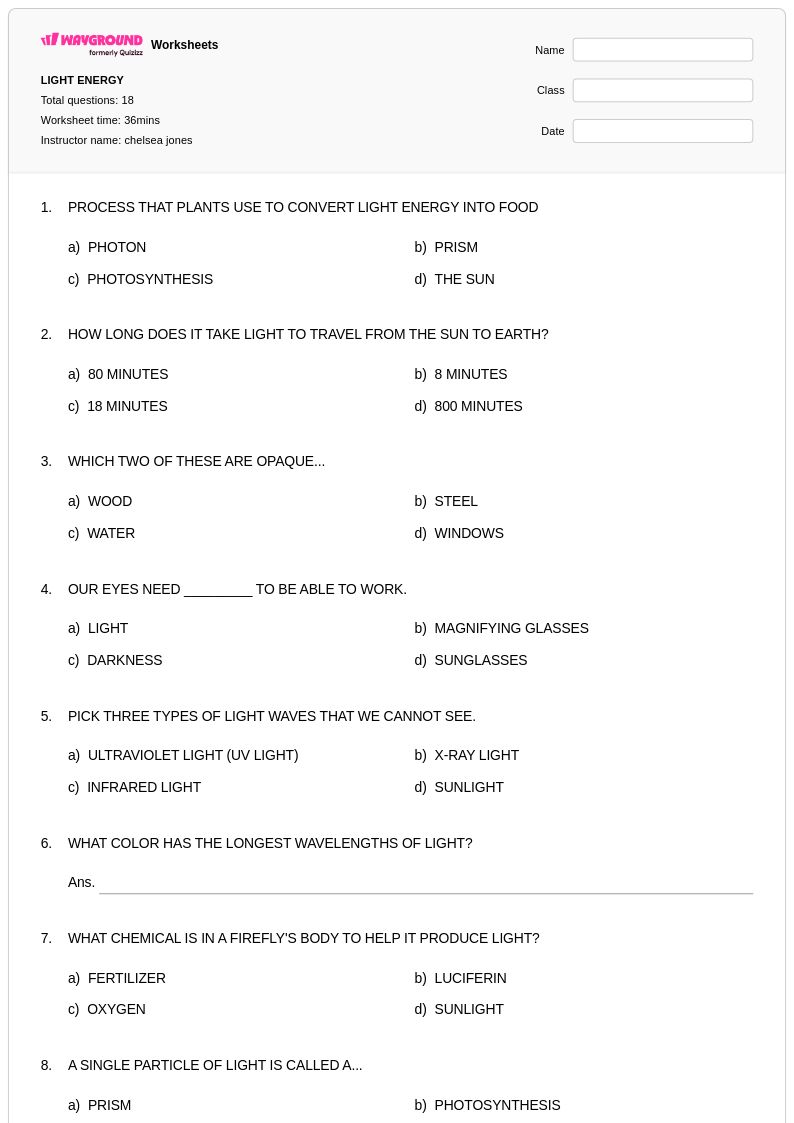
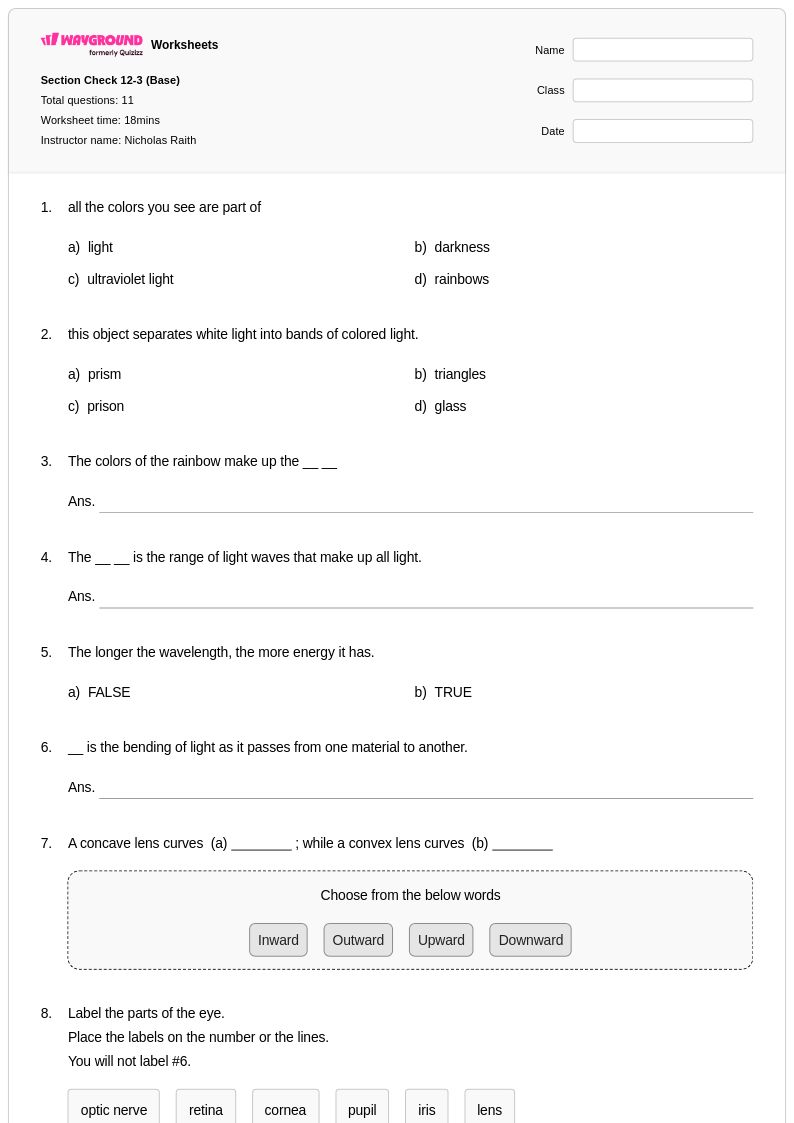
Explore Wayground's free rainbow worksheets and printables that help students discover the science behind light refraction, color spectrums, and atmospheric phenomena through engaging practice problems with answer keys.
Rainbow worksheets available through Wayground (formerly Quizizz) provide students with engaging opportunities to explore the fascinating optical phenomenon that occurs when sunlight interacts with water droplets in the atmosphere. These comprehensive educational resources strengthen critical scientific thinking skills by guiding learners through the physics of light refraction, reflection, and dispersion that create the spectacular color spectrum we observe in nature. Students work through practice problems that examine how white light separates into its component wavelengths, investigate the optimal atmospheric conditions for rainbow formation, and analyze the geometric principles that determine where rainbows appear in the sky. Each worksheet collection includes detailed answer keys and is available as free printables in convenient pdf format, allowing educators to seamlessly integrate these materials into their Earth and Space Science curriculum while supporting diverse learning styles and pacing needs.
Wayground's extensive platform empowers teachers with access to millions of educator-created resources specifically designed to enhance rainbow-focused instruction across multiple grade levels and learning objectives. The robust search and filtering capabilities enable quick identification of worksheets that align with specific educational standards and curriculum requirements, while built-in differentiation tools allow instructors to customize content complexity for individual student needs. Teachers can effortlessly switch between printable pdf versions for traditional classroom use and interactive digital formats that support remote or hybrid learning environments. These versatile worksheet collections prove invaluable for lesson planning, targeted skill practice, remediation support for struggling learners, and enrichment opportunities for advanced students, ensuring that every educator can effectively demonstrate the scientific principles behind one of nature's most captivating displays.
FAQs
How do I teach students about rainbows and the science of light refraction?
Teaching rainbows effectively means grounding students in the physics of white light before introducing atmospheric application. Start by explaining that white light is composed of multiple wavelengths, each corresponding to a distinct color, and that when sunlight enters a water droplet, it refracts, reflects internally, and disperses into the visible spectrum. From there, students can investigate why rainbows always appear opposite the sun and why the arc shape is consistent. Connecting geometric optics to a natural phenomenon makes abstract physics concepts far more concrete and memorable.
What exercises help students practice understanding rainbow formation and light dispersion?
Effective practice exercises for this topic include labeling the sequence of colors in the visible spectrum, identifying the atmospheric conditions required for rainbow formation, and working through angle-of-refraction problems that explain why rainbows appear at a predictable position in the sky. Diagram-based tasks where students trace the path of a light ray through a water droplet are particularly valuable because they make the refraction, internal reflection, and dispersion sequence visible and testable.
What mistakes do students commonly make when learning about rainbows and light spectrums?
A frequent misconception is that rainbows are physical objects located at a fixed point in space, when in fact a rainbow is an optical effect that depends entirely on the observer's position relative to sunlight and water droplets. Students also commonly confuse refraction with reflection, or assume that water droplets simply bend light rather than understanding that different wavelengths bend at slightly different angles, which is what produces color separation. Addressing these errors explicitly during instruction prevents them from becoming entrenched misunderstandings.
What are the right grade levels for teaching rainbow science and light refraction concepts?
Basic rainbow concepts, such as the order of colors and the idea that sunlight contains multiple colors, are accessible to early elementary students. However, the physics of refraction, reflection, and dispersion is most appropriate for upper elementary through middle school, where students can engage with geometric optics and wavelength concepts more rigorously. High school Earth and Space Science or Physics courses can extend this into quantitative applications like Snell's Law and angle calculations.
How can I use Wayground's rainbow worksheets in my classroom?
Wayground's rainbow worksheets are available as free printable PDFs for traditional classroom use and in digital formats for technology-integrated or hybrid learning environments, and can also be hosted as a quiz directly on Wayground. Each worksheet includes a complete answer key, so teachers can use them for guided instruction, independent practice, or formative assessment without additional preparation. The range of formats means the same content can serve in-person students working on paper and remote students completing work digitally.
How can I differentiate rainbow worksheets for students at different skill levels?
Differentiation for this topic can involve adjusting the complexity of tasks: foundational learners benefit from color-sequencing and labeling exercises, while more advanced students can work through light-path diagrams and atmospheric geometry problems. On Wayground, teachers can apply individual accommodations such as reduced answer choices to lower cognitive load for struggling learners, extended time for students who need it, and read-aloud support for those who benefit from audio delivery, all without other students being notified of those adjustments.

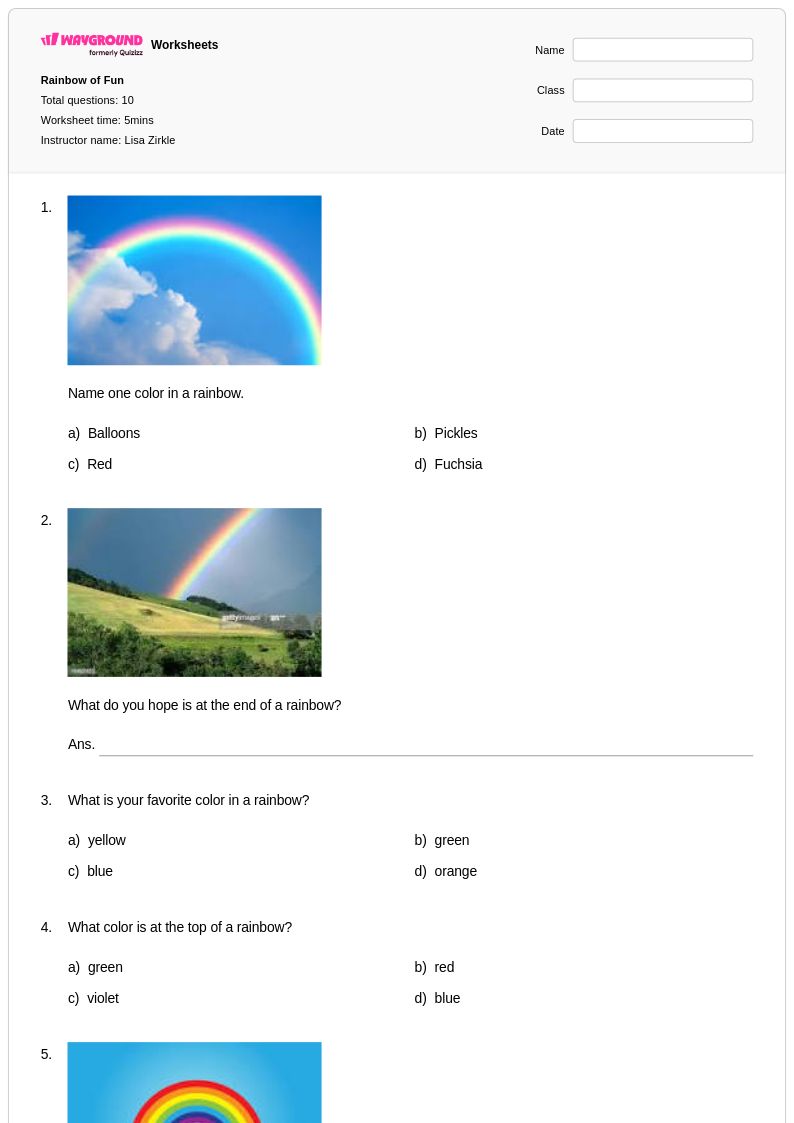
![6.3 Making rainbows [Must do] 1 - Printable Rainbows Worksheets - Wayground](https://quizizz-static.s3.amazonaws.com/_media/worksheets-new/6583c77d19d1464ca7349ea1-63-making-rainbows-must-do-1)