Free Printable Financial Statements Worksheets for Class 12
Discover comprehensive Class 12 financial statements worksheets and printables that help students master balance sheets, income statements, and cash flow analysis through engaging practice problems with complete answer keys.
Explore printable Financial Statements worksheets for Class 12
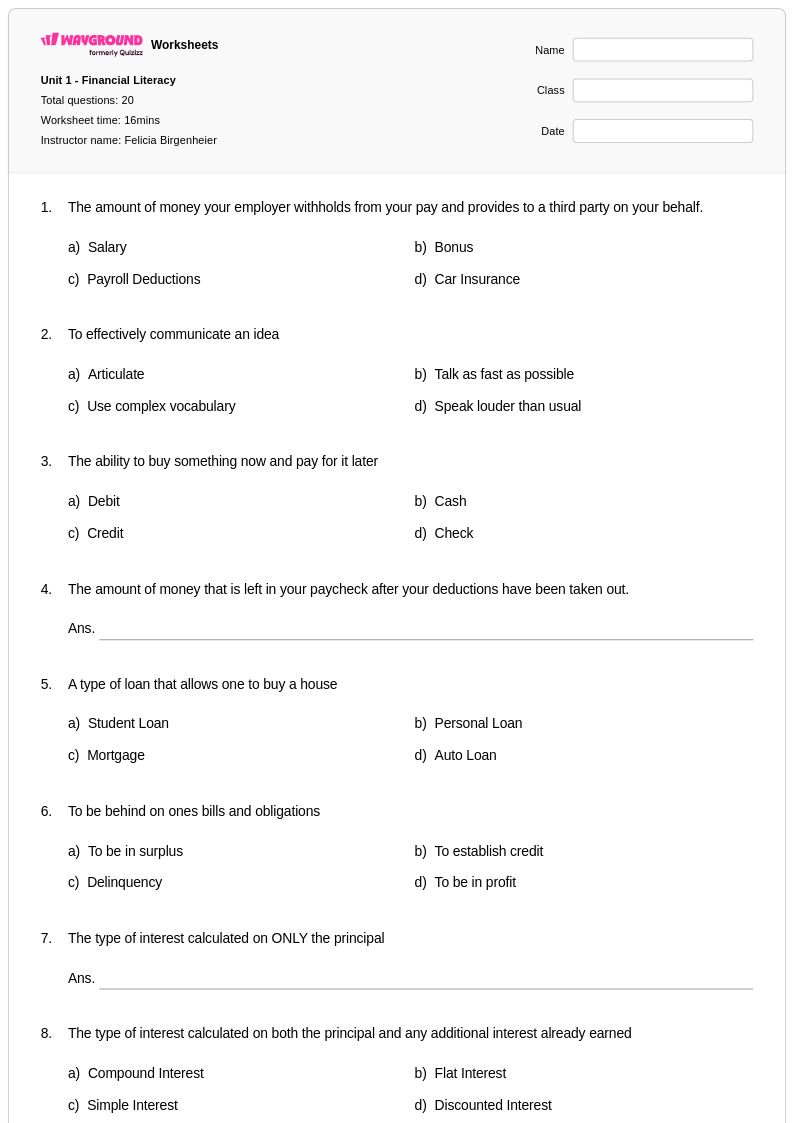
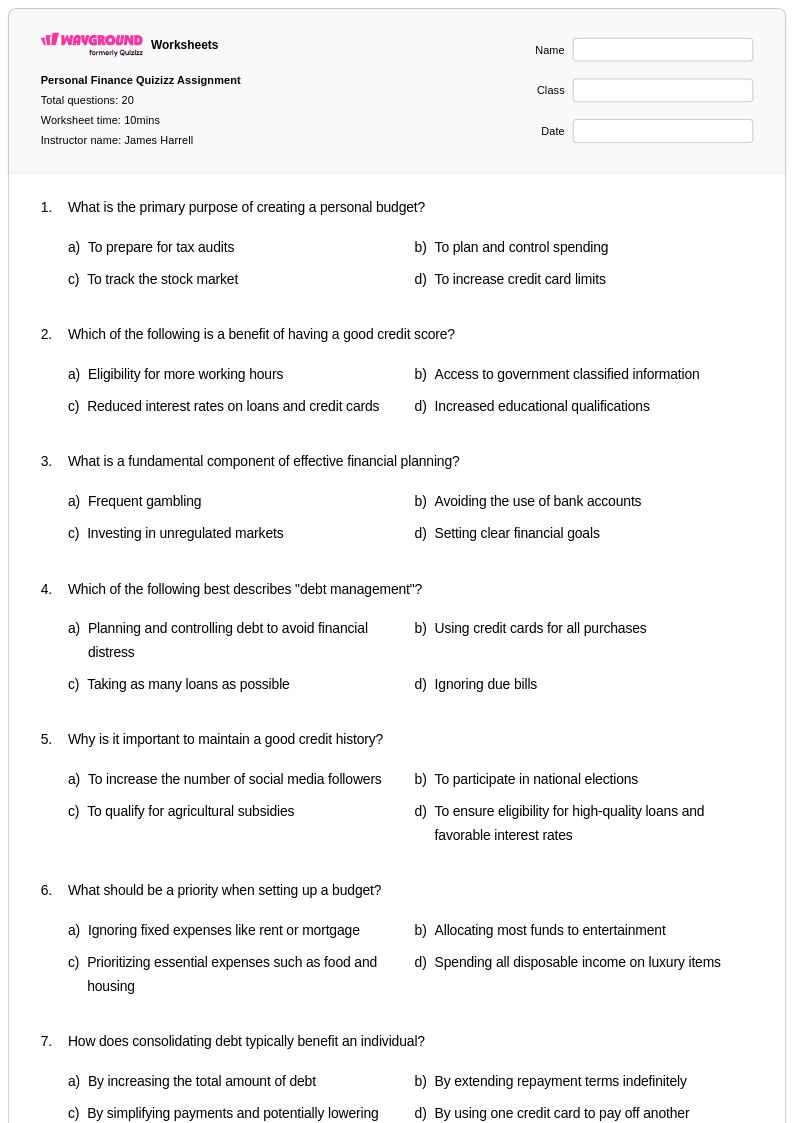
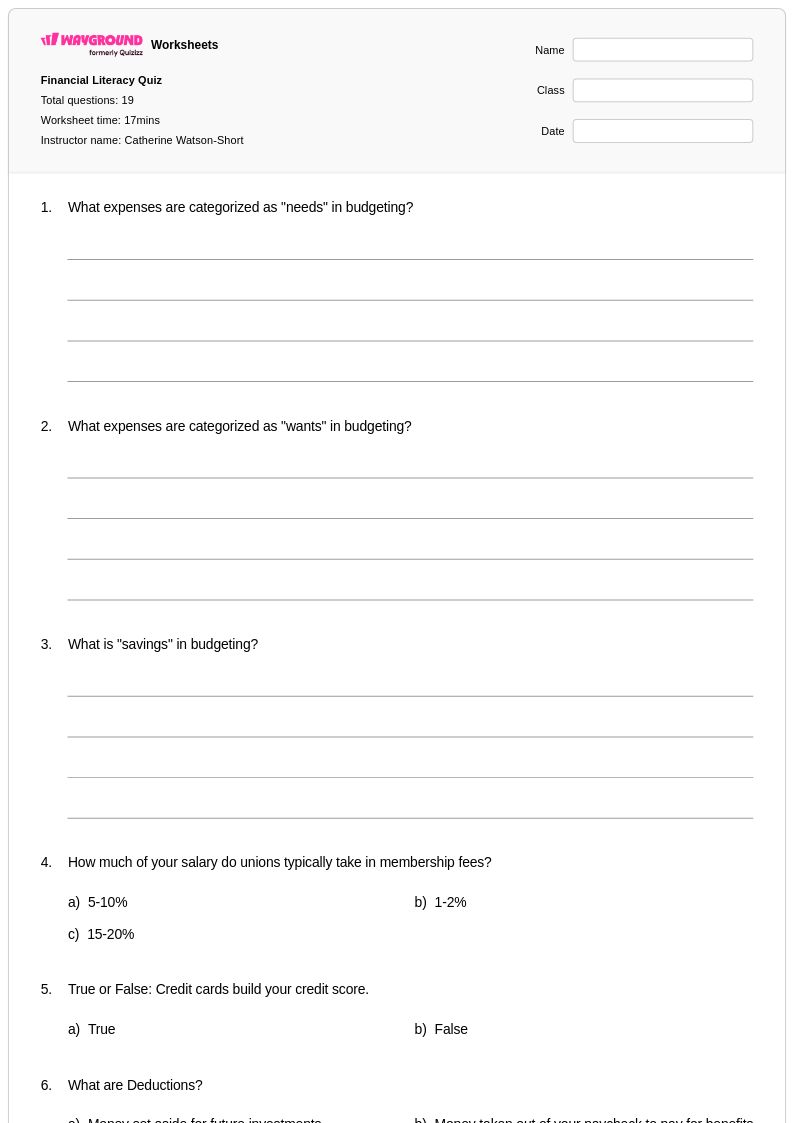
Financial statements worksheets for Class 12 students available through Wayground (formerly Quizizz) provide comprehensive practice with analyzing and interpreting corporate financial documents, including balance sheets, income statements, and cash flow statements. These expertly designed worksheets strengthen critical skills in financial literacy, ratio analysis, and business decision-making by challenging students to examine real-world financial data and draw meaningful conclusions about company performance. Students engage with practice problems that require them to calculate key financial ratios, assess liquidity and profitability metrics, and evaluate investment opportunities using standardized accounting principles. Each worksheet collection includes detailed answer keys and is available as free printables in PDF format, enabling students to master complex concepts like depreciation methods, revenue recognition, and financial statement analysis at their own pace.
Wayground (formerly Quizizz) empowers educators with millions of teacher-created financial statements resources specifically aligned to Class 12 economics standards and curriculum requirements. The platform's advanced search and filtering capabilities allow teachers to quickly locate worksheets targeting specific financial concepts, from basic accounting equations to sophisticated financial modeling techniques. Robust differentiation tools enable instructors to customize content for varying skill levels, while the availability of both printable and digital formats, including downloadable PDFs, ensures seamless integration into any classroom environment. These comprehensive worksheet collections support effective lesson planning by providing ready-to-use materials for skill practice, targeted remediation for struggling learners, and enrichment opportunities for advanced students preparing for college-level finance and accounting coursework.
FAQs
How do I teach financial statements to high school students?
Start by introducing each statement type in isolation before showing how they connect: balance sheets reveal what a company owns and owes, income statements show profitability over a period, and cash flow statements track actual money movement. Use simplified, real-world company examples so students can see financial data in a familiar context. Once students are comfortable with individual statements, use comparison exercises that require them to pull information across all three, reinforcing the interconnected nature of financial reporting.
What practice exercises help students learn to read a balance sheet?
Effective balance sheet practice involves labeling exercises where students categorize line items as assets, liabilities, or equity, followed by problems that require them to calculate totals and verify that the accounting equation (Assets = Liabilities + Equity) holds. Scenario-based problems, where students record transactions and update a running balance sheet, build procedural fluency alongside conceptual understanding. Worksheets that use authentic business scenarios are particularly effective because they ground abstract entries in recognizable business decisions.
What mistakes do students commonly make when analyzing income statements?
The most frequent error is confusing revenue with profit — students often assume a high revenue figure means a company is financially healthy without accounting for expenses. Students also commonly misplace operating expenses versus non-operating items, which distorts their calculation of operating income. Another persistent misconception is treating the income statement as a snapshot of cash on hand, rather than understanding it reflects earned revenue and incurred expenses regardless of when cash actually changed hands.
How do I explain the difference between cash flow statements and income statements to students?
The key distinction is that income statements report revenue and expenses on an accrual basis, meaning transactions are recorded when earned or incurred, not when cash moves. Cash flow statements, by contrast, track only actual cash inflows and outflows during a period, which is why a profitable company can still show negative cash flow. A concrete classroom strategy is to present a business scenario where a company records a large sale on credit — students can then trace how that single transaction appears differently across both statements.
How can I use financial statements worksheets to assess student understanding?
Formative assessment works well when worksheets require students to construct a statement from raw transaction data rather than simply filling in blanks, because construction tasks expose gaps in understanding that recognition tasks often mask. Error-analysis problems, where students are given an intentionally flawed financial statement and must identify and correct the mistakes, are especially diagnostic. Including short written justification prompts alongside numerical answers also helps teachers distinguish procedural fluency from genuine conceptual understanding.
How do I use Wayground's financial statements worksheets in my classroom?
Wayground's financial statements worksheets are available as printable PDFs for traditional classroom use and in digital formats for technology-integrated learning environments, giving teachers flexibility for in-class instruction, homework, and assessment prep. Teachers can also host worksheets directly as a quiz on Wayground, enabling streamlined assignment and automatic scoring. For students who need additional support, Wayground's built-in accommodation tools allow teachers to enable features such as read aloud, extended time, and reduced answer choices on an individual basis without disrupting the experience for the rest of the class.
How do I differentiate financial statements instruction for students at different skill levels?
For students who are newer to financial literacy, begin with single-statement exercises using simplified data sets before introducing multi-statement analysis. More advanced students benefit from problems that require them to evaluate business performance by comparing financial ratios or trends across multiple periods. On Wayground, teachers can apply individual accommodations such as reduced answer choices or read aloud to specific students, allowing the same worksheet to serve a mixed-ability class without requiring entirely separate materials.